Home Blog Page 601

Demand for high speciality services, human resources and care increase at NRH

0
Minister for Health and Medical Services Dr Culwick Togamana.

BY MAVIS N PODOKOLO

DEMAND for high- speciality services, human resources and care have been increasing at the National Referral Hospital, says Minister for Health and Medical Services Dr Culwick Togamana.

“The demand for high- speciality services, human resources and care has been increasing, so the Ministry will need to step up the care at various clinical, non-clinical and supporting services,” Togamana said.

He said the health ministry is aspire to achieve hospital systems, infrastructure and processes that are of a high standard and quality to ensure health care that people need and demand can be meet.

Togamana adds the Ministry’s vision for health as documented in the National Health Strategic Plan 2021 to 2031, is to ensure all hospitals are accountable for meeting the health care need of the people.

“To achieve this vision, the NRH and our Provincial health facilities must be provide the necessary support (resources) which is an extremely difficult challenge to attain without support from development partners, such as your government,” he said.

Togamana echoed the above sentiment at the official handing over event of the National Referral Hospital Molecular laboratory.

Auki public query new Malaita govt policy launch promise

0

BY SAMIE WAIKORI

Members of public in Auki are questioning when the new provincial government under Premier Martin Fini will launch its policy framework.

The men say they Malaita public would like to know the political roadmap for the province since it is now three months since the new government came into power.

Their spokesperson said during the 2022/2023 revised budget meeting, Premier Fini announced in his keynote address speech that the policy will be launched in a matter of two weeks.

The spokesperson said that two weeks has long passed, and there is still no policy launched as promised.

He said shortly after the revised budget meeting, the assembly convened its full assembly meeting and again Fini announced the launch of the policy in a week time.

The man said still nothing happened and since then the policy is yet be to launched.  

He said that this is the policy in which will direct the province and it must establish now considering the limited time MNGFR will lead the province.

The man said it’s time to work and such important document must prepare in time so that MNGFR have time to translate the policy.

On that note, he called on the technical group within MEDI that tasked with the formulation of the policy to speed up with the work on the policy.

The man said being without a policy is like a captain without a course to navigate its vessel and that the ship will just wander.

He said Malaitans don’t want to be wandered with the development aspirations they have and they want a course to navigate their ambitions forward.

Court acquits man of electoral offences

0

BY JENNIFER KUSAPA

THE man who was alleged of registering seven times at seven different registration centres during the voter registration in 2018 has been acquitted by the court due to no evidence when it comes to the defendant’s true identity.

Alif Vai is charged with seven counts of obtaining registration by false pretence contrary to section 311 of the Penal Code [Cap 26].

Principal Magistrate Felix Hollison said there is no evidence at all when it comes to the defendant’s true identity.

He said Prosecution does not provide any evidence that those names and particulars were false.

“A proper birth certificate should have been provided to confirm his names and birth date, his parents and where he is from pursuant to the relevant Act. In the absence of a birth certificate, a relative could have been called to properly identify him” Hollison said.

The Crown’s case is that from the 8th of September to the 20th of September 2018, the defendant made registration in various electoral registration centers here in Honiara. The defendant procured for himself registrations for seven constituencies for the 2019 National General Elections. On these occasions, he allegedly used different names to obtain registrations. In order to be registered as a voter or an elector, an applicant must fill out a form called “FORM B”. The details in this form would then create the voter identification card.

That Crown alleges that the defendant claimed to have resided in seven different constituencies in Solomon Islands. The defendant allegedly gave false representations to the registrations clerks by giving different names in order to obtain registration under the National Electoral Provision Act [Cap 87]

The Crown avers that there is documentary evidence which would support the proposition made by the Crown in its case.

Hollison after assessing all evidence and documents provided before the court not satisified with the Prosecution that the defendant by false pretence obtained registrations under various constituencies under the said Act in various dates in 2018 as alleged in counts 1 through to 7.

Therefore, he acquitted the Alif Vai of the Electoral offences.

Influenza H1 increasing

0
Chairman of NHA and Secretary to Prime Minister Dr Jimmie Rodgers.

BY MAVIS N PODOKOLO

INFLUENZA H1 a flu like illness is reportedly increasing in Honiara and other parts of the country.

This was confirmed by the Secretary of Prime Minister Dr Jimmie Rodgers on behalf of the Ministry pf Health and Medical Services in a press conference yesterday.

Health has recorded increase in flu-like illness in Honiara and parts of the country. NRH molecular laboratory following testing has detected Influenza H1 since last month.

“This is a different strain from Influenza H3 which was detected and has been circulating in August last year. Therefore, the current increase of flu like illness in the country.

“Such flu like illness can be life threatening to persons with asthma, and other respiratory illness as well as underlying health conditions,” Rodgers said.

He said to avoid catching these flu viruses and prevent it from spreading – public are advised to implement similar measures to that practiced for COVID-19.

“Washing of hands, coughing into the elbows and wear masks in public and crowded places and avoid close contacts with persons experiencing flu and cough,” Rodgers said.

He adds that dengue is also circulating and presenting similar symptoms such as acute fever so ensure you get tested for dengue and malaria.

Rodgers said the Ministry will be increase testing across its sentinel sites.

One active covid-19 case detected

0

BY MAVIS N PODOKOLO 

RECENT samples collected shows one active case of covid-19 been detected in the first week of April.

This is according to the Secretary to Prime Minister Dr Jimmie Rodgers in a press conference yesterday.

“Based on recent testing of 26 samples in the first week of April there is one positive case of COVID-19 and the Ministry is stepping up testing across sentinel sites for a more accurate picture of the viruses in circulation,” Rodgers said.

He said testing have highlighted earlier that Human Rhinovirus/Enterovirus as the predominant virus for the first week of April.

“We will provide more information once results from ongoing testings come through,” Rodgers said.

He adds in terms of priorities, COVID-19 operations all have ceased and only testing for surveillance purposes is continuing for patients presenting with flu like illnesses to clinics.

“Much of the focus now is on strengthening health systems to better respond to the health needs of our people and to better prepare for similar disease outbreaks such as COVID-19 in the future. This is implemented as per our National Health Strategic Plan 2022 -2031,” Rodgers said.

6-STOREY UNSAFE

0
The current state of incomplete Anthony Saru Building.

With only 1 emergency exit stairs and a faulty elevator, tenants are calling on NPF to fix the crumbling high-rise building

BY NED GAGAHE

Safety of tenants occupying the Anthony Saru Building is at stake following slow progress by Solomon Islands National Provident Fund (SINPF) to fully restore damages caused by last year’s 7.3 magnitude earthquake.

Concerned tenants have issued fresh calls for SINPF to swiftly take necessary actions and complete restoration works urgently.

It is still unclear when the restoration works will be completed and the building declared safe for use.

Tenants of the building told Island Sun public access via stairwell leading to upper levels of the building have been sadly out of use since November last year.

Tenants were assured in November via a notice by the SINPF Board and management that stairwell propping work was supposed to proceed following procurement of materials.

To date nothing has happened.

“The lift was not functioning properly. On few occasions the lift dropped with people trapped inside.

“Another occasion people being trapped for almost 30 minutes locked up inside before being freed.

“In case of an emergency, fire or earthquake, there is no alternate escape route except for the only one lift that is working.

“But the lift is working is not functioning properly as well.

“We fear that the worst might yet to come if these issues are not urgently addressed.

“Why took so long to fix these issues.” They said.

In light of these incidents the tenants have called on to the SINPF to investigate these and ensure that work is done to fix these problems as a matter of priority and urgency. To guarantee the safety of its occupants.

Comments is being sought from SINPF on the matter.

The building is the home of some of the government ministries which includes, Ministry of Women Children, Youth and Family Affairs, Ministry of Foreign Affairs and External Trade and other private sector firms.

Trepidations of a female student in Port Moresby

0

Not being apprehensive about your safety in public spaces is a luxury – one that I recently enjoyed as an ANU-UPNG Summer Scholar in Canberra.

Sadly, this is not a luxury that is available for Papua New Guineans.

The issue of law and order has been a longstanding one in the country, generating concerns of safety among the country’s population, especially its female population.

As a female student living in Port Moresby, my safety while travelling to and from school is a cause of concern for myself and my family.

The concerns faced by the female population range from petty crimes such as pickpocketing to armed robbery, kidnapping and rape.

During my childhood, I was fortunate to have been spared from the burdens of the anxiety of personal safety while travelling to and from school.

My father being an officer with the Papua New Guinea Defence Force (PNGDF) meant that I grew up in the safety net of a military barracks in Port Moresby, and attended the primary school located within the barracks.

My daily commute to and from school involved a 15-minute walk through the barracks with my siblings and other children of PNGDF officers.

The only concerns to our safety were speeding cars, and the occasional snake during periods of rainy weather when the bush became overgrown around the path.

This cocooned safe reality was not the case for students commuting to school outside the barracks, who had to face the threats of pickpocketing, armed robbery, and drunk and disorderly behaviour from men and youths – all of which I was soon to discover.

High school brought with it the introduction of apprehension for my safety.

The high school to which I was selected for my lower secondary education was notorious for the fights among its male student body, and interschool fights with neighbouring secondary schools.

It was also located within the vicinity of a suburb that was deemed an unsafe place in Port Moresby.

During the two years I attended the secondary school, there were school fights, petty thefts, drunk and disorderly behaviour from youths due to substance abuse, several armed robberies of students while they were travelling to or from school within the vicinity of the suburb, and the most unfortunate case of the rape of a female student in the toilets located on the outskirts of the school in 2016.

Even though I was only a witness to such incidents and not subjected to them myself, the fear was ever present in me and my female fellow students.

It prompted us to walk with our guard up at all times, to have our bags and bilums draped in front of us, to pack our phones and purses in the deepest parts of our bags or bilums, and to always be looking over our shoulder when someone got too close in the crowd.

University was no different. Residing off campus required that I still had to travel to and from university, however, unlike high school where classes concluded between 3.30pm and 4pm, I now had some classes that finished at 5pm.

On the days when I had late classes, I was most anxious as it was not safe, and especially not safe to be a female travelling alone, so late in the day.

I particularly disliked and avoided the crowded main bus stops, filled with street vendors and people who just loitered about, as it was usually amongst these loitering crowds that opportunist thugs mingled in wait for their next victim to pickpocket or rob.

I recall an armed robbery of two passengers on a public bus I was in. It was around 7am, the bus was parked waiting for passengers at the main bus stop at Holola, Port Moresby.

I was sitting two rows ahead of a couple of teenagers when two thugs walked in casually and held the duo at knife point.

They took their phones and walked out as casually as they walked in, mixing with the crowd outside.

I was left shaken and disgusted at the ease with which they committed the theft.

However sad and unfortunate the incident was, it is a norm for residents in the city.

These are my trepidations of travelling to and from school, but they are common trepidations shared by women and girls in Port Moresby going about their daily activities.

Crime and law and order issues are still on the rise in Port Moresby, in part fuelled by unemployment and the rural to urban drift.

There also appears to be a gun and knife culture on the rise among criminals in the city, evident in the increased use of these weapons amongst criminals recently.

While the government is making law and order a priority issue, and the Papua New Guinea Royal Constabulary is working within its capacity to curb crime, this is not a fight to be fought by the government and police alone.

Normal citizens must rise and make it their civil duty to take ownership of making their communities safer, working in collaboration with the authorities to make PNG a safe country for all.

Disclosure: This writing of this blog was undertaken with the support of the ANU-UPNG Partnership, an initiative of the PNG-Australia Partnership, funded by the Department of Foreign Affairs and Trade. The views are those of the author only.

*This article appeared first on Devpolicy Blog (devpolicy.org), from the Development Policy Centre at The Australian National University. Sharon Banuk is a final year economics undergraduate at the University of Papua New Guinea.

By Sharon Banuk

DEVPOLICY

Trepidations in Honiara – not so safe a town to walk

0

Safety was once a pride of Honiara. Once!

Citizens in the 80s and 90s can attest to this.

Children reading story books then would have had to shake their imaginations to picturise what pick-pocketing looked like, or they’d chance upon it in a video.

Nowadays, it is hard to imagine that of Honiara.

An Op-ed by one Sharon Banuk [read viewpoint below] details the ‘Trepidations of a female student in Port Moresby’ as its title goes.

Ms Banuk’s experiences in the article are synonymous to a female student travelling through Honiara’s streets.

There is no luxury of ‘not being apprehensive about your safety’ when walking in the streets of Honiara. Daytime or, worse, night.

In Banuk’s article, one experience stands out which can be said is similar here – “It prompted us to walk with our guard up at all times, to have our bags and bilums draped in front of us, to pack our phones and purses in the deepest parts of our bags or bilums, and to always be looking over our shoulder when someone got too close in the crowd”.

Pickpocketing is rife in Honiara, and has been given a name in the local pidgin – Beliga.

Social media is riddled with posts concerning Beliga activity in Honiara. This does not affect female students alone – from children to elderly, male and female.

Beliga activities in the city is most profound at the Central market and surrounding areas. Over the years it has spread to the city’s CBD, Pt Cruz.

It is also common along the Kukum highway near shops and offices eastwards of town, and further parts of Tandai highway, west of Honiara.

Odd enough, as with Banuk’s article, Beliga activities are somehow also linked with bus-stops here.

Over the years, Beliga activity has morphed to actual burglary. In some cases it has become armed burglary, such as the incident on January 19 this year, in a bus along the main road above Koa Hill in which a teenage boy was stabbed by a Beliga demanding his mobile phone.

A PLAN International report in September 2020 had said only seven percent of 236 girls surveyed said they ‘always feel safe in public’. The report said ‘adolescent girls, boys and their communities all agreed that girls weren’t able to fully participate in Honiara’s public spaces because of the high number of harassment and violent incidents, especially at night’.

And, the reasons they don’t feel safe include high levels of sexist behaviours and sexual harassment. Risks to girls in public include drunk and intoxicated people, theft, verbal harassment, touching and rape.

The PLAN report also mentions a high rate of Bystander Culture (more than 80 percent) in which members of public are indifferent to harassment or a girl being victimised in public.

For pickpocketing, it is believed that this may be lower. But the practice being rife contends it does not offer much of a deterrence.

An array of factors contributes to the high rate of Beliga activity in the streets of Honiara.

High urban drift and unemployment undoubtedly top the list. Inundated capacities of responsible authorities to deal with it, and lack of effective policies and ordinances to tackle this problem. Deteriorating family values and morals must not be overlooked.

Collective and concerted efforts are needed! (Sad that this line has become somewhat a cliché for Solomon Islands’ problems)

Proactive police action needs to step up. Such as what transpired over the Easter weekend, in which police carried out public awareness sessions in various spots in town.

The Honiara City Council has a law enforcement arm which is expected to consistently monitor hotspots within the city, such as the central market, busy walkways along the city’s CBD, etc.

Since this issue is indiscriminate for any Honiara commuter, it should be the business of the public not to become blasé bystanders.

There is a thing called the citizen’s arrest [Criminal law 9.0.2], rather than entertain the notion that it should be left for the authorities and law enforcers to deal with it alone.

While some of Ms Banuk’s experiences are relatable in the Honiara context, some are not. Yet! If we are not careful! Such as the use of guns, extreme boldness in committing such crimes in the open, and the very high prevalence of such open street crimes as in the context of Banuk’s experiences.

CAUSE faces challenges on land access and covid-19

0

By EDDIE OSIFELO

THE Community Access and Urban Services Enhancement Project (CAUSE) has faced challenges with land access and covid-19 to implement its projects in Honiara, Malaita and Western Province.

Project Manager Cris Afable confirmed this during questions and answers on the launch of its 10- minutes video on Covid-19 response and economic recovery at their office, Wednesday.

Afable said in component one which involved community access infrastructure, about 15-20 percent of projects faced of challenge of access, landownership and everything.

However, he said they have a robust social environment safeguard policy, where they able to reduce number of issues.

“We talk to landowners and eventually they would agree to do the work,” he said.

Furthermore, Afable said another challenge they faced was Covid-19.

“We have to follow protocol.

“When we doing the training, we want to enforce the vaccination card,” he said.

“In some areas in Honiara, Auki and Noro, the people were reluctant to do vaccination.

“We have to go to the communities and explain, because without vaccination we cannot do the training,” he added.

“If we do not get to employ the people, we cannot finish the work.

“During one and half years, we struggle against pandemic,” he added.

However, Afable said they were again somehow level up because of proactive stand they are doing with regards to vaccination requirements.

“It stuck a while for three months, then we find a way, luckily no infection, so we have to invest in PPE like masks.

“Pandemic made us a bit worry, if it continues on, it would have an impact on us,” he added.

Despite the challenges, Afable said they are now even with their targets, expenditures and timelines.

“We are right now on track and we are confident to finish the work before the end of the project in April 2024,” he added.

CAUSE is Government of Solomon Islands programe.

It is funded by the World Bank and the Australia Government Funding and PNG and Pacific Islands Umbrella Facility Grant.

LMU commences screening of applicants

0
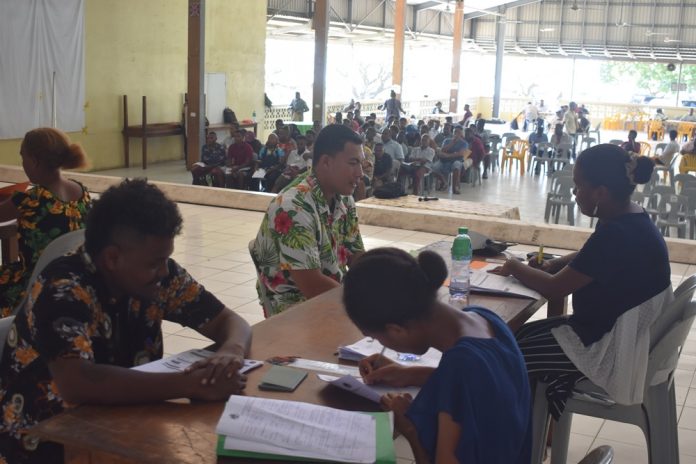
Two female interviewers (left) one is taking notes and the other talking to applicants as part of the screening process for LMU recruitment yesterday at St Barnabars Cathedral.

BY NED GAGAHE

Screening process for the Labour Mobility Unit (LMU) has kicked off at the St Barnabas Cathedral with the first batch of 151 applicants attended yesterday.

The programme commenced at 8am where the applicants have face-to-face interviews and fitness assessments conducted by panels led by LMU staffs and officials from Pasifiki HR.

Day-two of the screening process will continue on today where another 152 applicants will go through the same screening process.

Speaking to the Island Sun yesterday, officials who conducted the panel sessions explained the process involved assessing the applicant’s fitness by recording necessary information and actual face-to-face interview.

The official said the key focus of the sessions is to ensure that applicants meet strict requirements before their application is registered in the work ready pool.

She clarified that the sessions do not guarantee candidates work but is an initial step of the recruitment process.

Jason Lagho a 23-year-old youth from Lambi, west Guadalcanal was excited to be amongst the first group.

He said he is confident that he will get through the process.

Meanwhile, Ministry of Foreign Affairs and External Trade (MFAET) said that the two-day sessions are just the beginning of many more screening to be hosted in the coming months.

Applicants are encouraged to listen out for further advices on the upcoming interviews and fitness screening as they will be informed via calls or through published lists.

MFAET said the screening will proceed following the order in which applications were received.

The screening process will conclude 4pm today.