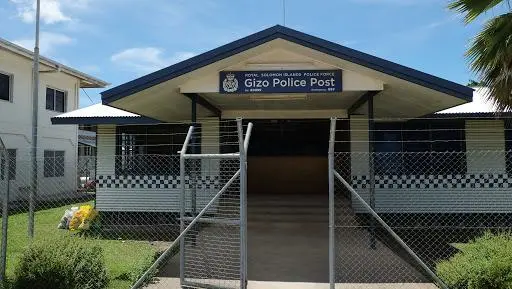
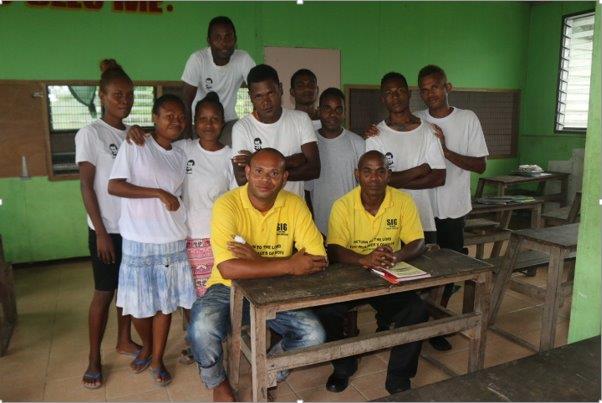
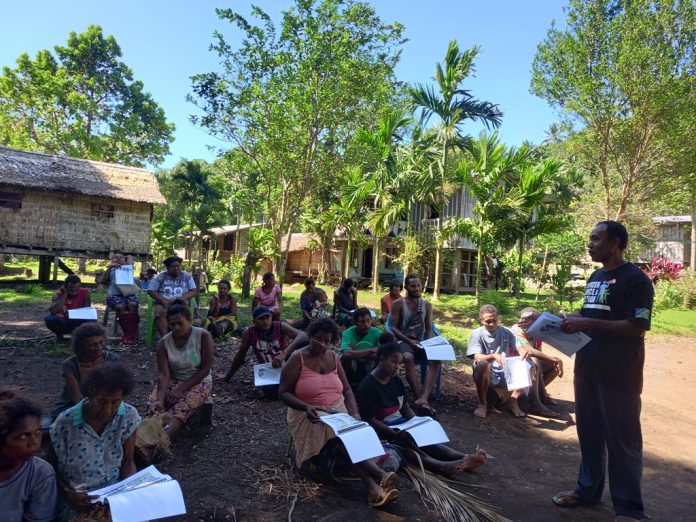
Gizo police is looking at establishing crime prevention committees in communities there.
A notice was circulated to churches to inform community leaders and residents on the proposed meeting scheduled today evening, tomorrow and Wednesday.
According to the letter, RSIPF officers will hold a meeting with Hill Top Community today at 5pm, District and Water Pump Communities tomorrow and Banana Valley Community on Wednesday.
The series of meetings will assist community leaders and residents to form a Crime Prevention Committee as part of a programme called “Tugether Iumi Mekem Gizo Town Safe and Peaceful”.
The committee will then formulate bylaws in an effort to maintain peace, safety and well-being of residents.
Crime Prevention is a four-year program established in 2019 and will end next year 2022 with the aim to provide police with better intelligence in communities so that criminal issues can be dealt with as they develop.
The RSIPF Crime Prevention strategy builds on previous approach and incorporates problem solving driven by stakeholders and communities in the absence of police.
Part of the strategy is to reinforce the key roles of leaders in communities and the traditional role of chiefs in crime and harm prevention activities as well as mediating and solving issues.
NCPD Supervising Director, Inspector Steve Sunaone speaking during the meeting at Lela on Tuesday
Citizens have power to arrest
BY JARED KOLI
ANY private person or civilian has the power to arrest anyone who commits a criminal offence.
This is according to the Royal Solomon Islands Police Force (RSIPF) National Crime Prevention Department (NCPD) during an awareness with the chiefs and community leaders of the Tandai House of Chiefs on Tuesday at Lela in Northwest Guadalcanal.
Constable Joel Saumanu of NCPD said a private person or civilian can do arrest to a certain level and hand the suspect to the police.
He said this is called ‘Arrest by Private Person’ provided by law in Section 21 and 22 of the Solomon Islands Criminal Procedure Code.
Section 21 Clause (1) states: “Any private person may arrest any person who in his view commits a cognisable offence, or whim he reasonably suspects of having committed a felony provided a felony has been committed.”
Clause (2) states: “Persons found committing any offence involving injury to property may be arrested without a warrant by the owner of the property or his servants or persons authorised by him.”
Section 22, Clause (1) had it that, “Any private person arresting any other person without a warrant shall without unnecessary delay make over the person so arrested to a police officer, or in the absence of a police officer shall take such person to the nearest police station.
Clause (2) adds: “If there is reason to believe that such person comes under the provisions of section 18, a police officer shall re-arrest him.
Clause (3) furthers: “If there is reason to believe that he has committed a non-cognisable offence, and he refuses on the demand of a police officer to give his name and residence, or gives a name or residence which such officer has reason to believe to be false, he shall be dealt with under the provisions of section 19. If there is no sufficient reason to believe that he has committed any offence he shall be at once released.”
The Tandai House of Chiefs requested the RSIPF through NCPD to assist them in setting up the committees to fight crimes in the Tandai area.
The initiative attracted around 100 chiefs and leaders in the Tandai House of Chiefs, from Barana to Doma gathered at Lela in Northwest Guadalcanal on Tuesday to dialogue and establish their Crime Prevention Committees (CPC) to address crime and lawlessness in the area.
Speaking after the awareness meeting, NCPD Supervising Director, Inspector Steve Sunaone said citizens have legal reasons to carry out their work and become law enforcers in our nation.
Mr Sunaone said the Tandai leaders really have the strong desire to change their community.
“They request us to come and make awareness about Crime Prevention Committees, in particular to ensure that CPC is establish in their communities.
“Tandai area is close to the city, and it is not immune to lawlessness as well. It’s more like empower them to take ownership of their community while giving them certain approaches which is recognised under the crime prevention strategy to enforce law and order within the communities,” said Sunaone.
Paramount Chief of the Tandai House of Chiefs Francis Peroqolo on behalf of the Tandai House of Chiefs thanked the team from the NCPD, and told each of the representatives that attendant the workshop to return to their various zones to form their CPC and start implementing their community by-laws.
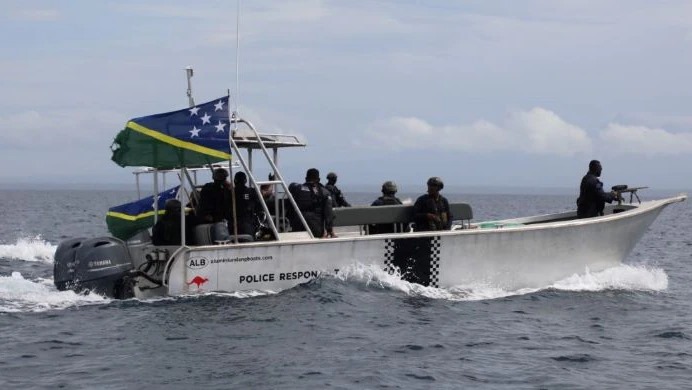
Police officers patrolling the Western border with Bougainville. PHOTO ABC
BY MAVIS N PODOKOLO
Seven Solomon Islands nationals have been detained for entering the border from Bougainville without authorisation.
The ministry of Health and Medical Services (MHMS) in a media statement said this occurred over the weekend.
“All seven were apprehended by the police and are currently being held at the Nila quarantine station where swabs were collected and COVID-19 testing performed.
“COVID-19 test results for six returned negative while 7th person will need to be re-swabbed as the sample collected from the person was spoiled. All will be quarantined for 21 days at the Nila quarantine station with additional COVID-19 testing as per testing protocols in place for all incoming travellers.
“MHMS again reminds everyone at the border that nothing is more important than the health and lives of our people, which is currently at great risk of COVID-19,” the statement said.
The Ministry thanked community members, families who assisted the authorities with detecting and informing the ministry about these people for appropriate actions.
“If you see any illegal border entry, please inform us or the police and do not interact with them.
“We are also working with other partners of the SIG to bring SI citizens in Bougainville to Solomon Islands. Let’s continue to work together to protect our people and country against COVID-19.”
THE National Government is working closely with the United States Government in progressing the design and programming of the SCALE Project.
The Ministry of Foreign Affairs & External Trade is leading the coordination together with the Ministry of National Planning & Development Coordination.
A Government statement said the current status of the SCALE project is now awaiting the conclusion of a Bilateral Framework document to guide the USA and Solomon Islands arrangement.
“Cabinet has already endorsed this document which is now with the US embassy for their endorsement,” the statement said.
“Once the US Government have their inputs it will be sent back to us for finalisation,” the statement added.
It further said that such framework is important to guide engagements between both countries especially on the development cooperation front; similar to what we have with other traditional partners like Australia, New Zealand etc.
The Government statement said that since there are no bilateral formalities to guide engagements between both countries; there are still no funds paid under the SCALE programme to date.
CBSI has also confirmed that it has not received any SCALE funding under the US Government, through any of its USD accounts to date.
“It is in our best interest that such development cooperation is aligned and responds to our national development priorities, complies with requirements of Donors and is implemented in a manner that is efficient and in line with International Principles of Aid Effectiveness,” the statement said.
The statement said progressive meetings between the Government and US Government will be held next week.
PREMIER of Malaita Province, Daniel Suidani has thanked the Republic of China (Taiwan) for saving his life.
This was after doctors in Taiwan found no disorder in his brain during the Magnetic resonance imaging (MRI) scan in Taiwan recently.
Speaking from Brisbane, Australia to mark the province’s 38th Second Appointed Day, Mr Suidani said, “As you are aware, Taiwan helped me to check my condition after doctors in Honiara referred me to do CT scan.
“We thank God that time when they (doctors) do MRI with me in Taiwan, what they suspect was not found.
“No matter, the doctors in Taiwan gave me medicines that really helped me,” he said.
Therefore, Suidani thanked Taiwan for saving his life.
He also extended his gratitude to the President of Taiwan and the good-hearted people that helped him in the trip to Taiwan.
Further to that, Suidani said he was surprised that some people in Malaita continue to ‘crucify’ him for the medical trip to Taiwan.
Suidani is expected to return to Honiara when international flights open early next month.
) Rep from Kilu’ufi nursing staff, Mr Alfred Toata, Dr Rex Maukera, Ms Anna Masioa, Deputy Premier, Hon Randol Sifoni and Kilu’ufi hospital secretary, Mr Douglas during the handing over of the donated clinical items at Kilu’ufi hospital yesterday.
BY SAMIE WAIKORI
AUKI
Malaitans living in Gatton, Australia have donated towards the province’s main hospital.
Yesterday, the Kiluufi hospital received sets of wheel-chairs and other hospital equipment from Ms Anna Masioa who delivered the support on behalf of the Malaitans in Gatton.
Speaking during the handover ceremony at Kilu’ufi hospital, Dr Rex Maukera on behalf of people and medical health services in Malaita province thanked the friends in Gatton for the support.
He said the donations will go a long way in serving the health and medical needs of the people of Malaita.
Maukera said the items donated included 10 wheelchairs, theatre clothing, sanitisers, mother birthing kits, and many more clinical items.
“The support will really help our people especially the elderly ones and disables within the psychio and therapy rehab who really need the items as they will be distributed to them.
“Also other items provided will help the people of the province especially during this time of pandemic,” he said.
He said the donated clinical items will be distributed to other health facilities in the province.
The handover ceremony was attended by Ms Anna Masioa on behalf of friends in Gatton, Dr Maukera and his staffs, and supervising premier Randol Sifoni.
An overwhelmng turn-out for the vaccination launch in Auki.
MALAITA Province Premier, Daniel Suidani has encouraged his people to seek advice from doctors over the two vaccines in the country.
They are the China’s Sinopharm and Europe’s AstraZeneca.
This comes after the delta variant is threatening neighboring countries like Fiji and Papua New Guinea.
Speaking from Brisbane, Australia, to mark the province’s 38th Second Appointed Day on 15th August, Suidani urges his people not to listen to advice on Facebook and other social media platforms.
He said this sick is killing many people in Fiji which is very close to us.
“So, it is important to go and see doctors for advice on the vaccine,” he said.
Island Sun understands the Government has rolled out the vaccination programme to Malaita last Friday.
A lot of people turned up to get their vaccination in Auki.
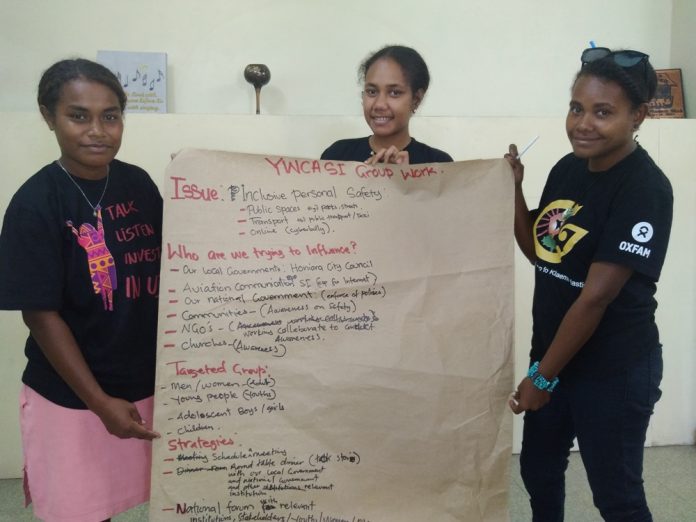
A group of young women under the Young Women Christian Association (YWCA) Solomon Islands are on a two-day regional training to fight climate change.
President for Young Women Christian Association Solomon Islands Georgina Ariki said the training was organised because of the importance of Climate Change for Pacific Islanders in terms of its impact to the lives of young women and girls.
“Actually this training is more focused on climate change and young women. To make recommendation to have YWCA being part of this Shifting the Power Coalition in Fiji. That is why with that focus and interest on Young Women YWCA currently really has a focus on young women,” Ariki said.
She said this training is all about training young women advocators to become vocal points for climate change for women in the country.
Ariki said this is the second training. Participants of this second training were handpicked from the first training.
“We had a first training where we have a lot of participants coming and from that training we picked out six young women to become advocators for climate change,” she said.
This training is support by Shifting the Power Coalition in Fiji.
Participating countries are Solomon Islands YWCA, Samoa, Tonga, Papua New Guinea, Fiji and Vanuatu. These countries were also part of the Shifting the Power Coalition.
Two male inmates from Tetere Correctional Centre are enrolled in Certificate Agriculture and Agriculture Business courses at Don Bosco.
Their three-year study began on July 13 this year.
Derol Havimana is serving 13 years in jail and Philip Hina Bonnie 16 years.
Commissioner CSSI Gabriel Manelusi says a new programme initiated by CSSI and Don Bosco College administration allows inmates to take courses to prepare them for life after incarceration.
“This is on trial purpose and my Executive will observe how it progress.
“Offering inmates the skills and training they need to find productive lives after prison. By bringing education to those who are currently in the prison system, the hope is that once they leave the system, they will never return,” Manelusi added
The programme offers inmates the chance to cultivate marketable skills that will help them with their employment efforts after their release.
“The hope is that programmes like this will reduce the rate of recidivism, and as a result, save a significant amount of taxpayer dollars in the future.”
The programme offered through Don Bosco, a registered Vocational School under Roman Catholic Church, are funded by SIG Development Budget under Rehabilitation, Regeneration and Reintegration Process through the Yellow Ribbon Project.
The two inmates participating in class
Manelusi explains, “In 2007/2008 our National Parliament passed the Correctional Service Act and Regulations (2007/2008) and had change the name Prison Service to Correctional Service of Solomon Islands so my target is to continue give Correctional Education to inmates and officers.
“Correctional education means education given to inmates to enable them leave correctional centres with more skills to be in the position to find meaningful and long-term employment. The correctional professionals operate on the principles that attitude, ideas and behaviour can be corrected and that educated humans are capable of progressing to higher thresholds of awareness and continuity to connect to Rehabilitation programs.
“Rehabilitation in correctional means for correctional inmates, to restore to a useful life through therapy, education, operation, or capacity.
“The assumption of rehabilitation is that people are not permanently criminal and that it is possible to restore a criminal as useful member of society, they are our country human resource assets to focus on Nation building and that we need to understand the Human Right.
“Human right is a modern term but the principle that it invokes is as old as humanity.
“It is that certain rights and freedoms are fundamental to human existence. They are inherent entitlements that come to every person as a consequence of being human, and are founded on respect for the dignity and worth of each person. They are not privileges, nor gifts given at the whim of a ruler or a Government. Nor can they be taken away by any arbitrary power.
“They cannot be denied, nor can they be forfeited because an individual has committed any offence or broken any law. Based on that my Executive re-focus on regeneration and reintegration approach with key partners, to prevent –Recidivism back to Correctional Centres.”
CVA conducts health policy awareness to communities.
Built in 1966, Aringana clinic in Arosi, West Makira is one of the oldest clinics in the country that continue to provide health services to communities despite lacking health standards of the National Role Delineation Policy.
Recently, community members in the Aringana catchment area spoke out that their clinic is lacking certain criteria stipulated under that policy after a recent awareness by the World Vision Solomon Islands’ One Voice Team.
The awareness was conducted to the catchment areas of 15 clinics in Makira and South Malaita on health policy and service monitoring. This equips the residents of these areas on how to identify whether their clinics are meeting the standard required under the policy.
The fundamentals to the policy are; defines the different levels of service in the Solomon Islands Health System, developed based on the principles of Primary Health Care, acts as a catalyst for health sector reform to strengthen quality service delivery, lays the service delivery foundations for future development of the Solomon Islands Health System, provides guidance on types of services (service delivery packages) to be provided at each of the six levels of service to inform service planning and improve service quality ¬ Defines the referral pathway.
CVA conducting rural health service user score card survey.
The recent awareness was led by Mothers Union where the CVA teams engaged with communities on public policy awareness, specifically sharing information about the health standards that rural communities should expect at their health clinics.
With this knowledge, community citizens will be able to provide qualitative evidence-based data on health service delivery needed to engage in a productive dialogue with the government on gaps or issues in relation to health service delivery.
It was through this awareness that the communities in the catchment area conducted monitoring on Aringana clinic.
Ida Mae from the catchment area who was part of the Mothers Union team shared that during their awareness they found very interesting findings at Aringana clinic.
“Aringana clinic was built way back in 1966 and has continued to serve residing communities to date without any infrastructural renovation or repairs. The clinic is old and falling apart but still operational.
“People continue to use the poor services without knowledge of a national standard public health service policy. However, thanks to the World Vision project as we now realize that our clinic never met the standards and this awareness really helps us to see and start to take ownership of the clinic,” she shared.
Communty CVA group in Makira
The monitoring which was also conducted during the awareness also identified Aringana clinic as not accessing water supply, no toilets, very bad admission room, bad antenatal room, bad sterilising room, bad laundry and bad delivery room.
The monitoring also identified that the clinic is using water tanks, accessing solar power and good sanitation to staff.
With the use of a visual information flipchart, the CVA teams were able to educate citizens on the standard health service deliveries for rural clinics as stipulated in the Ministry of Health’s role delineation policy.
Approved by the national health promotion department of the Ministry of Health and Medical Service, the information flipchart contains basic animated illustrations that depict standard facility infrastructures, staff posting and medical supply that is being offered for rural health clinics.
Meanwhile, an active CVA Member from South Malaita, Timothy, said the flipchart was very effective as community members easily understood the messages.
“The message on the flipchart are very easy for community members as they actively participated during the awareness by sharing their experiences and views,” Timothy said.
He says although many were shocked, they also thanked World Vision for paving a channel that would bridge a stagnant gap between authorities and users of public rural health services.
A user monitoring scorecard survey also followed to determine the current quality of services received by community citizens including people with disability. The information gathered will be compiled for the project’s initial interface meeting between the community CVA teams and the public health service authority.
One Voice Project is funded by the European Union.