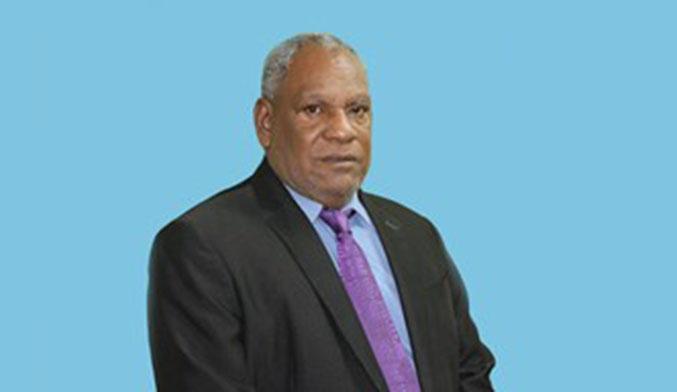
MID permanent secretary, Stephen Maesiola.Photo supplied.
PS Maesiola calls for investigation.
By EDDIE OSIFELO
POLICE is still to charge Members of Parliament, who received funds from the government but did not purchase any shipping vessels.
This is after the Ministry of Infrastructure Development had submitted a file to the police to do investigation on the MPs.
MID permanent secretary, Stephen Maesiola told media last Friday that since he joined the ministry in 2018, he called for an investigation into those used funds.
He said to date there is nothing on the progress of these cases.
Further to that, Maesiola said at one stage, he asked the Police to return the file.
“So, I think the files were lost already.
“It depends on police on investigation. I cannot intervene, it depends on how long they investigated,” he added.
Currently, about nine ships own by different constituencies in the country are in operational while two are in operational.
These ships were bought under the National Transport Initiative Grant in MID.
Those vessels currently operating are:
Vatu Constituency – MV Vatud Star (Operational)
Ulawa Ugi Constituency – LC Lokoiola (Operational)
South Guadalcanal Constituency – Funds provided to Hon. Dei Pecha (no vessel purchased) – Funds provided to Hon. Seleso- MV East Coast 1(Operational)
East Kwaio Constituency– LC Kulatatae. (Operational)
West Are Are Constituency – MV Taemareho. (Operational)
Kia Hograno Constituency – MV Lady Libaka (Operational)
Savo Russell Constituency – LC Rusa (operational)
Short lands Constituency – MV Short Lands (Operational)
Vessels currently in operational are:
Small Malaita Constituency – MV Mwalamwaimwei. (in operational)
North New Georgia Constituency – (vessel procured and in operational)
Temotu Provincial Government (no vessel procured since they received the grant.)
Malaita outer Islands – vessel never reached final destination Solomon Islands (wrecked in Fiji on its way to the Solomons)
Gela Constituency – LC?
Island Sun understands under the new proposed amendment Constituency Development Fund (CDF) Act 2013, that still to reach Parliament, all asserts will remain with the Ministry of Rural Development after the Member of Parliament loses in the election.
This is to allow new MP to continue operating the asserts during his or her term in Parliament.
RESIDENTS or people residing in Honiara are obliged to comply with City By-laws.
Magistrate Hayniel Max made the comments in court when he sentenced a woman of illegal hawking in the streets of Honiara.
Magistrate Max said provisions under the Honiara (Hawkers) By-laws are created purposely to regulate and control business activities within the perimeters of Honiara Town.
He said the By-laws must be respected by residents of Honiara to avoid inconveniences to town users and daily commuters, to garner equal opportunities and responsibilities to esteemed business service providers, that to prevent unnecessary loitering, and to elude uncontrolled and the cluttering of unlicensed small money-making schemes or services in Honiara.
Max said people need to understand that HCC is the body authorised by law to create, regulate and implement such laws as it is for the good and order of the Town.
“We seldom tolerate such offending in the highest degree possible. However, a petty crime is still a crime given the reasons for its commissioning, degree of seriousness and purpose of enactment. Obviously, the Council is as taking steps to criminalize and prosecute offenders is a sign that this issue must not go unnoticed to any given court of the day”, Magistrate Max said.
A woman who admitted selling betelnuts and rolls of cigarette at the Sol-plaza area was given a bound-over sentence by court.
Angelina Eri on March 15, 2023 was seen by two Law Enforcement officers from the Honiara City Council selling rolls and betelnuts at the Sol-plaza Town ground area while doing their random street patrol along the Point Cruz High-Way.
Having seen that activity, Law enforcement officers approached the woman and escorted to the Council’s station and charged her.
Magistrate Hayniel Max sentencing the defendant highlighted the maximum penalty for illegal Hawking in public place is a fine of 1000 penalty units ($1,000).
“Though I admire your ideal courage for breaking the law in order to feed your family, I must remind you that there other means available for you to lawfully earn money. First – simply make an application to the Executive Officer of the Town Council for a Hawkers license. Second – if your application is to be refused then take the same courage like you did when scampering around town for customers, to stand before the Counsel to address them in support of your appeal. Third – engage yourself in other lawful means for small income purposes. E.g. small gardening, baking, housemaid, shop assistant etc….
“I know you have your reasons for being deceitful, to avoid paying for a hawkers license before engaging in such unsolicited behaviour, but it’s good to be honest and just be a law-abiding citizen sometimes”. Magistrate Max said.
Magistrate Max told the woman that her admission to the court gives her credit that honesty is required of any human being, so as any Solomon Islander living in Honiara.
‘I understand that you have your reasons for breaking the law but you must be reminded to never feed your home with the proceeds gained from acts of trickery, ignorance and other unlawful activities” Max highlighted.
Therefore after considering the mitigating factors and also the circumstances of the offending, Magistrate Max impose a Bound over sentence in the sum of $200.
The court also made orders that the defendant to be of good behaviour for a period of six months.
He also orders for the forfeit of the goods confiscated to the Government.
Ambrose Motui Honiara City Council Prosecutor prosecutes the case in court.
Premier of Malaita province, Hon Martin Gaote’e Fini.
BY SAMIE WAIKORI
THE Malaita New Government for Fundamental Redirection (MNGFR) of Malaita province pledges to strengthen mechanisms within the province under its redirection policy.
This will be on the administration and governance of the province to see improvement on its standard of operation towards quality delivery of services to people.
Premier Martin Gaote’e Fini said the MNGFR is committed under its redirection policy to step up compliance management system of the financial procedures and processes of the province.
He added this is to strengthen competency and accountability in the procurement systems of MPG as accorded by the Financial Management Ordinance (FMO) and Financial Institutions (FI) of the PGA.
Fini said they will negotiate with MPGIS the payment of all outstanding Ward Development Grand funds so as to avoid the province from failing the Minimum Condition No. 9 in the PCDF Performance Assessment.
He said another area they will be looking at is to design and facilitate appropriate training for MPAs on good governance and procedures in applying the Standard Orders and PGA in the execution of their political mandates.
Fini said MNGFR will also step-up coordination, management, monitoring and evaluation processes within MPG systems to empower each division, in discharging their functions within the legal mandate with limited resources in a timely manner to the most urgent needs.
On the same note, he said his government will be promoting and applying more emphasis on ethical, accountable, responsible and credible leadership among MPAs to the people of Malaita, national government and wider communities.
Fini added that MNGFR is committed to promote and sustain political stability among its executive members and non-executive members of Malaita provincial assembly.
And as key objective under their redirection policy, he said they will be working closely with national government and donor partners on national projects and other key development priorities for the province.
Chief Executive Officer of the National Referral Hospital Dr George Malefoasi.
Health authorities sound alarm
BY MAVIS N PODOKOLO
CHIEF Executive Officer for National Referral Hospital Dr George Malefoasi says oral cancer in the country is currently increasing at a very fast rate.
Malefoasi confirmed this yesterday in a weekly press conference.
“I can confirm to you that cancer in general is increasing, in particular for oral cancer it is increasing as well, in terms of the statistic we have so far annually about 11 to 19 cases we usually managed at the oncology unit increase from 19 in 2021 and in 2022 it increase to 24. So, I can say the rate is increasing very fast,” he said.
Malefoasi said every day the oncology department at the National Referral Hospital sees between 15 to 14 patients.
He said these patients were scheduled in a way that those receives eight-hour cycle were separated from the general cases.
Malefoasi said for National Referral Hospital the consultation days for cancer illness is on Tuesday and Thursday
“On these days’ health workers mainly dealing with referrals from wards clinicians and clinics that they see them first and decide on the treatment and management,” he said.
Malefoasi said in terms of oral cancer related deaths the number is zero.
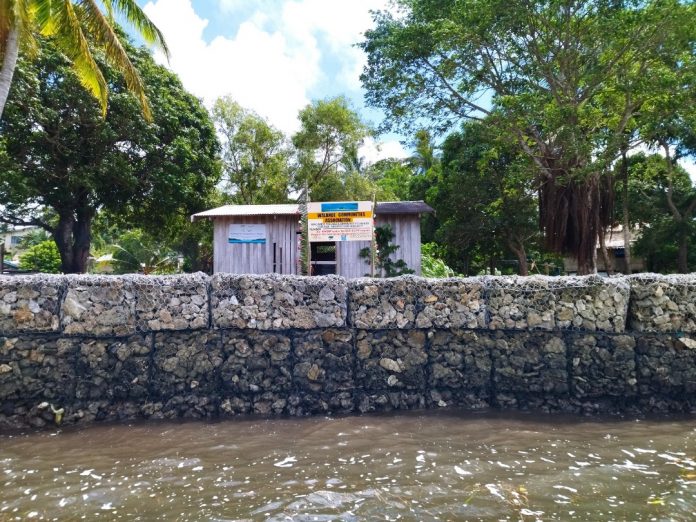
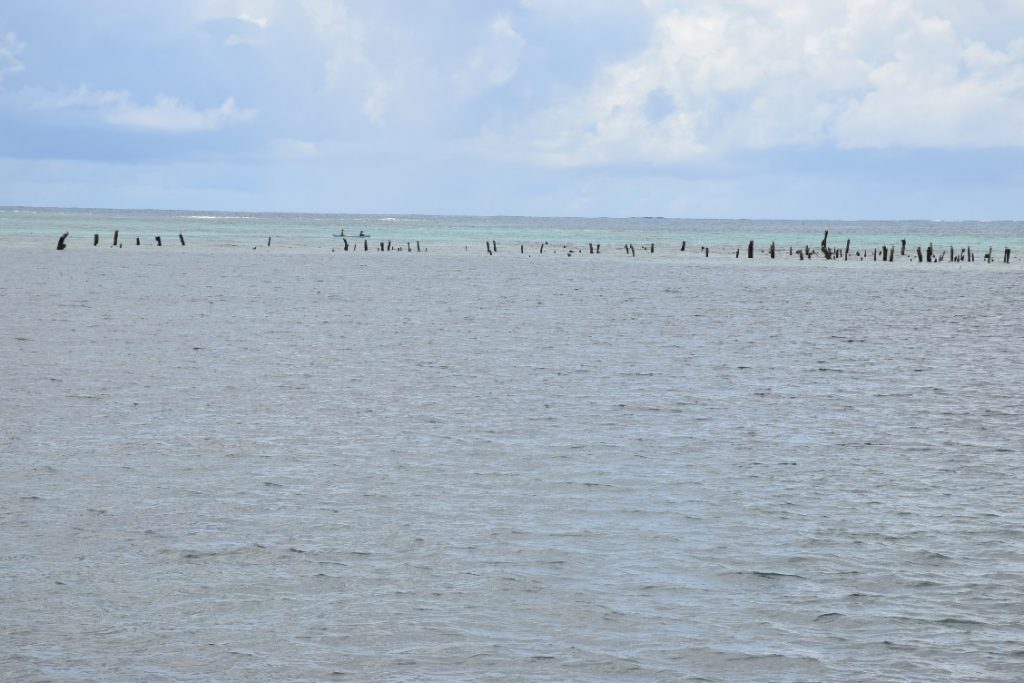
Walande, inhabited beginning 1937, was a thriving artificial island along the coast of Small Malaita, which could host 1,000 people at any one time. A decade ago its inhabitants relocated to the mainland after sea level rise became too much. (Pictured) House posts jutting out of the sea are what’s left of the original Walande settlement. (right) Seawall built with funds from UNDP’s GEF-SGP programme along the coast of the new settlement to shield against sea-level rise. Photo by Teiba Mamu/ SGP SI.
BY IRWIN ANGIKI
“We are walking when we should be sprinting.”
IPCC chair Hoesung Lee utters these sobering words to launch the IPCC Synthesis Report which warns that the window is closing on mankind’s hope to save the planet.
Lee’s haunting words describe how countries, especially developed and industrial powers, are not doing enough to slow down earth’s temperature rise.
More than 200 scientists are behind this ‘last chance’ to limit climate change call.
They work for the Inter-governmental Panel of Climate Change (IPCC) – the scientific body established in 1988 that advises the UN on rising temperatures.
The report was released last week Monday, March 20, the IPCC’s sixth ever comprehensive assessment report since its first in 1990 after climate change was accepted as a real threat.
Dubbed the AR6 report, it says more drastic emission cuts (about 50 percent) is needed and faster too by 2030 (just seven years away) to keep global temperature rise to 1.5 degrees Celsius since pre-industrial times.
But already global temperature rise has reached 1.1 C.
“The climate time-bomb is ticking,” says UN secretary general Antonio Guterres.
“The rate of temperature rise in the last half century is the highest in 2000 years. Concentrations of carbon dioxide are at their highest in at least two million years.”
What does this mean for Solomon Islands?
From this brief on the AR6 alone we can surmise that it will be business as usual for Solomon Islands – it is now a new normal to experience change over smaller time periods.
For starters, we would expect to see more bad weather extremes; such as the past month in which two cyclones formed on our shores just a week apart from each other.
More of our small islands or islets, along with our artificial islands which our hard-working forefathers had toiled to build, will continue to be swallowed by the waves quicker than before.
More and more coastal lands will lose their ability to support growth of crops and plants due to saltwater encroachment.
These would come at a time where government is slow with its repatriation plans, if there is any, for communities in sinking atolls and other vulnerable locations.
Most homes in the Solomon Islands are not designed to withstand cyclones, prolonged heavy rains and winds. Their designs do not factor climate change mitigation.
Solomon Islands joins other Pacific island states which are low-lying, most vulnerable and donor-dependent when it comes to facing climate change.
We collectively contribute an insignificant amount to global carbon emissions, compared to developed, developing and continental countries. But ironically, we stand in front to be the most vulnerable to climate change effects and impacts.
Climate finance is available but limited, simply not enough to prepare everyone equitably to face climate change.
Government’s main arm which deals with climate change is its ministry of environment (MECDM). And, MECDM has allocated a whole division to handle climate change.
With the climate change onslaught occurring at a fast pace, the MECDM Climate Change division has devised an innovative mechanism to holistically address challenges communities across the country face.
The Solomon Islands Integrated Vulnerability Assessment (SIIVA) programme incorporates all sectors as it reaches out to communities across country.
SIIVA assures communities are empowered to mitigate climate change impacts, taking onboard considerations from a wide range of sectors including agriculture, infrastructure, telecommunication, fisheries, water and sanitation, forestry, family & community welfare, education, finance and commerce, electricity and solar energy, inclusivity with persons with disability, disaster, health and medical, etc.
This week a major workshop and training is being carried out by the MECDM Climate Change division with the Australian Humanitarian Partnership with support of the Australian government.
Concerted efforts with partners and stakeholders will increase the efficiency of SIIVA.
All is well, save for the fact that SIIVA depends entirely on funds, something which the current government cannot afford at the moment with its flagship event only few months away.
Clearly, international donors are leading the charge. But, more climate financing are needed.
Back to the IPCC report
Keeping within 1.5 C is the main message. But already we are at 1.1 C. And, with the current rate of emitting we could hit 1.5 C in the 2030’s, just seven years away.
If we are to contain global warming within 1.5 C, IPCC warns that carbon emission must be halved by 2030, quite a huge ask for major emitters like the US, China, Russia, European and Asian countries whose economies ride on energy which depends on carbon combustion.
Meanwhile, warning bells rung by Stanford University research early this year say there has already been enough global warming that even if we were to reduce emission in the next decades, global temperatures will still rise by 2 C by the century’s halfway.
This research employed AI (artificial intelligence) to analyse recent temperature observations from around the world.
IPCC had maintained that if we can hit net-zero by 2050 we can avoid reaching 2 C. But, with the arrival of the AR6 report, tones have changed.
Nations are now being urged to “fast forward” on their net-zero plans, “super-charge” efforts to achieve climate change goals.
UN secretary general Guterres says countries should bring forward their net-zero plans by a decade, from 2050 to 2040.
“Leaders of developed countries must commit to reaching net zero as close as possible to 2040. The limit they should all aim to respect.
“All big emitters make extra efforts to cut emissions and wealthier countries mobilise financial and technical resources to support emerging economies in a common effort to keep 1.5 degrees alive.”
What can I do?
Clean energy and technology is the loudest answer. The IPCC report said this can be exploited to avert the imminent climate change disaster.
“The power is in our hands,” BBC News says in its brilliant analysis of the IPCC report.
While it is easy to think that scientific reports on climate change are all about governments and energy policy, the IPCC has been moving to highlight the fact that the actions that people can take/ make by themselves make massive difference to the overall picture.
“We could cut 40 to 70 percent of projected 2050 emissions with end-use measures,” Greenpeace tells BBC.
“This includes shifting to plant-based diets, avoiding flights, building more walkable and bikeable cities.”
The IPCC report nudges governments towards reforming their transport, industry and energy systems so that making these low carbon choices becomes much easier and cheaper for individuals.
There’s no future for coal, oil and gas on a liveable planet, BBC says.
18 points for policymakers
IPCC has condensed the AR6 report into a version for policymakers which gives 18 main points to take note of.
Solomon Islands has its focal point to the IPCC, which is the Solomon Islands Meteorology division within the MECDM.
Let’s hope that these 18 points make their way to legislations and policies soon.
Observed Warming and its Causes – Human activities, principally through emissions of greenhouse gases, have unequivocally caused global warming, with global surface temperature reaching 1.1°C above 1850–1900 in 2011–2020. Global greenhouse gas emissions have continued to increase, with unequal historical and ongoing contributions arising from unsustainable energy use, land use and land-use change, lifestyles and patterns of consumption and production across regions, between and within countries, and among individuals.
Observed Changes and Impacts – Widespread and rapid changes in the atmosphere, ocean, cryosphere and biosphere have occurred. Human-caused climate change is already affecting many weather and climate extremes in every region across the globe. This has led to widespread adverse impacts and related losses and damages to nature and people. Vulnerable communities who have historically contributed the least to current climate change are disproportionately affected.
Current Progress in Adaptation and Gaps and Challenges – Adaptation planning and implementation has progressed across all sectors and regions, with documented benefits and varying effectiveness. Despite progress, adaptation gaps exist, and will continue to grow at current rates of implementation. Hard and soft limits to adaptation have been reached in some ecosystems and regions. Maladaptation is happening in some sectors and regions. Current global financial flows for adaptation are insufficient for, and constrain implementation of, adaptation options, especially in developing countries.
Current Mitigation Progress, Gaps and Challenges – Policies and laws addressing mitigation have consistently expanded since AR5. Global GHG emissions in 2030 implied by nationally determined contributions (NDCs) announced by October 2021 make it likely that warming will exceed 1.5°C during the 21st century and make it harder to limit warming below 2°C. There are gaps between projected emissions from implemented policies and those from NDCs and finance flows fall short of the levels needed to meet climate goals across all sectors and regions.
Future Climate Change – Continued greenhouse gas emissions will lead to increasing global warming, with the best estimate of reaching 1.5°C in the near term in considered scenarios and modelled pathways. Every increment of global warming will intensify multiple and concurrent hazards. Deep, rapid, and sustained reductions in greenhouse gas emissions would lead to a discernible slowdown in global warming within around two decades, and also to discernible changes in atmospheric composition within a few years.
Climate Change Impacts 1 and Climate-Related Risks – For any given future warming level, many climate-related risks are higher than assessed in AR5, and projected long-term impacts are up to multiple times higher than currently observed. Risks and projected adverse impacts and related losses and damages from climate change escalate with every increment of global warming. Climatic and non-climatic risks will increasingly interact, creating compound and cascading risks that are more complex and difficult to manage.
Likelihood and Risks of Unavoidable, Irreversible or Abrupt Changes – Some future changes are unavoidable and/or irreversible but can be limited by deep, rapid and sustained global greenhouse gas emissions reduction. The likelihood of abrupt and/or irreversible changes increases with higher global warming levels. Similarly, the probability of low-likelihood outcomes associated with potentially very large adverse impacts increases with higher global warming levels.
Adaptation Options and their Limits in a Warmer World – Adaptation options that are feasible and effective today will become constrained and less effective with increasing global warming. With increasing global warming, losses and damages will increase and additional human and natural systems will reach adaptation limits. Maladaptation can be avoided by flexible, multi-sectoral, inclusive, long-term planning and implementation of adaptation actions, with co-benefits to many sectors and systems.
Carbon Budgets and Net Zero Emissions – Limiting human-caused global warming requires net zero CO2 emissions. Cumulative carbon emissions until the time of reaching net-zero CO2 emissions and the level of greenhouse gas emission reductions this decade largely determine whether warming can be limited to 1.5°C or 2°C. Projected CO2 emissions from existing fossil fuel infrastructure without additional abatement would exceed the remaining carbon budget for 1.5°C.
Mitigation Pathways – All global modelled pathways that limit warming to 1.5°C (>50%) with no or limited overshoot, and those that limit warming to 2°C (>67%), involve rapid and deep and, in most cases, immediate greenhouse gas emissions reductions in all sectors this decade. Global net zero CO2 emissions are reached for these pathway categories, in the early 2050s and around the early 2070s, respectively.
Walande, inhabited beginning 1937, was a thriving artificial island along the coast of Small Malaita, which could host 1,000 people at any one time. A decade ago its inhabitants relocated to the mainland after sea level rise became too much. (Pictured) House posts jutting out of the sea are what’s left of the original Walande settlement. (right) Seawall built with funds from UNDP’s GEF-SGP programme along the coast of the new settlement to shield against sea-level rise. Photo by Teiba Mamu/ SGP SI.
Overshoot: Exceeding a Warming Level and Returning – If warming exceeds a specified level such as 1.5°C, it could gradually be reduced again by achieving and sustaining net negative global CO2 emissions. This would require additional deployment of carbon dioxide removal, compared to pathways without overshoot, leading to greater feasibility and sustainability concerns. Overshoot entails adverse impacts, some irreversible, and additional risks for human and natural systems, all growing with the magnitude and duration of overshoot.
Urgency of Near-Term Integrated Climate Action – Climate change is a threat to human well-being and planetary health. There is a rapidly closing window of opportunity to secure a liveable and sustainable future for all. Climate resilient development integrates adaptation and mitigation to advance sustainable development for all, and is enabled by increased international cooperation including improved access to adequate financial resources, particularly for vulnerable regions, sectors and groups, and inclusive governance and coordinated policies. The choices and actions implemented in this decade will have impacts now and for thousands of years.
The Benefits of Near-Term Action – Deep, rapid and sustained mitigation and accelerated implementation of adaptation actions in this decade would reduce projected losses and damages for humans and ecosystems, and deliver many co-benefits, especially for air quality and health. Delayed mitigation and adaptation action would lock-in high-emissions infrastructure, raise risks of stranded assets and cost-escalation, reduce feasibility, and increase losses and damages. Near-term actions involve high up-front investments and potentially disruptive changes that can be lessened by a range of enabling policies.
Mitigation and Adaptation Options across Systems – Rapid and far-reaching transitions across all sectors and systems are necessary to achieve deep and sustained emissions reductions and secure a liveable and sustainable future for all. These system transitions involve a significant upscaling of a wide portfolio of mitigation and adaptation options. Feasible, effective, and low-cost options for mitigation and adaptation are already available, with differences across systems and regions.
Synergies and Trade-Offs with Sustainable Development – Accelerated and equitable action in mitigating and adapting to climate change impacts is critical to sustainable development. Mitigation and adaptation actions have more synergies than trade-offs with Sustainable Development Goals. Synergies and trade-offs depend on context and scale of implementation.
Equity and Inclusion – Prioritising equity, climate justice, social justice, inclusion and just transition processes can enable adaptation and ambitious mitigation actions and climate resilient development. Adaptation outcomes are enhanced by increased support to regions and people with the highest vulnerability to climatic hazards. Integrating climate adaptation into social protection programs improves resilience. Many options are available for reducing emission-intensive consumption, including through behavioural and lifestyle changes, with co-benefits for societal well-being.
Governance and Policies – Effective climate action is enabled by political commitment, well-aligned multilevel governance, institutional frameworks, laws, policies and strategies and enhanced access to finance and technology. Clear goals, coordination across multiple policy domains, and inclusive governance processes facilitate effective climate action. Regulatory and economic instruments can support deep emissions reductions and climate resilience if scaled up and applied widely. Climate resilient development benefits from drawing on diverse knowledge.
Finance, Technology and International Cooperation – Finance, technology and international cooperation are critical enablers for accelerated climate action. If climate goals are to be achieved, both adaptation and mitigation financing would need to increase many-fold. There is sufficient global capital to close the global investment gaps but there are barriers to redirect capital to climate action. Enhancing technology innovation systems is key to accelerate the widespread adoption of technologies and practices. Enhancing international cooperation is possible through multiple channels.
(Left-right) NMS Manager Mr Wesley Kukutu, Health PS Mrs Pauline McNeil, Counsellor Human Development Australia High Commission, Mr Mika Kontiainen & Ethel Wasuka Senior Programme Manager Health, Australia High Commission Office. Photo by MHMS/ Facebook PR.
Australia steps in with 4-month stock of essential drugs & consumables
BY IRWIN ANGIKI
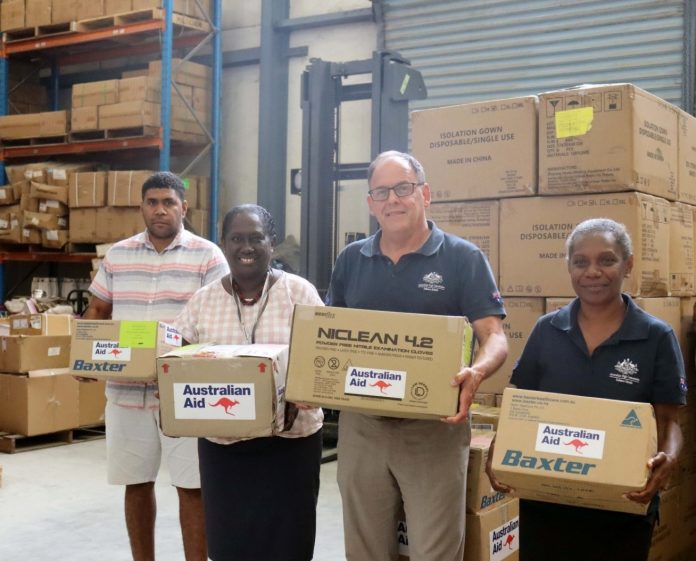
Australia has stepped in to aid Solomon Islands with much needed medicines.
This four-month supply of out-of-stock essential drugs and consumables comes amid a drug-shortage crisis hitting the country.
Government, through the ministry of health (MHMS) has acknowledged this critical support saying it will sustain the country until its annual order begins to arrive in May.
The seriousness of the drug shortage had forced MHMS to reach out to Australia for help.
“As part of the overall efforts of the ministry to address the shortages and stock outs, the Ministry of Health has reached out to Australia for support to fill in the gaps,” MHMS Facebook post yesterday said.
“Following subsequent discussions, Australia has agreed to provide [three to four months] supply of out of stock of essential drugs and consumables while the annual order for 2023 – 2024 starts to arrive in May 2023.”
In its social media announcement this week, the Australian High Commission (AHC) reiterates that Australia “does not usually supply medicines, this is a national government responsibility, but when the need is great, as it is here, we will step in when asked to assist our neighbours”.
The supplies were delivered to the MHMS on Tuesday.
Explaining the shortage of medicine in the capital and other parts of the country, MHMS said:
“Stock levels of certain essential drugs and consumables have been low in the past months and despite stock ups, efforts to replenish provincial stock levels including high consumption and rate of usage by end users have depleted stocks at the National Medical Store.
“Timely replenishment of these essential medical drugs and consumables has been hindered due to multiple factors.
“These include slow delivery by suppliers, international shipping delays, and MHMS financial constraints and internal procurement and payment processes to fulfill, debt repayment to vendors and distribution challenges which includes reluctance of domestic ships to load medical supplies for the provinces have all contributed to the delays with replenishments of essential medical drugs and consumables at the NMS and across health facilities.”
The consignments that arrived this week contain 27 types of medicines and five consumables, MHMS said. Adding that more ‘shipments will be delivered as they become available’.
An elated permanent secretary for MHMS Ms Pauline McNeil says, “The replenishment cannot come at a better time and clearly the efforts by the Australian Government demonstrate to the Solomon Island Public that Australia and MHMS is working in partnership to respond to the current situation such as this and will continue to do so.”
Handing over the supplies, AHC Counsellor Human Development Mika Kontiainen said Australia recognises the importance of maintaining adequate stock levels and the challenges faced by the Ministry therefore have agreed to support the provision of these essential medical supplies, MHMS reports.
Media for the last few months had signaled drug shortage in the capital’s national referral hospital (NRH) and clinics in some of the provinces.
This week clinics near Auki were reportedly sending patients home with paracetamol. Others which still had little stock left were able to give adult patients children’s dose of malaria tablet Coartem.
PRINCIPAL Magistrate Felix Hollison has issued a warrant of arrest on Martin Pola Nehemiah for not appearing in court yesterday.
Yesterday the case was listed for continuation of trial however Nehemiah failed to attend and the court issued a warrant.
Hollison made orders that police finds him and bring him to court for possible remand.
Nehemiah who was charged for three counts of false pretence in relation to the alleged incident that occurred on February 5, 2019.
The allegation said the accused met with the owner of the shop and introduce himself as the president of the Accelerate Christian Education Schools of Solomon Islands.
Upon their discussion the shop owner at Smart Technology convinced and agreed for the accused to collect the items discussed and will be re-paid when the school grants are ready.
Later on, February 28, 2019 around 10am the accused came and collected one mobile phone at a cost of $2, 250 as according to the agreement and walked out with a proforma invoice, again on March 15, 2019 he collected one notebook laptop14 inches and 1X 8c honour brand mobile, later on March 28, 2019, he again went to the Smart technology shop and collected two Redmi mobile handsets.
The total cost of all items collected is $12, 150, couple of months later the shop owner made several attempts to call the accused to settle his credits but was unsuccessful.
The shop owner gave him enough time but till March 2021 the accused never turned up to settle his credits and the matter was reported to the police in which the accuse Nehemiah was arrested and charged.
John Palmer Teula of the Police Prosecution Department appeared for prosecution.
Minister for Health and Medical Services Dr Culwick Togamana
BY MAVIS N PODOKOLO
MINISTRY of Health and Medical Service is seeing increases in the number of Sexual Transmitted Infections (STI), HIV, unwanted pregnancies and unsafe sex.
This is according to the Minister for Health and Medical Services Dr Culwick Togamana.
“The Ministry is seeing increases in the number of STIs/HIV cases in the country, including unwanted pregnancies and unsafe sex. There are substantial portion of the population yet to be reached with information around Sexual and Reproductive Health including related services,” Togamana said.
He said HIV/STI/Hepatitis national programme of the MHMS is proud to work closely the Solomon Islands Planned Parenthood Association SIPPA.
“We have secured funds through WHO under Global Fund to implement a targeted key population intervention project which SIPPA is the implementing partner.
“SIPPA has been instrumental and a key partner in ensuring that HIV incidence is low in the country through its resourceful activities.
“Other NGOs have realigned their priorities but SIPPA stands tall with the HIV/STI/Hepatitis national programme in our fight against HIV, STI, Hepatitis in the country,” Togamana said.
He said the Solomon Islands Planned Parenthood Association has been the leading Non-government Organisation in addressing the STIs/HIV cases in the country, including unwanted pregnancies and unsafe sex.
“Indeed, SIPPA remains an important partner of the Ministry of Health in the delivery of Sexual and Reproductive Health Services including education and awareness as well as in addressing many of the issues related to Sexual Reproductive Health and Rights,” Togamana said.
He adds while there is so much to appreciate and celebrate, there is still so much yet to achieve, accomplish and fulfil.