SIEC outlines cost-cutting priority measures for orderly elections in next NGE
By Alfred Sasako
THE Chairman of the Solomon Islands Electoral Commission and
Speaker of the National Parliament, Patteson Oti, has announced a range of
measures that could be the “game-changers” in the 2023 National General
Election.
“…I would
like to highlight only the main areas I consider to be the game-changers in the
way the 2023 General Election will be conducted if successfully implemented,”
Mr. Oti said.
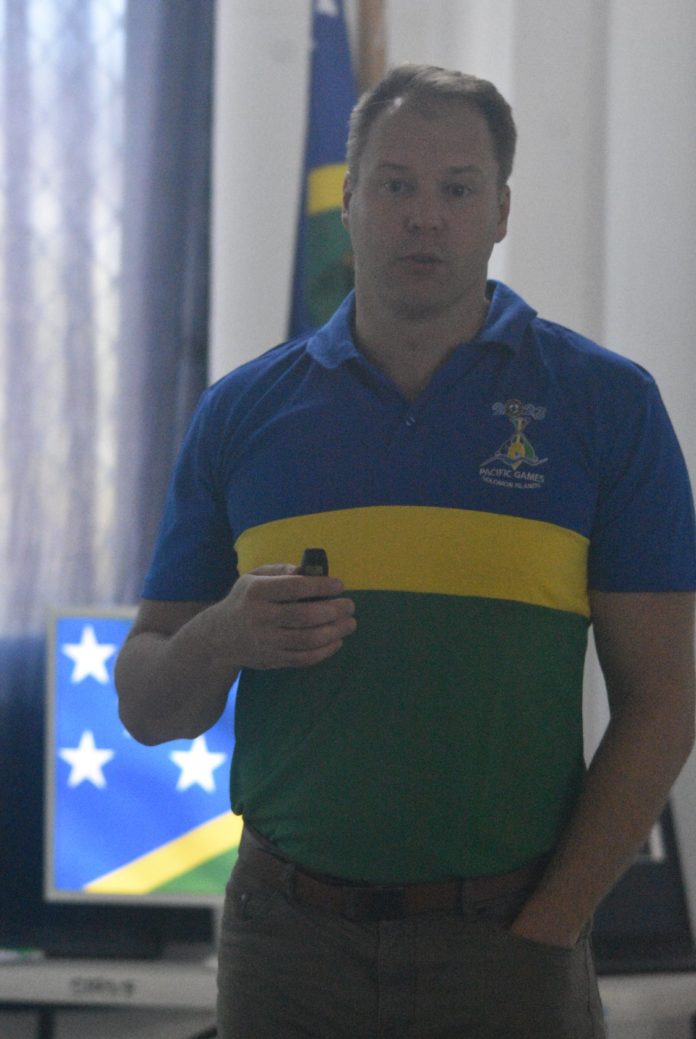
He was speaking at the Kukum campus of
the Solomon Islands National University (SINU) where a Australian National
University (ANU) team launched its 2019 Solomon Islands National General
Elections Observation Report last Wednesday.
“The priorities of the Electoral Reforms
Strategy Framework (ERSF) can also be regarded as ways the Commission will be
addressing the main findings of the ANU observer team as well as other
international observers.
The measures identified in six
priority areas are intended to cut costs as well as to help improve the conduct
of elections in this country.
Priority one, he said, is “Combining the conduct of national and
provincial elections on the same day.
“The conduct of both the national and
provincial election on the polling day of the 2023 General Election will be the
first since Solomon Islands became independent in 1978.
“… it will release public funds
usually allocated for election purposes at the provincial and local government
level because, with the change, we will be conducting only one election instead
of 11 elections (general election, 9 provincial elections and one Honiara City Council
(HCC) election).
“This means that all elections for the
national parliament, Honiara City Council and provincial assemblies will share
the cost of election as the Electoral Commission will only have to engage once
the venue as polling station and/or counting centre, temporary electoral staff
usually recruited to help conduct the election, security officers arrangement
(police officers and their equipment), transportation of electoral materials to
and fro and the cost of administering the conduct of the election.
It could potentially save more than
$20million to the Consolidated Fund, he said.
“It will also elevate the importance
and credibility of provincial and local government elections now that the
Electoral Commission will conduct them to international standards and subjected
(to) international scrutiny,” Mr Oti said.
The second priority area is changing
the voter registration phase to a continuing daily process throughout the year.
“Changing voter registration into a
continuous process will have huge positive impacts on the election. It will
solve many of the problems the Commission face(s) during the election year.
“The Commission spent $48.4million
from September-December 2018 for the voter registration process. There are two
main reasons for this high cost. First, the time allocated for voter
registration (registration update, publication of provincial (provisional)
list, objection and omission and public hearing) is usually short and tight.
“Second, because of the short and
tight period, the Commission has no choice but to recruit more than 1,000
temporary election officials to manage the registration period to its
completion,” the former diplomat and MP said.
“A continuous voter registration every
day, annually, means that there is no pressure for time and there is no need to
recruit 1,000 temporary election officials to help conduct voter registration.
We have estimated that it will only be sufficient to have a budget of $7million
each for years 1, 2, 3 and $10million for year 4 (of the election cycle) if we
are to do continuous voter registration. The change will generate more than
$15million savings to the Consolidated Fund,” he said.
“The change will also enable the
Commission to publish the Final List of Voters the same day Parliament is
mandatory dissolved. This is possible given that we would have more time to
complete the inspection of the provisional list of electors, the objection and
omission results, and the conduct of public hearing.
“The time period between the
dissolution of Parliament and the General Election polling day can also be
shorten(ed) as much as possible. In other words, because we can now publish the
Final List of Electors on the day Parliament dissolves, this means that the
Commission can request the Governor General within seven days, after Parliament
dissolution, to proclaim the day for the General Election, i.e. the first
Wednesday after the 56th day from proclamation.
The third priority is establishing SIEC’s
Electoral Offices in all Provincial headquarters
This will enable the Commission to:
- Conduct voter registration continuously;
- Conduct pre-registration of 17-years old by visiting secondary
schools in the provinces;
- More effectively clean out dead people in the Electoral Roll of a
constituency;
- Conduct voter awareness and/or vote education programs in the
provinces and Constituency level; and
- Help prepare the constituency in the province for a by-election
(national or provincial)
“The cost of delivering the above
mandate by our electoral provincial offices is considered to be sufficiently
covered by the additional annual $7million appropriation for year 1, 2, 3 and
$10million for year 4 that we are asking Government in lieu of $48.4million
budget we would normally require for the purpose of voter registration in an
election year,” Mr. Oti said.
Re-defining “Ordinarily resident” is
the fourth priority area the Commission has identified.
“The Commission has already commenced
work in tightening the definition of ‘ordinarily resident’. This is a very
important step to resolving the problem of cross-border registration. Notwithstanding
a voter’s motive to register in a constituency, without the ability of the
Commission to verify whether a voter is an ordinarily resident of a
constituency, the problem of cross-border registration will grow and there is
little we can do to stop this problem if we are unable to verify the claim by
an applicant.
“We are hoping that with the new
definition, which we hope would be more concise and pragmatic for enforcement,
comes with obligations for the new voter and an existing voter applying to register
in another constituency to provide proof during registration that he or she is
indeed an ordinarily resident of the constituency she/he is applying to
registering at,” he said.
The fifth priority is to introduce
out-of-constituency voting.
“Doing away with out-of-constituency
registration will go a long way to help stop cross border registration.
“On the other hand, introducing
out-of-constituency voting will help reduce corruption during election, provide
a level playing field for all candidates, and will also reduce campaign
expenses that would normally be incurred by intending candidates because there
is no longer a need to transport voters to vote in constituencies in the
province they are registered at. Voters can vote for the constituencies they
are registered at from designated out-of-constituency polling stations in where
they live, either at the provinces or at Honiara city,” Mr. Oti said.
Amending the Electoral Act 2018 is the
sixth priority area.
“There are a number of amendments that
have been identified in the current Electoral Act. Most … are intended to
bring clarity to certain sections of the Act.
“There are also other measures in the
form of offences we are seriously considering to curb certain practices, for
example the practice of Voter Identification Card being used as a promise for
the voter to vote for the candidate.
“We are also seriously considering
introducing other measures that would strongly discourage voters from taking
steps that could be deemed to be an act of selling their votes for a benefit
for cash or otherwise.”