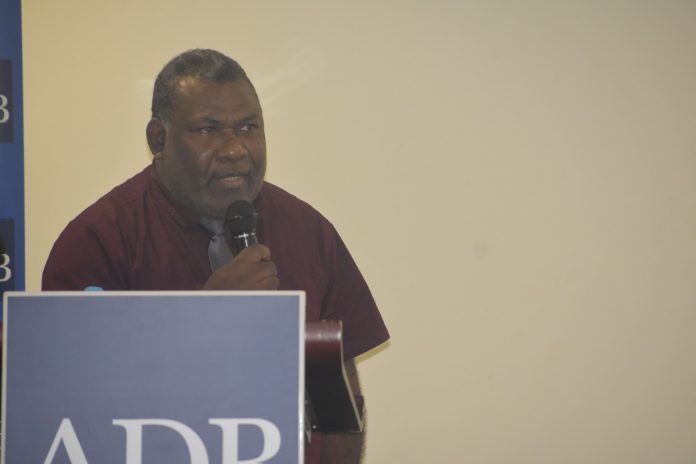
Economic Association of Solomon Islands President, Reuben Tovutovu
By EDDIE OSIFELO
ECONOMIC Association of Solomon Islands (EASI) has suggested some solutions to address the local content issues in infrastructures in the country.
This was after a study carried out between 2005-2017 states that about USD$490 million have gone through the country in infrastructure projects.
EASI President, Reuben Tovutovu asked “What are some benefits to the local contents?”
Tovutovu said infrastructure is key to grow the economy.
However, Tovutovu said some of the challenges is capacity issue.
“When you bid for international projects, you are competing with big players in region and world.
“How can you compete with them, some of them have been competing in all the continents,” he added.
“Not only financials but human resources.
“Some machines you need to build road, wharves and bridges cost millions of dollars,” he said.
Tovutovu said the way forward are:
Serious need to identify opportunities to improve procurement practices that can facilitate local content in infrastructure implementation and delivery in the country.
Need to deliver a greater understanding of the costs and benefits from local contents in the implementation of infrastructure in the country.
Infrastructure policy needed a plan on how local content can be rolled out over next 10 years, example, how much percent of all infrastructure projects to be local contents starting with 30 percent in year 1 to 40percent to 50 percent in year 10.
Tovutovu said in the way local constructors will have confidence to invest in new and expensive equipment and machines and hire qualified manpower
He suggested to make it compulsory through policy that by year 10 of the plan, at least 50 percent of the workforce are locals
DEPUTY Commissioner General Dennis Marita has met with officials from Israeli pharmaceutical company CODE PHARMA who have identified the Solomon Islands as one of the Island nations in the South Pacific where they plan to further develop a groundbreaking medical antiviral drug against COVID-19.
Codivir, an innovative new drug from Code Pharma, now appears to have the potential to revolutionise the fight against the Coronavirus.
Code Pharma claimed that in a successful phase 1 clinical trial, the affected patients were back on their feet within 48 hours without side effects.
In welcoming DCG Marita, Alessandro Rosso said that the State of Israel was privileged to have received a representative from the Solomon Islands attending the Expo 2020 Dubai and to further discuss the options of possible cooperation with our Ministry of Health.
DCG Marita responded that whilst the Solomon Islands is considered a Covid free nation, there were still reservations amongst many people of the risks associated with taking the vaccine.
He added that the Solomon Islands would be interested to learn more about this new invention and initiative in fighting this global pandemic that is currently impacting the world today.
“I have also contacted our Expo 2020 Commissioner General, Ambassador Moses Kouni Mose including the Head of COVID 19 Health Task Force team under the Ministry of Health & Medical Services (MHMS) in Solomon Islands, Dr Nemia Bainivalu for their notification in this regard.”
DCG Marita further requested if a virtual meeting could be organized between all stakeholders involved.
The meeting concluded with both parties agreeing to pursue further dialogue in helping to raise more awareness on the proposal presented by CODE PHARMA.
Also in attendance were Assi Alkobi, the Global Business Development Director and Alaa Balal, Economic Director for the Israel Pavilion
CHIEFS, elders and leaders of Kolombangara Island have called on their people to refrain from any unnecessary compensation demands in the wake of the recent killing of a school girl on the island.
The leaders made the statement in advance to remind those who may intend of doing that.
“We must dissociate ourselves from any compensation demands that were outside of our agreed resolution,” they said in a statement.
“Compensation can only be pursued when perpetrators are identified and charged,” they added.
“We cannot stake our demands left and right without legal justification.”
The statement further adds that families and parents who were employed around Kolombangara must share the sadness with the immediate families of the deceased.
“We wish to assure workers and members of the public around Kolombangara and its surrounding communities that as responsible leaders, we will continue to work with Police and other stakeholders to ensure justice is served.
“On the same token, we also appeal to workers from other provinces and islands to respect our children, girls and women.”
CHOISEUL Provincial government has reconciled and ready to move on with the province’s business after the motion and election of new premier.
Speaker of Choiseul Province, Greg Sokeni said a brief reconciliation ceremony occurred after the voting of new premier.
This occurred between the ousted premier and the newly elected Premier, Benjamin Harrison.
He adds that both leaders also exchanged words of encouragement to each other after the declaration of the voting.
Sokeni said the election of new premier and deputy speaker was done peacefully without any disturbance from the public.
“The voting was done through a secret ballot and the results are as follows; we have two candidates for the premier post and the result was 10/6 in favor of Harrison.
“Only one candidate was nominated for the deputy speaker’s post as such the winner was unopposed,” he said.
Sokeni said swearing in of the premier, deputy premier and executive portfolios have been completed on Monday.
He said the next task is to facilitate an Assembly meeting as soon as possible so that the leaders can table the province’s review budget for the remaining months of this year and next year.
Participants and facilitators with kava chips now sun dried on a raised bed after washing and processing demonstration.
THE Ministry of Agriculture and Livestock (MAL) through its Western Province Extension Division has successfully conducted a four-day series of farmer training on piggery and kava for members of the Sirubai Voko Tribe Association (SVTA).
SVTA is a community-based organization in South Vella La Vella Island, Western Province.
Funded by SVTA, the series of trainings ran from 11th-15th October, 2021 at Valapata community with the aim to equip existing and interested pig farmers with knowledge and skills to boost their pig production for improved profitability and also impart them with the right skills and knowledge on kava cultivation practices to guarantee they produce quality kava for local market and overseas export.
Kava roots and chips being cut in required sizes and sorted before sun drying.
The series of training also provided an opportunity for the farmers to share experiences and learn together especially on pig farming and kava production techniques and at the same time able to attained technical recommendations from MAL officers for guaranteed farming improvement.
Senior Livestock Officer for Western Province, Margaret Telemahau said the trainings were very successful with farmer participants acknowledged MAL for the knowledge and skills shared that would certainly support them on ways to improve their pig and kava production.
One of the women group did a presentation during the piggery training.
“The training were conducted in series, like we conducted kava training from 8:00am – 4:30pm during the day while training on piggery we started it off after 4:30pm till late each day,” Telemahau said.
“It was a success and we manage to complete the trainings successfully,” she added.
“Piggery farming has been recognized as one of the profitable undertaking among our rural farmers.
“This enterprise has proven to be one of the most important livelihood alternative.
“Generally, pigs are reared for pork, considering the increasing trend of pork consumers in our country during special occasions.
“Piggery farming will certainly take an industrial form of livelihood in Western Province in the future if piggery farmers around the province (Western province) see the potentials and roles piggery enterprise plays,” Telemahau said.
Demonstration on kava harvesting
Meanwhile, on Kava she said the training was very important to ensure farmers are entrenched with practical capacities to produce quality kava for the local market as well as export market.
“It is an important training because the knowledge and skills acquired will help them to improve and practice proper ways of kava harvesting and processing.
“Kava training involved both theory and practical and farmers have learned a lot from the field demonstrations,” she said.
Telemahau also took the opportunity and congratulated SVTA for being a role model and taking the lead in the initiative to ensure its members organized themselves and trained on practices to boost their farming for improved productivity and profitability.
She also thanked SVTA for its funding support towards the training.
Telemahau added that MAL Extension Division in the Western Province is looking forward to support SVTA with more similar trainings in the future.
Total of 47 participants including men, women and youths who are members of SVTA attended the series of trainings.
Kava roots and chips being cut in required sizes and sorted before sun drying.
Topics covered for the piggery training include; animal welfare; pig and the community; planning piggery project; pig management/ system of pig keeping; disease and parasites; feeding and different breeds of pigs while kava theory and practical sessions include management, harvesting, washing, sorting, cutting and sun drying.
SVTA (Sirubai Voko Tribe Association) consist of family members of the Sirubai Tribe, South Vella La Vella Island.
The association (SCTA) works closely with Community Based Organisations (CBO), NGOs, Government Ministries and communities with the vision towards self-reliant community, fostering good governance, healthy lifestyle, maintaining of food security and natural resources management with the mission strive towards sustainable natural resources management where people are secure in terms of food securities, socio-economic activities and having a healthy life.
THE Ministry of Agriculture and Livestock (MAL) through its Isabel Extension Division has successfully concluded a three-day training on kava pre-processing for farmers from Keregu, Haevo and Buma villages in Isabel Province from 13th-15th October, 2021.
The training was part of the ministry’s (MAL) willpower to impart kava growers in and around the country with necessary knowledge and skills to produce quality kava and ensure farmers meet requirements for overseas market.
It involved both theory and field demonstration activities.
Kava trainer and MAL Extension officer for Isabel Province Casper Manelugu said the training was a success.
“Farmers who attended these demonstration trainings stated their gratitude to the Ministry of agriculture and Livestock for possibly making these training available to their doorstep. It is the first of its kind especially concerning this new introduced crop since it was introduced in the country,” Manelugu said.
He said the training was very important because it equip farmers in and around the country with the same aspect on kava management and its quality assurance to make sure farmer growers meet the requirements and demand for international market.
The three days kava field demonstration training includes; field management; harvesting; sorting; washing; drying; grading and storage.
“It was a successful training and it was obvious that a good number of kava farmers had learnt a lot from these two days field demonstrations and have enjoyed the activities especially during the session such as pruning, harvesting and washing.
“Some of the participating farmers have never access to such pre-processing field demonstration training, therefore they have voiced out their appreciation to MAL for reaching out to them with the practical training,” Manelugu said.
MAL through its Extension Department is anticipating to provide further similar trainings to support farmers within the area in the future.
Manelugu thanked participants for their time and commitment proven during the trainings and also acknowledged MAL management through its Extension Department in Honiara for the continuous support to the Isabel Western Province Extension Division.
Cabinet agrees to decrease period spent in quarantine.
BY MAVIS N PODOKOLO
CABINET has agreed to decrease quarantine period for travellers who wish to enter Solomon Islands by modifying it into three categories according to COVID-19 risk profile of countries, says Dr Jimmie Rodgers.
Dr Rogers Secretary to Prime Minister said this modification is also carried out on quarantine requirements and the pre-departure requirement for travellers.
He stressed this modification was made in three folds.
The first one is whatever changes set in place will still be able to protect our country. Secondly many countries are now reopening their borders and this means quarantine conditions must be made slightly more attractive so that people and investors can come into the country. And thirdly is to commence re-generating the country’s economy so, these three are balanced and are currently focused on.
Rodgers said for the categories initially there are five but now the Over Sight Committee has narrowed it down to three.
“The first category is people traveling from COVID free countries now need to do one pre-departure test within 72 hours of arriving in Honiara and there quarantine period reduced to seven days from the current 14 days mandatory quarantine period,” he said.
Rodgers said when they are in quarantine they will only have one test on day six or seven and if the result returned negative they will be discharged.
“Now if some one is from COVID-free country and comes into the Solomon’s from a moderate risk country that person will be quarantined for 10 days and will have two tests. If that person comes through a high risk country that person on arrival will be quarantined for 14 days and will have three tests. This is what the regulation mentioned,” he said,
In addition Rodgers said for moderate risk countries and now Fiji is part of this there is one pre-departure test required within 72 hours of arrival and then 10 days quarantine after arrival and during the quarantine will be having two tests one within 48 hours day two and last one between day 10 and nine.
“If test results returned negative the person will be discharged. If however the person from a moderate risk country come through a high risk country then the person will be quarantined for 14 days and will have three tests before discharged,” he said.
Rodgers further adds the final group is from high risk countries with high rate of community transmission.
He said they must present two pre-departures tests one between day nine and 11 before departure and one within 72 hours of arrival in Honiara.
He said on arrival they will have 14 days quarantine. Currently this group will go through 21 days quarantine and will have three tests that will take place on day 13 and 14, if tests returned negative they will be discharged on day 14.
“So, the reason for the decrease of quarantine periods is because of the requirement of full vaccination. If travellers are not fully vaccinated they will be denied entry into the country except if they are exempted under the regulations”.
“Very importantly for each of the categories there will be risk assessment done by health and the IC will increase pre-departure requirement or post-arrival requirement depending on the risk.”
“If the risk is picked up before there will be changes to keep the country safe,” he said.
Rodgers said the most important part of the decision by the cabinet is that it is now a mandatory requirement that any one 18 years and above who want to come into the country must be fully vaccinated meaning they can only travel into Solomon Islands after having two doses of vaccine except for Johnson vaccine which is single dose.
And they can only travel four weeks after the final dose, so that is mandatory there is no exception except in very few circumstances that are defined in the regulation.
He echoed the above statements yesterday during the Office of the Prime Minister and Cabinet’s (OPMC) radio talk back show on COVID-19 update on the Solomon Islands Broadcasting Corporation (SIBC) in Honiara
SOLOMON Water needs about $60 million to provide sewages for key games facilities for the Pacific Games in 2023.
Chief Executive Officer, Ian Gooden revealed this during the 2021 Infrastructure Symposium at FFA recently.
Gooden said there are about 10 facilities that will require water and waste water servicing.
He said one is the accommodations and SIFF facility and the National Sports council ground.
“We need funding in the next 12 months,” he added.
Furthermore, Gooden said one of the impacts is the Kukum Highway project.
“We need sewage that will go under the road and from the Ministry of Fishery to Ranadi that is 1.4 kilometers of sewage that needs to be laid under the lane.
“That has not been taken into account and not funded. We are trying to work through that,” he said.
Gooden said they have a large sewage project for Ranadi that worth around $15 million US dollar and that includes deep sea ocean floor.
“Unfortunately, we are not funded for that, the project has been broken into four parts and would cost 20 percent to 35 percent more because we are forced to build in four different parts.
“The plan B is we continue to put raw sewage into the environment and vicinity of the SIFF and National Sports Council ground. That is not accepted to us and take us back to safe water and provisions,” he added.
In addition, Gooden said within their 30 years plan, they intended to build a new water treatment plan at Lunga worth around $50 million.
AN investigation is being launched after fake vaccination cards were reportedly discovered.
This as the country continues to face a slow vaccination rate.
Secretary to the Prime Minister Dr Jimmie Rodgers confirmed this yesterday at a radio talk back show on the Solomon Islands Broadcasting Corporation.
“It has come to our notice there are vaccination cards that have been faked we are investigating the cards that have been sold to people and people are actually writing names and putting dates on those cards and they are fake cards,” Rodgers said.
He said “it is very important that when you have cards it must be a genuine card therefore”.
Rodgers uttered they are now working closely with the Ministry Foreign Affairs and External Trade to ensure the upcoming flight that will leave for New Zealand on this Wednesday night carrying 150 RSE workers on labour mobility must have authentic vaccination card.
“So, with MFAET we have requested to them that we will be checking 150 cards belong to 150 travellers to ensure they are authentic. Only those that hold authentic cards will be allowed to board the flight”.
“Those that have photocopy card will be disqualified to board the flight,” he said.
Rodgers said a call will be made to the 150 people within the next 24 hours for them to bring in their cards to be validated because if any fake card is picked out the whole future of the labour mobility programme to New Zealand might actually be endangered.
“We cannot risk that thing. So the message to anyone that might be holding a fake card please know that is wrong and that is illegal and if get caught you will be prosecuted and whoever supply the fake cards will also be prosecuted,” he said.
OF the 141 people booked to board the recent Fiji repatriation flight, eight people were disqualified from boarding the flight due to strict COVID-19 measures.
According to Dr Jimmie Rodgers Secretary to the Prime Minister ,out of the eight people one did not turn up to do COVID-19 tests so that person was denied the right to fly.
Dr Rodgers stressed that of the seven two daughters of a family of five were tested positive with COVID-19 and so the whole family members were not allowed to board.
He said one student was indeterminate, meaning the persons tests is is not a definite positive nor it is a definite negative, so for safety it is regarded as positive so the person plus the person’s roommate was also denied to board.
“So, that leaves us with eight people unable to come over on the recent Fiji repatriation flight .Which means only 132 passengers boarded the flight on the 29th of October 2021,”Rodgers said.
He reiterated that on that flight 105 adults were all fully vaccinated ,27 children not vaccinated and also of that group of 105, 22 were positive previously fully recovered , tested negative and fully vaccinated.
“So that is to assure the public inside the country that no one came on that flight that is positive of COVID-19 everyone negative, of course the children cannot be vaccinated but all 27 of them tested negative of COVID-19,” Rodgers said.
He stressed test results of this Fiji-repatriation flight is currently worked on at the Molecular laboratory at the National Referral Hospital.
“We are hoping that results will be all negative but of course the test within 72 hours does not give the status of COVID-19 on the day of the test,” Rodgers said.