ABOUT 50 houses have been purchased at the new Mamara township on the western end of Honiara.
Permanent Secretary of the Ministry of Commerce, Industries, Labour and Immigration, Riley Mesepitu confirmed this in a press conference yesterday.
But he did not say whether all 50 houses were purchased by public servants.
Mesepitu explained that the project belongs to the developer, Metropolis Pacific PTE Ltd.
He said the project is divided into phases, with phase one to build housing project and the second phase to build hotels and other businesses like supermarket.
He said the project depends entirely on the investor, and has nothing to do with the government.
“The investor developed it according to its business plan and proposal,” he added.
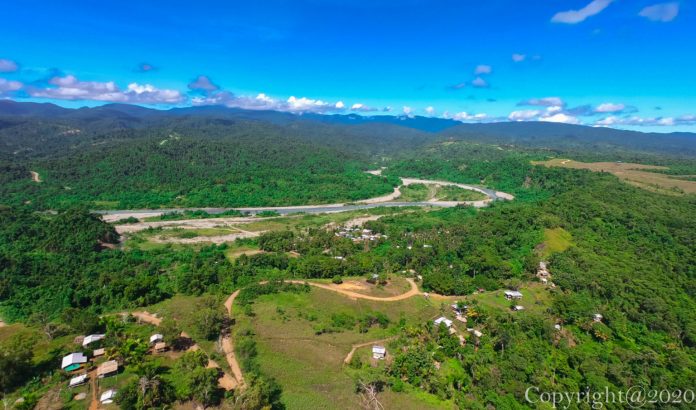
The Mamara Development Project is a real estate development consisting of a residential, commercial and recreation construction and supporting infrastructure and utilities covering a total land area of about 100 Hectares.
The development is part of a broad development plan known as the “MAMARA NEW CAPITAL CITY”.
The Mamara development proposal is a result of a development agreement signed by the Solomon Government and the Department of lands (Minister of land and resources) and Mamara Metropolis Pacific Limited (MPPL) on November 20, 1995.
On March 1, 1996, the agreement was formally reviewed and approved by the national council and formalised under the agreement and subsequent legislation the Mamara – Tasivarongo – Mavo Development Agreement Act 1997.
The total area covers more than 1166 hectares.
The Act allows for the land to be leased to the developer for 75 years as of 1995 and to date over 22 years have passed.
The developer having lost some time due to recent civil unrest now has about 53 years remaining and are confident that it is enough time for them to develop the site.
The Act also established the Mamara- Tasivarongo Mavo Development Council that has seven members as follows;
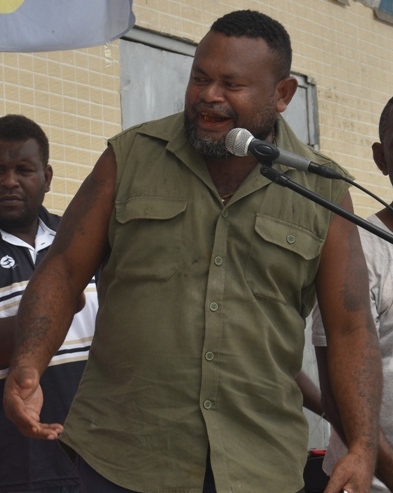
MEMBERS of Malaita For Democracy (M4D) say they support statements recently made by their president Knoxly Atu on his stand on certain issues affecting Malaita.
M4D rep George Ramo said they stand with their president and would be happy to see if Atu is arrested for his patriotic fight for his province.
Ramo said what Atu is facing now is not new in Malaita.
“Similar incidents happened during Maasina Ruru era when leaders were arrested and imprisoned for standing up for their people, resources, culture and island,” Ramo claimed.
“I want to assure the national government that our fight to speak-up on issues affecting Malaita province will not stop and will carry-on by the younger generation,” he added.
“Our fight is the fight for the good of our children, province and Solomon Islands like what leaders of Maasina Ruru had done in their fight for sovereignty now we are enjoying.
“Even then, we still see things not happening the way we should be and we won’t just sit-down and watch.
“With that spirit of patriotism in us, we will keep fighting even if there is opposition or pressure from whosoever that might have intention to dismantle us.”
Ramo said even if Knoxly Atu is arrest and imprisoned; there are many Knoxlys waiting in the wings to take his place.
“The day Knoxly is arrested, a new Knoxly will step up to lead the group.”
Ramo said M4D is a provincial civil society organization group that will continue to stand with their president in a collective fight for the good of Malaita province.
The national government last December declared M4D an illegal society.
It took the action after police investigation allegedly found a number of M4D members played leading roles in organizing last November’s rioting and looting in Honiara.
Work on the Tina River Hydropower Project in Solomon Islands is said to be progressing well despite the country’s war against COVID-19 community transmission.
Deputy Project Manager, Fred Conning says there is no formal notification yet calling for an extension for the project work, Solomon Times has reported.
The Tina River Hydropower Development Project (TRHDP) aims to reduce the cost of electricity in Solomon Islands as electricity costs in the country are said to be among the highest in the world, placing a huge strain on businesses and individuals.
Approved by the World Bank in 2017, the project also paves the way for the country to exceed its 2025 greenhouse gas emissions reduction target.
While there are concerns the project might face challenges because of the dire situation Solomon Islands is in now, the Deputy Project Manager remains optimistic, thanks to pre-planning and the establishment of a COVID Safe Management Plan.
“While the situation is not ideal, it will be manageable thanks to months of meticulous planning and preparation,” Conning said in a statement issued by TRHDP.
Conning said adhering to the government health advice in conjunction with the project’s COVID Management plans would be the way forward for the project.
“We have planned for this day eventuating and thankfully, we are prepared.”
Work on the hydropower project is carried out by private contractor Tina Hydro Limited (THL).
The company was expected to develop, finance, construct and operate the Hydro power facility with an installed capacity of 15 MW, located on the Tina River, 20km southeast of Honiara.
The TRHDP is the first large utility-scale renewable energy project in Solomon Islands.
The Solomon Islands government plus six different financiers have been involved at different levels of the investment.
The financiers are Abu Dhabi Fund for Development (ADFD), The World Bank, The Government of Australia, Green Climate Fund (GCF), Korea-EX-IM Economic Development Cooperation Fund and the Asian Development Bank (ADB).
Work on the project is divided into four components. They are namely Hydro power facility, road access, transmission line and technical assistance.
With less than three years to go, the contractors are still to construct a 71.5m dam, a 3.3km long headrace tunnel to connect the dam to the power house, a powerhouse equipped with 3 turbine generator units, each with a capacity of 5MW, a dual 66kv transmission lines, construction of permanent and temporary access roads to the powerhouse, dam, intake portal, dam base, mini-hydro quarries and Black Post reserve amounting to a total of 21.5km.
“There might be some delays but officially we have not heard anything yet from the contracted company,” Conning said.
“At the moment the project is on track to achieve its commercial operation date,” he added.
The project is expected to be completed by December 2025.
THE Government has defended the shipment of China-donated “replica guns” brought in by a logging ship recently.
Police Commissioner, Mostyn Mangau said the shipment came on a logging ship because the consignment of riot gears is “quite huge”.
He said why the cargo was loaded in the boat is a matter for other agencies to answer.
Chief of Staff Robson Djokovic said Solomon Islands has requirements for international ships and vessels.
“We have requirement for international ships and vessels,” Djokovic said.
“Despite questions regarding convention and movement of weapons, the point to make is these are not real weapons, but for training purposes,” he added.
“These are replicas and therefore can’t be fired and used as real weapons. So, it is impossible to use live round to discharge.”
Djokovic said the training equipment were put in a logging ship because we are in a crisis period in which even emergency supplies and materials for the Pacific Games came in logging ships.’
Furthermore, he said the Royal Solomon Islands Police Force are working to build public confidence through its media unit.
A question was also put regarding the Firearms and Ammunition Act which Section 40B(1) states (in part):
‘No person shall import into Solomon Islands or sell or display for sale any imitation firearm in any place in Solomon Islands.’
Kabui said the scheme of the Act is for people to apply for licence, but of course you can take it up to court.
THE man charged with false pretence and attempt to commit false pretence incident in 2019 has been found guilty by the courts.
He will be sentenced later.
Peter Fakaia was charged with three counts of False Pretence and one count of attempt to commit false pretence.
He entered not guilty pleas and a trial was conducted on his case at the Honiara Magistrate Court.
Principal Magistrate Felix Hollison having assessed the evidence provided in court found the accused guilty and convicted him.
Hollison said he is satisfied that crown witnesses are all credible witnesses.
“I am satisfied that the prosecution has proven beyond reasonable doubt that the defendant by false pretence with the intention to defraud, obtained monies which totalled up to $76,000 from the complainant on September 23, 24 and 25 of 2019 in Honiara for his own benefit”
Fakaia in 2019 faked his own death and obtained $76,000 from a local pharmacist in Honiara.
He had called People’s Pharmacy at the Kwaimani building at Kukum, after taking his medication he then left, however on the next day he returned to the pharmacy complaining that he had allergies with the medication.
He was then given another medication and advised to see a doctor.
On September 23 at about 8am, the complainant received a call through his office phone by a person who purported himself as the accused’s brother-in-law.
The brother in-law told the pharmacist that Fakaia had died and that his body was at the morgue.
Fakaia’s brother-in-law then demanded a compensation of $10, 000 for the cause of death.
The complainant in total allegedly gave $76,000 to the so-called relatives of the accused.
It was on 26 September police were alerted about the incident and police arrested a person who came to collect the last portion of money requested for Fakaia’s death.
Using the accused’s alleged associates; police finally arrested the accused after halting him in his vehicle at the Ranadi Roundabout.
The case will come back in court for sentencing and mitigation submission.
Jonathan Auga of the Public Prosecution appears for the crown while Ben Etomea is representing the accused.
ISABEL province has declared its first female Premier, Rhoda Sikilabu at Buala yesterday.
Her victory is also the first in Solomon Islands, a country dominated by male leaders at both national and provincial political levels, since independence in 1978.
After entering provincial politics since 2006 for Sigana ward, a position she held until today, Rhoda has managed to convince her male colleagues in the camp for the Premier’s post.
This was after former Premier, Leslie Kikolo tendered his resignation on Monday after three of his members have resigned and joined the other camp.
Speaking after her victory, Rhoda said the country has achieved a female leader today that comes out particularly from a matrilineal culture of Isabel province.
She strongly believed that if it is contested on the number game, it would be difficult for a change.
However, she said her camp has a common understanding after seeing her output and convinced to give her the change in the leadership.
She said her victory is a model for aspiring women leaders to follow.
“I can’t do it alone.
“I will try my best do a bit of change before the election,” she added.
Rhoda said her new Executive members have just sworn in and will sit in the coming days to discuss their policies and programmes for the remaining years.
Outgoing Premier, Leslie Kikolo congratulated Rhoda on her election and urged all members to work together for the good of the province and its people.
Kikolo said all the allegations levelled against him have no basis, but he decided to step down because he no longer has the number to support him.
Island Sun understands there are few women representatives in other provinces.
In the 50-seat National Parliament, women representatives are Lanelle Tanangada, Freda Rotutafi Rangirei, Ethel Vokia and Lily Maefai.
More than 600 people of Makira-Ulawa province are stranded in Honiara.
Authorities say two repatriation trips had already left for the province, taking back more than 300 in total.
This was confirmed by John Harara, health director for the Province in a recent Ministry of Health virtual talkback show.
“About 622 people from Makira/Ulawa province stranded in Honiara are still waiting to go home,” Harara said.
“Two vessels have already sailed to Makira/Ulawa province and brought home more than 300 passengers. These vessels navigated to Central Makira and West Makira.
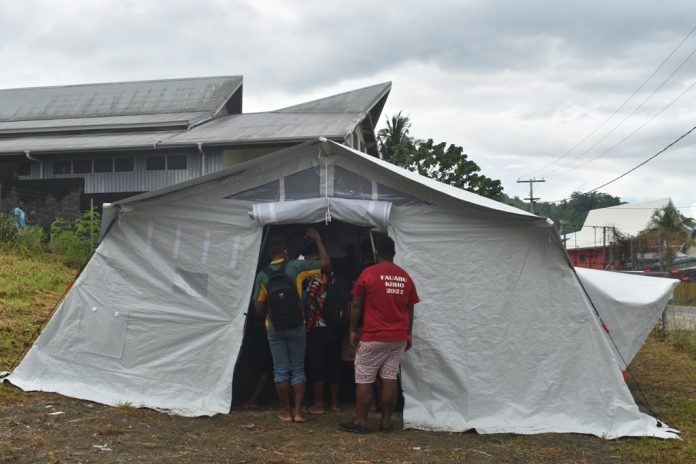
“Regarding testing and quarantine procedures for Makira people stranded in Honiara and waiting to go home, they will go for home Isolation if they are tested positive.
Further to that PDOC for Makira Ulawa have visited communities in in Makira/Ulawa province and make people aware of the measures they (communities) will adhere to when passengers reach their communities.
He echoed the above statement at the recent Ministry of Health and Medical Services talkback show on the SIBC.
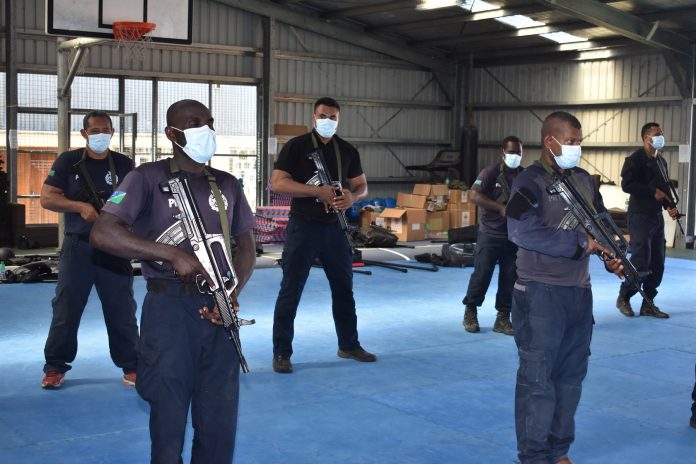
PRT with the replica during training session at Rove 1
The Royal Solomon Islands Police Force (RSIPF) have refuted ongoing media reports on recent consignment of alleged gun shipments into the country donated by Peoples Republic of China for RSIPF Training purposes.
Some questions raised on social media asking who imports the replica weapons? Why were they brought under secrecy? Why does it have to come in a log ship? Why was the shipment not handled by Solomon Ports and why the consignment does not have any manifest?
In response to these questions, Commissioner of RSIPF Mostyn Mangau says:
“To answer the first question, we must understand that Solomon Island is a sovereign country and when it comes to security we must be sensitive about police capabilities.
“There is nothing to conceal or hide regarding these replica guns.
PRT with the replica during training session at Rove 6
“These things do not in any way threaten the security of this country so far, except they are as good as helping RSIPF in building its tactical knowledge and capabilities.
“It would have been an issue of importance if it was a real weapon.
“Having said that, I want the public to be aware that, when it comes to real police weapons importation, such undertakings are always kept strictly confidential or secret as it is a matter of security and sensitivity must be put in place at all times until such consignment arrives safely in the country.
“Second question, why does it have to come in a log ship?
“There have been many logging vessels bringing cargoes to Solomon Islands over the past months, which has significantly helped the people of Solomon Islands at this time of COVID pandemic.
PRT with the replica during training session at Rove 7
“The question of where the ships are berthing are questions for relevant authorities like Solomon Islands Ports Authority (SIPA) and others to answer, however, there are surface wharfs in Honiara that have been approved from time to time for cargoes to be discharged as long as they meet and adhere to the International Ship and Port Facility Security Code. (ISPS Code).
“Logging Vessels are just like any other shipping company that provides services to our country.
“These two questions, why the shipment was not handled by Solomon Ports and why the consignment does not have any manifest?
“These are not questions of relevance as long as these firearms are replicas.
“There could be an error when data’s were put on the manifest and is not a question that I should respond to.
“These replicas are not concealed, but stored openly in the container, which are subject to Customs and other inspection and clearance processes.
“That is actually, what happens in this case.
PRT with the replica during training session at Rove 2
“RSIPF and other Law Enforcement Agencies (LEAs) have very good knowledge of the Modus Operandi or methodology of concealments in terms of firearms and dangerous goods such as drugs entering many borders.
“These replicas firearms when imported into the country do not form any such character of secret concealment of importation.
“These replica firearms (95 replica rifles and 92 replica pistols) are not capable of firing any live munitions.
“They are for training purposes and weigh about the same weight of real rifles and pistols.
“There are 60 pieces of x plastic rifles and 150 pieces of plastic pistol training aides received by RSIPF donated by PRC.
“People are questioning why RSIPF has not been transparent to inform the public when these fake guns are coming into the country.
“RSIPF is the main security agency of this country and so some of the methodology we use or apply does not need the public to be aware of this as a matter of national security.
“The initial report published in the newspaper by Alfred SASAKO does not say there was a shipment of fake guns coming for RSIPF, but reports on deadly gun shipment.
RSIPF Replica fireams for Trainning 2
“Therefore, the RSIPF went on to investigate what was reported on that paper.
“The Police investigation and intelligence in their assessment thereafter concluded there is no arms shipment at all but those reports are only referring to the Police training aides donated by PRC.
“It was at that time that RSIPF was in a position to inform the public that it was only replica rifles and not real weapons and therefore it would only be unfair to say that RSIPF is not transparent.
“I would like to acknowledge and honour the ongoing support and assistance provided by our bilateral partners in building and enhancing the capacity and capability of the RSIPF in its efforts to tackle and stay ahead of the security threats and challenges in this country.
RSIPF Replica fireams for Trainning
“Such commitments by our partners would also help us in contributing strategically to fortify our regional and international commitments such as the UN Peacekeeping Missions.
“I would very much welcome any other bilateral partners who wish to come forward to modernise the RSIPF to do so, as crime and security challenges are fast evolving over time threatening the lives of our people.
“It is only through such commitments and cooperation that we can be able to reap the benefits of prevailing over all forms of crimes and security challenges we face today nationally and globally.
“RSIPF will continue to strengthen the interoperability and collaboration with all Law Enforcement Agencies (LEAs) in the country and with external security agencies to ensure no such dangerous weapons or illicit goods are smuggled or illegally imported into this country.
“It is only acting in unison by all LEAs that will help us to be strong to protect and keep this nation safe.
“Solomon Islands is a member of INTERPOL and RSIPF INTERPOL National Central Bureau (Honiara NCB) is working with 195 police forces around the world 24/7 in sharing crime and intelligence information for the purpose of keeping our borders and countries safe.”
L-R – Andrew Darcy, Molecular Laboratory technician, First Secretary Health, Kathleen Bombell, Human Development Counsellor, Mika Kontiainen, Permanent Secretary Pauline McNeil, Australian High Commissioner Dr Lachlan Strahan, Minister for Health and Medical Services Dr Culwick Togamana and Alfred Dofai, Director for Laboratory.
Australia has delivered a new GeneXpert machine and 400 testing cartridges to assist the National Referral Hospital’s (NRH) molecular laboratory to diagnose COVID-19.
This machine can return COVID-19 test results within an hour. It can also test four times the number of samples at any one-time compared to previous GeneXpert machines in use, providing rapid detection of the COVID-19 virus.
This quick turn-around will enable laboratory and health care staff to identify patients who are COVID-19 positive with the result then quickly available to treating clinicians.
Better diagnostic capability is critical as we all continue to combat the spread of the virus.
Australian High Commissioner Dr Lachlan Strahan and Jean Moselen, scientist from the Peter Doherty Institute for Infection and Immunity
Working with the World Health Organisation, Australia supplied a PCR machine and GeneXpert cartridges in 2020 and over 100,000 rapid antigen tests in early 2022.
The new GeneXpert machine, ordered from the United States, further extends Solomon Islands’ testing capability.
The machine was set up by staff in the molecular laboratory, with help from the Peter Doherty Institute for Infection and Immunity (Doherty Institute) in Australia.
Two Australian scientists from the Institute, Professor Patrick Reading and Jean Moselen, worked closely with local laboratory and health personnel to provide technical assistance and build capacity during the COVID-19 outbreak response in Solomon Islands.
Providing technical assistance and testing equipment is part of Australia’s commitment to strengthening laboratory and diagnostic capacity in Solomon Islands.
Australia is also working with the Ministry of Health and Medical Services to renovate and extend the molecular laboratory in the coming months.
In a small ceremony on 21 March, Australian High Commissioner Dr Lachlan Strahan and Minister for Health and Medical Services Dr Culwick Togamana, Permanent Secretary Pauline McNeil and Dr George Wilson Malefoasi, CEO of the National Referral Hospital marked the handover of the GeneXpert machine.
Dr Strahan and Dr Togamana also presented the staff at the laboratory with certificates to acknowledge their training in PCR techniques to detect COVID-19 in clinical samples.
Doherty Institute scientists Professor Patrick Reading and Jean Moselen with laboratory interns and staff who completed training in PCR techniques to detect COVID-19 in clinical samples.
“Staff in the molecular laboratory are highly competent at the techniques needed to detect COVID-19 and I am pleased to award these certificates in recognition of their skills” Ms Moselen said.
The Doherty Institute will continue working remotely with staff in the molecular laboratory.
Health Minister Dr Togamana highlighted the importance of additional GeneXpert machine.
“ ‘The support is timely as one of our main focus of COVID testing at this stage of our response is with COVID-19 patients admitted to the hospital and for such group lab test is more appropriate, as it provides detailed data to assist clinicians in managing COVID-19 patients.
“Additionally, since the virus is transmitting more in the rural communities, the installation of the new 16 module GeneXpert machine that is capable of performing 32 tests per hour has freed up 3 other machines that have now been deployed to Guadalcanal, Makira and Temotu provinces for COVID-19 testing for clinical patients, suspected cases, and ongoing mass community testing in the provinces.
“Therefore, the additional GeneXpert is greatly appreciated,” explained Dr Togamana.
Dr Togamana also acknowledged the technical support from Doherty Institute in Australia in further building capacity of local lab technicians for COVID-19 testing of clinical sample, whilst highlighting that they will transfer knowledge and skills gained to their provincial counterparts to ensure consistency of performance across all laboratories. Thank you indeed.
The health minister praised the unwavering and steadfast, partnership and friendship of the Australian Government to the government and people of Solomon Islands.
“All the support we have received will go a long way in preserving the health and lives of our people especially at this difficult time of COVID-19 community transmission,” said Dr Togamana.
Australian High Commissioner Dr Lachlan Strahan said:
“Australia is absolutely committed to working with Solomon Islands to support its COVID-19 Response Plan.
“We have worked in lock step with the Solomon Islands Government since the COVID-19 pandemic started in early 2020 and our support will continue to be unwavering as we face this virus together.
“Australia’s assistance isn’t just one dimensional either. We’re committed to supporting Solomon Islands tackle COVID-19 with the appropriate infrastructure such as laboratories, medical equipment and supplies, logistics assistance and importantly, technical assistance and people like the scientists from the Doherty Institute and our AUSMAT colleagues. Australia’s COVID-19 support is wholistic and enduring.
“We’re here for the long haul.”
Australia’s longstanding health partnership is supporting Solomon Islands to respond to COVID-19 while continuing to assist with long-term health system strengthening.