SOLOMON Islands Government has established a guideline for approval and clearance of military aircrafts and naval vessels entering Solomon Islands airspace and maritime zone.
This comes after the country witnessed an influx of military aircrafts and naval vessels requesting approval to visit our shores.
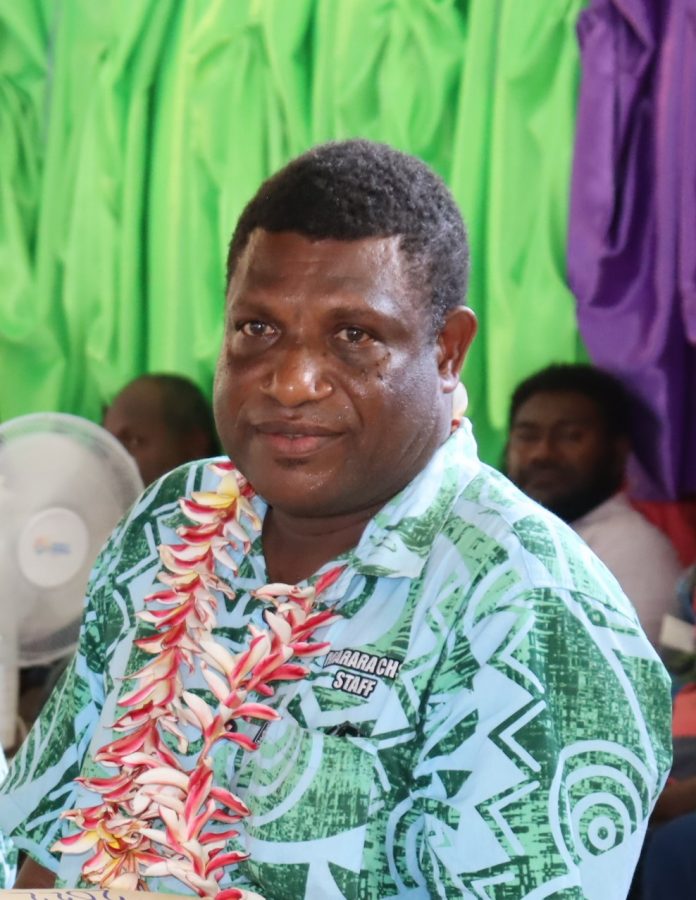
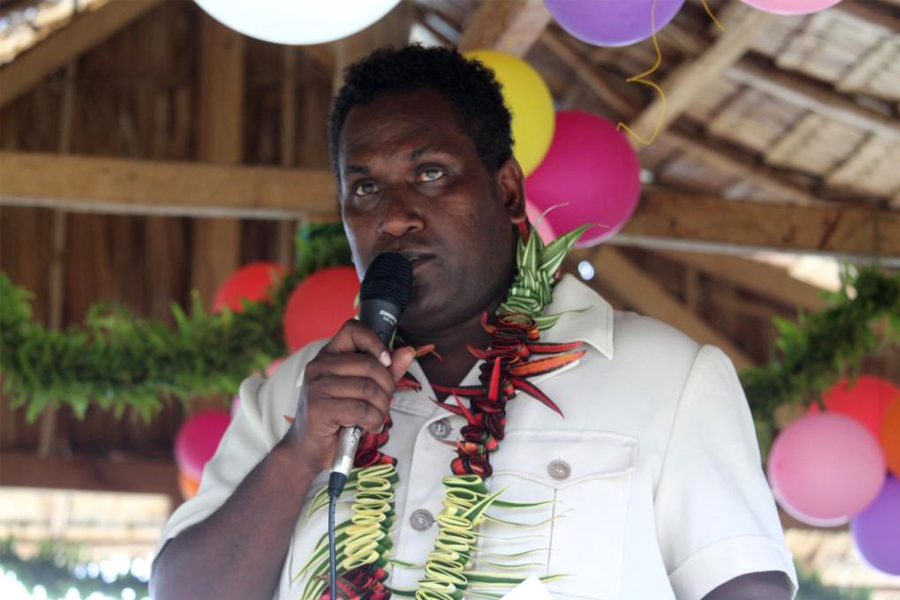
Minister of Foreign Affairs and External Trade, Jeremiah Manele confirmed this during the sine die motion in Parliament.
Mr Manele said this is connected to geo-politics.
“And we need to ensure proper clearance is granted before they enter into our territorial airspace, land and sea.
“This very important to ensure our sovereignty both air, land and sea is respected at all times by any country,” he said.
In August, Solomon Islands put a moratorium on naval ships entering the country after it was late to grant approval to US Coast Guard Cutter (USGC) Oliver Henry and the HMS Spey.
However, the Government denied reports of failing to grant approval, blaming it on delay of paperwork.
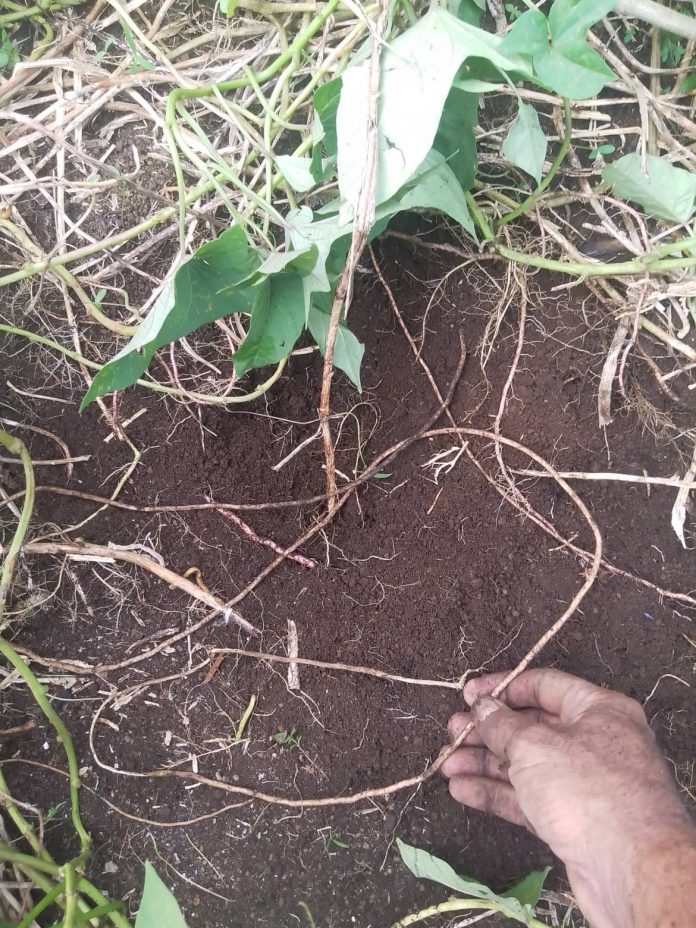
Potato vines nicknamed ‘telephone’ which fail to develop into tubers. Such are common in potato gardens on Bellona nowadays. Credit-Irwin Angiki.
BY IRWIN ANGIKI
Bellona is the typical tropical paradise island. A high-raised limestone atoll draped in lush green, sitting on the blue ocean and usually described as an island “where milk and honey flow”.
But, little is known that this serenity hides a calamity brought about by climate change – a fertile phosphate-rich land where food no longer grows well, a losing culture of traditional gardening, a stunned people struggling to come to terms with their changing environment.
Daley Tesuatai, a 50-year-old primary school teacher tilts his head skywards, his glazed eyes lost in the distance as he recalls his youth days.
“Gardens on Bellona just don’t produce food as it did before. I remember in the late 70s, the 80s, I would follow my parents to the garden and just be fascinated by the huge tubers that would break through the mound surface.
“We would dig and remove the soil around them carefully, slowly unearthing the huge sweet potato tuber. I would carry a huge one-and-half foot potato tuber and place them where we piled them. The same for yams. I remember yams more than three feet long.”
Suddenly he has a sad look. “Alas, those memories are painful to recall when what we are facing now on Bellona is completely different,” he laments.
Daley Tesuatai, 50, in his latest garden, cleared and ready for digging. Credit- Irwin Angiki
Over the years, root crop harvests have given yields which are getting smaller in size and number.
No matter how hard one works, the harvest will still be bad.
Mr Tesuatai and others old enough to remember the ‘good days’ (general term for the 70s, 80s and 90s in relation to gardening and harvests) share the same story – everything now is different.
Wilson Taungabea, 77, recalls the early 1970s.
“Bellona filled up the ship MV Kangava in the late 70s until it nearly sank with local food. When it arrived in the capital, Honiara, members of public gathered by the wharf and were amazed at the amount of food brought over from Bellona.
“Sadly, that feat is impossible nowadays,” he laments.
Wilson Taungabea, 77, recounting the good old days of Bellona when harvests were in abundance. Credit- Irwin Angiki.
Bellona is 170km south of Solomon Islands’ capital – Honiara.
Together with Rennell island, the largest raised coral atoll in the world, they form the country’s smallest province – Renbel. The Renbel people are Polynesians. Solomon Islands is predominantly Melanesian.
Bellona is a phosphate-rich island.
Its fertility is famously underscored by Danish geographer, Sofus Christiansen in his book ‘Subsistence on Bellona Island (Mungiki)’ (1975): “The highly fertile core land is the light of the eye of every Bellonese, and proudly demonstrated to any visitor.”
Edible plants and crops grew and yielded in abundance. Crop tubers were gigantic by today’s standards. Food was aplenty; it was said – when one harvests, the whole island eats.
Nowadays, the people on Bellona are questioning where this fertility has gone.
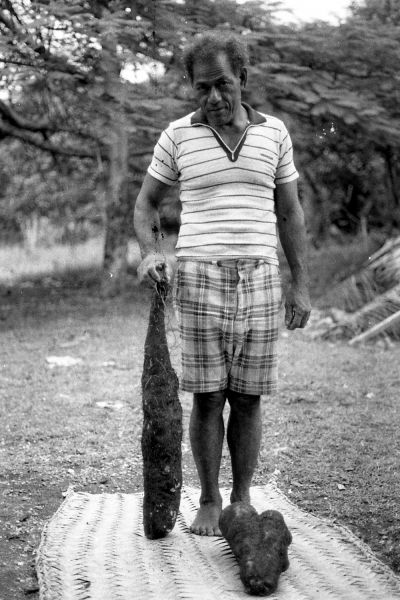
A man stands his yam next to him, 1983. Such sized yams are said to be rare nowadays. Credit- Bellona.dk.
Shocking changes, disappearances and migration
Strange never-before occurrences are unfolding in Bellona, which their ancestors never dreamt could ever happen there.
Local foods such as dry coconut, pana, yam, cassava, fish and even water are being brought over from Honiara to feed people on the island.
Bellona’s bats have also disappeared. Locals believe it could be connected to the phenomena that fruit trees on Bellona are no longer bearing fruits.
Days are getting hotter. According to Kristian Dalsgaard’s publication, “Soil profiles of Bellona’ (1967), the island’s average day temperature in the 1960s was 25°C. Nowadays, locals say 40°C is a normal day temperature.
June Paieke, 50, says, “Since garden harvests are always bad, relatives in Honiara send over bags of crops to help supplement rice. This is just shockingly new, unbelievable that I would live to see this in my lifetime.
“Foods which we thought were abundant here, are now being sent over from Honiara. Coconut, even though Bellona is completely covered with coconut trees. Fish, even though Bellona is surrounded by a huge clean, unpolluted ocean,” the mother-of-four shakes her head.
Housewife and farmer, June Paieke, says their struggles are exacerbated by climate change. Credit- Irwin Angiki.
Recent invasion and population boom of the coconut rhinoceros beetle is also making matters worse.
Food security woes has been counted as one of the push-factors for Bellona’s population-drain towards Honiara.
Twenty-two-year-old John, who requests only to be called by his first name, is a high school drop-out and left Bellona three years ago to live with relatives and friends in Honiara.
“It is very difficult to live on Bellona when gardens offer very little to no food. So much hard work using up all my energy that I feel like an old man even though I am young. I came to Honiara because here it is easier in terms of food, and I can also find work to survive.”
He is yet to find employment.
The weather puzzle
One of Bellona’s fundamentals to a successful subsistence way of life is the traditional knowledge on weather patterns, handed down hundreds of years.
But, locals are now accepting that traditional knowledge is helpless against climate change.
Prince Sokaika, 61, is well-versed with traditional knowledge on the island’s weather patterns, seasons for planting and harvesting, for sea-faring, fishing and diving.
“Weather nowadays is just all over the place and very confusing, without any set pattern. A difficult puzzle of sorts.
“For nearly two decades, I have observed sporadic disruptions to known weather patterns. At first, they randomly occurred between long intervals of months to years. Now, the disruptions have increased in frequency to the extent that the traditional weather pattern of Bellona is lost.
“Since last year, Bellona has had this weird weather of rain and sun every day. This has disallowed planting, which begins in May. May used to mark the beginning of the dry season, the planting season. We don’t plant in the wet season.
“When you plant during rain, the potato vines rot. Above soil, the potato leaves are green, but underneath, there is no tubers to harvest.”
For communities near the coast in Bellona’s lower western end, who utilise the sea more often, it is a question of striking the right time to take a dive with the spear-gun, or drag out the canoe with the fishing lines.
Sea level rise is not a direct threat due to the island’s topography (high coastal cliffs).
Nevertheless, disappearing sands, higher swells near the shore, waves breaking closer than before, are all well noted.
Tourism operator Greg Baiabe, 54, blames climate change for what they are experiencing.
“With the abnormal weather, everything we know regarding traditional planting and fishing methods along with their seasons are no longer applicable. The sand has disappeared. Vast shorelines which used to be covered with sand have now turned into rocky ones.
“With deep sea fishing, old techniques and knowledge regarding seasons are no longer applicable. Dry seasons are now no longer dry. Rain all the time. Unexplainable weather variations were begun to be noticed around 2010. Weather patterns changed with sudden unexpected rainy seasons, and sudden unexpected sunny seasons.
“We don’t know how to explain these changes, except to just make a blanket-blame on climate change,” Mr Baiabe mused.
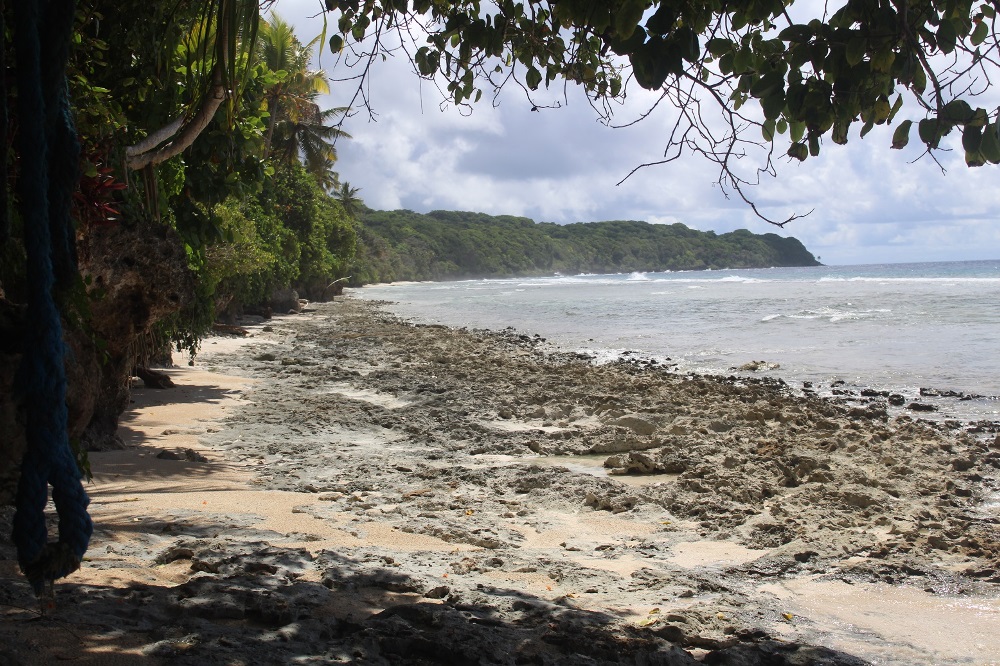
’One Bay on the north side of Bellona has been romanticized in Bellonese songs for its long scenic white sandy beaches and fine waves. Nowadays, the sand has been lost and jagged rocks line the beach. Credit- Kuipa Temenga.
Many abandoning gardening practices
With the hardships faced with bad harvests, more and more people are leaving the practice of gardening and turning to modern, processed foods from the shop.
Rice is replacing potato and yam as Bellona’s staple food. This expensive switch is having a toll on Bellonese – most notably their health and financial capacities.
Several factors are arguably behind this switch, the two common ones being – continuous bad harvests despite more effort thrown towards gardening; or sheer laziness.
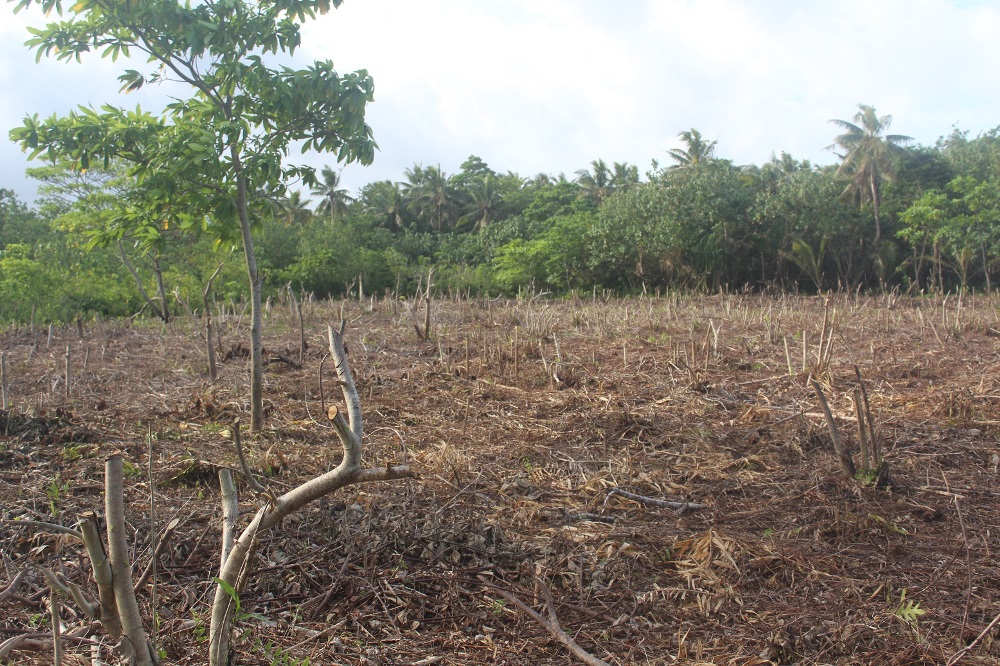
A garden being cleared ready for burning. Credit Kuipa Temenga.
Monty, 54, refuses to garden this year.
“I am taking a sabbatical this year from gardening. Maybe next year I’ll plant again. For now, I am resting and depending on relatives and family for food.
“My whole life on Bellona, I’ve been gardening. Before it was good, with good harvests. Now it is frustrating and discouraging. You give all your energy, time and effort, and harvest only a handful of potatoes (or yams, bananas, etc) in the end. Tangani mamate ai (I might be killing myself over nothing for a lost cause)!”
Meanwhile, Milton Pongi, 66, believes the younger generation have lost interest and knowledge in gardening.
“Young people nowadays are not strong enough, or even interested in gardening. Land is plentiful. Land sharing is still one of our strongly practised cultures, so those who do not own land can ask their close kins for land to garden.
“Before, gardens can be found from the backyard all the way up to the rocks (rocky terraces before coastal cliffs). Nowadays, people just don’t garden. Some who do, only make little ones beside their house.”
An expensive switch
It is estimated only around 300 people live on Bellona, mostly children. The vast majority of Bellonese live in Honiara and overseas.
Most Bellonese live below the average income line. Thus, this switch to rice is proving very costly for them.
Mrs Paieke says it is already a struggle to feed her family, pay for children’s education. Problems brought about by climate change make it worse.
“When our gardens produce very little food, we depend on family members in Honiara to send us food such as rice, etc. We also pay with whatever little we have from the retail canteens here, which sell at exorbitant prices to cover their expenses.”
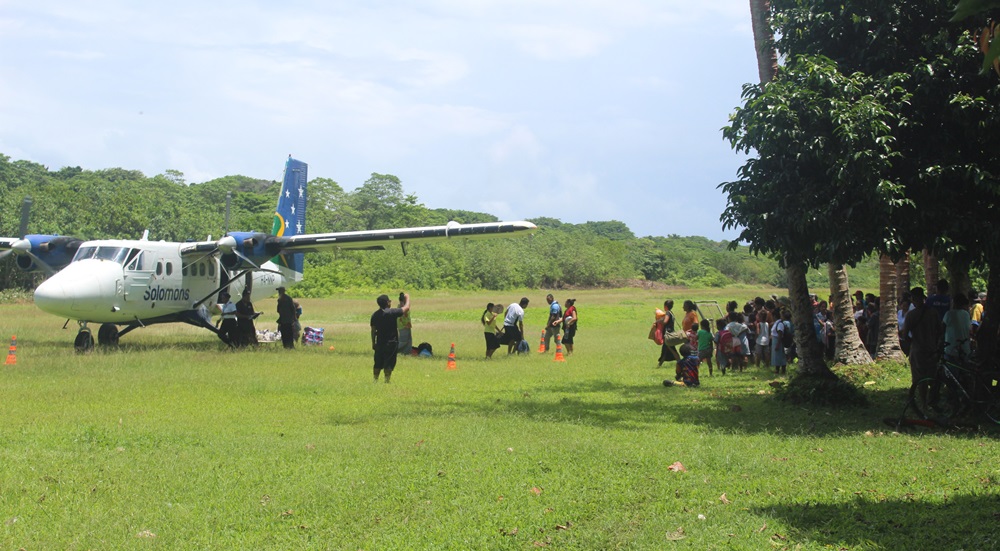
The main transport connecting Bellona and Honiara is the Solomon Airlines’ weekly flights. At a freight rate of SBD$20 per kg, it is burdensome on the wallet of someone sending food to Bellona from Honiara.
Due to poor shipping, the only transport connecting Bellona and Honiara is the two flights per week SolAir service. However, limited space and costly freight charges restrict the amount of food and other items receivable. Credit- Kuipa Temenga.
Rice and non-communicable diseases
Rice is the staple diet on Bellona. Breakfast, lunch and dinner – rice.
In the 90s, potato, due to its ease of planting requirement, became the staple diet. Now, potato supplements rice. Sometimes there is banana, yam, pana and taro.
School teacher, McQueen Tekatoha, 52, explains in the 1980s and 90s rice was treated as a special food and only consumed occasionally.
“Before, rice was only eaten by chiefs and special guests. Families fortunate to own a bag of rice kept it safe for special occasions only. Nowadays, rice is eaten by everyone every day, morning, lunch and evening.
“The dominance of rice in the daily menu began after the year 2000. Slowly at first, eaten once or twice a week. Then, a decade ago, it became almost a daily diet. Now, every meal of the day is rice.”
Newly retired nurse Josephine Angiki, 58, says during her 32 years of service to Bellona, she had noticed the impact of rice (loosely used here to represent modern processed foods from the shop) on people’s health.
The rise of rice consumption correlates with the rise of non-communicable diseases (NCD) on Bellona.
“The switch to rice as main diet has also led to the huge prevalence of Non-Communicable Diseases on Bellona.
“Before, such as the 90s, Bellona would register five or less NCD patients per year. Nowadays, each family has at least one NCD patient on Bellona. More and more young people are now being presented with pre-diabetes conditions.”
Food shortage and poor shipping service
Each year, Bellona has a season marked by low food supply. Christiansen (1975) describes the food shortage period – kangakanga – after gardens have been harvested completely, awaiting new gardens to mature.
Over the years kangakanga has slowly increased in frequency. Locals say kangakanga occurs only once a year, rarely twice, and would last a month or two, depending on when gardens would be ready for harvest.
But, in the last 10 years, kangakanga has taken a remarkable twist to depending on ships.
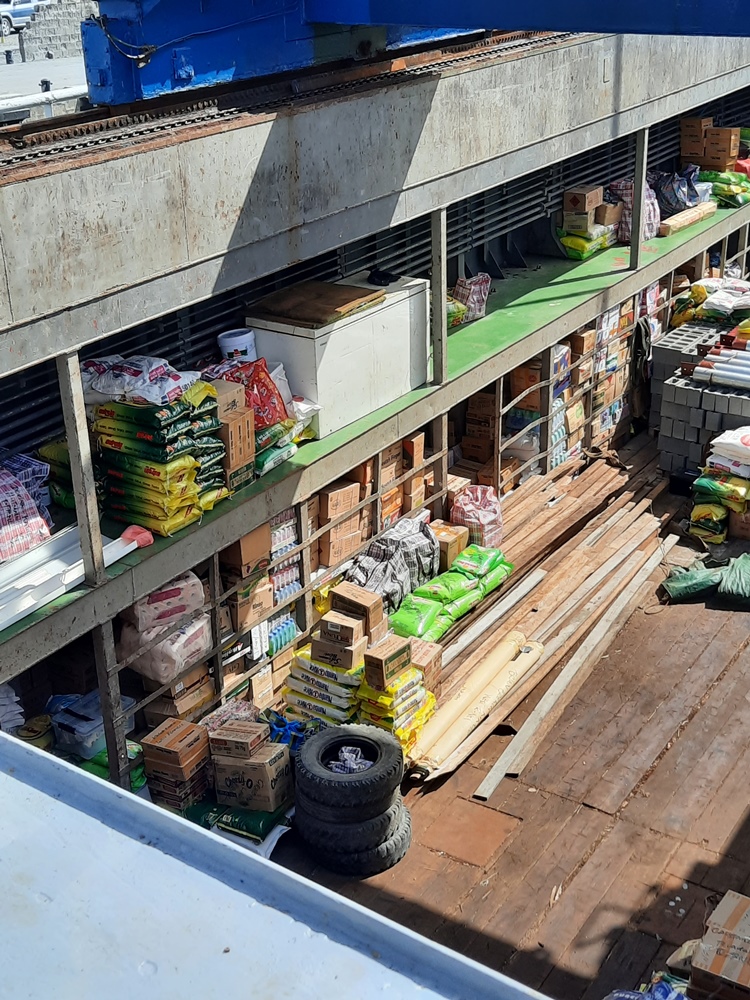
Cheapest means of sending food to Bellona from Honiara is via ship. But, shipping service is very poor. Seen here, early October, the third ship for the year, its cargo-hold heavily laden with food supplies. Credit- Kuipa Temenga.
Single mother Tiare Tamaika, 50, says over the years, each kangakanga has been worse than the last. “This year’s is worse than last year’s.
“Since the garden harvests are always bad nowadays, and a lot of people not gardening anymore, Bellona depends heavily on ships bringing processed and even local food from Honiara. Very expensive way of life.
“Making matters worse, shipping service to Renbel province is very poor. This year only three ships have visited Bellona. This exacerbates the situation in Bellona, with its already bad food security status.”
Solutions going forward for Bellona
All is not lost for Bellona. Few communities and enterprising individuals are piloting ways to adapt to climate change impacts.
Since it is always raining on Bellona, hindering potato growth, some people are switching to banana which grows better in wet weather to complement the staple food – rice.
Pongi Tebai, 43, is promoting the idea of moving away from potato and focus more on the few banana species on Bellona which thrive in wet conditions.
“More than five years of predominantly rainy weather on Bellona is ruining potato for us, so we are focusing on the available banana species which grow well in wet conditions such as the Huti puga [Hopa banana] and several cabbage species which grow fast in wet conditions.
“We cannot change the new weather pattern, so we look at what we can change. Since potato does not grow well in wet conditions, we can no longer rely on potato as our main food crop. We see these banana species as the answer to our food security problem.”
On the political leadership level, Renbel’s member of parliament is silent on this matter, but its provincial government is working towards an ordinance to address climate change.
Premier of Renbel province, Mr Japhet Tuhanuku recognises the seriousness of climate change and its detrimental impacts on Bellona.
“Renbel has no ordinance to address climate change and its impacts on Renbel. However, we are rushing against time to remedy this by pushing towards the formulation of a guiding policy with the ministry of environment (MECDM). From this policy an ordinance could come, be created by 2023.”
A recent UNDP-supported climate change study on Renbel’s capital Tingoa, on Rennell island, is a potential benchmark towards the province’s climate change and food security policy.
Renbel provincial secretary Aubrey Sau’eha says, “This document could be extended and amended to suit Bellona’s context and implemented there.”
The country’s ministry of environment and climate change (MECDM) is also rolling out a major project, Solomon Islands Integrated Vulnerability Assessment (SIIVA), which will be carried out on Bellona most likely in 2023.
Thaddeus Siota, Acting Director of MECDM’s Climate Change Division, says SIIVA will assess Bellona communities holistically, focusing on climate change and non-climate change factors, agriculture, health, education, ecosystem, income security, communication, water and sanitation, etc.
Thaddeus Siota, Acting Director of MECDM’s Climate Change Division, says there is hope for Bellona with government’s SIIVA programme.Credit – Irwin Angiki.
“This will help government accurately address the specific problems each Bellonese community faces.”
Climate change poses a real threat to more than 300 people in Bellona. For now, farmers and villagers like Mr Tesuatai will continue to face the challenges of producing nutritious and enough food while protecting the ecosystems and avoiding crop and food losses.
* Reporting for this story was supported by Internews’ Earth Journalism Network
LONG time investigative journalist who now a leading trainer at Aarhus Institute of Constructive in Denmark says constructive journalism is a new journalism concept that adds value to traditional journalism.
Orla Borg says Constructive Journalism focus on two questions “now what and to give readers the best obtainable version of the truth”.
Fellows listening to Orla’s presentation
He explains that Constructive journalism is not to replace traditional journalism.
“Journalists must still go on doing straight forward news stories that tell what has happened and how something has went wrong. They must also continuously go on doing investigative stories exposing why something has gone wrong and who holds the responsibility.
“But instead of stopping there and leaving the problems to somebody else – and go hunting for new problems – constructive journalism takes the matter one step further and ask the question, “now what?”.
“In other words, now that people know about the problem, what can we do as a society to address the problem? Has anybody got any suggestion to find a solution? If so, is there any documentation at all that the proposed solution would work?” Borg says.
“Constructive Journalism aims to play an active role in societal debate led by journalists on issues that matters to citizens,” he adds.
Fellows at one of their morning meetings
Borg highlights that Constructive Journalism strives to give nuanced picture of reality without overdoing the focus on all the things that don’t work, the conflict, the negativity and stuffs that create unnecessary fear in society.
“It balanced journalism exposing problems and wrongdoings but also reporting on progress, possibilities and hope when opportunities are there.
“It is not activism and certainly not politics. It is rigorous journalism aimed to be critical, fair, balanced and striving to be objective.
“Constructive Journalism takes the role of journalism in democracy seriously and is based on the idea that journalism is a feedback mechanism to help society self-correct,” he says.
Borg says Constructive Journalism operates under three important pillars and they are the angle, the view and the role.
“The angle focuses on exposing problems but also look for possible solution. The view is strive for the best obtainable version of the truth or see the world in both eyes. The role focuses on the role of journalists to engage and facilitate debates, including people in the communities.
“Constructive Journalism is all about tomorrow, inspiration, curious, facilitator, solutions oriented and best practices on “what now and how”, he says.
Founder and CEO of the Constructive Institute, Ulrik Haagerup shares similar sentiment saying that Constructive journalism is a response to increasing tabloidization, sensationalism and negativity bias of the news media today.
Ulrik Haagerup speaking at the symposium
He says constructive journalism takes journalism’s democratic function seriously, building on the idea that journalism is a feedback mechanism that helps society self-correct.
“Constructive journalism is balanced reporting on both good and the bad in society.
“It is not activism or advocacy and will never attempt to define the best solution to a problem
“It is an approach that aims to provide audiences with a fair, accurate and contextualized picture of the world, without overemphasizing the negative and what is going wrong.
“In other words, Constructive journalism tries to build a platform for better dialog between citizens and the media industry,” Haagerup explains.
Mr Ulrik speaking to business houses and stakeholders on the importance of Constructive Journalism
Constructive Journalism Institute provides fellowship program to interested journalists in Europe and are now expanding its reach to other parts of the world including Africa.
The fellows spend time at the institute researching potential solutions on numbers of issues.
One of the fellow, Jesper Himmelstrup says constructive journalism is a stepping stone to develop ideas that help journalists realized their purpose and role in society.
Himmelstrup made a huge achievement during Denmark’s 2022 election establishing a strategy that enable youths to interact with politician.
Himmelstrup is a veteran journalist and is teaching journalism in one of the institution in Aarhus, Denmark.
Another fellow, Kati Laukkanen says constructive journalism is a new journalism concept with absolute power to change how people looks at news.
She adds that constructive journalism helps her to pursue in-depth understanding when approaching issues.
Laukkanen is a winning documentary journalist from Finland.
Principal of Marara Community High School James Mepobu has highlighted the need for review of the current grade 6 form one entrance assessment process.
Mepobu said teachers in the secondary sector are seeing that students are not well taught and assessed.
He said most of the fundamental concepts are not well taught as apparent in their contribution in the secondary sector.
Mepobu appealed to the Minister of Education and Human Resource Development (MEHRD) to consider reviewing the process of implementing the assessment and the assessment elements used.
“The current grade 6 form one entrance assessment process needs to be reviewed.
“Teachers in the secondary sector see that students are not well taught and assessed.
“Most of the fundamental concepts are not well taught as apparent in their contribution in the secondary sector.
“May I appeal to the honorable minister of Education to consider reviewing the process of implementing the assessments and the assessment elements used,” Mepobu said.
THE Hapi Isles Health Foundation (HIHF) is looking at constructing a café at the National Referral Hospital (NRH).
Member of the foundation, Doreen Kuper, stated this on December 22 at the handing over of a children’s playground they built for the NRH’s children’s ward.
“We are going to build a café at this hospital for the patients, visitors and staff. All of you who have visited the hospital know how we need a café,” Kuper said.
“I know the National Referral Hospital will support the Hapi Isles Health Foundation (HIHF) on this new project,” she added.
She said HIHF was formed in 2016.
Their first project for the NRH was the children’s playground.
It was handed over to NRH’s supervising Chief Executive Officer Dr Rooney Jagily
Jagily said the handing over was timely and they see it as “a Christmas gift to our sick children”.
“It will be a long-lasting Christmas gift that will be enjoyed by many more children for years to come.
“I want to assure the HIHF that we especially the children’s ward staff will take care of the place and its upkeep as well as developing guidelines for the supervision and safe use of this facility for our children,” he said.
Minister of Foreign Affairs and External Trade Jeremiah Manele
By EDDIE OSIFELO
SOLOMON Islands is looking to review her air service agreements with some countries in the Pacific next year.
Ministry of Foreign Affairs and External Trade (MFAET) will work in collaboration with Ministry of Communication and Aviation to carry out the reviews.
Speaking at the sine die motion in Parliament last week, Minister of MFAET, Jeremiah Manele said they are looking at reviewing air service agreements with Papua New Guinea, Fiji and New Zealand.
He said their aim is to ensure that the service agreements with these countries are reciprocal, fair and one the country benefits from.
Apart from that, Manele said on visa waiver arrangement, the reciprocal visa arrangement Solomon Islands has with Peoples Republic of China will come into effect this month.
He said the bio-security arrangement to allow more products to enter the Chinese market is being worked on by Ministry of Agriculture and Livestock and Ministry of Fisheries and Marine Resources.
“I am confident this work will come to a conclusion soon so that our private sectors or businesses can export their products to Chinese markets,” he said.
Furthermore, Manele said his ministry in collaboration with Ministry of Commerce, Industry, Labour and Immigration, has been working hard to establish reciprocal visa waiver arrangement with other countries.
Further to that, he said this year, the MFAET has achieved and implemented visa waiver arrangements with India, Morocco and PRC.
Manele said this means Solomon Islands citizens with diplomatic and official passports can travel to those countries without having to apply for visas.
ALL schools throughout the country are expected to resume classes by January 23, 2023.
This is according to the approved school calendar 2023 released by the Ministry of Education and Human Resource Development (MEHRD) recently.
MEHRD says that 2023 school calendar will only run for three terms ending on Friday, October 27, 2023.
This is to make way for the 2023 Pacific Games that will begin on November 19 until December 2, 2023.
“As schools look forward to having their end of year holidays, be informed that 2023 school academic year starts on the 23rd of January.
“More importantly, the 2023 school calendar will only run for 3 terms ending on Friday 27th October 2023 as the Pacific Games 2023 will begin on 19th November untill 2nd December 2023.” the statement from MEHRD says.
According to the 2023 calendar schools term one will run for 13 weeks, beginning on Monday 23 January and ended on Friday 21 April 2023.
Term two will also run for another 13 weeks beginning on Monday 1st May 2023 and ended on Friday 28 July 2023.
Then there will be a four-week break for term two beginning on Monday 31 July and ends on Friday 25 August 2023.
Term three will run for only nine weeks beginning on Monday 28 August, 2023 to Friday 27 October, 2023.
Term three break will run for 11 weeks beginning on Monday 30th October, 2023 to Friday 12 January, 2024.
MINISTRY of Foreign Affairs and External Trade (MFAET) and Ministry of Police, National Security and Correctional Services, will continue to pursue the clearance of Unexplored Ordnances (UXO) with USA and Japan.
Minister of MFAET, Jeremiah Manele confirmed this during his contribution in the sine die motion in Parliament last week.
He said they will also seek their support to clear the oil spills from War War II sunken vessels.
Manele said formal outreach to Japan and USA to clear these leakages are being pursued and they will continue to follow up to ensure they clear their mess.
However, in good news, the US Embassy in Port Moresby released a stated-on December 21, 2022, the Department of State provided USD$1 million to The HALO Trust (HALO) to launch a comprehensive unexploded ordnance (UXO) project in Solomon Islands beginning January 1, 2023.
This project will address UXO priorities and enhance explosive ordnance disposal (EOD) capacity with the Ministry of National Police and the Royal Solomon Islands Police Force (RSIPF).
This project is part of President Biden’s announcement at the United States-Pacific Island Country Summit, where UXO priorities were one of nine U.S. commitments to implement the Declaration on US-Pacific Partnership.
The United States is a Pacific nation—geographically, economically, historically, and culturally—and remains invested in supporting a prosperous Pacific.
In Solomon Islands, the United States has provided more than $6.8 million since 2011 to establish a national capacity with the RSIPF to identify and destroy explosive remnants of war.
This included training 13 engineers who have conducted more than 1,200 explosive ordnance callouts and destroyed more than 29,746 items of UXO.
The United States’ work over the past decade to remediate explosive hazards is foundational for a prosperous Solomon Islands and continues to advance humanitarian and development priorities on land free of UXO.
HALO will advance shared United States-Solomon Islands priorities. With funding from the United States, HALO will locate and mark World War II legacy UXO while providing essential training and capacity building to the RSIPF EOD unit. This includes using existing data and historical records as well as conducting search activities to update the national UXO database, which will inform future explosive ordnance risk education and explosive hazard responses to UXO contamination by the Royal Solomon Islands Police Force EOD unit. U.S. funding will also provide technical advice while assisting the Ministry of National Police to establish a UXO coordination office.
The United States, through its Conventional Weapons Destruction program, has funded work in the Pacific since 2009.
Since 1993, the United States has invested more than $4.7 billion for the safe clearance of landmines and explosive weapons of war as well as the securing and safe disposal of excess small arms and light weapons and munitions in more than 100 countries and territories. The United States is the world’s single largest financial supporter of conventional weapons destruction.
LOBBYING for the Western Provincial Executive has reached both sides claiming 13 members each.
Western province has a total of 26 wards meaning both camps are tightening their grip to hold on to their existing numbers.
However, a report alleges that one of the camps are expecting another three leaders to join their side.
This will bring the number of one of the camps to 16 – an absolute majority and likely they will move to establish the executive government if the report is true.
“It is still game-on at the moment. There is no clear indication which camp has the number and when will one of the camps pull the last string and get the number.
“It seems to me that the winning camp will be determined in the next two to three days,” an insider told Island Sun Gizo yesterday.
This paper understands that there are two camps that have been identified and are now tough on lobbying to form the new executive.
Earlier last week, one of the elected leaders said cheap and greedy politics is not good for Western province and its people.
Freedom Tozaka stressed that the only for Western Province to move forward is for elected leaders to compromise and form a strong government to serve the people.
On Monday December 26, Speaker Adrian Gina shared similar sentiment saying that Western province needs a stable and strong government to drive the province going forward.
“Divided and we will be still in the losing side of our development aspirations,” he said.
Provincial Assembly Hon Speaker Adrian Sinabule Gina
BY BEN BILUA
SPEAKER of Western Province says he will not contest the Speaker’s position.
Adrian S Gina made the announcement before elected Provincial Members during a brief meeting on December 26.
“To clear all doubts, I will not be contesting the Speaker’s Position. Reason is because I have other commitments and other matters I wants to pursue,” he says.
Island Sun understands that the date for the nomination of Speaker’s position has been rescheduled from Monday December 26 to Wednesday December 28 due to the special gazette order which recognize Monday December 26 as a public holiday.
“Under Section 11 of the Western Province’s Standing Orders, we cannot kick off nomination because it’s a public holiday.
“The Clerk and Assembly Office have determined that nomination will begin on Wednesday and election of Speaker will proceeds on Friday.
“This is to comply with section 11,” Gina says.
Gina also explains that the date to elect the Premier will also be rescheduled due to changes on the election of the Speaker.
“It will be still next week,” he said.
“As soon as Speaker is elected, the Speaker will use his power under Section 60 of the Standing Order to give a seven days’ notice for an Assembly meeting to appoint members of the Provincial Public Accounts Committee.
“This is important because of the urgency to table the 2022/2023 revised budget, Gina adds.
He calls on MPAs to collect the nomination forms at the Clerk’s office and submit their candidates for the Speaker’s position.
As per Western Province’s Standing Order, nomination of Speaker will close two (2) days after the Clerk’s announcement (s10).
Section (12) provides that the Speaker must be a registered voter, ordinary resident in a ward of the Province and not a member of the Assembly or the National Parliament.
Section (13) provides that nominations must be in writing, signed by two members and personally delivered to the Clerk during the nomination period.
Section (14) provides that the candidate shall sign the nomination form to indicate acceptance of the nomination.
And, section (15) provides that no member may nominate more than one candidate in any election for the Speaker or Deputy Speaker.
Section (16-40) stipulates the proceedings during and after the election of the Speaker’s position.