Home Blog Page 635

UNIONS TO MEET ON MPs PAY RISE

0

By EDDIE OSIFELO

MEMBERS of the Solomon Islands Council of Trade Union (SICTU) will meet tomorrow, to discuss the proposed 10 percent salary increase for MPs this year.

A SICTU executive Tony Kagovai confirmed the meeting following the proposal by the Parliamentary Entitlement Commission (PEC) to give a $13,000 pay rise to each MP this year.

Kagovai said members to attend the meeting include: Workers Union of Solomon Islands, Solomon Islands Public Employees Union, Solomon Islands Teachers Association, Solomon Islands National University, Solomon Islands Medical Association, Solomon Islnads Paramedics and Solomon Islands Nurses Association.

He said the meeting is scheduled for 12 noon at WUSI office.

The PEC proposal will see the Prime Minister Manasseh Sogavare awarded an extra $30,000, on top of his annual salary.

This will give the PM a new annual salary of $338.000.01 from the $307,919.30.

The current base salary of the Prime Minister is $11,843.05 per fortnight, multiplies by 26 paydays, equals to $307,919.30 for his annual salary.

Furthermore, the Deputy Prime Minister’s new annual salary will be $304,872.67.

Ministers, Leader of Opposition and Leader of Independent Group will get $266,123.00.

The Deputy Speaker, Chairperson of Parliamentary Caucus, Chairpersons of Parliamentary Standing Committees to get $241,166.24 and the members to get $218,231.60.

Other benefits include:

  1. meal allowance that increases from $200 to $500;
  2. education allowance increases from $10,000 to $25,000;
  3. appointment grant increase from $10,000 to $15,000;
  4. Clothing allowance (to be differed from outfit) none, with Members to get USD$3000 (SBD24,000) while PM, DPM, Ministers and Leaders to get USD$7000 (SBD$56,000).

The PEC invites MPs and beneficiaries to attend a consultation meeting on 15th February 2023 at their conference room at AJ City Mall Room 42.

The Commission is currently in the process of reviewing the Members of Parliament Entitlement Regulation.

Already, the proposal has been heavily criticised by members of the public.

Opposition Leader Mathew Wale says it is an ‘unwise and insensitive’ proposal given that the country’s economy is in recession, public servants have not had any pay increases for 3 years, nor have private sector employees.

Wale adds the 2023 budget has the largest deficit in history to be financed by borrowing.

He said with an economy in recession, these proposed increases are unjustified.

“Ordinary Solomon Islanders are struggling with just putting food on the table and such increases to MPs are divorced from the economic realities faced by Solomon Islanders,” he said.

Wale said public servants especially nurses, teachers and our police should be the ones considered for a pay rise.

Senior Opposition figure and East Are’Are MP Peter Kenilorea Jnr, in a Facebook post, described the proposal as “self-serving”.

He accused the Government of delaying the national elections scheduled for this year so that it could reward parliamentarians with tax payers funds.

“You deny the people’s right to vote by delaying their vote,” Kenilorea wrote in his post in reference to the Government.

“These rights are fundamental to our democracy and good governance. And yet you deny these rights of the very same people who put you in power – through a vote.

“This effectively extends your time in parliament.

“After you bulldozed this highly questionable constitutional amendment in parliament to deny the vote, you then collude with relevant authorities to concoct a scheme to enrich yourselves, as parliamentarians, from public funds – funds that many of our people contribute towards through their tax contributions and hard work.

“I am embarrassed to be an MP in the 11th parliament.

“But this is more than embarrassing. It is self-serving to say the least.

“You will argue that this was done under the laws of the land.

“But I say your actions have nefarious (evil or immoral) intentions.”

Kenilorea said the unjustified proposal must be rejected by all MPs.

Calls for security for Central, Kukum markets

0
City Clerk Justus Denni

BY NED GAGAHE

Honiara City Council (HCC) has called on interested firms that they are currently accepting applications from security firms to provide 24 hours security service to its Central and Kukum Market.

City Clerk Justus Denni confirmed this to the Island Sun in an interview on Thursday, January 5, 2023.

Denni said that HCC is looking at outsourcing the security of Central Market and newly upgraded Kukum Market.

“We have already put up a notice about this, the due date is on 20January 2023,” he said.

Denni said hopefully by February 2023 a private security will now take responsibility to man the Central and Kukum Market.

He said the private security firm will be assisted by the Law Enforcement officers of HCC.

Denni said such measures are necessary to maintain security and safety for vendors and city residents using the markets.

According to the statement HCC invites sealed bids from reputable Security Firms to tender for the provision of 24 hours security service to its Central and Kukum Market.

“Terms of References (TOR) can be collected at the HCC Cashier, Monday – Friday from 9 am to 4:30 pm with payment of non-refundable tender fee of $250.00.

“Completed bid documents must be submitted in an envelope, sealed and marked “Provision for Security Service Tender 01/2023” and addressed to City Clerk

“All submission must not reach the address not later than 20 January 2023 at 4:00 pm.” The statement said.

Meanwhile, HCC Market Manager Nelson Sakui has revealed this to local Journalists at the opening of Kukum Market on Friday 3 December 2022.

He said HCC wants to see Kukum market to be the role model market for Honiara City.

Ahetaha Water Conservation gives WASH Bottleneck Analysis training

0
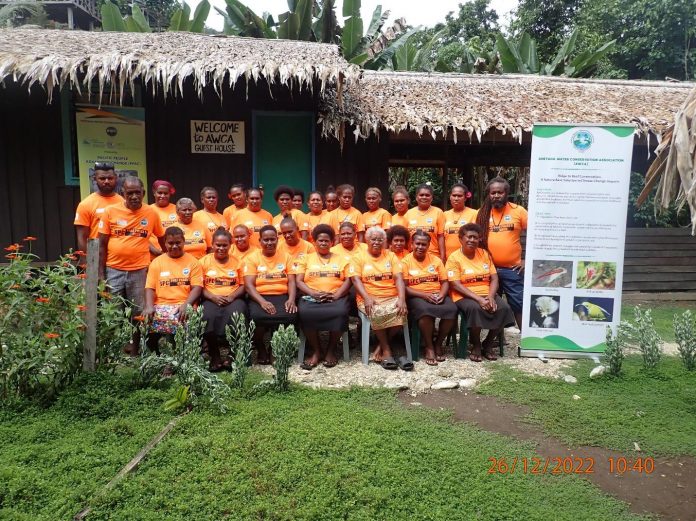
Group photo on the first day at the AWCA training center at Ahetaha Conservation Village.

BY SAMIE WAIKORI

AHETAHA Water Conservation Association (AWCA) has successfully completed a two-day training on Village and Community WASH Bottleneck Analysis Manual for 12 communities in East Are Are.

The training happened at Ahetaha conservation village from December 26-27, 2022 at Manawai and about 27 participants (representatives) from Foulofo, Waima’aka, Kanata, Moosi, Su’u, Manawai, Ahetaha, Raeao, Nariaoa, Anopo’u, Airoke and Aarahau communities attended training. 

The objective of the project or campaign is to train rural communities particularly women and girls to proactively implement WASH Bottle Neck Analysis (BNA) in eight selected villages and to raise awareness on the barriers and WASH BNA for Ahetaha community members residing around Manawai Harbour.

According to Eddie Hikau Huitarau, ACWA founder and mentor, the training was part of a project funded by SPC through PPAC and ACWA as grantee to seek and address burden of having BottleNeck (BN) and barriers with basic WASH facilities in the rural villages of Solomon Islands.

Thus, he said the project seeks to empower rural women to gain skills and knowledge to enable them to carryout BNA baseline findings around four communities in the area.

Adding that this is to identify data to support WASH Project proposal application in order to reduce family poor hygiene and other family WASH needs in the communities. 

With regards to the project, he said AWCA identifies there were women who can take the lead and the initiative to bring about change in their own communities.

“With the right direction and motivation, these women themselves can bring about the changes that we wish to see in the households and eventually the community,” Huitarau said.

He said this WASH BNA has five main components and for the purpose of this project activity it is referred to as “Standards”.

Standard 1 is the village WASH management – this means that each village will have a system for managing WASH development and maintenance

Standard 2 is the sanitation – the sanitation should be seen as; sufficient, accessible, private, clean, secure and culturally have appropriate toilets provided for all women and girls.

Standard 3 is the water supply – sufficient water is available at all times for drinking, food preparation, personal hygiene, cleaning and laundry, and is safe for the purpose intended.

Standard 4 is the water facilities & access – sufficient water collection points and water use facilities are available in the community to allow convenient access to, and use of water for drinking, food preparation, personal hygiene, cleaning and laundry.

Standard 5 is the correct use and maintenance of water supply and sanitation facilities.

Huitarau said this is to ensure through sustained hygiene promotion. And communities of Aiaisi ward 19 should see and use WASH facilities as resources for improved hygiene behaviours.

He said each standards have its own indicators with three rating colours; red-which means barava nogud, orange-means lelebet gud and green-means barava gud and this shows that it meets healthy and national WASH standards.

Huitarau said the project or campaign is well aligned with the key message “Promoting rural women and girls to take lead in WASH BNA survey in Aiaisi ward 19”.

He said the WASH BNA training manual was designed by AWCA.

“We are at least trying to give to ward 19 and East Are’Are Constituency in whatever resources that is available to us.

“Thus, let’s identify the issues and the needs of EAC and rank them into priorities with evidence to convince potential funder,” Huitarau said. 

He said the training was facilitated by himself with other local facilitators include Clifton To’otalau, James Singi and Peter Kenieroa.

Huitarau also said other supporting topics covered during the training included;

  1. Good Leadership and Governance.
  2. Developing good mindset, and how to conduct a meeting that really works at the community.

He said under this manual training will provide a summary of WASH BNA baseline findings for communities in Ward 19 AIAISI.

Huitarau said the key target audience for this report are community leadership of AIAISI ward, Aiaisi Ward Development Committee (WDC), East Are’Are Constituency office and AWCA for reporting and project proposal purposes.

He said copy of the report is to be shared with the leadership of communities taken part in the survey.

HCC GETS TOUGH

0

Unauthorised contract awarding will be stopped, says city clerk

BY NED GAGAHE

HONIARA City Clerk Justus Denni says effective as of January 4, 2023 Honiara City Council (HCC) is taking a tough stance on procurement and awarding of contracts for small works done for HCC.

In an interview with the Island Sun yesterday, Denni said in the past procurement and issuing of contracts were done without approval or authorisation before work is carried out, goods are delivered or service is provided.

These works include brushings, tree felling and clearance, building repairs, vehicle repairs and maintenance, printing of HCC documents and receipt books, supply of uniforms, supply of office equipment, supply of stationeries, supply of cleaning detergents and toiletries, supply of toners and provision of security service.

Denni said such practice has to be stopped.

He further said that the current administration has seen the importance of accountability and having proper management of how these processes were done.

Denni also confirmed that most of the small contracts providing these services for HCC have already expired at the end of 2022 with only few still have valid contracts to continue this year.

He further added that effective as of January 4, 2023 no procurement and contract for small works will be recognized and honored unless prior approval is obtained from or is duly authorized by the City Clerk.

He said the office of the City Clerk will not authorize payment for any procurement or contract which does not get prior approval or authorization before work is carried out, goods are delivered or service is provided.

Meanwhile, on Wednesday January 4, 2023 HCC also issued a statement. The statement was directed to government ministries, state owned enterprise, private sector entities, organisations and individuals.

“This restriction order applies to and includes procurements and contracts for brushings, tree felling and clearance, building repairs, vehicle repairs and maintenance, printing of HCC documents and receipt books, supply of uniforms, supply of office equipment, supply of stationeries, supply of cleaning detergents and toiletries, supply of toners and provision of security service,” the statement says.

WPG under tight schedule

0

BY BEN BILUA

WESTERN Provincial Assembly and Administration are working around the clock to ‘stabilise’ the province’s yearly requirements.

In an interview with Island Sun, Speaker of Western Province Ramrakha Talasasa said his office is trying its best to achieve numerous requirements in a very short time.

“Right now we are trying to get the province’s business back in track.

“We expect to elect our new Premier this Friday and we are expecting a new executive next week.

“If the executive is established, we will then appoint the Provincial Public Accounts Committee (PPAC) to look at the supplementary budget 2022/2023 as well as the 2023/2024 Appropriation Ordinance (2023/2024 budget.

“To be frank, there is no time to make good preparation,” he said.

Talasasa said his office and the Province Admin have established a timeline to achieve all that are required.

He said one of the immediate requirements is to appoint PPAC members as soon as the new government is established.

“PPAC is an important component under the provincial government processes as such we are eying to elect the members soon as the new government is formed.

“By the look of things, there will be two more assembly meetings before the supplementary budget and appropriation budget are tabled.

“We will meet to appoint the PPAC then another meeting will be held to appoint the deputy speaker.

“There is no breathing space for the assembly from now until March,” he explained.

He said the Ministry of Provincial Government is to blame for the disarray that has put Western Province in an awkward position.

Warning as Copen drug increases in potency

0
Copen Drug. Photo Supplied.Photo By SOLOMON TIMES ONLINE.

BY IRWIN ANGIKI

Copen drug is evolving and becoming more potent, a Borderline resident warns.

Kwaso, the illegal home-made liquor, is reportedly the latest ingredient in the production of Copen.

This poses greater risks for Copen users and their communities.

The East Honiara Borderline resident, who requests anonymity, says kwaso replaces water when making Copen to provide a ‘stronger kick to that high feeling users get when taking Copen’.

The resident also warns that authorities need to act fast because the Copen business is highly lucrative with a huge turnover, and that more and more people are becoming users.

“Copen profit is just too much to resist. You spend say $100 for ingredients and production, and end up earning $600.

“Producers spend $100 and cook Copen, produce 120 packets, sell each for $5. This process can be repeated four to five times per day because of the high demand.

“A normal sales day rakes in thousands of dollars for producers and salesmen and women.

“Users range from children as young as five, to primary and secondary students, unemployed boys, girls, men and women, employed men and women, non-smokers and smokers.

“Marijuana sellers are switching to selling Copen, even marijuana users are switching to Copen.”

People have reportedly become ill from Copen, with stories of Copen being implicated in the death of some people, the resident says.

“In our neighbourhood of the huge Borderline settlement, people have become ill from Copen. Mid last year a group of men and women came and chased the producer who is my neighbour, demanding compensation because their kid had fallen ill after taking Copen purchased from him.

“I hear several stories of some people having died, one who was reported to be drunk and took Copen and it was believed she accidentally swallowed it,” the resident said.

Students are reportedly losing the interest to go to school, or are doing poorly at school in relation to Copen usage, the resident adds.

“Most of the users in my neighbourhood are young girls, teens, followed by young students. More and more of these children are not going to school, preferring to hang out with their peers and get high on scoop [street name of Copen].

“My neighbour is having a hard time with her two young children, having to force them every day to go to school.”

Last year Island Sun reported the extent of Copen in the country with incidence reported from Choiseul and Western province in the west to Temotu province in the east.

It is reportedly prevalent in Honiara, Renbel province and Wagina, Choiseul province.

Copen is still to be recognised and defined by law as a drug or as an illegal one. This remains to be an obstacle to law enforcement against the substance.

Drug and Alcohol unit of Community policing could not be reached yesterday for comments, however, an officer told Island Sun in November last year that because the law does not recognise Copen, police cannot do much against it.

“There is a lot needed to be done on Copen such as research, laboratory studies and investigation, and as for now, we can only do limited awareness on Copen to schools and communities we visit,” the officer said.

Initially, the Copen problem was left to parents and communities to tackle.

But, on December 5 last year, minister for Health Dr Culwick Togamana took a new turn on the campaign against Copen by revealing that it has caught his ministry’s attention.

He said the Health ministry will take Copen head-on with a to-do list which includes: sending samples overseas for testing, upgrading the lab here to enable Copen testing to be carried out locally, working with police against Copen, put together a communication plan against Copen, work with the Education ministry to carry out a survey nationwide to gauge the effects and impacts of Copen.

Copen is made using household items and tobacco leaves. Its ingredients are readily accessible in the country, which is seen as a factor to its huge prevalence.

NEW YEAR PRESENT?

0

PM to get extra $30k in PEC new proposal

By EDDIE OSIFELO

PRIME MINISTER Manasseh Sogavare is awarded an extra $30,000 or 10 percent, on top of his annual salary, in the Parliamentary Entitlements Commission (PEC) proposal for 2023.

This is after a $13,000 increase is awarded to the fortnight salaries of all 50 members of Parliament.

This will give PM a new annual salary of $338.000.01.

Initially, the PM’s annual salary was $307,919.30.

This was revealed in the proposal leaked by the Opposition Group on social media yesterday.

Lyall Patovaki, in the Payroll Section in the Ministry of Finance and Treasury, justified the increase by giving an example of the Prime Minister’s annual salary.

Patovaki explains that the current base salary of the Prime Minister is $11,843.05, multiplies by 26 paydays, equals to $307,919.30 for his annual salary.

The ten percent increase from his annual salary is $30,080.71.

As such, the PM’s annual salary of $307,919.30 plus the $30,080.71, results in his new annual salary of $338.000.01.

Furthermore, the Deputy Prime Minister new annual salary is $304,872.67.

The Ministers, Leader of Opposition and Leader of Independent Group to get $266,123.00.

The Deputy Speaker, Chairperson of Parliamentary Caucus, Chairpersons of Parliamentary Standing Committees to get $241,166.24 and the members to get $218,231.60.

Other benefits include:

  1. meal allowance that increases from $200 to $500;
  2. education allowance increases from $10,000 to $25,000;
  3. appointment grant increase from $10,000 to $15,000;
  4. Clothing allowance (to be differed from outfit) none, with Members to get USD$3000 while PM, DPM, Ministers and Leaders to get USD$7000.

The PEC invites MPs and beneficiaries to attend a consultation meeting on 15th February 2023 at their conference room at AJ City Mall Room 42.

The Commission is currently in the process of reviewing the Members of Parliament Entitlement Regulation.

Already, the proposed increase has attracted a lot of criticism from members of the public and Unions.

Why COVID was costly

0
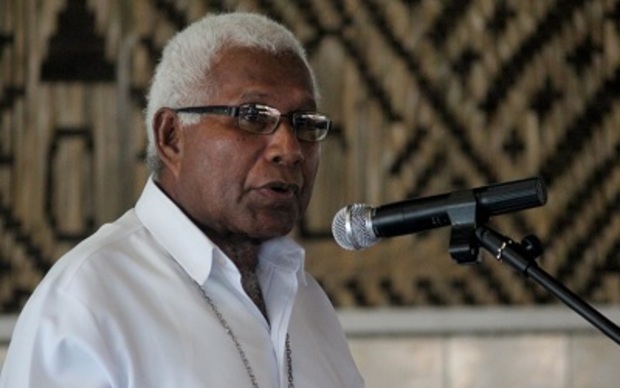
Governor General Sir David Vunagi

By EDDIE OSIFELO

GOVERNOR General Sir David Vunagi believes the impact of COVID19, was exacerbated by the country’s lack of proper management, for its natural resources.

Sir Vunagi stressed this when he delivered his New Year’s speech to the nation on the 1st of January 2023.

He said the country loses money in the millions, when raw materials like mineral ores, logs and fish are exported direct to overseas markets.

“Mining and logging industries should be governed by well documented set of compliances that the national government, provincial government, resource owners and the company concerned must comply with.

“Failing that only the Logging or Mining Company benefits from the operation while all the other three parties are only regarded as incidental beneficiaries who do not seem to have legal rights to anything from the operation,” he said.

Sir David said this is especially true for the resource owners.

“I think the country should have a stable economy and unemployment should be reduced greatly if all raw materials are processed in the country. 

“The dilemma of exporting raw materials to overseas markets cost the country both money and job opportunities,” he said.

Sir David said the Provincial Governments and Resource owners should be encouraged to engage in processing of raw materials in their own areas.

COVID has huge impact on nation

0
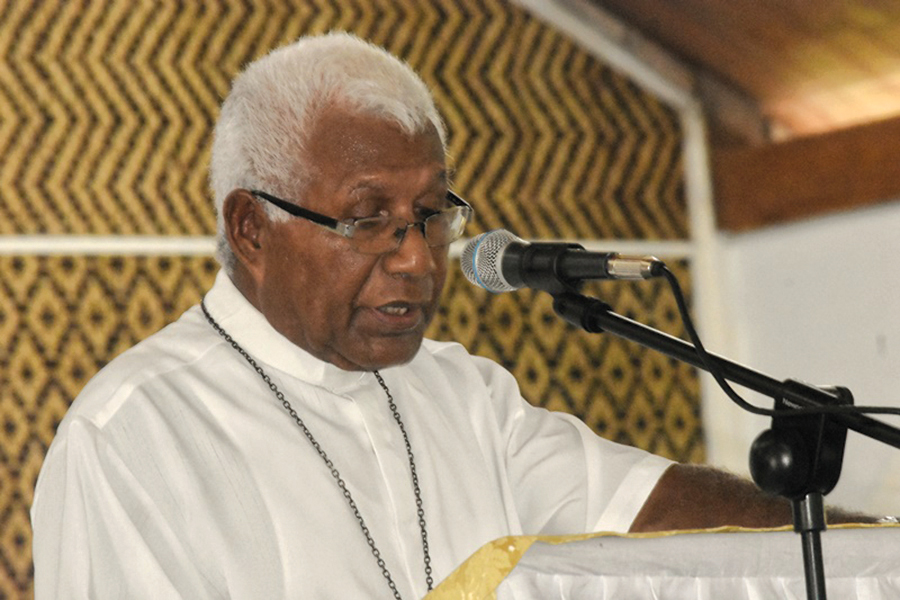
Governor General Sir David Vunagi

By EDDIE OSIFELO

THE impact of the global covid 19 pandemic in 2019 has affected the Solomon Islands economy and exacerbates unemployment and social issues.

Governor General Sir David Vunagi confirmed this, when he delivered his New Year’s message to the nation, on the 1st of January 2023.

He said during the last two years, the global community was drastically affected by the effects of pandemic Covid 19.

Sir David said in Solomon Islands, the community transmission of the virus created anxiety, fear, uncertainty and depression.

“To prevent the spread of the covid 19 virus, health protocols were instituted, wearing of face masks, washing hands with soaps and water, social distancing, lock down of borders, restrictions of movements, closures of schools, churches, offices, hotels and so on.

“Still, many people contracting the virus and some died. May their soul rest in peace,” he said.

Furthermore, Sir David said as the dust settles, the impact of covid 19 becomes more visible in the social and productive sectors.

He said the health protocols triggered the downward flow of the economy.

“Cash flow slows down the completion of the developmental projects.

“Inflation increases to 8.5 percent, pushing the prices of goods in the shops and markets to a level ordinary citizens struggle to put food on their tables,” he said.

Further to that, Sir David said people have also cut back on spendings because the room for spending has been greatly minimized.

He said even operators’ business entrepreneurs have struggled to provide reliable services and transport providers have been challenged to increase fares and in order to remain operational.

Moreover, Sir David said boarding schools argued to increase fees to a level that both parents and students struggle to meet.

He said even clinics and provincial centres lack accommodations and other basic facilities to cater for the needs of nurses.

Sir David said short supplies of basic drugs like panadols, bandages and plasters also continued to be unending issues for health institutions to provide equitable services to the general public.

Furthermore, he said employment in both the public service and private sectors have been saturated, that said university graduates and school levers find themselves on the deep end of the stick in trying to secure employments.

Sir David said a generalization has been made as unemployment increases, so are anti-social issues.

“Many organisations both churches based and Non-Government Organisations strive to address these social issues but lacking resources, so they end up addressing the symptoms other than the cause,” he said.

Sir David said the main cause is unemployment that causes stress, trauma, that leads to domestic violence and other anti-social behaviors.

He said unemployment is a central issue that needs to be addressed if self-reliance and economic independence is to achieve by all.

Vunagi: gender abuse everywhere

0
Governor General Sir David Vunagi

BY JENNIFER KUSAPA

GOVERNOR General Sir David Vunagi has highlighted in his new year’s message that the recurrence of domestic violence, rape and abuse of girls and women is happening everywhere.

“This shows that we have failed to address the combination of behavior and cultural attitudes of perpetrators,” Vunagi said.

He said the 16 Days of Activism against Gender- based violence that is celebrated every year from 25 November to 10 December does not impact the society.

“I think awareness alone is not enough. What is required is better-informed and pragmatic responses from all stakeholders including women and girls that touch the hearts of perpetrators,” Vunagi said.

He also said the recurrence of an undesirable attitude from some close relatives that dehumanise daughters or granddaughters, the incest practice is destroying the cultural equilibrium and what is regarded as ‘normal life’ within the family. 

The effects show a range of attitudinal behaviours that create emotional, physical and perceptional response to life.

“When communities are weak in their moral and ethical standing, they start to develop ‘a no care attitude’ towards respect for relationships, and so lawlessness and chaos become the results.

“Therefore, I think, Lawlessness continues to happen not because people choose to randomly commit crimes but also because law enforcing agencies are not enforcing the law,” Vunagi adds.

END///