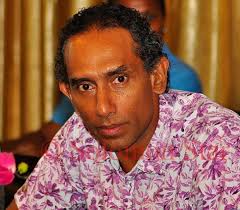
Dr Alex Munamua with the AstraZeneca vaccine that arrived last month/
BY MAVIS N PODOKOLO
SOLOMON Islands has received its first batch of 24,000 COVID-19 vaccine, the AstraZeneca vaccine yesterday.
The vaccine was shipped via COVAX Facility, a partnership between CEPI, Gavi, UNCEF and WHO. This is a historic step towards achieving the goal to ensure equitable distribution of COVID-19 vaccines globally.
The arrival of the 24,000 doses of the AstraZeneca COVID-19 vaccine marks the first batch of the vaccines to arrive in the country under the COVAX facility.
Minister for Ministry of Health and Medical Services (MHMS) Dr Culwick Togamana in receiving the vaccines at the Honiara International airport yesterday afternoon stated “today (yesterday) marks a significant milestone in Solomon Islands against COVID-19 with the arrival and receiving of the first 24,000 doses of COVID-19 AstraZeneca vaccine.
“This is the first of many more consignments of COVID-19 vaccines that the government and partners are working hard to bring into its endeavor to protect all of us against the global pandemic.”
“With the high global demand of these vaccines, let us thank our Almighty God that we are now amongst many countries in the world to receive the AstraZeneca vaccine and also among few Pacific Island Countries to have received the COVID-19 vaccine.”
“These 24,000 doses of AstraZeneca vaccine we receive today, is the first tranche of the 108,000 doses confirmed by COVAX facility to cover 20 percent of our population. These vaccines are provided by the Serum Institute in India for making these vaccines available through the COVAX facility.”
“I would like to also acknowledge here the contributions of many of our donors and bilateral partners, the British Government as one of the major donors of GAVI, Australia, New Zealand, Japan, China. All your contributions to GAVI have enabled us not only to receive these vaccines today (yesterday) but in the past decades we were able to protect our population from vaccine preventable diseases. So, thank you indeed.”
“With this, I stand in salutation of the staff, experts, specialists and advisors of the ministry of health under the leadership of my Permanent Secretary who have worked tirelessly with determination to ensure that we continue to enhance our capability to protect our people from this virus by all possible means. What are witnessing today (yesterday) is the reflection of your determination. Thank you.”
Dr Zelalem Taffese UNICEF field officer to Solomon Islands said “I am honored to stand with you today to welcome the first shipment of COVID 19 vaccines to Solomon Islands.
“Exactly a year ago, the world was in a very different state. Borders were closing, hope was flickering, and we looked to face a very grim and unknown future.”
“Today, we mark a very important milestone. Access to vaccines through The COVAX facility which had set the target of vaccinating at least 20% of the world’s population by the end of 2021,”
“The vaccines we are welcoming this afternoon indicate the light at the end of the tunnel. The beginning of the journey to Normalcy.”
“COVAX represents an unprecedented global cooperation and collaboration that gives us hope in Humanity’s capacity to work together to address our common collective problems,” said Taffese.
Prime Minister Manasseh Sogavare in his special national address yesterday said the arrival of the first doses of COVID-19 Vaccines is a tremendously proud day for the country.
“I give Honour and Praise to our Almighty GOD for working through our partners to ensure our first batch of vaccines arrive today.”
“I also thank Solomon Airlines for ensuring the Vaccines get into the country, and our Customs team for ensuring their pre-release so that they can be stored appropriately immediately after arrival,” said Sogavare.
He said the bulk of the vaccines will be deployed to the western border zone where the highest urgency, and priority exists to protect people of this country.
CHIEF Education Officer of Western Province, Freedom Tozaka says partnership is the only way forward towards achieving development goals during COVID-19.
He made the statement during his visit to Buri School, Rannongga Island, Western Province on Thursday.
Tozaka said development aspirations have been exposed to economic stress and that developments are at stake.
“We are at the centre of this pandemic and there is no room for individualism,” Tozaka said.
“We cannot work alone, rather requires greater partnership and collaboration to keep development aspiration going,” he added.
Tozaka said all sectors and stakeholders including national and provincial government must ride on a same boat and reading the same book in order to drive the economy and development of the country.
He said government alone cannot perform miracle to stabilize development aspirations and challenges faced in the country.
“We understand that we in a brink economic disorder as such we must look at other alternatives to help us achieve our goals.
“We have lots of donor partners who can help us with our plan as such, like I said, greater collaboration and partnership is paramount at this post-Covid situation, Tozaka said.
OFFICE of the Director of Public Prosecution says they need some more information before they can lay charges against Chief of Staff in the Prime Minister’s Office Robson Djokovic.
“We have not charged him yet. We are waiting for some information from the Electoral Office,” the DPP office said in response to questions from this newspaper.
The High Court recently ruled Djokovic, whose mother is from Choiseul and currently holds an Australian passport, is not a Solomon Islands citizen.
Djokovic is understood to have registered to vote here and reportedly voted in the 2019 national elections.
Police Commissioner Mostyn Mangau said they are still working to get additional statements regarding the case.
He said the DPP’s office wants some additional information and police are still working on that.
He added after police gathered those information then they will provide to the DPP before any actions can be taken from there.
The Opposition Office in 2019 referred Djokovic’s case to the police for investigation.
Dr Zelalem Taffese, UNICEF Field officer to the Solomon islands shakes and with Minister of Health Dr Culwick Togamana following the arrival of the AstraZeneca vaccine into the country on March.
BY MAVIS N PODOKOLO
THE official launch and roll out of the newly arrived AstraZeneca vaccine will commence next week on Wednesday at the Central Field Hospital according to Health Minister Dr Culwick Togamana.
Togamana said the commencement of this vaccination will on be for priority groups.
“Next Wednesday, we will once again gather at the Central Field Hospital to officially launch these COVID-19 vaccines and will commence vaccination in Honiara for priority groups and roll out the vaccination down to our Western border communities, as such would like to send this message to each and every Solomon Islanders across the country,” he said.
Prime Minister Manasseh Sogavare in his national address yesterday said the roll out of the vaccination program will commence at the Central Field Hospital.
“This is because the Field Hospital is well equipped for mass vaccinations but importantly to observe people after they receive their vaccinations.”
“Following the launch, vaccinations will begin. I am very happy to lead our nation into this vaccination program after the launch on Wednesday morning.”
“We expect the Honiara vaccination to be completed within one week. Our vaccination and medical teams will then be deployed to the western border to roll out the vaccination program,” said Sogavare.
Meanwhile, the first batch of 24,000 doses of COVID-19 AstraZeneca vaccine have arrived yesterday in the country.
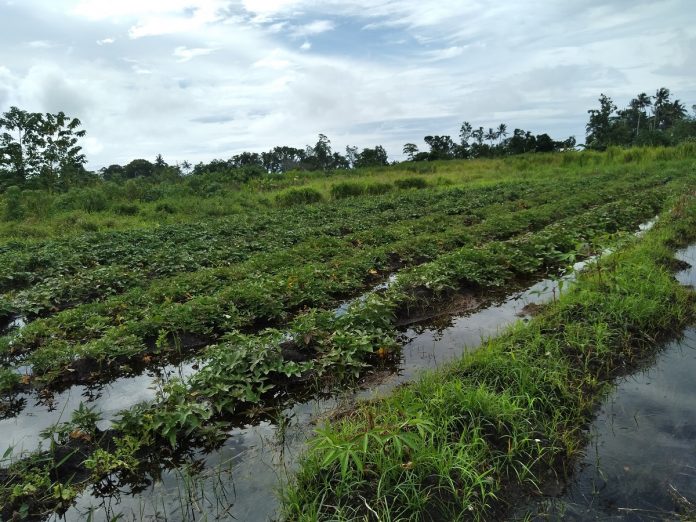
water-logged crop food garden damaged by flooding on Guadalcanal
By Ben Bilua, Mavis Nishimura Podokolo and Jennifer Kusapa
From King tides swamping villages to crop confusion leaving families hungry, changing weather and climate patterns due to climate change have spawned a new era across the Solomon Islands – forcing people to adapt to survive.
Many Solomon Islanders depend on subsistence agriculture to eat and changing weather and climate patterns now threaten both food security and the effectiveness of traditional knowledge.
Traditionally, Solomon Islands has only two seasons. May to March is dry season, with traditional names called Koburu (Eastern wind) and Ara (Western wind), and November to April is wet season.
For many generations, traditional knowledge handed down from Solomon Islands’ founding fathers and mothers guided when to plant certain crops during these seasons for best results. Across the provinces, farmers report this knowledge is less and less reliable as the season change character.
Intense cyclones, heavier-than-usual rain and sea level rise have made drastic changes to people’s way of living and also the reliability of traditional crops for survival. Central province, Guadalcanal province and Isabel province are amongst the hardest hit areas.
food garden damaged by flooding on Savo
John Keoro from Sisiaka village in Savo Island, Central Islands Province, says his island normally expected extreme wet weather from the end of the year to around April, but this has changed.
“We experience bad weather any time of the year,” the 38-year-old says.
“Disaster resilience has been an issue for us as we are unable to predict disasters to brace our families and the community.”
According to Keoro, traditional knowledge on when to plant traditional crops has been impractical due to the changing weather and climate pattern – meaning food security is a growing concern.
He says other new disaster threats have emerged. Continual heavy rain has caused flash flooding which washed away gardens, the only means of food for many people. Recent tropical cyclone Lucas is the latest example.
What is left of the Keoro’s family garden on Savo island.
“One of the new disasters that we experience is flash flooding,” he says.
“Our garden has been washed away by pools that used to store water naturally at top of our gardens that became waterlogged.
“My family ended up having nothing to eat for months.
“At the moment we survive on processed foods we bought from the shops.”
Keoro says repeated requests for help from both provincial and national governments have failed to provide solutions.
He says people in Savo survived or get over previous disaster through spirit of community assistance.
“We seek responsible authorities for assistance in previous disasters but we realised that there were empty promises.
“We have short term and long-term types of assistance build from the spirit of community. Short term assistance is when people who are not affected by disaster lend foods to disaster victims. Long term assistance is through sharing of tradition crop’s seed where victims of disaster can replant to provide food for their survival,” Keoro said.
With cash running low and no more crops to sell for income, Keoro says his family is struggling to cope with other needs such as school fees and also providing a healthy diet.
John Tom from Longaka community in Savo Island has had similar experiences.
“It’s really hard to prepare for bad weather because the weather patterns and cyclones seasons are non-standard,” the 53-year-old says.
“We lost our house, our outrigger canoes and outboard motorboats.
“Our sea walls were destroyed and also our food gardens. Permanent crops were washed away by running water. All because there is less preparation prior to natural disasters like cyclone,” he says.
Mr Tom says today’s weather patterns are radically different from what he remembers growing up and that radio and social media are becoming increasingly important for weather forecasting.
Central Province Environmental Health Officer Julie Leinga says her office is aware of the new threats to agricultural crops in Savo Island.
“We didn’t expect these agricultural damages that recently happened to the people and communities of Savo,” Ms Leinga says.
“We often visit these communities after rainy seasons and cyclones but this year the damages to crops are enormous, leaving nothing behind for people to consume.
“Streams have changed from their usual directions causing damage to food gardens,” she said.
Ms Leinga fears water source contamination from recent disasters will lead to health issues, such as diarrhoea.
In Isabel Province, Chief Martin Goriso from Suva village says sea level rise has changed the landscape of his village.
“I was born and grew up in this village (Suva) way back before the World War II,” the 77-year-old says.
“What I see now is absolutely different from the past.
“This village has changed a lot. The coastline was about 10 to 15 metres away but now waves break just steps away from the village.”
Unpredictable King tides now wash deep into the village and coastal erosion is forcing residents to move further inland, leaving behind their long-time connection to the sea. And, even here, food security is a growing fear. Seashells and other eatable marine creatures are becoming scarce as nearby coral is bleached.
“In the 90s our footpath along the shoreline was far from the sea but now its sinking under water, even the beautiful trees growing along the seashore are gone,” Mr Goriso says.
“My fear is the loss of land by the rising sea.”
Waters where children used to swim and play have become deep and unsafe.
“I feel sorry for my grandchildren and the future generation because they will no longer see and enjoy the beautiful beaches and the beauty of this place,” the Chief says.
Young mother Margret Tige also fears for the children. She says King tides have invaded her back-yard garden.
The 30-year-old’s love of coastal living, with its beach and sparkling sea, has turned to fear. Her family stays alert every night in fear that rising tides might destroy their home.
“We always stay up late when there is King tide,” Ms Tige says.
“Fear is always there and this is sad for me and my family.”
Margret Tige pointing to saltwater intrusion at Suva village, isabel
Chief Goriso recognises her fear but say re-location is not an option. The families are caught between a natural and a social issue; sea level rise and land disputes.
“As coastal erosion continues, people move in land to build houses but the trend of land disputes also increases,” he says.
Goriso says traditional leaders, provincial government and the national government have tried their best to find the best solution to address land dispute but attempts prove unfertile as landowners refuse to listen.
“Back in the days, we lived together. Both landowners and nonlandowners lived together in spirit of sharing, care and love for each other.
“Population growth and also modern lifestyles have changed people’s way of life. This is really sad for us,” he says.
In Guadalcanal province, where the capital Honiara is located, a comprehensive survey carried out by Office for the Coordination of Humanitarian Affairs in 2020 found that two out of every three people experience some level of food insecurity or deprivation. Most either worry about having enough money for food or they have had to compromise the variety or quantity of food because of lack of money. Some are regularly going without food.
Martin Itogho from Komabulu in east Guadalcanal province says traditional crops are not adapting well to the changing weather. He agrees with those from other provinces that traditional knowledge doesn’t work as well as it used to.
“We would plant taro during dry season and from experience harvest was good then; our staple foods are available,” he says.
Drainage were dug to force water out of the SAPE farm on Guadalcanal.
“Now, it is difficult to know when to plant taro because of frequent rain all over the year.”
Itogho says that uncertainty has led to lower yields and food is becoming scarce at times.
Adding to the supply problem, torrential rain brought on by recent tropical cyclone Lucas, swamped gardens in East Guadalcanal.
Director of Solomon Islands Meteorology Service, David Hiba Hiriasia says the current wet weather will have direct impact on Agricultural crops due to water clogged underground.
He stresses that wet weather will affect most communities who depend on agricultural crops production for nutrition and income generation.
Hiriasia says communities in Malaita and Western province have experience unusual King tides believed to be the effect of La Nina.
“Lagoon experiencing coastal flooding reports received form West Are’Are and Western province,” he said.
Hiriasia says the wet season is above normal due to La Nina.
Landslide damaged taro gardens on Savo island during the recent tropical cyclone lucas
“We still be experiencing wet season and so our ministry is working very closely with line ministries in using climate data and rainfall data to ensure crops planted during wet season can tolerate long period of rainfall,” he says.
From Savo Island to Suva village, Honiara to the most remote islands, the impacts are being felt but the responses are proving inadequate.
The traditional knowledge of yesterday must somehow combine with the solutions of tomorrow.
This feature story is produced with support from the ABC International Development Media reporting on climate change 2021
Local musician and person living with disability, Blind Tome
BY ALFRED PAGEPITU
LIVING with disability was never seen as a barrier for 52-year-old Tomme Tanisuda, or known in the local music scene as ‘Blind Tome’.
The gifted musician who was born blind, talked with the weekend sun about his experiences in making music as a lead guitarist and vocalist.
He decided to reveal his story when participating in an inclusive three days workshop (from Wednesday the 10th of March 2021 to Friday the 12th of March 2021).
The success behind his musical trade proves that one only needs his heart and not eyes to be a brilliant musician.
Currently he is the President of Blind visually impairment Association of Solomon Islands and hails from Bina, West Kwaio in Malaita province.
Tanisuda has never attended formal education or musical studies for that matter.
He comes from a family of six and has a bigger dream than just being someone living with disability.
Tanisuda said when he was born at his home village, he never knew until he grew up and that he was born blind.
“My mother got the shock of her life and couldn’t believe when she realised that I couldn’t see anything,” he recalled.
“My father died when I was 9 years old and I never learnt to read, write and do things that an able person could do,” he said.
“After some years, some village youths saw that I was not capable of contributing to my community, so I decided to learn how to play music and do my best to practice daily.
“This is my dream that one day I can be a musician,” he said.
He said that his family knew him very well because of his disability and took care of him as he grew older.
“I was inspired by famous artists like Brian Adam, Jimi Henrick, fire house and even Bob Marley as my favorite when I was young. I love those bands because of their styles of music and their lyrics.
This inspired me most that one day I can create my own music,” he said.
“But it was a totally different experience as I was most of the time laughed at and I felt out of place and hopeless,” he said.
“I never give up but I am doing my best. He continued to learn music at his home village, where few boys encouraged him to learn how to play a guitar.
“Only then and by practice he started to recognise the basics, and that he was a special person in learning music despite his inabilities.
“My only hope as a blind person back then is to learn to play a guitar and earn something for a living rather than depend on my mother, brothers, sisters or close relatives.
“I start to feel the surface of the guitar, the sounds of the strings, lovingly and softly at first, getting bolder as I go along.
“The sound of my music got me to paradise, where I can forget my status as a blind person.
He started to take serious interest in music and created his own styles of playing guitar, moving on to star as a lead guitarist where he decided to move to Honiara and engage in bigger shows with other local artists.
“My passion for music started early when I was 12 years old until today,” he said.
He said being a person living with disability the love of music can relieve your stress as you can never see anything around you, only feelings and sound.
His involvement in music helped his community to raise fund for school, church and an exposure to life outside his community.
“My interest in music started to grow so I decide to travel to Honiara in the early 1990’s to reside with my cousins.
“Between 1995 to 1996 I started to record my song and my passion for music gave me hope that music could be the only source of income for me.
He said that most of his songs are gospel songs, cover songs and chorus , his idea was to present the songs with deep meaningful message.
“I played from my heart. It was extremely difficult at first, but the fingers guided me along and I can create something different for my own.
Tanisuda got more feedback from friends and was motivated as he heard his songs being aired through SIBC.
“I don’t think I have had a more life-altering experience than depriving myself of the sense of sight. Such is the power of the specially-abled.
He said in 1997 he was involved with other musicians in Honiara and joined up with the Apprentice Band to travel overseas.
“My eyes hear, and my mind responded. My mind speaks and my heart responds with music when I heard that I will travel with the Band members to Papua New Guinea (PNG).
“I can’t believe that I was in PNG but I can imagine when I we were playing live on stage as thousands screamed,” he recalled.
“It was my first time to travel to PNG to join the South Pacific Musical festival in Port Moresby with other pacific musicians show casing different styles of music.
In 2001, he travelled to Nauru and spent one year six months in Australia. Learning to feel through the mind is also humbling.
“On my trip to Australia, I visited a few states, as I recalled I wondered how someone without the gift of seeing could travel to such amazing place like Australia but because of the love of music I made my own history.
When I returned to my home country, I was involved much with other bands and made money out of my talent.
He said that most of the challenges is that he had no musical instrument but had to borrow from others, and at times found it difficult when it comes to hiring instruments.
“Sometimes the money I raised couldn’t make any profit, but with the little I raise I am satisfied with the help I have given to my family.
Being a dad of two children, he acknowledged his wife, Eve Tomme who he adores so much even though his condition.
Most of his songs can be heard today and from his engagement with young people of Solomon Islands and those living with disability, his advice is to never give up on what talent god has given them.
“Music can provide good income in some ways, but in Solomon Islands, to become a musician is challenging compared with musicians in other countries,” he said.
“Never give up and continue on with your music career but let us not forget to go back to our original music where we first come from.
“Music changed my life as a blind person, so I would like to encourage others like me to never give up on whatever talents they have. I hope this story will be read by someone with disability like me to encourage him or her that you can make a living through music or other areas to earn a living out of darkness.
Tanisuda called the government and other NGO’s to help him provide his instrument and never to look over people with special need in Solomon Islands.
Member of Parliament for West New Georgia Vona vona, Silas Vangara (left) and Permanent Secretary of Ministry of Rural Development Allan Daonga with signed copies of the MOU document
West New Georgia-Vonavona MP sets history by channelling constituency funds through wards
Member of parliament for West New Georgia-Vonavona, Silas Vangara, has broken history by merging constituency and provincial wards.
His constituency development fund (CDF) will be channelled to the people through the four wards in his constituency for the next two years.
This, he says is for the sake of maximising services, development and reaching every constituent.
No member of parliament has done this, and Mr Vangara’s initiative is said to be one which other MPs will be monitoring very closely.
To ensure its success he signed a Memorandum of Understanding (MOU) with the Ministry of Provincial Government and Institutional Strengthening yesterday.
The MOU will be signed by Premier of Western Province David Gina when the provincial government meets next week.
Speaking during the signing ceremony yesterday Vangara said the agreement reflects the level of funding he will support his wards.
He said this is the first of its kind given that for the first time, provincial assembly members and Member of Parliament will be working together.
He said the constituency fund will be directed to the province to take ownership and take initiative to provide services to the people.
He said the most difficult thing is having the members of provincial assembly working in one direction with the MP to serve the same people in the constituency.
“I look forward in the next two years and see the report provide.
“I have the full support of the Prime Minister seeing that he found about this new approach.
“This is not something I take it lightly. It has taken me over the course of three term to finally come with to put a potential avenue in how to channel the constituency funds to the wards.”
He acknowledges MPGIS for their support and looks forward to a working partnership.
Permanent Secretary of PGIS Stanley Pirione said there are 172 wards across the country which the ministry wants to equip to deal with project implementation in terms of planning and budgeting.
He said in one constituency there are a few wards. For West New Georgia Vonavona constituency, it has four wards.
“Those wards funding that go for the constituency will channel to them through the provincial government of western province,” he said.
Perioni said before the provincial member receives Ward Development Grant that fund goes through their own account.
“Now it goes through inside Ward Development Committee which means the member might contribute on planning but have no direct influence on the fund,” he said.
Vangara added that the new approach will merge the provincial government, ward member and constituency to come up with one plan and budget to deliver services to the same people they serve.
He said this year his constituency will inject $3.4 million for the four wards within his constituency.
He also wants to make it clear that the funds will be controlled under discretion of the Ward Development Committees.
THE March-8 attack in Jejevo village reportedly led to an estimated $350,000-worth of damage to properties and livestock.
Police have so far arrested five people in relation to this incident. A security guard of Sunshine Mineral company is also being questioned with allegations he is connected to the attack.
Police Commissioner Mostyn Mangau, in yesterday’s press conference, said reinforcements were sent to Isabel province over the weekend following a request from the provincial police commander.
Officers of the elite unit, police response team (PRT) and criminal investigations (NCID) were deployed, leading to the arrests.
The men are in custody, in Honiara, awaiting their court appearance date.
Mangau said on March 8 this year a group of people armed with knives and axes went inside the Jejevo community and destroyed properties.
Mangau said investigations are still ongoing and police are calling on the communities around Jejevo, Furona, Jajao and Hurepelo village in the Katova District to remain calm and allow police to investigate.
He said the investigation may take some time but police want the communities to allow the law to take its course, as taking law into one’s own hands will create problems.
The incident is believed to be related to the proposed mining that little-known Sunshine Mining Ltd intends to carry out in the area.
Member of Parliament for Aoke Langalanga and Opposition Leader Matthew Wale. Photo Credit; Pacificwin NZ Aus Pacific on LinkedIn.
Leader of the Opposition Matthew Wale calls on national leaders not to meddle with Provincial Government issues for their own interests and those of their cronies, and calls on national leaders to respect decisions made by provincial governments.
“With the recent failed attempt to topple Premier Suidani, we now have a pending Motion of No Confidence looming against the Premier of Guadalcanal Province. Who knows what other province is lined up.
“Regrettably the common denominator in all these cases is, dissatisfaction by foreign interests with political decisions or positions taken by provincial governments. What is even more disconcerting is, national leaders are being used by these foreign loggers against our provincial governments. This is very bad leadership and these actions only serve to further undermine the trust and confidence of our people in their national leaders.
“Information on hand clearly suggest that the pending Motion of No Confidence against the Premier of Guadalcanal Francis Sade is directly connected to a recent decision taken not to issue a business license to SINO Capital in respect of the company’s logging operations in East Central Guadalcanal.
“Guadalcanal Province has the right under law to review and refuse grant of any business license to any investor found to be conducting business contrary to provincial ordinances and there are legal avenues for dealing with any grievance arising,” says Wale.
However, the Opposition Leader points out that it seems in the case of Guadalcanal, the decision did not go down well with some of our national leaders who are plotting the removal of the provincial Premier and executive. This is a terrible state of affairs.
Wale calls on the Prime Minister to discipline his Ministers from this practice which causes political instability at the provincial government level, unless it is his government’s policy to do this.
“Information from reliable sources suggest that the MP for East Guadalcanal is behind the motion against Premier Sade and his government and the intention is to bring into power a puppet one instead. This is akin to the early attempts against Premier Suidani. This is just not right.”
“This behavior raises questions on the integrity of the East Guadalcanal MP and others that continue to interfere with the administration of our provincial governments to further the interest of foreign loggers against the good interests of our people,” adds Wale.
Wale said Premier Sade and his government are doing a great job in leading the province and ensuring that their finances, resources and peoples rights are safeguarded against dubious investors. He is cleaning up the Guadalcanal provincial financial management, after years of mismanagement by prior governments. He should be supported in his endeavours not threatened with removal.
“These recent allegations it would seem, are further evidence of the close connection between foreign loggers and the top level leadership of the DCGA. The public have very little trust in government when it comes to dealings with the logging industry, and this further erodes what little trust is left. The Prime Minister must explain to the public where his government stands in all of these, and whether he condones this practice.
“For the sake of our people I call on our national leaders to respect our provincial governments and allow them to take leadership in their respective provinces,” the Opposition Leader adds.
BURI Community High School in Ranongga Island, Western Province is calling on kind hearted individuals or organisations to help address their water supply project.
Principal of the School, Gregory Patovaki made the call when Chief Education Officer of Western Province and Save the Children paid a visit to the school yesterday.
“We managed to build two tanks, one of which has not been functioning due to lack of resource. Currently we use only one tank to supply water to the school. However, water distribution has been quite poor as pressure is too low which is unable to supply water to most of the school’s stand pipes. Stand pipes situated along the valley are able to supply waters for our students and staffs.
“Further assistance would bring effective and sufficient water supply to the school as well as staff houses,” he said.
Patovaki said the school is looking at utilising the other water tank but fell short with funding as school funds along with funds raised by surrounding communities have been exhausted.
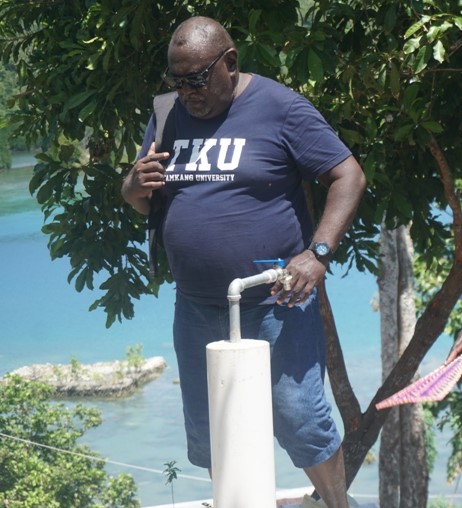
Chief Education Officer Freedom Tozaka and Mr Gregory inspect one of the newly constructed and unused stand pipe.
“Our need of proper water supply can be addressed only if we have seven poly-pipe roll with 150 metres in length to connect to the other unused tank to our main supply line.
“We believe this is the only hope we are waiting for and we are seeking assistance from our partners to help us with this project,” he said.
Potavaki says that the main supply tank at the school needs further improvement in term of its capacity to serve the school 24/7.
He said the school is rationing its water supply so that enough water is reserved to serve the school on a daily basis.
“We are very caution in terms of using our water. We have decided specific hours student and staffs can access water.
“For example, we switch off our supply line during school hours after students have their wash early in the morning. Later in the afternoon we open the supply line till late,” Potavaki said.
Principal Mr Patovaki explain to the visiting about the school’s plan on developing a better ablution for girls
He said the school has already constructed stand pipes within the school boundary along with proper toilets while waiting for the water supply to be fully functional.
Chief Education officer of Western Province, Freedom Tozaka said his office will look at possibilities to assist Buri School with its water supply issue.
He acknowledged Potavaki and Chairperson of the school, Roby Paul for their efforts in trying to improve the school’s water supply.
“Our task at the moment is to seek further assistance. More focus will be on poly-pipe lines and improvement of the school’s reserve tank.
“My office will work closely with the school board and management to make sure the issue of water supply is fixed,” Tozaka said.