Home Blog Page 965

VIEWPOINT- Candidates urged to campaign with plan & policies

Not copper/solar promises

TRANSPARENCY Solomon Islands (TSI) in its continuous advocacy focused at fighting corruption and promoting transparency, accountability and good governance, call on and remind candidates intending to contest the up-coming by-election for South Choiseul Constituency to show to the people of South Choiseul that, as a potential South Choiseul representative in Parliament you have the people’s needs at the forefront.

If you are a party candidate, you must convince the people of South Choiseul with your party polices or the platforms that you stood for, what potential development plans that can benefit the people, not business as usual of luring voters with material things like copper and solar panels.

Offering such goods in return of their votes.

TSI thanked the office of the Electoral Commission, the Democratic Coalition Government for Advancement (DCGA) and the Governor General (GG) for officially declaring 19th May as the date for holding the by-election for South Choiseul Constituency.

It is worth appreciated that the government listened to the cries of South Choiseul people after a year without a voice in parliament. Given the current financial hardship posed by covid-19 pandemic, DCGA is committed to hold the by-election for South Choiseul, that is commended and acknowledged.

During TSI’s recent visit to five communities in South Choiseul early this month, two questions were repeatedly asked by South Choiseul constituents, (i) When will they have their by-election and (ii) How can they access information about funds channeled through their representative (members of Parliament) to develop their constituency.  

Constituency Development Funds (CDF) is a catch phrase to the ears of citizens whilst at the same time very elusive.

It’s an issue that villagers are concerned about and rightly so because CDF is a funding that is purposely for the development of the constituency.

Through the information sharing sessions carried out by TSI in various communities throughout the country and most recently in South Choiseul, it is evident that there is an absolute lack of transparency and accountability with regards the use and disbursement of CDF at the constituency levels.

MPs and Constituency officers treat CDF as if it is confidential information and must not be shared. Such disinformation does not and will not achieve the purposes of what CDF was established for. CDF was established to help constituents generate income, to encourage and bring about development in constituencies and generally to improve the livelihoods of all citizens of Solomon Islands.

Despite the millions of dollars that have been disbursed under CDF, we are still hearing the same sad stories from our rural communities. (9th Parliament each MP received more than $19Million, 10th Parliament each MP received more than $26Million and this current 11th Parliament each MP already received more than $5 Million, however this will soon drastically increase).

A general view shared by constituents is that there is lack of development plan, and millions of dollars channeled through their MPs over the years till today does not reach the constituency.

Having no representative for over a year further disadvantaged the people of South Choiseul as some of their projects from the previous year have been halted after their MP was ousted through an election petition.

Transparency Solomon Islands through its advocacy programs for good governance shared with the people information about their civic and political rights and encourage citizens to vote wisely for candidates who campaign on good policies.

While the date for the by-election has been set for May 19th 2021, TSI reminds intending candidates to be mindful of the requirements and provisions of the Electoral Act during this campaign period.

People in South Choiseul are already raising concerns and asking clarifications about potential intending candidates who were going around communities distributing goods.

These concerns were raised by constituents from Wagina, Sasamunga and Loloko, stating that some people received solar panels, fuel and bags of rice.

Although there may be some other reasons behind the distribution of these goods, TSI cautions and reminds all candidates that a campaign is any activity that is intended, calculated or likely to affect the result of an election or to influence an elector with regards the manner in which he/she cast his/her vote.

As such any actions done outside the campaign period aimed at influencing voters is campaigning outside campaign period and an offence under the Electoral Act.

Now that campaign period is open, candidates must adhere to the provisions of the Electoral Act and must ensure not to commit offences listed by the Act like election bribery which involves directly or indirectly promising or offering  or giving benefits to someone with the intention of influencing the other person to either (i) vote or refrain from voting, (ii) vote in a particular way at an election; or (iii) influence a third person to vote, refrain from voting or vote in a particular way.

The people of South Choiseul have been without a representative for a long time and candidates must ensure not to carry out practices that will result in another by-election, the people deserve better.

Candidates who are registered with a political party must campaign under the party platform, policies and strategies, give voters the choice of voting based on party policies.

Do not bribe voters, remember your role will essentially be representing and serving the whole constituency, that means all constituents regardless of whether they support you or not.

Voters do not deserve to be bribed with promises of individual help of solar and iron roofing to be given prior to or after casting votes.

Once elected an MP is responsible for the whole constituency – not voters only.

The culture of vote in Solomon Islands over the years is “you scratch my back and I scratch your back.”

This practice of electing candidates based on what he/she gives the voter prior, during or after the election is a disease that give way for dishonest leaders to go into parliament and breeds corrupt government.

It is important for voters to understand that accepting gifts in return for your ballot is an offence, it breeds corruption and a candidate who wins through corrupt means will have little or no concern at all for the development of his/her constituency.

Obligations are focused at keeping and maintaining deals made out of corrupt conducts and bribes, uninformed voters who were promised riches expect MPs to provide everything for them.

Thus, this vicious cycle continues, “you scratch my back and I scratch your back” benefiting only a handful of people and ignoring the rest of the constituency and undermining development of Solomon Islands. Who suffers? The people.     

TSI in its continuous advocacy against corruption, engage in activities promoting transparency, accountability and good governance in communities.

TSI took note of the concerns raised by constituents of South Choiseul and the pressing need for wider reach, awareness and information sharing during this by-election period.

Thus, TSI calls on the Electoral Commission, together with development partners like the United Nation Development Programme (UNDP) to visit South Choiseul with the important message to educate people to vote wisely.

Being isolated, the constituents are susceptible to being influenced through promised gifts and voter buying, hence not freely making up their mind to go to the poll on May 19, because reports of some intending candidates and their supporters are going around to influence and lure people with gifts is disturbing and breaches the freedom of individuals to participate in a free and fair election.

TSI believed that the importance of voting party policies is the way forward to put in place the right leader at the right place in the right time.

Voting candidates who is only good in luring voters with copper, solar and other material things not only will put corrupt leaders in power, but as long as such practice of electing representatives continue, corruption will continue to thrive and citizens continued to be deprived of their rights to be represented in a sovereign nation, and development of this nation continues to be undermined.

VIEWPOINT- Pacific Way(s) and regionalism

Dr. Tarcisius Kabutaulaka in one of his recent visits to his beloved ‘Tasimauri’ region.

TARCISIUS KABUTAULAKA

THE tumultuous dispute over the selection of the Secretary General of the Pacific Islands Forum (PIF), which led to Micronesian countries deciding to withdraw from the premier regional organisation, provides an opportunity to re-examine the idea and vision of Pacific regionalism and the concept of the “Pacific Way”.

The Micronesian countries argue that according to an unwritten convention, it was their sub-region’s turn to fill the Secretary General (SG) position. Palau President Surangel Whipps Jr. said: “If we want to bring the Pacific together… let’s treat everyone equally – that’s why it’s so important that the SG be selected on a rotational basis [between Polynesia, Micronesia and Melanesia].”

The last time a Micronesian held the top regional position was 20 years ago.

By March 2021, the three US-affiliated states – Palau, Federated States of Micronesia (FSM) and Marshall Islands – had started the divorce proceedings. FSM President David Panuelo has said “the train has already left”, casting doubt on any hopes the Micronesian countries will reverse their decision. Nauru and Kiribati have not yet started the process.

Robert Underwood, Guam’s former delegate to the US Congress, referred to this as a “Micronesian revolt” and “Micrexit”.

He said Micronesian leaders “are justifiably unhappy” and that this “could have been avoided if Guam, the Commonwealth of the Northern Marianas and American Samoa were members of the Forum” just like the French territories of New Caledonia and French Polynesia.

Micronesian scholars, Katerina Teaiwa, Vincent M. Diaz and Julian Aguon highlighted the Micronesian countries’ shared historical experiences, cultural connections, diversities and leadership on issues of ocean policy, anti-nuclear weapons and climate change.

They say the PIF decision was a “strong showing of Micronesian unity that should not be underestimated.”

The Micronesian countries’ sense of hurt and their united and assertive response should not be underestimated.

Nor should we underestimate the disruptive impacts of this quarrel on the future of Pacific regionalism.

It could potentially weaken the power of island countries’ collective diplomacy, vital to achieving the South Pacific Nuclear-Free Zone Treaty, the US-South Pacific Tuna Treaty, the Biketawa Declaration and more recently in Pacific Islands leadership on climate change issues.

The Parties to the Nauru Agreement (PNA) is an example of collective diplomacy around a particular resource.

The dispute gives Pacific Islanders the opportunity to have frank and deep conversations about the ideas and values that inform Pacific regionalism, examine how we perceive and treat each other, and appraise the relevance and effectiveness of regional institutions, including Council of Regional Organisations in the Pacific (CROP) agencies and non-state organisations.

A central idea in this discussion is the “Pacific Way”, which is often touted as foundational to Pacific diplomacy.

FSM’s President Panuelo said the dispute “has planted the seeds of mistrust and a noticeable ‘erosion’ of honouring the Pacific Way.”

But what exactly is the Pacific Way? Is there a single Pacific Way or multiple ways? Does it manifest itself in the same way across the region and over time?

Who determines what the Pacific Way is? Does the Pacific Way embody both a collective regional identity as well as valuing the sub-regions? How does it offer a resolution to the current dispute? These are questions worth reflecting on.

When Fiji’s first prime minister, Ratu Sir Kamisese Mara, invoked the term at the UN General Assembly in 1970, he was referring specifically to Fiji’s peaceful transition to independence.

Over the years the term has been used to mean doing things in ways that are mutually respectful, inclusive, consultative, consensual, flexible and allow for compromise.

The Pacific Way is a set of ideas, visions and processes that are dynamic, reinventing itself under new contexts while simultaneously grounded to core values.

Over the years these values have been marginalised in favour of the increasing bureaucratisation of regionalism and regional organisations. The Pacific Way has become subsumed by bureaucratic requirements and processes. While such requirements are important, they need to be grounded in regional values.

Disagreements amongst PIF member countries is not new.

Greg Fry highlights past disputes, often around perceptions of Polynesian dominance.

Fry recounts his 1975 interview with Melanesian leaders who “felt that the Polynesian leaders looked down on them, making them feel like second-class citizens in the Pacific regional community.”

In these instances, leaders reached across this divide to create strong relationships, which saw the great collective diplomacy gains of the 1980s.

The current falling-out also illustrates how Pacific Islanders have appropriated the colonial divisions of Polynesia, Micronesia and Melanesia. Transform Aqorau, the former CEO of the PNA, states “there are already sub-regional groupings. The region is multidimensional, and constantly changing, and to assume that it should always be united, perhaps underestimates the emergence of strong national and sub-regional impulses.”

Despite these divisions, relationships continue to exist and are strengthened across these arbitrary and racialised boundaries.

The current quarrel gives Pasifika peoples the opportunity to have deep conversations about our collective regional identity, and our belongingness to and shared responsibilities to this blue continent.

At the same time we must bear in mind the dynamism, multilayered nature and complexity of Oceania, its people and the issues that concern us.

How metropolitan powers respond to and take advantage of the situation is also important.

The PIF provides a one-stop-shop for diplomatic courtship between its 18 member countries and territories and the 18 dialogue partners at a single venue.

It will not be the same without the five Micronesian countries.

Perhaps there are many in Washington DC, Canberra, Wellington and other metropolitan countries jostling to save Pacific regionalism.

It would be best for them to support, but not interfere or attempt to take advantage of the situation.

There are ongoing conversations amongst Pacific Islanders aimed at creating better understandings going forward.

This dispute, while disruptive, provides us the opportunity to re-examine the Pacific Way and chart new routes and new forms of Pacific regional partnerships.

* This article appeared first on Devpolicy Blog (devpolicy.org), from the Development Policy Centre at The Australian National University.

Tarcisius Kabutaulaka is Associate Professor and Director of the Center for Pacific Islands Studies at the University of Hawaiʻi at Mānoa. He is the author of “Mapping the Blue Pacific in a changing regional order”, in The China alternative: changing regional order in the Pacific Islands, edited by Graeme Smith and Terence Wesley-Smith, ANU Press, 2021.

RSIPF reminds communities of COVID-19 threat

DC Matanga together with some of the community members at Gaomae village

THE Royal Solomon Islands Police Force (RSIPF) reminds people in the western border with Papua New Guinea that the threat of the COVID-19 entering our country through Bougainville is real and everything must be done to prevent it.

Deputy Commissioner, Operations, Juanita Matanga emphasised the threat when she conducted awareness talks with members of the public at the Taro Market and Vurango Village on 26 Match 2021 and at Moli Village on 28 March 2021.

DC Matanga talking to community members at Kariki Village

“This COVID-19 is a challenging issue for all of us here in Solomon Islands and more especially those of you here in Choiseul and Western provinces because of the threat of the virus coming across from neighbouring Bougainville,” DC Matanga said during the awareness meetings.

“COVID-19 has impacted on our normal norms and practices including interactions with your people on Bougainville. We must accept that we are not in normal times. That is the reason why I have to come down to talk with you so we can work together to fight this virus.”

Community organiser at Komaliae Village acknowledges the presence of DC Matanga

“Our people must stop going across to Bougainville and we must stop Bougainvilleans from coming to our side. This should continue under the COVID-19 situation has been brought under control,” DC Matanga told the communities she met with during her visit to Choiseul Province

DC Matanga inspects officers at Taro Police Station during a parade

 She explained, “Once COVID-19 has been transmitted into communities we have no way escaping it because of how we live. So am urging you my good people to please adhere to the health protocols and work together with our frontline police officers who are working hard to protect us all.”

“I strongly appeal to the few people who think they can sneak across the common border in their outboard motors to stop this immediately as you are not only putting your lives in danger but the lives of your family members and the rest of the people in your community and the nation of Solomon Islands.”

An elder of Samanago Village thanking DC Matanga at the end of the awareness meeting

Speaking during the awareness meeting at Moli Village on 28 March, a member of the community Raphael Singa said, “We are so fortunate that DC Matanga has availed herself to come and speak to us. We had one incident two weeks ago when one of our community members was picked up at night by his father from Bougainville and went across the same night. Now the communities fear what will have when he comes back.”

RSIPF

BYE BYE MAMAE

Ousted City Mayor, Wilson Mamae appearing recently before the Public Accounts Committee

Mayor loses motion of no confidence

-Councillors swing sides during secret ballot vote

Wilson Mamae’s reign as Honiara City Mayor came to an end yesterday after he was defeated in a motion of no confidence.

An overwhelming majority of eight votes went in favour of the motion, which was moved by Councillor for Vavaya ward, Billy Abae. Only four voted for Mr Mamae.

Media was not allowed to cover the proceeding of the debate and election process of the motion.

However, sources inside told Island Sun four councillors from the Mayor’s executive switched sides during the secret ballot voting.

Sources add that also without the crucial votes of the three MPs and ex-officio members, which reportedly helped him win mayorship in June, 2019, Mamae stood no chance against yesterday’s motion.

Deputy Mayor, Francis Idu will be the acting Mayor until the Minister of Home Affairs gives a notice of 14 days to carry out election of new Mayor.

Sources said currently there is no one singled out to claim the mayor spot as three councillors are interested in it as well.

Cr Abae accused the Mayor of ‘very weak’ leadership as well as alleged misconduct and misappropriation of HCC funds for the last 18 months.

One of the highlights of the motion regarding weak leadership is that the City Clerk was allowed to act outside of executive decisions for all matters of the council and for his personal gains.

Evidence include the appointment of the clerk, 2019 staff recruitment, the continuous public calls for the mayor to resign, and the clerk’s control over the executive being the head of administration.

Other evidence under the misconduct and misappropriation of funds include the misuse of petty cash, budget overspending, conflict of interest within HCC, regularity of errors in journal entries, unrecorded and missing PVs, accumulation of workers SINPF contributions, Mayor and Clerks rental entitlements, and others.

Some other latest evidence comprise the illegal sale of HCC lands, poor financial management which gave rise to debt servicing in the 2021 budget, suspicious awarding of contracts, and many more.

Most of the allegations are also featured in the Special Investigation Audit Report on the Accounts and Records of HCC and Public Accounts Committee report.

Parl extends SOPE

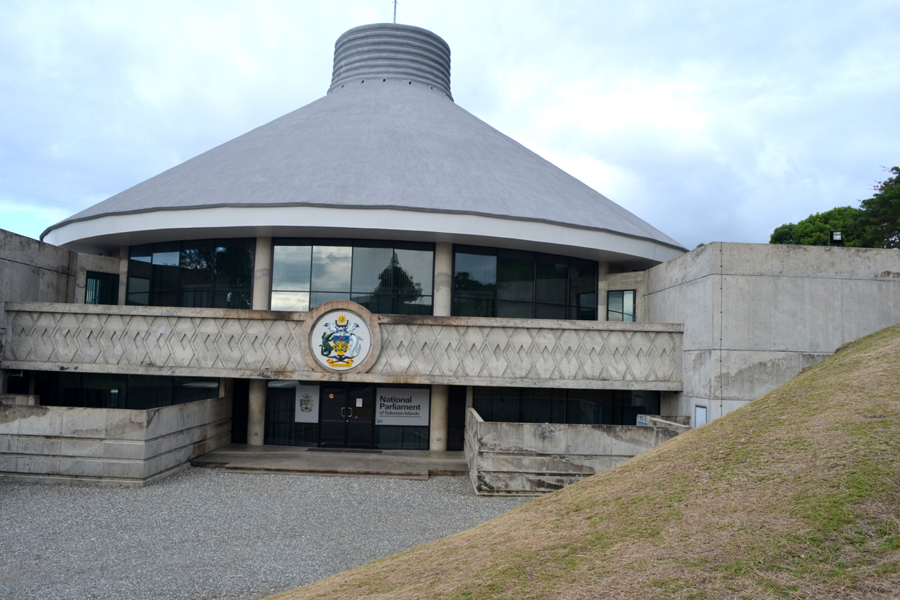
Solomon Islands National Parliament

BY ALFRED PAGEPITU

Parliament has passed the motion to extend the State of Public Emergency (SOPE) for another four months, making this the fourth consecutive SOPE.

As Parliament is in session, Prime Minister Manasseh Sogavare yesterday moved the motion following the declaration made by Governor General Sir David Vunagi on March 24.

Forty-four of the 49 MPs voted in support of the motion while five members were absent.

Speaker of the National Parliament Patteson Oti said the total number of votes surpassed the required number of votes needed to pass a motion.

Meanwhile, Parliament is now on special adjournment until April 9.

The first SOPE was declared on March 26, 2020. The first extension on July 29, 2020. The second extension on November 24 last year.

Health workers want jab at NRH: PS McNeil

St John Ambulance Team showing V sign indicating that they have taken their first

BY MAVIS N PODOKOLO

SOME front-line workers of the health ministry have reportedly wanted to be vaccinated at the national referral hospital.

But, the NRH is not a gazetted vaccination site.

This is according to reports that reached Pauline McNeil, permanent secretary to Ministry of Health and Medical Services.

I know some health workers want to be vaccinated at the NRH but field hospital is the designated and gazette facility for vaccination centre so that is the only place it is not at the private hospital or private clinic. Please go forward at the fielded hospital to be vaccinated as the gazette centre,” said McNeil.

She said this in light of the low turnout by Honiara frontliners for vaccination, which means the AstraZeneca rollout in the capital will be slower than hoped.

“We reach out to all the frontliners especially frontliners at health to come forward and be vaccinated because if we not vaccinate ourselves then we are putting the lives of our families and communities and patients at risk.

“Again, another plea from my side to urge every health workers to come forward that tomorrow and we are looking forward to getting a full report of my front liner health workers by the end of Wednesday to see who is full vaccinated.”

Guangzhou flight Apr 5

0
Solomon Airlines airbus

BY MAVIS N PODOKOLO

THE next Guangzhou flight is scheduled for April 5.

Jimmie Rodgers, secretary to Prime Minister and deputy chair to Oversight Committee, said this flight will be bringing workers to build the University of South Pacific 4th Campus in Honiara.

“On the 5th of April we have a flight coming in from Guangzhou and that flight will take workers to build the USP campus,” he said.

Rodgers said that same flight will also take 80 workers of China Harbour to Nauru. Only 24 of the 80 workers will disembark here and Solomon Airlines will fly over to Nauru to drop the rest.

He said another flight from PNG is being planned, pending assessment of the situation in PNG.

Also on April 9, a Garuda Indonesia charter flight is planned to return Indonesian nationals here back to their homeland.

“On this flight we will have 31 engineers to come in and help complete the futsal stadium constructed by Indonesian,” he said.

Rodgers said on April 4 there will be a charter for the company that won the bid to build the national Stadium for Pacific Game; 104 people are expected to come.

88 in quarantine

0
Chengs Quarantine Station

BY MAVIS N PODOKOLO

There are currently 88 people in quarantine.

This was confirmed by Permanent Secretary for Health and Medical Services Pauline McNeil.

“For quarantiners we currently have 88 persons who are still in quarantine stations serving their mandatory quarantine periods,” said McNeil.

She said last week 14 were discharged from quarantine stations and united with their families and communities.

Meanwhile, Mrs McNeil said the positive case and one suspected case are isolated and accommodated at the Isolation unit, National Referral hospital.

She said for these two cases, health is continuing to do contact tracing and surveillance in closely monitoring others who also flew in on Friday with the positive case.

McNeil said these persons are part of the team of five who are in the country to support Telekom in developing their directory; out of the five, one tested positive and the other is a covid-19 suspect.

Court to decide on bail for 5 men in gold heist

BY JENNIFER KUSAPA

CHIEF Magistrate Emma Garo will decide on the bail application for the five co-accused in the Winwin robbery incident tomorrow.

This was after defence lawyers made application to the court to release the accused men before Ms Garo.

Prosecutor in carriage Vernon Taupongi made no objection to the application but cautioned court to consider strict bail conditions if it decides in favour of bail.

This is the case against Ken Anilava, Harrison Ramo, Olson Seda, Martin Maelifanua and Norman Garnita; they are facing various charges including armed robbery and impersonating a police officer.

They were charged in relation to the alleged armed robbery which occurred in the early hours of December 9, 2020 at Winwin mining camp in northeast Guadalcanal.

Prosecution alleged the men entered the mining camp in a G-plated land cruiser and took off with two gold bars, $140,000 in cash, and 15 mobile phones.

The men allegedly wore balaclavas and some of them were armed with pepper spray. It was also alleged some of the men wore police blue sky uniform police t-shirts.

They escaped in the land cruiser but were later arrested on different dates and locations in and around Honiara.

So far only two mobile phones have been recovered, the court heard.

The Public Solicitor’s Office with two other Private Lawyers Ben Etomea and Joseph Iroga represents the accused.

Public Prosecutor Vernon Taupongi appears for the crown.

Revealed: wastes from COVID-19

By EDDIE OSIFELO

PEOPLE quarantined for 14 days are generating an estimated 32 tonnes of solid wastes during their time in quarantine.

These normally increase when a person spends more than 14 days in the centre.

Ministry of Environment, Climate Change, Disaster Management and Meteorology permanent secretary, Dr Melchior Mataki revealed this in his paper presented to journalists at a media workshop on ‘Reporting Extractive Industries and Endemic Species in Solomon Islands’ at Heritage Park Hotel last Thursday.

His paper focuses on the impact of COVID-19 on the environment.

Mataki said solid waste and liquid generation from quarantine stations had direct impacts on the environment.

“Given that quarantine process has now been in operation for nearly one year (52 weeks), the average solid waste generation rate in Honiara was estimated at 0.97kg/person/day,” he said.

“2,378 persons that have passed through the quarantine stations managed by the Government, and the average period of quarantine is 14 days, about 32 tonnes of solid wastes has been generated so far,” Mataki added.

He said three of the largest quarantine stations have had their septic tanks desludged once or twice already in the same period; this is also indicative of the high level of liquid wastes generated as well.

He said a notable impact of the quarantine process is the heavy use of single use disposable items to minimize the potential for COVID-19 transmission in catering and personal protective services.

“Nationals that pass through the quarantine process are provided with 3 hot meals per day.

“All meals are packed in single use disposable plates and cups, and served with disposable cutlery,” he said.

Mataki said each person is also provided with 10 disposable facemasks per week.

He said since mandatory quarantine started last year up to 10th March 2021, a total of 2,378 nationals (excluding 640 foreigners) have passed through the quarantine stations.

“On weekly basis, the persons that passed through quarantine generated an estimated 99,876 disposable plates, 49,938 disposable cups, 49,938 disposable spoons and 16,646 facemasks.

“On average a person in quarantine stays for 14 days and this doubles the quantity of items that eventually reach Ranadi landfill,” he said.

Mataki said because of potential transmission through disposable items used in quarantine stations, all wastes from quarantine stations are burned on daily basis at Ranadi landfill giving rise to gaseous emissions.

He said to aid combustion of the wastes, about 25 litres of petrol is used on weekly basis.

“In addition, compulsory testing for COVID-19 and infection protection control measures generate, biomedical wastes, and plastic wastes arising from personal protection equipment.

“Beside waste arising from persons in quarantine, the mass campaign for the use of facemasks and hand sanitisers by the public also increased solid waste generation and subsequent flow into the environment,” he said.