Home Blog Page 785

Sinking sands in the Western Solomons

Sea level only a few meters before covering this island

BY BEN BILUA

Gizo

As dawn broke in the Western Solomons, frigate birds were searching for their resting place only to find few coral stones. The stones are what is left of a sinking island. These stones sit above sea level during low tides and disappeared underwater during high tides.

The birds fought for the stones to rest. After minutes of fighting, few birds flew away while few sat on the stones in despair wondering what had happened to their resting place. The birds are not alone, people have also shared the grief as their childhood memories and heritage were taken away.

This story revealed how sea level rise took away fond memories of sinking islands in the Western Province of Solomon Islands in a span of three years.

Solomon Islands has six main islands, Choiseul, New Georgia, Santa Isabel, Malaita, Guadalcanal and Makira, which are characterized by rugged and mountainous landscape of volcanic origin. Between and beyond the bigger islands are hundreds of smaller volcanic islands and low lying coral atolls. All of the mountainous islands of volcanic origin are forested with many coastal areas surrounded by fringing reefs and lagoons. More than 300 of the 994 islands are inhabited.

According to country’s National Determined Contribution (NDC) 2021 report, Solomon Islands hope is on the Paris Agreement ambition to limit the global average temperature increase to 1.5 oC above pre-industrial levels if it is to withstand the risks and impacts posed by climate change.

A study carried out by World Vision Solomon Islands shows that warmer sea water, coral bleaching, sea-level rise, coastal erosion, soil salinization, changes to tidal patterns and population growth are all connected, and negatively impacting the marine environment.

Solomon Islands Ministry of Environment, Climate Change, Disaster Management and Meteorology says sea levels will rise by as much as 1 meter by 2100, increasing the level of risks to low lying coastal communities throughout the country. Some of these risks include increased coastal erosion due to the rising sea levels as currently being experienced in low laying areas.

The rising sea levels also expose these communities to other risks such as coastal salt water intrusion, which is a serious problem for coral atolls and which leads to decreased levels of fresh water supplies and increased risks to communities’ food gardens and food security in general.

I accompanied 65-year-old, Freedom Tozaka – the Principal Education Officer of Western Province Education Authority on September this year to see firsthand the effect of climate change on islands close to Gizo, the capital of Western Province in Solomon Islands.

Few minutes’ boat drive west from the Western Provincial capital, Gizo, lies the wreckage of Nusa Ivili Island. The island was once a hotspot for communities around Gizo to go for a picnic in the 90s, early 2000 until mid this year when sea level rise invaded the island.

What is left of Nusa Ivili Island in Western Province. This island went underwater in less than three years.

“It is upsetting and surprising that this island went underwater in less than three years. This is a beautiful island with a long sandy beach. It was a haven for people who came and spent their time here,” Tozaka said.

He adds that Nusa Ivili was an inhabited island full of life with beautiful orchid flowers around the island giving sweet aroma for people visiting the island.

“Fish and other seafoods were also abundant – a perfect island to take nap while entertained by the sound of the seabirds and the cold sea breeze coming from Kolombangara Island,” Tozaka said while shaking his head.

He recalled he and his friend went to the Island back in 2018 for a barbeque after returning from a trip to Shortland Islands.

In her statement when launching the Emissions Gap Report 2021, Executive Director of the United Nations Environment Programme, Inger Andersen said Climate change is no longer a future problem but it’s a ‘now’ problem.

“As we saw this year, devastating impacts are spreading across the globe and growing ever stronger. The Intergovernmental Panel on Climate Change told us a few months ago that we have a 50 per cent chance of exceeding a 1.5°C temperature threshold within the next few decades,” she said.

Heartbroken with the scene beforehand, the skipper starts the engine and we travelled further down to a few small islands that were also threatened by climate change.

Cruising past a few beautiful islands, the conversation drew to a close as we approached Mburuburu island, Nusa Belama Islands and Sulumania Island.

This time it was difficult for Tozaka as he had a close connection with the small islands.

Some of the small islands belong to Tozaka’s tribe and now they are eaten up piece by piece, the culture and traditional heritage which connects the tribe with the islands are at risk while some important history have already gone.

Tozaka’s connection to the islands came along way since head hunting days and now the tales of head hunting days are partly gone. In the past, warriors of respective tribes fought to claim ownership of the islands and according to Tozaka, this was how his tribe conquered the islands.

A ridge of sandy beach full of life connecting these Islands is drowning. One can barely see the landscape underwater.

When he was a child, Tozaka used to travel to the inhabited islands with his parents on a Seagull Engine for a picnic every weekend.

65 year old Freedom Tozaka

“These islands are our lives, we are connected to these islands and what lives within. We are helpless as climate change robbed us without warning. We cannot do much to save these islands,” Tozaka said.

He said the islands’ landscape are getting smaller and there’s not much life within them, unlike in the 80s where people shared the paradise islands with the seabirds.

There is no official record showing the exact number of islands disappearing around Gizo in recent years but, 55 year old Patrick Vilaka has his own math.

Vilaka is a well-known boat driver around Gizo and he has been travelling around the islands for over 30 years.

“I think close to three small islands have perished recently around Gizo but people did not take this happening seriously due to lack of awareness.

“To me, many low laying islands are at risk. I’ve travelled around this province and I saw lots of island that are at risk. The islands that we visit today are just a top of this issue,” he said.

Evidences of the effect on the islands we visited were obvious. We show that the islands are getting smaller due to soil erosion caused by sea level rise. I’m curious about how one village I’ve visited earlier this year lived through these adversity.

A small island close to Bhurubhuru island eaten up by sea and will soon disappear in the next 7 to 10 years.

On our way back, I told the driver to stop at a village called Fishing Village. The name of the village say it all. These people depend entirely on sea resources to survive.

Fishing Village is less than five minutes’ drive from Gizo. The village is built on coral surrounded by muddy mangroves. Fifty two year old Emma Edau calls the place her home.

“I came here with my father and mother when I was eight. This place was full of mud, there was no land. My father with the support of my mother build this place with corals.

“It was hard work paid off by my parents for us to call home but there is another concern. We realised that the sea has invaded our land during high tides. It worsened when there is a storm. Sea level can reach up to the floor of my old kitchen,” she said.

Mrs Edau said finding sea foods such as sea shell and reef fish are also becoming difficult putting pressure on women who depend on easy catch to feed their families.

She said sea level rise has caused coral bleaching as a result of rise in sea temperature causing acidification in the mangroves killing few types of mud shells where women normally go and pick for their meal.

“We depend on sea resources for everything; our food and money among other things.

“Most women in my village are not employed so we normally sell fish at Gizo market to meet our needs.

“We pay our children fees, uniforms and also other household needs from money we get.

A house at Fishing Village during low tide.

“This is our life, there is no option or choice,” Edau said.

She said fishing has also be difficult as catch continues to decrease over the years.

Mrs Edau said men of her village have to travel far to catch enough fish to sell at the market.

Mrs Edau is originally from Malaita province but has been living in Western Province most of her life.

She called Fishing Village her home and as a mother she is desperate to relocate her family higher ground behind her village.

“Our village leaders have discussed this idea with the landowners but there is no green light for now. We hope landowners will allow us to relocate to their land in the future,” Mrs Edau said.

In July this year, the government announced that technical studies and community consultation for the development of relocation guidelines for low-lying atolls and artificial islands vulnerable to climate change will commence soon as preparation and logistic work is finalised.

The report states that International Organisation for Migration (IOM) has contracted an international group in partnership with the Ministry of Lands, Housing and Survey (MLHS) to develop the relocation guidelines

It is still unclear the communities that will be part of the relocation program.

Though Solomon Islands contributed very little to global emissions the clock is ticking for Edau and her family.

The islands we visited earlier are also risk sinking – meaning Tozaka will lost everything when that happens.

“This story was produced with the support of the Internews’ Earth Journalism Network”

M4D denies claim to topple DCGA

BY SAMIE WAIKORI

AUKI

THE Malaita For Democracy (M4D) group has denied any secret plot carried out with the Malaita Provincial Government or any stakeholders to overthrow the ruling national government as claimed on social media.

Secretary of M4D, Robin Ratu made the statement in response to a recent Facebook post by a Samson Faisi saying “MARA provincial government is secretly plotting to overthrow the DCGA government”.

He said information in the post holds no truth and that it is blatant lies and misleading as far as M4D is concern.

Ratu said in the post Faisi referred to him as “M4D secretary” and the one who revealed the plot to people of west Fataleka during a “highly secretive meeting held by M4D” at Gwaunatafu on Sunday.

He explained that the meeting was not “highly secretive” as referred to by Faisi, as it is a public meeting for communities of west Fataleka in particular ward five (5).

He said the purpose of the meeting was to organize communities in the west Fataleka area for the Malaita Sons and Daughters Reconciliation currently ongoing at Aimela.

Ratu said this is the intention of the meeting and there’s nothing secret or anything secret discussed during the meeting.

He also clarified that M4D had no deals with the MPG, MPs for West Are Are and Aoke Langa Langa and the management of MV Taimareho 1 to provide free transport for 5,000 MARA supporters to Honiara on the 20th November as claimed.

Ratu said there’s nothing of such claimed and Faisi’s mention of the two MPs in his post was only to discredit them as honorable Malaitan leaders. 

He stressed that the reconciliation ceremony is for the purpose of reconciling Malaitans and not to organize or incite anything that is contrary to it as he also said in his post “more details on this (plot) will be discussed during the planned reconciliation.”

Ratu said M4D is well aware of Faisi’s status in the DCGA circle and it should not be a surprise for him to make such false rumors on those that are not in good terms with them.

He said as a Malaitan, Faisi must think otherwise that this reconciliation is for Malaitans like him and everyone to iron out their differences and work together for the development of the province.

MPG without a PAC

0
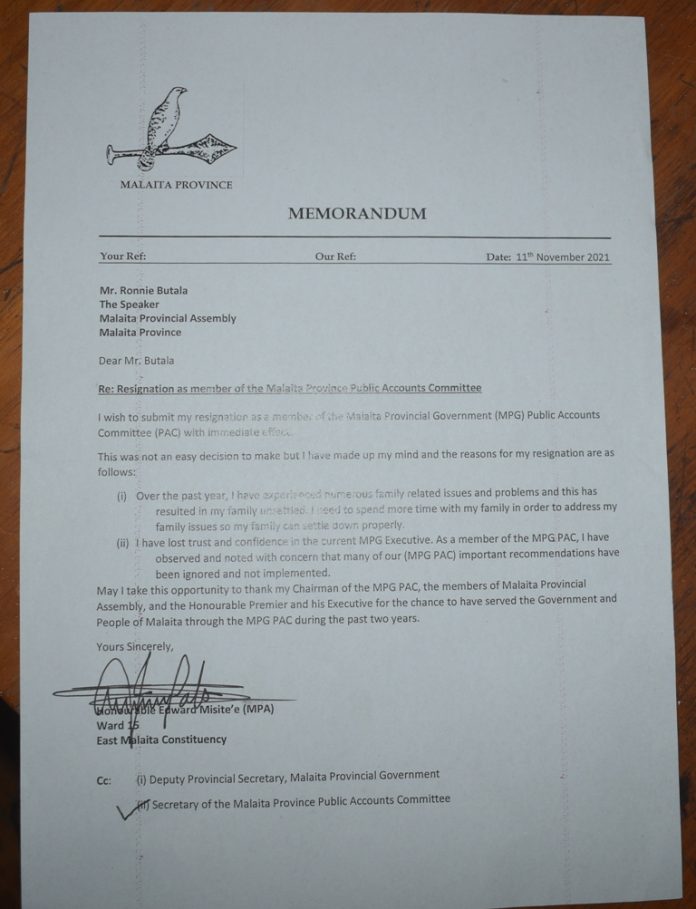
A resignation letter from Edward Misite'e

BY SAMIE WAIKORI

AUKI

MALAITA Provincial Assembly is currently without its Public Accounts Committee (PAC) after the recent resignation of three of its members (MPAs).

The resignation left the committee with only its chairman after another three committee members joined the executive.

Clerk to Malaita provincial assembly, Matthew Maefai recently told Island Sun as the assembly is preparing for its revise budget meeting, the PAC plays an important role in the budget proceeding and without them the budget won’t pass.

He said what the province needs is an urgent appointment of new members into the PAC to allow the progress of the budget to be passed for the delivery of services in the province.

Maefai said the three resigned members did so on the grounds of: family commitment, health, their insecurity and loss of trust in the executive government.

He said the members are MPA for ward 20 Jimmy Rerehe, MPA for 14 David Solo Baerara and MPA for ward 15 Edward Misite’e.

Maefai said the other three members who left PAC and joined the government are MPA for ward nine Eric Daoni Dauafa, MPA for ward six David Osuria and MPA for ward 19 Meshack Maukera.

He said the departure of these six MPAs from the PAC has left only its chairman, MPA for ward three Martin Fini.

Maefai said with only Fini, he won’t perform the role of the PAC as it needs the appointment of six new ordinary MPAs into the PAC.

He said the matter has become a concern to the office and the office of the speaker and it needs to be addressed so that it won’t hamper the budget.

Maefai said the executive has already completed the budget meeting and by now the PAC should have been looking into the budget.

He added as of Monday this week his office and the office of the speaker are yet to receive appointment of new members (MPAs) into the committee (PAC).

Landowner offers water for Gizo

Gideon Luaboe

BY BEN BILUA
Gizo

SEVENTY-three-year-old Gideon Luaboe says he is ready to offer the underground water source on his area at Malakerava for any water development in Gizo.

In an interview with Island Sun Gizo, he said the water source on his area never goes dry and is a potential water source that would supply water to parts of Gizo.

Luaboe’s area is at Malakerava 3 and most business houses have been visiting his area to collect water when water shortage strikes Gizo.

“It is an underground water and in the past 30 years I lived in Gizo, the water never went dry. If the government is serious about our water issue, build a huge reservoir, connect to storage tanks and supply water to eastern part of Gizo.

 “Similar development should be made for central Gizo and west Gizo,” he said.

Luaboe said there are lots of underground water source within Gizo vicinity that would make such development possible.

He stressed that Gizo water issue is a result of leaders’ lack of commitment for the welfare of people living and working in Gizo.

“I made a proposal to a group called Gizo Water Supply in the 90s but they just ignore the proposal. I don’t know what forced the group to ignore the proposal given the need of proper water supply in Gizo.

“I see this issue has no political support and this must change,” Luaboe said.

Gizo hospital opens to all, says Health

0
Gizo Hospital

HEALTH authorities have clarified that Gizo Hospital, Western Province, is opened to all and not only to those who are vaccinated with COVID-19 vaccines.

“Rumour that Gizo hospital is only providing medical services to those vaccinated with COVID-19 is not true,” a statement from the ministry said.

“Not at any time did the national nor the western provincial ministry of health issued a directive for such condition as prerequisite for anyone to receive medical service,” the statement added.

“Should anyone come across a health facility or medical worker advising of such condition, please call health’s emergency operation centre toll free line, 115 and provide details for relevant health authorities to address the matter.”

The statement says that it is crucial that all media outlets, even social media platforms and groups, take great precaution on information provided by the public for publication on print media and broadcast on radio as well as postings on social media group pages.

It says that when in doubt it is important to verify such information with the Ministry of Health’s media office on phone 24529 before publication.

Plea bargain in robbery case

0

BY JENNIFER KUSAPA

PUBLIC Prosecutor Margaret Suifa’asia assured court yesterday that prosecution has accepted a proposal made by defence in a 2015 robbery incident for a plea bargain.

She said there is room to accept the plea bargain proposed by defence counsel Bobby Harunari on the case of Nathaniel Junior Eric.

But since there are three defendants charged in relation to the same incident, prosecution will give time for other defence counsels representing the other accused persons to make their proposal for plea bargain on behalf of their clients.

Mrs Suifaasia said she is intending to address one legal opinion for all the three accused together and forward it to the Director of Public Prosecution for consideration.

High Court Judge Justice Leonard Maina then adjourned the case to November 29 for an update regarding the negotiations between the counsels.

This is in relation to the case against Ramo Stanley, Farobo Ben, Faiga Junior David and Nathaniel Junior Erick who were charged together in relation to an armed robbery incident.

Police alleged that the accused were masked and armed with a knife when they attacked two Asian men as they were about to enter the BSP bank.

The court was told that one of the Asian businessmen was struck with a knife and also shot from sling, the court was told.

Police also alleged that in one of the interviews one of the accused admitted having several meetings with the other accused days before the robbery and that they shared some of the money.

According to the prosecution, police recovered $200,000.

Children should be judged on their ability: Masepitu

0
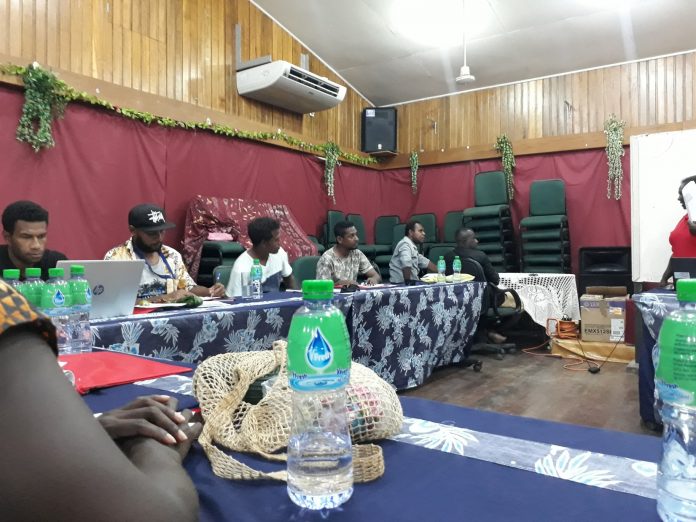
Part of the participants who attended the workshop

BY BEN BILUA
Gizo

LITERACY Coordinator of Western Province, Mavete Masepitu, says schools within the province lacked proper system to monitor children’s learning ability.

She said the existing system of monitoring and evaluation of children learning is more like judging children based on their performance and not their ability.

Masepitu suggests that a system where a diagnosing test on the ability of children performance should be done at the beginning of semester to determine children’s strength and weaknesses be put in place.

She stresses that the tests can determine areas where teachers and parents can collaborate in helping children’s learning at school and homes.

Masepitu said children’s learning differs from each other so as their learning ability and that it is important for schools to establish a system where children’s ability can improve their performance.

“It is obvious the teachers can easily recognise children ability to learn.

“We can categories children based on their learning ability and this is the baseline information we as teachers need to focus more to help the low learning children,” she said.

Masepitu said most schools in the country failed to accommodate proper approach towards children learning more especially an environment where children with special needs can best fit in the learning process.

She adds that there are children with special needs among other children in classrooms and lack of proper learning process forced children with special needs on the bottom of the learning process.

Masepitu said the lack of schools available for children with special needs is also a huge problem that needs immediate attention.

She made the statement during a stakeholders meeting organized by Save the Children to discuss how “Helpem Smol Wan Skool Gud” project can be delivered effectively.

Helpem Smol Wan Skool Gud Project is implemented by Save the Children through funds from Education Sector Support Program (ESSP).

Education Sector Support Program (ESSP) is a joint partnership between the government of Solomon Islands, Australia and New Zealand toward education development and services in the country.

WinWin told to halt its mining operation

By EDDIE OSIFELO

CHOVOHIO Midstream Association wants to see WinWin Investment Solomon Limited halts its mining operation at Turarana in Central Guadalcanal.

This was after claims they did not receive royalty payments comparable to the loss and damage caused by the operation on their environment and land.

Chairman Joel Jackson said the mining operation is now on pit 6 and they want the company to halt its operation now.

Jackson said their call followed by Gaenalu (Moro) Movement of Guadalcanal and Guadalcanal Post Conflict Reconciliation, Rehabilitation & Restoration Association (GPCRRRA) earlier who asked the Minister of Mines, Energy and Rural Electrification, Bradley Tovosia, to stop the operation as well.

“I call on the chairman of Koihoto Landowners Association to call an urgent meeting to discuss the operation of Win Win.

“We realized the company did not pay its royalties to the people from January to December this year,” he said.

However, the company said it cannot response to Jackson in the media because he has issues with them.

The Company said it can only response on the issue if the 2000 people in the community request the information.

According to WinWin mining report on 10th July 2021, alluvial gold mining is continuing and progressing well at the Turarana (Kavahambe) alluvial flats during the month of June, 2021 within Pit 5 that was initially opened up at the start of April 2021.

Pit 5 is located just to the south of previously mined out and rehabilitated Pit 4.

Mining output production data for the month of June totaled 76,100.0 cubic meters of ore gravels hauled and processed from which 24,387.12 grams (784.15 oz at 31.1g/Oz) of alluvial gold was recovered.

Production from 2019-2020 and January to June 2021 totaled 1,194,210.0 cubic meters of ore gravels mined and processed with total gold recovered from its being 115,708.65 grams (3,720.52 oz)

In June 2021, WinWin exported 24,337.97 grams (782.57 Oz) of gold bars or pellets  to its buyers in Hong Kong.

It is the 16th gold consignment ship from the company.

The June export consignment is now the 6th month of alluvial gold export consignment from the Turarana Mining Lease MML02/18 operations.

The export was facilitated by the Director of Mines who signed and authorized the Export Permit.

From the current practice of royalty’s payment, the Company pays 3 percent royalties from its gold export to the Government who then is responsible to pay the landowners and the concerned Provincial Governments hosting the operations accordingly.

The 3 percent royalty payment is then proportioned at 50 percent to the Government, 40 percent to the two Turarana Landowner’s Associations and 10 percent to the Guadalcanal Provincial Government.

Students visit Rove Correctional Service

0
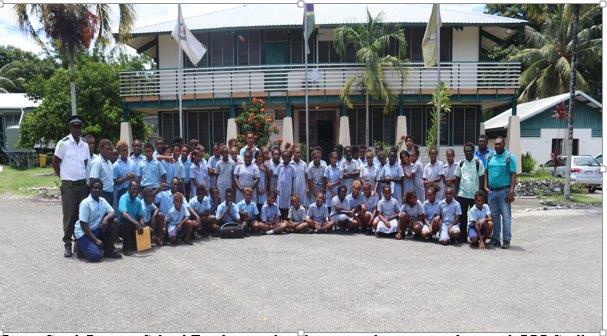
Burns Creek Primary School Teachers and students pose for a group photo with RRR Staff after their visit inside RCCC.

A delegation of 72 students and three teachers from the Burns Creek Primary School led by Head Teacher Raynold Sikepitu conducted an hour’s educational visit at Rove Central Correctional Centre.

The students first entered the Correctional main entrance gate where they were warmly received by the Commandant Rove Central Correctional Centre Chief Superintendent Catherine Kere and her Acting Chief Security Officer Lawrence Isa.

Kere informed the students the protocols and rules of the Rove Central Correctional Centre.

The student first visited three blocks in the Centre including block-three for female inmates, block-five for long serving inmates and block-three for Juveniles inmates  

The school visitation is a part of their learning capacity development, said the Headmaster.

“It is very important for the primary student to visit Correctional facilities, inmates and environment here at the Centre to ensure that the student should experience the real life in the Centre rather than hearing stories from anybody else outside there.”

Kere expressed her appreciation to the Head Teacher for his continuous support to the organisation especially with regards to supporting inmates with prayers.

She said, CSSI looks forward to further collaboration with the Burns Creek Primary School for future visitations.

Head Teacher Sikepitu said as a result of the Covid-19 pandemic, “we are so lucky and fortunate to visit our inmate’s brothers and sisters here in the Rove Central Correctional Centre”.

–CSSI PRESS

SICCI hails student visit to airport project site

International Cooperation Department Consultant Tetsuya Ishikawa showing the progress of the project

THE Solomon Islands Chamber of Commerce and Industry (SICCI) describes the recent site visit to the Honiara International Airport Improvement Project by Civil Engineering students from the National University (SINU) as a positive step forward in its continuous effort to realize local participation in major infrastructure projects in the country going into the future.

SICCI acknowledges Gyros and Kitano Construction Cooperation and Japan International Cooperation Agency (JICA) Solomon Islands for this initiative which is understood to be one of the positive outcomes of a recent Infrastructure Symposium the Chamber hosted which brought together key stakeholders in the infrastructure development sector.

“At the Symposium, I and my colleague presented a brief introduction about this Airport Project and informed the participants of an intention that the project member would be planning to hold a site observation tour for students who are learning civil engineering in Solomon Islands.

Today (Tuesday 16 November) we made it a reality,” Motoyuki Uegaki, Resident Representative of JICA, said.

At the Symposium, Mr Uegaki said the issue their Projects are facing is a shortage of Engineers or Technicians in specific construction area in the local market and that job training is the most important factor for the future Employment Promotion through Public – Private Cooperation.

During this week’s site visit, he uttered that it is a bit hard to find enough resources who are able to provide a certain level of engineering knowledge and skills in the country, however, recognize that these students will be crucial engineers who will be able to drive the infrastructure development of Solomon Islands in the near future.

Project Manager Takeshi Iwasaki, of Kitano Construction, said: “Solomon Islands needs the participation of young people in the task of nation building.

While we are making good quality things, nurturing of local workers is also our important objective.

In line with this, I am looking forward that many engineers will be trained among you for the future development of Solomon Islands.”

SICCI maintains that we can maximise the benefits of infrastructure spending in the country if there are policies and regulations in place to promote local content.

“Focusing on maximizing local content ensures that local workers have a job that will lead to skills development and transfer.

“Not only that but local suppliers will also have an opportunity to grow in the market, and local companies will develop and contribute to revenue that remains in the country and promotes the standards of local private sector,” a SICCI statement said.

One of the outcomes of the Infrastructure Symposium in October was to get an overview of infrastructure projects across the country and to gauge its impact on the local economy.

The Honiara International Airport Improvement Project is one such project which is a $340 million Japanese Government funding that will add tremendous value to the economy.

The project is scheduled to be completed by 2023, just in time to cater for the anticipated increased demand of people arriving in July 2023, when Solomon Islands host the 2023 Pacific Games.

The completion of the Airport Project will coincide with the completion of another major infrastructure project funded and built by the Government of Japan, the second phase of the Kukum highway project.

-SICCI Media