PM and Western Premier giving 3 happy cheers marking the provincial appointed day
BY BEN BILUA Gizo
PRIME Minister Manasseh Sogavare has called on landowning groups not to scare off investors but work with them to establish developments.
He said investors invest in the country, however the lack of land available continues to stop investors from investing in the country.
“Land must be made available for development. We must not scare away investors by our unfriendly attitudes,” Sogavare said.
“We need to bear in mind that changing the structure of our government system alone does not guarantee the benefits we are talking about. They are benefits that flow from developments happening in the states,” he added.
According to a research carried out by two Solomon Islanders, Customary land in Solomon Islands is already working as it always has.
The report states that many current economic activities such as logging, copra, cocoa and other agricultural crops are happening on customary land.
“This means the bulk of our national economic gross domestic product (GDP) comes from customary land, so I don’t think customary land needs opening up,” Joseph D Foukona, one of the researchers said.
“What is more important when we discuss land reform is making sure that all landowners receive equitable returns from development on their land,” he added.
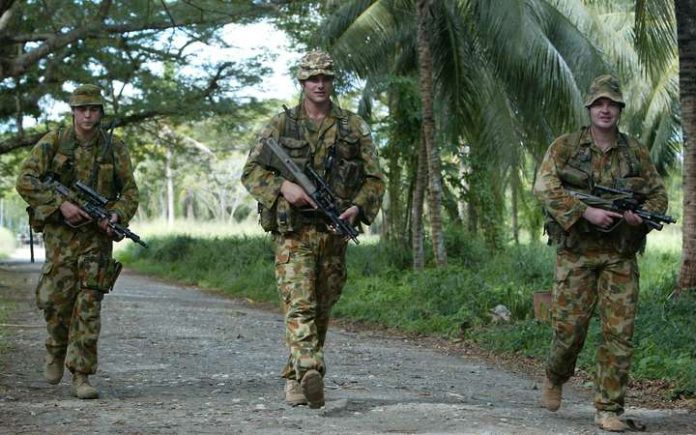
RAMSI personals in the country in 2003. PHOTO SUPPLIED
JAMES BATLEY*
One of the noticeable features of Australia’s response to the Solomon Islands government’s request for security assistance on 25 November was Scott Morrison’s instinctive desire to broaden the response to a regional level.
Solomon Islands Prime Minister Sogavare reached out separately to Papua New Guinea – something welcomed by Australia – but Australia acted quickly to encourage at first Fiji, and then New Zealand, to contribute personnel.
Unexpectedly, the deployments have given a fresh lease of life to a persistent and curious claim about the origins of the Regional Assistance Mission to Solomon Islands (RAMSI) in 2003: that, but for the intervention of then New Zealand Prime Minister Helen Clark, RAMSI would have been an Australian-only operation.
The claim emerged in a chapter by Nicola Baker in The New Pacific Diplomacy (2016), co-edited by Greg Fry and Sandra Tarte.
In his own definitive history of Pacific regionalism, Framing the Islands (2019), Fry endorsed Baker’s judgement, writing that she had argued “persuasively” on this point. But what is the evidence for the claim?
Baker cites two New Zealand Herald stories as evidence.
The first, by Audrey Young, was written in the wake of the 2006 riots in Honiara.
Although not quoting anyone directly, Young wrote that “[Clark] negotiated hard with Howard on the ground rules for Ramsi [sic] and both have a strong sense of investment in it.
New Zealand insisted on the approval of the Pacific Islands Forum and the involvement of as many island states as possible – not to mention the invitation of the host country.” (Note here the insinuation that Australia might have been contemplating an intervention in the absence of an invitation from Solomon Islands.)
The second story, by Claire Trevett, was written at the time of the 2008 Pacific Islands Forum leaders meeting in Niue.
The story quotes Clark as saying “We had to work very hard to see that it actually had a Pacific flavour. It became a mission mounted really under the auspices of the forum, rather than just being an Australia/Solomons bilateral initiative.”
Clark was asked directly about this set of claims during a recent Twitter discussion. She did not repeat the view attributed to her by Young and (more emphatically) Trevett that it was she who was responsible for turning RAMSI into a regional exercise.
She posted as follows: “Details are lost in the mists of time, unless detailed research is done on Cabinet papers & my press conferences at the time. I was concerned that RAMSI not be an Iraq-lookalike, that Solomons Govt had agency & that its capacity was built, & that PIF nations were involved.”
Well, one person who has done detailed research on Cabinet papers is Australian historian Bob Breen, author of The Good Neighbour, the fifth volume of the official history of Australian peacekeeping which focusses on the south-west Pacific.
Breen’s work provides no evidence to support the claim that Australia was planning a unilateral intervention, let alone one that would be launched without an invitation from Solomon Islands.
On the contrary, Breen quotes a May 2003 letter from then Foreign Minister Alexander Downer to Prime Minister John Howard stipulating that an intervention “had to be at the invitation of the Solomon Islands Government, receive the endorsement of the Pacific Islands Forum and be accompanied by Pacific Islands military and police contingents.”
If, prior to this letter, there were high level communications between Prime Ministers Clark and Howard which influenced the latter’s thinking, they are not recorded in the voluminous papers canvassed by Breen, nor in the interviews he conducted as part of his research, including with Howard.
Quite apart from the documentary record, though, how plausible is it that the Australian Government would have planned a unilateral intervention in 2003?
This was a time when the South Pacific Peacekeeping Force to Bougainville (1994), the Bougainville Truce and Peace Monitoring operations (from 1997 and still in place in 2003), INTERFET in East Timor (1999-2000), not to mention the International Peace Monitoring Team in Solomon Islands itself (2000-2002) were still fresh in everyone’s minds as models for regional security cooperation.
Australia played a leading role in all of these operations, every one of which was organised along regional (and international in the case of INTERFET) lines.
This would surely suggest that even back in 2003 – the mists of time if you like – Australia well understood the utility and legitimacy offered by collective rather than unilateral action in its immediate region.
And it is beyond implausible that Australia would have launched an intervention in the absence of an invitation to do so from the government of Solomon Islands.
It is true that there were debates between Australia and New Zealand about the posture of the initial RAMSI deployment: to put it crudely, Australia argued for a ‘shock and awe’ approach as against New Zealand’s preference for a more ‘softly softly’ approach.
Those debates (and the impacts of the decisions made) are more interesting and indeed more relevant to the current situation in Solomon Islands than any origin debate for which the evidence is scant – although that is a story for another time and place.
The idea that Australia might have been planning a unilateral intervention in Solomon Islands in 2003 serves a conventional (and rather lazy) narrative which contrasts Australia’s supposed insensitivity in the region to New Zealand’s cultural competence.
But that doesn’t make it true.
Breen’s book may not necessarily be the last word on this subject, but until better evidence comes along, we are surely entitled to exercise scepticism about the claims originally reported by Young and Trevett.
This article appeared first on Devpolicy Blog (devpolicy.org), from the Development Policy Centre at The Australian National University.James Batley is a Distinguished Policy Fellow at the Australian National University’s Department of Pacific Affairs. He served as Australian High Commissioner to Solomon Islands from 1997 to 1999 and as Special Coordinator of the Regional Assistance Mission to Solomon Islands from 2004 to 2006.
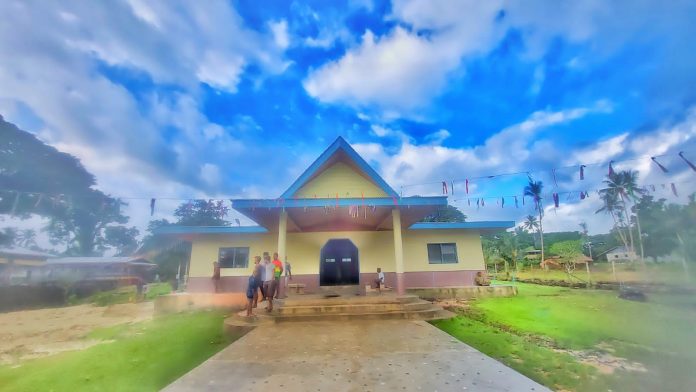
The people of Takwa village, North Malaita, celebrated the dedication of their newly completed church over the weekend.
The three-day programme kicked off on Friday and culminated in a finale on Sunday, marked with much feasting and celebrating.
St Therese Takwa Parish of the Northern Deanery, Auki Diocese, celebrated the dedication of their church building, which took nearly 20 years to complete.
Speaking to Island Sun from Takwa over the weekend, chairman of the working committee, Dr Lawrence Diau, underscores the huge significance the occasion is for the Takwa community.
Bishop Peter Houhou being escorted by youth Parishioners
In paying homage, Dr Diau said the road has been long and hard, with some loved ones having passed on and not being able to be present with fellow Takwans to witness this momentous occasion.
“The church can accommodate a congregation of 1000-plus,” an elated Dr Diau adds.
Also listed among the achievements to be celebrated are the completion of the new house for the priest, “Patere”, rest houses and significant monuments for the people of Takwa.
Parish Priest, Fr. Selerino Diau(left) holding a shell money gifted by visiting parishioners from Maluu Parish.
Mr Diau said, “Since my committee came in less than 24 months ago, we were able to pick up from where the works left off, and complete the church building, which had taken about 20 years to complete.”
The working committee is based in Honiara, and all their activities are focused on the church construction and the needs to make the work progress.
“We are also able to complete the new house for the parish priest, Patere, plus the rest house and some significant monumental structures in this parish.
Bishop Peter Houhou of Auki Diocese
“It is something significant for the people here, a new path, and significant positive thing to their belief and faith.”
The highlight of the opening day on Friday was the presence of the Bishop of Auki, Peter Houhou. A special welcome was staged by the St Therese youths.
Diau estimates that “between 5,000 and10,000” people graced the three-day occasion, with invitation having been sent to other parishes within the Northern Deanery of the Diocese of Auki.
“The highlight of the programme will be the blessing of the building, which will be held on Sunday, feasting and entertainment will be held which will make it a good three days of happiness and celebration,” Diau reports.
The celebrations at Takwa
Diau says the Takwa community and his committee feel proud and happy with their achievement.
He adds by acknowledging those who have helped in the journey to complete their buildings.
“On this note, we would like to highlight and thank the sponsors who have supported us. Business houses, individuals and family and friends overseas who have assisted in goods and kind.”
The programme began on Friday and ended on Sunday, December 19.
Relationship stronger than ever after riot and looting
BY CHARLES KADAMANA
CHINA-Solomon Islands bilateral relations is stronger than ever before after being tested with the recent riot and looting.
This was reiterated by State Councilor and Foreign Minister Wang Yi during his conversation with Minister of Foreign Affairs Jeremiah Manele on Friday.
He claimed the recent riots erupted under complicated background.
“Some forces with ulterior motives took the chance to smear China-Solomon Islands relations and attempted to subvert the outcomes achieved since the establishment of our bilateral ties.
“It does not comply with the interest of Solomon Islands’ people at all and is doomed to fail.
“After this test, China-Solomon Islands relations have become stronger than ever before.
“China is fully confident in the prospects of bilateral relations and will take a series of measures to support and assist Solomon Islands in restoring order and reconstruction and achieving stable development,” he said.
Mr Yi said that Solomon Islands is an essential member of the South Pacific region and the family of developing countries.
“China and Solomon Islands share broad interests. It will continue firmly upholding multilateralism in the international arena and vigorously defend the legitimate claims of developing countries, especially those of medium and small-sized countries.
“At present, both sides need to be vigilant against a few countries’ attempts to constantly interfere in other countries’ domestic affairs in the name of human rights under the Cold-War mentality and jointly uphold the basic norms of international relations and international fairness and justice,” he added.
Mr Yi said Solomon Islands is a good friend and good partner of China. The establishment of diplomatic ties between both countries fully serves the long-term and fundamental interest of Solomon Islands’ people and fully meets the trend of our times.
“Ever since that, the two countries have been respecting and supporting each other, treating one another as equals and seeking common development.
“Both countries have worked together to effectively defend the shared interests of both sides and bring benefit to the two peoples.
“Our bilateral relations have become a model of friendly exchanges between countries of different social systems and sizes,” he said
Mr Yi said China attaches great importance to developing friendly relations with Solomon Islands and stands ready to work with it to implement the important consensus reached between the leaders of the two countries and promote lasting and steady progress in bilateral relations.
He said the serious riots not long ago has affected the safety and daily lives of local citizens and overseas Chinese residents.
“We extend deep sympathies and sincere condolences to Solomon Islands’ government and people and strongly condemns all violent acts.
“We stand firmly with Solomon Islands’ government and people, staunchly supports the government’s efforts to maintain stability in the country, and resolutely protects China-Solomon Islands relations and the legitimate interests of the Chinese citizens in Solomon Islands.
He hopes and believes that Solomon Islands government will take all necessary measures to protect the safety of local people and the Chinese citizens according to law.
Meanwhile Manele extended warm congratulations on the successful convening of the sixth plenary session of the 19th Central Committee of the Communist Party of China.
He thanked China for providing enormous support and assistance to his country’s economic and social development and expressed sincere condolences for the property losses suffered by the Chinese citizens in Solomon Islands during the riots.
Manele said his conversation with Mr Yi demonstrates that we firmly stand together at difficult times.
He assures China government that the situation has gradually returned to normalcy.
He said Solomon Islands highly values its relations with China.
“It will continue strictly abiding by the one-China policy, which is the political basis of developing Solomon Islands-China relations.
“It is the responsibility of Solomon Islands side to make all efforts to protect the safety and legal interests of the Chinese citizens and Chinese-funded organizations in Solomon Islands.
“Solomon Islands is ready to work with China to enhance coordination and cooperation, effectively uphold multilateralism, and safeguard,” Manele said.
Crowd of protestors in Honiara. PHOTO: Mavis N Podokolo
By EDDIE OSIFELO
MINISTRY of Education and Human Resources is under pressure to find a solution to the issues facing youths in the country following the last month’s riot and looting in Honiara.
This came after 33 juveniles of the 217 people were arrested on the initial stage of the unrest.
Minister of Education and Human Resources, Lanelle Tanangada told Parliament during the Sine Die motion recent that two questions came to her mind after reading the new on newspaper.
The questions are:
How else can we educate and train our children so they can learn positive behavior and not easily influenced by others and do not even join mobs that caused violence?
How else we can teach our children so that they not only possess the necessary skills and competency and right attitude to survive in this ever changing world and contribute positively to the social and economic development of this country but also become law abiding citizens who can freely live with their fellow citizens and environment as well demonstrate respect for one and another, respect the properties, express their opinions on sensitive issues that affect them but with caution and understanding irrespective of their differences such ethnicity, culture, religions and political affiliation?
Minister Tanangada said this recent riot and involvement of many youths in looting and burning of shops in Honiara has exerted more pressure on her ministry to step up its plans and efforts to educate and train our young people so that they are not left behind and be prepared well for the future.
She said the burning of Honiara High School is very very sad indeed.
“Why would rioters target a learning institution?
“It should be the least building rioters should target,” she added.
“These are the many challenges that we must find solutions to and the intervention that my ministry would consider would form the basis of our reform agenda to improve quality of our education system.
“Despite the gaps in education system to prepare our young people for future, Iam still optimistic and hopeful for a future yet some difficulty decisions have to be made as we progress in terms of designing learning pathways for our young people,” she said.
“And I believe we can use education as a tool to empower our young people so that they can realise their full potentials and choose to make good choices and decisions that can avoid them resort to violence,” she said.
Tanangada added there is a need to insert peace education in the curriculum to promote culture, peace and unity.
Dr Nemia Bainavalu, left, Dr Janella Solomon second right and Dr George Wilson Malefoasi cutting the cake to celebrate the christmas party of National Referral Hospital at Pacific Casino last Friday
BY EDDIE OSIFELO
THE NATIONAL Referral Hospital in Honiara has recognised its staff in the 33 plus departments for their efforts, dedication and commitment this year at the Pacific Casino last Friday.
These included the high performers or best achievers as recommended by each department of the hospital for their performance rooted in focus, dedication, hard work and a desire to excel.
Speaking at the Award Ceremony, NRH Chief Executive Officer, Dr George Wilson Malefoasi said today (last Friday) is a special day of recognition to all of you, for your service to mankind, the sick and people in need.
Christina Katu’u receives her award from Dr Solomon.
“We may have some flaws, weaknesses, and shortfalls but the minimal care offered is something not to be neglected.
“Today we renew our pledge to continue our commitment to our country, to our people through the communities,” he said.
Dr Malefoasi said their core values of health are everyone business through excellence, innovation, collaboration and accountability are the foundation of their commitment to help them to grow.
Ruth receives the NRH CEO award.
“We are bonded intellectually, personally, professionally, and culturally.
“Our mission is to provide each patient we serve with quality care that should be affordable and accessible,” he said.
Dr Malefoasi said despite the challenges of the past 12 months, they have been able to sustain and maintain basic minimal hospital care to their people.
Constance Bukiri of Laundry Department receives her award from Dr Solomon.
He concluded that despite many challenges faced by the Government, people, and especially the unforeseen circumstances, “we will never give up.”
In addition, Dr Malefoasi acknowledged the Permanent Secretary and Ministry of Health and Medical Services for the continuous support to the hospital, corporate and services staff and management of the MHMS, World Health Organisation, DFAT, JICA and private businesses like LKK, Origin Gas, Food works, Sullivan.
Dr Augstine Fonoata receives his award from NRH CEO Dr Malefoasi
A NRH 2021 Award committee consisting of Medical Superintendent Dr Janella Solomon, Rosemary Kiriau the Secretary, Sr Betty Ramolelea, Ileen Geli, Sandra Tavake and patron Dr Rooney Jagili.
Director of Government Communication George Herming, left with members of the SI cultural group arriving in Dubai.
The Solomon Islands delegation to the Dubai 2020 World Expo led by the Minister of Commerce, Industry, Labour and Immigration Hon Frederick Kologeto arrived in Dubai on Sunday 19 December ahead of the Solomon Islands National Day on December 21.
The delegation consisting of Government and Private Sector Officials and cultural performers arrived on separate flights from Sydney and Singapore and were met by Solomon Islands Deputy Commissioner General (DCG) Dennis Marita and Staff of the Solomon Islands Expo Pavilion.
The 10-member performing group includes five pan pipers from Makira Ulawa Province and three contemporary musicians accompanied by the Director of Government Communications Mr. George Herming.
The Solomon Islands National Day will be celebrated at the main Expo Pavilion tomorrow.
Deputy Commissioner General Dennis Marita, left welcomes the SI cultural delegation on arrival at Dubai.
The event provides a rare opportunity for Solomon Islands to promote its investment opportunities and way of life to the outside world.
Some countries around the world have already celebrated their National Days and promoted their countries to the host country and international visitors which were attended by the Solomon Islands Pavilion Staff.
Minister Kologeto is expected to deliver the Solomon Islands Expo statement during the event to be followed by an explosion of cultural and contemporary performances by our local artists.
“This is our unique opportunity to highlight our country to the outside world and I would like to thank the Government and people of the United Arab Emirates (UAE) for this wonderful opportunity,” said DCG Marita.
Marita briefing the SI delegation. Photos: Supplied
The Solomon Islands Expo official team is being headed by the Commissioner General His Excellency Ambassador Moses Kouni Mose supported by DCG Marita and representatives from the Government and Private Sector since the opening of the Expo in September this year.
According to Mr. Marita, the Solomon Islands Pavilion has attracted thousands of international visitors so far with hundreds buying locally made products on sale at the event.
The Expo will officially end in March 2022.
The Solomon Islands official delegation are expected to return home at the end of this month.
ONLY 9.9 percent of elderly people are fully vaccinated with only 33.8 percent having their first dose.
This was confirmed by Prime Minister Manasseh Sogavare in his latest national address delivered on Friday.
“9.9 % of our elderly population are fully vaccinated and 33.8% have had their first dose. We encourage families to help the elderlies including those with terminal illness, disability to reach vaccination centres to get vaccinated because if we have community transmission, the elderlies are more vulnerable, ”Sogavare said.
He further adds that about 54percent of all people vaccinated are males and 46 percent are females.
“I encourage our women and girls, to come forward and get vaccinated,” Sogavare said.
He adds that to go out to vaccinate people costs a lot of money for health teams.
Sogavare stressed that after eight months of vaccination, the health ministry has administered a total of 267, 338 doses of COVID-19 vaccines both for AZ and Sinopharm vaccines and includes first and second doses.
“This represents only 32 percent of the total doses we must give to fully vaccinate the 414,327 eligible adults in Solomon Islands which is 828,654 doses”.
“73,540 people are now fully vaccinated against COVID-19, which is 17.7 percent of the total eligible population. 120,258 people, or 29 percent, have had their first doses and we encourage all to come get their 2nd doses,” he said.
Kava stalks are distributed to youths from wards 15 and 16 during a youth kava training at Faumamanu this year.
BY SAMIE WAIKORI
AUKI
MALAITA Provincial Youth Desk has reassured its commitment to reach out with its “Youth Kava Training” for youths in Malaita province.
According to information received from the office, the training program is ongoing and they will make sure it reaches 27 wards in the province.
It said Malaita has 33 wards, six of them are coastal wards which will look at fishery projects, while 27 wards are to roll out with the kava program especially for youths.
And out of these 27 wards, seven wards had been visited with the youth kava training program while 20 wards are yet to approaced.
The wards included; wards two, four, six, seven, 10, 15 and 29 and more than 600 youths had attended the kava trainings programs in their respective wards.
Also during the trainings, youths were distributed with kava stalks to encourage them into the industry.
According to the youth office, the program is part of MARA government’s policy of restorative economy that encourages Malaitans to make great use and benefit from their abundant resources.
The policy promotes self-reliance and as part of it, the kava training program is encouraging youths to think self-reliance and do away with the dependency syndrome.
The kava training is part of the provincial youth office’s priority programs and they will ensure all youths in the province benefit from it, despite budget hindrance the office is facing to roll out the program.
Danny Kennedy outside the Gizo Hotel. Photo Supplied
BY BEN BILUA Gizo
ADVENTURES are full of surprises; some cannot never be forgotten for years. The world is full of surprises and human beings must step out from their comfort zone to see what the world can offer.
This is what happened to a backpacker who left his home country in 1985 on an adventure to explore Solomon Islands.
His journey exposed him to the beautiful islands and people of Solomon Islands where he chose to become a citizen.
This is the story of Danny Kennedy, owner of Dive Gizo. He has run his business in Gizo for over 35 years.
With curiosity about his history, I sat down with Kennedy for a chat and I nailed it! Striking a conversation which brings back Kennedy’s fond memories of when he first set foot in the Solomon Islands.
“I first came to Solomon Islands in 1985 as a backpacker tourist. Back then there were no invasion of destructive development like logging. The Islands were beautiful with diverse resources.
“Not to forget the lovely people of Solomon Islands. I was young and strong then so I travelled to quite a few Islands in Solomon Islands. I’ve been to Malaita, Tulagi and of course Western Province,” Kennedy said.
He said his adventure brought lots of mix feelings one of which is to venture into tourism with much focus on diving.
Danny Kennedy second from right at Dive Gizo Office in Gizo
After spending sometimes in the country, Kennedy went back and return with his much anticipated plan that is to establish a Dive Shop at Gizo.
His plan went successfully and he set up a little Diving Shop now called Dive Gizo.
“I’m a dive instructor so the first time I visited Solomon Islands, I went with some of my friends on diving expeditions in a numbers of sites. I can’t express what I saw, the corals, fish and other marine resources are spectacular.
“The underwater world in Solomon Islands is different and that caught my attention,” he said.
The year that followed, Dive Gizo became one of the leading Diving destinations for tourists in Solomon Islands.
Being the first to establish in Solomon Islands, the news spread to the outside world which led to tourists flooding into the country trying to get a glimpse of Solomon Islands’ underwater world.
“It was gold, in the early days of my business and I managed to invest more and expands my business.
Coral Reefs in Western Province. Photo taken from Dive Gizo Website
“I managed to build few properties in Gizo and also help in provincial development undertakings.
“My contributions to the economy of this country helped be me to become a citizen, to which I’m proud off until today,” Kennedy said.
At one stage of his life as a Solomon Islander, Kennedy entered into politics at the provincial level winning three times as a Provincial Member.
He said he is not a fan of politics but became one due to suggestions from locals and he was happy to contribute towards Western Provincial assembly.
According to Kennedy, doing business in Solomon Islands has been a challenge with little opportunities for tourism operators.
“I’ve heard leaders talking about tourism development for years but there is not much happening on the ground.
“I’m of the view that the tourism industry is one of the sectors that is going to help drive the country’s economy if there is more support granted to the sector.
Underwater world of Solomon Islands. Photo supplied
“Solomon Islands for that matter has all that is required to put tourism on the world chat. We have beautiful islands, corals reefs, fish, birds, reptiles and many more as potential markets. Furthermore, we have a huge potential on other tourism activities like surfing.
“All these opportunities can be achieved and all these resources can be maximized if there is political will to drive tourism development in this country,” he said.
As a long time diver in Solomon Islands waters, Kennedy said Solomon Islands underwater world has the best offer to the outside world.
He said diving is one of the most attractive activities that brings tourists to Solomon Islands.
“There are marine species that counts as specific surprise for tourists. We have the beautiful corals and reefs that cannot be found nowhere in the world.
“I’ve been diving in Solomon Islands waters for over 35 years and I’ve been greeted by new things each day I go under water,” Kennedy said.
While all the glamorous adventures put Kennedy and his business on the top of diving business in Solomon Islands, the pandemic has crippled his business.
Border restriction has stopped tourists from travelling which is a major blow not only to Dive Gizo but also other tourism operators.
“My business had survived many crises but the pandemic is the worst one ever. I’ve survived the ethnic tension and the 2007 Tsunami. I was able to bounce back quickly with business operation and recover.
“This pandemic is different, I’ve lost my employees due to limited financial resource some of my employees were forced to stop working while others are on casual basis. It’s a sad decision but I have no choice but to do what’s best for my business to open its door,” he said.
Kennedy said the pandemic and also challenges in running a business in Solomon Islands has taken its toll on him and that he is planning to deracinate his business and look for new opportunities somewhere.
“As I’ve said, doing business here is very expensive and challenging. Everything is expensive, from electricity to other bills and I thing I had enough.
“My decision will be based on how I can survive this pandemic and also the growing expenses of doing business here,” he said.
Dive Gizo not only contributes to the country’s tourism industry but also provide employment for locals.
Last week, Dive Gizo officially opened its new office.
Danny Kennedy far right with Provincial Minister of Tourism cut the ribbon to officially open Dive Gizo new Office (1)
For those with an interest in history, Dive Gizo have researched the local WWII war history in Washington, USA, and have information on well-known subjects, such as John F. Kennedy and the PT109.
Diving highlights are the intact Japanese transport Toa Maru, three WWII aircraft, unlimited wall diving, coral gardens and exciting drift dives for the more experienced divers.
Bush walks to WWII land sites, village tours and bird watching excursions can be arranged.
Dive Gizo assisted the Institute for Exploration headed by Dr Robert Ballard and National Geographic in their successful search for the remains of PT109 in 2002.
Dive Gizo has well-trained local drivers who have the potential to help in underwater activities.