Home Blog Page 747

Economy struggling, according to CBSI report.

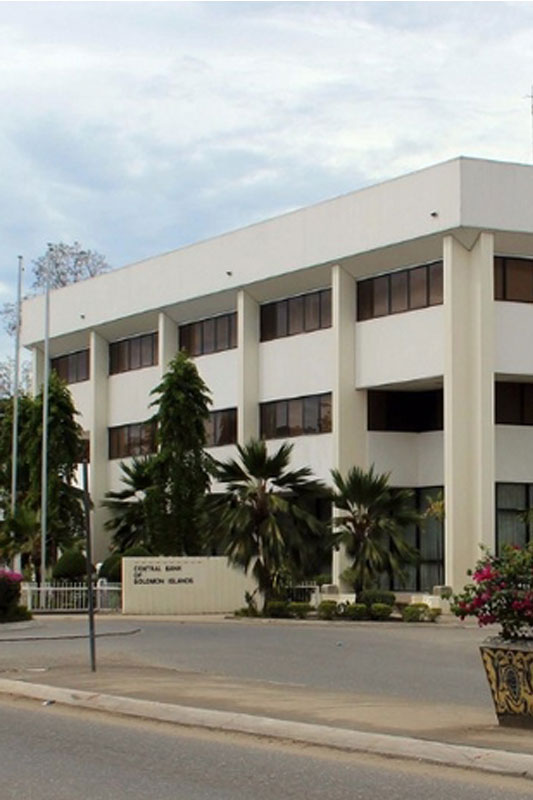
Central Bank of Solomon Islands. Photo by CBSI

Domestic economic activities remained broadly weak across all sectors since the COVID-19 pandemic took hold two years ago.

In its report yesterday, CBSI estimated that the Solomon Islands economy contracted by -0.6% in 2021, reversing the positive 0.4% recovery forecasted earlier in September 2021.

This downgrade mainly reflected the adverse economic impact of the November riot which pushed the economy back into recession at the close of 2021.

 Growth for 2022 is projected to further decline by -7.3%, owing to sluggish economic activities due to ongoing control measures to mitigate the impact of the pandemic.

Underpinning the contraction is the adverse impact of the community transmission with associated lockdowns and daily curfews.

 Over the medium term (2024-2025), the recession is expected to bottom out and the economy is projected to rebound by an average growth rate of 1.5%, as vaccination rate increases, and international border restriction eases.

 Headline inflation remained subdued in 2021 and is expected to be contained at 3.2% by the end of 2022.

Core inflation is projected to register at the upper band of 3.5% by end of 2022, on account of more pronounced supply constraints which outweighs the current weak demand in the economy.

Elevated risks to this outlook remain and is subject to revision.

 Against the back drop of expected decline in economic activities in 2022/2023, fiscal position is projected to remain in deficit amid expected lower domestic revenue collection and elevated spending commitments.

With higher spending pressures, the fiscal deficit is projected to widen by 6% of GDP in 2022, or 9% of GDP with a fully-fledged policy response.

 On the external front, the current account deficit is projected to widen by 9% of GDP in 2022, on the back of slower exports and FDI inflows.

Although, this deficit is anticipated to be partially financed by the surplus capital and financial accounts, it is insufficient to offset the anticipated deficit over the medium term when economic activity is expected to pick up.

Accordingly, gross foreign reserve is projected to slow down by an average of 1% over 2023-2025 but remain adequate for trading needs. 

 Meanwhile, developments in the monetary sector are expected to fall in 2022/2023 in line with growth forecasts. Over the medium term, monetary aggregates are expected to grow moderately, as the economy rebounds.

 Policy response. The country is currently facing two key impending challenges – that of health and the economy.

Policy reprioritization is presently critical to mitigate the economic fallout. CBSI will continue, as part of its mandate, to support the Government to address the economic challenges.

It is also expected that other stakeholders and our development partners will continue to support the Government to address both these challenges.

Finally, everyone should get their vaccination.

Australia provides aircrafts to support COVID efforts

0

Australia yesterday deployed two Royal Australian Air Force (RAAF) C-27J Spartan cargo aircraft to Honiara to deliver medical and other essential supplies to provinces experiencing a surge in COVID-19 cases.

The C-27Js, which was deployed in response to a request from the Solomon Islands Government, will also be used to distribute personal protective equipment (PPE) for health workers and emergency food aid to the provinces hardest hit by the pandemic.

The aircraft will also support the delivery of six Australian-supplied ‘bricks’ of medical equipment and consumables to be distributed in provincial hospitals.

The deployment will be undertaken in close partnership with the Solomon Islands Government.

The 15 cubic metre “bricks”, currently being assembled in Brisbane, contain oxygen equipment and consumables, medication and PPE specifically designed to provide care to those unwell with COVID-19.

An Australian Medical Assistance Team (AUSMAT) deployed to Solomon Islands last month, continues to work in partnership with Health officials in Honiara to meet critical health needs.

The deployment of the C-27Js complements Australia’s support efforts to date, which include the provision of 300,800 AstraZeneca vaccine doses, and 19 tonnes of emergency medical supplies – including 100 oxygen concentrators.

Australia steps in with more relief food supplies

0
Permanent Secretary of MAL, Ethel Tebengi Frances (center), her Deputy Secretary Administration, Elda Wate (fifth from left) and staff of MAL with Heather Randall, Second Secretary at the Australian High Commission (second left) and Australian High Commission officials during the delivery yesterday.

The Livelihood Sector Committee (LSC) of the National Disaster Operation Committees (N-DOC) has received with boundless gratitude yet another major delivery of relief food assistance from the Australian Government on Monday for its food distribution program to households within the Honiara Emergency Zone.

The delivery includes 14,000 bags of rice and 3,126 cartons of Solomon Blue Tuna.

This second round of support is in response to the committee’s findings that there are many missing houses but this will be the last for this food relieve to Honiara Emergency Zone.

Australia’s first relief assistance in response to Prime Minister Manasseh Sogavare’s call for support as the country continue its fight to manage and control the pandemic (Covid-19) community transmission was delivered to LSC on January 27th which included 22,000 of 20kg bags of rice and 7,000 cartons of tuna.

With the second delivery, it brings the total support from Australia to-date towards the Committee’s food distribution program to 36,000 bags of rice and 10,126 cartons of Tuna.

The donated goods will be distributed by the LSC distribution team to households within the Honiara Emergency Zone to sustain them during these Covid-19 restrictions.

Receiving the additional support is the Permanent Secretary of MAL, Ethel Tebengi Frances.

“Let me thank you on behalf of our people and government for this commitment to support us.

“Your commitment to ensuring this food relieve is completed is truly appreciated,” Frances said as she acknowledged the Australia High Commission during the delivery.

Chairman of LSC, Michael Ho’ota also acknowledged Australian Government for the generous support.

Ho’ota assured the Australian Government and its people that the additional relief supplies will be distributed to support all household in the Emergency Zone.

“To date, we have delivered to 80 per cent of Honiara households with the initial donations and government purchased goods.

“Food distribution is continuing and it is the government’s commitment that every households within the Honiara Emergency Zone must receive a share from the relief food assistance,” the Livelihood  hair said.

Ho’ota acknowledged the assistance provided by donor partners, business houses in Honiara, Market Vendor Association and individuals who have step in with food assistance and logistic support during these difficult times as the country continue its fight against Covid-19.

Meanwhile, there are two response plans that the Livelihood Sector Committee is undertaking.

First is relief response to ships on lockdown, to isolated communities and households (Isolation households) that on isolation after a member or members of their families are tested positive for Covid-19, and relief response to the general public which is delivered to households through Wards/Community committees.

The LSC is co-led by the Ministry of Agriculture and Livestock (MAL), Ministry of Fisheries and Honiara City Council together with other stakeholders and partners. The Committee is working closely with Honiara City Council on the food delivery mechanism.  

Suidani welcomes US moves to reopen embassy here

Former Malaita Premier, Daniel Suidani

BY SAMIE WAIKORI

Auki

PREMIER of Malaita province, Daniel Suidani has welcomed the announcement by the US Government to re-establish its embassy in Solomon Islands.

The outspoken premier made the statement following the announcement made by US Secretary of State, Antony John Blinken during the US – Pacific Islands leaders meeting held on February 12, 2022.

In a statement, Suidani said Malaita province is a strong supporter of US in Solomon Islands and like the US, they also believe and share the same democratic principles of good and transparent governance and respect of the rule of law.

He said the establishment of the embassy will no doubt continue to increase the presence of US in this part of the world. A place that has now come under intense pressure from the influence of other world powers like China.

Suidani said one thing is for sure that Solomon Islands stands to benefit more from the varieties of support from the US and its funding agencies.

He said Malaita province is a beneficiary of the US25m USAID SCALE program and is happy with such development assistance that targets the economic empowerment of the people of Malaita province.

Suidani said this is the economic development modality that the premier believes will go a long way in improving the lives of the people. Providing opportunities for local businesses to develop the communities is the way forward.

He said Malaita province is looking forward to further engaging with the US in areas that would advance the implementation of its restorative economy policy.

The US SCALE NRM is in Auki, Malaita province since 2020 and they are working with MPG and other stakeholders on arrays of sectors of development for the province.

Late 2021, Suidani has announced a number of projects that the USAID Scale program will implement in the province after an agreement signed by MARA government and Green Power Tech under the program.

The projects are Bonale pineapple factory, Luaniua wharf, pig feeder factory for the province, Gwaigeo Kava factory and warehouse, Afio fishery and warehouse and others.

SORE SEEKS $2.7M PAY

Former Honiara City Council Clerk Rence Sore. Photo: Charles Kadamana

Claims council unfairly dismissed him

By EDDIE OSIFELO

CONTROVERSIAL former Honiara City Council clerk, Rence Sore is waiting for three months for the High Court to make a ruling on a default judgement filed by his lawyer.

He is seeking up to $2.7 million from the council for claims he was unfairly dismissed.

Ron Law (Barrister, Solicitor and Commissioner for Oaths) filed an application in court last year following Sore’s termination by the council.

The Council’s new Executive led by Eddie Siapu terminated Sore’s contract in their full Assembly meeting in April 2021 because of his close association with former Mayor, Wilson Mamae and his involvement in many controversial issues.

Sore was accused of orchestrating the move for the Council to purchase the two containers of fire extinguishers from Jiangshan Anbao Firefighting Equipment from China.

The Council borrowed $1.8 million from a local Chinese businessman and appointed city councilor John Szetu to make the purchase.

In addition, Sore was accused of selling the council’s land to an Asian after he allegedly submitted fake minutes to the Commissioner of Lands for the transfer of the land.

Lawyer Ronald Dive said an application was served to the Council but it did not file its defence within time.

He said according to Civil Procedure rule, if Council don’t file within time, a default judgement could be filed.

“We filed a case for default judgement and argued in court last year already.

“The only thing we are waiting is for the decision of the High Court to make a ruling on the Default Judgement,” he said.

Dive said if the court grants the default judgement, then the Council has to pay around $2.7 million to Sore for his termination.

On other hand, Dive said if the court says no and refuse the default judgement, both parties will go for proper trail to determine the issue.

FEATURE: A nation with a climate target

0
60-year-old Toma Liveti watching the ocean from his home on the island of Funafuti, Tuvalu. Photo: Puaseiese A. Pedro

Threatened by climate change, Tuvalu forges ahead to become a renewable energy-reliant nation by 2025

PUASEIESE A. PEDRO

Tuvalu Broadcasting Corporation (TBC)

AT his Kavatoetoe village on the island of Funafuti, Tuvalu, 60-year-old Toma Liveti is building a seawall in front of his house.

The wall was designed to prevent the frequent big waves that are threatening his family home, backyard food garden and poultry farm.

While the future looks bleak for Liveti and his family because of rising sea level, he is hoping the seawall would keep the rising waters at bay while the Government of his tiny Pacific nation works with the international community to come up with measures to reduce carbon dioxide emissions.

“I wish to call on world leaders, especially industrialized countries, to help us small atoll nations by cutting down your emissions,” Liveti told me in an interview.

“We are not only small but poor, financially…” he added.

Located in the west-central Pacific Ocean, Tuvalu has a target: to become a 100% renewable energy reliant nation by 2025.

While this may sound highly ambitious, the country’s Energy director Simona Kilei says it is achievable.

“In fact, we are already progressing towards achieving that,” Kilei said.

One of the steps being taken to push Tuvalu to achieving its renewable energy target is the passage of the Efficiency Act in 2016.

Under the Act, households are required to reduce their energy use through the purchase and use of low carbon electrical appliances in order to minimize the demand for fossil fuel.

Furthermore, Kilei said an Energy Bill is expected to be tabled in the upcoming Parliament.

If passed, Kilei says, it will become an overarching guide for all energy-related issues.

At the moment, most of Tuvalu’s outlaying islands are using solar energy, which the Government installed in people’s homes.

According to Kilei, majority of households are using solar panels for their energy needs, resulting in less demand for fuel.

“Records have shown that most of the out-laying islands have each sent in requests for only a drum of fuel per month compared to previous years.

“This is a positive sign in our efforts to become a 100% renewable energy reliant nation by 2025,” Kilei stated.

On the other hand, Funafuti, where the capital city is located and where half of the population lived, have a higher demand for electricity (fuel), hence the Energy Efficiency Act.

Recently, Tuvalu, through its Increasing Access to Renewable Energy Project (IAREP) received funding assistance from the Asian Development Bank (ADB).

The funding was geared towards transforming Funafuti and selected other outer island power systems from diesel-based power systems into modern power systems based on a high level of renewable energy.

This, according to Kilei, will reduce the reliance on imported fuels for power generation, while increasing the use of solar power.

The project, Kilei said, is expected to displace 6.7 million litres of diesel fuel and avoid the production of 17,800 tonnes of carbon dioxide.

“Tuvalu is always thankful to donors for funding our solar projects however, more funding are needed to put up more solar-related projects to enable the country meets its target,” Kilei said.

During COP26 in Glasgow, Scotland, last year, Tuvalu’s voice was again amplified by the country’s Minister of Finance Seve Paeniu, together with leaders of other low lying atoll nations, who pleaded with the big emitters to bring their carbon emissions down to a 1.5 degrees.

Paeniu said that although big emitters have agreed to commit to the 2050 target to bring carbon emissions down to zero, 1.5 degrees need of the Pacific will still be unmet as they can only go down to 1.8 degrees, which is still a threat to low lying atoll nations.

“Why do we have to suffer because of the failure of the big emitters to reduce their carbon dioxide?” is the question that’s been asked around in Tuvalu.

It’s a big question and a matter of serious concern to Tuvaluans because culturally, Tuvaluans were taught to look after each other – the concept of ‘te falepili’ or ‘neighborliness’.

Tuvaluans were taught by their ancestors to take responsibility when violating rights of others and that has been the culture but then, the report of the Intergovernmental Panel on Climate Change IPCC stated that if carbon emissions do not get below the 1.5-degree commitment by 2050, low lying atoll nations like Tuvalu will disappear.

‘Who is to be blamed then?’ is another question Tuvaluans have been asking every climate change gathering.

Like all low-lying atolls, Tuvalu is less fortunate not only in terms of finance but resources as well and therefore relies heavily on donors.

Minister Paeniu shared how glad and thankful he is that during the recent COP meeting, the increase of climate adaptation finance was approved.

“This is good news for Tuvalu as a tiny nation that is in the frontline of climate change,” Paeniu stated.

‘Loss and Damage’ is also another issue of contention among low lying atoll nations like Tuvalu and even though it did not come out well, Paeniu said Tuvalu is committed to pushing countries to come to a fair agreement.

On the island of Funafuti, 18-year-old Jeannette Tineiafi Pedro is, like most residents, worried about her future and the impacts of climate change on her country.

She is currently studying at the University of the South Pacific Tuvalu campus with the aim to get her Law degree and help other Tuvaluans fight for their rights.

Further to the south of the island, 50-year-old woman Pua Luki said although she and her families and neighbors are vulnerable to impacts of climate change, will will never move.

She vows to remain in Tuvalu no matter what.

For Liveti, the big waves that frequently hit the seawall in front of his house are a constant reminder of the threat climate change poses to his country and people.

  • This story was produced with support from the East West Center and the Internews Earth Journalism Network.

GET YOUR BOOSTER

0

BY MAVIS N PODOKOLO

BOOSTER doses of covid-19 vaccines are now available for eligible people.

That’s according to the Ministry of Health’s technical adviser Dr Yogesh Choudrhi.

“Booster is now available for those who have completed their second dose five months earlier,” Choudhri said.

He said those who have taken their two doses of vaccination can get their booster shot five months after the second dose.

Choudhri adds there is no policy that states a person needs to be swabbed before they can get their booster dose.

However, if you have covid-19 likely symptoms and if you are tested positive, it is advisable that you delay it.

Dr Elizabeth Rodgers, Technical Advisor MHMS, also reiterated the sentiments.

“If you have covid-19 like symptoms, health workers will advise you to delay your second dose or booster dose and if you are tested positive you will be asked to delay your doses for three months,” Dr Rodgers said.  

Renbel public decry Sore’s engagement

0
Former Honiara City Council Clerk Rence Sore. Photo: Charles Kadamana

By EDDIE OSIFELO

MANY public in Rennell and Bellona have opposed the appointment of former Honiara City Council clerk, Rence Sore as a new political advisor/consultant.

They lashed out their frustration on Renbel Forum on Facebook given the many allegations of corruptions in Sore’s previous jobs.

This when he was the former permanent secretary in the past governments, Special Secretary to Prime Minister and HCC clerk

The Renbel public believed if he works for the province, there is high chance of him corrupting the province as well.

However, Lence Tango, Deputy Premier and Minister of Works, Transport, Marine, Civil Aviation and Communication, said it was an executive decision to appoint Sore to develop the policy and translation document.

Tango said Sore is given a three months contract to formulate the policy and translation document because he is the best man for the job.

He said his contract is expected to end in March.

In addition, Tango said the province leaves any case against Sore to the court to deal with it.

He claimed if Sore is a criminal, he should be spending time in jail.

“As far I know, he (Sore) won his case at HCC over all the allegations and Council still to pay him on $2.7 million,” he said.

However, HCC said the court case with Sore is pending in High Court.

“We have not received any judgement at the moment,” HCC said.

Furthermore, another Councilor claimed all the allegations against the former clerk was filed with the Police but no action to date.

Police gets tough on betel nut vendors

Police advicing the vendors to stop selling betel nut at Buni area

BY BEN BILUA
Gizo

GIZO Police have questioned betel nut vendors at Buni area yesterday as part of curbing selling of betel nut in public places.

The situation attracted the public who have mixed feeling about the regulation against selling of betel nut.

Few bystanders sympathized with the vendors while majority support police’s action due to risk of COVID-19.

One bystander said the current situation has put the society and law against each other.

“We understand that there are COVID-19 regulations to minimise the spread of the disease, but on the other hand, these regulations are threatening people’s livelihood. Looking at the scenario now, it seems to me that these vendors are trying their best to find income to help their families but the law says otherwise.

“I’m not a lawyer, but from what I saw today, we need to balance regulations with people’s livelihood,” the by-stander said. 

Over the weekend, Gizo police sealed the area with barbwire to stop vendors from selling betel nut.

Island Sun understand that late last month, Gizo police through advises from Western Provincial Executive and Provincial Disaster Operation Committee made a clean sweep on vendors selling betel nut next to Gizo market.

The operation also extended to Buni area. Tables confiscated during the operation were burnt and disposed at Gizo rubbish dump.

At the moment, no single betel vendors can be seen at Gizo business districts.

‘No jab, no market ‘enforced in Gizo

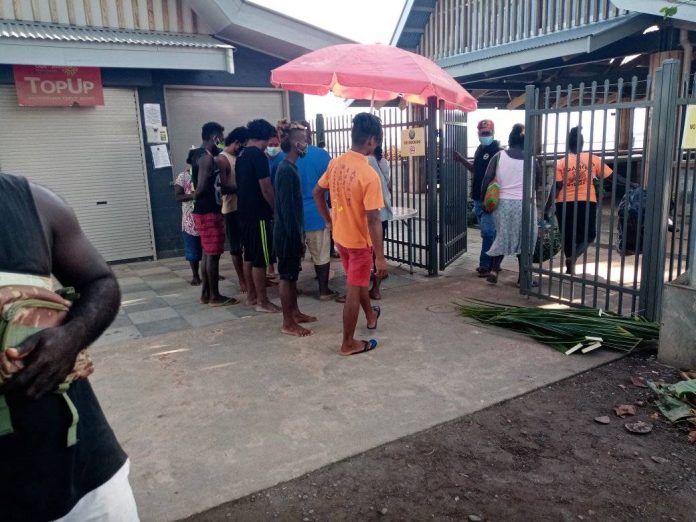
Officer of Gizo Market managing people entering the market yesterday. Photo by Juice Man

BY BEN BILUA
Gizo

‘NO jab no market’ will come into force today as Gizo Market Management takes extra measures to stop COVID-19 from further transmission.

Yesterday, the rule was put into trial following approval from Western Provincial executive.

The new regulations will also prohibit unvaccinated customers to enter the market.

This measure is expected to hit hard on market vendors who are not vaccinated to source income in an effort to support their living.

However, in a statement Gizo Town Council states, the increasing number of positive cases in Gizo is putting the general public at risk, as such the regulation is to safeguard people’s lives.

“Gizo market is a bustling venue for vendors and customers. It is very good that there is a lively venue for local economy to strive and at the same time feeding the people in the province. 

“Now that Western Province is threatened by COVID-19 community transmission, we must also apply our part to avoid the virus from causing further harm to our society.

“Gizo Town Council (GTC) therefore enforce the following measures; only those who are fully vaccinated will sell and buy at the markets, vendors and customers must bring their vaccination cards and show them to our officers before entering the market,” the statement said.

In the meantime, GTC is looking forward to work closely with vendors and customers on how best to implement the regulation.