Defendant David Tingi will have his case set for trial from April 24 – 28 before High Court judge Justice Ronald Bei Talasasa.
Justice Talasasa said the trial is fixed for April 24 and will not be moved to another date.
Mr Tingi is charged with one count of murder in relation to an incident at Peochakuri village in South Guadalcanal on May 6, 2022.
The allegation said that the defendant and the deceased had an argument prior to the incident. The defendant allegedly struck a hammer on the victim’s head and continue to punch the victim whilst the victim is on the ground.
Due to the alleged attack the victim sustained serious injuries; the victim then was transported to the National Referral Hospital for medical treatment unfortunately the victim later died several days after.
Police alleged that the cause of the incident started with an argument in which the deceased was alleged to have attempt to rape his own daughter on several occasion prior to the murder incident.
The deceased was transported to the National Referral Hospital (NRH)
Office of the Director Public Prosecution appears for the crown.
Solomon Islands National University (SINU) graduation ceremony scheduled to take place on April 20 has been postponed to Thursday, April 27.
SINU announced this yesterday in a statement posted on their Facebook page.
SINU said only the date is change but the time 9am and venue at the Friendship Hall will remain the same.
SINU said that the final list of graduates will be released next week once it is finalized and ready.
“The Solomon Islands National University wishes to inform all SINU 2023 Graduands, families and the general public that the graduation ceremony scheduled for April 20th, 2023 is being postponed to April 27th 2023.
“The ceremony will commence at 9:00 am at the Friendship Hall.
“We apologize for any inconvenience this may cause and appreciate your understanding.
“We are committed to making the rescheduled ceremony a memorable event for you and your families. We will be releasing the final list of 2023 graduates next week, so please stay tuned for updates.” SINU said.
Electoral Commission to abolish Out of Constituency registration
By EDDIE OSIFELO
THE Electoral Commission has agreed to abolish Out of Constituency registration for the National General Election proposed for April 17, 2024.
The Out of Constituency registration was done in the 2018 voter registration where out of constituency registration centres were opened in Honiara and in the provincial headquarters.
However, Solomon Islands Election Commission (SIEC) Chief Executive Officer, Jasper Highwood Anisi told media yesterday “if you want to register in a constituency, you will have to trave back to the constituency you want to register in”.
He said Out of Constituency registration in the past has opened up the voter registration process for registration fraud resulting in cross border registration and multiple registrations.
Furthermore, Anisi said there will be no on the spot issue of voter ID cards.
He said in the past, the on-spot issue of ID cards has resulted in multiple registrants ending up having too many cards though cross border registration.
“Voter ID can only be used at a later date determined by the commission and only those whose names are on the final voter list will be given cards.
“Instead of a voter ID card, each registrant will be issued with a copy of their registration form,” he said.
In addition, he said this form will be used as an identity for the purpose of issuance of a Voter ID card as well as proof of successful lodgements of voter registration during the omission and objection of the registration phase, in case of registration is been challenged by someone.
Anisi said every new registrant must provide a proof of eligibility before their voter registration application form can be processed.
“To prove that your eligibility, an applicant must present a birth certificate, baptismal certificate, or a testimony statement by a registered voter in the same constituency you’re applying to register to testify that you are 17 or 18 years old or you’re are a resident of the constituency you are applying to register in.
“For urban centers, you must provide proof such as a receipt of electricity, water, or rental bill to provide your residency or again a testimony statement,” he added.
Moreover, Operation Manager, Fredrick Bosoboe said there will be more than 120 registration teams, one per constituency with more than 10 registration teams will be on standby who will be stationed at the provincial headquarters.
Bosoboe said registration will move according to movement plans to Voter Registration Center (VRC) within their assigned constituency.
He said team will move from one VRC to another within the Constituency from 17th July to 26th August and new registrants and other who need to update their voter details will have to meet the teams at the VRCs closer to them to update or register as a voter.
“Registration will be done in more than 800 VRCs around the country.
“On average, there will one voter registration kid per team for constituencies with 10-20 VRCs,” he said.
Bosoboe said this is to allow all teams to finish the field registration around the same time within the given registration period (17th July-26 August).
There will be other processes follow behind like submission of Omission and Objection claims and the list of those who had made claims will be published to notify claimants and defendants to appear before electoral Commissioner’s Revising Office to justify the basis of the claims.
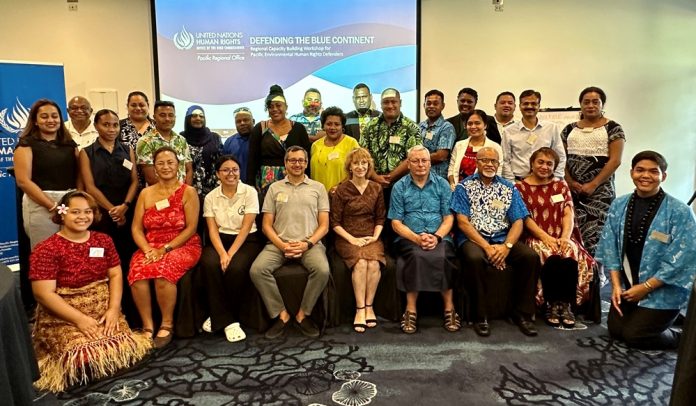
Participants and officials reaffirmed their vows after the workshop.
BY BEN BILUA Nadi
The Regional Representative of the Office of the High Commissioner for Human Rights has called on human rights defenders and activities to be beacons of hope for victims of human right violation.
Speaking during the Human Right Workshop held at Nadi, Fiji this week Heike Alefsen said Civil Society Organizations and human rights defenders play an important role in protecting the environment by seeking solutions and advocating for accountability.
She adds that the role of civil society organization and human right defenders are to educate indigenous people to understand types of human rights violations that are commonly hidden in the name of economic development and other interests.
Alefsen also said human defenders are vital to the development of democratic processes and institutions, ending impunity, speaking out against violations, and promoting so as protection of human rights in all situation.
“Your role going forward is to protect the rights of future generations. “You are speaking out about these practices that harm the environment and stand up for victims. “From our office’s perspective, we stand with those you who are engaging in all the spaces and we would like to underline it,” she said.
Alefsen said the Pacific region contributes little to the pollution of the environment, to climate change loss of biodiversity, however, the population is facing the risk as well as the impacts, this is why environmental human right defenders and activists is important.
She said the newly endorsed United Nations Convention on the right to a clean, healthy, and sustainable the environment is an important international legal framework that human defenders can use to save the people from natural and man-made pollution.
Alefsen said she is pleased to see human rights activists and human rights defenders from 13 countries in the pacific coming together to reaffirm their duties by way of learning and sharing information. She told the participant that human defenders and activist in the Pacific region is part of a global movement trying to protect the environment.
“There are expectations on natural resources such as mining, logging, and fisheries which sometimes contributes to the loss of traditional asserts and livelihoods as businesses and states have little obligation to protect the environment and this requires institutional and structural reform to align issues and at the same time encourages activists to do their job without oppression and pressure from any institution.
“The role of human rights defender is not easy as activists will face backlash from authorities and at times put their lives and the lives of their loved ones at risk,” Alefsen said
She said the Office of the High Commissioner for Human Rights in the Pacific region has an ongoing initiative to engage human rights defenders in the work of international human right mechanism and the international ecosystem mechanism.
Alefsen hopes the three days workshop will encourage serious networking and build the capacity of participants to take back to their respective countries.
Participants who attend the workshop pose for a group photo with officials.
BY BEN BILUA
Nadi, Fiji
OFFICIALS from 12 countries in the Pacific Islands including Australia and Hawaii have completed a three days workshop on Environmental Human Rights Defenders.
The workshop focuses on Regional Capacity For Pacific Environmental Human Rights Defenders.
The purpose of the workshop was to equip participants with relevant information and understanding of the role of Environmental Human Rights Defenders as well as the process in which citizens with the help of Environmental Defenders file complaints to the United Nations Council on issues that threaten human rights.
Topics covered during the workshop include; special procedures of the Human Rights Council, Communication Procedures, Human Rights Defender, and the situation of Environmental Human Rights Defenders in the Pacific.
Participants were also introduced to examples of Communication and Cases of Environmental Human Rights Violations.
Cases include the Frieda River Project and the potential adverse impact on the Human Rights of the Sepik People in Papua New Guinea.
Coordinator of Project Sepik, Emmanuel Peni shared his People’s struggles to serve the Sepik River from Chinese miners.
The training will see participants help communities and people of their respective countries with unjust decisions that would lead to violation of the Right to a Safe, Clean, and Healthy Environment.
Interview and fitness assessments for labor mobility applicants is set to take place on April 13 and 14 at the St Barnabas Cathedral Hall.
Ministry of Foreign Affairs and External Trade (MFAET) announced the dates this week as it released two lists of 303 applicants who were part of those who applied on day-one, Monday, February 27, 2023.
MFAET said the screening will proceed following the order in which applications were received.
MFAET advises applicants named on the lists to come forward and attend face to face interview and fitness assessment from 8am to 4pm.
“All candidates must arrive on time and must be neatly dressed and well presented. Please bring your passport and vaccine cards to this event. Candidates with a driver’s licenses should bring their license.
“Candidates should bring clothing suitable for fitness assessment. Ladies must wear skirts or lava lava in the church compound (don’t forget to bring your sport wear to do fitness test)
“All candidates are encouraged to bring in their own lunch and a bottle of water. Candidates will be screened strictly according to the order in which their applications were received.” MFAET said.
MFAET said that the upcoming interview and fitness assessments are the beginning of many more LMU screening and interview sessions that will be hosted in the coming months.
Candidates are required to wait until they are notified by telephone contact or through published lists.
Meanwhile, MFAET has clarified that the interview and fitness assessment does not guarantee that candidates will work in Australia.
Solomon Water Chief Executive Officer, Ian Gooden. Photo supplied.
By EDDIE OSIFELO
SOLOMON Water is supporting Government to re-negotiate the lease with landowners of the Kongulai water source in North West Guadalcanal.
This comes after the Paramount Chief of Haumbata Haniguana, Haumbata Taonavoa tribe, Chairman and Trustee of the Kongulae Water Source, Charles Keku Chilivi said they will shut down the supply if Government fails to review its lease as ordered by the supreme law of the High court of the Solomon Islands.
Further to that, Solomon Islands Post Conflict Rehabilitation and Restoration Association (SIPCRRA) threatened to shut the Kongulai water source if the Government did not table the Federal Constitution Bill and Truth and Reconciliation Commission (TRC) report.
Solomon Water Chief Executive Officer, Ian Gooden said they have received letters in the last couple of weeks.
“So, I am communicating with the Commissioner of Lands to communicate with Special Secretary to Prime Minister.
“And it’s an ongoing issue to trying to get that resolve,” he said.
However, Gooden said what the people are doing are breaking the law.
“And we are trying to persuade them not to use Solomon Water and people in Honiara as a leverage for other things that they want to achieve,” he added.
Recently, Chilivi said landowners (LO) of the Kovi catchment area and five trustees of Kongulae Water source have come to an agreement that the outstanding issues of Kongulae must be settled before any development can take place in the area.
“Trustees of the Kongulae Water source is currently observing a court order that’s still effective till today.
“The court made aware the Solomon Islands Government that they must settle our arrears with the review its lease,” he said.
Chivili said failure to comply with the matter will result in the shutting down of the supply for areas and outlets around Honiara.
“So, we are still waiting for the Government to respond on the matter but if the negligence remains as usual, we will shut down the supply as soon as possible.
“We intend to shut down the source because we can’t wait any longer for a lot of fake promises and sweet talks,” Chilivi added
In addition, the Kongulai water source supplies water to 40 percent of Honiara, which includes the whole of west Honiara, and parts of central and east Honiara.
More importantly, due to its elevated location, Kongulai plays a critical role in pressurizing 60 percent of the supply network.
Solomon Water Chairman Donald Marahare is concerned Solomon Water is being used for leverage on a matter unrelated to the operation of the water utility and the water supply service it provides to its customers in Honiara.
“The potential forced closure of the Kongulai water source would result in severe consequences for Solomon Water, including financial loss and reputational damage. It would also cause serious inconvenience and health risks to Honiara residents due to potential loss of water supply.
“I urge SIPCRRA to engage with the Government and not use the people of Honiara for leverage. I also ask the Government for support and resolution of longstanding landowner issues in the Kongulai and Kovi areas,” he said.
Marahare said loss of water supply to the city can result in damage to the pipes and customer fittings, significant economic impacts due to business houses and government offices being forced to close and health and social effects on schools and other institutions, including the hospital.
Government disqualifies former Malaita premier for defying China
BY JENNIFER KUSAPA
Government has removed former Malaita premier Daniel Suidani from his seat as the provincial representative of Ward 5 Baegu – West Fataleka.
The two reasons given for Mr Suidani’s removal are related to China.
Mr Suidani could not be contacted for comments. However, his close advisor Mr Celsus Talifilu tells Island Sun that Suidani is taking the matter to court.
This development is said to show that the Sino-Solomons bilateral relations is the first to go this far – the removal of a legal representative to a provincial assembly.
Minister of provincial government (MPGIS) Rollen Seleso disqualified Suidani from the Malaita provincial assembly in line with section 15(1)(a) of the Provincial Government Act, Government communications unit (GCU) media statement yesterday said [read more on page 3].
Reasons include – “Suidani’s ongoing failure to recognize the One China Policy which is a key policy of the National Government which all Provincial Governments are an agent”.
And, “Suidani’s collusion with Chinese Taipei in defiance of the Sovereign decision of the National Government to recognize the One China Policy”.
This action is “National Government exercising greater control over all Provincial Governments”, Seleso said in the GCU report.
Section 15(1)(a) of the Provincial Government Act 1997 says – A person [MPA] shall be disqualified from membership of a provincial assembly if the person is, by virtue of his own act, under any acknowledgement of allegiance, obedience or adherence to a foreign power or state.
Responding to Island Sun enquiry on behalf of Suidani, Mr Talifilu said the former Malaita premier is not surprised by this “abuse of the law” by the minister.
Suidani is quoted as saying: “I believe since in the past the courts have been perceived to be robust. It will be shown in the end that the Minister is acted outside of its powers and abusing his office.
“As for me I will continue to stand against the abuse of the state by this minister who thinks he can use the law to fulfil its government’s reckless political agenda. This abuse will be exposed for the world to see for themselves.”
Meanwhile, local legal pundit Andrew Muaki questions Minister Seleso’s action and the usage of clauses from the 1997 Act to justify it.
“Section 15(1)(a) of the PGA does not empower the minister to disqualify an MPA. If Parliament did want to empower the minister to disqualify MPAs, Parliament would clearly did so under Section 15(1)(a) of the PGA.”
Muaki explains, “the omission is a deliberate act by Parliament for good reasons. It does not want the minister of the national government- indeed the national government- to get involved in provincial politics to the point where the minister can easily disregard the will of the voters by disqualifying provincial elected political leaders.”
“I think the decision of the Minister is based on shallow legal grounds,” Muaki commented on the issue in Yumi Toktok Forum, the country’s popular facebook forum. (See viewpoint on page 6)
It is understood that China’s bilateral relationship with the country is the first partnership which has led this far – the partner pursuing its own agenda to the point of removal of a provincial or municipal leader.
A long time senior public servant told Island Sun that China is the first bilateral partner to penetrate this far into Solomon Islands’ internal matters.
“This is the first time it has happened.”
Making reference to the Republic of China (Taiwan) whom China (Peoples Republic of China) has replaced as Solomon Islands bilateral partner, the senior public servant said, “ROC often protested vehemently when any GP delegation headed to China in the past.
“Its ambassador would come running into PMO and complained.
“But SIG advised ROC a provincial government could establish sister relations only.
“National government never removed any MPA or premier then.”
The Chinese embassy has not responded to an Island Sun media enquiry for comment.
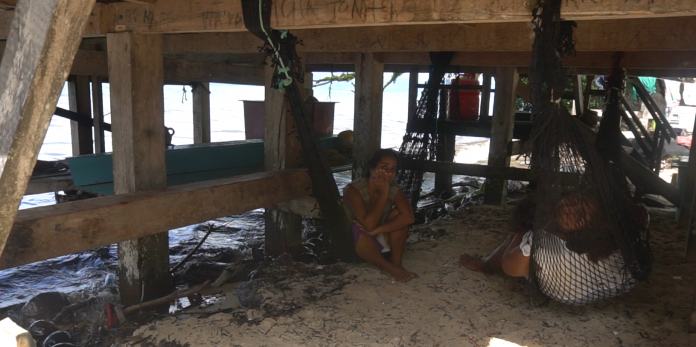
Two women relaxing under a house without realising the tide is getting closer to where they were sitting..
BY BEN BILUA
If scientist believes that sea level will continue to increase, I’m confident that our village needs to be relocated because this island will sink underwater in the next five to 10 years.
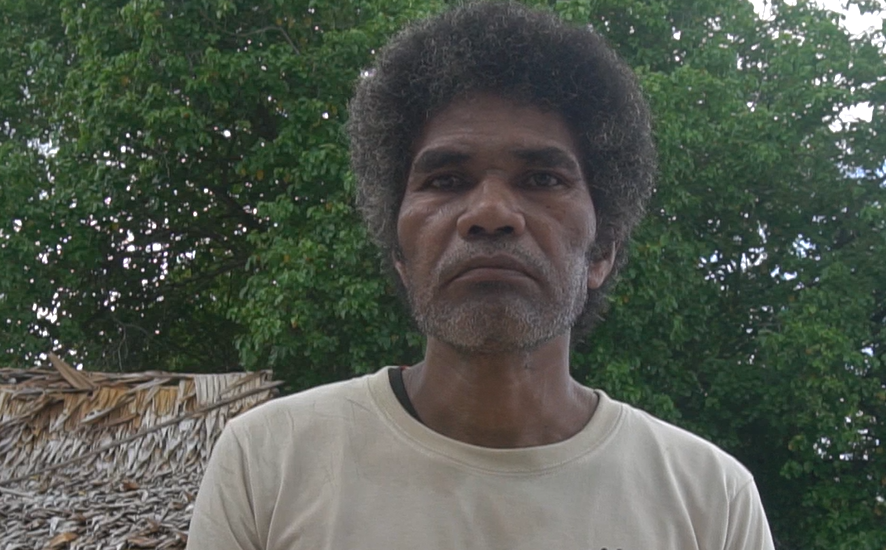
These are sentiments from 38-year-old Wilfred Lee Teho who lived at Babanga Village – a tiny village at risk of sea level rise.
Mr Lee Teho.
Babanga Village is located in the Western Province of Solomon Islands and is inhabited by close to 200 Gilberts’ – a minority group of people in Solomon Islands.
Mr Teho who moved to Babanga village in 2007 says things have changed drastically over the past five years.
This includes; extreme weather such as frequent heavy rain, strong wind, king-tide and overall sea level.
Teho says, sea level rise is the community’s most feared issue as they depends on dug-out walls for drinking water and cooking.
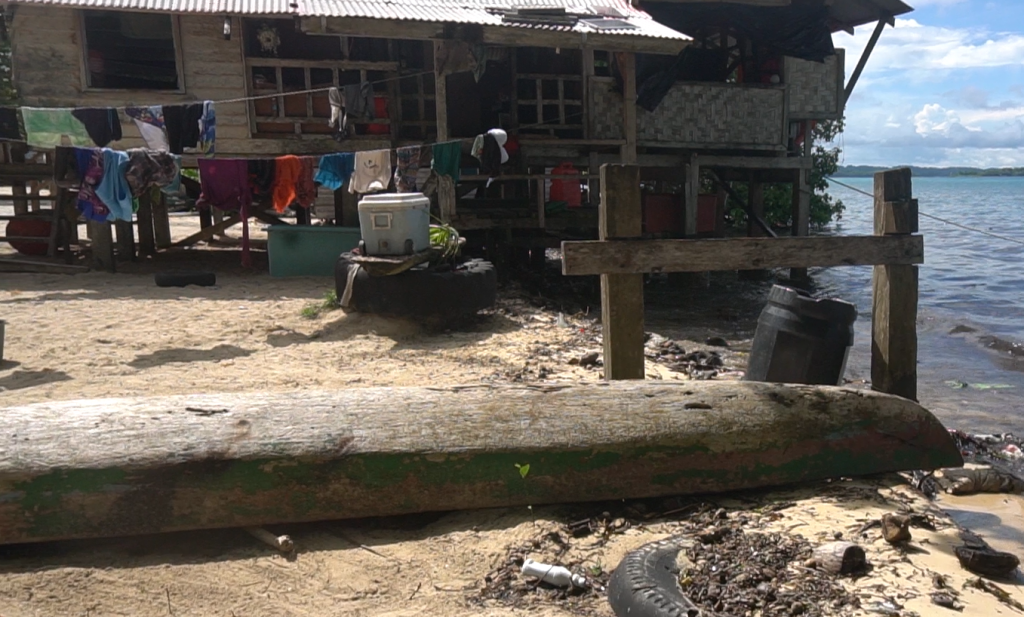
This house was few meters away from the shoreline when it was built. Now it is sitting above the shoreline.
“Our island has no running water so we depend on wells to get water for washing, cooking and even drinking. We also collect rain water on water tanks, but again rain water accessibility is short term.
“If there is no rain for a month, our tanks will be empty and if the sea level continues to increase will are doomed because our only water source will be contaminated by salt water,” he says.
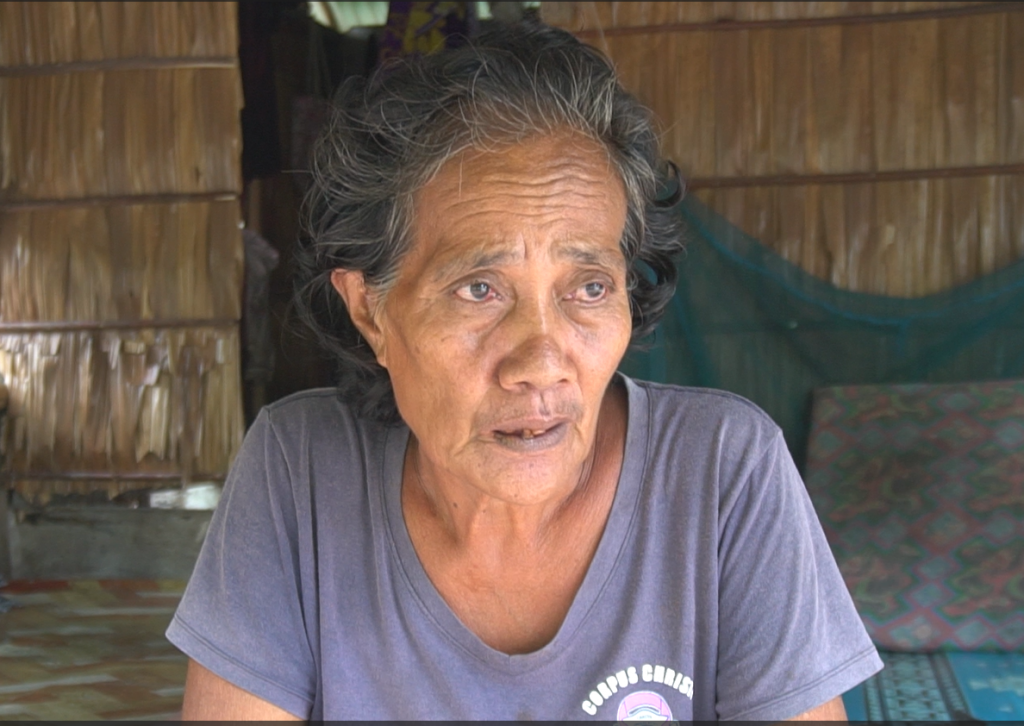
Just like Teho, 60-year-old, Janet Tereven who lives at Babanga all her life described that the island is getting smaller in size.
Mrs Janet Tereven.
She says, the width of Babanga Island is less than 100 meters with a flat land with no knolls – meaning residence are at risk of Tsunami and high-swells.
“I’m worried because our village will be sinking in the next five to ten years.
“Not only that, root crops produce less fruits and recently we depend entirely on rice and other processed foods from the shops.
“As a woman, I feel helpless as I cannot do much to mitigate the ongoing risk pose by climate change,” Tereven says.
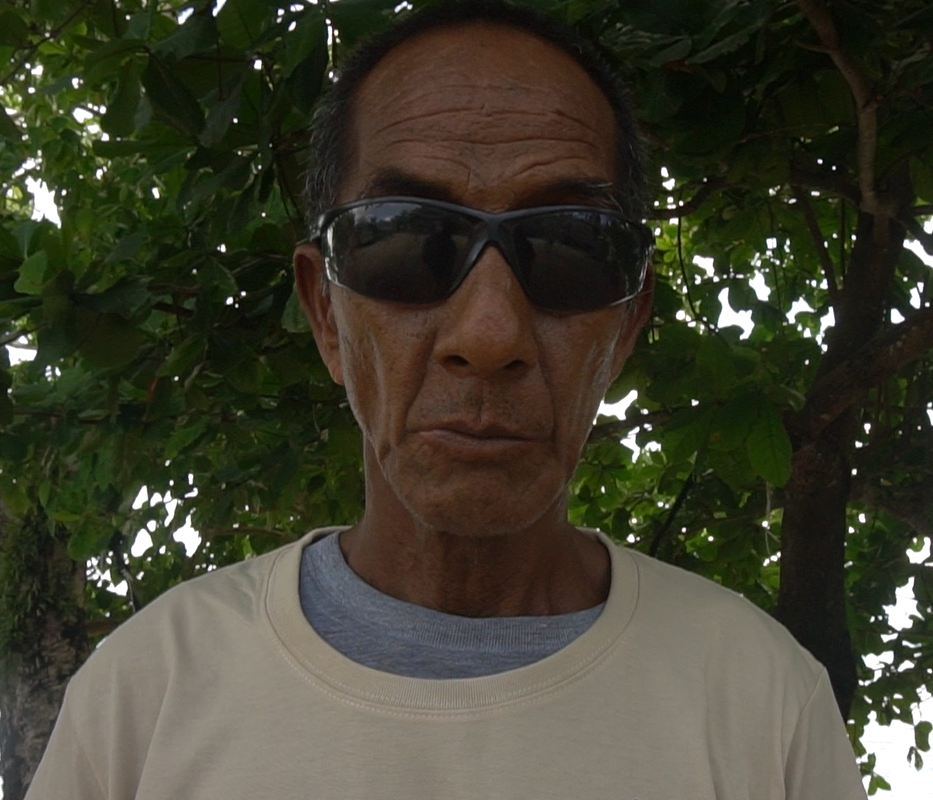
Seventy year-old, Reakai Waitusi Euta says, the shoreline has moved approximately five meters inland.
Mr Euta.
He recalls the houses were far from the shoreline in the 90s.
“I lived here for over 40 years and I cannot describe the changes and the effect of climate change to my community.
“Our village was really beautiful in the 90s, we planted flowers on our footpath. Now all these footpaths are just few meters from the shoreline and the flowers were all dead and gone due to salt water,” Euta says.
He also recalls finding seafood was not a problem in the 90s and his fellow villagers enjoy living on the quite island.
“I realized that fish is very difficult to catch at the nearby reefs. Some people believe that fish is scares because of the increasing population but I think, it is because of sea level rise.
“I believe fish are migrating to other islands or into the deep waters as our shorelines are getting hotter which leads to coral acidification.
“You have to paddle to other islands to get a good catch unlike before, there is abundant of sea foods just outside our village,” Euta says.
One of the wells the people use.
He says people’s health are also at risk as few wells have been contaminated by salt water.
Euta fears that sea level rise will force his people to leave the village living behind childhood memories and connections to the island.
“I always call Babanga a home but when salt-water were found in most walls, my hope for a better Babanga fades away bit by bit every day.
“As minority group of people in the Solomon Islands, my people are mentally and socially in trouble,” he says.
Youth Leader of Babanga village, Terry Anita says relocation is important and must be seriously considered.
Mr Terry Anita.
He says relocation is urgent as lives and properties are at risk as sea level rise is raising in an alarming pace.
“We have no time to waste and we cannot live here until that time when disaster strike
“I really think our leaders both at the national and provincial level need to recognize and consider our call.
“Come to our community and see for yourselves the challenges we faced day in day out.
“It is a pity that our leaders enjoy the luxury they have while people on the ground are suffering,” Anita says.
He says people at his village has been self-thought and try to cope with the changing weather pattern and sea level rise.
Newly elected Provincial Assembly Member of Western Province, Honorable Freedom Tozaka says effects of climate change can be seen in every island within Western province.
He says it is time for Western Provincial Government to seriously look into programs and plans that would help communities to adapt to the changing climate.
“I’ve been touring my Island during my campaign and see most coastal communities are badly affected by the sea level rise.
“I saw water running into an entire village during high-tide.
“I have advised by people to move inland but it will take time, because people are used to live in the coastal area.
“I will still try my best to help my people mitigate the issues brought in by climate change,” Tozaka says.
In a recent Assembly Meeting, Tozaka was very vocal on climate change urging the provincial government to take serious measures and resources to assist communities in low lying islands within the province.
Following pressure from affected communities, Premier Billy Veo says his government is looking at formulating climate change and environment policy to mitigate the ongoing challenges faced by communities within the province.
A dwelling house just few feets from the shoreline.
He says the effect of climate change has continued to threaten his people and his government has very limited manpower and resources to address the issue.
“My government will put all efforts to support affected communities in any way possible through window of necessities available within the WPG’s capabilities.
“First and foremost, climate change/environment is a non-devolved function hence Western Province does not have the mandate nor the resources to fully absorb the responsibility;
“Secondly, WPG will still need to formulate a climate change/environment policy to cater for how it plans to address climate change at the community/provincial level;
“Thirdly, we’ve liaised with the Ministry to provide a technical officer support our environment division but so far the Ministry has not been forthcoming; Veo said.
Special acknowledgment to Earth Journalism Network for supporting this article
THE case against the Premier of Temotu Clay Soalaoi Forau will come back in court on April 2023 for mention.
This is to allow defence lawyer Jim Seuika and the Prosecution sort out issues regarding the charges before any trial date can set on the matter.
Principal Magistrate Fatimah Taeburi then adjourned the case to April 13 2023.
Premier Forau was alleged of converting $358,890 for cocoa and coconut funding under the Ministry of Agriculture Livestock for his personal benefit when he was the MP.
The allegation said in 2012 payments were raised to assist farmers in Temotu VATUD constituency for Cocoa and Coconut assistance fund, on August 9 2012 an amount of $164,131 for cocoa assistance and $186,759 for coconut totaled up to $358, 890 was paid into the VATUD constituency account.
It was alleged that farmers who applied for those two funding did not receive any assistance from Forau and then reported the matter to the Police for investigation.
Mr Forau was arrested in Honiara when he came for his official duties and charged for the alleged conversion offence.