Home Blog Page 803

SolAir welcomes Fiji’s border reopening announcement

0
Solomon Airlines airbus

Solomon Airlines has welcomed the announcement of Pacific neighbour Fiji’s international border reopening, confirming Solomon Islands national carrier is also ready to increase scheduled international flying, when the time is right.

After Fiji reached its milestone of 80 percent of the eligible population being fully vaccinated, the country will begin to welcome international visitors from 11 November, with other airlines announcing the return of commercial flights into Fiji for fully vaccinated international travellers from December 1, 2021.

Initially quarantine-free travel to Fiji will be available to fully vaccinated travellers from ‘travel partner’ countries including Solomon Islands and other Pacific Island Countries and Territories, Australia, New Zealand, United States of America, United Kingdom, United Arab Emirates, Canada, Qatar, Germany, Spain, France, Republic of Korea, Japan, Singapore, and Switzerland.

“We welcome the news from Fiji that they will begin receiving international visitors from selected countries including Solomon Islands and Pacific countries within weeks,” said Colin Sigimanu, Manager Commercial for Solomon Airlines.

“After nearly two years of closed international borders, it is a positive sign, made possible by the high level of vaccination within the Fijian population and with the co-operation of other travel ready countries.

“Throughout the pandemic, Solomon Airlines has remained ready and prepared to reintroduce more regular international services pending the further easing of Solomon Islands and other border restrictions.

“At this time, we are not able to publish a schedule, however we are ready to do so at very short notice, depending on how the travel restrictions evolve.”

Travellers from travel-partner countries including Solomon Islands, after showing proof of vaccination and testing negative for COVID-19 virus 72 hours before their departure, will be required to spend three days in a single hotel accommodation in Fiji, and following a negative COVID-19 test result, will be allowed to travel further into Fijian communities.

Travellers from countries that are not yet designated travel-safe partners, must be fully vaccinated and will complete a 10-day stay in a quarantine centre upon arrival in Fiji, before a negative COVID-19 test result will be required to clear them to enter the community.

All travellers must also fulfill any obligations based on individual home country requirements.

Solomon Airlines to operate Government repatriation flight to Fiji

The national carrier has also confirmed it will operate a Solomon Islands Government repatriation flight from Fiji on 26 October.

The repatriation service managed by the Solomon Islands Government will carry eligible, Government approved passengers. It will depart Brisbane at 9.00am as flight IE605 on 26 October, arriving in Nadi at 2.35pm. It will then redepart Nadi as flight IE606 at 3.35pm arriving in Honiara at 5.35pm.

A same-day return service will depart Honiara for Brisbane at 6.35pm arriving at 8.20pm.

As this is a Solomon Islands Government managed flight, interested passengers are advised to contact the Solomon Islands High Commission in Suva, or their nearest Solomon Islands embassy or consulate.

–SOLAIR PRESS

Suidani thanks Japan for support

0
H.E Yasuhiro Morimoto and Premier Daniel Suidani cut a ribbon to mark the officially handing over of the garbage truck to MPG.

BY SAMIE WAIKORI

AUKI

MALAITA Premier Daniel Suidani has thanked the people and government of Japan for supporting Auki town with a new garbage truck.

Speaking during a ceremony to mark the handing over of the vehicle yesterday, Suidani lauded Japan for this is the third largest project they have donated to the people of Malaita.

He said the projects are Auki wharf, Auki Central Market facility and the new garbage truck.

 And Japan also funded lot more projects that benefit people in rural areas within the province.

Suidani gave credit to Japanese government, saying Japan is one of the friends indeed and friends from the heart.

He assured Ambassador Morimoto that the province was encouraged and will make sure that the garbage truck will be well looked after.

Suidani told the public of Auki that witnessed the donation; it’s time the Malaita Provincial Government and its people should come together to unite and happy about gift from a friend.

“I have seen the hearts of the people of Malaita to the people of Japan and we need to stand-up strong to look after ourselves with resources we have and will come from our friends,” he said.

Suidani said now the province has a vehicle at its disposal, it will put into its purpose to boost rubbish collection in Auki.

“Auki is the gateway to Malaita province and we must keep it clean,” he said.

Suidani said the vehicle will add to the existing one which was funded by MPG through the PCDF project that was already in operation in Auki.

On that note, he also announced to the public of Auki yesterday that he was assured by Ambassador Morimoto that Japan is steadfast to its commitment to build the new Kilu’ufi hospital.

Suidani said MPG will continue to enhance its partnership with the Japanese government and other friends towards the development of Malaita province.

Gov’t boosts value-added project recipients

0
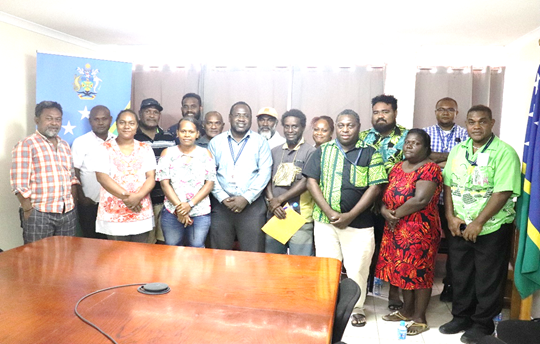
Recipients posed with Permanent Secretary Mr. Riley Mesepitu (3rd in front row- from right), IDD Director Mr. Jacob Gala (third-front row from left), and Productive Sector National Coordinator Mr. Brian Chapel Wate and government officials witnessing the MOU signing ceremony

The national government through the Ministry of Commerce, Industry, Labour and Immigration (MCILI) last week signed an MOU with a number of existing and potential entrepreneurs to expand into value added production.

The MOU outlines key recipient requirements and deliverables in the scheme including project implementation, reporting, acquittal of subventions and grant funding, training, monitoring and evaluation.

The requirements also include procurement process for payment of investment capital assets or equipment which shall be paid directly to the genuine suppliers. The MOU also prevents diversion of Funds for different businesses not approved while converting equipment into cash is prohibited.

This scheme is vital to enable Micro Small & Medium Enterprise (MSME) clients transform the DCGA re-direction policy to utilize funds on business prototypes while at the same time stimulate creativity, product innovation and import substitution under the value adding and downstream processing development program.

The MOU subvention grant agreement for value added projects totaled to $2,959,022.  This would fund investment sector needs of 25 projects. Coconut value adding sector with 34%, cocoa sector 14%, kava 34%, youth entrepreneurship and innovation investment portfolio with 18%.

During the process, business proposals have been appraised and evaluated by the MSME technical and evaluation committee including on site consultations with potential and existing entrepreneurs.

Verification and feasibility assessment has been done through industrial development officers in the Provinces and Ministry officials.

The appraisal matrix to further determine viability of the business proposals include clear goals that link with entrepreneurial competencies to become successful in implementation of business ideas for better returns on investment.

Furthermore, clearly stated product key features and benefits indicating competitive advantage to withstand risks through better management, marketing, operations and production and financial projection plans.

Kava recipients will sign their MOU grant agreements shortly when the tender process completes. Indicative 56% of the 25 projects are located in the Provinces and 44% in Honiara.

An amount of $3 million under this value adding program with a budget of $7,001,225.00 has been already transferred to the Development Bank of Solomon Islands for the credit line facility which was launched in 2nd September 2021.

The credit line facility is cross sectoral and targeting agri-business, fisheries sector, tourism, agro-forestry, and value added and export oriented SMEs. It provides opportunity for women economic empowerment, youth entrepreneurship and innovation.

Start-ups and existing entrepreneurs are encouraged to utilize the financial product. It offers direct funding for potential start-ups or expansion on products, interest payment support and loan guarantee. Another product line is also planned to support contract markets in the value chain between producer and buyer. Threshold is $10,000.00 – $3 million with interest rate of 8%.

The rippling effects would gradually trigger a broadened economic base to connect and create market value chain for rural informal sectors in value adding and downstream processing.

Over short and medium terms support MSMEs as the engine for economic growth to create employment, income, self-reliance and better standard of living in the urban and rural areas during this COVID 19 pandemic and to keep the economy afloat.

Speaking during the signing of the subvention grants agreement, Permanent Secretary MCILI, Riley Mesepitu said the subvention grants are meant to cater for SMEs that are not qualified to access the credit line facility under DBSI.

Mesepitu revealed that the credit line facility under DBSI is for those SMEs that are engaged in exportation.

He explained that a guarantee scheme is also in place with the Central Bank of Solomon Islands (CBSI), the scheme is to provide security for small businesses to access loans from the financial institutions.

Mesepitu highlighted that recipients of the subvention grants will be monitored to ensure they are accountable for the grants they have received.

He further added that the monitoring system of the Ministry has been strengthened with the launching of the Micro, Small, and Medium Enterprises Management Database last month.

Mesepitu also revealed that the database will not only ensure recipients have maximized the resources they have received but it will trigger the Ministry to implement coaching and mentoring programs for recipients to ensure sustainability and diversification of business undertakings.

Riley Mesepitu further pointed out that the MSME MIS (Management Information System) will capture all SMEs in the country and based on that the Ministry will find out existing and address them accordingly. Also, it is critical for better planning and decision making.

He stressed that the subvention grant recipients are part of the effort to keep the economy afloat, and that their obligation to paying taxes must be embraced rather than being shunned at.

Deputy Secretary Technical, Eric George Ongoa also highlighted that women are important partners in economic development of the country. He congratulated four women entrepreneurs who are recipients of the subvention grants as well.

Mr. Ongoa encouraged more women to take up business opportunities. Both male and female entrepreneurs can work together and make use of the opportunities provided by the government through this subvention grant.

As it has been realized from historical reviews entrepreneurs emerge from different professions with different backgrounds and invest in various businesses. But they have similar characteristics.

Involving women, youths and all working aged citizens is very vital in the DCGA’s re-direction policy with strategy to create employment and income generation for recovery and transformation of the economy of Solomon Islands.

He said investment servicing cost with 12% on value adding program has been committed for financial literacy trainings, mentoring and technical supporting services during project implementation.

The MSME recipients that have signed MOU with MCILI also received their award letters from the ministry.

–GOVERNMENT COMMUNICATION UNIT

PM PLAYS IT COOL

Premier-Daniel-Suidani-meets-members-of-his-executive-upon-his-arrival-at-Auki-wharf.

Sogavare: we are not confrontational to Malaita

By EDDIE OSIFELO

PRIME Minister Manasseh Sogavare has downplayed any ‘confrontational’ approach towards Malaita Province.

This was after the most populated province in the country, Malaita, opposed the Government’s decision to switch diplomatic relationship from Taiwan to Peoples Republic of China in September 2019.

Malaita Province’s opposition was due to lack of nationwide consultation and concern of PRC’s communist system and religion.

Sogavare told Parliament last week that the way they handled this matter is not confrontational because the government allows the Ministry of Provincial Government and Institutional Strengthening to deal with it.

He said the last thing to do is to spoil their relationship with Malaita province

“What comes out from Malaita does not represent the full people who are law abiding citizens?

“We allow democratic process to work to sort things out,” he said.

“It starts from the switch.

“My simple advice to Provincial government, let’s respect where our responsibility stops,” he said.

“Our switch to China, we are not doing anything outside.

“I know there are powers at play, these are the same people who have diplomatic relationship with China,” he said.

“We are sovereign nation.

“We make decision on what is best for this country. Decision has been made for the good of this country. We don’t take decision to spoil our country,” Sogavare said.

Opposition Leader, Mathew Wale urged Sogavare to take steps to seek healing after geopolitics has divided the nation.

Stranded nurses may not get support here

0
Some of the Solomon Islands nurses in Vanuatu.

BY MAVIS N PODOKOLO

Stranded Solomon Islands nurses in Vanuatu may not be getting any support from the national government.

This is because the nurses had signed an agreement with the government of Vanuatu, therefore their dilemma now is left for them and the ni-Vanuatu government to resolve.

This is the message conveyed by the national director of nursing under the ministry of health (MHMS), Michael Larui, at a press conference yesterday.

However, a glimmer of hope can be seen in Attorney General John Muria Jnr’s statements yesterday that government has plans to repatriate our countrymen and women overseas, including those in Vanuatu.

Larui, during yesterday’s conference, when asked if MHMS is responsible for the return of the stranded nurses and their families, said:

“The contract is signed between Vanuatu Public Services Vanuatu with individual nurses so they actually left on their own.”

He said there wasn’t any agreement signed between SIG and the Vanuatu government for nurses to go and work there.

“These nurses were directly recruited by the Vanuatu government with individuals’ contracts for each nurses. So, before they leave for Vanuatu they have to first resign,” Larui said.

He adds on their return to the country there will be job opportunities provided but they will have to follow the normal process to apply like all other public servants in the country.

“They can still be recruited by government but this depends entirely on the government’s situation next year on public servants’ registrar,” Larui said.

He further confirmed that he did not have the total number of the nurses in Vanuatu.

Attorney General John Muria Junior, meanwhile, on the matter, said the government already has plans to repatriate all nationals overseas and that included the nurses in Vanuatu.

‘Get the jab’ Sisilo tells SI workers in Australia

0
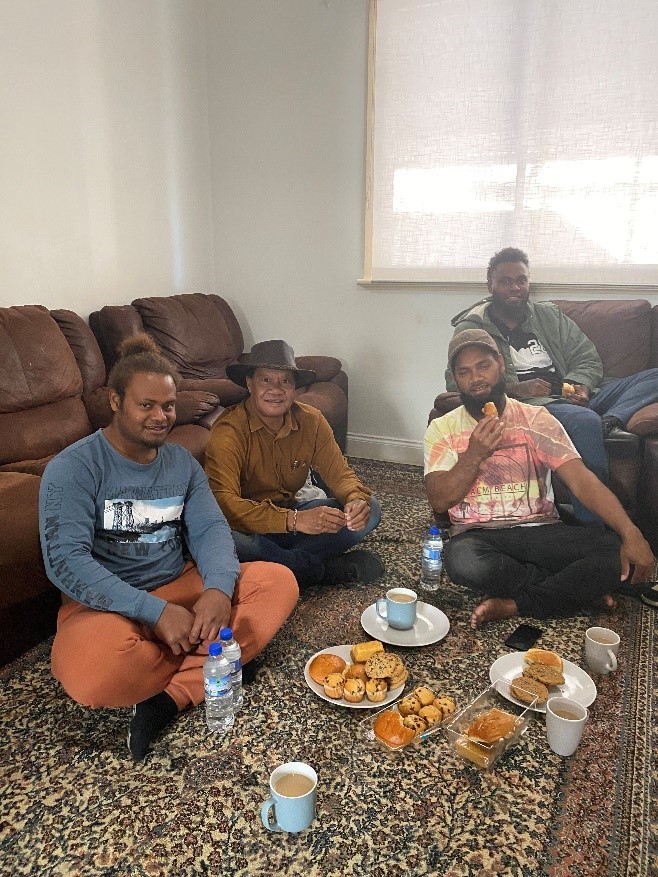
Coffee and snacks with 4 (include photographer) of our workers at a sheep farm in Katanning, Western Australia

Solomon Islands’ High Commissioner to Australia, Robert Sisilo, has told Solomon Island workers in Australia to get their COVID-19 jabs if they have not yet got their first and second vaccine doses.

This is despite the country hitting a key milestone as more than 80 percent of Australians aged 16 and over have now had at least one vaccine dose.

“It is important to get vaccinated to keep yourself, your family and your community safe,” Sisilo told the workers.

“COVID-19 has resulted in the deaths of millions of people worldwide,” he added.

“When more people are vaccinated, outbreaks of the disease are less deadly.

“Being vaccinated helps save lives.”

Sisilo, based in Canberra, made the appeal in a 3-minute COVID-19 vaccination video to address the disappointing rates of vaccinations among workers.

“In some cases, if you are not vaccinated you will be unable to work.

“For example, if you are required to travel between states that require a vaccine on entry (e.g. seasonal workers) or if you are in an industry where you are required to be fully vaccinated, such as aged care or meat processing,” Sisilo warned when encouraging workers to vaccinate on the Pacific Labour Facility social media platforms.

Solomon Islands plays a crucial role in addressing workforce shortages across a range of sectors in regional Australia. 

Since the restart of Australia’s Seasonal Worker Programme (SWP) and Pacific Labour Scheme (PLS) in September last year, 1,806 from the Solomon Islands have arrived at the end of September 2021. 

And another 160 (70 women, 90 men) have left early in the week and more to follow.

According to one research, countries that have increased their share in the restart period are Solomon Islands (from 3% to 13%), Samoa (from 7% to 13%) and Fiji (from 4% to 7%).   

Vanuatu’s share of both SWP and PLS workers has decreased from 43% in the immediate pre-COVID period to 39% since the restart. 

Tonga, also a major sending country, has seen its share fall from 26% pre-COVID to 23%.

“To take advantage of this huge labour market, Solomon Islands will have to invest more on vocational and skills training in hospitality, tourism, aged care, housekeeping, welding, bricklaying, tiling, tinting, panel beating, vehicle mechanic, fitting, machining, plumbing, construction, fishing sectors etc. 

“The demand for skills and semi-skilled jobs is growing and will continue to grow,” Sisilo, who has put labour mobility with Australia his number one priority, told his Director of Trade in one of his postings.

17 docs still refuse covid-19 vaccine

BY MAVIS N PODOKOLO

SEVENTEEN doctors at the National Referral Hospital (NRH) continue to avoid being vaccinated.

This is according to the chief executive officer of the NRH, Dr George Malefoasi.

He confirmed this yesterday during a press conference with local journalists at the Prime Minister’s Office.

He said there are 95 doctors from key departments at the NRH; of this total number, 17 doctor still refuse to get vaccinated with the covid-19 vaccines.

“Of the 95 doctors at NRH key departments 17 refused to take the vaccine. So, at the moment we are still talking with them but they still stand not to receive the jab.

“Out the 17 doctors three are from a very high positions and key decision maker clinicians in one of our key department at the NRH,” Malefoasi said.

He stressed they are looking at having another dialogue with them and also to engage international doctors to get the doctors to receive their jab.

“As a CEO I am very much concerned on three senior doctors from one of our key department, all the rest are junior registrars. These junior ones need to decide,” Malefoasi said.        

Dr Jones Ghabu, senior consultant physician at NRH and head of internal medicine department, in a recent radio talkback show had appealed to all doctors and nurses who have not yet had their jab to do so.

“I again asked all Doctors and Nurses who are unvaccinated in the country to please go get your jab because if there should be an outbreak of covid-19 in the country all of us will be affected,” Ghabu said.

He said all individuals have the risk to get infected with the covid-19 virus. The only way to minimise it is to get vaccinated.

Ghabu also called on all citizens in the country to no get manipulated by theories about the covid-19; “theories are not truthful,” he said.

He uttered, “the truth is that people are dying everyday with the COVID-19 virus. The vaccine that we are trying to rolling-out works and saves a lot people.”

Girls Day marked here

0
Guest of honours cutting the cake marking the IDG

SOLOMON Islands yesterday marked International Day of the Girl (IDG).

A two-day program was organized by Plan International Solomon Islands and Care International which brought together their partners such as the Honiara City Council and Young Christian Women’s Association, YWCA Safer Cities for Girls clubs and Care International clubs in Honiara.

The guest of honours at the celebration at the S-M-I grounds are the Permanent Secretary of the Ministry for Women, Youth, Children and Family Affairs, Dr Cedric Alependava, the Acting Australian High Commissioner to Solomon Islands Sally Anne Vincent, President of YWCA Georgina Ariki,  Plan International Solomon Islands’ Country Program Manager Joseph Hika, Country Manager for Live and Learn Environmental  Education Elmah Panisi and the head of the People with Disabilities Association of Solomon Islands, Casper Fa’asala.

The International Day of the Girl was declared by the United Nations to focus attention on the challenges girls face, like violence, education inequality and child marriages.

It is also a day to celebrate the work and achievements of girls and women, gender inequalities  and the needs of women and girls and a reminder that girls across the world face numerous adversities and yet succeed,

The theme of today’s International Day of the Girl is “Freedom Online on how misinformation and disinformation online affects girls’ lives, learning and leadership”.

Activities for the two days include speeches from the invited guests of honours, cultural performances and sports.

Hundreds of mostly young girls took part in the day’s activities and more is expected in today’s sporting and cultural activities.

Activities to mark International Day of the Girl will end this afternoon.

We must seal the fisheries deal: Falemaka

0

BY BEN BILUA

Gizo

Trade talks aimed at creating rules to stop countries providing harmful subsidies to their fishing fleets are reaching a climax with much at stake for Solomon Islands and the Pacific.

Mere Falemaka, the Geneva-based Pacific Ambassador to the World Trade Organisation (WTO) has spent the last 8 years of her life working for a good outcome for Pacific nations in these talks.

She says the negotiations must be sealed during the WTO Ministerial Conference (MC12) that will be held next month.

“What is clear from members, we don’t want to negotiate for another 20 years, and we have the opportunity now to close the deal. Let’s try and do it,” she said.

Subsidies – especially those by large industrial fishing nations – have contributed to many of the world’s fisheries being overfished and to too many fishing boats trying to catch the fish that are left. They have also contributed to illegal, unreported and unregulated fishing (IUU).

Tuna stocks in the Pacific are still healthy but as fisheries elsewhere decline more boats from around the world – including many receiving lucrative subsidies – are wanting to fish here.

“Our leaders have clearly said that we need to put in place the prohibitions for harmful fisheries subsidies,” Falemaka said.

“We are coming from the point of view that yes, you (foreign fishing boats) can access but …should not be subsidised …(to) deplete our stock.

The Pacific has much to gain from an end to harmful subsides, but, as Falemaka acknowledges there are also risks in the negotiations, including:

  • that existing subsidies paid by Pacific governments to help small fishers – such as subsidies for fuel subsidies, fishing gear or ice plants – might become illegal.
  • that fewer foreign boats will want to fish in the Pacific leaving cash-strapped economies without their usual stream of access fee payments.
  • that rules to stop overcapacity (too many boats) will prevent the Pacific developing its own fishing industry. At the moment 44% of the world’s tuna is caught in the Pacific but Oceania (Pacific, Australia and New Zealand) accounts for just 0.3% of global fishing vessels

Members of the WTO have insisted that the agreement be a ‘comprehensive’ agreement meaning there must be consensus on all aspects before the final documents can be approved.

That makes it a high stakes deal.

Falemaka says negotiations will be tough, as they will depend on the political will particularly from the heavyweights.

To ensure the final agreement is tune with Pacific needs, Falemaka says Pacific nations will insist it must:

•Prohibit harmful fishing subsidies to overcapacity and overfishing (OCOF) and IUU fishing; and to provide appropriate and effective special and differential treatment (SDT) for developing countries.

•Preserve access fees/licensing, from the scope of the agreement

•Exempt artisanal small-scale fishing from the Agreement for food security and livelihood reasons

•Provide policy space for small fishing nations and SIDs, to develop their fisheries in future including developing fishing capacity and

•Ensure that rights of the FICs under other international agreements are not undermined e.g sovereign rights to their 200 mile EEZ under UNCLOs. This should ensure they retain their rights to determine IUU fishing, to determine stock assessment, and the right to grant fishing access.

Falemaka says the Pacific group has been very vocal and constructive and has been working with many other developing and small island nations to put a strong case.

Time is running out. The WTO has set a deadline of 29 October for a final text of the Agreement.

This is to allow time for ministerial consideration before MC12, which takes place 20th November to 3 December 2021.

SI lack capacity to treat covid-19 outbreak: Ghabu

0
The National Referral Hospital (NRH) in Honiara

BY MAVIS N PODOKOLO

SOLOMON Islands does not have the capacity to handle a covid-19 outbreak in the country if there should be any, says Dr Jones Ghabu.

Ghabu, senior consultant physician at the National Referral Hospital and head of internal medicine department, said this yesterday

“As someone working in the hospital and is treating people daily we do not have the capacity to treat outbreak in the country.

“This is the very reason why I appeal to you all to please; we must prevent COVID-19 entering the country and prevent community transmission to happen,” he said.

“If we cannot prevent it and COVID-19 came into the country either I watch you dead or you watch me dead that is the truth about our current situation.”

He on the same note calls for all to continue following strategies put in place by the Ministry of Health Medical Services.