HONIARA stands to benefit $500 million from Solomon Power five years $1 billion SBD capital programme from 2022-2027.
This is because it has a customer base of 23,000 people.
Solomon Power Chief Executive Officer, Donald Kiriau highlighted this during the 2021 Infrastructure Symposium at FFA recently.
Kiriau said under the programme, Western will get $80 million, Malaita -$80 million and Guadalcanal – $80 million.
He said Isabel will get $70 million.
Kiriau said Choiseul Province, Makira Ulawa, Temotu and Rennell and Bellona will share $40 million each.
He said only Central Islands Province will get $30 million under the programme.
In addition, Kiriau said there is estimate that only 17 percent of our population has access to electricity and only 72 percent of Honiara has access to electricity.
“So, there is an ambitious plan for Solomon Power to bring more of our people to access electricity because as we all know electricity enhances standard of living for everybody.
“On that note, Solomon Power is faced with a lot of issues and challenges particularly in bringing energy to our people. This includes the tyranny of distance, scattered islands and high costs of operations,” he said.
“We note that 40 percent to 50 percent of our costs is fuel.
“For Solomon Power, our key investment plans are guided by the following strategics over the medium term and in turn these are linked to our National Development Strategy, Our National Energy Policy and Japan International Cooperation Agency (JICA) Renewable Energy roadmap,” he said.
Kiriau said under these govern policies, Solomon Power aims to ensure 90 percent to 100 percent renewable energy for Honiara by 2030 and an ambitious 100 percent access to electricity by 2050.
“So, with our mid-year term plans 2022-2027, one of our key goals is Strategic initiative is that we realise the importance of diversify our reliable assets into more renewable energy solutions.
“So that is the only way forward that is Tina Hydro, Solar farms and hybrids solutions,” he said.
Furthermore, Kiriau said they have to ensure that their royal customers value their service and particularly a service that is safe and reliable.
“And thirdly an operational excellence model that supports strong performance, delivery and returns to stakeholders, government and the people of Solomon Islands,” he said.
Kiriau wish to thank their development partners such as Australia, World Bank, ADB, New Zealand and others for supporting Solomon Power with its ambitious goal of bringing more people into the greed.
CHOISEUL Province will elect a new Premier today following a motion of no confidence against the former last week.
In an interview with Island Sun on Friday, Speaker of Choiseul Province, Greg Sokeni says his office has received nominations for the Premier and Deputy Premier’s position.
He says the election of the Premier and Deputy Premier will be conducted based on the standing orders of Choiseul province followed by swearing in of the officials when time permits as the province is in dire need to proceed with its business.
Sokeni says one of the province’s important business is to appropriate the revised budget.
Provincial Assembly Hon Speaker Adrian Sinabule Gina
BY CHARLES KADAMANA
Speaker of Western Province Adrian Gina says he has been fair to both sides of the Assembly when he adjourned the last meeting to November 7 due to lack of quorum.
Despite the November 7 adjournment, 17 provincial members who are challenging Premier David Gina’s leadership on Monday this week held an Assembly meeting following instructions from the Minister of Provincial Government and Institutional Strengthening (MPGIS) Extraordinary Gazette Notice on October 14.
The ministry’s intervention has pushed the political impasse in Western province into the court for judicial review after Premier Gina challenged the order.
Speaker Gina said the bottom line of what actually happen was there were two notices issued to convene the Assembly meeting on 8 July and 28 August but prior to the day of the sitting on 28 August, five members of the executives resigned on 21st of August.
He said because of that he took time to get the position of the ruling government on their situation so he further moved the meeting to 21 September.
He said during that meeting only eight members of the ruling government attended while 18 provincial members boycotted it.
So, he invoked standing order 71 to get a quorum.
Under the standing order 71 it states that when at any time during a sitting (a) the Speaker determines a quorum is not present, (b) a member draws the speaker’s attention to the lack of a quorum the proceeding shall not continue until a quorum is present.
Based on that he adjourned the meeting to November 7.
“Right after I adjourned the meeting, they were caught by surprised and in respond they gave one petition and motion of no confidence but I already adjourn it.
“This is where the point of argument started.,” he said.
Gina said if they don’t agree on his decision the only place to sort out their disagreement is in the court.
“I cannot leave this office when these are still hanging on my neck,” he said.
Sharing his view on the litigation, leader of the non-executive group Ramrakha Talasasa said the Assembly is the right place to solve the political impasse and not the court.
He said the litigation will be time consuming and those who will suffer the most are the people of Western Province.
Talasasa said the public of Western Province has been a bystander with lots of questions pending answers.
“Just for public’s information, of course there are opportunities to go to court with these issues but we don’t feel that the court is the right place to address these matters.”
Deputy Premier, Hon Glen Waneta between the two newly sworn-in ministers, Hon Simon Ke’ebo (left), Hon Jimmy Daoni (second from right) and Clerk Matthew Maefai (right).
BY SAMIE WAIKORI
Auki
THE MARA government yesterday sworn-in another two MPAs following Wednesday’s failed no-confidence vote in Auki.
Jimmy Daoni was one of the 18 who supported the no-confidence motion filed against Premier Suidani.
He joined the MARA Government on Tuesday.
Simon Ke’ebo was all along a non-executive member, but his name was not amongst the 18 that signed that signed to support the motion.
He also joined MARA on Tuesday.
These two MPAs had been with the non-executive since MARA government was established and this was their first time to be in the government.
They joined MARA government this week and just after two days on the government side they were sworn-in to take up ministerial portfolios.
Daoni, MPA for Ward 10, was sworn-in as new minister for climate change while Ke’ebo, MPA for Ward 27, is the new minister for southern region.
According to the office of the provincial clerk, the swearing-in ceremony was facilitated by commissioner of oath and witnessed by Deputy Premier Glen Waneta and members of the executive government.
The inclusion and swearing in of the two MPAs has increased number on the MARA side to 16, leaving the non-executive with 17 – a majority of one.
Island Sun was informed that several MPAs on the non-executive will soon join MARA.
Solomon Islands High Commissioner to Australia Robert Sisilo
SOLOMON Islands High Commissioner to Australia, Robert Sisilo, strongly believes more students from Solomon Islands and other Pacific countries will study in Australia if they pay the same local fees like Australians and others with permanent residency status.
“Unfortunately, they don’t and instead pay the same tuition fees like other international students which start at around $25,000 (Australian dollars) per year of study,” Sisiol said.
“We currently have 40 students in Australia, 14 are funded by Australia and 26 by the Solomon Islands Government,” he added.
“Many more would be here if only they pay local tuition fees instead of the prohibitively expensive international student fees,” Sisilo told the Canberra Pacific Roundtable of Pacific Nations in Australia with the ACT Government’s Commissioner for International Engagement and the Department of Foreign Affairs and Trade.
The Roundtable, held on Wednesday this week, focused on the activities Solomon Islands and other Pacific Island Countries are planning post COVID-19 pandemic and how the ACT Government and the business community can assist moving forward.
It identified climate change and its impact as another activity that deserves serious consideration.
“Australia’s commitment over the weekend to a net-zero 2050 target is a very important step forward and I commend the Prime Minister for taking this to the COP26 UN Climate Change Summit in Glasgow next week.
“But there are some countries that have come up with more ambitious targets for 2030 and I would urge Australia to also do the same,” Sisilo said.
These two key areas, education and climate change, are part of the ACT Government’s international engagement strategy to explore and create opportunities for possible partnership with Solomon Islands and other Pacific Island Countries.
The others are tourism, defense, renewable energy, health and sports.
The Commissioner for International Engagement, a co-host of the Roundtable, was established to reach out and engage internationally to fulfill the 2050 Vision for Canberra “to be recognized as one of the world’s great innovations, creative and art cities while remaining the world’s most livable city”.
The first Roundtable was held in 2019 and this was the second.
NO COVID-19 positive persons arrived on board the repatriation flight from Fiji yesterday, the Ministry of Health says.
It was responding to social media rumours that three COVID-positive persons were allowed on the flight.
“These rumours are not true,” a statement the ministry issued said.
“COVID-19 tests were performed on all passengers listed to travel on the flight, results for all returned negative except for three persons. 2 confirmed positive and 1 inconclusive,” it added.
“Two of the positive cases were children of the same family and were not vaccinated as they are below 18 years of age.
“As such the two children together with their family were denied boarding the flight.
“The third case with inconclusive result is a student.
“Inconclusive results are neither positive nor negative and usually in such cases, COVID-19 retesting is done.
“Nevertheless, with the current precautionary measures in place, all inconclusive test results are treated as positive therefore coupled with time constraint in relation to flight scheduled both student and his roommates whom he was in close contact with were also denied boarding the flight.
“Therefore, from the 132 passengers who boarded the flight, none of the them tested positive for COVID-19 as opposed to the rumors.
“107 have been fully vaccinated against COVID-19 with the remaining 25 passengers under the age of 18 years thus not yet eligible for vaccination.
“Nevertheless, all have generated negative test results for COVID-19 which is a key criterion for all incoming travelers and have been practicing COVID-19 key preventative measures days before boarding.”
The ministry said as per the policy of Solomon Islands, no one who is tested positive for COVID can board the flight to Solomon Islands.
“The Ministry maintains enforcing strict repatriation protocol, procedures and standards and therefore any person not adhering or having breached the regulations or did not meet the criteria of the repatriation protocol will not be allowed to board the flights.
“As part of pre-arrival assessments, every person repatriated had to undergo COVID-19 test within 72 hours of intended arrival in Solomon Islands.
“All the people proposed to board this flight were tested for COVID-19 on October 26, 2021.
“Furthermore, as per the regulation, all eligible individual travelling passengers have provided full evidence of completed COVID 19 vaccination before travelling to the country.
“However, despite fully vaccination status all travelling passengers will have to follow the mandatory quarantine and testing regime in place in the country.”
The ministry said it is also aware of the unvaccinated population below 18 years old who are on this flight, but there are already existing mechanism to address such situation.
“The period of quarantine will be determined based on risk assessment which is an ongoing process and will differ for those who are vaccinated and those who are not.
“It has been a long wait for our nationals from Fiji to return.
“Flights from Fiji has been delayed since the Delta variant hit Fiji and our country has then worked tirelessly, ensuring safety of our nationals are of the highest concern.”
The ministry re-iterates plans to open the borders.
“The risk of importation of COVID-19 is always there, so please get vaccinated to protect yourself, your community, and the country.”
MINISTER of Finance and Treasury, Harry Kuma is currently seeking medical attention in Australia.
Kuma travelled to Australia last month after he felt the medical complication in his body.
Sources confirmed MoFT has already issued memos to all line ministries to inform them on the absence of the Finance Minister Kuma.
Prime Minister Manasseh Sogavare is currently the Acting Finance Minister and he will likely to table the 2022 Supplementary Appropriation 2022 Budget in the November sitting of Parliament.
In the meantime, Minister of Environment, Climate Change, Disaster Management and Meteorology, Titus Fika is also seeking medical treatment in Brisbane.
A staff in the Ministry confirmed that Minister Fika is still to return home.
A second Economic Stimulus Package (ESP) is possible depending on the outcome of monitoring and evaluation of the effectiveness of the current ESP payments.
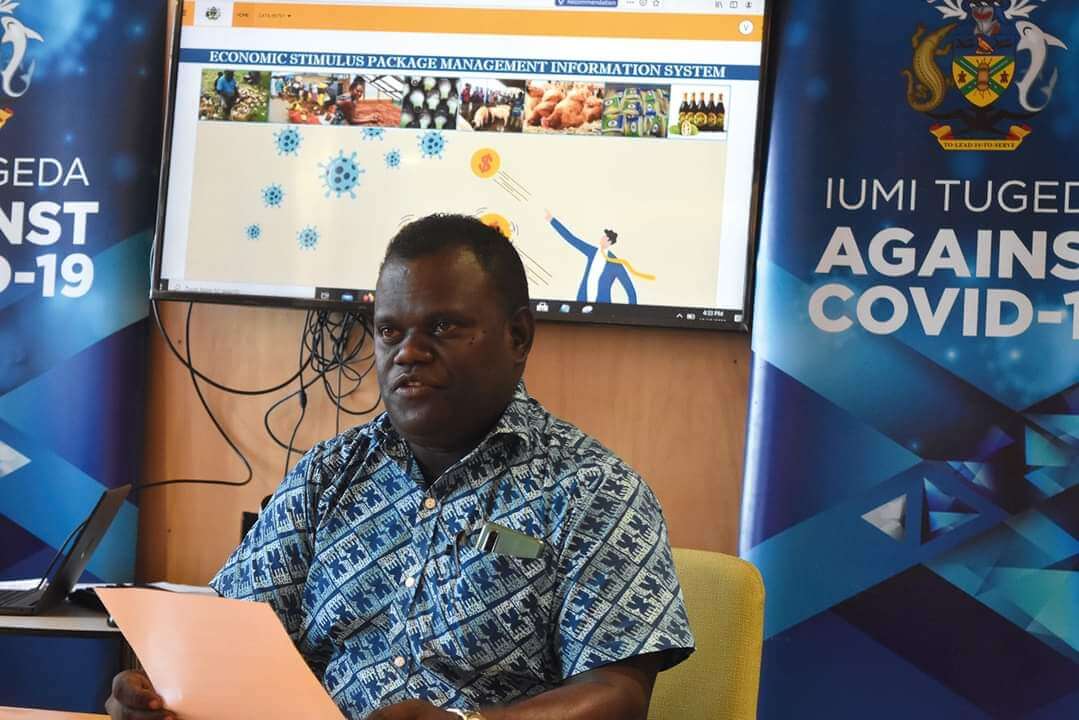
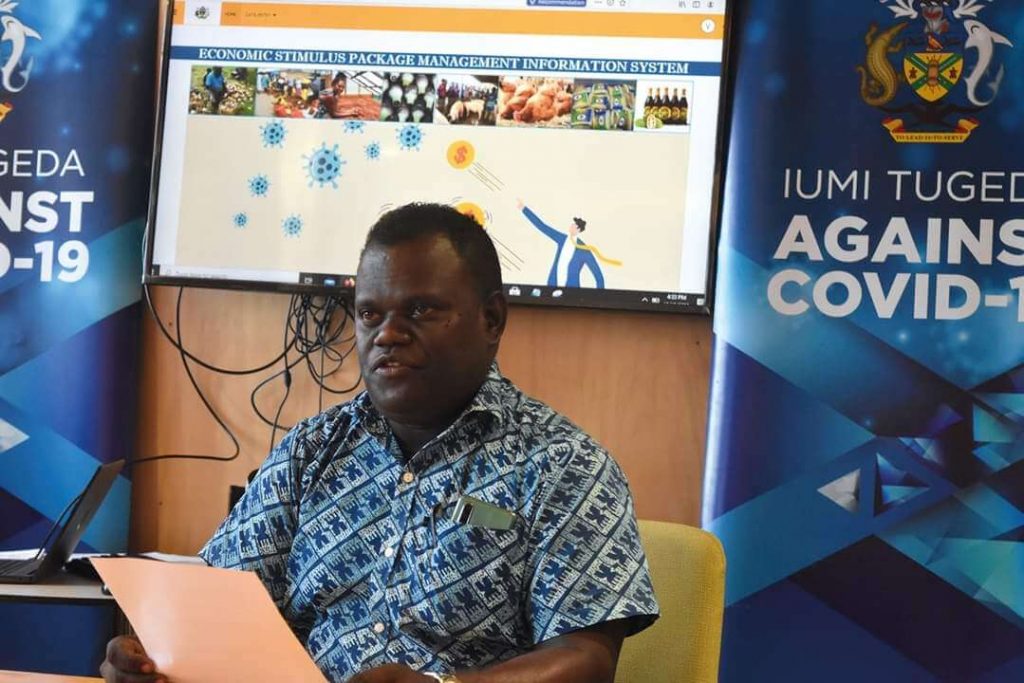
Permanent Secretary of the Ministry of Finance and Treasury, McKinnie Dentana told Island Sun future payments would likely be restricted to bigger recipients such as exporters rather than to small farmers or business-owners.
In the first phase of the ESP hundreds of farmers and other micro- and small-businesspeople benefited from funding for practical business inputs such as tools or planting material.
In July 2020, $124 million was allocated for immediate measures to help these businesses cope with the economic impact of the COVID-19 pandemic, including $70 million for rural production, $44 million for forestry, fisheries and tourism businesses and $10 million for assistance through the Development Bank of Solomon Islands.
Further money was made available through Members of Parliament, a total of $42 million dollars.
The payments were due to be completed by July this year.
Mr Dentana told Island Sun that the ministry of Treasury and Finance will need to see the report of the monitoring and evaluation phase of the payments before deciding on any future initiatives.
“We need to see how faithful people who receive our support are, there are some genuine recipients and some are not that genuine.
But he said any focus in the future should look at bigger players such as companies exporting kava, cocoa, foods, vegetables and cassava.
“These people are easy for us to get information (on), not like micro individual recipients which is challenging.
“Our export (income) goes back to rural people who bring their products for export, the government should only look at issues such as subsidy which it did on copra,” Mr Dentana added
The Permanent Secretary said the monitoring and evaluation report could be ready by the end of this month or in November.
Among those that have supported calls for a second round of stimulus assistance include local exporter Varivao Holdings.
According to General Manager, Benjamin Hageria the economic stimulus package is a lifeline to companies during the pandemic.
Varivao was among the larger local companies that benefited from the stimulus package and according to Hageria, the money was used to buy kava from locals to export.
Despite being provided a lifeline, the company only received two-thirds of the one million dollars it applied for under the stimulus funding.
“We have faced a lot of challenges and we were not able to go further on kava production, hence any similar assistance from the government as suggested by Opposition leader Matthew Wale recently is welcome,” he added
Meanwhile, the Permanent Secretary said a number of ESP recipients from the public have submitted their reports on the implementation of the ESP, including some of the exporters of copra, cocoa, timber and kava.
“A total of five Members of Parliament have also submitted their reports,” Mr Dentana said during his interview with Island Sun.
Apart from the report on the monitoring and evaluation of the Economic Stimulus Package, an audit of the whole funding package will be carried out as well.
The results will feed into preparations for the 2022 budget, which were launched last week by the Prime Minister, Manasseh Sogavare.
Mr Sogavare said the Government will continue to prioritise the productive and resources sectors in the 2022 budget as these two sectors are major drivers and enablers of economic growth.
“This does not mean that other sectors are not important, they will continue to be supported,” he said.
Under the Productive Sector, Prime Minister Sogavare said the Government is aiming to support infrastructure and communication investments, support food security, create employment and entrepreneurship to empower youth and women.
The Ministry of Finance and Treasury and the ESP Committee of which McKinnie Dentana is Chairman will have important input.
“With the Information from the team I can recommend to government whether to roll out another ESP scheme or not,” Mr Dentana said
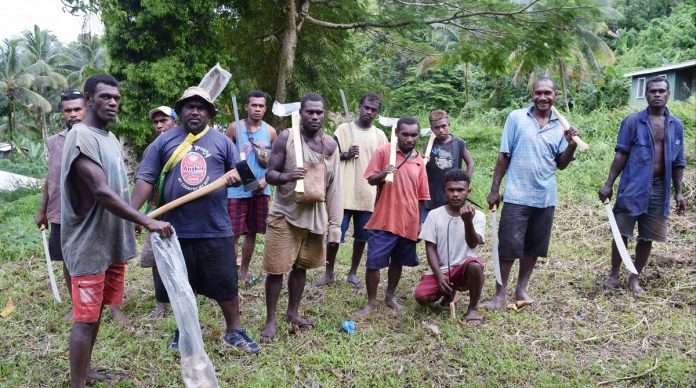
Farmers from Aitolo village with their tools from ESP assistance
By Brian Lezutuni
When COVID-19 brought the biggest economic crisis in a generation the government responded with an equally unprecedented package of funding – it put $309 million into the economic stimulus package (ESP).
Fifteen months on some farmers are happy while others are asking why they didn’t see any of the money.
A big portion of the stimulus package – $70 million – was allocated to agriculture. This included famers growing noni, kava, cassava, taro, potato, coconut, cocoa and copra.
According to the Permanent Secretary of the Ministry of Finance and Treasury and chairman of the oversight committee, McKinnie Dentana said the productive and resource sector is a challenging component of the whole stimulus package arrangement.
“It’s challenging because we opened it for people to apply in relation to their small projects and that takes a longer period to complete,” he told Island Sun in an interview.
While the evaluation and monitoring phase of the project is still being carried out on the implementation and impact of the funds to recipients, some communities in the country are counting their blessings and others are wondering how they missed out on such a lifeline in these trying times.
For farmers on Aitolo village, Malaita Province the Economic Stimulus Package helped expand their flourishing kava gardens in their community.
To them, the government assistance could not have come at a better time. The kava revolution on Malaita is booming and the creation of wealth in the local community in Aitolo are realised 10 years from when the first kava was planted on these rugged parts of the Island.
The Aitolo Self-Reliance Association was set up after applying for assistance under the stimulus funding in July 2020.
According to Association Secretary, Lesley Sanga, the initial application was for $30,000 but only $12,000 was allocated under the scheme.
Tools being shared
He said the funds were made to purchase tools for the 30 farmers making up the association.
Sanga said the tools helped expand existing kava gardens for these farmers.
Walter Ara, a long-time kava farmer and member of the Association said with tools acquired he was able to expand his garden.
“I now have 2000 kava plants, and was able to expand the past year,” He added.
Mr Ara began his kava farm back in 2011. So far, he has engaged in six harvests, earning enough money to build three permanent houses in his village.
According to Sanga, the Association is on the right track in terms of its development aspirations.
While the community on Aitolo are fortunate, other farmers around Malaita felt that due to their remoteness, schemes such as the stimulus package are un-heard of.
Walter proudly showing his kava garden
Silas Su’ufua, from Gwounafou village, East Malaita can only dream of such a funding. He said there were no awareness done to his part of the Island about the availability of such a fund.
“We never heard about the ESP, but we too need some form of assistance to help us on our farms,” the softly spoken father told Island Sun after selling his Kava products in Auki.
Senior Agriculture Officer from the Malaita Agriculture Office Patrick Maesuba said over 100 recipients have benefited from the funding on Malaita.
He said the only issue is they were not part of the implementation process of the funding, hence would not know if the funds have benefited communities on the Island.
Senior Agriculture Officer from the Malaita Agriculture Office Patrick Maesuba
“Such a funding should come through the Ministry and more importantly the provincial office, as we know who the active farmers on the field are, and will identify them.
“The government did not see those on the ground, it is the agriculture staff who go around the province and interact with farmers.
But Permanent Secretary, McKinnie Dentana said the Stimulus Package has saved the country from further deterioration over the past year as COVID-19 closed borders and disrupted economic activity.
PS Finance Mckinnie Dentana
He said the ESP is implemented in short term, just like other stimulus packages implemented by countries around the world.
“It should be a quick urgent government measure to ensure economic activity remains stable during the crisis,” he emphasised.
According to the Central Bank of Solomon Islands Governor, Dr Luke Forau the country has yet to realise the economic benefits of the Economic Stimulus Package to the economy.
He said as far as export commodities go, only copra has increased exports in the past financial year.
“All other other export commodities declined, so I suppose the stimulus package on the cCopra industry has worked, especially when they subsidized the copra freight,” he said when addressing local Journalists around June this year.
Mr Forau looks forward to the monitoring and evaluation report, adding it may shed light on the impacts of the stimulus package on the economy.
Permanent Secretary Dentana further explained that in the productive and resources sector the government targeted copra, cocoa and timber as in the Solomon Islands trade is still operating and export is continuing.
“But people do not have money to participate to bring in their product to the market to be exported, this goes for kava as well.
“The assistance can see farmers turn their resources into money for them to use during the crisis and for export purposes to help our bilateral trade,” he explained.
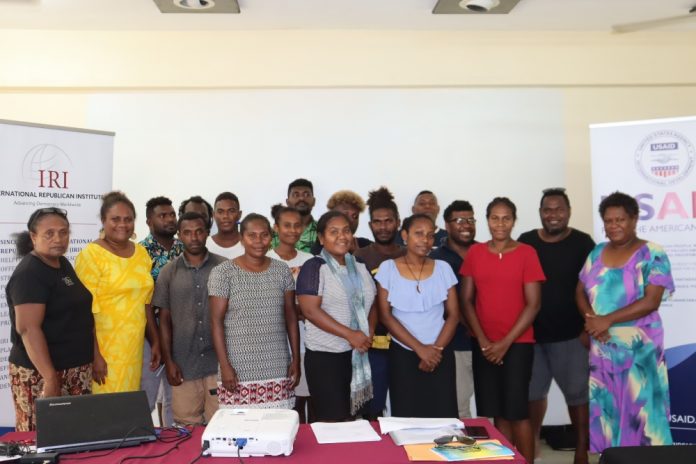
Group photo of participants attending the three days youth leadership training
BY MAVIS N PODOKOLO
YOUTH leaders from Guadalcanal Province are undertaking three days of leadership training aimed at grooming youths to have good leadership qualities.
The training is hosted and funded by the International Republican Institute in the US.
Janet Tuhaika, general secretary for Solomon Islands National Council of Women, said the idea is to train these youth leaders to help young people to become good leaders in all settings.
“We need to groom new leaders because young people are the new people to take over leadership positions. They need to be groomed because we Solomon Islanders sometimes have no care attitudes on things but leadership is very important because leaders makes decisions where affects the lives of people.
“It doesn’t matter at what level. Leaders if they are mentored as to what makes a good leader we hope that we can groom people with potential to become better leaders in the future,” she said.
Melinda Kii, programme officer for International Republican Institute in the country said his training is to encourage youths networking around the provinces where the training is implemented in for them to work together from the village level to their community, ward level and provincial level
Kii said these provinces were identified because they have existing provincial youth councils. This training is also to engaged youth on civic awareness in terms of their rights and engagement especially on leadership.
Twenty-six-year-old Esther Tangithia from Longu in Guadalcanal said she is grateful to be part of this youth leadership training because it will help her to motivate her fellow youth members in her community on how to become a good leader in all works of life.
“Also this training will help me see and recognise the challenges leader’s faces in all setting and how they are managed or addressed. At the same time this training will help me groom my skills to become a good leader in the future,” Ms Tangithia said.
Meanwhile the same training was already conducted for Western Province youth leaders and the second training was carried out in Malaita.
This one is the third and the next one will be for Choiseul youth leaders.