Home Blog Page 721

Inside the Fiji-Solomon Islands maritime boundary agreement

0
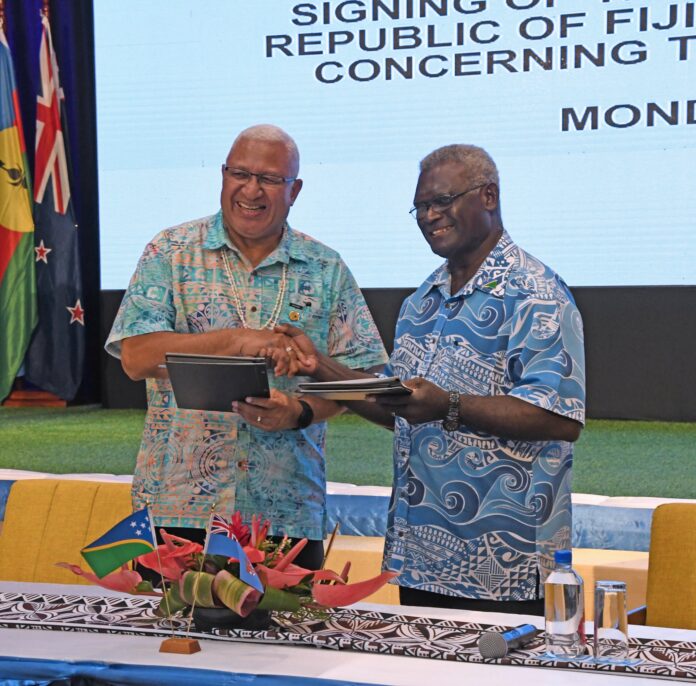
PM Bainimarama and PM Sogavare after the Agreement Signing

The signing of the historic Solomon Islands-Fiji Maritime Boundaries Delimitation Agreement in Suva yesterday by Prime Ministers Manasseh Sogavare and Frank Bainimarama now establishes the two countries’ respective maritime zones in accordance with the principles of the United Nations Convention on the Law of the Sea.

The event marks a promising step towards a brighter and bluer future for Fiji and the Solomon Islands to demarcate their shared maritime boundaries.

Ongoing negotiations and bilateral discussions between officials from the two countries led to this signing with technical support provided by the Pacific Community (SPC) under the Pacific Maritime Boundaries Project and with assistance from Development Partners (the Consortium).

The Agreement sets out the intersecting maritime boundaries of Fiji and the Solomon Islands in accordance with the United Nations Convention on the Law of the Sea (UNCLOS) which both countries are a party to.

As Large Ocean States, the finalization of this Agreement will ensure that both Pacific Island countries’ maritime boundaries are clearly defined and that their rights and obligations under UNCLOS are properly established.

Through this Maritime Boundary Agreement, both Leaders have also declared the permanence of their country’s respective maritime zones, irrespective of climate change-related sea-level rise and its potential impact on maritime boundaries. This aligns with the Pacific Island Leaders’ Declaration on Preserving Maritime Zones in the Face of Climate Change-related Sea-Level Rise (‘Declaration’) that was issued in August 2021.

Prime Minister Sogavare said that the Agreement is a celebration of the chapter on oceans in the 2050 Blue Pacific Strategy.

“This is a historic moment which signifies Solomon Islands’ commitment to the UNCLOS and I thank Prime Minister Bainimarama for creating space for this signing,” he added.

The signing of this Agreement highlights the long history of engagement and diplomatic relations that Fiji has had with the Solomon Islands and paves the way for future cooperation.

There are 48 shared or overlapping boundaries between countries in the Pacific Islands region. 35 of these boundaries have been formalized through an Agreement, and there are 13 outstanding bilateral and five high seas boundaries remaining to be declared.

The signing of this Agreement brings the number of outstanding Agreements to 12.

ENDS///

Bilateral talks line-up for Solomon Islands delegates

0
Prime Minister Sogavare, Minister of Foreign Affairs Jeremiah Manele and Solomon Island High Commissioner to Fiji met with Secretary General of Pacific Island Forum Secretariat on Monday

BY BEN BILUA
Suva, Fiji

SOLOMON Islands delegates to the Pacific Islands Forum Leaders Meeting has a long line of bilateral talks beginning today.

Prime Minister Manasseh Sogavare will meet with the Korean Delegation today to discuss matters that would bolster both countries bilateral relations.

Australia, New Zealand and New Caledonia are up next for bilateral talks.

Source familiar with the arrangements says, Sogavare will meet with leaders of Australia, New Zealand and New Caledonia tomorrow (Wednesday).

The source says there are other countries who are showing interest to hold bilateral talks with Prime Minister Sogavare.

“We are still trying to find a free time to slot in bilateral talk session between Sogavare and the Palau delegates,” the source adds.

According to the source, these bilateral talks are very important for Solomon Islands going forward in terms of development aspirations and also close economic collaborate as countries move towards the post-covid error.

On the ground in Suva, Prime Minister Sogavare has been a most wanted person to talk to since Monday.

International journalists were trying to get hold of Prime Minister Sogavare last night who has had a very busy schedule representing Solomon Islands in the regional leader meetings.

PM pays tribute to Oversight Committee

0
Members of the Oversight Committee recently. Photo PETER ZOLEVEKE II

BY MAVIS N PODOKOLO

PRIME Minister Manasseh Sogavare has paid tribute to the vigilance of the Oversight Committee who have put together efforts to prevent, contain and control COVID-19 in the country.

“I pay tribute to the vigilance of the Oversight Committee who for almost three years oversaw the development and implementation of our strategy to prevent, contain and control COVID-19 in our country,” Sogavare said in his nation-wide address last week.

“As we have finally re-opened our international borders, I thank all the front liners and their families for the huge sacrifices you have made over the past three years to protect our country and our people from COVID-19, in particular our staff from the Ministry of Health and Medical Services; Ministry of Police, National security and Correctional Services; Immigration, Customs and Bio-security,” the prime minister added.

He also thanked all other government ministries that became part of our collective defence against COVID-19 during the pandemic.

“I also take this opportunity to thank the Provincial Premiers and your staff and the Lord Mayor of the Honiara City Council and your staff for working with the national government to control the COVID-19 pandemic. Thank you for leading the vaccination efforts in your respective province.

“I also thank the members of our churches, the business community, and the general public that have assisted the government in our fight against COVID-19.

“It is our collective effort that has allowed the government to fully re-open our borders 6 days ago on 1st July 2022,” Sogavare said.

21,237 infected by covid-19

0
Corona

BY MAVIS N PODOKOLO 

UP to 21,237 people were infected by the COVID-19 virus.

However, Prime Minister Manasseh Sogavare said authorities were able to manage the cases successfully.

“We have successfully managed the COVID-19 pandemic in our country,” he said in his independence speech last week.

“About 153 people lost their lives to COVID-19. Our vaccination rate had been slow,” he added.

The country reopened its international borders on July 1.

Sogavare said about 50 percent of the eligible population are now fully vaccinated.

He added it is government’s policy that all eligible person must still be vaccinated.

“We encourage all eligible persons including children between 12 to 17 years of age to get vaccinated,” he said.

Bleak outlook ahead for country: CBSI

Honiara is the beating heart of the country's economy.

By EDDIE OSIFELO

SOLOMON Islands economic outlook for 2022 points to an even weaker prospect, with myriad of challenges in front of us, both from the external and domestic fronts.

This came about following the COVID 19 pandemic and November riots last year.

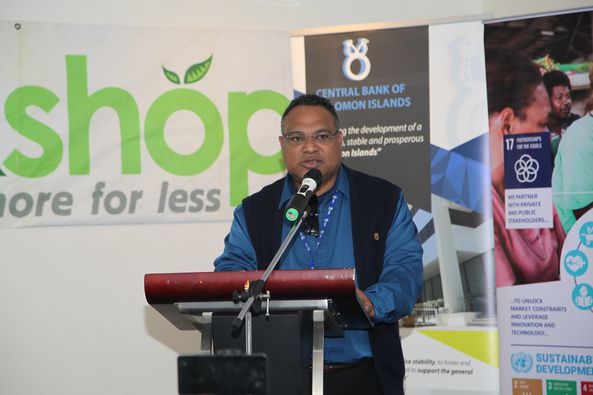
Central Bank of Solomon Islands (CBSI) Governor, Dr Luke Forau projected this when he presented the 2021 Annual Report of CBSI in this medium last week.

The theme for my statement is “Navigating the way to recovery and strengthening resilience to mitigate future shocks”.

He said the adverse impacts will continue to linger and take its toll on our economy.

In terms of growth, Dr Luke said the Solomon Islands economy was initially projected to decline by 7.3% in 2022, on the back of sluggish economic activity and on-going COVID-19 containment measures with declines expected across all sectors of the economy.

“This economic fallout was expected to bottom out over the medium term with some moderate rebound expected to start in 2024.

“However, with containment measures now fully eased as of 1st July this year and international border restrictions lifted, the economy is now expected to recover earlier than anticipated,” he said.

Dr Luke said under these conditions, Gross Domestic Product (GDP) growth has been revised upwards and is expected to contract by 4.3% in 2022 (i.e., a 3-percentage points upward revision) and to rebound by 1.9% in 2023.

He said this is better than expected six months ago.

“All sectors, except for logging, are expected to recover in 2023,” he said.

Further to that, Dr Luke said risks to these forecasts however remain, and these include:

  1. resurgence in COVID19 cases that would lead to reinstatement of restrictions in economic activities;
  2. natural and man-made disasters, and the prolong Russian-Ukraine war.

He said all these would reduce GDP.

In terms of inflation, Dr Luke said following the surge in imported inflation in April 2022, inflation is expected to rise to around 3-4% by end of 2022, driven by surging global fuel prices due to the Russian-Ukraine war.

He said core Inflation is expected to rise to 4.7% on account of the passthrough effect of high fuel prices.

On the external front, Dr Luke said the current account deficit is estimated to increase to 10% of GDP in 2022 and 13% of GDP over the medium term.

“This stems mainly from the reopening of the economy and expected higher imports from construction activities of key national projects.

“This is expected to lead to a slight fall in reserves, however, expected strong donor support will keep reserves at comfortable levels over the near-term,” he said.

Furthermore, Dr Luke said fiscal pressures are expected to remain elevated in the near and over the medium term owing to weak revenue from declining logging activities while pressure on spending remains high.

“Consequently, the fiscal deficit is estimated to widen to 9% of GDP in 2022, leading to eroding of fiscal buffers and rapid increase in government borrowing,” he said.

Moreover, Dr Luke said partial employment indicators (Solomon Islands National Provident Fund (SINPF) contributions and Pay As You Earn (PAYE) showed partial signs of recovery from the pandemic in March 2022.

“While employment outlook is unavailable, it is expected that the labour market would move in line with economic activity over the near term,” he said.

CBSI reports $62m loss

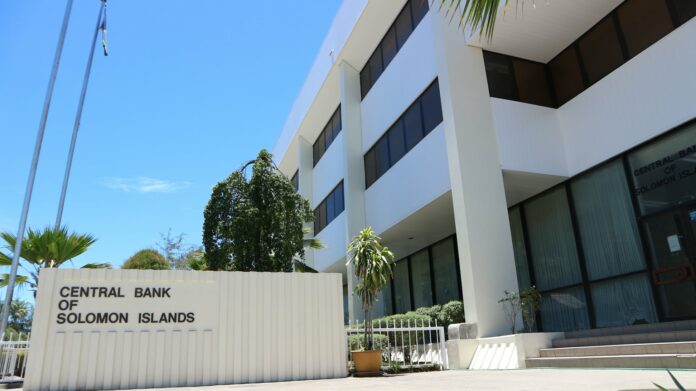
The Central Bank of Solomon Islands

By EDDIE OSIFELO

CENTRAL Bank of Solomon Islands reported a net loss of $62.7 million at the end of last year.

This stemmed from weak investment returns overseas and unfavourable foreign currency revaluations.

CBSI Governor, Dr Luke Forau when presented the Banks’ 2021 Annual Report in this medium last week, said of the $62.7 million loss, $15.5 million was realized (operational) losses and $47 million was due to unrealized foreign currency revaluation.

He said the Bank’s net equity however, remained firm at $308 million.

“Despite the loss, the Bank continued to operate and managed its resources prudently, thereby achieving its mandate.

“Moreover, the Central Bank managed to cushion the economy from worst adversities in the toughest of times,” he said.

“This, of course, was done with the strategic oversight role played by the Board, which I commend them sincerely.

“With the full board comprising nine directors, they were able to provide strategic direction to the organization,” he said.

Furthermore, in terms of staffing, Dr Luke said there was no change to the Bank’s staff complement.

He said the total number of staff complement remained unchanged at 157, as was in 2020.

“Of the 157 staff, 61% were male and 39% female.

“The Bank continues to invest in training and upskilling of its work force despite COVID-19 setbacks,” he said.

Dr Luke said a total of 20 officers were engaged in full and part-time trainings, of which 9 officers successfully completed their tertiary qualifications.

Moreover, Dr Luke said with respect to financial stability, the overall financial system remains stable and sound amidst weak economic conditions and COVID-19 induced disruptions in 2021.

He said the Central Bank relaxed prudential guidelines 2 and 8 during the year to allow financial institutions to provide loan reliefs to borrowers.

Furthermore, CBSI granted a full banking license to Solomon Finance Limited (SFL) in December 2021 to operate banking services as a credit institution.

Dr Luke said in the financial inclusion space, the Bank and its stakeholders launched the third National Financial Inclusion Strategy for Solomon Islands (NFIS3) 2022-2025 in 2021.

The strategy provides a roadmap of key strategic objectives of financial inclusion policies and activities for the next 3 years.

CBSI: November riots push back economic growth

0
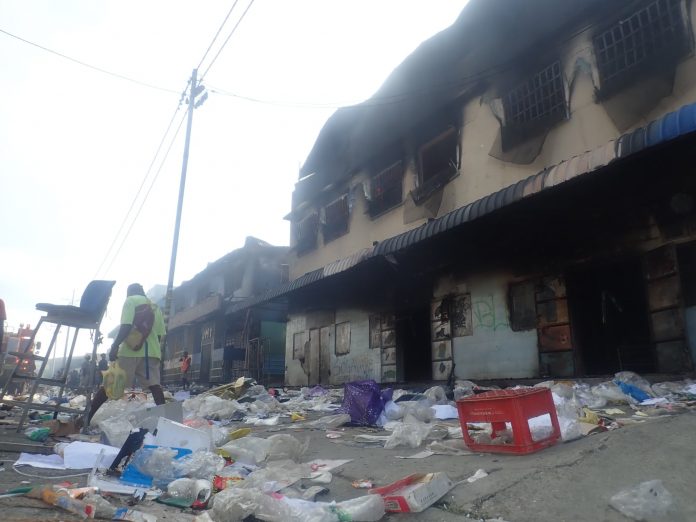
Part of the burnt-out China town from the recent riots. Photo supplied.

By EDDIE OSIFELO

THE November riots in 2021 has pushed the economy into recession with a negative 0.6% growth at the end of 2021.

This after the economy was on its way for recovery in 2021, although at a slower pace, following the depressed condition in 2020.

Central Bank of Solomon Islands (CBSI) Governor, Dr Luke Forau stated this when presented the 2021 Annual Report of the Central Bank of Solomon Islands in this medium last week.

The theme for my statement is “Navigating the way to recovery and strengthening resilience to mitigate future shocks”.

Dr Luke said the decline stemmed from declines across all sectors of the economy, with the exception of fish and copra.

He said the current account position worsened further, driven by the increase in imports relative to the slowdown in exports.

“The fall in primary income surplus during the year also contributed,” he said.

However, Dr Luke said despite the worsening external position, gross foreign reserves for the country grew, reaching 14.2 months of import cover.

He said this is well above the minimum target of six months.

“The increase in foreign reserves came mainly from donor funds and SIG revenue from fishing license,” he added.

Furthermore, in terms of government operations, Dr Luke said the fiscal deficit position stood at 5% of GDP in 2021, owing to the adverse impacts of the COVID-19 pandemic and the November riot.

He said the government debt stock increased to 15% of GDP by the end of the year, owing to COVID related borrowings.

Further to that, he said labour market conditions remained subdued in 2021 in line with sluggish activities.

Furthermore, Dr Luke said partial employment indicators from Solomon Islands National Provident Fund’s (SINPF) showed a decline by 3% to 55,573 contributors in 2021 from 57,028 contributors in 2020.

He said public service positions declined by 38% both for filled and unfilled positions due to the on-going freeze in recruitment.

Moreover, the consumer prices rallied to positive trajectory in 2021, following muted prices in 2020.

Headline inflation reached 2.5% in December due to the surge in food and fuel prices in the second half of last year.

Core inflation increased to 1.2% from -1.5% in 2020.

Dr Luke said the the pick-up in core inflation indicated broad increases in the prices of broad items in the Consumer Price Index (CPI) basket during the year.

He said recent headline inflation for April 2022 eased to minus 0.8% from minus 0.6% in March.

“Falling consumer prices in the domestic component of inflation contributed to this deflation.

“Domestic inflation fell to minus 4.2% from minus 3.2%, owing to price falls in betel-nut and tobacco,” he said.

Further to that, Dr Luke said imported inflation, however, rose to 8% from 6% in March attributable to high global fuel price as a result of the Russian-Ukraine war and its passthrough effects on transport, food and non-alcoholic beverages, housing, water and utilities categories.

“Core inflation increased to 3.3% from 2.8% reflecting broad price increases in April 2022,” he said.

CBSI boss offers way forward

CBSI Governor, Dr Luke Forau.

By EDDIE OSIFELO

CENTRAL Bank of Solomon Islands has offered three actions to start the economy recovery of the country.

This is after the Solomon Islands open economy faced risks of further macroeconomic slowdowns, coming from both the external and domestic fronts.

From external, the Russian-Ukraine war brings a new setback, on top of the pandemic, adding further threats to inflation and recovery for the country.

Domestically, the COVID-19 new variant, declining fiscal space amid elevated debt levels, and spill over effects from the war among other things are adding to headwinds for the economy’s recovery.

CBSI Governor, Dr Luke Forau when presenting the 2021 Annual Report of CBSI for this medium last week, said nonetheless, these challenges bring opportunities for a relook at our macroeconomic policies, objectives, choices, technology and doing things differently.

“We need to get the economic fundamentals right, with the right policy mix to move this country forward and improve our living standard.

“I would like to emphasize that these emerging challenges and opportunities will be the new normal that we will live with,” he said.

Therefore, Dr Luke said strengthening our capacities to navigate these uncertainties will be an important determinant for a resilient recovery from the pandemic.

The three key actions we can prioritize now to start economic recovery include:

  1. Expedite and maintain support for the affected businesses till the recovery takes hold. The return to economic activity and growth hinges on their ability to weather the pandemic and return to work safely and revive from the aftermath of the riot. Business activities have been severely disrupted since the pandemic started, with added challenges now on the horizon, in particular, war outside and the second wave, the future is more uncertain now than ever. It is encouraging to note that businesses and employees remained resilient last year despite these challenges and have successfully adapted to the new normal and returning to work quicker during the year. This brings me to my second point;
  2. In the short to medium term, strengthening resilience and capacity across all sectors of the economy, to sustain the country’s ability to absorb future shocks. Implement strategies that enhance revenue mobilization that will broaden the revenue base, build capital and macroeconomic buffers and expand and promote export diversification to foster a resilient economy. As an example, improving tax administrators’ capacity, reducing tax evasion, improve tax compliance and increase efficient tax administration is a crucial objective to prioritize and execute.
  3. Finally, as I had highlighted in my recent statement during my appearance before the Public Accounts Committee in March this year, we should start working on a growth policy that will drive growth in the country. Prioritizing key commodities with export opportunities in non-logging sectors or new diversification opportunities for instance, can facilitate growth transformations for a resilient recovery.

2050 Strategy will be a beacon of hope for pacific

0
Secretary General of Pacific Islands Forum Secretariat Henry Puna delivers his remark in front of journalists in Suva

BY BEN BILUA
Suva, Fiji

THE Secretary General of Pacific Islands Forum Secretariat says the 2050 Strategy will be a beacon of hope for Pacific Island Countries.

Speaking to Journalists yesterday (Sunday) Henry Puna says the Pacific Islands 2050 Strategy has been tailored towards addressing challenges and opportunities for Pacific Islands States in the next 50 years.

He says Pacific leaders who are currently in Suva Fiji for the Pacific Islands Forum Leaders meeting will be discussing the Strategy and put the strategy forward for adoption at the end of the meeting.

“If there is one thing we Pacific leaders are good at, it is talanoa – the ability to talk, to share great ideas and passion, visions and dreams are often born from the time we spend in the art of talanoa.

“But without a purpose, a plan and a strategy to test and carry ideas forward we would be wasting the same gifts which brought our seafaring ancestors to this sea of islands.

“Just as the stars have mapped the journeys that brought first canoes to our Blue Continent, the 2050 Strategy would be our North Star, guiding our journey to 2050 and beyond.

“Whether we speak of voices, of people, challenges and opportunities you should know that every story you are working on up to this point and onwards will resonate with this document,” Puna says.

Chinese Police train local mining employees on martial arts

China Police Liaison Team instructor, Yin Wei demonstrate a Gong Fu technique with a Win Win employee yesterday.

EMPLOYEES of Winwin Mining Investment Ltd and Solomon Islands Resources Company Limited (SIRCL) have learnt their martial art for self-defence at work places.

China Police Liaison Team instructors Yin Wei and Chen Cheng have trained the employees at their camp at Alligator Creek, East Honiara yesterday.

The purpose of the training:

  1. leads to the building of good health as well as the consciousness and the strength of self defense for existence; and
  2. it helps to improve the way of looking at the world and behaving in a more restrained, tolerant and forgiving attitude.

Overall, the activity broadens their view for international culture exchanges and helps them understand that the real power lies in the strength built up by themselves on a regular accumulated effort.

Win Win and Solomon Islands Resources Company Limited employees doing their drill with the stick.

The same is true with the economic development for a business company and a country.

They were shocked by the strength and deep-rooted culture of how to behave in their human society demonstrated by the Chinese martial art (Chinese Gong Fu) after watching the China Police Liaison Team project put into action smoothly.

As such they invited the Chinese Police Liaison team to train their workers in body and nurture their mind through the martial art in relation to how to behave in the society.

China Police Liaison Team instructor, Chen Cheng demonstrate a combata technique with Win Win employee.

So, a few weeks ago, they formally invited the China Police, Chinese Embassy, Solomon Islands Chinese Association and Solomon Islands Chinese Business Council to pay a visit to the working sites and camps of some Chinese companies in Solomon Islands.

“Our idea for the above-mentioned training activity was greeted by the police team’s great effort in the coaching activity.

“The interactive activities have been strongly supported by China Embassy, Solomon Islands Chinese Association (SICA) and Solomon Islands Chinese Business Council (SICBC),” they said.

Win Win and SIRCL acknowledged China Embassy, SICA and SICBC and Chinese Police Liaison team who has also trained some of local boys of Solomon Islands with Chinese Gong Fu.

“All this, for sure, sets up a good example and plays an important part in developing and strengthening the relationship between the Chinese people and the Solomon Islands people.

“They are worthy of our respect,” they said.