Home Blog Page 1251

Utah 1 shipping service questioned over treatment

0

BY LORETTA BRIGIDIA MANELE

A man from Isabel province is questioning Utah 1’s shipping service.

Speaking to the paper yesterday, Esau Ije of Hograno Highlands said he and others are not happy about how they were treated by the Managing Director, Selwyn Riumana.

He explained that on August 10 after having freighted four tyres for “Kosi Transport”, a pickup truck of Koge and Siligodu communities in Hograno Highlands, they made their way to Utah 1 but before even loading them onto the vessel, Riumana approached them and told them to return them to the warehouse.

Ije said that the tyres were later loaded on Ortega on August 13.

He stressed that they are very disappointed by this treatment and are questioning the leadership and service Riumana is offering to the people of Isabel province.

Ije strongly voiced that he should put an end to this behavior as it is not right and most importantly, so that others do not have to go through the same experience in the future.

“He should provide good services for the people of Isabel province,” he said.

Gov’t focuses attention on nation-wide airport improvement projects

0
Prime Minister Rick Hou and officials at the re-opened Parasi airport in South Malaita. Photo from GCU.

THE Solomon Islands Democratic Coalition for Change Government (SIDCCG) is focusing attention on airport improvements around the country as part and parcel of the country’s National Development Strategy 2016-2035.

To support this objective, the Ministry of Communication and Civil Aviation has already began the implementation of the SIDCCG’s policy to ‘Facilitate Rehabilitation and Development of International and Domestic Airports throughout Solomon Islands’.

The Supervising Minister for Communication and Aviation (MCA), Jerry Manele, who is also the Minister for Development Planning and Aid Coordination (MDPAC) has announced these developments Monday this week at the re-opening of the Parasi Airport in South Malaita.

Mr Manele highlighted that the successful re-opening of the Parasi and Mana’oba airports to facilitate air transport services were examples of the Ministry’s implementation programmes.

“The Ministry of Civil Aviation takes this redirection seriously and want to learn from our past mistakes, and build on our current successes, as we move into to the future,” Manele said.

He added that the Ministry is focused on delivering on its sector flagship policies of providing better access and connecting people through air transport services.

The Minister has also highlighted a number of ongoing projects which the Ministry will implement in partnership with development partners such as JICA, the World Bank and the New Zealand Government.

These includes the Honiara International Airport Improvement Project to be co-financed by JICA and Solomon Islands Government which is expected to deliver a new Departure Terminal, an additional new taxi-way, a new Control Tower, the Expansion of Apron to the east end of the airport and the refurbishment to the International Terminal of which three-quarters will become the Domestic Terminal. The project will start in 2019 and is expected to be delivered by the end of 2021.

Another project is the Solomon Islands Road and Aviation Project to be funded by a World Bank grant and part credit by the Solomon Islands Government.

This project will be co-implemented by the Ministry of Infrastructure Development (MID) and the Ministry of Communication and Aviation which will deliver an Overlay for the Honiara International Airport Runway, an Overlay for the Munda International Airport Runway, the Munda Terminal and Traffic Tower, an Unexploded Ordinance clearance programme, Navigation and lightning improvements and a Honiara Fire Station. The implementation of these projects will start in 2019 and is expected to be delivered by 2022.

The SIDCC Government is also partnering with the New Zealand Government to co-finance the design of Lata, Seghe, Suavanao and Taro airports to meet all weather operation standards. These projects are expected to start in 2019 and will be delivered in 2021.

Another development announced by Minister Manele was the improvement of pavement reworks for Gwaunaru and Parasi airports to cater for DASH 8 operations which was already completed while Kirakira and Lata airports will follow soon.

–GCU

Malaita second appointed day holiday confusion

0

BY SAMIE WAIKORI

AUKI

CONCERNED members of Auki public have raised concern over the two days that were set aside as public holidays to commemorate the Malaita province 2nd Appointed Day this year.

On Monday this week schools, businesses and offices closed doors to mark a public holiday for the province’s day.

On Wednesday this was again repeated for the same event. And, many people are confused why two days are being laid down as holidays, and why one does not fall on August 13, the province’s day.

A Mr Henry Tuhu said on Wednesday people in Auki were confused on the exact day to mark the provincial holiday to honour this official day.

“So we have two days of provincial holiday this year. One on Monday where services and everyone laid down activity and yesterday it happened again.”

Tuhu said there is no honour in respect of the second appointed day as people didn’t know who is celebrating and honouring the right day for the second appointed day.

He also uttered that pause of services experienced in Auki for these two days was also a source of frustration for many.

HCC law enforcement will not back down: Madeo

0

By Mike Puia

HEAD of the Honiara City Council (HCC) Law Enforcement Division, Robert Madeo, maintains that they will not back down in the execution of their duties within Honiara boundary.

The Division, which enforced HCC ordinances, has continued to face issues ranging from criticisms, political bullying to threats.

Madeo admitted that his Division is facing many challenges but that will not stop them from doing their work.

He was responding to criticisms laid against his officers.

There were people who claimed that some HCC’s law enforcers have compromised HCC by-laws by not being disciplined.

An example provided to explain how HCC’s by-laws compromised HCC by-laws is how law enforcers deal with betel nut street vendors.

Informants claimed some law enforcers appear to be lenient on other vendors while tough on others by going as far as confiscating their markets and arresting them.

Madeo said they have been criticised over this issue many times but no one has come forward with ‘black and white’ prove to back his or her claim.

He said they take criticism as normal and the only time they impose disciplinary actions of officers who compromising HCC laws once proven documents are provided.

Madeo said enforcing the city laws will always anger those who violated these laws and are dealt with.

He said they will not be intimidated by criticisms in their effort to ensure city laws are upheld.

He also admitted that politics has a part in his Division’s capability to deliver its work.

“Yes, we have issues with resources which affected the way we carry out our work. That’s a matter for the HCC executive to help sort out,” Madeo said.

He added they have plans that would help their Division effectively do its work but these plans depend on the will of their executive.

Malaitans told to stay united and stop separatist thinking

0
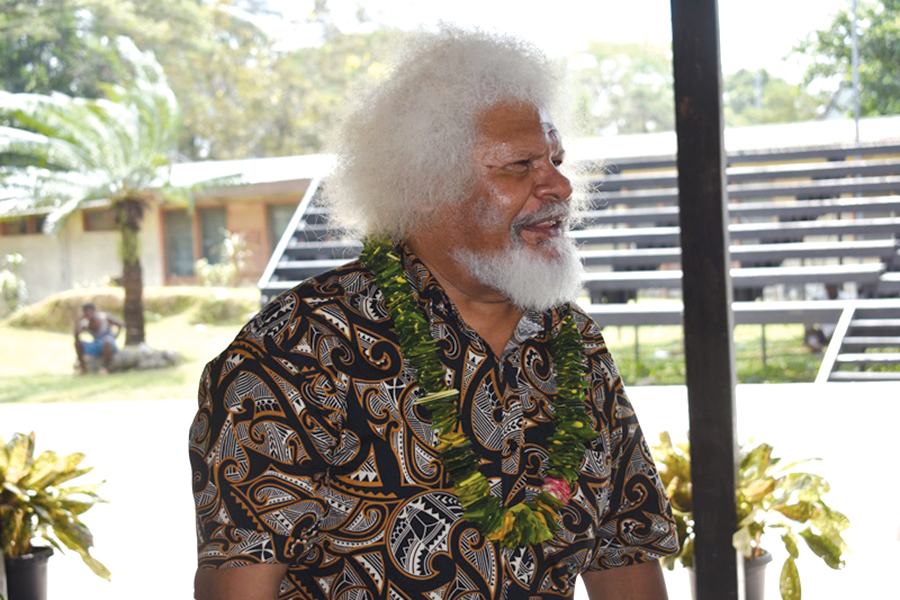
Dr David W. Gegeo.

BY LORETTA BRIGIDIA MANELE

Dr David W. Gegeo.

THERE are two ways you can interpret whether regionalism is evident in Malaita province and it’s either negatively or positively.

This was raised by Dr David W Gegeo, Research Coordinator of Social Sciences at the Solomon Islands National University’s (SINU) Office of Research who was delivering his keynote address to mark Malaita Province’s Second Appointed Day on Wednesday at the national museum’s auditorium.

Speaking of regionalism and whether it exists in the province, Gegeo spoke about how it is evident in both positive and negative aspects.

Initially, he said that from a positive realm, regionalism does exist in Malaita province as there is vast number of islands, pointing out Liungiua, Pelau, Sikaiana, North, East, West, Central and South Malaita as relatable examples.

Gegeo adds that regionalism is also when the province is divided into regions for the purpose or ease of development such as Manaoba airport, Atoifi airport, Gwaunaru’u airport, Parasi airport and so on.

“If we see regionalism in Malaita province in this positive light then I would say yes, we do have regionalism which we construct ourselves for the purpose or convenience of managing our economic, political, cultural and spiritual development,” he said.

Gegeo noted that regionalism is not only in Malaita province but it in all provinces thus is not something new.

He explains that the whole idea of the colonial government dividing the islands into districts for economic and political manageability is in principle an act of regionalism.

In contrast, Gegeo said that if regionalism was perceived in the province negatively, as a separatist ideology then they need to stop it now.

“It is not healthy for us on all dimensions; politically, economically, culturally, spiritually and otherwise. Malaita people must stay united together like our brothers and sisters in other provinces,” he said.

The research coordinator proceeded to state that if there are issues between North and South Malaita, Liungiua and Pelau and Sikaiana they must bring their leaders and people together in public forums and dialogue amongst ourselves and solve those issues.

He mentioned that separation or fragmentation is not the solution.

“Our strength is in our being united and staying together as one people and I am talking about South and North Malaita and Liungiua and Pelau and Sikaiana,” he said.

Gegeo expressed that Malaita is one of the few provinces in the country whose population consists of the three indigenous ethnic groups of Melanesians, Micronesians and Polynesians who settled in North and South Malaita and Liungiua and Pelau and Sikaiana and not through recent transcontinental migration but transcontinental migration that dates back to 40,000 to 60,000 years ago.

“I am very proud of that part of our provincial history,” he said.

Gegeo voiced that when their community leaders brought up the idea of Maasina Rule after the Second World War, it was so that their people and communities can stand united together as one people against colonization.

He furthered that they must stand firm against the temptation to be misled by the separatist ideologies of the modern world.

To add on, Gegeo said that they need each other to form a strong labor force for successful economic development in the future not only for Malaita province but for Solomon Islands as a whole.

“Let us stay together as one peace loving and caring people from Liungiua and Pelau and Sikaiana to Sa’a, Are’Are, Kwaio, Langalanga, Kwara’ae, Fataleka, Baegu, Baelelea, Tobaita, Lau, Ngongosila, Kwai,Walande, Fanalei etc,” he said.

Women Real Deal, only when we support each other

0

BY GEORGINA KEKEA

Ms. Regina Gatu of GPPOL giving her closing remark

WOMEN are encouraged to support each other in their daily work. Speaking during the closing of a session with SIPNET (Solomon Islands Professional Women Network), through the Waka Mere Commitment to Action, Regina Gatu, Sustainable Manager of the Guadalcanal Plains Plantation Limited (GPPOL) says the most complex challenge for women is how we see our fellow female colleagues.

“Do we take time to listen to the things they have to say? Do we appreciate the little things they do? Do we say thank you when we are being showed with curtesy? Do we appreciate the little things they do?” Ms Gatu questions.

She says each one has a unique journey. She said it is about getting from Point A to Point B in life and expecting results and changes as an individual.

“It is about individuals and how individuals are valued by self, by others and their organizations. It is about giving that opportunity for individuals to explore their strength and build on that. It is about acknowledging others who strive to be someone.”

Gatu says only when we start showing support and genuine concerns will we see individuals starting to change and be able to grow positively.

She says how females treat each other both in the workplace and home is very important. Respect for one another and to listen and to give attention, space and mentorship are very important factors to consider if women are to support each other.

“The question I would like for us to take away with us and answer at our own time is, ‘how will I support my sister, mother, friend and colleague so that she can reach her full potential as a leader’? Then we as women can say YES we are the real deal.”

The Waka Mere Commitment to Action is an initiative of the International Finance Cooperation (IFC) and the Solomon Islands Chamber of Commerce and Industry (SICCI).

Recently twenty women representing seven companies have in the country have undergone a Leadership and Management course through the Waka Mere Commitment to Action.

Seventeen of the country’s largest companies (of which GPPOL is one) have signed up and now undertaking measures to move more women into leadership positions, build respectful and supportive workplaces, and promote women to non-traditional jobs.

Yesterday SIPNET hosted an event for the IFC Vice President, Nena Stoilijkovic who is currently in the country.

Paparanghu Women’s Association receive donation from Sigoto

0
Sigoto’s representatives handed over the cooler boxes to the women from Paparaghu Association on Monday.

BY ALFRED PAGEPITU

GIZO

Sigoto’s representatives handed over the cooler boxes to the women from Paparaghu Association on Monday.

PAPARAGHU Women’s Association in Gizo have received 10 cooler boxes donated by Member of Parliament (MP) for Ranonga/Simbo Constituency Charles Sigoto.

The newly formed Paparaghu Women’s Association women consists of women from Simbo and Ranonga who are based in Gizo.

They are involved in cooking at the bonebone fish market and also sell handicrafts.

Speaking to Island Sun Gizo yesterday President Mrs Tamaua Ghemu on behalf of the association thanked MP Siqoto for the donation.

“This donation is vitally important to us as a women group from Paparaghu Women’s Association.

“It is the first ever donation we have received since their Association established early this year 2018.

“We are happy because the cooler boxes will help to preserve drinks and food for them for sale during the day.”

She further thanked Solomon Post Office for allowing the women to use their area for cooking (bonebone), selling of food and drinks and also selling of handicrafts.

Paparaghu in Ranonga and Simbo lingo means “bonebone”

Leadership and management training helps professional women

0
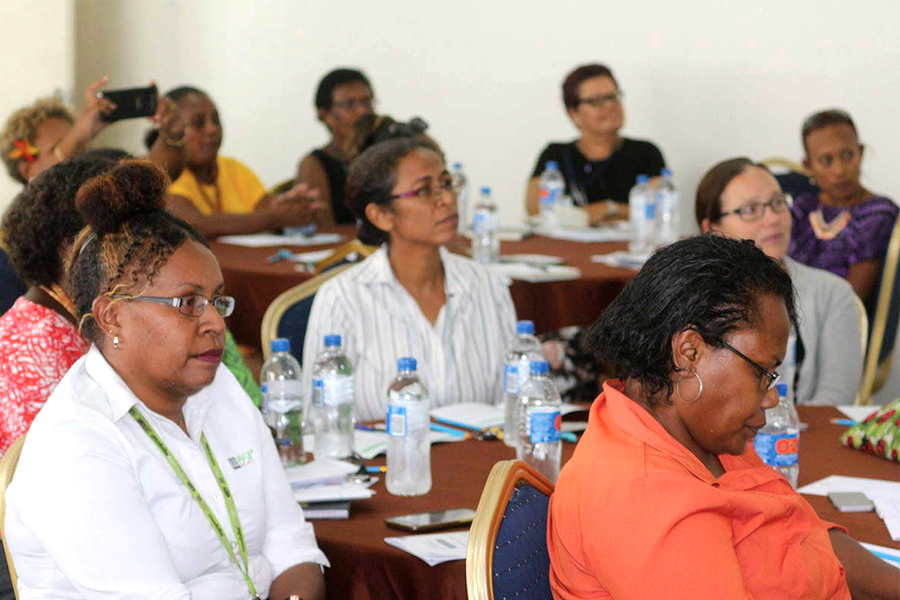
SIPNET members listening to a panel discussion.

BY GEORGINA KEKEA

Ruth Maetala from Waka Mere Committment to Action.

A weeklong training on Leadership and Management has just concluded for women through the Waka Mere Commitment to Action.

The weeklong workshop was mainly on leadership.

Coordinator of the SICCI-IFC Gender Programme, Ruth Maetala said empowering and encouraging women to leadership and management roles in the workplace is one of the focus of this workshop.

She said women in leadership positions are more visible in the private sector than in the public sector.

She said this is attributed to the kind of projects and trainings that the private sector, through the Solomon Islands Chamber of Commerce and Industry (SICCI) had been involved in.

She said this kind of leadership trainings and project through Waka Mere has boosted the women’s confidence and networking skills and also open their eyes to what leadership is.

“Some of those that have attended the workshop said when they go back to their office on Monday, they have started cleaning up their office space and trying to set a standard whereby they can set an example and also raise the standard of being persons in leadership positions.”

SIPNET members listening to a panel discussion.

She said the challenges faced by women in the workplace are also many. She said private businesses aim to make money and the issue of gender is still a sensitive one for some. She said despite that, employers are now starting to realise the importance of recognizing the needs of women and the space they need in order to excel in the workplace. She said the sort of trainings that the women had attended also contributed to the changes being witnessed now in the private sector.

Participants to the weeklong course were awarded Australian accredited qualification after their successful completion of the workshop.

Most of the participants commended the course on leadership saying it had opened up their mind on how they can practically carry out what they have learnt in the work place.

They say the training is practical based, thus very applicable and appropriate for them. The workshop brought together 20 women from 17 companies. These women were mainly Managers and senior staff in their respective companies.

The workshop concluded on Saturday, August 11.

Education is everyday

0
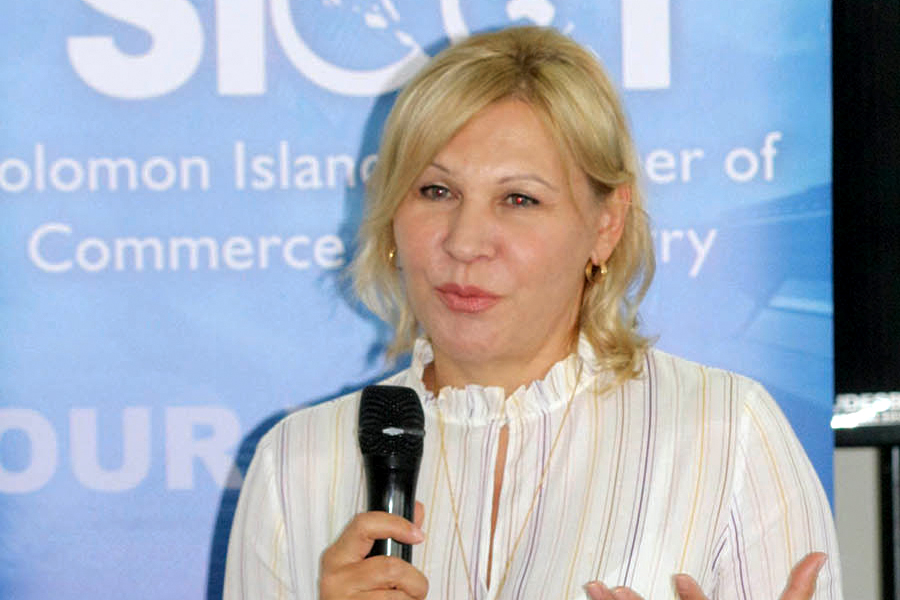
IFC Vice President Asia Pacific Nena Stoiljkovic

BY GEORGINA KEKEA

IFC Vice President Asia Pacific Nena Stoiljkovic

WOMEN are encouraged to pursue education in order to reach leadership positions. This was said by the IFC Vice President Asia Pacific for young girls and women pursuing excellence in their areas of work.

Yesterday Nena Stoiljkovic was guest speaker in an event hosted by the Solomon Islands Professional Women Network (SIPNET).

Stoilijkovic said women and girls that aspire to be leaders must not only pursue the regular education but take courses online, self-taught education and constantly try to improve each day.

She says getting vocational training is one of them.

“And when you get the job that you like, try to do the best that you can. Every day you wake up and think about how you can do best the task that you have.

“Networking is important, your relationship with your superiors but most important, doing right the job that you are given and spotting the right opportunities that come.

“Not shying away from making changes and learning new things but it is really a constant learning journey.”

Stoilijkovic says learning never stops, no matter how high up one is in her position at the work place.

Rethinking Development and what’s next?

0

By Derek Mane

DESPITEa the arguments and debates on the type of development approach to adopt, Solomon Islands continue to implement the SAPs (Structural Adjustment Programmes) policies influenced by the World Bank, and the International Monetary Fund.

Although in some countries, the miracle therapy induced by the SAP has increased their national GDP, people’s livelihood and standard of living, their rural areas remained stagnated or have further deteriorated.

This brings the attention on development scholars to review the effectiveness of the mainstream development model and its goals.

The discussion on alternative development emerged in the early 1970s due to the unsatisfactory level of modernist development prescriptions and its impacts on Latin America, Africa and the rest of the developing countries.

Alternative development theorist believed that the mainstream development (economic growth model) has failed and should be reassessed.

Inspired by the 1975 Dag Hammarskjold Foundation report-“what Now”? A Development alternative proposed by development scholars is to be ‘people centred’ than ‘growth oriented’.

As a concept, this alternative development focuses on ‘alternative development practices’ and the ‘redefining of development goals’.

In the Pacific, particularly in PNG and the Solomon Islands, there are interesting cases of how indigenous communal systems have merged effectively alongside the capitalism framework to enhance rural livelihoods.

In West New Britain, Oro (Popondeta) (Papua New Guinea) and in the Guadalcanal Plains (Solomon Islands), the palm oil companies instead of acquiring land through land alienation processes, they have encourage tribal groups (to register community/communal association-land trust boards) and to retain their land but engage them as out growers of palm oil. By doing so, both the multinational company and customary land owner’s benefit.

However, a more radical version of alternative development practices is seen in Latin America with the Andean Indigenous Buen Vivir (living well or collective living) movement.

The Buen Vivir movement which gain both political and legal status in Ecuador and Bolivia, is grounded on Manfred Max-Neef and Amartya Sen’s development perspectives that put emphasis on ‘integral’ and ‘sustainable’ human development.

Buen Vivir emphasises development through the individual than the society nor is it reliant on or related to the transformation of its institution.

In broad terms, Buen Vivir focuses on the interconnectedness of economics with the political, social, cultural, and environmental sphere, as well as necessities, capacities and potentialities of human beings.

The key elements of this new framework are; equity, democracy, participation, protection of bio-diversity and natural resources, and respect for ethnic-cultural diversity. Buen Vivir envisages a new social, political, economic, and natural-based mode of development that is distant from capitalism.

Nonetheless, alternative development scholars believed that development at the rural level can only be successful, if rural people themselves participate or take control of their own lives.

Furthermore, rural areas need democratic decision-making system, social policies that foster equality as well as social security suitable for local conditions, and sustainable rural livelihood that encourage financial support and approaches that empowers the most vulnerable people in poor societies.

For traditional and closed societies, the alternative development also pays close attention to the nurturing of informal social networks, community cohesiveness or cooperation which are seen as social capital to drive community development.

Community best practices and successful home-grown development initiatives that promote good governance and opportunity for all are hailed as the way forward to develop. In fact, alternative development approach has led to the proliferation of non-governmental organisations throughout the developing world.

In Melanesia and in particular the Solomon Islands, informal social networks and social capital are common and relied upon by many to mitigate their hardship.

Although modernisation, dependency and alternative development theories may assist explaining why our rural areas are not developing, we need to really understand and seek solutions to some very important questions.

These include ‘How do we appreciate the difference between the diverse tribal civilisations and communal attributes that exist in the Solomon Islands? ‘Does communal arrangements, tradition and kastom promote good governance, rural development and eliminate poverty?

‘Is the wantok system as a social capital at the village level immune from such negative impacts? ‘Does the wantok system actually foster stability and livelihood well-being at the village level? ‘What type of wantok system promotes peace and prosperity?

In the Solomon Islands, social relations (can be individuals and groups-tribe) and group arrangement (can be a village to village or other institutions) are key to stability and prosperity. How these relationships are established and managed dictates individuals or households’ access to resource, market and livelihoods.

Although answers to these questions are yet to be investigated, these questions are relevant to the social construct that could be used to critically reorganise local level development models and networks.

The interest here lies on the wantok system as an alternative development practice to alleviate poverty at the village level in the Solomon Islands.