27 lives were lost on the MV Taimareho in April 2020 when the ship sailed through rough weather.
One year on, and charges finally laid over Taimareho sea tragedy
BY JENNIFER KUSAPA
TODAY marks the day that 27 lives were lost at sea following the MV Taimareho sea tragedy and police can now confirm that charges are being laid against individuals in the High Court
Police Commissioner Mostyn Mangau confirmed that these people are being charged under the Marine Act.
Mangau said the case file was lodged at the High Court and further details on how many people were being charged as well as what charges they are facing will be revealed soon.
This announcement came as families of the 27 people victims announced this week that they are pursuing legal actions against five defendants in their case which includes; the West Are Are Constituency shipping company, the charterer MP John Maneniaru, MV Taimareho, SIMSA, captain Galo and captain Malepa.
The 27 lives were lost at sea between Malaita and Guadalcanal after the vessel met strong winds and rough seas. It was allowed to embark on its journey despite a cyclone warning issued earlier during the evening of 3rd April 2020.
The vessel was carrying passengers back to their constituency on West Are’are after a nationwide repatriation of people living in Honiara back to their home villages. Out of the 27 that were swept from the vessel only six bodies were recovered during search efforts.
As a result of that incident the police, marine and other stakeholders launched an investigation in to the incident and a report was released last year in May.
Minister of Infrastructure Development Manasseh Maelanga during the release of the report on the sea tragedy highlights that there are a number of recommendations made by the Board in the report dated 30th May 2020.
“These recommendations will now be forwarded to the relevant authorities including the Royal Solomon Islands Police Force and the Director of the Solomon Islands Maritime Authority for their necessary actions.
Maelanga also said that once it reaches the police, they have the ball in their court to deal with the issue according to the law.
The recommendations are:
(a) That the Shipowner and Master violated the following:
(1) Sections 78 (1) and (2) of the Shipping Act 1998;
(2) Sections 8 (1) and (2) of the Shipping Act 1998;
(3) Sections 115 (1) and (3) of the Shipping Act 1998;
Meanwhile, section 78 (1) of the Shipping Act 1998 states “Neither the owner nor master shall permit more persons to be carried in a vessel than the number stated in the passenger ship safety certificate issued in respect of the vessel as being the maximum number of persons that may be carried in the vessel.
Section 78 (2) stated; “Every owner and the master of the vessel who contravenes this section each commit an offence, and each shall be liable upon conviction to a fine not exceeding ten thousand dollars and to a further fine of not more than two hundred dollars for each person carried on board the vessel in excess of the number stated in the passenger ship safety certificate.”
Sections 81 (1) (c) however states every vessel is unsafe if –the vessel is overloaded or improperly loaded and section 81 (2) states “Where an unsafe vessel goes to sea, every person who knowingly sends, and the master who knowingly takes, the unsafe vessel to sea commit an offence, and each shall be liable upon conviction to a fine not exceeding sixty thousand dollars..
Section 115 (1) states “No person shall be employed on a vessel as a seaman unless there is in force an employment agreement approved by the principal shipping officer, in writing in the English language, between the owner, or licensed shipping agent, or master and the seaman which agreement maybe-
(a) With respect to employment in one or more vessel; or
(b) For a particular period not exceeding one year; or
(c) For one or more particular voyages.
Section 115 (3) however states every person who acts in contravention of subsection (1) or subsection (2) commits an offence, and shall be liable upon conviction to a fine not exceeding ten thousand dollars.
Families of those who perished in the tragedy have formed a Victims Custom Compensation Committee, in which they have pursued legal action against those purported to have given the green-light for the vessel to sail during the night.
Vice Secretary of the Committee Venasio Huniehu said they have engaged a private law firm to proceed with their case.
Huniehu said in their legal suit they claimed $250,000 for expectancy of dependency, $100,000 for expectancy of life and $50,000 for special expense.
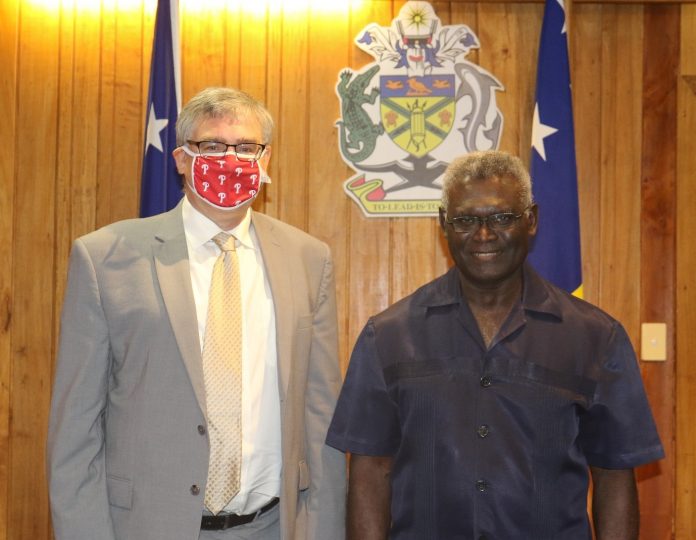
Prime Minister Manasseh Sogavare and US Deputy Chief of Mission Mr. Bernard Link.
The United States of America this week updated Prime Minister Manasseh Sogavare on plans to upgrade the former’s development programmes in the country.
The US Deputy Chief of Mission from the Port Moresby Embassy, Mr. Bernard Link lead the team for the Courtesy call.
Updating Prime Minister Manasseh Sogavare on US’s development projects in the country, the US Deputy Chief of Mission said, development project initiatives for Solomon Islands are related to:
USAID’s $25 million Strengthening Competitiveness, Agriculture, Livelihoods and Environment (SCALE) Program, which will be the USG’s largest investment in the Solomon Islands. This is a national Project that will benefit Malaita and other provinces. The primary objective of SCALE is to advance the Solomon Islands’ economic competitiveness and inclusiveness with specific emphasis on the development of the agribusiness sector and improved management of the forestry sector. It will seek to improve the enabling environment for increased trade and investment; promote the expansion and further development of the agribusiness sector; and improve governance. By advancing regulatory reform and improving the performance of the agriculture and forestry sectors, more employment will be generated, incomes are expected to rise and the quality of life of the citizens of Solomon Islands will improve. An agreement is under development.
The Millennium Challenge Corporation (MCC) threshold programme. This seeks to assist the Solomon Islands Government in addressing two major constraints to economic growth through the Accessing Land for Tourism Investment Facilitation (ALTIF) Project and the Forest Value Enhancement Project (FoVEP). The MCC threshold programme is approximately USD 23 million. An agreement on this is under negotiation.
The US Government is also negotiating the framework that would authorize Peace Corps’ return to Solomon Islands. At present, Peace Corps has no volunteers posted overseas due to COVID.
Meanwhile, Prime Minister Manasseh Sogavare is grateful to the US Government for its development initiatives.
The Prime Minister welcomes the US projects and hope they contribute meaningfully and inclusively to national development.
He emphasised, Solomon Islands must address its development issues. They are important to sustain our economy.
On the US25 million Aid as with other bilateral undertakings between Washington and Honiara, a formal Third-Party Note is a precondition.
The Prime Minister further underlined, any development in the country must ensure Solomon Islands progress as a united country not focusing only on one particular interest. The nation is still struggling to address issues and bitter memories of the past Ethnic Tension.
“We want to keep our corner of the world peaceful.”
On MCC, he adds, “My Government is receptive to Millennium Challenge Corporation programme negotiations.”
The announcement to re-establish Peace Corps in Solomon Islands 20 years after departing the country is also commended.
Peace Corps’ efforts in Solomon Islands will initially focus on education and will recruit short-term volunteers with experience in Peace Corps’ education sector to help re-establish the program.
The first group of volunteers is scheduled to arrive mid-2021.
Ishmael Kukiti speaking during the motion of Sine Die
GUADALCANAL Province will get tougher on logging issues this year.
It will also limit the number of logging companies operating in the province.
The province’s Minister for Forestry and Mining, Ishmael Kukiti, revealed this in his contribution to the Sine Die motion Tuesday this week.
More than 20 logging companies – including licensees and contractors – have been operating on Guadalcanal since 2015.
Licences of some of the loggers and contractors are expired to expire sometimes this year.
Kukiti said his ministry will be closely monitoring all logging business licences, and also environmental impacts once the relevant ordinances are assented.
“The Government for Inclusive Change and Sustainable Development (GICSD) had started mid last year to do background checks on these logging companies, one of which is the SINO Capital Ltd case (now in High Court),” Kukiti said.
“We are also looking at limiting the number of logging companies operating on Guadalcanal,” he added.
“We aim to pass an ordinance that would control the negative environmental impacts due to logging activities.”
Despite efforts by a number of provinces to limit logging, the national government continues to issue logging licences one after the other.
Permanent Secretary of the Ministry of Forestry Vaeno Vigulu told the Public Accounts Committee last week his ministry has issued 435 licences to logging companies operating across the country.
These include 281 valid licences and 154 operation licences.
POLICE Commissioner Mostyn Mangau is calling on individuals and the public to always do the right thing and refrain from illegally selling alcohol.
Mangau said during the Easter operation one of their main target is to re-enforce the law and the illegal sale of alcohol will also be targeted during their operation.
He said people need to obtain proper licenses before they could sell alcohol, and calls on the public and communities to support police stop those illegal activities happening inside their societies.
Mangau said police cannot do policing alone without public support.
He said there must be a report from the public before police can obtain an order or search warrant to search the spots where some individuals are using to sell alcohol.
When questioned as to why police are not going undercover to trap those selling alcohol, Mangau said police will not resort to that idea.
Mangau explained that on one occasion police have been doing that, trying to trap those involved in the illegal sale of alcohol, but when the case came before the court, it was thrown out as police officers are not supposed to trap people into trouble.
Therefore, the police needs the public to support them in providing information before they could obtain proper warrants to search those people involved in such illegal activity.
This paper understands that the Bahai area and behind the bulk shop near the Church of Melanesia premises at Point Cruz, are some of the spots people use to do those activities.
HEARING of evidence into the case against the bus-driver accused of causing death on a pedestrian will commence on April 6 2021 before Deputy Chief Magistrate Ricky Iomea.
The accused Konge Diau denied the charge against him and a trial was set to April 6, where the prosecution will call their witnesses to give evidence in court in regards to the incident.
The accused Konge was charged for a hit and run incident at the Henderson area on July 2020 where a man died as a result.
Prosecution said the deceased was with his wife and their teenage boy on board a pick-up truck travelling from Honiara’s main market heading back home. The deceased is believed to have taken some alcohol before he and his family boarded the vehicle. On their way passing the Lungga Bridge, East of Honiara, the deceased asked his wife to give him some money. His wife gave him $100.00.
Police said they stopped at the shops in the Lungga area and the deceased went into one of the shops and bought some goods before they drove out again heading in the easterly direction.
Police said just opposite the Island Night Club in the Henderson area, the deceased asked the driver of the motor vehicle to stop.
As the driver was about to stop the deceased suddenly jumped out of the truck, without looking for incoming vehicles from both lanes. It is believed that he ran straight into the main road, as one vehicle was approaching from the westerly direction. Police said when the deceased crossed the road, a 15-seater mini bus travelling at high speed from the easterly direction unfortunately hit the deceased and it is believed he died instantly
The Royal Solomon Islands Police Force (RSIPF) Explosive Ordnance Disposal (EOD) team will be conducting live demolition of bombs at the Hells Point, in Alligator Creek, east of Honiara from the 7to 8April 2021
Supervising Officer In-charge (OIC) of EOD, Staff Sergeant Peter Ririvere said the Hells Point Demolition Range in Central Guadalcanal area will be active from 8am to 12 mid-day on both days.
“Fishermen, farmers, hunters and the general public in the Henderson, Alligator Creek and Tenaru School areas are warned to keep out from Hells Point while the Operation is in progress.”
Staff Sergeant Ririvere explains, “This is a normal EOD task aimed at reducing the amount of unexploded ordnances stored at the site to a minimum level. The bombs were collected from various areas in Solomon Islands more especially around Henderson, Lungga and Alligator Creek areas in Guadalcanal Province.”
“The Air Traffic Control Tower at Honiara International Airport will coordinate the firing of each serial. No serial is to be fired without specific air clearance and permission from Honiara Air Traffic Control Tower,” Staff Sergeant Ririvere said.
He adds that an EOD Operator/Technician from the RSIPF EOD team will be posted at the control tower during this operation from the actual times of the Demolition and completion time.”
The Makira Ulawa Provincial Assembly has repealed its Investment Arm, the Makira Ulawa Province Investment Corporation – MUPIC.
The Makira Ulawa Province Investment Corporation has been operating under an Ordinance, a previous Provincial Government created in 1998.
But the Makira Ulawa Provincial Assembly in its meeting on March 27, 2021 in Kira Kira, the Provincial Capital of the Province decided to repeal the ordinance following a motion moved by the Premier, Julian Maka’a.
He said there were three factors that acted as pillars for moving the motion, the first being MUPIC had failed to fulfill its functions and powers.
Mr Maka’a said the Investment Corporation was established with noble commercial and economical intentions under the Ordinance which was passed by the Makira Ulawa Provincial Assembly then.
He said the Corporation became operational with certain very general purposes as contained in Part 2 of the Ordinance, adding it had existed with specific objectives under its Functions and Powers as also spelled out in Part 2 of the Ordinance.
Premier Maka’a told the Assembly that Section 4 (1) of the Ordinance MUPIC was set up purposely to promote economic development within the Province, it should be responsible to ascertain businesses and other enterprises were developed within the Province and their efficient and regulated operations were secured.
And since its inception, he said, MUPIC had been operating a Rest House in Kira Kira; had rented out a Warehouse at Kira Kira landing area; had rented out a building to a retailer at the Kukum housing area within Kira Kira; had rented out several leaf huts for catering meals at Rain-tree area next to the Kira Kira Football Field; had been leasing out Residential Quarters at Kola’a Ridge in Honiara and had bought a piece of land at Okea on the Guadalcanal Plains on Guadalcanal Province.
He said the Corporation has not developed the Okea land since it bought it.
And on the question of whether or not MUPIC has in the past 20 years been attaining and fulfilling its established purposes and functions, Premier Maka’a said “in my very humble, logical and respectable observation, my simple and pragmatic response to that critical question is but a simple NO”.
Mr Maka’a said it was obvious the Corporation had not been promoting economic development; had not been developing businesses and other enterprises and had not been securing efficient and regulated operations of those supposed to be businesses and enterprises within the Province as stipulated in the Ordinance.
Taking those failures into consideration, he said “I will strongly maintain that the Corporation has failed miserably to fulfill its obligatory purposes and functions as demanded by the Ordinance”.
Mr Maka’a said the second pillar was the due Reform necessary to change in circumstances, situation and environment.
The Makira Ulawa Province Investment Corporation was formed in 1998, 20 years ago, and it is important to note it was amidst social and economic situations and circumstances which were totally different from the experiences of today.
And in the dynamics of change, Premier Maka’a said much had evolved and changed the initial environment as development had either caught up with “us or bypassed us, and the many good determinations made in the past.
“But we must accept the fact that the World is scientifically circumventing faster than it used to be, hence alarming visible changes emerge, which is called in the political language “Reform”.
He said the notion must not be overlooked as “we need to be current and be able to live in the World today, we must embark on Reform the moment its need becomes evident and inevitable otherwise we continue to live in our own outdated world.
“Let us not lax and lay by as matters deteriorate before our very eyes. We must get up, flex up and act lest we fall below the resurrection line, as the changes have inevitably distorted the initial environment necessary for the initial functions and purposes devised for MUPIC.
“Then, there were no Provincial Government Strengthening Program, no Provincial Capacity Development Fund, no regular auditing, and compliance was on the verge of extinction.
“Elements of Good Governance, Transparency and Accountability were obscene features in governance and the good environment we now witness had almost disappeared.
“But we have now changed all those with Good Governance now featuring highly the elements of Transparency and Accountability in the systems and mechanisms, credible systems of accountability, regular reporting and auditing are now obligatory to ensure compliance to frameworks of the day which are now common happenings, not seen before”.
The Makira Ulawa Premier, Mr Maka’a said Resource, Opportunity in gaining and losing considerations made up the third reason for moving the motion, so members could ponder and deliberate on the economics of MUPIC.
He said since the Corporation’s inception, tremendous attempts had been made to secure financial professionals to tidy up its mess in not keeping financial records, but they had come to no avail; failure to keep proper records as required under Part 111, Section 15 (1) of the Ordinance continued to impede on MUPIC from producing Financial Statements, these Reports were also required by Part 111 of the Ordinance; No audit had been carried out on MUPIC as there were no financial records or systems in place to be audited; the failure to produce financial reports made it difficult to gauge, ascertain and declare whether or not MUPIC was making profits or losses, an obligation also contained in Part 111 (Finance) and the chain of subsequent downsides of MUPIC continued to rise and its inability to report profits or losses resulted further in its inability to declare dividends due to the shareholder, the Makira Ulawa Provincial Government.
On the other side of the coin, Mr Maka’a said MUPIC had not strictly been honoring its Superannuation and Taxation obligations as required under law with arrears mounting and causing ultimate burden to the Makira Ulawa Provincial Government; MUPIC is the Economic Development Arm of the MUP Government, naturally therefore, it is connected to the Provincial Government, as such they are compelled to jointly declare their financial activities through consolidation of their two separate Accounts or Financial Reports; this has not been forthcoming for many years as MUPIC has not provided credible reports, resulting in plaguing the Audit Reports of the Makira Ulawa Provincial Government to this day.
Premier Maka’a told the meeting that Provincial Governments including MUPG will be missing out Provincial Capacity Development Fund resources if they fail to provide Income Accountability because it is a Performance Measure it uses when considering funds towards their Investment Corporations.
The measures are keeping proper Account Books; producing regular credible financial reports; consolidating their Accounts with those of the Provincial Governments; getting accounts audited; realizing profits and profitability; declaring profits and distributing dividends to shareholders, the Provincial Governments.
Premier Maka’a said the report he had provided portrayed a gloomy picture of MUPIC, but they were necessities as they could ensure its credibility, prudence and profitability; they could ensure satisfying returns of the Provincial Government’s investments and certainly the Provincial Government would not desire to continue putting its money in an institution that was not making profits and was not giving out rewarding dividends.
He said why he was trying to impress on the third factor of the reasons for repealing the MUPIC Ordinance were Makira Ulawa Provincial Government and the Province had been losing and would continue to miss out on good resources including those from PCDF if the Provincial Government continued to hold on MUPIC.
In the final analysis, Premier Maka’a said it was a common knowledge that the loss of resources from PCDF was due to the Makira Ulawa Provincial Government not scoring in the associated Performance Measure in PCDF, adding the Prime Minister carried huge funds that could be shared amongst the nine provinces.
He said the Performance Measures will be elevated to become a Minimum Condition as from the next PCDF Assessment due towards the end of the year.
The motion was passed and the MUPIC Ordinance is now due to be repealed.
Two Rangers from Haevo Khulano Intergrated Conservation Jonas Havimana and Brian Siama ready to relelase off hatched turtles from one of the relocated nests. Photo -IAN KAUKUI
BY IAN KAUKUI
WHAT used to be a turtle slaughtering ground for a coastal community in the Solomon Islands in the past is now a safe sanctuary for the leatherback, the largest sea turtle species on earth.
The Haevo Khulano Integrated Conservation area in Isabel Province was established in 2013 following initial consultations between stakeholders in 2012 which include a local committee formed out from the Haevo Khulano Integrated Conservation area surrounding Communities, Isabel Provincial Government, Solomon Islands Government and The Nature Conservancy (TNC).
TNC is one of the Global Environment Organisation in Arlington, Virginia, United States but has a branch in Honiara that deals with environment conservation including the different types endangered species they have such as the Leatherback turtle including others turtle species for that matter
Before 2013, local residents of Haevo usually harvesting turtle eggs and killing the turtle for its meat given the weak law enforcement on the part of the fisheries act and because it already become a normal practise they culturally grew up with to kill and harvest those turtles including their eggs, without realising it is one of the most endangered turtles species on earth and that it against the fisheries act to kill them
The 4.6 kilometres stretch of black sandy beach is situated in the north-east of Isabel Province and is amongst the few nesting sites for leatherback turtles in the Pacific region.
One of the Ranger at Haevo Khulano Intergrated Conservation Jonas Havimana conducted DNA test on one of the Leatherback turtles as she lays her eggs
Following the establishment of the Haevo Khulano Integrated Conservation area in 2013, turtle monitoring training tagging, data collection and other technical aspects of the monitoring also started with the direct involvement of the so called Rangers.
Chief Hubert Haehathe from the nearby Buma village, situated at the western end of the Haevo turtle nesting beach is also an active member of the local committee who is part of the conservation initiative and also attended several leatherback trainings leading up to the conservation establishment.
He said the nesting beach was actually where they used to get turtles and their eggs for food when turtles came ashore for nesting.
“At first we didn’t mind about protecting the leatherback turtles but we only see them as food.
“Not until in 2013 when the conservation started and we managed to stop the practise.”
Haehathe said today, the leatherback turtles are now part of his community’s culture and identity.
“Some of us especially the older people are well versed with the knowledge and skills which we have developed in understanding the leatherback turtles’ behaviour such as mastering knowledge of the suitable nesting season for the year.
“It’s already becoming part of our culture which are not new, as our ancestors use to tell us about the nature and lifestyle of these turtles,” Haehathe said.
Following the establishment of the conservation effort, people in Haevo no longer slaughter the leatherback turtles and dig their eggs given they themselves have also agreed to conserve the turtle after several awareness and workshops has really opened their minds on the importance of that particular species and why it should be protected.
Currently movements of the certain leatherback turtles are tracked down by local Rangers who are manning the Haevo beach nesting ground inside the designated conservation area but only for those they put tags on.
These rangers are tasked to manage the beach both day and night and record any sighting of turtles on the beach.
Relocating eggs to a safer place to avoid high tide which might spoil the eggs
Supervising Ranger Bryan Siama said their roles are to monitor and record the number of turtles coming in and how many actually lay eggs on the beach.
“We do assessment as to how many eggs are actually laid by each turtle and those surviving after hatching before swimming out into the Pacific Ocean.
“Interestingly, we now able to understand the movements of these turtles when we started recording them since their nesting until hatching of newborn babies. We can now tell when they will return for their next nesting season.
One of the Rangers Benson Cliford points to one of the nesting cites where the high tide and big waves washed away due to impacts of climate change.
“We started with around 10 Rangers and sometimes we attended trainings conducted by TNC team as the leading body that supported the conservation program,” he said.
Siama said with the support from TNC, the Isabel Provincial Government, the Maringe Kokota Constituency and Secretariat of the Pacific Regional Environment Program (SPREP), they managed to put up a two-storey iron roofing building as a hub for the Rangers and to provide accommodation for visitors and guests alike.
“As one of those who are currently on site, we normally provide security and work to help protect these leatherback turtles by assisting them during the process of laying of eggs, and transfer of eggs to safer places if urgently needed especially when their nests are close to the water mark.
“But the most challenging part of our work is the impact of climate change and threat caused by humans. Given the king tides normally experienced toward end of each year, it can destroy the turtles’ nests and so we have to relocate all the nests to a safer or higher ground to avoid being washed away by the high tides,” he said.
Siama added other threats to the conservation initiative are from lizards, iguana, crabs and other animals that usually dig up the turtles’ nesting sites and eat the eggs.
“Not only that, several people are still yet to fully understand conservation and sometimes harvested turtles’ eggs when they come across the nests on the beach.
“We see that there is a need to do more awareness so that our people can fully understand the purpose of turtles’ nesting conservation and what benefits it can bring to our communities,” he said.
Siama reiterated construction of new houses at the western end of the beach, also disturbs the turtles when they want to get ashore for nesting.
However, with regards to the conservation work, it really helps a lot in many ways to both the Rangers, the villagers, communities, the provincial government and NGOs because more achievements have already been achieved following its establishment in 2013.
Another Ranger, Benson Clifford said he is able to provide food for his family because he is paid for his work as a ranger under the conservation work.
Clifford said as rangers, they normally encounter turtles every night and one of the highest records they had was up to six turtles.
“This normally occurred during the peak season.
“Leatherback turtles normally have two seasons namely mid-year season from June to August and end-year season from October to March. The peak seasons are from June to July and November to January.
“As part of our job, we record how many eggs each turtle lays and how many eggs hatch. Each turtle can lay up to around 80 to 100 plus eggs.
“After going through some trainings, we’ve also been able to do tagging of the turtles, get their measurements, DNA samples, handling of eggs during relocation and record as much information we can get from the turtles,” he said.
In terms of the laws that governs the conservation of turtles, TNC officer in Honiara Madlyn Ero said only the Solomon Islands Ministry of Fisheries has the law that strongly prohibits the killing of Leatherback turtles than any other turtle species.
Mrs. Ero said Rangers only carry out the monitoring, and if anyone found breaching the laws by killing any leatherback turtles, they can only report to the Ministry and orders can be made for Police to carry out arrest.
She said the law strongly applies only to the leatherback turtles and not so much on the other species, like the Hawksbill and Green turtle as their population is much higher than the Leatherback turtle.
The law she referred to is the current management or protection of Marine Turtles in Solomon Islands which highlights issues regarding turtles, and their nests and eggs as well as protection of certain turtles in Solomon Islands.
Under the country’s national fisheries law on turtles’ protection, any person who sells or exposes for sale or buys or exports any turtle or part of any turtle or the product thereof, shall be guilty of an offence and on conviction liable to a fine of one hundred dollars or to imprisonment for three months, or to both such fine and such imprisonment.
Furthermore, any person who takes nesting turtles or eggs or destroys turtle nests or eggs during breeding seasons which are from June to August and November to January shall be guilty of an offence and on conviction liable to a fine of one hundred dollars or three months imprisonment or to both such fine and imprisonment.
The law also prohibits fishing for the leathery backed turtle or luth (Dermochelys coriacea); or takes, destroys, possesses, sells or exposes for sale, buys or exports any eggs of any leathery backed turtle or luth. Anyone found to be breaking this law shall be guilty of an offence and liable to a fine of one hundred dollars or to imprisonment for three months, or to both such fine and imprisonment.
And for this reason, and with that conservation in Haevo, Chief Haehathe said up until today, they never harvested any leatherback turtle or catch people digging turtle eggs on the beach and also no body being arrested, fined for violating the law.
Former Minister for Environment, and Member of Parliament representing the constituency where Haevo nesting beach is, Dr. Culwick Togamana said Solomon Islands Government also supports the conservation of endangered species in the country including the leatherback turtles.
He added the key roles of provincial governments and communities in coastal resource management are also pivotal in the implementation of the Solomon Islands National Ocean Policy.
“It is through this government’s initiative that the government together with the Isabel Provincial Government in partnership with TNC and community representatives declared Haevo Khulano as a conservation area for the leatherback turtles,” Dr. Culwick said.
He said essentially, leatherback turtle management and conservation are a matter of national priority supporting the global effort to protect this majestic creature.
“Leatherback turtle remains a restricted species and its survival still is now under threat. In fact, the population of leatherback turtle has declined by almost 80% in waters of Western Pacific countries, Solomon Islands included so that the survival of this turtle species is considered critically endangered.”
Meanwhile, TNC Country Director-Solomon Islands Program, Willie Atu said they’re working together with relevant stakeholders to discuss improvement on current state of Leatherback Turtle conservation and management in Isabel Province.
TNC Country Director-Solomon Islands program Willie Atu during one of the recent Leatherback turtle workshops in Buala
He said TNC is also discussing the re-commencement of monitoring and management of the Leatherback nesting population in Sasakolo, at the the western end of Isabel Province, including signing of Memorandum of Understanding between relevant stakeholders.
He said over the past months, they have conducted workshops which brings together different leather back conservation groups within the Isabel Province covering the three constituencies on the island.
TNC Marine Conservation Scientist Simon Peter Vuto said past scientific assessments already compliment local knowledge which had shown Isabel Province to host some of the most active nesting beaches for leatherback turtles in Solomon Islands.
He said satellite tracking have shown some stocks of leatherback turtles feeding as far north as California, USA would make a treacherous migration south just past the equator covering thousands of miles journey to nest on Haevo beach in Isabel.
Vuto said the critically endangered Western Pacific leatherback sea turtles embark on an annual migration of over 6,000 miles each year to feed on dense aggregations of their favourite food, jellyfish.
He said there are estimated to be between 34,000 and 36,000 nesting females left worldwide (compared to 115,000 nesting females in 1980). The Pacific populations are facing extinction and the Atlantic population is being caught as by catch (living things caught unintentionally while fishing) at an unsustainable rate.
As the largest of all sea turtles, he said leatherback have experienced a catastrophic 95% decline in their Pacific nesting populations over the last several decades due to constant threats of entanglement in commercial fishing gear, poaching of turtles and turtle eggs from nesting beaches, ingestion of plastics and pollutants, and habitat loss on tropical nesting beaches.
Vuto said records shows leatherback turtles after their eggs hatched and released, migrated to other parts of the ocean, before returning to lay their eggs on the same beach where their mother once laid them as mere turtle eggs.
There are seven different types of turtle species but Vuto said only three have been sighted and recorded in the Solomon Islands. The other two apart from leatherback are hawksbill and green turtle.
TNC Isabel Coordinator, John Pita said turtles come with different sizes. Some have a length of up to 2.5 meters and weighs up to 1000 kilograms. However, he said the record is no longer matched in any of the current nesting sites, which means their sizes and lengths have decreased over time.
Pita said currently the sizes in terms of length can reached up to 2.4 metres and 1.6 metres width and weights up to 400kgs.
He said leatherback turtles love to lay their eggs on hard black beaches unlike other turtle species who love white sandy beaches.
“Whilst other turtle species takes 30-40 years to reach maturity stages, leatherback turtles take only 10-20 years and they can leave up to 40 years which means they grow faster and die faster. Their main diet is jelly fish and each jelly fish contains up to 200 litres of food which leatherback turtles really need to feed on.”
On the Haevo turtle conservation beach, Ranger Clifford said it seems there is hope at the end of the tunnel when it comes to the current effort to conserve the leatherback species compared to the past.
“Increasing the population of the leatherback turtle is possible given there is no more consumption of leatherback turtles in Haevo or other parts of Isabel like it used to be in the past.
“Assisting with its nesting and looking after the eggs is also contributing to increasing the population of the leatherback turtle species in the wild.”
Ranger Clifford said he is looking forward to see and record more leatherback on Haevo beach. That to him would be the result of his contribution and commitment to the conservation work as a ranger.
The establishment of Haevo turtle nesting conservation area including Sasakolo and Arnavon islands in the western tip of Isabel Province and Rendova island in the Western Province, is already a positive sign for the future of the leatherback turtles.
Such turtle conservation effort in Solomon Islands can also be supported by stopping the consumption of turtles as it is still a delicacy for many coastal residents in the archipelago.
Collaboration from all stakeholders is also paramount to help address the issue of climate change as one of the main threats to the leatherback population. That is to come up with strategies and actions to encounter those risks.
* This feature story is produced with support from Internews’ Earth Journalism Network (EJN) under its Special StoryGrant Award.
CRUCIFIXION RELIVED: The crucifixion drama was relived in thousands of churches around the country yesterday who came to celebrate Good Friday. This scene was taken at the Kukum field where the Catholic Church in Kukum used the occasion to dramatize the events that took place Calvary more than 2000 years ago. PICTURE: Alfred Pagepitu
BY ALFRED PAGEPITU
Christians across Solomon Islands joined others worldwide in commemorating Good Friday which signifies the crucifixion of Jesus Christ.
The crucifixion of Christ is held every Good Friday, and is part of the local observance of Holy Week. It is a day observed around the world before the Easter Sunday.
It commemorates Jesus Christ’s Passion, crucifixion and death which is told in the Christian Bible.
Drama of the cross at the Kukum catholic church.
To commemorate Good Friday is an important festival in the Christian calendar and is usually celebrated annually.
Good Friday, the Friday before Easter, the day on which Christians annually observe the commemoration of the Crucifixion of Jesus Christ.
From the early days of Christianity, Good Friday was observed as a day of sorrow, penance, and fasting, a characteristic that finds expression in the German word Karfreitag (“Sorrowful Friday”). Good Friday is celebrated on Friday, April 2.
The observation involves people fasting and praying as well; churches across the country hold services in the morning up until around 3pm.
These kids came out to witness the dramatization of the crucifixion of Jesus on good friday.
Island Sun yesterday, visited churches within Honiara which commemorated the day with programmes that also featured the dramatization of the crucifixion of Jesus Christ.
Youths at the Holy Cross Cathedral, held a dramatic re-enactment of the Passion of Christ that started at 9am at the Holy Compound, followed with the veneration of the cross at 3pm.
The drama processionn
Kukum Catholic church also performed a dramatization of Christ’s crucifixion at the Kukum field to a large audience. The drama, which is traditionally called a ‘passion play’ was performed by the youths.
A large number of Christian believers also took part at church services to mark Good Friday.
The drama continues
Church members and visitors of the Saint Alban Parish also re-enacted the procession of the Cross as in the ritual station of the cross which depicts the final hours of Jesus’ life from White River to St Alban Church at the Rifle Range.
Hundreds of Anglicans also marched with the cross from KGVI to the Vura Parish as the youths dramatized the crucifixion of Christ from station one to 14.
Prime Minister’s nephew and chief of staff, Robson Djokovic, will appeal the High Court’s decision on his citizenship status.
Djokovic’s lawyer, Mr Wilson Rano, has come out with a statement confirming this.
Early last month, Justice Howard Lawry passed judgement that Djokovic, although being an indigenous Solomon Islander, is not a citizen.
This judgement was said to have rippling effects because Djokovic was also facing allegations that he had registered and voted in the 2019 national general elections.
Rano, confirming instructions from Djokovic to appeal, said the issue of his client’s citizenship status has received both political and legal commentaries.
“In most cases far beyond what the law is. We at Rano & Company, being the legal representatives of Mr Djokovic wish to clarify these misconceptions.
“Indeed, the High Court had made a decision declaring our Client Mr Djokovic not a citizen. The decision of the High Court is binding whether it is wrong or right. However, a person aggrieved can appeal the decision to the Court of Appeal, being the final appellate Court.
“In this case we have received instructions from Mr Djokovic to appeal to the Court of Appeal. Citizenship is a sensitive, as well, a national issue. The assertion which we have argued before the High Court and which we will advance further to the Court of Appeal is whether being an Indigenous Solomon Islander one cannot lose his or her Solomon Islands citizenship.
“It will be our argument, amongst other things, that the Constitution protects the citizenship of indigenous Solomon Islanders. This was clear in the constitutional conference our framers of the constitution held at Lancaster, London on 16 September 1977,” Rano said in his statement.
Rano said the High Court had held correctly that Djokovic is an indigenous Solomon Islander. As an indigenous Solomon Islander Djokovic is vested with the right to be in Solomon Islands without any restriction in terms of movement, employment and his right of association and assembly, which broadly includes political affiliation.
“The Firm understands Mr Djokovic is a target of numerous people and agencies which resulted in negative comments and personal attacks as to his person, character and cultural background. Some individuals have personal dislikes and issues against Mr Djokovic for reasons unrelated but have seen it fit to attack Mr Djokovic publicly.”
He said regarding the calls for criminal charges against Djokovic, the DPP is an independent institution and no government bodies or the Office of the Opposition have the right to influence its work.
“On this we are aware that the Secretary of the Opposition Office have met with the DPP to force the DPP to institute charges against Mr Djokovic.
“It is therefore obvious that the vehement calls to institute charges against Mr Djokovic are politically driven. The so-called ‘Legal Pundit’ also calls for the DPP to charge Mr Djokovic without considering other issues. Whilst any charge can be laid and a stay of prosecution can be sought, there is also the potential liability which the Government will be exposed to,” Rano said.
“Djokovic can and or may sue the Government for malicious prosecution if he wins. On the same any criminal trial will be affected if Mr Djokovic continues to be trialled by the media because any fair trial will become untenable.”
Rano also said DPP has been informed that an appeal will be lodged to the Court of Appeal.
“Whether they will charge Djokovic before the appeal is heard or after the appeal has been heard is a matter entirely for the DPP.”