Home Blog Page 622

APTC AWARDS ANNOUNCED

0
From (L-R) Australia High Commissioner Mr Hilton, APTC Country director for SI and Kiribati Abigail Chan and Tim Harbison Skills for Employment and Training Director APTC.

285 Solomon Islanders to undergo TVET studies 2023

BY MAVIS N PODOKOLO

The APTC TVET awards have been announced.

Two hundred and eighty-five people will undergo studies.

Australian High Commissioner to Solomon Islands Rod Hilton made the formal announcement at the APTC head office in Honiara on Thursday this week.

Hilton said he is delighted to announce the APTC TVET Awards for the 2023 training year on behalf of the Australian Government.

“We (Australia) are here (in Solomon Islands), working under Solomon Islands leadership, to foster more jobs and economic growth and to enable all Solomon Islanders to engage fully in everyday life.

“A healthy, educated and inclusive society is fundamental to achieving this, which is why we invest in Technical, and Vocational Education and Training (TVET).

“TVET builds the very skills that form the backbone of any country’s economic development,” he said.

Hilton said one of Australia’s flagship investments in TVET in the region is the Australia Pacific Training Coalition (APTC).

“Our support through the APTC to strengthen TVET and the Rural Training centres in the Solomon Islands provides young people with the right skills and helps prepare them for the labour market both locally and abroad.

“I am pleased to announce that 285 young people, including 85 women, will be awarded an APTC TVET Award to train towards one of five pilot national qualifications at seven TVET providers across the Solomon Islands,” he said.

Hilton said three provinces will provide these trainings, Malaita Province (Afutara Adventist Technical Institute and Malaita Provincial Technical Institute), Western Province (Batuna Adventist Technical School and Tabaka Rural Training Centre) and Guadalcanal province (Divit Rural Training Centre, Don Bosco Technical Institute and Don Bosco Tetere Rural Training Centre).

He said the pilot national skills package that the successful Award recipients will be supported to undertake in 2023 are Certificate III in Agribusiness, Certificate III in Automotive Engineering, Certificate III in Carpentry and Joinery, Certificate III in Tourism and Hospitality and The New Directions for Young Women and Girls pathways programme.

The Australia Pacific Training Coalition (APTC) Technical and Vocational Education and Training (TVET) are part of Australia’s assistance towards the country to help boost Solomon Islands human resource, and economy.

Former MEF and IFM sign joint resolution on TRC report and federal constitution

0
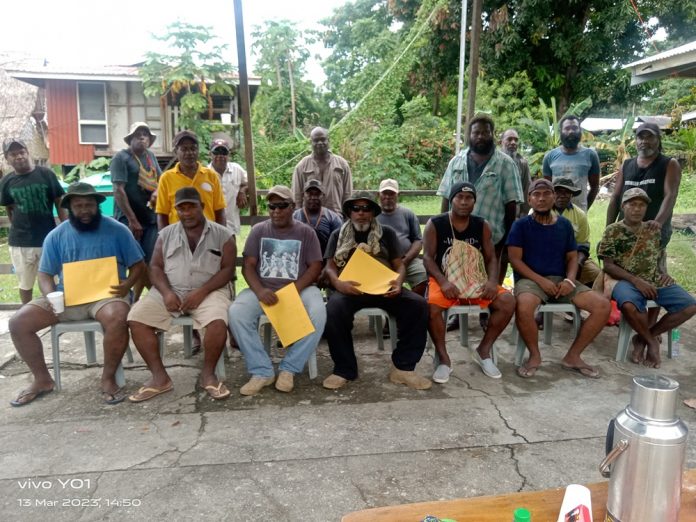
Members of former MEF and IFM after their meeting at Kakabona, East Honiara yesterday.

By EDDIE OSIFELO

FORMER members of Malaita Eagle Force and Isatabu Freedom Movement of Guadalcanal have submitted a joint resolution to the Government to deal with the Truth and Reconciliation Commission (TRC) report and Federal Constitution 2018.

This follows delays by successive governments in progressing the issue pertaining to the TRC and the Federal Constitution 2018.

Both parties signed the joint resolution following their meeting at Kakabona, west Honiara yesterday.

Prior to that, they had met on Thursday, March 2 and made resolutions as follows:

That Manasseh Maelanga (Deputy Prime Minister) and Bradley Tovosia (Minister of Mines, Energy and Rural Electrification) are to convene a meeting for Members of Parliament to hold consultation with members of Solomon Islands Post Conflict Rehabilitation and Restoration Association (SIPCRRA) and leaders of Guadalcanal and Malaita at a venue and date convenient to them not later than seven (7) days upon receipt of this resolution.

That Manasseh Maelanga and Bradley Tovosia to contact the Prime Minister Manasseh Sogavare and to convene a meeting with members of Guadalcanal Post-Conflict, Reconciliation Rehabilitation and Restoration Association (GPCRRRA), SIPCRRA and the leaders of Guadalcanal and Malaita on the Democratic Coalition for Government Advancement (DCGA) position regarding the tabling of the TRC report and the Federal Constitution.

Failure to comply may result in members of GPCRRA and the people of Guadalcanal and Malaita resolving to other alternatives to address our long and outstanding issues.

According to the letter signed by President of SIPCRRA Malaita, Chris Mae and President of GPCRRA Western Region, John Damusi, they have the highest regard and confidence on your capacity and capability in progressing the outcome of the attached resolutions and will remain steadfast in anticipation of positive outcomes.

Island Sun has obtained the signed resolution signed by the members of former MEF and IFM.

Trainers deployed to teach sign language

0

BY BEN BILUA

UMI Tugeda Helpem Solomon Aelan Def Komiuniti Project is the champion of giving voice to people with speaking and hearing impairments.

Over the course of this month, trainers were deployed to eight communities in Malaita, Guadalcanal, and Western provinces to teach sign language.

Project Manager, Jackson Meke said the project is aimed at encouraging people with disability to be part of the community.

He said people with disability always find themselves isolated in communities and this has forced them to live a life full of wonders and questions.

“We share this planet earth with our brothers and sisters who cannot speak and hear. It is our responsibility to make all efforts in making sure these people are part of our community and nation.

“It is our role to give these people a place in our communities where they can take part in the discussion and also whatever development that takes place in our society,” Meke said.

Meke has completed his visit to trainers at Gizo who have been facilitating workshops on sign language at Gizo and Titiana.

He described the workshops as very successful and his team is looking forward to working closely with communities to further the training programme.

Meke acknowledged Catholic Church Education Authority, Australian Government, and New Zealand Government for funding the programme.

He said sign language is very important and he wishes that the government through the Ministry of Education can establish a sign language curriculum and offer training at Solomon Islands National University.

People behind failed MID $7m project gone: PS Lilia

0
MID acting permanent secretary, Alan Lilia.

By EDDIE OSIFELO

THE people involved in the controversial $7 million refurbishment and renovation of the Ministry of Infrastructure Development (MID) headquarter have left the ministry.

MID gave this statement in response to Opposition Leader Matthew Wale’s call for the police commissioner to investigate the incomplete project.

MID acting permanent secretary, Alan Lilia told media last Friday the contractor only managed to complete floor-1 and started to work on floor-2 when the workers left.

He adds that MID is engaging a contractor to continue work on the second floor.

Lilia, who just joined MID, said the people involved in the work from 2015-2017 including the permanent secretary, directors and staff have left the ministry.

However, Wale urged the Police Commissioner to immediately investigate these payments to see where they lead.

“These kinds of abuse of the procurements; payments systems are only possible with collusion by key public officers in MID and Treasury. Investigation must be carried out to determine why $7M was paid for an unfinished job, and why no due diligence was carried out from the finance ministry.

“Furthermore, there are also claims that certain officials the MID also benefited from the $7M. This too must be looked into. Everyone responsible must be held to account” Wale emphasised.

The Leader of Opposition stressed that the Police Commissioner must act with urgency as these abuses are becoming more common within Government ministries and departments.

“There are also reports that a leaf house project that was paid for more than 200,000 to be built at the MID is still incomplete,” the Opposition Leader said.

“Others highlight immoral dealings in the architecture department creating ghost companies for their own benefit and even officials within the vehicle-hiring department providing personal vehicles for hiring. These are all very concerning.”

Wale concluded that the MID needs a major clean up.

“Firstly, people who are involved in fraudulent acts must be removed. Second, the public service recruitment process must be free from political interference.

“People coming into the public service must not be people merely handpicked by politicians,” he said.

ONE STEP CLOSER

0
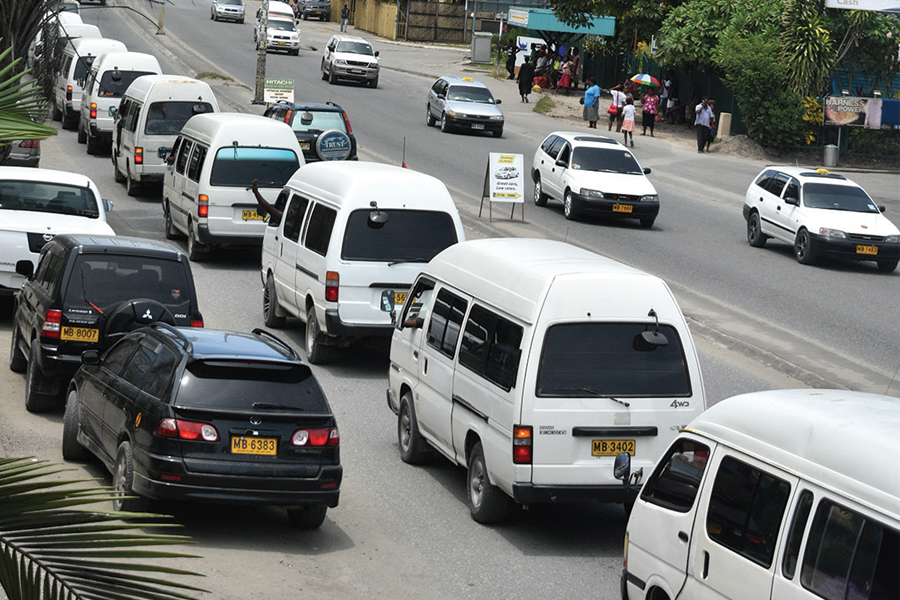
Buses

HCC holds meetings as it moves to take over public bus service

BY MAVIS N PODOKOLO 

Honiara city council (HCC) is moving forward with its plan to take over the public bus service.

HCC has carried out two meetings since its announcement of this plan early this month.

Paul Inifiri, HCC senior legal officer, told Island Sun that two meetings have been held ‘purposely for HCC to proceed on with operating bus services in Honiara together with other stakeholders’.

“It is true that HCC will be operating bus services in Honiara, is true.

“An ad hoc committee has been established and is currently looking at this proposal.

“We HCC have engaged a private consultant who works with that ad hoc committee already I drafted a proposed bus route which goes in line with HCC regarding operating bus services in Honiara and on Thursday and Friday last week they met to look at this matter,” Inifiri said.

Island Sun understands that this plan stemmed from several issues:

1) the need to have an improved traffic during the Pacific Games later this year (short term).

2) the impossibility of achieving this with the current uncontrolled public bus service in Honiara.

3) continued refusal of bus owners and drivers to adhere to HCC calls and regulations to stop short bus routes

4) HCC’s obligation to ensure better public transport service (long term)

Mayor Eddie Siapu on January 19 this year had warned that HCC would consider taking this action.

“HCC is also looking at the viability of operating public bus services serving the main routes within Honiara City.

“If bus operators do not listen to HCC, we will venture into operating bus service in Honiara and cancel all public bus licences,” Mr Siapu said.

Siapu mentioned this when he appealed to bus owners/drivers a week before launching an operation across Honiara in partnership with RSIPF traffic police to crack down on short bus routes.

This operation however failed to stop short bus routes as public continued to complain that buses were still running these short routes, causing traffic jams and inconvenience for travelling public.

Early this month, City Clerk Justus Deni told media that HCC was looking into this plan seriously.

“HCC actually launched our programme to crack down on short bus routes.

“This programme worked for the first day but with some mentality issues and attitude problem that people have this programme did not serve its purpose.

“It was noticed that after first few days the issue of short bus route still stands.

“But going forward we are seriously looking at Council running bus services in partnership with some private sector, we have a committee working on that at the moment to develop our polices and ordinances,” Deni said.

Environmental sustainability in Guadalcanal province

0

The ‘Happy Isles’ is geographically found in the east of Papua New Guinea. It is a very tiny nation that is made up of a group of islands with incredibly diverse cultures that behave in incredibly unique ways – as revealed by their people’s appearance. It is a beautiful and attractive place, with people that are welcoming to all people from any other parts of the world. Way back, Spain in 1567, commanded Alvaro De Mendana who discovered these groups of islands in the South Pacific Island Region. He then happily found so much gold laying around the black sandy beach on the coast of Naghoniara (Honiara) along the riverbank of Matanako (Mataniko) river during his exploration. This Spanish explorer biblically believed that this is where King Solomon brought gold to build the Temple of Jerusalem. Without hesitation, he announced the name of this group of islands as the Solomon Islands. Later the British navigator John Scotland anchored in the northern coast in 1788, followed by English traders who annexed the island in 1893.

The battle of Guadalcanal between the US and Japanese during WWII (1942-1945) saw both sides experience bloodshed along the Tetere beach. More buried, but active bombshells still remain beneath the grounds of Guadalcanal today. But the extent of the environmental damage caused by the war does not end there. More than one warship sank releasing oil and toxic fuels on the ocean floor of the famous Iron Bottom Sound Sea. The seafloor is full of shipwrecks and war planes that crash landed there. Generally, this is the birth of pollution in the surrounding marine, freshwater and other terrestrial land-based ecosystems within Guadalcanal. We have seen all manner of toxic materials, waste, burning of fuels and fuel and oil spills occur all over the surface of the island. It is sad to see all the endangered species slowly fade away day by day.

Furthermore, combating climate change is something Solomon Islanders desperately need if we are to protect our beautiful islands. This struggle defines environmental sustainability as the way of living on our planet responsibly, treating it with fairness, respect to all the species’ survival and our ability to breathe happily is all related to climate change. Our nature depends on us and ecosystems need our actions to survive. Most importantly, combating climate change is also for future generations to breathe the same fresh air we inhale freely and give them the chance to cultivate the same fertile soil we yield today.

This struggle for environmental sustainability led to the creation of the Adetao Association last year. The organization has operations in the Northeast Highlands region of Guadalcanal and they successfully organized a land forum where all clans respectively come together and discuss all the missing parts of their ancestral signs, symbols and genealogy. They also discussed their land blocks of which they owned and were then formally registered after each tribesman confirmed all the documents with valid proof of ownership. All this happened due to an increase in tribal arguments over land boundaries and done for the purpose of human development and to stop large-scale destruction of land and water for logging activities.

With all this in mind, many Solomon Islanders are raising grave concerns for their survival, the survival of the untouched tropical green rainforest of Guadalcanal Province and the health of all their people for a better future. The aforementioned therefore invites the term ‘environmental sustainability’ to this conversation to describe the needs of Northeast Guadalcanal. This term also applies similarly to all other provinces in Solomon Island. Increasing the amount of emissions from factories, mining activities and heavy machines all contribute to global warming and therefore results in sea level rises, as experienced by the parts of Solomon Island (see below for pictures taken in Malaita Province at Falua Village).

Another hugely significant fear that we have in the Solomon Islands is a concern about deforestation, impeding natural resources to both human beings and organisms. See the images below to get a  glimpse of the highlands of Guadalcanal, the waterfalls and fogs flying over the mountains every morning. The pictures below those are of the freshwater in Upper Paripao along Bokokimbo river.

Due to the increase of fuel and oil spills into the surrounding environment, there has been an increase of cutting trees by logging companies. This all results in an increase of rainfalls that leads to soil erosions flowing through clean rivers and natural drink waters. Below are pictures taken along the ridge where logging destroys the forest and where I fear all the living organisms and natural water sources will become extinct and turn into dry land.

I am concerned about the non-stop emission of greenhouse gasses in the capital of the Solomon Islands, Honiara, the surrounding factories in the plains of Guadalcanal and the mining factories in the upper highlands of Guadalcanal Province result in depletion of ozone layer that leads to sea level rise. Nonstop rainfall gives off acid rain to people that store rainy-water in tanks for cooking and drinking – all resulting in an increasing number of sick patients in clinics and hospitals every day.

The people of Northeast Highlands, upper Paripao area used their resources responsibly but due to road accessibility to their home (see right), they have become economically incentivised to use some of their rainforest resources for long term growth. Furthermore, they harvested a few logs so that they could make the road to their village in the first place. But they do so without harming the environmental aspects, and protecting social and cultural inhabitants.

A good example of social sustainability – people at Kolosulu village live happily without needing too much money, enjoy eating local foods then breathe fresh air and drink from natural spring water.

Finally, the importance of environmental sustainability has been shown in the above pictures. It is clear that in order to live longer and have healthy lives, people must eat more local foods, drink more clean water, and breathe unpolluted air from the surrounding environment. Note that almost one quarter of global human deaths cause those factors mentioned above.

To conclude, the environmental sustainability of the Solomon Islands is  becoming an increasingly unresolved issue. It is caused by increasing contamination and pollution in the land, air, water and marine ecosystems. Since the government remains so unsettled from all the previous political issues, policy-makers are distracted from addressing these real issues.

We must keep in mind that the unsolved problem of environmental issues like sea level rise which is experienced by other parts of Solomon Islands today, was not for fun and is a real thing happening today. Hence the Solomon Island government  and other environmental sectors should act on it.

The birth of pollution in Solomon Islands, especially in the Guadalcanal Province, started during the beginning of WWII 1942. But the major worries of the people of Northeast highlands of Guadalcanal are the pollution from loggers that may cause the extinctions of all the natural rainforest ecosystems that have been there naturally which allows people to hunt and yield foods from.

Last year the Adetao Indigenous Association organized a remarkable gathering where all tribes came together to straighten all their genealogies and land blocks within the highland’s region to avoid confusion and arguments in the near future. Most importantly, since development is moving very fast nowadays, people need to be sure of their land to protect from over harvesting of resources. Most of the people agreed on harvesting their resources in a sustainable way for their upcoming generations to still be able to survive. They have brilliant minds to preserve some of the untouched forests and to build a conservation site where people can visit and study in the jungle. Clearly, the three pillars of sustainability (economic, social and environmental)  have been illustrated in the pictures above of how the people of the Northeast Highlands evolved to survive.

*This article was first published in the blog – https://sites.google.com/view/young-solomon-islanders/home which is a project supported by the UN’s Sustainable Development Solution Network.

By Kelvin Kelo Neleta

The Perspective of Young Solomon Islanders Blog

Menstrual health in rural Solomon Islands

0

Menstrual health in the Solomon Islands is one of the topics which is considered taboo and is socially forbidden to be talked about openly.

This is especially the case in rural communities.

 It is, however, one of the major challenges that women and girls in rural communities have to tackle every time they have their monthly period. 

Three years ago, I was working on a WASH project and the following  are some of the significant challenges we found through WASH surveys collected from female primary and secondary students, asn well as community female mothers and female leaders.

Female students in the rural Solomon Islands don’t have much access to sanitary pads and therefore, during their monthly period they would miss their classes and spend the whole day in the river washing clothes or dirty plates.

According to some females, during their monthly period, it is embedded in them to treat such time as the time for them to wash clothes, beddings and kitchen utensils.

This is a particularly worrying issue as some told us that these long periods spent in rivers would lead to pneumonia and other cold-related complications.

In classrooms, some young female students told us that they would sometimes stain their clothes as they did not have proper access to sanitary pads.

The students get teased by male students which can lead them to stay out of school for fear of being teased.

In the rural Solomon Islands, some girls didn’t attend school because of such a situation.

During the monthly period, when students don’t have the money to buy sanitary pads or the stores were out of stock, the following are some options the young girls use instead; Some female students use dry leaves, coconut husks, or used cloth rags to manage their period which obviously is not healthy and can cause diseases if they weren’t careful.

Others who weren’t comfortable using these chose to spend the whole time in rivers or water taps washing all day long just to manage their monthly period.

Menstrual health remains one of the challenges our young females in rural areas have to face monthly, breaking the taboo barrier, and educating our young girls and mothers are among the solutions.

*This article was first published in the blog – https://sites.google.com/view/young-solomon-islanders/home which is a project supported by the UN’s Sustainable Development Solution Network.

By Paul Taka

The perspective of young Solomon Islanders Blog

To deprive people, forget education

0

The International Day of Education 2023 was celebrated on January 24, 2023 by the Ministry of Education and Human Resources Development with donor partners on the theme ‘invest in people, prioritise education’ (Star, 2023).

As I came across this article and its theme, I one-hundred percent agree with it. Education is of great importance because it is a catalyst for development.

Education provides a pathway out of poverty and importantly it gives meaning to life.

When you have been educated, having a university degree increases the chances of a good-paying job but also opens up many doors for your career.

But on the other hand, if we talk about the reality of education here in the Solomon Islands, from my point of view, what is currently happening is the opposite.

I would describe the current situation as ‘to deprive people, forget education’.

Education is a human right and sadly, I have seen this right being taken away by decision-makers.

In 2021, the outbreak of COVID-19 entered the shores of the Solomon Islands and this resulted in the closure of services such as those in education.

Schools were closed for a period of 15 weeks in which young people had little to no education during that time. Later that year, it was announced that schools would be cut short in preparation for the South Pacific Games.

Schools would finish by October since the schools are being used as venues for the South Pacific Games and thus are in need of preparation (Star, 2023).

This year, 2023, schools are meant to begin the academic year in late January but because of some preparations for the Solomon Games and late exam results, some schools actually started weeks later or haven’t even started as I write this.

Education is a human right and based on these situations, it seems to me that the education of our young people is not being prioritised and valued.

If we have a generation that is uneducated, we are depriving our nation.

If we are to prioritise education then the economics of education must be prioritised.

Because of globalisation, the education of the Solomon Islands is being affected because of unfair markets, trade imbalances, infrastructures and high unemployment.

Most parents send their children to school to ensure they are able to complete their education and get a well-paid job but what we have now is a great number of university graduates who are searching for employment.

The majority of the population of the Solomon Islands is Youth, and if nothing is done about the employment of youth then I wouldn’t be surprised if riots become a common thing every 10 years or even worse (Short, 2019). Unemployment of youth is a serious issue as this is depriving our nation as well.

Even though our nation faces many challenges and difficulties, I believe we can still make a difference. Instead of investing in people as the theme suggests, I am convinced that we need to invest in technology and entrepreneurship.

In this fast-changing society, technology can advance the education of our youths and also encourage them to be creative and critical thinkers.

Another positive is that technology can have a wide reach in which young people can learn more about the world and how it works.

Even if a teacher is absent, a student is still able to learn through technology.

Technology can provide a pathway for the betterment of education in which young people can be empowered.

Therefore, in conclusion, Let us prioritise people but also technology and infrastructure.

There is no one size fits all solution.

As much as we must continue to strive and support any pathway that helps our young people to realise their potential whether it be sports, music, entrepreneurship, creative arts and so forth education must be valued.

*This article was first published in the blog – https://sites.google.com/view/young-solomon-islanders/home which is a project supported by the UN’s Sustainable Development Solution Network.

By Caleb Maehanua Pollard

The perspective of young Solomon Islanders Blog

MPG loses approximately $185m due to isolation policy: Premier Fini

0
Premier of Malaita province, Hon Martin Gaote’e Fini.

BY SAMIE WAIKORI

THE Malaita New Government for Fundamental Redirection (MNGFR) says the province has lost an estimated $185 million worth of approved projects due to former government MARA’s isolation policy.

New premier of Malaita, Martin Fini announced this recently.

He said the goal of MNGFR is to put an end to this ‘costly’ isolation policy.

“Malaita province had lost approximately $185m worth of approved development projects from the national government for the past three years; this included the PCDF funds forfeited under the MPGIS in 2021 and 2022.

“This included road improvement, agriculture, fisheries, health, education and other important government projects planned for Malaita province since 2019. The non-accomplishment of these projects negatively affected the lives of our rural populace.

“Your new government now cannot afford for Malaita to forgone the 2023 development projects from the national government ear marked for Malaita under the 2023 development budget.

“This included infrastructure, education, health, commerce, agriculture, fisheries, sports & youth and other sectors.

“I want to say, it is enough of business as usual. We must move on to new direction and ride into unchartered waters. We must step on new grounds we had never put our feet in the 38 years of Malaita journey.

“Therefore, I wish to state that meaningful development is only possible through dialogue and collaboration by all stakeholders.

“Mutual cooperation is an essential ingredient in this mix. It must be at the heart of this collaboration. Nothing works without it.

“Malaita has missed out on millions of dollars in approved projects because of the policy of isolation and deceit promoted by some over the last three years.

“Our people, unsuspecting as they are, were given false hopes,” he said.

According to premier Fini, the intention of his government is to revive hope and empower Malaitans to have faith and trust in their government.

“The time to keep deceiving our people is over, it is time to revive our hope for a better Malaita,” he said.

First parliament sitting expected in April

0
Special Secretary to Prime Minister, Albert Kabui.

By EDDIE OSIFELO

Parliament is expected to start its first sitting for this year around April.

This after the Office of Prime Minister and Cabinet receives the bills from the ministries.

Special Secretary to Prime Minister, Albert Kabui confirmed this to media last Friday.

Kabui said once the ministries get back to them and the bills are ready for first reading, they will recall Parliament.

Furthermore, he said since 2019, they have started the traditional speech from the throne from his Excellency the Governor General, Sir David Vunagi, where he addresses Parliament.

He said the GG is out of the country, so when he comes back before they can call for Parliament.

Moreover, Kabui recalled that last time, OPMC called Parliament quickly because of the resolution to pass the Budget.

However, he said Parliament has passed the budget before end of last year, so the constitution does not require to call Parliament quickly.

According to Solomon Star, the fifth meeting of the 11th Parliament was adjourned sine die on Monday 19th of December 2022.

The motion of the sine die was moved by the Hon. Prime Minister Manasseh Sogavare on Thursday 15th December 2022 “That at the adjournment of Parliament on Monday 19th December 2022, the present meeting shall be concluded and Parliament shall then stand adjourned sine-die.”

It took three days for members of both sides of the house to debate the motion.

In his response speech last year, Prime Minister Sogavare thanked all members who have contributed to the motion whilst responding to their queries and defending the government’s policies and programs of national interest.

The Speaker of Parliament, Hon. Patteson J. Oti in his closing remarks before adjourning Parliament said the passage of the sine die motion moved by the Prime Minister concludes the fifth meeting of the first session of the 11th Parliament which commenced on Monday 28th March 2022 and concluded on Monday 19th December 2022.

The Speaker highlighted that during the course of the 5th meeting, Parliament had sat for 48 days in a plenary; • 6 bills were tabled and were passed by the house, 4 of which were appropriation-related bills. • In this period a total of 38 parliamentary papers were tabled, • 11 motions were put on notice • 30 questions asked and answered

Also, during the 5th meeting, Parliament resolved and approved the extension of the state of public emergency on one occasion to allow the executive government to manage responses to the global pandemic of Covid-19.

Mr. Oti added with community transmission of Covid-19 affecting the country earlier this year, Parliament has to be resilient and ensure continuity.

Also, during the last meeting, one constituency retained a new Member of Parliament in this year’s by-elections, a member for West Kwaio.

A total of five inquiries were conducted so far as the standing committees are concerned, 110 deliberative meetings convened and 5 committee reports were tabled.

The Speaker further told Parliament that he looks forward to when Parliament will have a meeting calendar for the whole year.

The Motion of Sine-die has been put in and passed and Parliament has now stood Sine-Die meaning without any future date being designated for its resumption. This is for an indefinite period.

PM last year said, Parliament will resume as soon as possible as there are many issues to address given the upcoming Pacific Games this year.