Home Blog Page 1551

GP police uproot 570 marijuana plants

0
Marijuana plants uprooted during the raid

POLICE at the Tetere Police Station in the Guadalcanal Province have uprooted 570 marijuana plants in the Guadalcanal Plains Palm Oil Limited (GPPOL) One and Totoba areas in North Guadalcanal on February 3, 2018.

Supervising Provincial Police Commander Superintendent Nixson Manetoga says, “On Saturday February 3 at about 4am Tetere Police officers raided two marijuana gardens at different locations following information from the communities.

“The alleged suspects, who farmed the marijuana plants, fled before the police arrived.

“The marijuana plants confiscated will be disposed at an isolated location where public have no access to avoid inhaling the smoke produced.

“An investigation into the matter is continuing and I appeal to people who farm these dangerous drugs to refrain from such activities.

“These drugs are dangerous for your health and it will cause mental illness.

“Such an activity is illegal and police will continue to track down people responsible for such activities.

“We have lot of legal ways of earning a living in our communities instead of the illegal activities such as growing and selling marijuana.”

–POLICE MEDIA

Lady Margaret passes

0

BY ROMULUS HUTA

LADY Margaret Lepping, the wife of the late former Governor General Sir George Lepping passed away on Tuesday night in Honiara.

Late Lady Margaret, who hails from Langalanga in Malaita Province, passed away at her family estate at Rove, West Honiara following a long illness.

Lady Margaret’s late husband, Sir George was the second Governor-General of Solomon Islands between July 7, 1988 and July 7, 1994 where he was awarded the Grand Cross of St Michael and St George, Knight of the Order of St John, and was a Member of the British Empire.

Sir George passed away on December 24, 2014.

Late Lady Margaret is survived by two sons, four daughters and a number of grandchildren.

The funeral service will be held at the Holy Cross Cathedral this week and details of it are yet to be confirmed.

Siota’s poor results irks Premier

0

BY BARNABAS MANEBONA

CENTRAL Islands (CIP) Provincial Premier Hon Patrick Vasuni questions why Siota Provincial Secondary School (PSS) has produced poor examination results during the past three years.

He said out of the whole province, Siota PSS has the highest number of high qualified teachers beginning with Masters Degree and only a few Diplomas’, yet the school’s academic performance is very low.

“Why is that?” questioned the Premier over teacher’s qualification.

“Compared to the other secondary schools in the province, most teachers are only Diploma, Certificate and TIT’s. Yet these schools produce good academic results compared to Siota PSS last year.

“Siota PSS last year is also reported to have been overstaffed in which students should have all the privilege to learn.”

The current new School Administration for Siota PSS, CIP’s Education Authority and the Executive Government of the province have already met this week to rectify issues affecting the school.

“We have already identified areas where we will be working on which includes meetings to be always held by the School Administration and the Board of Management, an area that lacked during the past two years contributing to the problems faced by the school,” said Vasuni.

According to the Provincial Education Officer (PEO) for CIP Mr Charles Kasuni, all senior posts of the school have now been changed and they are looking forward to working closely with the new School Administration and Provincial Government to improve the Premier school of the province.

Commuters want tough acts on buses

0

By Mike Puia

HONIARA commuters are demanding Honiara City Council (HCC) to take tougher actions on buses that continue to run short routes.

One commuter vented his anger through this paper yesterday.

Leonard Aru, who used to be a bus conductor and driver in the 1990s, said the HCC and the bus association have agreed on things, one of which is buses not to make short routes.

Despite this, Aru said there are buses that continue to run these routes and he has been watching this for some time.

“HCC officers should monitor and identify drivers who run short routes and took off their driving license. There are drivers who made these decisions without the knowledge of owners,” Aru said.

He said HCC is playing its part but since some buses are not complying, it should take tougher action for the good of the public.

Aru said during the 90s, public transport services were the best.

He said buses service the city well and everyone enjoys it.

“Commuters just enjoy bus riding. Bus drivers and conductors always keep clean and dress properly because they respect commuters,” Aru said.

He said this is something he hasn’t see in buses nowadays.

“HCC should consider work in a bus a legal and formal thing. Conductors should apply to the HCC to become a conductor. They need to have an ID card,” Aru added.

He said HCC should introduce new ways to get buses to make decent service for commuters a priority.

Call for traffic check in Auki

0

BY GEORGE MANFORD

AUKI

A public transport owner in Auki has called on the Auki police to do a massive traffic check as the first one for this year.

He said Auki police traffic department should organise and do traffic check for expired vehicles that are still on the road.

He adds the owners of expired vehicles are breaking traffic law when their expired vehicles are providing public transport service.

“This is not good having expired vehicles providing public services with their expired licences.

“It is not fair for those that often renew their vehicle licences while others have taken the law into their own hands.”

He calls on the Auki traffic officers to consider this call as a very important one for the safety of the travelling public and the vehicle owners as well.

Auki is currently one of the most populated provincial towns in the country with more vehicles pouring into the province almost every week.

US reaffirms support for SI

0
US Ambassdor Ebert-Gray, PM Hou and US Consular Agent to SI Keithie Saunders.

UNITED States Ambassador to Solomon Islands Catherine Ebert-Gray has spoken highly of Prime Minister Rick Hounipwela’s administration on the current reforms and plans undertaken by the Government.

Ambassador Ebert-Gray praised the Government in its effort to bring about change which has brought back a lot of confidence to the donor community.

She was also particularly impressed with the Government’s commitment to pass the anti-corruption bill and with the Government’s legislative programme.

“We acknowledge you and your Government for the reforms you have undertaken and also for your efforts in stabilising your country’s finances as part of your Government’s priorities,” she said.

The United States ambassador also took the opportunity to brief the Prime Minister on the current Trump administration’s Indo-Pacific Strategy and also the United States Asia Pacific Policy.

Ebert –Gray also reaffirmed United States’ support to the Solomon Islands through the Green Climate Change Fund Support as well as Gender Violence programmes in the country.

She also commended the Prime Minister for re-engaging donor partners with the vision to bring back confidence to the international community.

Houenipwela in response, thanked the US Government for its continuous support.

He also thanked the United States for its continuous support in empowering women in the society.

“Despite the cultural challenges, women have played significant roles in our society and I am pleased to see a lot of women now holding top positions in Government and the private sector. The Government has and will always support and encourage women participation in the society,” he said.

The Prime Minister also thanked the ambassador for the positiveness shown by the United States in supporting his Government.

–OPMC PRESS

4 clinics in Northeast Malaita face drug shortage

0

BY LYNTON AARON FILIA


FOUR clinics in North East Malaita are facing shortages in medicinal drugs.

This adds on to nearby Takwa clinic which had already issued out an SOS call with a similar problem.

Takwa clinic in Northeast Malaita is operating with only Paracetamol, Septrin and Amoxicillin drugs only. Now four other clinics are voicing out the same problem.

The four sister clinics are Molatabi, Gwaunatolo, Kwailabesi in Lau/Mbaelelea constituency and A’ata clinic in Baegu/Asifola constituency.

Island Sun understands that low efficiency in drugs distribution to these clinics is the main reason for the shortage.

Supervising Director of Nursing for Kilu’ufi Hospital, Mr Richard Maegerea said they have not received any report of such situations from the said clinics.

He adds their pharmacy is also not aware of the reports.

Maegerea said there is process to follow by collecting reports from the pharmacy before drugs are supplied to any clinic.

He reassures that they have taken serious note of the report and will ‘follow up’ on it.

Maegerea said Kilu’ufi will continue keep in touch with Malu’u clinic to verify the problem these clinics experienced.

This has been the centre of hot debate in the Facebook forum of Lau/Mbaelelea constituency.

Commenters say it is a problem of immense degree which authorities should address immediately.

They also call for the constituency’s working together with the responsible authorities.

The Lau/Baelelea forum encourages constituency and its people not to rely much on responsible authorities but be initiative enough to take up responsibilities.

This will help find best solutions and attract partners for support, the Forum said.

Mystery taro disease prompts call on MAL

0

BY BARNABAS MANEBONA

MYSTERIOUS disease causing taro plants to wilt before bearing is prompting people in Northwest Choiseul to call on the Agriculture ministry (MAL) for help.

Suspecting the disease, Teresia Vinequana on behalf of Varisi Lavata subsistence farmers at Ward 12 said they are concerned as this is a threat to one of their main food crops providing both food and income.

“Taro is one of the main food crops providing food and income for us therefore we call on the experts of MAL to assess this situation as taro sizes are also shrinking,” said Mrs Vinequana.

“If there is truly an unknown disease circulating then we need advice on how to stop or control it from the local crop food.”

Director of Extension from MAL Mr Micheal Hoota when contacted over the concern yesterday said that they have not received any report yet but will check with staff on the field to carry out work from there.

Water arrears forces clinic to close  

0

By Mike Puia


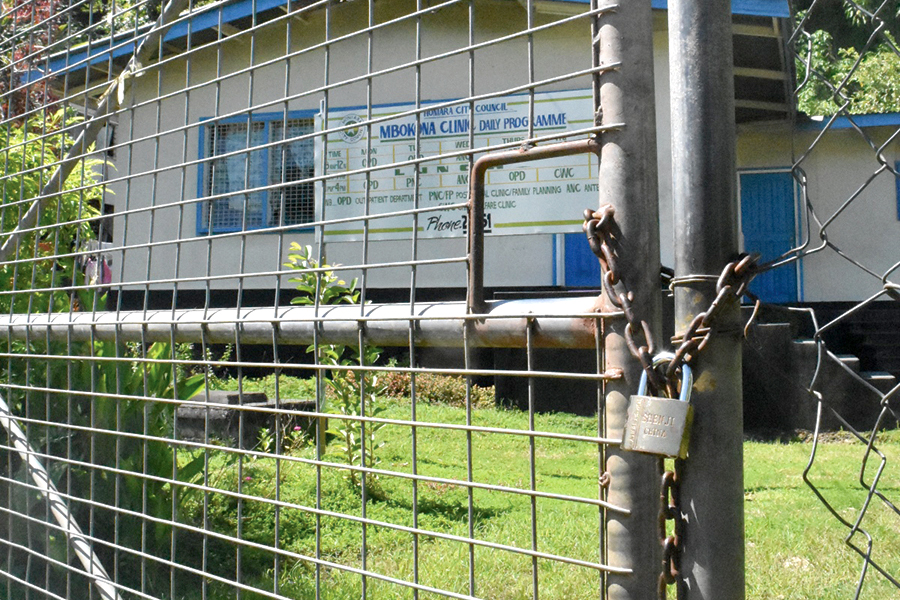
WATER arrears has forced the Solomon Water to disconnect water supply to the Mbokona clinic.

About five nurses who are in charge of the clinic have left the clinic since its closure last month. The actual day of the clinic’s closure is not known.

Honiara City Council (HCC), which is responsible for Honiara clinics’ water and electric bills, confirmed it is aware of the closure.

“We will raise a payment to settle Mbokona Clinic’s water bill tomorrow (today),” Mr Harvest Maebule, HCC’s Director of Nursing, said.

Maebule said he was only made aware of the clinic’s closure last week when he resumed duty.

He explained there was confusion between his Division and their main office last year as to who will pay the clinic’s bill.

Maebule said this year their main office has agreed to take up all clinics’ water and electricity bills in its budget.

“What we will do now is, we will only provide clinic-bills to our main office to pay them as all bills are billed to our Division,” Maebule said.

The City Council pays $34,000, a month to Solomon Water to cater for the water bills of 10 clinics it operates across the city. For electricity, the Council pays out $52,000, a month, to Solomon Power.

For small clinics like Mbokona Clinic, Maebule said the water bill would be about $1,000 a month.

“I am told Mbokona clinic water bill is about $3,000. This is a small outstanding but sadly it has closed an important service,” Maebule said.

A resident from Mbokona, Mr Humphrey Piringparu, said their community has a big population and whenever the clinic closes the closest is Rove clinic.

Piringparu confirmed their residential water supply is connected except the clinic’s.

Maebule said they have experienced issues with Mbokona clinic a couple of times. Issues in which its water or power got disconnected with small arrears.

He said there are bigger clinics that have huge outstandings but are not disconnected.

He confirmed they will look at signing agreements with authorities like Solomon Water and Solomon Power so that they can be lenient to Honiara clinics.

It is understood Mataniko clinic has also been closed for renovation.

Report angers Gold Ridge mine stakeholders

0

By Alfred Sasako


GOLD Ridge Mine stakeholders have angrily reacted to a cyanide research results published this week, describing it as “deliberately misleading and factually incorrect.”

The results were published in a front page article of the Solomon Star newspaper on Tuesday under the title, “Cyanide threat Gold Ridge, Metapona communities at risk”.

The research was undertaken by Dickson Boboria, a doctoral research student from the University of the South Pacific who is claiming that high levels of cyanide in sediments downstream of the Gold Ridge Mine Tailings Storage Facility (TSF) in the Guadalcanal Province are putting the livelihoods of Metapono communities at risk.

In a statement issued last night, the company said Mr Boboria’s findings “are in direct contradiction to the cyanide sampling results obtained from Gold Ridge Mine and accredited independent environmental consultants.”

“Gold Ridge Mine in collaboration with an Independent Environmental Auditor and

community monitors has in place a robust environmental monitoring protocol to monitor cyanide levels in the TSF and downstream. TSF monitoring has been in place from the inception of the mine in 1996.

“The results of monitoring from December 2017 show that cyanide is not present in the top five metres of the surface water of the TSF. GRML took sediment samples prior to and during the 2016 spill over event including locations downstream of the dewatering discharge pipe into the Tinahulu River and downstream of the spill over into the Kuara stream. All samples taken from rivers and stream were below detection levels of cyanide – less than 1 milligram per kilogram (<1mg/kg).

“GRML undertakes sampling of the TSF and downstream to robust good practice standards with the results analysed at an internationally accredited laboratory, Australian Laboratory Services. GRML is transparent in its approach. Relevant ministries and government officers receive a weekly report on the TSF which includes results of sampling as soon as they are received,” the statement said.

It said in addition, two independent sampling regimes complement the company’s approach.

“The National Public Health Laboratory carry out a sampling regime and The University of Queensland (UQ) on behalf of the Solomon Islands Government (SIG) have collected samples since 2014 and analysed them at internationally accredited laboratories. Sediment samples taken by UQ and SIG in 2016, started from the Chovohio River, all the way down to Metapono including Kwara and the Tinahulu rivers.

“The UQ/SIG research sampled sediment at a total of 19 sites, with the majority around or downstream of the TSF. The sampling included four sites along the Matepono River including one at the river mouth.”

The statement said cyanide has only been found in sediment taken from deep core sediment samples at an approximate depth of half a metre into the sediment layer of the dam. In January 2018, UQ and SIG undertook another program of comprehensive TSF and downstream sampling commissioned by the United Nations Development Program with the results to soon be released.

“I am surprised that the institution where Mr Boboria studies allowed him to publicly report data that is factually incorrect and misleading especially on a matter that has the potential to create uncertainty and emotion for downstream communities”, said Mr Walton Naezon, Director of Gold Ridge Mining Limited (GRML).

Mr Henry Tobani, the Independent Environmental Auditor for the tailings dam and downstream communities also expressed concern that Mr Boboria may not have potentially exercised his duty of care as a researcher in the manner in which he has presented his findings.

“We understand that the media can sensationalise reports, especially when presented verbally, but there is no excuse for what could possibly be blatant misinformation”, said Mr Tobani.

“It is usual for researchers to have a research method and protocol and to request

permission to access and use data. It is my understanding that Mr Boboria did not obtain informed consent from the designated Gold Ridge Mine representative to access site, so we are unsure where and how he got his data”, said Dr Fiona Martin, Gold Ridge Mine’s General Manager Community and Government Relations.

Dr Martin believed that this situation could possibly mean that Mr Boboria may have

breached his university data collation protocols. She expressed concern that the usual ethical and research methodological standards expected from a doctoral research student from a university of standing may not be in place for this project, which calls into question the research.

Dr Martin requested Mr Boboria to contact the Gold Ridge Mine environmental team to share and discuss his results.

“We are transparent in how we share our data and are happy to provide Mr Boboria access to our data to assist with his research. We expect researchers to extend the same courtesy and to discuss their research methods and preliminary findings from Gold Ridge Mine data with us prior to public release”, said Dr Martin.