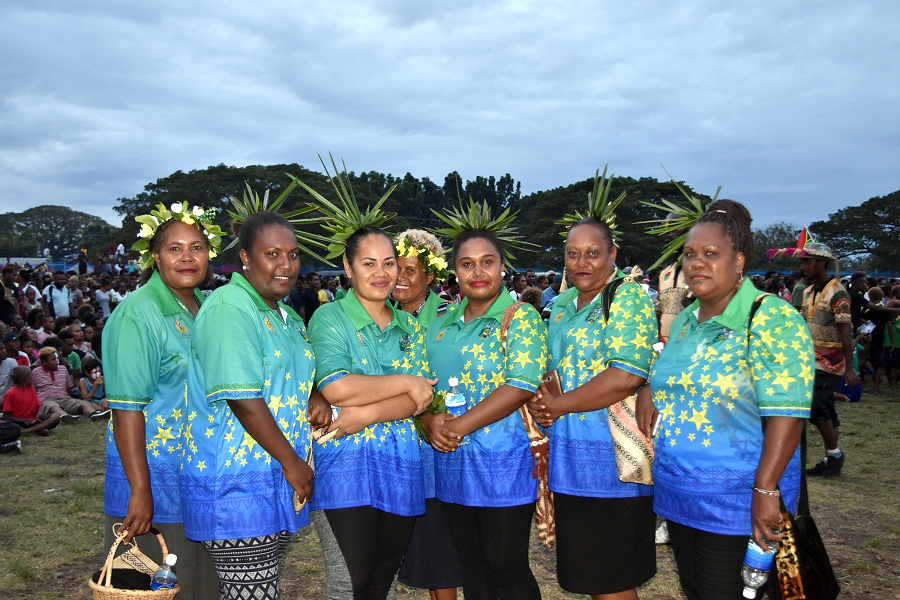
Solomon Islands women of 'Stage of Change' at the closing ceremony
BY LYNTON AARON FILIA
THE 6th Melanesian Arts and Cultural Festival 2018 are believed to foster another pathway for future connection as reflected in the theme – “Past Recollection, Future Connections”, Acting Prime Minister Manasseh Sogavare said.
The 6th MACFest officially ended on Tuesday this week followed by a handover of the MSG flag to Vanuatu as the next host country.
This year’s event is one of the Solomon Islands’ biggest occasions held after RAMSI’s departure last year in June, thus it contributes towards restoring peace and strengthening the country’s culture including MSG members.
With the festival’s objectives and theme, “Past Recollection, Future Connections”, Mr Sogavare said it has been achieved.
A local taking a picture with two dancers from PNG, reflecting the reconnection.
In his keynote address he said, “I believe we have achieved the objective of the 6th MACFest period.”
He said over the past 10 days participants have exchanged ideas, skills and knowledge, had the opportunity to showcase products and traded and even realise economic opportunities.
“I believe you fostered and establish partnership for future connections and I’m certain that the festival help us reconnected, revive renew of commitments of our people and cultures in Melanesia,” he said.
Solomon Islands women of ‘Stage of Change’ at the closing ceremony
He congratulates and thanked the MSG member countries and other countries beyond the region saying they help contributing in achieving the objectives of the festival to ensure that all embrace and believe according to the festival theme.
“Helping one another is spirits of you are brother’s keeper is an intense Melanesian value which we must continue to uphold because it sets us apart as a people in the world.
“We are wantoks and nothing must and should be allow to change that.”
Sogavare also encourages MSG members that we are powerful and control more than 90 percent of the population and resources in the region outside Australia and New Zealand.
Vanuatu will host the seventh MACFest in 2022.
PNG rep, presents their gift to Deputy PM, Sogavare.
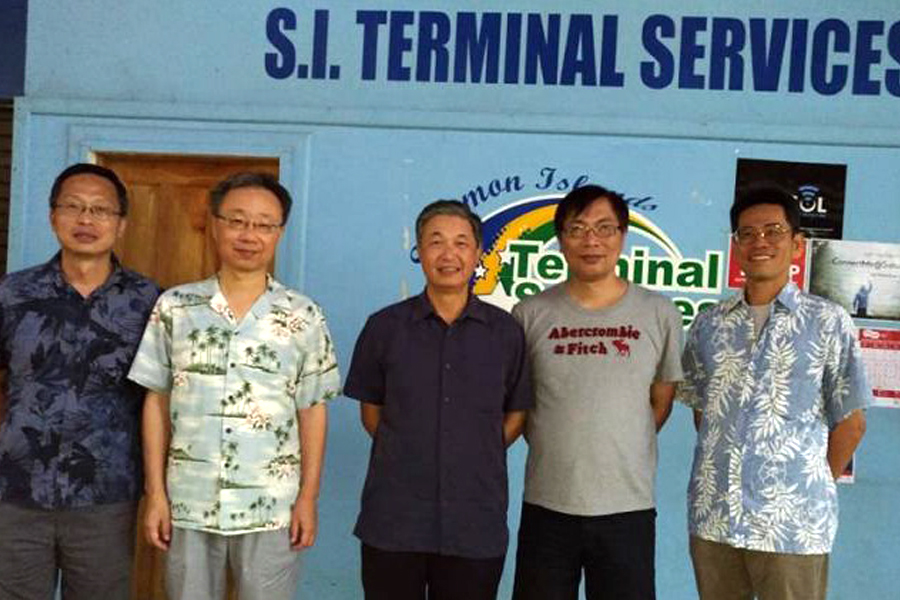
Minister Counselor Mr Calvin Yen (centre) with Taiwan’s Ambassador HE Roger Luo (second left) with other staff of
the Taiwanese Embassy.
BY LYNTON AARON FILIA
Minister Counselor Mr Calvin Yen (centre) with Taiwan’s Ambassador HE Roger Luo (second left) with other staff of the Taiwanese Embassy.
MINISTER Counselor for Taiwan’s Embassy in Solomon Islands was bade farewell by the Ambassador His Excellency Roger Luo on Sunday July 8, 2018.
Mr Calvin Yen after completing two and half years as Minister Counselor for Taiwan’s Embassy in Solomon Islands has left the country on Sunday July 8.
The Embassy expressed its gratitude for the good work Yen has done in fostering the relationship between Solomon Islands and Taiwan.
Taiwan and Solomon Islands have been good friends for more than 30 years, and their friendship has not changed, and numerous support of human resources have been deployed here to maintain the partnership.
Taiwan’s Deputy Counselor Mr Oliver Weng said Yen has served in the Solomon Islands for two and half years and has been instrumental during his term in office.
The Embassy has promoted Mr Oliver Laio as new Minister Counselor.
ON the morning of July 7, 1978, Solomon Islanders in various locations throughout the country lower the Union Jack and raised the Solomon Islands flag. A birth of a new nation, 40 years later to be ravaged by a civil conflict in 1999 to 2003, deteriorating socioeconomic development, rampant corruption and a malfunctioned public service that contributes to lack of development and poor government services.
But who are we blaming for all these misfortunes? Will we be lamenting on the institutions left by our colonialist or review ourselves on our failures and visions towards the future. Indeed, there are many commentaries often made by scholars, journalists, politicians, development partners and others pointing to the lack of consciousness or a sense of nationalism as one of the country’s largest challenges to development. Francis Fukuyama a Japanese American scholar emphasises the country’s informal social network (the wantok system) as the culprit to lack of modernisation.
The story line portrays that the fragmentation of the wantok system produces weak institutions that have failed to drive development. But is this the case for lack of development at the rural areas? Is Solomon Islands’ fault lines really ethnic diversity and fragmented informal social networks? Just recently, we close the Melanesian Arts Festival where we showcase our cultural heritage with other neighbouring island nations. Solomon Islander even recognises the importance of their culture and traditional land tenure system within the national constitution. So if the wantok system and culture are important elements to development in the Solomon Islands. What is it? What is the wantok system?
Informal social networks have been around for generations in both developed and developing countries. Although different societies use and apply them in various context and setting, many have used them to cope with hardship or elevate themselves from poverty. In more developed countries informal social networks are often organised and practised in more formal arrangements such as social clubs doing community services, neighbourhood watch groups and sports or building networks in business and commerce. In the developing world where government organised social protection mechanism are weak, informal social networks are important social safety net that assists people to access needed resources, jobs, educational placements, favours or just basic essentials household needs to survive. Informal social networks are formed and organised around family, kinship, church groups, sport clubs, neigbourhoods or just work colleagues. In Latin America, such informal social network is popularly known as ‘Parenteso’ that allows families to seek assistance via the extended family or kinship. Similar informal network is called ‘Jeito’ in Brazil, ‘Blat/Sviazi’ in Russia and ‘Yougo’ in South Korea. In the Pacific region, particularly in Melanesia, especially in the Solomon Islands, Vanuatu and Papua New Guinea, such informal social network is called the ‘wantok’ (one- talk).
The term ‘wantok’ is a Solomon Islands pidgin term that refers loosely to people who are united through kinship or share the same language, although people use and understand it differently. The term Wan-tok comes from the English word ‘one-talk’ which literally means speaking the same language or belonging to the same kinship group. The wantok system however, refers generally to the widespread practice of helping and favouring one’s wantok. Such informal social networks are also found practised in other Pacific Island countries. In the Fiji Island, it is called the ‘Kerekere system’ ‘Karekare’in Kiribati and ‘Fa’asamoa’ in Samoa. In Vanuatu it is called the ‘Penama’ System, to which describes a tendency of Penama people favouring their own people over other in assisting and helping those in need.
In a more rural setting, a Santa Isabel chief (Jason Leguhavi) once said “The wantok system is a system that involves people who are related (clan and kin-members) working together in assisting and looking after each other in their livelihood. However, the system also includes those individuals who are married to us (sons and daughter of our brothers) and those relatives who are members of the village. In Santa Isabel, those who are born from our brothers are considered not of the tribe (only have secondary rights to land), because their mother is of another tribal group. The wantok system also caters for the welfare of these groups of people in the tribal land. In Uta language this system is call ‘glegu gu’, in Bugotu language it is call ‘tamagha’. ‘Glegu gu or Tamagha’ are terms used to refer to our sons and daughters (nephew and nieces) who are born from our brothers. These individuals we cannot say no or turn our backs on them whenever they need assistance or help.”
Although the system is known in many different languages throughout the Pacific, the term ‘wantok’ describes a cultural way of life based on relationship building (sharing and caring) and reciprocity network that urban and rural households and communities use to cope with stress and shock that affect their livelihoods. Sometimes it can be viewed as a social network that promotes kinship and group identity, where individuals from the same tradition language come to collaborate. However, Melanesians employ the wantok system to influence politics, power (who get what) and control (resource sharing and equality) in their society. At the village level, the wantok system is widely practiced as a social system to maintain social order (family ties and respect), governance (land rights), resource sharing (wealth and redistribution), and to cope with daily stresses of life.
From a theological view point, Maladede a theologian from Papua New Guinea described the ‘wantok system’ as a culture that possesses certain characteristics and roots which she describe as tangible’, has ‘structure’ and ‘intangible’. She argues that in Papua New Guinean culture for instance, the circle of intangible are ‘beliefs’, ‘natural theology’, ‘world view’ and ‘philosophy of life’, which cannot be changed. Structure includes the ‘community’, ‘relationships to the living and the dead’, ‘environment’, ‘exchange and marriage’. The tangibles which can be altered or change are; customs, ‘rituals’, ‘behavioural patterns’, ‘mannerism’, ‘social habits’, ‘fashion’ and the ‘arts forms’.
In any Melanesian society the ‘wantok system’ consist these three characters, however, it is the intangible factors that shape and drives the philosophy of the ‘wantok system’. Although, the structures and intangible factor may or can change, the ‘wantok system’ as a belief and philosophy is embedded and ingrained in the society’s political and economic systems. Therefore it is natural for any Melanesian man to always serve his families and relatives first. In other words, family and relatives are important assets and must be assisted in any circumstances. However, Mohanty an associate professor from the University of the South Pacific has observed that the wantok system is gradually fading due to modernisation factors but is still relevant and widely practiced by the socially and economically vulnerable. So what do we need to do about it?
Derek Mane
Derek Mane Smiles has a PhD in Development Studies from the University of the South Pacific, Fiji Islands, MA (Political Science) from the University of Hawaii at Manoa (USA), and BA (Hon) from the University of Papua New Guinea (International Relations and Public Policy).
THE Pacific Community (SPC) is currently running a leadership course for six local female mid-level public servants.
Four of them come from the Ministry of Development Planning and Aid Coordination (MDPAC), Ministry of Lands, Housing and Survey (MLHS), Ministry of Foreign Affairs and External Trade (MFAET), Ministry of Fisheries and Marine Resources (MFMR) and two come from Youth@Work and SeifPles.
This is the fifth group to undertake this course. The course is based on the Singapore Cooperation Programme (SCP) course given to SPC by the Singapore Civil Service College (SCSC).
SPC’s Regional Director, Mia Rimon, has set the course in the context of Melanesia.
Rimon said the course is designed for managers and leaders.
She said it equips participants to be able to develop their own work ethics and integrity to a higher level, while learning to be leaders.
Rimon said at the heart of public service excellence are leaders who drive the purpose and mission of their organisations and their success in achieving the development outcomes for Melanesia.
“The ability to develop and lead high achieving teams that produce exceptional results is an increasingly important skill for staff in leadership positions,” Rimon said.
She said even without being in a position of authority, learning how to be the most productive and effective staff for their organisations is essential to their collaborative success.
The participating public servants will spare 12 hours of staff time over several months to cover topics in the course.
Topics covered in the course includes; managing projects, communications, leadership, vision and motivating teams, managing conflict and so forth.
Rimon said through this course it has the potential to help locals change this country and increase its civil society for better.
She has already run this course with staff of the SPC country office in Honiara, staff of SPC regional office, leaders of the Youth@Work programme and staff of the Melanesia Spearhead Group.
SOLOMON Water has labelled the front page article in the Island Sun newspaper by Mr Alfred Sasako on Wednesday’s headlined ‘New Water Fee’ as misleading.
The article claimed that thousands of Solomon Water’s customers have been dealt an extra bill to pay in the event their accounts are disconnected and forfeiture of their initial deposit.
“Apart from settling their arrears and reconnection fee, defaulters will now be required to put down a house deposit fee.
“House deposit once upon a time only applied to new connections.
“Now it appears that once an account is disconnected, the account holder has to pay a new house deposit besides arrears and reconnection fee.”
In one case, the article cited, a current existing customer was told to pay $1,010 (one thousand and ten dollars) in new house deposit charge before his account could be reconnected.
The new charge prompted the customer to demand an explanation from the Solomon Water management, saying such a huge outlay is not justified.
He said the new connection and reconnection fees are fair but certainly not the new house deposit charge when one is disconnected.
However, according to Solomon Water in their media statement, the house deposit is not a new fee but is a current fee which has been in place for several years and is charged to customers in the following situations.
On application for a new water connection
Existing Customers who have not paid initial House deposits
Customers whose accounts have been closed or disconnected due to unpaid water fees for a period of time. Standard practice and the exact purpose of the house deposit is that the deposit be used to offset the arrears. As the house deposit has been used for payment of unpaid water bills, the customers will be required to reinstate their house deposit before reconnection can occur.
“The complainant in this instance had never paid a house connection, so falls into category 2 above,” says Solomon Water.
“It should be noted also that after the complainant’s water was disconnected in 2017 for unpaid charges, an illegal connection was made, and the customer only came forward to pay the account, including house deposit, account arrears, illegal fee and reconnection fee when the illegal connection was disconnected by Solomon Water staff in June 2018.
“To clarify, there is no new fee, the complainant has simply been charged appropriately in accordance with our fees.”
Solomon Water’s General Manager Mr Ian Gooden says, “This was all explained to the complainant’s family member when the charges were paid, and had the complainant approached us, this could have been explained to him as well and an erroneous and defamatory article in the press would have been avoided.”
He said neither the Solomon Water executive nor the communications team from Solomon Water were contacted by the journalist for information on this issue.
Being in their announcements every now and then, people who wish to complain about Solomon Water’s services are requested to take their concerns to their Office or dial their landline phone number on 23985, and not the press.
Solomon Water’s Chairman, Phil Bradford also reminds everyone that those people who make illegal water connections and steal water from Solomon Water are in fact stealing money from the good customers who must be forced to subsidise the thefts.
Mr Bradford requests any person who is aware of an illegal water connection to report it to Solomon Water.
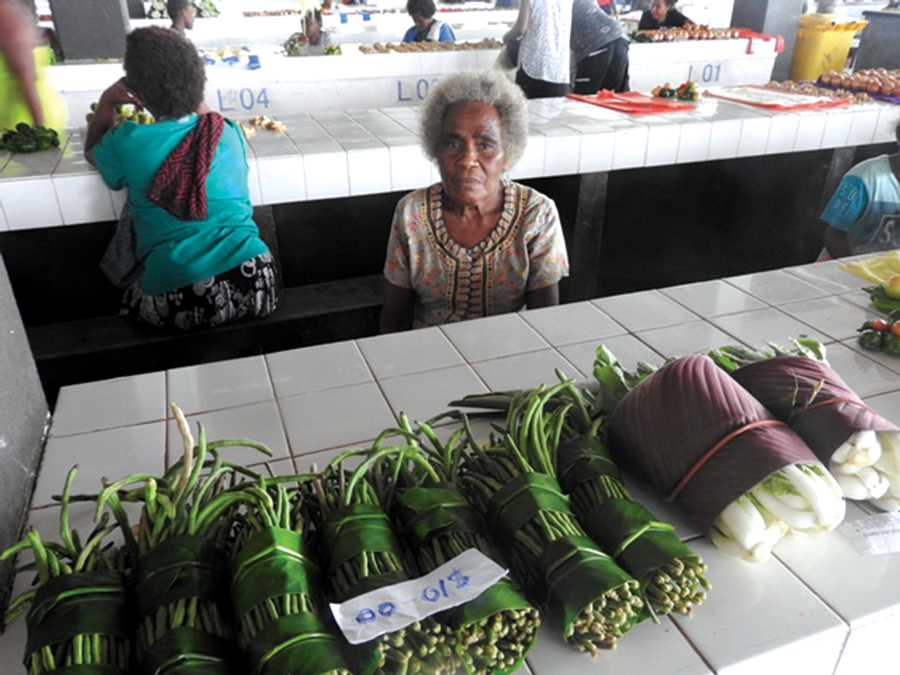
Ellen Hitala with her market products at the Auki market on Wednesday.
BY GEORGE MANFORD
AUKI
Ellen Hitala with her market products at the Auki market on Wednesday.
FARMERS in Malaita province are concerned at the threat the continuing bad weather is posing on their farms.
A local vegetable farmer in central Kwara’ae Mrs Ellen Hitala, is one such farmer, who believes that the bad weather which is entering its full month, will destroy their crops.
Already, she says, many of her crops have been destroyed.
“Definitely our crops and gardens will surely be destroyed because we are living in low land areas that will be easily destroyed if the heavy down fall of rain continues.
“Currently some of our vegetables have already been spoilt by water and pest.
“As a regular market producer in the Auki market we have been affected by producing our products for marketing.
At the moment local farmers are coming up with less products, she says.
“I believe if the bad weather continues we will be heading towards destruction especially farmers and rural people that depend entirely on gardening.
“Most farmers today also sing the same tune where their gardens and root crops have been disturbed by the bad weather.”
PRIME Minister Rick Hou has revealed to Business houses that government is aware of the lack of medicines in the National Referral Hospital (NRH) and has classified it as critical.
When questioned by a member of the Solomon Islands Chamber of Commerce and Industry (SICCI) during a Business Breakfast with him last month, PM Hou says government is aware of the dire situation of medical supplies at the NRH.
“The issue of the hospital is a very critical one, and the matter has been brought to caucus which we are looking at ways to ensure medical drugs not only medical drugs but also the situation at NRH which is not good.”
PM Hou was being questioned on discretionary funds and government’s priority spending at the moment, considering the dire situation of medical supplies at the NRH.
“To grow the economy, we need a healthy society and a healthy workforce to be productive as alluded to in your speech. So my question is, how are you managing your priority spending now that you have only a few months to go?” the PM was questioned.
The PM in his response says government is implementing spending according to the budget, as it is. He said monies are being spent on where they are intended.
However he admits that half of the government’s budget is being allocated to the RCDF.
“I think what you referred to was the RCDF, this is where 50 percent or more of the budget is allocated and this is where it is being spent.”
Rural Constituency Development Fund (RCDF) is donor funding paid to Members for constituency development purposes.
Members have for many years been strongly criticised by the public for allegedly misusing the funds.
THE Leadership Code Commission (LCC) is now carrying out enforcement against public servants who have not submitted their completed statements of declaration to the Commission before its due date.
Early this year, LCC had issued out a declaration form for the public service within the government ministries to declare their wealth and properties.
The timeframe to fill in the form according to sources has already lapsed but many within the ministries had either ‘not completed and submitted theirs’, or ‘had not signed’.
Island Sun sought comments from LCC’s Chairman, Solomon Kalu, who said that they are now carrying out enforcement against officers within the ministries who had not submitted their statements of declaration.
“The enforcement starts with charging of officers who failed to comply with their duties & responsibilities under part II of the Leadership Code (Further Provisions) Act 1999.
“That is failing to submit statements for the preceding period.
“Officers must provide written explanations for their non-compliance. The Commission will then decide whether an explanation is reasonable to excuse the officer’s non-compliance.
“Of course the charge does not preclude an office from tendering his or her late submissions. They must still submit their declarations but with an explanation,” said LCC’s Chairman.
Information on which government ministries had been completed and which ones are still outstanding for enforcement were not revealed as the Chairman said he will not provide them.
A 23-year-old male has been arrested for the alleged rape of a 20-year-old girl in the Lungga area in East Honiara on July 9, 2018.
Supervising Provincial Police Commander (PPC), Guadalcanal province Superintendent Nixon Manetoga says, “My officers attended to the report of the alleged rape after it was reported to police on July 10 and apprehended the alleged suspect around the Plywood area at Lungga.
“The alleged rape happened when the victim was on her way home after work on the evening of July 9.
“The suspect allegedly used a long bush knife to threaten the victim and allegedly raped her.
“The suspect was formally arrested at the Henderson police station and interviewed. A remand application is being processed for the suspect to be placed in custody as the investigation into the alleged incident continues.
“The Criminal Investigation Team at the Henderson police station are investigating the alleged rape incident and I appeal to both parties to refrain from taking the law into their own hands but allow the police to investigate the matter.”
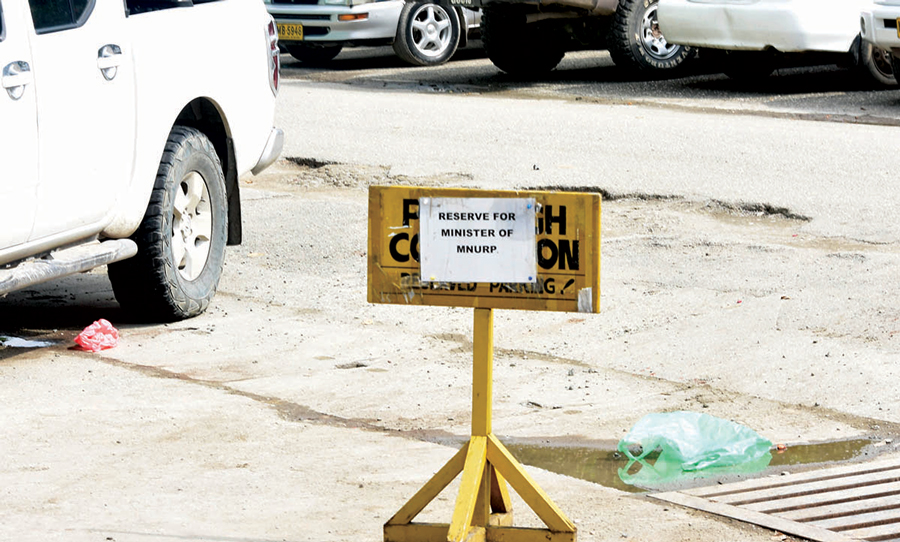
A Minister of the Crown has been criticised for allegedly abusing security guards over parking space at the Anthony Saru complex.
In a ‘Letter to the Editor’ article, an El-ten Jama says on Monday morning, the Minister of National Unity Reconciliation and Peace (MNURP) angrily accused the security guards for not doing their job in making sure his allocated car park space was not taken up by any other persons.
The Minister was said to be angry because his parking space was taken up by another vehicle.
Jama says what interests him the most is the way the Minister of the Crown approached the guards and pointed them in the face and told them off for not doing their job. He kept repeating that he is the Minister and that the guards should look after his interest first.
“Me nao Minister ino you fala, iu fala saveh tu? [I am the Minister, don’t you know that?]” Jama reported in his article.
He said on his way out, the Minister threw down the parking notice that bears the notice ‘Reserved for Minister’. This was after repeated comments about him being the Minister.
He questions if such attitude qualifies the said Minister to lead under the Motto, ‘To lead is to Serve’.
Upon receiving the article, Island Sun made queries to the relevant Ministry with the hope to get comments from the Minister.
However since this incident is in isolation of the Ministry, Island Sun was not able to get comments from the Minister. But an email from MNURP says the Ministry will call on the Management of the Security firm and apologise for the Minister’s action.
It was reported by Jama that this is the second time the same Minister had an argument of this nature.
The said Minister is responsible to look after the government’s focal Ministry for advising, facilitating and coordinating policies with regards to Peace, Reconciliation and also longer term peace building in the country.