SENTENCING submission on the case against a man charged with one count of attempted murder will be made today.
This is the case against John Kebol who was charged in relation to an incident occurred in Sukiki village Weather-coast of Guadalcanal.
The Prosecution said that the accused on June 13, 2015 had an argument with his nephew regarding a bicycle, their argument heated up in which the accused intend to stab the victim with a kitchen knife.
The allegation said when the knife missed the victim all others who were present during the argument reacted and stoned the accused in which he fell onto the ground and sustained injuries.
Office of the Director Public Prosecution prosecutes the matter in court while Rodgers Tovosia is representing the accused.
MANY youths in Temotu province have benefited from the Provincial Capacity Development Fund (PCDF) projects since its implementation in 2008.
Among many projects Temotu province achieved under the PCDF project, Youths and Sports development of the Provincial Government have touched the lives of young people by providing opportunities.
In a report delivered by the provincial government of the two projects implemented for youths and sports sector, 4,051 females and 4108 males have directly benefited with 69 job employment created for young people.
According to Temotu provincial government, Ministry of Provincial Government and Institutional Strengthening continues to serialise the Provincial Capacity Development Fund (PCDF) projects delivered by nine provinces.
It said since the inception of Provincial Governance Strengthening Programme (PGSP) in July 2008, there has been positive impact of development successfully implemented and Youths and Sports is one of them.
Other beneficiaries for young people are the development of new decent dormitory for 120 boys at Luesalemba Secondary School, Temotu provincial government adds.
Provincial government also adds the completion of the two sixth form classroom block which provides a lot of opportunities to students to complete their sixth form in Temotu.
It said since the completion of the sixth form more than 500 students went through sixth form and few have made it to various universities of higher education.
A concerned citizen is calling on responsible authorities of Honiara City Council (HCC) to address the issue of street sellers and the overcrowded Central Market bus stop.
James Menai of Nangu village, Santa Cruz stressed the above to the paper yesterday.
He said that having seen law enforcement officers dealing with street sellers’ day in and day out only for them to return when they are not on site is a waste of time and makes no sense at all.
Menai stated that if HCC can provide a 24 hour security service, placing their law enforcement officers around the capital to ensure people don’t sell goods on the street then this would prompt street sellers to stop the practice as they would see the officers present for a long period of time in areas they would normally sell their items.
He went on to speak about the current overcrowded Central Market bus stop.
Menai explained that while the bus stop is designated for buses heading for KG and Naha Kola, buses destined for Mbarande and GIPPOL in East Guadalcanal are also swerving onto the bus stop area, taking up space of KG and Naha Kola buses.
He expressed that this has caused people and buses to hover over each other for space at the bus stop with buses causing traffic on the road.
Menai suggests that HCC find a way to deal with these buses.
He reiterates his call for Honiara City Council to address these issues and bring them to the table in their next council meeting.
“We need to develop and development involves you and me. We cannot wait on the government because the government has already provided for us. It us people who must work together to develop our country”, said Menai.
CHIEF Infrastructure of the Ministry of Police and National Security Christian Suri explained the bid process when he was testified in court on Wednesday.
Mr Suri in cross examination confirmed that anybody can participate in the bid when any project is tendered by the government.
He said that he was the chair of the Technical Evaluation Committee and his job is to assess and evaluate the applications before recommending to the Ministry Tender Board.
He also confirmed that the former PS Edmond Sikua is also the member of the MTB.
The defence Lawyer Gabriel Suri also questioned the witness on whether or not in any paragraph of the Request for Quotation that mentioned of no relatives or families of the employees within the Ministry to participate in the Bid, the witness said nothing like that was stated in the forms.
Christian Suri is one of the Prosecution witness giving evidence on the case against Mr Sikua who is charged with counts of official corruption contrary to section 91(a) of the Penal Code Cap 26.
Mr Sikua was charged in relation to the allegation on 22 December 2016 for allegedly awarding government tenders worth $630,436.50 to Beeds Investment, a company registered and owned by his two daughters.
Prosecution alleged the accused Sikua is by default the chairman of his ministry’s tender board.
The allegation said between 18 December 2015 and 29 August 2016 Beed Investments responded to calls for tenders and was awarded business contracts for service delivery to the Ministry of Police, National Security and Correctional Services on seven different occasions.
The Ministry of Police, National Security and Correctional Services have made payments of $630,436.50 to Beeds Investments for these services.
Prosecution further alleged that Sikua used his position of power and influence within the Ministry of Police, National Security and Correctional Services to manipulate the tendering process for his own and his family’s pecuniary advantage.
Sikua is the third public officer to have been arrested by Janus, since the establishment of the joint taskforce.
Office of the Director Public Prosecution appears for the crown in court.
PROMOTING healthy diet lifestyle is the least thing most people in Solomon Islands think about when consuming food. At later stages, they regret it.
About 50 to 80 percent of chronic diseases are related to or affected by poor nutrition.
Chronic disease such as, heart disease, diabetes, high blood pressure, obesity and stroke are high in Solomon Islands resulted from poor balance diet.
An Australian dietary report said that practising poor diet is a result of poverty but not education.
It is estimated that about 12.7 percent of population in Solomon Islands live below the poverty line and are categorised poor as reported from Solomon island national statistical office.
Increase in poverty is more likely to influence the high rate of people consuming unbalanced diet.
A concern citizen also stated that, most people living in Solomon Islands are living with a low wages and only few a high wages working class people.
To date, country population is increase since the last census in 2009, more youths are unemployed and the country standard of living is high, meeting the balance food for people in Solomon Islands could be a great concern in years to come.
Since most death case in the National Referral Hospital (NRH) are the results of chronic disease. The Ministry of health and medical services are working firm in promoting healthy food diet through SIBC, Public awareness and providing stickers and charts to Honiara City Council clinics and other private clinic in Honiara to tackle unbalance diet.
LEARNING about human rights is empowering women to speak out and improve equality in Solomon Islands.
A report issued from the global educations on human rights in Solomon Islands has divulges that most women are taking responsibilities in addressing the needs of or the family such as gardening, house cleaning, marketing, cooking and washing as part of their daily job.
Some woman are concerned about the consequences of their low status, including their powerlessness in decision-making and the high levels of domestic violence.
Since logging is a common issue in Solomon Islands resulting from man making decision. A well trained human rights Paralegal female Miri (partly funded by Australia Aid) is very concern on the logging issue by the large international company.
Meri stated that logging is significantly affecting the forest and the community have very little benefits as a results.
She added that in her cline, females had no power against males to speak for the right of the Community.
When their clan gathered his people to discuss the logging issue, she also attended. When Meri was about to share his points, she first ask the men if he could add something, but the man family couldn’t allow her to spoke on behalf, but she apologise to those men before she spoke.
She added that, their clan only receive short term economic benefits but looking in the long term, his generation will suffer from the effects of logging. Her points creates a door way for his people to see that she has a concern for the future generation of his clan.
Step-by-step the women of Solomon Islands are showing that they are capable of doing many things that they had previously been excluded from. Others can see that the culture survives and even thrives with the greater participation of women.
MALARIA is a life-threatening disease caused by parasites that are transmitted to people through the bites of infected mosquitoes. It can be fatal. Occurring in the tropics, about half the world’s population live in areas where malaria is present.
Prevention and control of malaria can be through limiting mosquito breeding areas of stagnant water, spraying around homes, preventing mosquito bites, and sleeping under mosquito nets treated with insecticide.
Young children, pregnant women and people living with HIV (who have depleted immune systems) are those most at risk of malaria. Healthy adults who live in malaria-prone areas are likely to have developed a degree of resistance and their symptoms may be less severe than those with no immunity. Malaria mostly affects poor people who cannot afford treatment or have limited access to healthcare. It traps families and communities in a downward spiral of poverty.
Combating malaria requires a multi-pronged approach: tackling the parasite that causes malaria, the mosquito that transmits it and the infected human whose blood multiplies it.
Preventing mosquitoes from biting humans is vital to limiting the spread of malaria. People can sleep under bed nets that have been treated with long-lasting insecticide, tucking them under bedding even though they may be hot and stuffy, and ensuring to check them for holes. They need to seek healthcare quickly if they have malaria in order to limit its spread to others.
Also, Mosquitoes can be prevented from entering houses by spraying insecticide on the walls and ceilings. Burning mosquito coils made from pyrethrum daisies (most commonly chrysanthemums) and coconut husks also limits mosquito bites at night.
Early treatment reduces the severity and length of the illness. Quinine harvested from the bark of the cinchona tree in present-day Peru and Ecuador was traditionally the main form of treatment. While quinine interrupts the parasites’ breeding cycle, it is short acting and can have serious side effects.
In the 1940s a synthetic medicine, chloroquine, was introduced. It was inexpensive, safe and provided long-lasting protection against all forms of malaria. However, poor usage led to the development of resistance.
Since the 1980s a new drug based on a traditional Chinese herb, qinghaosu, has been used. The active ingredient is artemisinin, and it has significantly contributed to the decline of malaria. Artemisinin is used in combination with other drugs to reduce the development of resistance.
The global malaria eradication campaign, launched by the World Health Organization in 1955, was effective in eliminating malaria in many temperate and subtropical-zone countries through treatment, swamp drainage and spraying walls with DDT. Lack of funding prevented the expansion of these programs to tropical countries.
Recently the Roll Back Malaria Campaign and the Millennium Development Goals have renewed efforts to tackle malaria.
Whilst, The Solomon Islands Government has supported malaria elimination programs for more than 40 years, but difficult terrain, use of outdated drug regimens and lack of finance led to a peak number of cases.
New programs, treating those infected quickly, distributing treated bed nets, indoor spraying, drain clearing and community education, are reducing the incidence of malaria. A network of medical centres, with doctors, researchers and other medical staff using radios to communicate across the country can respond rapidly when high numbers of malaria cases are reported.
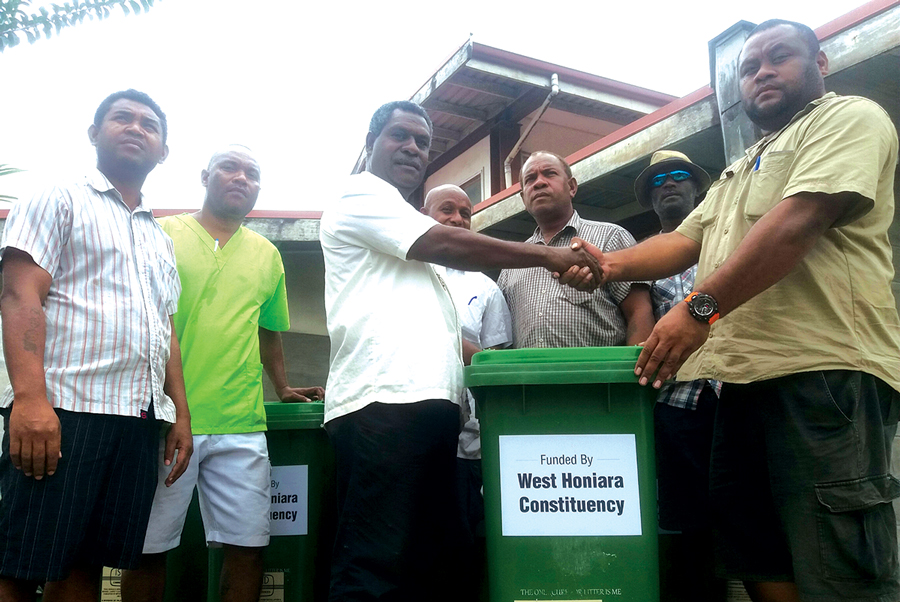
West Honiara Constituency Development Officer, Brian Taupiri (right) handed over the rubbish bins to the NRH executive and staff, Director of Nursing, Father Selwyn Houniola and witnessed by some of the nurses or the NRH.
West Honiara constituency donates bins to hospital
By Gary Hatigeva
West Honiara Constituency Development Officer, Brian Taupiri (right) handed over the rubbish bins to the NRH executive and staff, Director of Nursing, Father Selwyn Houniola and witnessed by some of the nurses or the NRH.
THE National Referral Hospital (NRH) is the latest to have benefited from the continuous generosity of the West Honiara Constituency leadership and its people, for the donation of 20 rubbish bins.
This comes after growing concerns over the littering of wastes and rubbish within the National Referral Hospital compound, which received criticisms from patients and concerned citizens.
After continuous pressure to tackle the issue and being constrained with limited funds, the executive of NRH made calls for support and assistance, thanks to the Member of Parliament for West Honiara, Namson Tran MP, who according to his officers, saw the genuine need for help.
West Honiara Constituency Development Officer (CDO) Brian Taupiri explained during a low key handover ceremony of the bins, that their MP expressed no hesitation after receiving the request because it is about maintaining the country’s only national referral hospital clean.
Taupiri added that it is everyone’s concern to see that the issue of littering and cleanliness within the hospital vicinity is maintained for a healthy environment.
“Remember, cleanliness is part of healthiness and the only way to achieve this, is through close collaboration between the hospital management and staff, and the public.
“So I kindly ask all of us to respect the hospital and its facilities, which off course includes the new bins that are handed out today (yesterday),” the CDO appealed.
Receiving the bins on behalf of the NRH executive and staff, Director of Nursing, Father Selwyn Houniola was emotional when he received the equipment yesterday.
“It’s been quite a while since this issue of waste management here at the hospital was dealt with through the heavy presence of equipment as such to ensure the maintenance of a clean and tidy instititue.
“We have been handicapped and kept inside the confines of this hospital but with this generous donation, let me assure you that we will ensure they are looked after and will certainly help our responsible divisions keep this institute clean and healthy,” the Director added.
He then thanked the West Honiara Constituency and its MP for what he described as a worth assistance and timely, as the issue of waste and littering had slowly become a big problem for the hospital to deal with.
He further added that the donation has more significance as the institute has a national status and outside of the West Honiara Constituency, yet MP Tran chose to continuously supporting it.
The donation of the bins is something the West Honiara CDO stressed and suggested for the NRH executive should not be too troubled on, as it is where all patients from clinics and rural health centres within the 50 constituencies are referred to.
“We all use benefit one way or another from this important service and should therefore take pride of it and help those in charge, look after it,” Taupiri further stressed.
It is not the first for Tran and his constituency to have been involved in supporting the National Hospital.
NRH has been a regular recipient of past assistances from the MP for its various sections, with the recent being through the Rotary Solomon Islands, for hospital equipment.
Diocesan Secretary (DS) of the Anglican Diocese of Malaita, Mr Anthony Maelasi
BY SAMIE WAIKORI
Auki
WORK is progressing well toward the establishment of an Anglican Church of Melanesia (ACOM) secondary school in Malaita.
Diocesan Secretary (DS) of the Diocese of Malaita, Mr Anthony Maelasi recently told this paper that, “despite several challenges faced, things are going on reasonably well”.
He said MEHRD is now finaliSing the Terms of Reference (TOR) for a feasibility study to be carried out on the project site, as well as the detailed design of the school.
According to MEHRD, this is one of the national projects of the current government.
Maelasi said they are expecting the feasibility study to be completed within the remaining part of the year and work on the project to begin as of next year 2019.
He said 38.89 hectares of land was initially negotiated, acquired and registered for the project. An MOU between ACOM and the land owners will be signed soon.
Maelasi also stated that the proposed secondary school at Ilikata Tolokwasa land will cater for forms one to seven.
This paper understands that the establishment of this school will be additional to the current five owned by ACOM, namely, Selwyn College, St. Nicholas College, C.E. Fox Sa’a, Norman Palmer and St. Stephen’s College Pamua.
It is also known that there are also several rural training centres in the country owned by ACOM.
PROVINCIAL Police Commander (PPC) Western province, Chief Superintendent Mathias Lenialu thanks the people of Western province for a peaceful 40th anniversary of independence celebration from July 4-6, 2018.
“This is a very positive outcome for the people here in Western province especially residents of Gizo Town and visiting people from our neighbouring islands,” says Lenialu.
“So far there is no report of any criminal activity received and there were no arrests made during the celebration.
“I want to thank the people here in Gizo and our visiting people from our islands for making this event a crime free event where everyone participated peacefully.
“I also want to thank community, church and women leaders as well as elders, youth and children for the good behaviour shown during the celebration.
“And I also thank my officers for their dedication and working together with our communities to ensure the celebration ran peacefully. Let us all continue to work together for the betterment of our people.”