Home Blog Page 1157

‘No quality education if there is no quality teacher’

0
Chief Education Officer of Malaita Province Mr. Andy Siarana

BY GEORGE MANFORD

AUKI

Chief Education Officer of Malaita Province Mr. Andy Siarana

CHIEF Education Officer for Malaita province Mr Andy Siarani urges teachers that if there is no quality teacher there will be no quality education seen in our schools.

He made this statement during the official closing of this year’s world teachers day celebration in Auki last Friday.

He challenges teachers to question themselves if they are providing the much needed service in the classroom, and whether that service is of quality which would produce the much needed manpower in the future.

“We are the role models that influence our children to become good citizens of this country in the near future.

“Yet still and very importantly what legacies do we leave in the hearts of our children.

“Have we been doing well in our profession as teachers and have we fulfilled the requirements expected of us by our stakeholders.

“The basic principle here is access, management and quality.

“Have we got enough school to cater for basic education and are there enough senior schools to cater for the broad based school population.

“Do we have the quality man power to deliver the quality managers who could manage this whole episode.

“We are the John Baptists in our millennium we paved the way to better future leaders who would be our successors.

“We should also take time to appreciate our predecessors for what we are experiencing now in our education system and the education of our children.

“Had it not for their smart input into our education system we would not have been what we are now today. But let us not be content with our current system. We need to put more effort into creating a more robust education system that should drive us further.”

Malaita and Guadalcanal teachers create way forward through peace

0
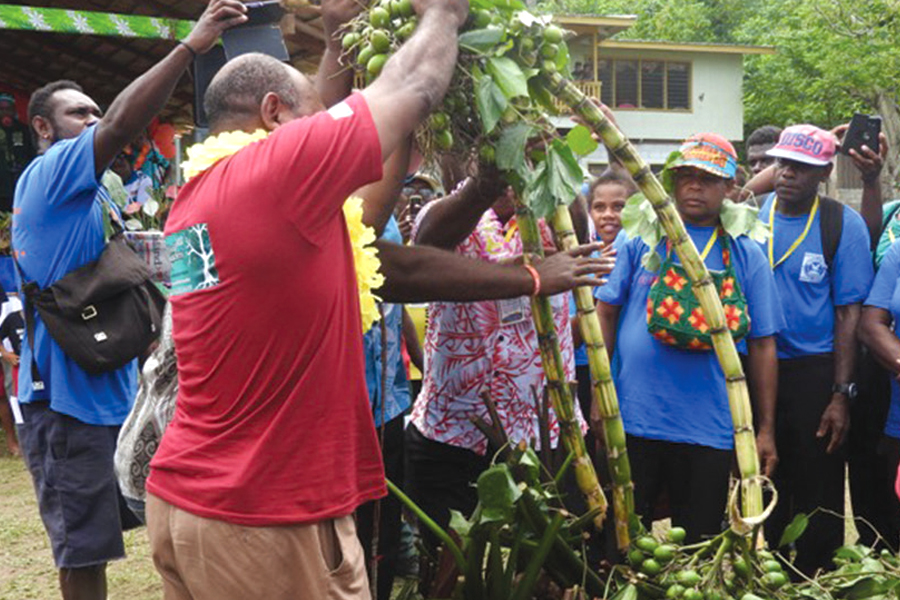
Chief Education Officer of Malaita province Andy Siarani and teachers from Malaita lifting the chuku during a short peace ceremony last Friday in Auki.

BY GEORGE MANFORD

AUKI

CEO for Malaita Education Authority Andy Siarani.

A peace ceremony has taken place during the closing of the World Teachers Day celebration 2018 in Auki last week between Malaita and Guadalcanal teachers.

The short ceremony included exchanging of gifts between both parties especially through reuniting the link and friendship as teachers regardless of what has been done in the past between the two provinces.

The short peace ceremony between these two provinces paved a way forward in the teaching profession which reflects friendship and unity amongst them as teachers.

The main intention of the peace ceremony is to have respect for them where it should be the right way teachers should be through communication and sharing.

Last Friday’s programme is the first to be done by teachers where most peace ceremonies between the two provinces have been done by the government leaders and other dignitaries.

This short peace ceremony means a lot to all teachers attending the world teacher’s day celebration where it also creates avenue for teachers from Malaita and Guadalcanal with lasting peace and by building peace through education.

Chief Education Officer of Malaita province Andy Siarani and teachers from Malaita lifting the chuku during a short peace ceremony last Friday in Auki.

Unsustainable harvesting of mangroves a concern

0
Unsustainable harvesting of mangroves a concern

BY LYNTON AARON FILIA

A report has highlighted that mangroves across Solomon Islands are facing increasing threats from human activities such as unsustainable harvesting for firewood and building materials.

Besides, the ongoing sea level rises as a result from ocean warming and thermal expansion and contamination from logging activities, plastic pollution and increasing population are contributing factors.

From the World Fish facts file, it stated that mangroves are important ecosystems that provide food, firewood, building materials, and shoreline protection for coastal communities.

It is a crucial nursery grounds for fisheries, which support the livelihoods of 85 percent of people in the Solomon Islands, it said.

Despite the how valuable these ecosystems are to people, mangrove is reportedly under increasing threat which comes from sustainable harvesting and building materials and climate change impact, it said.

It said, “In many areas, mangrove trees are unsustainably harvested by for firewood and building materials. This harvesting threatens vital marine resources.”

According to the Solomon Islands’ National Marine Ecosystem Service Valuation summary report 2018, mangrove has been destroyed at an alarming rate of 1.7 percent per year.

If country continues to experience such increasing rate, it means a loss of SBD161.9m (USD$21.6M) yearly.

The report shows, Solomon Islands mangroves provide carbon sequestration benefits to the world, worth about SBD$161.9M (USD$21.6M) each year.

If protected, areas of mangroves and seagrass at risk for destruction could be marked and sold as carbon offsets, but the cost of verifying and managing protected areas would need to be assessed case-by-case basis, it said.

Unsustainable harvesting of mangroves a concern

Meanwhile, if mangroves are seriously considered to be protected, the report highlighted its potential revenue from sale of carbon offsets is estimated to SBD$51.1—$72.8M (USD$7.3M—9.69M) per year.

Solomon Islands’ mangroves have covered a total land area of 27,556 (km2) with 17 species (2 hybrid), a report shows.

Currently, Solomon Islands Government through Ocean 12 steering committee, are working on creating an Ocean policy on how to protect and sustain our ecosystem which might spell out mangroves.

Meanwhile, marine pollution, due to land-based sources, is reaching alarming levels, with an average of 13,000 pieces of plastic litter to be found on every square kilometre of ocean.

The Sustainable Development Goals aim to sustainably manage and protect marine and coastal ecosystems from pollution, as well as address the impacts of ocean acidification.

Enhancing conservation and sustainable use of ocean-based resources through international law will also help mitigate some of the challenges facing our oceans.

Rural community seeks knowledge on climate change

0
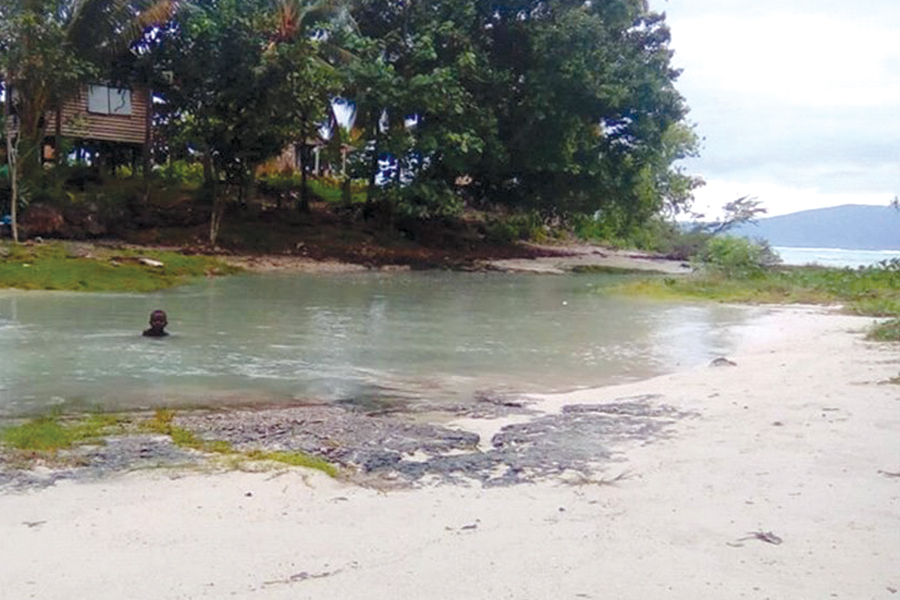
Children enjoying swimming at Lubao water source mixing with salt water.

BY ALFRED PAGEPITU

GIZO

LUBAO community along the coast of South Vella la Vella Island is now feeling the effect of climate change.

Sea level rise is now affecting their freshwater catchment areas.

The community for many years had been using the stream as their water source for washing, cooking and swimming.

It has been the main supplement of water for families, however when high tide comes, their water source will be affected and there is nothing much the community can do.

The villagers last week told Island Sun Gizo that they depend very much on this water source as for long time they had been able to rely on it for their needs.

“We also need water for swimming, cooking and washing, but the current sea level rise affecting our water source. Many of these problem put pressure on our water resources, stresses that are likely to be exacerbated by climate change,” they said.

Villagers felt that purity of their water source has been affected by the rising sea level.

“As waves reach further in the water source and mixed with salt water,” they say.

Mothers are more concerned and worried for the next generation.

“What will happen next for the next 50 years-time,” they questioned.

The communities are now reserving their drinking water through water tanks.

The people there said they will appreciate any awareness program carried out for them to help them understand the issues of climate change.

‘Ma’asina Ruru Movement’ name to be maintained: Housanau

MMF President Martin Housanau

BY ELLISON VAHI

MMF President Martin Housanau

THE chairman for the Malaita Ma’asina Forum, Mr Martin Housanau has declared that the name ‘Maasina Ruru Movement’ must be kept.

During a talk on re-establishing Ma’asina Ruru Movement organisation (MRMO) in which to include Makira, Isabel, Central Islands, Guadalcanal and Malaita as provincial bases, yesterday, Housanau said that there is nothing wrong with the name.

“What the name do is important. That is, it is our action that speaks louder than our words. While I understands that the past Ma’asina Ruru movement was rebellious, came across challenges and other issues discussed.

“Nevertheless, Name is just a name, now what we do from here and onwards is important. It is not the intention of Ma’asina Ruru movement, now to be rebellious, as avenues and provisions in terms of laws has defined.

“Ma’asina Ruru as a movement, has followers, ie they are people who follow ideals, funding principals and beliefs of value systems of our own.”

He said that Ma’asina Ruru Movement as a movement must advocate that this country should come back to people who own it.

“The sovereignty of Solomon Islands as a country is no longer here, as hence, at the moment, even we the real original people of this country where we know everything about, for instance, our customs, culture, values, our land boundaries and our genealogies, law & orders, intelligences, all these is no longer secret or controlled by original owners but outsiders.

“Why Ma’asina Ruru Movement must maintain this name Movement is that, because of the point that our country tales and secrets, for sure, is a very sad thing that all foreign countries knows well about them.

“It is not meant that for us to battle, it means Ma’asina Ruru as a movement, we must advocate that this country must come back to the original peoples who owns it. We talk about issues like NPF and Police. These issues are too small. Once we are looked after by someone from outside, such issues can’t be under the sun solved. Even the government won’t listen to this issues, why, because they are controlled by outside influences.

“Unfortunately, with due respect to our previous leaders, they have done their part. Our previous leaders since independence, they have done their part. They’ve govern these nation, until with the hands of our current leaders.

“We do not have a leader that can stand and say no, this country belongs to us, what we want is this. Whether you liked it or not this is what we want. Whilst, we do not have such a kind of leaders. Thus that is what Why Ma’asina Ruru Movement ls targeting. To advocate and encourage our leaders for them to lead our country with integrity, to lead with the sense that the country has its own sovereign status of its own.”

Climate aid money not reaching most vulnerable in the Pacific

0

DEAR EDITOR, on a day when an international report says rapid, far reaching and unprecedented changes are needed in all aspects of society to limit global warming, we are told that climate aid money is not reaching the most vulnerable in the Pacific.

Quoting from today’s Radio New Zealand’s news bulletin, 8 October 2018.

“The Intergovernmental Panel on Climate Change (IPCC) said limiting warming to 1.5 degrees compared to 2 degrees is necessary to ensure a more sustainable and equitable society.

“The report provides key scientific evidence ahead of the December climate change conference in Poland, when governments review the Paris Agreement to tackle climate change.

“It said every extra bit of warming matters, especially since warming of 1.5 degrees or higher increases the risks of long-lasting or irreversible changes, such as the loss of some ecosystems.

“The lower limit would reduce sea level rise by 10 centimetres by the end of the century, the Arctic Ocean would be free of sea ice in summer just once a century instead of once a decade, and coral reefs would decline by around 70 percent rather than be completely lost.

“It says “rapid and far-reaching” transitions are required and CO2 emissions will need to fall by 45 percent from 2010 levels by 2030.

“The report is clear that avoiding a warmer future above 1.5 degrees will bring significant benefits for millions of people who will face significantly reduced risks of flooding, food insecurity and climate stress, including Pacific communities,” said Associate Professor Bronwyn Hayward from Canterbury University, one of the report’s authors.

“The world is already seeing the consequences of 1 degrees of global warming through more extreme weather, rising sea levels and diminishing Arctic sea ice, the report said.

“The IPCC noted good news in that some of the kinds of actions needed to limit global warming to 1.5ºC were already underway, but they did need to accelerate, with current decisions vital to ensuring a safe and sustainable world.”

Copyright @ 2018, Radio New Zealand.

Meanwhile, also quoting from Radio New Zealand, we learn that around the world money is being poured into helping vulnerable countries fight climate change.

But Caritas New Zealand director Julianne Hickey said finance was not getting beyond large institutions and government structures.

“We’ve heard time and time again from the Solomon Islands through to Tonga, to Papua New Guinea, that it is not reaching those who need it most and those who’ve done the least to cause the issues of climate change.”

Caritas Australia Pacific manager Stephanie Lalor said preparedness was where money was best spent.

“We know for every one dollar invested in mitigation, preparation activities at community level, we save ten dollars in the cost of actually then responding to the impact of a disaster.”

Sad to think, as many in the Pacific countries are saying, the people have become the victims of a problem others had caused.

Yours sincerely

Frank Short

Message from UNESCO, ILO, UNICEF, UNDP and Education International regarding World Teachers Day

0

BY GEORGE MANFORD

AUKI

EDUCATION is a fundamental human right and public good.

It transform lives by driving economic and social development, it promotes peace, tolerance and social inclusion.

It is key to eradicating poverty and enables children and young people to fulfill their potential.

According to MEHRD officer to UNESCO Ms Christina Bakolo Misibini highlighted during last week’s world teacher’s day celebration in Auki.

She said, in many places children are deprived of the right to education because of a global shortage of qualified and experienced teachers- particularly female in low- income countries.

Despite an overall increase in access to education more than 263 million children and youth worldwide are not in school.

A staggering 617 million children and adolescents, nearly 60% globally have not mastered basic literacy or numeracy.

The poorest, most marginalized children, including those living in areas affected by conflict are most at risk of either being out of school or attending school, but learning very little.

The 2030 agenda to which the international community has committed itself calls for universal early childhood, primary and secondary education for all to achieve this goal, we must expand access to quality education for every child and youth, end discrimination at all levels in the education system and dramatically improve the quality of education and learning outcomes.

These objectives in turn, will require an increase global supply of qualified teachers- as estimated 69 million more.

Ms. Misibini stated, the theme of world teacher’s day 2018- “The right to education means the right to a qualified teacher” reflects this reality.

It also echoes the words of the universal declaration of human rights. Adopted 70 years ago this recognized education as a fundamental right.

We remind governments and the international community of the importance of safeguarding that right by investing in a strong teaching workforce, including in conflict affected countries.

To ensure that all children are prepared to learn and take their place in society, teachers must received effective training and support that equip them to respond to the needs of all students including the most marginalized.

But teachers shortages are hampering efforts to achieve equitable, inclusive, quality education for all particularly in countries beset by widespread poverty and protracted crisis, and in regions where the youth population is growing rapidly.

To meet the demand for new teachers, education authorities often employ individuals with little or no training or by lowering qualification requirements.

They are asked to teach subjects for which they have no pedagogical training.

In low income countries addressing the teacher shortage has meant drastically increasing class sizes with a devastating impact on the quality of education.

The most marginalized and excluding children tend to be taught by the least experienced teachers who may be on temporary contracts and receive no pre-service or in- service training.

Teachers available to work in emergency or crisis context may not be trained to respond to the complex needs of vulnerable children, particularly girls who have been forced to flee their homes because of armed conflict, violence or natural disaster.

Despite widespread recognition that teachers are key to achieving quality education for all, teaching is still not widely regarded as a valued profession.

Its low prestige impedes efforts to recruit and retain teachers in reach and poor countries alike.

Governments and education partners must take bold action to improve the quality of training for new and practicing teachers.

Teachers must receive quality initial teacher education, effective induction into the profession and have opportunities for high quality professional development to hone their skills throughout their careers.

And they must demonstrate to the public that teaching is a valued profession by providing decent salaries and improving working conditions for educators at all levels of education.

The most important contribution of a teacher is to improve the lives of children and youth around the world, we reaffirm our commitment to increasing the global supply of qualified teachers.

We urge all governments and the international community to join us in this Endeavour, so that all children and young people no matter their circumstances can secure their right to quality education and a better future.

Seif Ples provides new accommodation for victims of gender violence

0
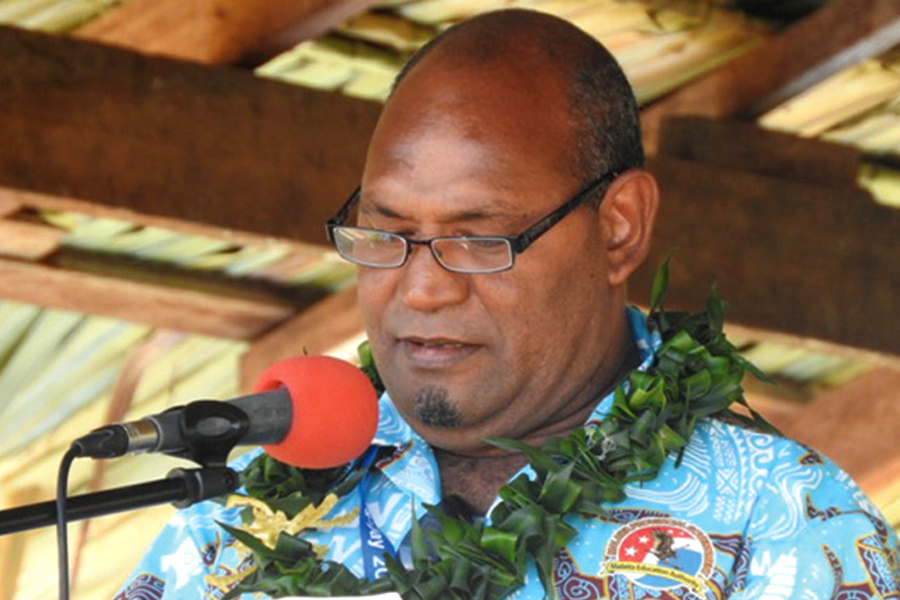
Assistant Commissioner of Police, National Capital and Crime Prevention, Mr Solomon Sisimia

BY LYNTON AARON FILIA

Assistant Commissioner of Police, National Capital and Crime Prevention, Mr Solomon Sisimia

A new accommodation Seif Ples establishes will set right direction for women and children in Solomon Islands, the Assistant Commissioner of Police, National Capital and Crime Prevention, Mr Solomon Sisimia said.

Last week, Seif Ples commenced a groundbreaking for expansion of its new accommodation space funded by the Australian Government through DFAT under the Solomon Islands Justice Programme.

Sisimia said, “Seif Ples is set on the right direction and will always be seen as means of safety for abuse women and children today and into the future.”

He said as Solomon Islands is facing many issues relating family violence and rape, such project will upgrade two new accommodation for victims or survivor of sexual and gender base violence.

“This expansion will be a milestone for Seif Ples and its partners as well as Solomon Islands as a whole in combating gender base violence in all its forms.”

He said Solomon’s history on gender base violence is one that they will not tolerate especially under the label when country has a total population of 99 percent Christians.

On behalf of the SIG and project partners, Sisimia acknowledged the greatest support from Australia Government through DFAT under the Justice Programme for funding the refurbishment of Seif Ples’ new accommodation.

“I must be frank here that your support is not in vain but was one that place into the right cause and safety for all victims of crime within and abroad the country.”

Permanent Secretary for the Ministry of Police National Security and Correctional Karen Qalokale said the expansion of Seif Ples is a reflection of Seif Ples and its partners to fight gender based violence.

She said the expansion set as milestone for Seif Ples and its partners as well as country as whole in a collective fight towards gender based violence.

Gizo council calls for public support

0

BY ALFRED PAGEPITU

GIZO

MEMBERS of the Gizo Town Council (GTC) have called on the Gizo public to support council workers in cleaning up and looking after the Western provincial capital.

A concerned GTC employer told Island Sun Gizo yesterday that most people at market and street have carelessly thrown all their pile all over at the market area rather than put them in the right places provided.

“I would like to call on the general public to keep the surrounding clean at all times to keep Gizo Town clean, safe and attractive for visitors and tourists.

“We GTC workers will not clean all your waste, but we need your support and helping hands to keep our town clean at all times.

“Please all my good people in Western Province take ownership and be responsible and be a good ambassador to take good ownership of our township with good manner and behavior of cleanliness.”

Concern raised over growing ‘fish pirates’

0

BY ALFRED PAGEPITU

GIZO

The national fisheries development (NFD) is reportedly facing threats to its fishing fleet from fishermen who allegedly board NFD’s purse seiners by force.

It is reported that they forcefully board the ships and take off with whatever amount of fish they can carry. It is alleged that these so-called fishermen take their booty and sell them in Honiara.

And, according to sources this practice has been ‘going on for some time now’.

Along with fish they take, they sometimes make off with fishing gears belonging to the ships which they board.

It is understood that this has been reported to a high level delegation from the Western provincial government which visited Noro recently.

It is also understood NFD is also looking at means to protect its ships and employees.

Speaking on condition of anonymity, a NFD employee says, “There is danger the practice could happen at Honiara harbour but a senior police officers in Gizo said they are monitoring the situation as a serious case of fish piracy which is going to be fully investigated.

“The photos of the fish pirates are available at the NFD offices in Noro.”

Police, in an email correspondence with Island Sun, confirms through its media unit that they are aware of the situation and are monitoring it.