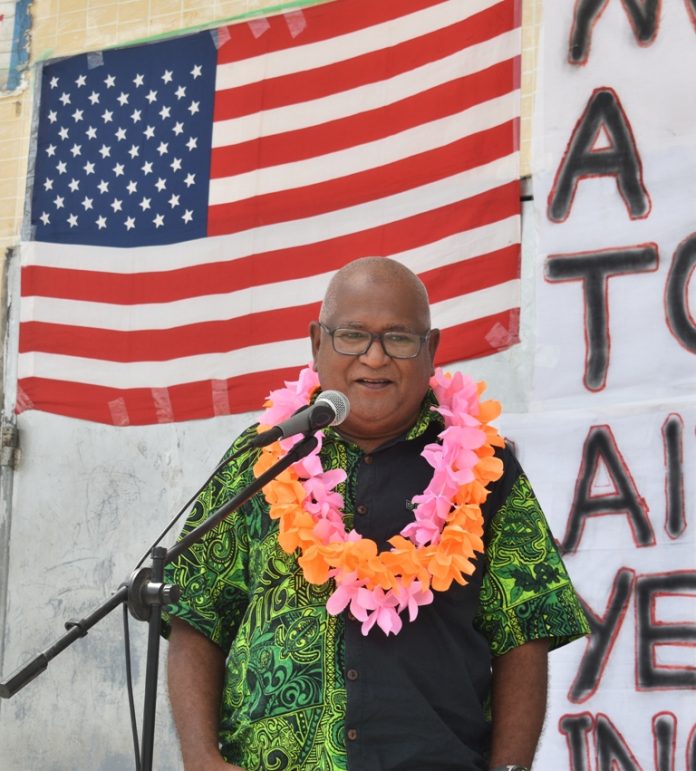
Deputy Chief of Party for Winrock Solomon Islands, Dr Morgan Wairiu
BY SAMIE WAIKORI
AUKI
THE Public Accounts Committee (PAC) under the Malaita Provincial Assembly held an information sharing session with Winrock SCALE-NRM Deputy Chief of Party, Dr Morgan Wairiu last week in Auki.
PAC chairman, and MPA for Ward three, Martin Fini said the session was held upon invitation by PAC for Dr Morgan Wairiu to share with them information on the USAID Scale programme in the province.
He said during the session, they were happy to get first hand information on the USAID Scale programme and five different entities/components which will implement the programme on Malaita province.
Fini said Winrock International as heard is one of the five bodies who will execute the USAID US$25 million on various sectors of development in the province.
He said the entities have their specific areas like agriculture, environment, livelihood and other areas that they will implement programmes on Malaita.
Fini said members of PAC have lauded Dr Wairiu for the session as it gave them the direction on how MPAs will work with people in their respective wards to prepare for the programme.
He called for cooperation from colleague leaders, community leaders, resource owners and implementing partners to support the execution of the scale programme.
In a statement from MPG following a recent information session with Dr Wairiu’s, he said the programme is designed to achieve the overarching Restorative Economy policy of the MPG.
He said the Malaita Provincial Government Restorative Economy policy is the anchor for the SCALE programme.
It stated that the different components are responding to this overarching policy direction which is to restore the economy of Malaita that in a way has been destroyed through very destructive development models.
Therefore, it will be the priorities of MPG that the Implementing Partners (IPs) will be working in line with it.
Under the SCALE programme, IPs are also expected to engage with a variety of stakeholders including communities, NGOs, business houses, provincial authorities, national authorities and international actors in the implementation of the programme.
Rep from Orea youth group receives bags of kava stalk from president of MPYC, Mr Philip Subu (right) this week in Auki
BY SAMIE WAIKORI
AUKI
MALAITA Provincial Youth Council (MPYC) has yet again donated seven 20kg bags of kava stalks this time to Orea youth group last week in Auki.
The support is part of Malaita Youth’s Economic Stimulus Package (ESP) assistance, especially for the kava sector and the assistance will only be received by one youth group in the 12 constituencies of the province.
President of MPYC, Philip Subu said MPYC is very happy to support the youth group as they are one among seven youth groups that have already received the MPYC ESP assistance.
He said Orea youth group is from the highlands of East Are Are and their determination to reach Auki to receive the support shows their seriousness towards the kava programme.
Subu acknowledged the youth group for their effort and urged them to make great use of the programme for their benefit.
He said MPYC is eager to cooperate with youths in the province to empower them and become self-reliance to support the development of their communities, province and country.
He said the assistance comes in the form of kava tools and kava stalks.
“Now we are left with only five youth groups to receive their support under the programme as they have already been identified, and we are waiting for them to get their assistance,” Subu said.
He said MPYC is facilitating the programme with the $10k they applied and received under the national ESP.
Fisheries Officer Priscilla Pitakaka explaining the fisheries regulations during one of their visits to the famous cooking star restaurant at Rove
THE Ministry of Fisheries and Marine Resources (MFMR), Inshore Fisheries Division team have successfully completed a two-weeks awareness on the Fisheries Management (Prohibited activities) Regulations 2018 in Honiara.
The team conducted an awareness program at the Honiara Central Market, followed by distribution of regulation flyers to restaurants, hotels, shops and fish markets outlets from Henderson area in the east to White River in the west of the city.
The Fisheries Regulations sets out prohibited activities for targeted marine products which include certain finfish, shells, crustaceans, mammals, reptiles and fishing gears.
The species in the regulations are regulated because of their dwindling stock status in the wild due to unsustainable harvesting for subsistence and commercial use. Restrictions are placed on certain activities and also size for harvesting, selling and buying.
The awareness aims to educate fish vendors, restaurants, hotels and fish shops who normally buy and sell marine animals and fishing equipment. Enforcement of the Fisheries Regulations is expected to happen after the awareness program.
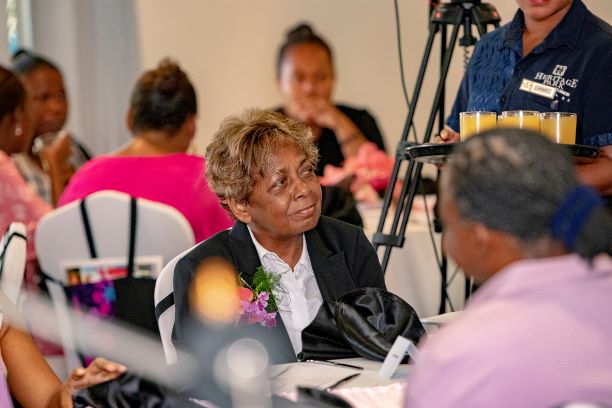
Hon Justice Bird enjoying the Women in Law Breakfast last week
BY BEN BILUA
JUSTICE Maelyn Bird says there is a great need to educate women of their rights and freedom from violence.
She made the statement during the Women in Law Breakfast which was held at Heritage Park last week.
“I lament the lack of awareness by many women to this day of their rights to freedom from violence, and their rights to protection from violence.
“I see the need for much more work to be done in this area.
“This awareness must meet women where they are, not just those of us lucky to have an education,” Justice Bird said.
She said most violence cases are family related and it demonstrates that more awareness will help more women and girls to know their rights and at the same time willing to bring perpetrators to court.
“As a judge on the High Court, I have become increasingly aware of and concerned by cases of sexual assault, many of them perpetrated by family members against children.
“The fact that people are coming forward to report the cases is really important, as is their willingness to testify in court,” Justice Bird said.
She said collective support is needed to address violence against women and girls as police and courts cannot address the issue alone.
Justice Bird said more focus should be on preventing the crimes with necessary actions.
“As a lawyer, I have also been confronted by the prevalence of domestic violence, and the needs of women who seek protection from domestic violence.
“And in fact, it has not been just the experience of my clients, but also me. I stand before you as someone who has survived domestic violence.
“With these personal and professional experiences, I was so pleased to see the elected leaders of our country take the important step in 2014 to pass the Family Protection Act.
“This is a very welcome and important reform. But, as I am sure many of you in this room will agree, enacting a law does not automatically lead to the effective implementation and enforcement,” she said.
Justice Bird calls on stakeholders to work closely with the Ministry of Justice and Legal Affairs, including the Justice Sector Gender Equality and Social Inclusion Strategy, and the review of the Family Protection Act.
THE court has ruled that the record of interview on a man accused of faking his own death to obtain thousands of dollars from a local pharmacy was carried out fairly.
The accused, Peter Fakaia recently challenged the record of interview done on him, claiming it was conducted unfairly and the copy of Record of Interview (ROI) as not the one he signed.
During the trial, the crown called two police officers who conducted the ROI and found the evidence given by the crown witnesses were consistent.
The court then ruled that the crown had proved its case beyond reasonable doubt and the officers conducted the ROI fairly.
Therefore, the record of Interview was admitted as part of the Crown evidence for trial proper with the case adjourned to 30 March 2021 for setting of a new trial date.
Mr Fakaia was accused of faking his own death and obtaining $76,000 from a local pharmacist in Honiara in 2019.
He is facing trial on three counts of false pretences relating to the allegations that occurred between 21 and 26 September 2019 in Honiara.
The Prosecution said the accused sought medication from the People’s Pharmacy at the Kwaimani building in Kukum.
After taking his medication he then left, however on the next day he returned to the pharmacy complaining he had allergies with the medication.
He was then given another medication and was advised to see a doctor.
On 23 September at about 8 am, the complainant received a call through his office phone by a person who allegedly purported himself as the accused’s brother-in-law.
The complainant was informed by the accused’s brother-law that the accused he diagnosed died at the National Referral Hospital and is at the morgue.
The accused’s brother-in-law then allegedly demanded a compensation of $10, 000 for the cause of the death.
The complainant in total allegedly gave $76,000 to the so-called relatives of the accused for his alleged death.
It was on 26 September that police were alerted about the incident and arrested a person who came to collect the last portion of money requested for the accused’s death.
Using the alleged associates; police finally arrested the accused after halting him in his vehicle at the Ranadi Roundabout.
Private lawyer Ben Etomea represents Fakaia, while the Public Prosecutor Jonathan Auga is prosecuting the case in court.
Hon Justice Bird enjoying the Women in Law Breakfast last week
Call for more women in Justice Sector
BY BEN BILUA
JUSTICE Maelyn Bird has encouraged women and girls to pursue judicial path as part of promoting gender quality in the country.
She said the justice sector has been a male dominated profession until recently when few women broke the deadlock.
“The justice system has traditionally been seen as a male dominated area.
“However, we are seeing more and more women coming to the justice sector, in a range of different roles, including lawyers, administrators, and judicial officers,” Justice Bird said.
She said the justice system has a fundamental role to play in our country’s efforts to promote gender equality and putting more women in the job will make a difference.
“Increasing the participation of women in the justice sector, including at senior levels can make an important contribution to the goal of gender equality.
“I see the justice sector as having a fundamental role to play in addressing one of the key impediments to gender equality, and that is the prevalence of sexual and family violence,” Justice Bird said.
On that note, she calls on the people of Solomon Islands to recognise and acknowledge women’s contribution to the operation of the justice sector at all levels, and across all the different arms of the justice sector, whether it be prosecutions, legal aid, law reform, legislative drafting, as well as the critical services provided by the police, corrections, and front-line service providers for victims of sexual and family violence.
“I see so many sisters in the legal profession showing, on a daily basis, in the course of their work the discipline, commitment and ability to manage multiple complex matters that are fundamental skills to those on the bench,” Justice Bird said.
27 lives were lost on the MV Taimareho in April 2020 when the ship sailed through rough weather.
BY JENNIFER KUSAPA
POLICE are still working with stakeholders in regards to investigations into the tragedy behind the MV Taimareho sea incident last year.
Police Commissioner Mostyn Mangau said investigations into the case is progressing very well, and they are working closely together with relevant authorities, the Solomon Island Maritime and the office of the Director Public Prosecution for possible charges to be laid on those who are actually involved.
He said given the sensitivity of the investigation and the incident, police will not work alone but will consult the relevant stakeholders about the tragedy.
Mangau also said there needs to be proper legal opinion on that.
He also said consultation is underway and cannot comment further and further adding that charges will be laid upon the DPP’s advice.
When asked who are the people likely to be charged by Police, Mangau said that will depend very much on the consultation with the stakeholders.
On his previous response on the issue, Mangau said investigators have compiled the file and have forwarded it to the DPP’s office for viewing and once anything is needed to be patched up then the DPP’s office will recommend to the Police what action will be taken.
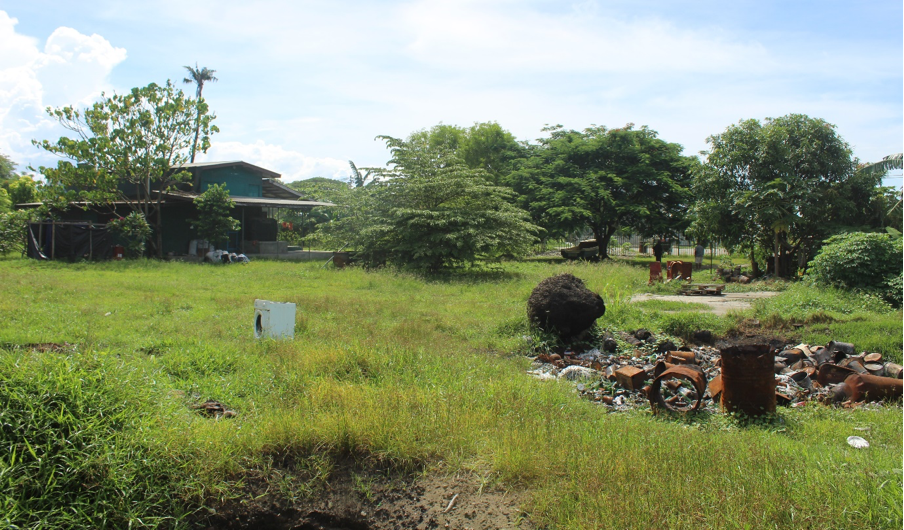
The MAL land at Ranadi that was sold of by the HCC to a Malaysian logger. Picture supplied
MAYOR WELCOMES INVESTIGATION ON THE TRANSFER OF HCC LAND.
THE Honiara City Mayor has welcomed investigations into the sell of the Honiara City Council owned land used by the Ministry of Agriculture and Livestock at Ranadi, east of Honiara.
The issue has been making headlines this week after news of the sale drew condemnation and calls for investigation over the dealings of the council which continues to find itself on the wrong end of public scrutiny.
City Mayor Wilson Mamae in a statement confirmed that investigation is being carried out into the sale of Council Land at Ranadi.
He welcomed any investigation on the matter of transfer of the land used by the Bio-security Division of the Ministry of Agriculture.
“Following what has been published in the media, I would like to inform the public that investigation now has been carried out through responsible body,” he said.
“In the meantime, I would like to urge all parties, whether it be public or private stakeholders who currently occupy HCC land to come forward and show your continuance interest of using HCC land,” the Mayor added.
HCC will be conducting valuation of all the land it owns and is expected to be concluded by the end of this quarter.
Permanent Secretary of the Ministry of Agriculture and Livestock, Ethel Tebengi Frances said she is very disappointed about the action taken by HCC to sell off the land without consulting her ministry.
That piece of land houses the Biosecurity incinerator at Ranadi, east of Honiara.
“The land is used for destruction of all garbage remove from international vessels and aircraft coming into Solomon Islands,” Director of Biosecurity of MAL, Francis Tsatsia said in a strongly-worded statement.
“It’s a requirement that garbage of this sort must be offloaded and incinerated as biosecurity risk is very high,” Tsatsia added.
Villagers fight to reclaim stolen logs from Gov’t & Asian logger
By OFANI EREMAE
AT Korona logging base on San Jorge island in Solomon Islands’ Isabel province, the logging machinery lay quiet.
Except for the movement of three local security guards, the silence in this once bustling log pond was deafening.
“The workers have gone home,” Eric Gnokro, a chief in the area who negotiated my entry into this tightly guarded logging worker’s camp, said.
“There’s a dispute going on so work has stopped,” he added.
On site, huge piles of freshly cut Xanthostemon logs, locally known as Tubi, lined the strip of dirt road that runs through the camp.
Up to 30 workers – both local and foreign – used to live and work on the campsite, which spans an area of about 8,000 square metres.
Tubi is a rare tree species found only in two provinces in the Solomons group: Isabel, where Korona is; and Choiseul, to the country’s west.
The rich, dark hardwood is sought after mostly by Asian countries for furniture and is being advertised at $US2, 300 (SBD$18,110) per tonne in some online markets.
Since it was a rare and endangered tree species, the Solomon Islands Government decided to restrict its felling and export.
For the people of Isabel, Tubi is a tree of significant value that holds a special place in their culture and belief system.
“Tubi grows in the wild, but we have a responsibility to look after them,” Gnokro explains.
“That’s because it provides timber for our houses,” he added.
Gnokro said carvers prefer Tubi trees when producing wooden bowls and other traditional artefacts.
Chief Eric Gnokro of Lelegia village infront of a pile of illegally felled Tubi logs at Korona, San Jorge.
Tubi trees also form a significant part of the natural forests, which villagers rely on for traditional medicine, building materials, soil cover, and as hunting grounds.
Locals referred to it as the “iron tree” because it is strong and durable.
This is why Asian companies are coming out for it.
But under Solomon Islands’ environmental laws, Tubi is described as a “regulated and controlled species.”
It can only be felled and exported on a commercial basis under strict compliance with the country’s Wildlife Protection and Management Act (WPMA).
To do that, a company or community has to apply for a special felling licence from the Ministry of Environment.
But the ministry rarely issues such licenses. Ministry records show Tubi permits were previously issued only to allow illegally harvested logs to be exported.
So who felled the logs piling up at Korona?
“These are disputed logs,” Gnokro explains.
“The company cut them illegally.”
The company he was referring to was Sunrise Investment Ltd, a Malaysian logging firm that was issued a five-year licence in 2018 to operate on Korona.
But the company’s logging licence does not include the felling of Tubi. It is only for other commercial species within the concession area.
Wilson Tohidi, chairman of the recently established San Jorge Island Resource Owners Association Trust Board, a body established to represent landowners on logging and mining issues, said Sunrise didn’t have permission to cut the Tubi but did so anyway.
“They were simply trying to steal our trees,” Tohidi said.
“We are fighting to get our logs back.”
With financial contributions from community members, Tohidi initiated legal proceedings against the Malaysian logger in the Solomon Islands High Court that resulted in the “stop work” order on Korona.
Initially, Tohidi explained, all three landowning tribes on San Jorge gave their consent to Sunrise to log on Korona.
That consent, he added, was reached on the understanding that Sunrise would be there to log other commercial species and not Tubi, and to provide job opportunities, as well as income in the form of royalties to landowning tribes.
Map of Korona logging Camp.
But Tohidi said after the company cut down all the other commercial species, they went on and started felling Tubi.
“They did this although they knew it was illegal,” he said.
Members of our community protested, but Tohidi said the company, with the support of a group of tribal members, refused to listen.
“That’s when we decided to go to the court and obtained an order that stopped them from their illegal felling,” he explained.
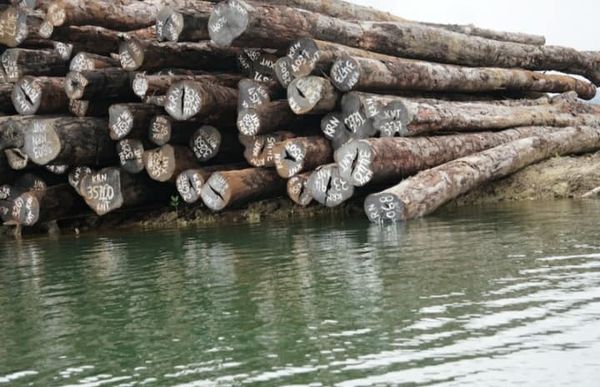
At Lelegia log pond, this pile of illegally felled Tubi logs is visible from the sea. Mas Solo, a Malaysian logging company is accused of felling these logs.
Sunrise has not responded to an email sent to them for comments.
But owner Richard Song Sing Ngea did plead guilty in December to a criminal case the Solomon Islands Director of Public Prosecution (DPP) filed on instructions from the Ministry of Environment, accusing the company of illegally harvesting Tubi trees.
Ngea was fined SBD$50,000 (USD$6,232), the maximum penalty for such offence. But the company’s licence has not been cancelled so it can resume operations if it wishes.
Tohidi estimated that around 10,000 cubic metres of Tubi logs, worth tens of millions of dollars, are lying inside the logging camp.
That would make it the biggest stockpile of illegally harvested logs ever seen or recorded in the Solomons.
Tohidi said landowners would earn more money from their trees if they sell the logs themselves overseas.
A history of exploitation
While Sunrise Investment still has two more years to operate on San Jorge before its license expires, locals claim there are no more trees left to log on the island except Tubi.
Located at the southern end of the province of Isabel, San Jorge is a resource-rich island with an area of 184 square kilometres. It is host to virgin forests and large deposits of nickel.
Spanish explorer Alvaro de Mendana gave the island its current name during his 1568 expedition to the Solomons.
On one end of the island, more than 70,000 metric tonnes of nickel ore worth up to USD$30 million (SBD$256 million) have been lying idle in a deserted mining camp since September 2019.
The nickel was extracted by Axiom Mining Limited (AML), an Australian firm that holds a lease over the mining tenement on the island.
However, Axiom was unable to export the nickel ore after the Solomon’s government refused to grant it an export permit on the basis that the company had failed to obtain a provincial business licence from the local government of Isabel.
Axiom has challenged the decision and the matter is currently before the courts.
San Jorge is also an island that is highly revered by the people of Isabel. That’s because they believe it’s the final resting place for the spirits of their dead.
A logging road that runs through San Jorge Island.
But since the late 1990s international logging companies have been pillaging San Jorge of its virgin forests and shipping the trees to places such as Malaysia and China, where they’re turned into furniture and building materials.
“Today, the only loggable trees on the island are Tubi,” says Samuel Efulu, a landowner and elder of Talise, the only village on San Jorge island.
Efulu, now in his 50s, has lived all his life on San Jorge and witnessed first-hand how Asian loggers have been “stealing” Tubi from local landowners.
“They have been doing it since the first logging operations in the late 1990s,” said Efulu, who had previously worked with the loggers.
In the past, he said, the loggers mostly cut the Tubi when they were constructing their roads.
“They would just mix the Tubi logs with other species and export them without any questions from forestry officers,” Efulu said.
Samuel Efulu of Talise village, San Jorge claims foreign logging companies have been pillaging the island’s forests for over 10 years.
Battles over Tubi heat up
About six kilometres across the pristine Thousand Ships Bay on the mainland of Isabel, another huge stockpile of Tubi logs is visible at Lelegia log pond.
Mas Solo Investment Ltd, another Malaysian logger, holds the lease over the area.
Like Sunrise Investment, their licence also does not allow them to fell Tubi.
“Mas Solo gave the excuse of cutting them down while clearing their road into the forest,” Tohidi said.
“We’ve included those logs in our High Court challenge so Mas Solo cannot ship them out.”
Some four kilometres west of Lelegia is Totoru-Rarade log pond, also located on the edge of Thousand Ships Bay.
Pacific Logging Company, owned by Solomon Islands politician Freda Tuki, used to operate there.
Like Sunrise and Mas Solo, Pacific Logging also felled Tubi trees illegally during the course of its operation on Rarade land.
In 2019, a group of landowners took up a court case against the company over the Tubi logs it felled.
The High Court issued an order preventing Pacific Logging from shipping the logs out.
As a result, the logs were kept at the Totoru-Rarade log pond for months until September 2020 when the company covertly shipped them out.
Customs later seized the logs at the country’s second international seaport at Noro in the Western Province.
Mary, a mother of two in the nearby commercial station of Kaevanga, remembered that incident quite well.
“The barge the company sent to pick the logs arrived there in the evening,” Mary said, pointing to the log pond at Totoru.
“It was not unusual for a barge to come and berth at the log pond so there was nothing suspicious about the arrival of this barge,” she continued.
Under the cover of darkness and with no villagers watching, Pacific Logging loaded the barge and took off during the night.
News of this “illegal shipment” spread out the next day and quickly reached environmental authorities in capital Honiara.
Together with Customs, the logs were seized and stored at the premises of another Asian logger at the port of Noro.
But Tuki, who is the country’s Minister for Women and Youth, claimed the Tubi shipment that was seized and held at Noro was her company’s property.
“We have already bought the logs from the original Rarade landowners,” she said.
“They’ve collected their money from us which they used to meet their children’s school fees,” Tuki added.
“In fact, it was the original landowners of Rarade who agreed for us to harvest their Tubi trees.”
But in a separate Tubi case in 2015 before the Magistrate Court, Principal Magistrate Augustine Aulanga stated that any Tubi felling that was done without a licence from the Department of Environment would always be illegal even if landowners gave their consent.
Following Pacific Logging’s covert shipment, landowners took out a court order that restrained Tuki and all her agents from dealing with the logs that were seized and held at the port of Noro.
The case is expected to be heard this year.
At the Ministry of Environment, Permanent Secretary Dr Melchior Mataki said the law on the illegal harvest of Tubi is clear.
“It’s a violation of the relevant sections of [the] Wildlife Protection and Management Act (WPMA) 2017 if you fell Tubi without a permit,” Mataki said.
He said his ministry acted on the matter and referred the Sunrise case to the police, who then initiated the criminal case.
Mataki said the other cases involving illegal harvesting of Tubi are being pursued as well.
While some welcomed the ruling against Sunrise, long-time environmental activist Lawrence Makili described it as a mockery to the Solomons environment laws.
“What is $50,000? That’s nothing compared to the damage this Malaysian logger caused to our environment and his deliberate act in breaking our laws,” Makili said.
“This Malaysian company should be closed down and its owners deported,” he added.
Makili said loggers with a no- care attitude must not be entertained in the Solomons.
Back at the Korona log pond, the guards continue to keep watch over the huge stockpile of logs, unaware that a new battle has emerged over who holds legal rights to them.
According to Mataki, the Solomons environment minister has exercised his powers of forfeiture and declared the logs now “government property.”
But Tohidi and his group argue the logs are rightly theirs.
The rights issue will be determined in the High Court in coming weeks.
* This feature story is produced with support from Internews’ Earth Journalism Network (EJN) under its Asia-Pacific Story Grants 2020-21
POLICE Commissioner Mostyn Mangau says police are still waiting on the Director of Public Prosecution for advice regarding Robson Djokovic’s case.
Mr Mangau said public is aware that the Prime Minister’s Chief of Staff has lost his Solomon Islands citizenship status, police investigators will rely on DPP’s advice on what action to take next on the matter.
He said the file is currently with the DPP’s office and the High Court has made its ruling.
Mangau said police investigations are based on the Electoral act offences Djokovic allegedly committed in 2018.
Mangau also confirmed that no charges have been laid yet since the declaration was made by the High Court.
Director of Public Prosecution Rachel Olutimayin on Monday confirmed that her office will file charges on the Prime Minister’s Chief of Staff towards the end of this week.
Djokovic’s case is based on a complaint made by the Leader of Opposition last year that he is an Australian.
Djokovic is an Australian citizen however he also registered to vote during the 2019 National General Election.