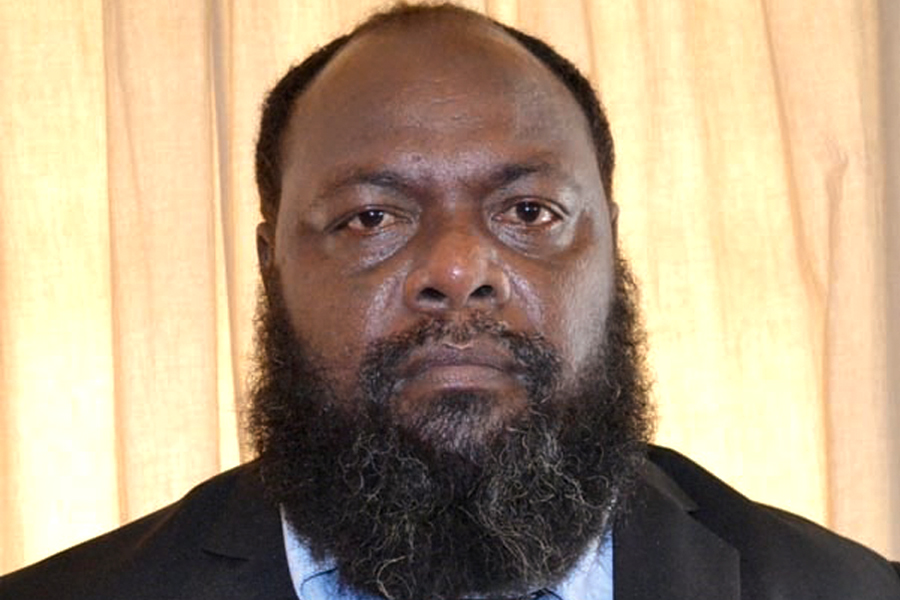
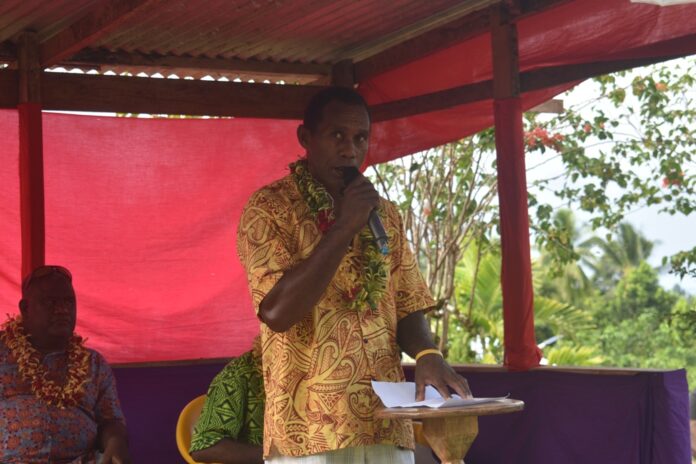
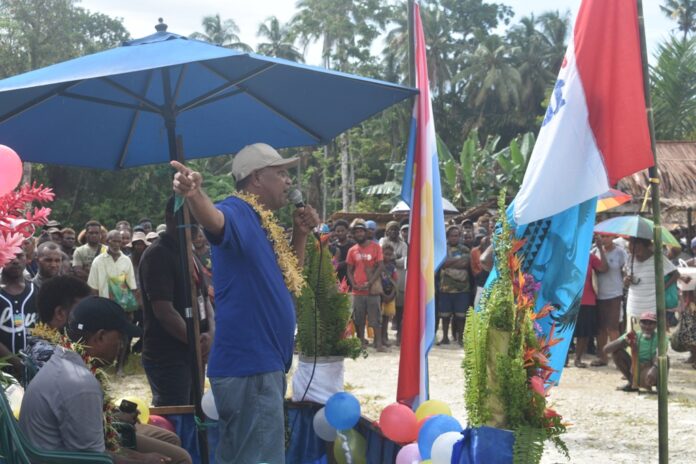
LAU/MBAELELEA constituents are still waiting for their Member of Parliament to consult them on government’s idea to defer the current parliament from four to five years.
They are making a call for MP Augustine Auga to visit them soon and consult with them.
Constituents told this paper at Rameai village in Mbaelelea that they are still waiting for MP Auga to provide them with information on the matter.
He said they have heard that many MPs have visited their constituencies and carried out consultations with their constituents.
They said like all constituencies, people of Lau/Mbaelelea also have opinions to share on what they see and think on the matter.
They call on MP Auga to visit them soon and explain to them government’s deferment plan.
Guadalcanal Province is open to any donor partner willing to help its dire health service, says Premier Francis Sade.
Mr Sade uttered this at the commemoration of the province’s 38th second appointed day yesterday.
“My Executive Government is open up to any donor partners who wish to also help us on our dire health situation,” Sade said.
He said the COVID-19 community transmission early this year is an example of why Guadalcanal needs an improved health service especially in terms of a tertiary hospital and second level medical stores.
“This is on the top priority list on a short/medium plan and the consultation with MHMS/SIG is ongoing at the moment.
“Having these two important health infrastructures would help solve the overcrowding of sick patients at the National Referral Hospital,” Sade said.
He also highlighted the positive progress done by the GP Health and Medical Division.
This includes:
“Opening of the Aola and Avu Avu Area Health Centers which are of high quality and built in accordance with the Ministry of Health Role Delineation Policy Standards.
“Combined action and operation to mitigate the effects of Covid-19 through the establishment of the Emergency Operations Center (EOC), this is something which has never been done before.
“An increased provincial commitment to health human resources whereby five nurses have been employed by GPG early this year.
“The first ever clinic renovation by the provincial government at Barainagho Clinic, in Talise Ward, which was completed in April.
“All six GP Health Zones now have medical doctors posted to them. If accommodation is sorted out we will have our people accessing the services of a medical doctor at their nearest Area Health Center, something no province has achieved yet, and dental officers and support staff will follow soon.”
“And lastly, the improvement of nurse to population ratio at 0.8, which never been done for the last five years, this is due to the increased number of nurses to GP. We also thank the Ministry of Health and Medical Services for this,” Sade said.
Guest of honour and Minister of Provincial Government and Institutional Strengthening (MPGIS) Rollen Seleso since the beginning of this year, Guadalcanal has been hit hard by the community transmission of the covid-19 virus.
“Our fight against the virus has taken much of our time, resources, and efforts. It has affected our ability to set up better plans and work programs. You will note that most of our work plans and implementations are heavily influenced by this virus,” Seleso said.
He adds they experienced the impact it has on the public sector, churches, community groups and other sectors as well, particularly in terms of tourism, shipping, communication, transportation, health and education.
“The revenue collection capabilities of both the National Government and Provinces were also severely hampered and affected service delivery networks. I believe it has also impacted on the distribution of funds to our nine provinces, which subsequently affected our communities.
“Despite this transmission and the disturbances it has created, I believe we had not lost focus on the significance of development,” Seleso said.
Secretary of Marodo House of Chief, Mr Steve Micky.
BY SAMIE WAIKORI
Auki
MARODO House of Chiefs, governing the areas from Sasava to Takwea Rivers in Lau/Mbaelelea constituency, has thrown its support behind the Suidani-led MARA government.
Secretary to the house of chiefs, Steve Micky assured of their support in light of MARA government’s courageous stand to protect Malaita from “foreign intrusion”.
In an interview, Micky said Marodo HoC values the importance of their culture, tradition, lands and genealogy and wants to uphold them.
He said for the past four decades the country has only known developments associated with destruction of natural resources that created division among tribes, communities and people.
Women and children attended the awareness program at Abuisaia.
“Marodo House of Chiefs met with Premier Suidani and team and assured them of our continue support toward their stand for issues of common concern to Malaita,” he said.
Micky said in addressing some of the challenges faced with issues relating to Marodo HoC traditional governing system, they are working with MARA government for ways forward.
“This area is on our preparation to carry out genealogy mapping on all tribes within Marodo and educating them on their landownership and genealogy.
“This is mainly to prepare our people and resources for development by trying to minimize land dispute or related areas that may lead to disputes,” he said.
On that note, Micky thanked Premier Daniel Suidani and team for dialogue with Marodo HoC and visit to Abuisaia community within Marodo areas.
Part of a group of Solomon Islanders who went under the Australian Seasonal Workers Programme and Labour Mobility Scheme. PHOTO AUSTRALIAN HIGH COMMISSION OFFICE
By EDDIE OSIFELO
THE five-year Labour Mobility Strategy (2019-2023) to achieve more than 5000 workers by 2023 is progressing well.
More than 4000 workers are currently working under the Seasonal Worker Programme (SWP) and Pacific Labour Scheme in Australia and Recognised Seasonal Employment (RSE) in New Zealand.
Ministry of Foreign Affairs and External Trade permanent secretary, Collin Beck confirmed to media last week having passed the 4000-mark.
He said by the end of December, they are projecting to pass the 5000-mark.
“Work on this is going in the right direction, there is a lot of interests.
“The challenges they face now are positive challenges, like the process of dealing with passports,” he said.
Beck said the increase of numbers is basically because “our workers have built a good reputation.
“We have built a brand ‘here to work’ which is about responsibility, commitment, dedication and courteous with the employers.
“Of course, there are one or two issues but they don’t affect the general reputation of everyone,” he said.
In addition, Secretary to Prime Minister, Dr Jimmie Rodgers said the projection set four years ago is to hit 5000 by 2023.
He said by 2025, it should hit 10,000.
“This is achievable,” he added.
In terms of economic impact, Central Bank of Solomon Islands has confirmed that the total remittances (inflow) for 2021 was SBD$215 million.
This is 68 percent increase from $128 million reported in 2020.
CBSI also confirms that these figures include remittances from both seasonal workers and non-seasonal workers.
The Labour Mobility Strategy was developed and endorsed by Cabinet in 2018.
It has been developed in tandem with the Labour Mobility Policy Framework and together these documents outline the Solomon Islands Government’s [SIGs] plans and system for growing labour mobility opportunities over the next five-year period (2019 – 2023).
Fundamental principles underpinning the labour mobility strategy are that it aligns with other government strategies for the development of the domestic economy, by:
Developing new employment opportunities for Solomon Islanders
Increasing international earnings for investment in the domestic economy
Developing workforce skills for entrepreneurship and the creation of new industry.
Embassy Counsellor and Deputy head of mission, Yao Ming hands over the computers to representatives of Betikama College.
THE Embassy of the People’s Republic of China last week handed over 24 computer monitors and one R240 Computer server to the Betikama Adventist College in Honiara.
The handover was made on July 27 by the Embassy Counsellor and Deputy head of mission, Yao Ming.
School principal, Partinson Bekala, Form 7 head tutor, Samantha Buka, former Form 7 class president Chrisdan Tonawane, together with representatives of teachers, students and parents attended the ceremony.
Deputy head of mission, Counsellor Yao Ming gave a briefing on the development of China and Solomon Islands relations and fruitful outcomes of exchanges and cooperation between two countries.
He said that as a Chinese saying goes “It takes ten years to nurture a tree, but one hundred years to educate a person”.
Education holds the key to a nation’s future. In the context of COVID-19 pandemic and social unrest, Betikama Adventist College has overcome enormous challenges and managed to make education opportunities accessible to the youth. China places high premium on educational cooperation with Solomon Islands.
“Hopefully by using the donated computers and server, Betikama students can improve their ICT skills and gain a better understanding of China and the world at large,” he said.
Counsellor Yao also called on students to undertake study tours in China and play roles as ambassador of good will to promote better ties between China and Solomon Islands and make contributions towards the development of this nation.
Principal Partinson Bekala shared the school’s historic background and expressed sincere appreciation for the Chinese Embassy’s valuable support.
He said that since its opening 74 years ago, the school has remained committed to quality education and is among the prestigious high schools in Solomon Islands.
Most of the school computer facilities are out of date or inaccessible for ICT learning courses.
He said the timely donated equipment by the Chinese Embassy is instrumental for a better learning environment for students.
“Betikama Adventist College remains committed to promoting people-to-people friendship between China and Solomon Islands and will further facilitate students to learn Chinese language and Chinese culture.
After the ceremony, Counsellor Yao Ming was given a tour to the school’s computer laboratory and other learning facilities by Principal Bekala.
INLAND Revenue Division in the Ministry of Finance and Treasury has collected about $10.7 million from issuance of passports from 2021 to 2022 (January to July).
This after the Passport Unit in the Ministry of Commerce, Industries, Labour and Immigration issued a total of 13,304 passports in that 19-month period.
Permanent Secretary, Riley Mesepitu told the media last week that in the whole of 2021, a total of 8804 passports were issued, which was equivalent to $6 million.
He said from January to July this year, a total of 4500 passports were issued and costs about $4,713,000.
This brings the total to 13,304 passports, and equivalent to $10.7 million.
Mesepitu said more than 90 percent of passports issued were for seasonal workers.
Further to that, the PS clarified the delay of issuing passports due to only four people working in the office to meet the high demand of people every day.
As part of managing the inflow of people, Mesepitu said allocated days for seasonal workers are Monday, Wednesday and Friday.
He said Tuesday and Thursday for others.
Moreover, Mesepitu said the ministry plans to open mobile units in provincial centres like Auki and Gizo to help reduce costs of people coming to Honiara.
He said people in the provinces can enrol in the provincial centres to get their passports.
UNITED Nation wants to see more youths and women participate in provincial and national political levels.
United Nations Resident Coordinator (UN RC), Sanaka Samarasinha told the media after he met with Speaker of Parliament, Patterson Oti in Honiara last week.
“One of the key areas for us ensure young people are engaged, have jobs, political participation at provincial and national levels is key,” he said.
Further to that, he said they need to ensure greater participating of women in political and decision making.
“Example in Parliament to increase those numbers,” he said,
Furthermore, Sanaka said they talked about the need to ensure Parliament exercises oversight and legislative role in a robust manner, so they can provide support in analysis, data and research.
Sanaka had visited Solomon Islands for the last 22 years. He led a team of UN agencies to the Solomon Islands for the first time since COVID-19 forced its borders closed in 2020.
The team engaged with key Government counterparts, the Parliament and development partners.
During discussions with Government, the UN Team discussed key priorities of the Solomon Islands and highlighted potential support by the UN, including in the areas of sustaining peace in Solomon Islands, achievement of the sustainable development goals (SDGs), governance reform, better coordination, a scale-up of the UN presence and assistance in the Solomon Islands.
Other issues discussed were Least Developed Country (LDC) graduation, job creation, service delivery, especially in the provinces, as well as disaster preparedness and COVID-19 response.
Suidani's awareness talk at Takwea market in Mbaelelea.
BY SAMIE WAIKORI
AUKI
COMMUNITIES in the Mbaelelea and Baegu Asifoloa constituencies have shown overwhelming support towards Premier Daniel Suidani’s recent awareness program to the northern region of Malaita province.
The awareness talk is the second phase of his awareness program to communities to inform people about the work of the provincial government.
The awareness tour began last Wednesday where Suidani and team visited the Urudao market, Abuisaia community, Suluone/Sasava market, Takwea market and Ata market.
In his addresses to the people during the tour, Suidani said the right and honorable thing for any government to do is to bring the government to the people they represent.
Premier Suidani receive by elders from Abuisaia during his awareness tour to their community last week..
He said only through meaningful engagement with the people that the government will see their need and discuss how they could work together to achieve them.
Suidani said being a government owned by the people is important to engage them on issues they need to know to make better decisions.
Issues that Suidani and his team had talked about and discussed with the people include, MARA government’s restorative economy policy, development aspirations of the province and the work of his government.
Members of communities within Sasava during the awareness talk at Suluone market.
Suidani also clarified other issues like MARA government’s stand on china, MP’s road construction in the province, MARA government’s stand against cross border voting, land court system, proposed political party, Auki communiqué and others.
Suidani, although met resistance at the Urudao market, people within the area had shown overwhelming support and were eager to learn from their government.
Similar sentiments was also received from people in other venues like; Abuisaia community, Suluone/Sasava market, Takwea market and Ata market where Suidani and team had visited.
Lack of staff, facilities and vital medicine has long been a problem for rural clinics.
So, with COVID adding to the pressure clinics are under, Island Sun set out to investigate the state one rural health clinic – the Kalenga Clinic in Isabel province.
Rural health facilities are the first-place people turn at times of medical need and the backbone or our health system.
While there have been more financial resources allocated to health budgets as a result of COVID-related initiatives, rural clinics still have the same load of other illness and accident to deal with.
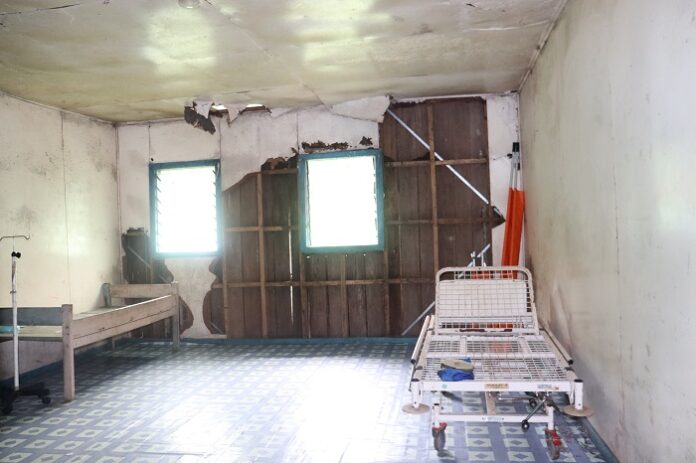
Run-down labour room for mothers
In many ways Kalenga Clinic is an average clinic – not particularly better or worse than so many across the country.
What we found were some big gaps in basic services and not much improvement from the time of the last major assessment of the state of medical services done in 2018 by the Ministry of Health, despite fundraising efforts of the community.
In 2022, Kalenga clinic is sometimes without a nurse to look after almost a thousand people, including boarders at its primary and high schools.
Island Sun arrived at Kalenga’s beautiful beach early in the morning of June 3, 2022 after a four-hour boat ride via outboard motor to Isabel from Honiara.
Kalenga is located at the southern end of Isabel, the longest island in the Solomon Islands.,
Upon our arrival we were welcomed by villagers.
Not so welcome was the bad smell that greeted us – a sign that this community does not have proper sanitation and that people are having to use the beaches for convenient purposes.
Sanitation is a basic building block for health, but it is just one part of the the health picture.
A roof inside the clinic beign destroyed by white-ants
Island Sun was there to look more specifically at the status of Kalenga Clinic and to see if it is adequately serving the people of surrounding communities.
We asked the villagers to introduce us to Kalenga Clinic’s newly-appointed nurse, but the nurse was not there.
Having found a lack of crucial medical supplies when he arrived to take up his post, he had set off for Honiara to obtain medicines to restock the dispensary.
That left the clinic without its only trained medical staff.
Back in 2018, the Ministry of Health and Medical Services found that lack of trained staff is an all-too-common occurrence across the country.
The Ministry’s Statistical Health Core Indicator Report showed most provinces had rural health clinics with no registered nurse.
Isabel was not one of those provinces, so it seems that in 2022 things have not improved despite new COVID funding.
Kalenga Clinic Chairman Josie Gedi revealed the clinic has been struggling since 2015 despite the surrounding communities working hard to raise funds to make up for gaps in services.
Josie Gedi Kalenga Clinic Chairman infront of the highfloor clinic
“This clinic was built almost 25 years ago and due to its closeness to the seashore, the clinic committees then, agreed to build a high floor building to avoid high tides or king tides washed inside the building.
“But a high-floor building is not suitable for women, elderly and people with disability, as there was no access for such people and they always find it difficult to climb up the stairs”, Gedi said.
Gedi who is now taking up the position of chairman has been organizing his committee to raise funds to build a new clinic convenient to all people.
His committee has been seeking funding from leaders and authorities since 2020 to re-construct a concrete floor clinic, but there has not been much support.
Gedi said only the members of their communities contributed but that was not enough.
“As you can see this clinic is without a bathroom and toilet and it has been difficult for sick patients and even women who come here to give birth.
“Authorities should come and assess this place properly and see for themselves the problems we face, even our Provincial leaders and Health authorities never address the problem this clinic face,” Gedi highlighted.
Gedi also said the clinic often runs out of medicines, leaving sick patients to turn to home remedies or herbal medicines for their health problems.
Clinic Pharmacy without panadol and antiobiotic drugs for sick people
Meanwhile, Provincial Member for the Kalenga clinic area Tony Vahia, said that the provincial government does not have enough funds to support all rural clinics within the province.
“Even-though we knew that our rural health centers need funding support and it is a need for us leaders to support, as our health is important, we did not have the funds to build proper facilities, unless donors support us”, Vahia said.
He said with the current state of Kalenga clinic and with COVID cases in the country, proper health facilities are needed in the rural areas.
Annette Kafa, one of the women representatives in her late 40s, shared her concern that, as a woman and mother, she wants the Ministry of Health and the Provincial Health to always make sure that nurses posted to rural clinics do not leave clinics unattended.
She said during the recent COVID community transmission Kalenga clinic was without a nurse for almost four months and it really affect the communities especially women and children.
“Provincial health should always bear in mind that whenever a nurse is on annual leave, they should send a nurse to relieve the nurse on leave to avoid inconvenience for our community” Ms Kafa said.
GUADALCANAL Premier Francis Sade has called on the national government to return the Perpetual Estate titles for alienated lands to the province and its people.
In his speech on Guadalcanal’s 38th second appointed day celebration yesterday, Premier Sade said his executive is looking forward to work with the national government about who should now hold the Perpetual Estate (PE) title to those parcels of land, or if the FTE titles should be transferred to the Guadalcanal Provincial Government.
He said it is important for the national government to assist Guadalcanal province in addressing the long-standing issues affecting the province.
“As old as these issues are, it is therefore crucial that the National Governments helps the Guadalcanal Provincial Government address these issues, and do so urgently.
“Our policy is clear! We want the PE title for alienated lands to be returned to the Guadalcanal Provincial Government and eventually to the people of Guadalcanal.
“This will ensure that our Province and people benefit from our lands and lessen the fast land selling issue without any proper social and economic regulation services.”
He also said due to the migration of people from different parts of the country in search of opportunities, many of them have built settlements beyond the town boundary, on customary and alienated lands.
“Many of these are informal or squatter settlements.” He adds.
“This creates challenges as well as opportunities. As stated earlier before, due to Nahona’ara, Guadalcanal Province hosts people from all over the country and is in many ways the center of Solomon Islands, it has also created tensions between indigenous Guadalcanal people and our fellow citizens from other provinces. It also increases the competition for social services.”