Home Blog Page 620

MHMS without documents for $4.7m Multi-purpose hall works

The Multi purpose hall used as a field hospital.

By EDDIE OSIFELO

MINISTRY of Health and Medical Services has not provided any documentation to support the contractor that refurbished the Multipurpose Hall into an Isolation Ward for $4.7 million.

The Office of the Auditor General found this in its compliance audit released on Wednesday.

“For example, the refurbishment of the Multipurpose Hall into an Isolation Ward was contracted at a cost of $4.7 million but there was no documentation supporting the selection of the specific vendor chosen to do the refurbishment.

“The first documentation  available for this project was a letter from the vendor on 5 October advising a contract price and also indicating that work was well underway,” OAG states.

“This means that work was started even before a contract price was established.

“Three weeks later on 26 October 2020, PS MHMS indicated to the Oversight Committee that this refurbishment work was 95% complete, but a Purchase Requisition was not signed until 20 November 2020,” OAG report states.

“Neither the availability of this contract nor its award was publicly advertised.

“The procedure used to select vendors in non-competitive procurement is also not documented and neither is the reasoning for individual selection decisions,” OAG report states.

Furthermore, OAG obtained some transaction documentation held by MHMS but this was not complete.

“There was no compliance check list and no funds transfer advice.

“The Scope of Works Schedule provided held by the Ministry was an illegible copy but did seem brief for a complex refit project,” report states.

OAG was not provided with any documentation related to a bid waiver submission.

“Urgency of work was mentioned on the request letter there was no other supporting documentation and no approved bid waiver.

“A memorandum dated 6th October 2020 was sighted that mentioned specifications, drawing, scope of works, and costing, but the Ministry was not able to provide these documents,” OAG said.

Apart from that, another payment was a total value of $1,190,000 for motor vehicles was also missing original documentation from Ministry of Finance and Treasury.

OAG said there was no justification for the number of vehicles.

“The Bid Waiver, PR and Payment Voucher referred to eight vehicles but this was reduced by the Accountant General to four.

“There is no clarification or supporting documentation for either initial number of vehicles or the reasoning for reducing the number of vehicles,” OAG said.

“Although the bid waiver application was completed, significant controls such as compliance checklist has not been completed by MoFT.

“No contract agreement or award letter was provided,” OAG said.

Further to that, OAG said the decisions around these procurements were significant.

“Inadequate documentation of decisions and missing original documents is a failure by the Ministry to secure original documentation and maintain evidence of the implementation of internal controls.

“Inability to provide the OAG with full documentation to review transactions also indicates a major failure of accountability,” OAG said.

The OAG conducted this audit in accordance with International Standards for Supreme Audit Institutions (ISSAI) namely the ISSAI 400: Compliance Audit Principles and ISSAI 4000: Compliance Audit Standard issued by the International Organisation of Supreme Audit Institutions (INTOSAI).

The objective of the audit was also to assess whether the Ministry’s procurement for disaster relief complied with required procedures, and in accordance with the principles of transparency, accountability and inclusiveness. These procedures included the Public Financial Management Act (PFMA), the Financial Instructions (FIs) and the Solomon Islands Government Procurement and Contract Manual 2013 (PCAM).

MHMS documentation management was inconsistent: OAG report

0
Released audited reports from the Office of the Auditor General ( OAG).

BY MAVIS N PODOKOLO

FINDINGS of the Office of the Auditor General uncovered that Ministry of Health and Medical Services documentation management was inconsistent, with some documents not able to be found.

OAG audited the accounts of Ministry of Health and Medical Services and discovered that signatures of authorising officers varied from document to document and handwritten changes to documents after signature.

OAG when carrying out the audit recommended to MHMS that where significant errors are made in documentation MHMS should ensure that documentation should is recreated and reauthorised rather than being changed by hand and copies of all key documents which support payments are maintained in the Ministry.

“MHMS should ensure that key signatures have been verified before documentation is sent to Ministry of Finance and Treasury (MoFT) for payment,” the OAG report says.

Ministry of Health and Medical Services in response to OAG says their management has agreed to the recommendations and has proposed to do the following:

“· The MHMS will comply by taking a sample of all key signatures of the accountable officers in the ministry.

· The ministry will through the offices of the HODs, Accounts and Procurement, will address this. Where major errors are noted, the request will be cancelled and instruction will be given to recreate and re submit proposal.

· The ministry through workshops and conferences and supervisory tours and on a one to one basis with officers will remind officers of this recommendation,” OAG report stated.

$677K IN 5 DAYS

0
Released audited reports from the Office of the Auditor General ( OAG).

NDMO rushes to spend covid-19 fund on expensive vehicles ‘not related to the pandemic’, OAG report finds

By EDDIE OSIFELO

The National Disaster Management Office had purchased a Toyota landcruiser and Toyota Hilux under dubious means in 2020, an audit report has suggested.

The audit report by the Office of the Auditor General published on Wednesday says these vehicles were bought from Ela Motors totalling $677,500 of covid-19 funds.

Following declaration of state of emergency on March 25, 2020, government had redirected funds from ministry budgets towards its covid-19 preparedness and response plan – generally called covid-19 funds.

This special fund was purposely to pay for goods and services towards government’s covid-19 preparedness and response plan.

These two brand new expensive vehicles bought by NDMO using the covid-19 fund were not relevant to the purpose of the fund, the OAG Report suggests.

“One significant procurement appeared to be unrelated to the pandemic. The NDMO chose to supplement its vehicle fleet with the addition of two new Toyota vehicles at a cost of $677,500.”

OAG investigations also found that the competitive bidding process for the purchase of two vehicles was a paperwork process only.

On June 15, 2020 the Director NDMO received a quote from Ela Motors for a Toyota Land cruiser.

  1. On June 16 at 11.18am the PS MEDCM wrote to the PS MOFT seeking support to procure a Toyota Land Cruiser and a Toyota Hilux under the COVID-19 budget citing the age and maintenance requirements of the current fleet to support the need to do this. At this stage the Ministry seemed to be set on purchasing the two Toyotas.
  2. On June 16 at 1.05pm the PS of MOFT requested the PS MECDM complete the procurement process including quotes and a report from the MTB for consideration by the CTB.
  3. On June 16 at 2.58pm, PS MECDM directed the Director of the NDMO to seek quotes for a trooper and a hilux from Ela Motors and other suppliers.
  4. On June 18 the Deputy Director NDMO received a quote from United Auto for a Nissan Navarro vehicle which is equivalent to a Land Cruiser but not equivalent to a dual-cab Hilux. The NDMO also received an undated quote from Kosol for a Hyundai Tucson, a medium sized SUV which is not equivalent to either a Toyota Hilux or a Land Cruiser. The supposed competing quotes obtained by the NDMO were not for two vehicles which were comparable to the two vehicles they had indicated they wished to procure.
  5. On 18 June the Director of the NDMO sought permission from the PS of MECDM to procure a Land Cruiser and a Hilux at the quoted price, even though the quote for the Hilux had not yet been received. Although not mentioned previously the specification was for an all-terrain diesel vehicle capable of carrying 10 people with a winch and tow-bars.
  6. On 19 June the Director of the NDMO received a quote from Ela Motors for a Toyota Hilux.
  7. On 23 July the CBT approved the purchase of the vehicles from Ela Motors.
  8. On 29 July the Payment Voucher was certified as goods having been received.

AOG said ultimately, a Bid Waiver was granted so the fact the NDMO did not have a comprehensive specification and was not doing a serious comparison of possible solutions as detailed in the PCAM is probably overtaken by this.

“Although a Bid Waiver was granted by the CTB, the OAG did not sight the Bid Waiver application so the reasoning behind the waiver is not known,” AOG said.

According to SIG Procurement, in a normal cycle of procurement, up to $10,000, you have to provide one written quote.

From $10,000 to $100,000, you have to provide three written quotes with selection using a comparative bid analysis.

From $100,000 to $500,000, the bid will go through the Ministerial Tender Board competitive tender.

More than $500,000, to go through Central Tender Board (CTB) competitive tender.

However, procurement during State of Emergency, there will be a bid waiver.

Where competitive and simple tendering is not possible a bid waiver request can be used.

A reasonable reason needs to be justified.

CTB approve procurement with value of $100,000 and over and Accountant General is delegated authority for $10,000 to $100,000.

The OAG conducted this audit in accordance with International Standards for Supreme Audit Institutions (ISSAI) namely the ISSAI 400: Compliance Audit Principles and ISSAI 4000: Compliance Audit Standard issued by the International Organisation of Supreme Audit Institutions (INTOSAI).

The objective of this audit was to assess whether the National Disaster Management Office (NDMO) managed COVID-19 Procurement in accordance with relevant laws, policies and regulations of Solomon Islands Government.

These include the Public Financial Management Act 2013, The National Disaster Council Act 1989, Emergency Powers Acts for COVID-19, the Interim Financial Instructions currently in force and the Solomon Islands Government Procurement and Contract Manual (PCAM).

First ever child care centre opens in Noro

0
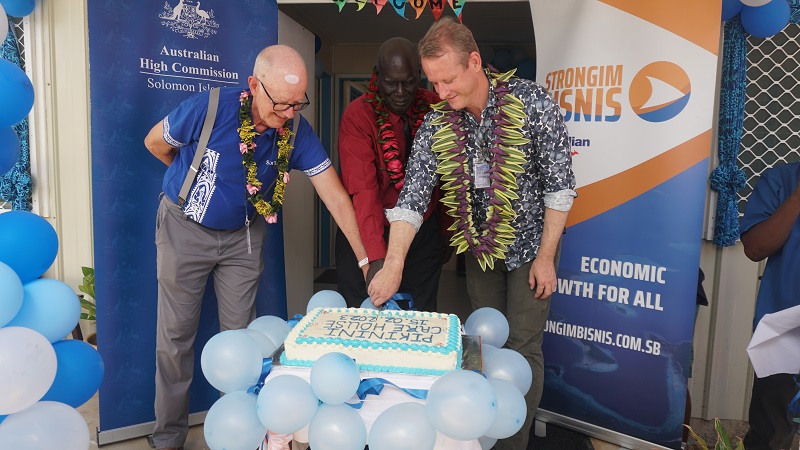
Premier Veo left and H.E Hilton right pose for a group photo with children and staffs of Soltuna Pikinini Kea Haus.

BY BEN BILUA

A first ever Child Day Care Centre has officially opened in the country, congratulations to Soltuna and Strongim Bisnis Programme for the huge achievement.

Australian High Commissioner to Solomon Islands, His Excellency Rod Hilton, Premier of Western Province, Billy Veo, Western Provincial Executive, other stakeholders and officials from Soltuna witnessed the opening of the SOLTUNA Pikinini Kea Haus yesterday.

GM of Soltuna Mr Jim, Premier Veo and H.E Hilton cut the cake to mark the great achievement.

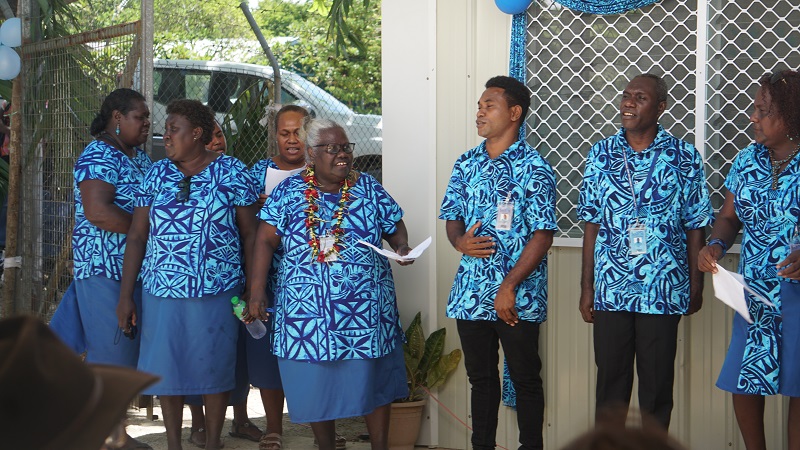
In her speech, Soltuna’s Human Resource Manager, Bella Simiha said the facility was made possible through support from the Australian Government under the Strongim Bisnis Programme.

She said the main idea prompting the establishment of the facility was to address absenteeism.

“As a company we see lots of women faced challenges when comes to family commitments, especially when their children are sick.

“We also realised that women who come out from maternity find it difficult to choose between their job and newborn baby.

“After much discussions, Soltuna Management see the need to establish this facility to support our women,” Simiha said.

Children sleeping while Day Care officers on duty looks on.

She said the journey to complete the facility was very difficult but she is happy that the facility is up and running.

Simiha said the facility will be managed by 10 staff who have been trained to execute the needed job.

She acknowledges those who contributed one way or the other towards the completion of the project.

“I want to thank the Australian Government for the funding, constructors who renovate the building and also Soltuna Management for the support towards this project,” Simiha said.

Strongim Bisnis Business Advisor, Zefi Keritina said Strongim Binis is a programme funded by the Government of Australian dedicated to promote sustainable and inclusive economic growth in Solomon Islands.

She said the facility is a result of a partnership sealed between Soltuna and Strongim Binis in May 2021.

Keritina said the project aimed at establishing a day care center for the employees of Soltuna to improve attendance, working condition, and access to free high quality child care.

“Long-term goal is to boost productivity and profitability for business operating on a large scale and at the same time reduces the burden of child care on working mothers and to improve women economic empowerment in workplace,” she said.

Officers who worked at the Soltuna Pikinini Kea Haus.

Keritina said Strongim Binis is proud to provide support and resources to the child care facility which includes hiring a mentor to build Soltuna’s capacity to run the center.

Capacity building program includes health care and early childhood education and supporting the production of child care resources.

She said the project will support the lives of over 300 hundred women working at Soltuna

“We are thrilled to be part of this innovative project that will not only benefit the employees of Soltuna but also serves as a model for other business to follow,” Keritina said.

General Manager of Soltuna, Jim Alexander said the facility is a product of ideas and strong ambition which started six years ago.

He acknowledges the committee and those who drive the project to its completion.

Alexander said absenteeism has raised to 10 percent and it has affected the production of the company.

He said the dream is to reduce absenteeism to the lowest number as possible.

“From business point of view, the child care center is a very important investment as more people will work and production will improve,” Alexander said.

MHMS bid waiver process for NRH isolation ward not effectively managed: OAG Report

0
Isolation ward at NRH during the height of the covid-19 pandemic.

BY MAVIS N PODOKOLO

THE bid waiver process (procurement in a state of emergency) of the isolation ward at the National Referral Hospital was not effectively managed by the Ministry of Health and Medical Services.

That is according to the audit report on procurement relating to COVID-19 Disaster relief fund by the Ministry of Health and Medical Services (MHMS) released yesterday by the Office of the Auditor General.

The report says there are cases that the health ministry was unable to provide required documentation. For instance, 16 contracts were issued for the refurbishment of the isolation ward at the National Referral Hospital in March 2020.The certificates of completion of this work was issued on April 10, 2020.The purchase requisition or these procurements was signed in June 16, 2020 as bid waiver.

“If required authorizations and approvals are not obtained before work has been done or goods have been accepted, the government has no choice but to pay the vendor, so applying the internal controls at that point does not have any meaning,” the report said.

It adds, Ministry of health stated that most of the documentation was completed at a later date due to activities were requested to be completed in a given time frame to and during the auditing process the OAG picked out that internal controls do not just apply when is convenient.

“The appropriate response to the urgent situation was to put more effort and, if necessary, resources into completing controls activities in the correct order, not to discard them until after the procurement was complete,” the report stated.

The report also spelt out that in the case of the isolation ward refurbishment, the bid Waiver for 15 procurements totaling SBD2.4 million was approved by the Permanent Secretary of the Ministry of Health and Medical Services Pauline McNeil even though this authority rests with the Central Tender Board, under the the Ministry of Finance & Treasury (MoFT) and chaired by McKinnie Dentana who is also the Permanent Secretary of MoFT.

“The failure to implement controls prior to undertaking procurement is a significant breakdown of internal control and the Ministry should take steps to ensure that it does not happen again,” the report stated.

Ministry of Health and Medical services comments inside the report stated that the ministry has highlighted that the context of this occurrence, the pandemic, their roles, resources allocations or mobilisation legislative guidelines in protecting the country is limited, challenging and with many gaps.

“Since this is the first in the Solomon Islands history, the ministry acknowledges their resort to moblising resources through available or existing procurement guidelines as per the Procurement & Contract Administration Manual 2013 (PCAM) for Bid Waiver request,” Ministry of health stated.

Bid waiver not managed in covid-19 fund spending by MHMS, NDMO & MID: OAG Report

Released audited reports from the Office of the Auditor General ( OAG).

By EDDIE OSIFELO

THREE frontline ministries during Covid 19 pandemic have not managed their bid waiver process in the procurement process effectively.

This was found in a thematic audit released by Office of the Auditor General yesterday.

OAG audited the accounts of Ministry of Health and Medical Services, Ministry of Infrastructures Development and National Disaster Management Office (NDMO) through the Ministry of Environment, Climate Change, Disaster Management and Meteorology from April 2020 to December 2020.

The objectives of these audits were to assess whether these agencies managed COVID-19 Procurement in accordance with relevant laws, policies and regulations of Solomon Islands Government. These include the Public Financial Management Act 2013, the Interim Financial Instructions currently in force and the Solomon Islands Government Procurement and Contract Manual [PCAM].

According to SIG Procurement, in a normal cycle of procurement, up to $10,000, you have to provide one written quote.

From $10,000 to $100,000, you have to provide 3 written quotes with selection using a comparative bid analysis.

From $100,000 to $500,000, the bid will go through the Ministerial Tender Board competitive tender.

More than $500,000, to go through Central Tender Board (CTB) competitive tender.

However, procurement during State of Emergency, there will be a bid waiver.

Where competitive and simple tendering is not possible a bid waiver request can be used.

A reasonable reason needs to be justified.

CTB approve procurement with value of $100,000 and over and Accountant General is delegated authority for $10,000 to $100,000.

Auditor General David Teika Dennis said in February 2016 the Central Tender Board issued a Memo (CTB Memo) reminding Ministries all bid waivers of any value had to be approved by the Central Tender Board.

Dennis said this Memo explicitly overrode existing contradictory instructions or memoranda.

He said this meant that when the State of Public Emergency was declared the existing rules provided that bid waivers would be allowed under the SoPE and all bid waiver requests were required to be submitted to the Central Tender Board for approval.

“The results in all three audits showed that on many occasions non- competitive procurement had occurred before a bid waiver approval was received and, in some cases, there was no indication that a bid waiver approval was ever received.

“In several instances, procurement was completed before a bid waiver was even applied for, as if the approval of the bid waiver by the CBT was just a rubber stamp,” he said.

In other cases, Bid Waivers were approved by the Ministerial Tender Board or the Permanent Secretary of the Ministry in contravention of the CBT Memo.

“For example, significant refurbishment work was done at the King George VI School, as this was designated a quarantine centre on 27 March 2020. By 8 April 2020 all of the required work had been certified as complete.

“OAG examined 12 individual procurement activities for this refurbishment. The purchase requisitions for all of this work were signed in early May2020 and Bid Waivers were issued by the CTB for all 12 procurements on 5 May 2020, nearly a month after the work had been completed,” he said.

Dennis said all 12 contracts were signed on 11 May 2020, also more than a month after the work was completed.

Furthermore, one business provided various accessories for a quarantine site, and issued an invoice for these on 16 September 2020.

“A Purchase Requisition had been approved on the same day and a Payment Voucher was approved on 22 September.

“At this stage the goods had been provided and certified as such,” he said.

Dennis said a Bid Waiver was then approved on 29 October, well after the substance of the transaction was complete and six weeks after the items purchased were available for use.

Apart from that, Dennis said one contract for refurbishment of the Kiwi hostel at the NRH was for $625,123.

He said this contract involved significant construction and concreting work.

“A bid waiver request was submitted on 7 April 2020 at which time the work must have been substantially complete as it was certified as such just two days later.

“The contract to undertake this work was signed on 24 September 2020. The Bid Waiver was approved by the CTB on 17 September 2020,” he said.

Dennis said the approval to incur this expenditure on the Purchase Requisition was signed on 19 October 2020, 7 months after the expenditure had actually been incurred.

He said justification for the bid waiver was often that the provider was able to supply the goods or services and was willing to do so on credit.

“There was never any indication if the purchasing officer had found out if any other suppliers were willing and able to do the same.

“Officers responsible for procurement appeared to assume that the approval of a bid waiver was guaranteed, but even in this situation the officer is still responsible for at least a cursory check that the Government is getting good value of money,” he said.

“Phone calls to a few suppliers with brief notes on their responses would have provided accountability for these decisions but there was no evidence that this was even considered.

“The new Public Financial Management (Procurement) Regulations (2021) (PFMR 2021) state that a Bid Waiver applies in an SoPE if as a result of the SoPE, procurement by competitive tendering or simple procurement procedures is not possible. ‘Not possible’ is an absolute term and normal competitive or simple procurement would have been possible with all of the transactions reviewed in these audits,” he added.

$400 FOR 1 PILLOW

0
The National Referral Hospital (NRH) in Honiara

Audit report shows how covid-19 funds were spent by MHMS, NDMO & MID in 2020

By MAVIS N PODOKOLO & EDDIE OSIFELO

Millions of dollars of public funds were squandered and misused in 2020, a report from the Office of the Auditor General (OAG) published yesterday has suggested.

OAG investigated how three ministries procured goods and services using covid-19 funds from April to December, 2020.

They are the Ministry of Health and Medical Services (MHMS), The Ministry of Infrastructure Development (MID) and National Disaster Management Office (NDMO) under the ministry of environment, climate change, disaster management & meteorology (MECDM).

The OAG in publishing the thematic audit report yesterday also called on the national government to strengthen its procurement processes.

$90 million was spent by MHMS, NDMO and MID in 2020. They used the disaster relief fund to spend on goods, services and works to support the response to the pandemic.

MHMS spent $26 million, MID – $14.9 million and NDMO – $49.5 million.

However, the report found that most of these spendings were made though “truncated procurement process”.

When the state of public emergency was declared on March 25, 2020, government’s normal procurement procedure was replaced by the use of Bid Waiver system – an alternative procurement system which was used in exceptional circumstances in which ‘observing the normal requirements would result in detriment to the people or assets of the Solomon Islands’.

The bill waiver system was abused. For example, some works were completed and paid for before the bill waiver was approved and contracts signed in ‘cart-before-horse’ style.

Since the tender process was absent, conflicts of interest were not declared. There was high risk of nepotism, wantok business and offering contracts to family members, relatives, friends or associates.

Bloated prices of goods and services popped up which ate away the covid-19 funds.

For example, $400 for one pillow and $130 for one blanket, provided to the national referral hospital (NRH), seen in an invoice of $99,500 dated May 25, 2020.

Documents were missing, which would have provided information to prove that public funds were well spent.

In many cases, documents show that amounts have been manipulated by hand. For example, a payment voucher made out for a $11,089 payment was manually changed to $110,089.

Some businesses which were not registered under the Company Haus were awarded contracts.

Imprest account system was abused. Close to $12 million was used up by way of imprest payment.

An imprest raised by the MHMS is the largest recorded at $225,900. This contradicts the rule of the imprest system, which is meant for ‘small, frequent payments that it is not practical or convenient to pay through Treasury’.

Transparency, accountability and inclusiveness was lacking.

The objectives of these audits were to assess whether these agencies managed covid-19 procurement in accordance with relevant laws, policies and regulations of Solomon Islands Government. These include the Public Financial Management Act 2013, the Interim Financial Instructions currently in force and the Solomon Islands Government Procurement and Contract Manual [PCAM].

In the thematic report Auditor General David Dennis said it is a consolidation of all three audits undertaken which are individually tabled to Parliament.

“Our assessment recognised some common themes across the three ministries which provided an opportunity for all ministries including Ministry of Finance and Treasury (MoFT), to address these findings together in a consistent and sustainable manner and improve the level of internal control in Government procurements.

“Whilst the individual audit reports provide recommendations directed at the auditee, this thematic report focuses on suggested inputs from MoFT,” he said in the report.

However, Dennis said it is important to acknowledge the extraordinary circumstances created by covid-19 which heightened the inherent risk for expediting procurements and delivery of services at the expense of following established procedures.

“It is my view however that the existence of an urgent requirement should mean that controls are applied with urgency, and not discarded.

“The common themes include the lack of transparency and required documentation, including the inability to provide my office with full documentation to review transactions, indicating a major failure of accountability and this is an area that all Ministries need to address,” he said.

Dennis said there are also areas in which noncompliance, potential fraud and lack of accountability could together impact the efficient emergency procurements to deliver required and effective services expected during a crisis situation.

He hoped that the recommendations in the thematic report would assist the Government, in particular the Ministry of Finance and Treasury (MOFT), as well as the three ministries involved to strengthen their procurement processes both in emergency and normal operations.

All three ministries and MoFT have been provided with copies of the audits and offered the opportunity for further briefings and discussions with the OAG. 

“I intend to follow up on the findings and commitments made in response to our recommendations, through future audits of each of these Ministries.”

The OAG is one of the key accountability institutions established under the Solomon Islands Constitution which requires the Auditor General to audit and report on the public accounts of Solomon Islands, including all Ministries, offices, special funds, courts and authorities of the Government, and of the government of Honiara City and of all provincial governments.

Nurses found to be selling drugs: Gov’t

0
Chairperson for NHA and Secretary to the Prime Minister, Dr Jimmie Rodgers.

BY MAVIS N PODOKOLO

Government has accused nurses of illegally selling medical drugs.

Secretary to the prime minister, Dr Jimmie Rodgers uttered this allegation during a press conference last week.

He also suggests that this alleged practice is caused by nurses’ low salaries.

“There are observations nurses selling drugs. They should not be selling drugs, that is illegal.

“If nurse were found selling drugs, it means drugs are coming from the National Medical Store and Government suppliers,” he said.

“The other reason is because maybe their earning is very low hence, they want to supplement it; but it is still wrong.

“They should not be selling because you might never know that you are selling good drugs but if you don’t know enough about it you could kill someone,” he said.

Rodgers said “for Solomon Islands, even the shops are selling drugs, but they are not supposed to sell drugs because the Pharmaceutical Benefits Act is very clear.

“Only pharmacies can sell and there are no other laws in this country, but then again because there is no much way of implementing these laws thus, people can buy medicine anywhere in town.

On the same note adds, a minor corrupt activity at the National Medical Store has been identified and has raised public concern. This is regarding NSD selling drugs to pharmacist.

“That said, the Ministry of Health is looking at ensuring whatever is bought for the public its management must be such that is accountable.

“There is no problem that NSD suppling for pharmacists because that provided for but it must be through a proper procurement process and must send money through Finances and through hidden accounts somewhere,” Rodgers said.

MEHRD starts notifying successful applicants for SIG scholarship awards

0

BY NED GAGAHE

APPLICANTS or students who have applied for the Solomon Islands Government (SIG) scholarship for 2023 are being urged to log in their accounts on the Solomon Islands Tertiary Education and Skills Authority (SITESA) online portal.

In a latest statement yesterday posted on their Facebook page Ministry of Education and Human Resource Development (MEHRD) advised candidates that they have now commenced notifying successful recipients on the online portal.

“Applicants or student who have applied are advised to log into their accounts on the SITESA online-portal.

“Successful recipients for the SIG Scholarship 2023 are currently been notified through the SITESA online portal.

“This notification is inclusive of the Awardees’ Conditional Offer and other notifications required for the facilitation to the next steps.

“Only successful applicants are being notified.” MEHRD said.

The prolong delay to release award have caused frustration to applicants who said that the most regional institutions have already kicked off lectures on 13th February.

The applicants said such delay will cause problem to them in terms of registration and aligning their offers with that of universities.

Meanwhile, the applicants have repeatedly called on SITESA to update them on the scholarship progress.

They said the SITESA website is one of the platforms which SITESA can use to communicate crucial updates about the status and progress of the scholarship awards.

However, the website was not updated since December 2022.

Policy statement next: Premier Fini

0
Premier of Malaita province, Hon Martin Gaote’e Fini.

BY SAMIE WAIKORI

PREMIER of Malaita province Martin Fini says his government will immediately work on their policy statement after all have been sworn-in.

The premier told SunAuki yesterday they look forward to begin soon.

He said things will be unfolding and one of the very important aspects of any newly formed government is the swearing-in, for ministers to take their portfolios.

“Next after this is, we will sit-down together and begin to work on our policy statement.

“Once we finalise it, we will than declare to the public to aware of and work together on implementing it,” Fini said.

Fini does not rule out the possibility of adopting some of MARA’s [former Malaita provincial government] policies.

He adds, they will be look only at priority policies to take onboard into their new policy.

Fini said considering the short period of time they will lead the province; their focus will be on priority areas of development for the province. He said that above all, it’s about working together with donors, stakeholders and people of the province to move the province forward and realise its potentials.