THE appointment of a new Interim Director for the Solomon Islands National Institute of Sports (SINIS) High Performance (HP) Center by the National Sports Council (NSC) has thrust the organization into the spotlight, but not for reasons it might have hoped.
Amidst a backdrop of controversy surrounding Pacific Games 2023 facilities ownership and management, NSC’s leadership style is under intense scrutiny, with allegations of opacity and political maneuvering.
As the saga unfolds, the media finds itself caught in a whirlwind of challenges.
Attempts to provide clear, ethical reporting are stymied by NSC’s reluctance to engage, preferring clandestine “off the record” discussions.
This cloak of secrecy not only obstructs the media’s quest for truth but also erodes public trust in the transparency of NSC’s operations.
At the heart of the matter lies the contentious issue of PG23 facilities ownership. NSC’s decision to proceed with the appointment of an Interim Executive Director for SINIS, despite objections from the Government citing its illegality, underscores the power struggle between NSC and the National Hosting Authority (NHA).
The move to ban sports federations from the HP Center, ostensibly to safeguard NSC’s interests, only adds fuel to the fire.
Efforts by SunSPORTS to obtain NSC’s perspective on the closure of SINIS were met with silence until a delayed response from NSC CEO Alison Burchel, whose comments, when finally provided, were shrouded in ambiguity and confidentiality.
Burchel’s insistence on off-the-record discussions frustrates journalistic integrity and leaves vital questions unanswered.
The saga takes a dramatic turn with the government’s intervention through the Office of the Prime Minister (OPM), halting the appointment pending proper procedures between NHA and NSC.
However, NSC Chairperson Joe Sika’s conspicuous silence speaks volumes, leaving SunSPORTS to navigate the murky waters alone.
It is only through the Government Communication Unit (GCU) that confirmation of NSC’s breach of the Pacific Games Act emerges, leading to the removal of SINIS’s Interim Executive Director.
Burchel’s past leadership controversies in Fiji cast a long shadow over NSC’s current predicament, raising questions about her management style and accountability.
Georgina Kekea, President of the Media Association Solomon Islands (MASI), laments the absence of a ‘Right to Information Law’ (RTI), which could bolster transparency and hold public officials accountable.
As the NSC saga unfolds, it serves as a stark reminder of the perils of unchecked power and the imperative of transparency in sports governance.
The media’s role in holding organizations like NSC accountable remains crucial, but without legal frameworks to support their efforts, the battle for transparency will continue to be an uphill struggle.
The High Court of Solomon Islands. Photo supplied.
BY MAVIS N PODOKOLO
THE High Court so far has received a total of seven petition cases filed as of yesterday 3.30pm.
High Court Deputy Registrar Jack Taloifuila confirmed this to Island Sun yesterday.
Mr Taloifuila said all petitioners have done their filing and paid their security and petition fees in full.
“These filed petition cases are ready for listing,” he said.
Taloifuila confirmed petitions were filed by
Petitions confirmed by Taloifuila include:
1. Samuel Manetoali against MP Trevor Hedly Manemahaga, Gao-Bugotu constituency
2. Jeremy Manengelea against MP Peter Shanel, Central Guadalcanal constituency
3. Dickson Mua and Peter Osike against MP Oliver Salopuka, Savo-Russells constituency
4. Samson Maneke against MP Dr Paul Bosawai Popora, North Guadalcanal constituency
5. Peter Soqoilo against MP Jimson Tanangada, Gizo-Kolombangara constituency
6. Augustin Auga Maeue and Harry Philip against MP Ben Maenu’u, Lau-Baelelea constituency
7. Anthony Veke against MP Moses Garu, West Guadalcanal constituency
“With that I confirmed that as of yesterday 3:30pm we have received a total number of seven petition cases filed. We are expecting some more to be filed,” Taloifuila said.
Taloifuila adds the due date of election petition is this Friday, May 30, 2024.
Speaking to one of the petitioners, Samson Maneka, he said his petition is filed based on 16 grounds of allegations; one for threatening and 15 for bribery.
L & L Lawyers representing Mr Auga and Mr Philip confirmed a total of eight grounds of allegations – mainly centred on bribery and fraud.
Mr Veke, former member of parliament for West Guadalcanal, confirmed his petition case stands on 17 grounds of allegations.
I am writing to discuss a concerning issue that has persisted for decades.
In an age where information is power, we must uphold the fundamental right of every individual to access government information freely.
Transparency is the cornerstone of democracy; however, barriers too often prevent citizens from exercising their right to know.
We must advocate for greater transparency and accountability within our governments, ensuring that citizens have unrestrained access to information that affects their lives.
By empowering individuals with knowledge, we enable them to make informed decisions and actively participate in civic life.
Moreover, the right to access government information is not just a legal imperative, it is a fundamental aspect of freedom of speech.
When information is withheld or hidden, it stifles public discourse and undermines democracy.
We must educate and raise awareness about our rights, empowering individuals to demand transparency from their governments.
Let us work together to break down the barriers to information access and empower every citizen to exercise their right to freedom of speech.
In doing so, we strengthen our democracy and ensure a more just and equitable society for all.
The settlement's riverside. Photo credit - Morris Nafu.
BY IRWIN ANGIKI
It’s a cool evening with sounds of small waves gently lapping nearby and laughter of children playing in the distance, a recipe for a relaxing moment. But, Kevianga isn’t.
Squinting eyes lost out in the sea, 40-year-old Lemuel Kevianga’s mind is a warzone – torn between worries over the burdens of his people and their struggles against a backdrop of increasing economic challenges, an upward curve in population growth, endless sickness and disease woes, low levels of education, ebbing traditional and cultural values, and the cruel effects and impacts of climate change.
Kevianga is losing sleep over his beloved Lord Howe settlement.
One of Honiara’s oldest & most dense settlements
Nestled in the heart of Honiara, Solomon Islands’ capital, the Lord Howe settlement is home to nearly a thousand inhabitants from the country’s most northern outlier near the border with PNG known as the Ontong Java atolls. Ontong Javans are Polynesians.
At around two hectares and nearly as old as Honiara city itself, the Lord Howe settlement is one of the most dense of Honiara’s 92 informal settlements identified in a 2019 study led by the World Bank Group.
Community built seawall to prevent further erosion and seawater encroachment. Photo credit – Irwin Angiki.
A major study by the Honiara City Council (HCC) and the national government in 2016, supported by the UN Habitat and RMIT University, found the settlement’s population density to be 218 residents per hectare. Honiara’s average population density then was 26.8.
The figures are believed to be higher nowadays, given population growth against the same land area.
Lord Howe settlement is enclosed on all four sides. To the north is the sea, to the west is the Mataniko river, to the east is the city’s only major hospital, the National Referral Hospital (NRH), and the city’s main highway runs along the settlement’s southern boundary.
The settlement reportedly began in the early 1960s. It is said the pioneers favoured the location because of its proximity to the sea, allowing them to live some resemblance to their way of life in the islands where they are connected to the sea.
Changing landscape
Kevianga who has been living here nearly all his life said there have been huge changes since his earliest recollection of memory of the settlement.
Being highly prone to coastal flooding, riverine flooding and flooding from the drainage and stream that runs into the settlement, along the years the land has eroded, reducing its elevation level.
The HCC and Government 2016 report said most parts of the settlement, towards the sea, were below the 0.5m high water mark.
Lemuel Kevianga a concerned settlement resident and young leader. Photo credit – Irwin Angiki
Sea wave action during bad weather and cyclones have also eaten away the seafront, bringing the shoreline closer to the first line of houses.
Kevianga’s family home stands on their plot of land which is at the furthest corner of the settlement, right where the sea meets the river at the river mouth.
They have built a concrete wall along the riverbank all the way to the sea front; the freshwater is just five metres away from the stairs to Kevianga’s home, with the sea’s spilling waves gently laving against the seawall only 10 metres away.
However, it wasn’t always like this.
“In the 1970s and beyond it was said one had to walk about 20m from our house towards the river before setting foot in the water. And, to get to the sea, we walked nearly 100m from our house.
“In the 1980s I remember there were few houses after ours, a few metres towards the middle of the river. Over the years the level of the river rose and with flooding, the owners relocated further into the settlement.”
Where Kevianga pointed is near the middle of the river, nearly two metres deep and a busy highway for outboard motor engines.
“The seafront of 1980s is a far cry from what it is today. Sometimes when the delta landscape changes, the sandy beach can be so wide and long that you could fit two soccer pitches along the beachfront, and it stretched from the river mouth all the way eastwards past the hospital seafront.”
School teacher Mrs Rosa Sapivaka, 54, said the devastating flood in 2014 brought major, permanent changes to the landscape of the settlement, washing away huge strips of land beside the river, and more in the seafront.
“Some houses along the sea front have been removed and families relocated further into the settlement as the shoreline was permanently moved further inland.
Kingae – a lost tradition
The beach was the playing ground for the community, where men, women, youths and children gathered in the late afternoons to play soccer, volleyball, rugby, touch rugby or athletics.
One of the water stand pipes the community uses to access clean water. Photo credit – Irwin Angiki.
There was a traditional customary sport called the kingae, which used to be held on this huge stretch of sandy beach; a custom which celebrated the first-born son of each family and involved racing either by canoe along the river and sea, or by running along the beach, similar to a 100 or 200 metre track event.
The last kingae was held in the early 2000s, says Aaron Sangai, 50, who had lived there in the 1980s but had recently moved to Honiara’s inland suburbs.
This was markedly the last time the diminishing beach could afford to cater for the large crowd which this event attracted. The following years, the beach never recovered and this customary practice was halted. Kingae is now only recounted from memory.
Water and sanitation
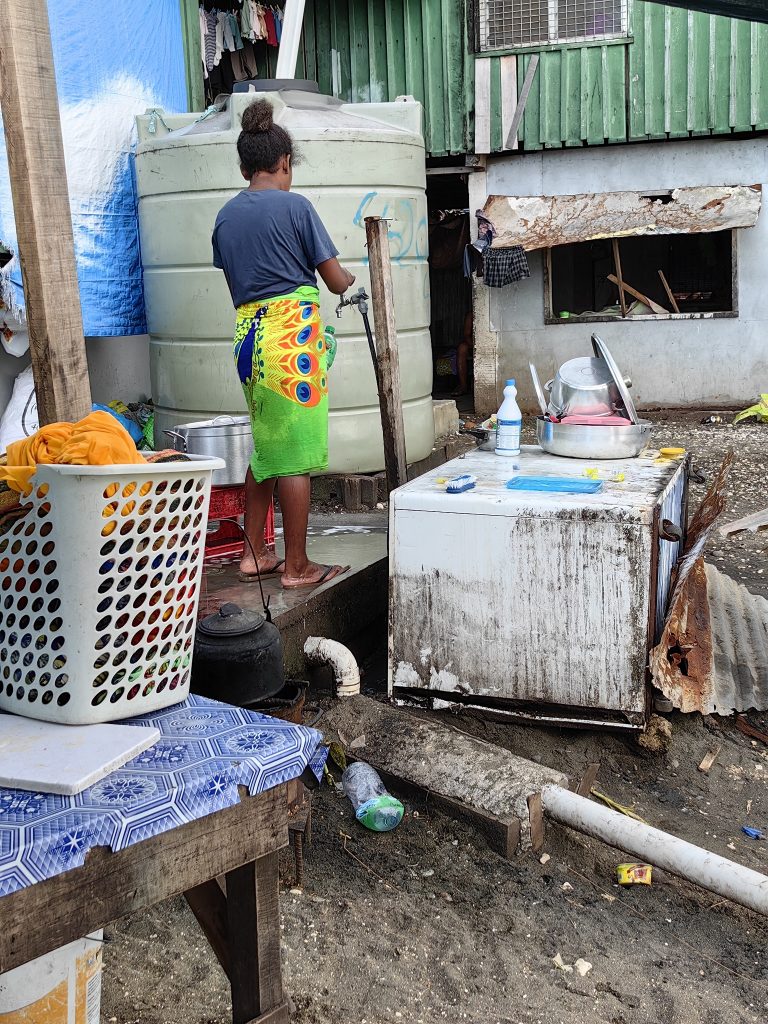
Water tanks to trap rain water was the main source of clean drinking water and has been around since the settlement’s beginning, however, as population growth became significant, water had to be sourced from the country’s water authority.
Following a 2019 study by the World Bank Group for the local water authority, Solomon Water, nearly two dozen stand-pipes are stationed across the settlement, providing clean water to supplement the tanks.
As part of their culture, the settlers use the sea for bathing and defaecation. Hence, most of the houses do not have proper toilets and septic waste management systems, except for the few houses near the highway.
Self-employed Topa Hatigeva, 43, says the further away one builds from the sea the more inconvenient it became to depend on the sea, so they built their own systems.
However, due to the shallow water table it is very challenging to build proper toilets and their waste management tanks.
When it rains, the septic tanks overflow, spilling effluent into the water ways which meander through the settlement.
More frequent rains due to climate change is making matters worse, says Mr Hatigeva, who now resides in one of Honiara’s inland suburbs, but regularly visits and spends time with family members at the settlement.
A creek flows into the settlement from across the highway which also adds to the flooding during rains, bringing pollution by way of organic rubbish, plastic objects and wastes from communities upcreek.
Disease, pollution and hygiene
Pollution hits the settlement on all fronts.
A Rapid Coastal Assessment study headed by the South Pacific Commission (SPC) in 2020 found the Mataniko river to contain unsafe levels of pollutants such as sewage and other contaminants, which come from the communities upstream including the light industry at Chinatown.
The adjacent hospital to the east releases waste into the sea which affects the settlement, along with the sea breeze which blows in bad odour.
The highway offers dust and vehicle fumes.
Hatigeva says sicknesses such as diarrhoea, malaria, influenza and the common cold are regular.
Outboard motor highway at rivermouth just metres from nearest house. Photo credit – Irwin Angiki.
“Flooding in every rain, whether huge or small, the sewage and rubbish from the creek running into the settlement is spread throughout the settlement, causes sicknesses, diseases and a lot of inconvenience, and these diseases and parasites spread due to the crowded nature of the settlement, such as coughing, tuberculosis, flu and diarrhoea.
“This disturbs children in their schooling and their growth, and adults in their employment and whatever work they are engaged in. And, now that medicines you have to purchase from the pharmacies, it is an added cost for us.”
Social changes
Mrs Sapivaka believes the deteriorating values in traditional beatitudes and values can also be blamed on climate change and its impacts.
“There is a significant rise in social issues such as domestic violence, the age-group indulging in cigarette and alcohol getting younger, teenage pregnancy and marriage. This is because climate-change related impacts and effects take up most of the parents’ time that they have less and less time to monitor their children.”
Mr Sangai says, “An example are the few incidents over the years in which a man assaults his spouse because of something related to the rainy weather or the very hot temperature, spoiling something in their house, etc.”
Hatigeva says, “When it rains, even moderately, the settlement will flood, which directly means there’s no school that day for the little children, even the older students. This is how more and more students are behind in their studies, and begin to lose interest in their schooling.”
Resilience and community solutions
The Ontong Javans are a hardy people. With very minimal or no government support, the community are fighting back.
Seawall:
A business man from the Lord Howe settlement has given back to his community by building a landfill in front of the settlement to act as buffer against the sea and wave action.
The 2014 flood removed the sandy shore line and brought waves straight to the doorsteps of the nearest houses. Whenever there was rough seas, the waves would wash into the settlement.
“Businessman Tarzan brought it on himself to help the community, and began building the landfill more than a year later,” Kevianga said.
Over the years, several cyclones and cyclonic weather have damaged the landfill, but the businessman returns and refills it, and continues to do so today, expanding and compacting the ground and now lining the shoreline with wave breakers.
River wall:
Community river wall to prevent further erosion. Photo credit – Irwin Angiki.
Home owners of houses near the river have pooled their resources, building a concrete wall along the bank preventing river water eroding what’s left. However, the wall is helpless in the event of flooding.
Rebuilding higher:
Home owners are raising up their houses, not only to accommodate more people and provide more leisure space and cooler spots, but to escape the sinking effect of constant flooding and a sandy base.
“Now the houses in the settlement are getting higher than before, this is because houses over the years have dropped, and in order to combat this, we are building higher. Some are applying concrete slabs under their homes to hold their building in place, and slow down the sinking effect,” Hatigeva says.
Proactive politicians with heart
The Ontong Javans just came through the polls this year, voting in a new charismatic young leader to be their member of parliament who has been involved in community initiatives to help the settlement and people back on the Ontong Java atolls.
MP Polycarp Paea, 47, in an interview said relocation, which is a much-contested topic, is possible and can be done within his four-year term in parliament.
“I have seen firsthand and can say that indeed climate change has affected my constituency so much.
“The main reason I came into politics is to help my people of Ontong Java and Sikaiana, with climate change being in the forefront of issues surrounding these two groups of people since we all come from low lying atolls on the fringes of our country’s border, far away from the big islands.
“I will continue with the ongoing work with non-government organisations to help my constituency against the impacts of climate change. I have already set up a committee which is working on it.
“I will find land to relocate my people, land either here near the capital on Guadalcanal, or in Isabel province or on Malaita province.”
Landfill in progress. Photo credit – Jeremy Gwao.
Meanwhile, Kevianga following our first interview, has successfully been voted as the provincial member of assembly (MPA) for Sikaiana, the other atoll group which makes up the Malaita Outer Island constituency.
Kevianga hails from both Ontong Java and Sikaiana. He is also the Malaita province’s new Finance Minister.
He assures that he will push in his political capacity to help the settlement where he is needed.
There is light at the end of the tunnel for the Lord Howe settlement with a promising set of leadership at the political level working in synergy with community and traditional leaders to find ways forward for this vibrant community.
*Reporting for this story was supported by Internews’ Earth Journalism Network
Court has granted bail for a pastor and two co-suspects who are accused of terrorising a village in Savo island in February this year.
Deputy Chief Magistrate Ricky Iomea granted bail for Pastor Bana, Rolland Fiu and Charles Bane on Tuesday this week at the Magistrate Court.
However, court refused the principal bail in which defence counsel Rochella Palmer sought the court’s discretion over.
Instead, court imposed that the surety for the three accused pays a cash bail of $500 before they were allowed bail.
Court further imposed bail conditions on Bana, Fiu and Bane to reside at Henderson, to report to Henderson Police station every Monday from 8am to 5pm, not to leave Guadalcanal Province without the leave of the court, the surety to pay a cash bail of $500, always attend to court whenever their case listed, not to interfered with the crown witnesses and not to commit any more crime but remain as a law-abiding citizen.
Court suspended the matter for today Friday, for Pre-Trial-Conference (PTC) and for Junior Rollin to take his plea on the charge of possessing a firearm during the incident.
The nine accused namely, Pastor Bernard Bana,34, Charles Bane,72, David Bane,35, Junior Rollin,27, Thomas Fenli,37, Albert Ramo,21, Rolland Fiu,41, Patterson Iugasia, 38, and Jacob Gore,47, are jointly charged with Criminal Trespass and Malicious Damage.
All the accused pleaded not guilty.
Iete Tebakota of Police Prosecution Department act for the Crown and Rochelle Palmer of PSO represent Pastor Bernad Bana, Rolland Fiu, Albert Ramo, Charles Bane and Junior Rollin and Bobby Harunari of PSO represent Thomas Fenli, Patterson Lugasia, Jacob Gore and David Bane.
A 24-year-old man has been sentenced to eight years imprisonment for having sexual intercourse with a girl under the age of 15.
The man, who was a teacher, pleaded guilty to three counts of sexual intercourse.
Judge John Keniapisia gave this judgement on May 1.
Keniapisia said this sentence must be a custodial one to teach the accused (teacher) a lesson that teachers hold a parental role over their students, and that role is a higher calling to take good care of every aspect of the student’s welfare, not just academic, but also her future welfare and interest.
Keniapisia said education is the key to the future well-being of any young child and this is the fundamental responsibility of every school teacher.
In this case the victim was under 15 years old and a form 2 student in one of the schools around Auki at the time the crimes took place. The perpetrator was one of the victim’s teachers.
The accused had sexual intercourse with the victim on three separate occasions. The first incident was on an unknown date in June 2019 at night in Auki.
The facts said the accused and the victim made an agreement to meet under the mango tree and the accused went there and both had a sexual intercourse. At that time the victim was 14 years old and eight months.
The second offending occurred on the night of September 24, 2019.
The victim knew there was a unit test the next day so she called the accused and informed him that she will come to his house with her notes for explanations.
The victim went to the accused’s home and after they went through the notes they had sexual intercourse. The victim was 14 years and 11 months old when the second offending occurred.
The third offending occurred on October 22, 2020 at Auki. Both the accused and victim planned to meet that night. The victim informed the accused to come to her house. The accused had to wait until the victim called and inform him that her parents and brothers had already slept.
The accused went to the victim’s house and ask for them to have sexual intercourse outside of the house, but the victim led him into her room and they had sexual intercourse in the victim’s room. The victim was only 15 years and 11 months old at the time the third incident occurred.
Court imposed a starting point of eight years imprisonment.
Aggravating factors include the accused being in a position of trust to the victim as her teacher, the age disparity where the accused was 24 years and victim was 14 years old and 8 months, emotional and psychological harm, the repetitive offending and pre-planning.
For all of the above four aggravating factors, court inflate the starting point to15 years head sentence before mitigation factors.
Court took into account the mitigating factors which included the early guilty plea, first time offender with no previous conviction, compensation and delay. Court deducted seven years for the mitigating factors.
Accused faces the head sentence of eight years in prison.
Samuel Tovosia for Crown and Limeniala for the accused.
A 19-year-old male has been sentenced to seven years in prison for raping a five-year-old girl in a village in West Kwara’ae, Malaita Province.
The sentence was delivered on May 3 at the High Court by Judge John Keniapisia.
In delivering sentence Judge Keniapisia said the head sentence of seven years is to alert like-minded offenders to take notice that sexual contamination of small girls’ private part is not acceptable, thus, adults should take care of small girls who are the most innocent, vulnerable and weak in the village.
The convict, who cannot be named to protect the identity of the victim, was charged with one count of rape to which he pleaded guilty on April 26.
Court heard that on September 7 last year at Dala South village, the victim was playing with her cousins at a nearby playing field. Her mother was at the garden at that time.
The victim, after playing, wandered around and came across the lodge of the accused which was just beside the field.
The door of the lodge was open. The victim went and sat on a bench in the accused’s room.
The accused knew someone was inside. When he went inside, he saw the victim.
Court heard that the accused could see her private part as well because she was only wearing a skirt at that time.
He removed the victim’s skirt and raped her.
After raping her he made the victim to wear her skirt and gave her a shampoo and she went from the accused’s lodge.
At around 5pm that same day, the victim’s mother returned from the garden and learnt about the incident from her four-year-old son.
The victim’s mother asked the victim and she confirmed to her mother that the accused had removed her skirt and raped her.
The matter was later reported to the Auki Police who did an investigation and arrested the accused and charged him.
Samuel Tovosia acts for crown and Mr Limeniala for the accused.
The Honiara City Council’s law enforcement is under the spotlight for abuse of power, following its members’ arrest and assault of a man for ‘shouting’ at the officers.
The incident occurred on Tuesday when HCC law enforcers demolished street food vendors’ tables and confiscated their produces at the raintree shade beside the King Solomon hotel, and outside the Girl Guides area.
After detaining the food vendors near the Girl Guides, members of HCC law enforcers ran towards the Anthony Saru building ground floor, entered the SIEA Cashpower office, assaulted and dragged the security guard outside and bundled him into their landcruiser, witnesses told Island Sun.
Chris Inosia, the 38-year-old guard, intends to open police case against the Honiara City Council (HCC) Law Enforcement Officers who apprehended and assaulted him.
Inosia, an employee of Focus Security Services Limited was arrested by Law Enforcement Officers on Tuesday for what they say Inosia was yelling insults at them and interfering with their job.
Inosia, denied the he was shouting at the officers, instead he said the officers mistook his yelling which was directed towards two women food sellers who were running away from the raid.
He was swiftly apprehended and forcibly taken into custody by seven HCC officers who transported him in a Landcruiser to HCC headquarters.
Speaking to Island Sun yesterday, the father of six from East Kwara’ae confirmed that he will pursue the case with the police.
He is currently awaiting his medical report from Doctors at the National Referral Hospital.
Chris said once he received the report from doctors then he will proceed to open the case with the police.
He said he was held from 11 and later released around 3:30pm where he was punched repeated and traumatize.
He described the physical assault, recounting how he was punched repeatedly, even facing a challenge to fight from one officer.
Despite his attempts to explain the misunderstanding regarding his shouting at two women to show their permits, Chris alleges the officers did not listen and continued their assault.
“I shouted at the two women, urging them to present their permit to the officers to avoid confiscation of their belongings.
“However, the officers inside the HCC vehicle mistook my shouts as directed towards them. Moments later, I retreated to the office and sat down. To my shock, they barged in, punching me immediately.
“Despite my attempts to resist, they forcibly dragged me outside, with one officer even attempting to break my hand.
“Then, they thrust me into the Landcruiser, where the assault continued. Upon arrival at HCC headquarters, I was thrown out of the vehicle and taken into a small room.
“Without inquiry, they commenced a barrage of punches. Despite my efforts to explain, they ignored my pleas, intensifying the assault.
“At one point, I nearly lost consciousness, resorting to washing my head with water to regain my composure.”
“Despite his pleas for understanding and attempts to clarify the situation, he endured relentless beatings until he nearly lost consciousness.
“Chris revealed the officers warned him against reporting the incident, threatening him with charges if he dared to do so.
Allan Tom the General Manager of Focus Security Services Limited strongly condemn the incident.
“I was not aware of the incident until when Solomon Power called me to have one of their security officers to be sent over at the Plaza to relief Chris while he was taken by the HCC Law enforcement officers.
“Yes, at least the officers have the curtesy to call and inform us his employer for us to aware of what is the situation, so that we go down and settle the issue.
“The HCC Law enforcement officers had never made any attempt to inform us.
“The action they did is inhumane. They know the law and they should ask him what happened and to beat him like that, I for one I am totally disagree.
I mean they should have concern that he is a human being. They should question him on the right way. At least one of our representatives is there to witness what happened.
“For their action to beat him up I am totally disagreeing with that.” Tom said.
The Head of Law Enforcement for the Honiara City Council, Robert Madeo, said in an interview that their enforcement authority allows officers to arrest anyone who insults or disturbs them while they’re doing their job.
Regarding an incident this week where a security guard was arrested by Honiara City Council enforcement officers, Madeo said he wasn’t aware of it until later that day.
He assured the public that they can voice complaints and concerns about such incidents and promised to investigate the matter.
Madeo emphasised that while they understand people’s right to complain, they also have the authority to arrest those who insult or disrupt them during their duties.
Meanwhile, the HCC Bill Amendment Bill, 2023, says the following:
55N Function and powers of law enforcement officers
(1) The function of a law enforcement officer is to enforce this Act and Ordinances.
(2) In performing that function, if the law enforcement officer believes on reasonable grounds that a
person is committing or has committed an offence under this Act or an Ordinance, the law
enforcement officer may:
(a) require the person to state his or her full name and usual place of residence and to produce
evidence of the person’s identity; or
(b) enter and search premises or a vehicle which appear to be being used or to have been used for
committing the alleged prescribed offence; or
(c) ask the person questions relating to the alleged prescribed offence; or
(d) ask the person to give the law enforcement officer specified information or a specified thing relating
to the alleged prescribed offence, or to produce the information or thing at a specified place and time;
or
(e) search the person’s bags or other articles in the person’s possession; or arrest and detain the person
or arrest the person and take the person to the nearest police officer or police station; or
(f) arrest and detain the person or arrest the person and take the person to the nearest police officer or
police station; or
(g) ask another person, who the law enforcement officer reasonably believes has knowledge of matters
in respect of information about the alleged commission of the offence, questions about such matters; or
(h) seize and retain goods or movable property which the law enforcement officer believes on
reasonable grounds to have a connection with the alleged commission of the prescribed offence and
issue a receipt for the goods to the person in whose possession the goods appear to be; or
(i) as provided for by a court order, destroy or demolish property in connection with the commission of
a prescribed offence; or
(j) under Division 2, issue infringement notices and receive payments of fixed penalties; or
(k) take necessary steps and use reasonable force to take an action under paragraph (b), (e), (f), (g), (h)
and (i).
(3) If a law enforcement officer arrests a person under the age of 18 years, the officer must as soon as
practicable take the person to the nearest police officer or police station.
(4) A person is not obliged to provide information as required under this section if to do so might tend to
incriminate the person or make the person liable to a penalty.
(5) A police officer may assist a law enforcement officer perform the law enforcement officer's function.
(6) A law enforcement officer who arrests a person under subsection (2), must not after doing so
continue investigating the case against a person, unless the law enforcement officer does so in
accordance with a warrant obtained from a Magistrate.
(7) The procedures for arresting or detaining a person under this section must comply with the Criminal
Procedure Code (Cap.7).
55Q Offences relating to law enforcement officers
(1) A person commits an offence if the person:
(a) assaults, obstructs or hinders a law enforcement officer performing his or her function; or
(b) aids or incites another person to assault, obstruct or hinder a law enforcement officer performing his
or her function; or
(c) uses abusive, threatening or insulting language to a law enforcement officer performing his or her
function; or
(d) if required by a law enforcement officer to give or produce information or to answer a question:
(i) gives, produces or provides false information; or
(ii) fails to comply with the requirement to the best of the person’s knowledge, information and belief.
Maximum penalty: 20,000 penalty units or imprisonment for 5 years, or both
(2) A person commits an offence if:
(a) the person is a law enforcement officer; and
(b) the person directly or indirectly asks for or takes an unlawful reward or payment.
Maximum penalty: 50,000 penalty units or imprisonment for 10years, or both
(3) A person commits an offence if the person directly or indirectly offers or gives a law enforcement officer an unlawful reward or payment.
Maximum penalty: 50,000 penalty units or imprisonment for 10 years, or both
Division 4 Detention of persons
55R City Council may detain persons
(1) The City Council:
(a) may detain persons aged 18 years or more arrested by law enforcement officers; and
(b) may establish facilities for detaining those persons; and
(c) has a duty to take care of and protect the persons detained and must fulfil that duty.
(2) The detention of a person under this section must be in accordance with:
(a) the Constitution; and
(b) the United Nations Standard Minimum Rules for Treatment of Prisoners (General Assembly
resolution 70/175, adopted 17 December 2015).
(3) The manner of construction of the City Council's detention facilities must be to a standard and in a manner that enables the City Council to comply with subsection (2).
55S City Council procedures for detaining persons
(1) Where the City Council establishes detention facilities, the City Council must:
(a) establish procedures for:
(i) admitting and managing detainees, including their access to visitors and religious observance; and
(ii) maintaining good order and security at the facilities; and
(iii) managing the health and welfare of the persons detained; and
(b) establish and maintain records of detained person's identity and reason for the person's detention, warrants, appearances, sentences and other information about the detention of the person.
Principal Magistrate Fatima Taeburi has issued a warrant of arrest for a 43-year-old man charged with sexual intercourse with child under 15, a boy aged seven years old.
The matter mention in magistrate court yesterday, where the state prosecutor Monica Rehamora make an application to the court for a warrant of arrest to be issued, because the accused was present on the previous hearing and he fully aware of the date but did not come to court yesterday.
Court suspended the matter to May 31 for review of warrant of arrest.
Prosecution alleged on 1st of August to 31st of December 2020, the victim who alleged to be a seven- year- old (7) boy was sitting at the veranda of the house at Talise, Central Honiara.
At the time the victim mother was doing her laundry outside of the house.
The accused approached the victim and told him to follow him to the bedroom.
When they entered inside the room, the accused closed and locked the door.
The accused then ordered the victim to take off his trousers and he rape the victim private part (anus).
As the result, the victim felt sharp pain in his private part (anus).
He wanted to shout but the accused threatened him with a knife, saying that he will cut off his neck if he shouted.
The victim was afraid of what the accused had threatened him on so, he just follows what the accused told him to do.
As the result of the incident, the victim’s mother noticed several times facial waste strained on the victim trousers.
Also, victim teacher informed the victim mother to clean up the victim.
The mother asks the victim and that’s when the victim disclosed what the accused did to him to his mother.
On 8th of January this year the victim mother together with the victim reported the matter at Central Police Station.
On 3rd of April 2024 the accused was formally arrested after the investigation conducted and he charged.
Office of Director of Public Prosecution act for the crown and Bobby Harunari act for the accused.
A Honiara based businessman who has been victim of the COVID-19 Pandemic and riot in 2021 has urged the new government of Prime Minister Jeremiah Manele to prioritize addressing and resolve business losses the incidences have subsequently caused to business houses in Honiara.
The businessman who requested not to be named emphasized that after the two incidences, the Democratic Coalition Government for Advancement (DCGA) of former Prime Minister Manasseh Sogavare devised paying compensation for loss of the business.
However, the businessman stated that compensation efforts by the DCGA government fell short of adequately addressing the losses suffered by businesses.
This paper understands in 2022, the DCGA government announced a commitment of $200 million for the reconstruction and rehabilitation of buildings and businesses affected by unrest.
Additionally, COVID-19 lockdowns led to an estimated $81 million in revenue loss for the government.
A 2022 technical report by the ADB revealed that the 2021 riot directly impacted 126 businesses, both public and private properties.
Meanwhile, the businessman, in a plea, believes it would be beneficial if the new government acknowledged the contributions of local businesses by fulfilling pending payments to those who are still awaiting them.