Home Blog Page 991

Wale urges gov’t MPs not to meddle with provincial government affairs

Member of Parliament for Aoke Langalanga and Opposition Leader Matthew Wale. Photo Credit; Pacificwin NZ Aus Pacific on LinkedIn.

Leader of the Opposition Matthew Wale calls on national leaders not to meddle with Provincial Government issues for their own interests and those of their cronies, and calls on national leaders to respect decisions made by provincial governments.

“With the recent failed attempt to topple Premier Suidani, we now have a pending Motion of No Confidence looming against the Premier of Guadalcanal Province. Who knows what other province is lined up.  

“Regrettably the common denominator in all these cases is, dissatisfaction by foreign interests with political decisions or positions taken by provincial governments.  What is even more disconcerting is, national leaders are being used by these foreign loggers against our provincial governments. This is very bad leadership and these actions only serve to further undermine the trust and confidence of our people in their national leaders.

“Information on hand clearly suggest that the pending Motion of No Confidence against the Premier of Guadalcanal Francis Sade is directly connected to a recent decision taken not to issue a business license to SINO Capital in respect of the company’s logging operations in East Central Guadalcanal.

“Guadalcanal Province has the right under law to review and refuse grant of any business license to any investor found to be conducting business contrary to provincial ordinances and there are legal avenues for dealing with any grievance arising,” says Wale.

However, the Opposition Leader points out that it seems in the case of Guadalcanal, the decision did not go down well with some of our national leaders who are plotting the removal of the provincial Premier and executive. This is a terrible state of affairs.

Wale calls on the Prime Minister to discipline his Ministers from this practice which causes political instability at the provincial government level, unless it is his government’s policy to do this.

“Information from reliable sources suggest that the MP for East Guadalcanal is behind the motion against Premier Sade and his government and the intention is to bring into power a puppet one instead.  This is akin to the early attempts against Premier Suidani. This is just not right.”

“This behavior raises questions on the integrity of the East Guadalcanal MP and others that continue to interfere with the administration of our provincial governments to further the interest of foreign loggers against the good interests of our people,” adds Wale.

Wale said Premier Sade and his government are doing a great job in leading the province and ensuring that their finances, resources and peoples rights are safeguarded against dubious investors. He is cleaning up the Guadalcanal provincial financial management, after years of mismanagement by prior governments. He should be supported in his endeavours not threatened with removal.

“These recent allegations it would seem, are further evidence of the close connection between foreign loggers and the top level leadership of the DCGA.  The public have very little trust in government when it comes to dealings with the logging industry, and this further erodes what little trust is left. The Prime Minister must explain to the public where his government stands in all of these, and whether he condones this practice. 

“For the sake of our people I call on our national leaders to respect our provincial governments and allow them to take leadership in their respective provinces,” the Opposition Leader adds.

–OPPOSITION PRESS

BURI SCHOOL CALLS FOR ASSISTANCE

BY BEN BILUA

IN GIZO

BURI Community High School in Ranongga Island, Western Province is calling on kind hearted individuals or organisations to help address their water supply project.

Principal of the School, Gregory Patovaki made the call when Chief Education Officer of Western Province and Save the Children paid a visit to the school yesterday.

“We managed to build two tanks, one of which has not been functioning due to lack of resource. Currently we use only one tank to supply water to the school. However, water distribution has been quite poor as pressure is too low which is unable to supply water to most of the school’s stand pipes. Stand pipes situated along the valley are able to supply waters for our students and staffs.

“Further assistance would bring effective and sufficient water supply to the school as well as staff houses,” he said.

Patovaki said the school is looking at utilising the other water tank but fell short with funding as school funds along with funds raised by surrounding communities have been exhausted.

Chief Education Officer Freedom Tozaka and Mr Gregory inspect one of the newly constructed and unused stand pipe.

 “Our need of proper water supply can be addressed only if we have seven poly-pipe roll with 150 metres in length to connect to the other unused tank to our main supply line.

“We believe this is the only hope we are waiting for and we are seeking assistance from our partners to help us with this project,” he said.

Potavaki says that the main supply tank at the school needs further improvement in term of its capacity to serve the school 24/7.

He said the school is rationing its water supply so that enough water is reserved to serve the school on a daily basis.

“We are very caution in terms of using our water. We have decided specific hours student and staffs can access water.

“For example, we switch off our supply line during school hours after students have their wash early in the morning. Later in the afternoon we open the supply line till late,” Potavaki said.

Principal Mr Patovaki explain to the visiting about the school’s plan on developing a better ablution for girls

He said the school has already constructed stand pipes within the school boundary along with proper toilets while waiting for the water supply to be fully functional.

Chief Education officer of Western Province, Freedom Tozaka said his office will look at possibilities to assist Buri School with its water supply issue.

He acknowledged Potavaki and Chairperson of the school, Roby Paul for their efforts in trying to improve the school’s water supply.

“Our task at the moment is to seek further assistance. More focus will be on poly-pipe lines and improvement of the school’s reserve tank.

“My office will work closely with the school board and management to make sure the issue of water supply is fixed,” Tozaka said.

EDITORIAL

0

Auki market leads in cleanliness and hygiene

JAPANESE-FUNDED Auki Market in Malaita is showing how market facilities in the country should be maintained.

Every visitor who had been to the market spoke highly of Auki market.

This newspaper can attest to those sentiments.

Last week, Auki Market received a facelift with the completion of concrete slabbing and proper drainage done to the seaside area, increasing floor area for vendors and a much cleaner area for fish and seafood vendors.

Funding for this additional upgrade came through the Markets for Change [M4C] project, an initiative funded by the Australian Government.

A security fence was also erected around the market premises, addressing security concerns for women vendors and ensuring a secure place for their produce.  

This funding support did not just come out of the blue.

It came as a result of the good work the management of Auki Market did in looking after and maintaining the facility.

We are sure the Government and people of Japan are also happy to see a facility they’ve funded well-looked after and maintained.

Of all places, a food market should be the cleanest facility one could find around.

This is because markets are where food and other household items are sold daily.

So the level and importance of cleanliness and hygiene at our food markets cannot be further stated.

Furthermore, women spent most of their days at the market selling goods.

They deserve a nice and clean environment inside the markets.

Unfortunately, most of our food markets, especially in Honiara are no way near to the level of cleanliness and hygiene seen at the Auki Market.

The current situation at the Central Market in Honiara was a tragedy.

The market building was stinky, dirty and messy.

The facility needs a complete overhaul to bring it back to an acceptable state.

The thing is, if Auki Market could be well managed and looked after, why not our Central Market?

Understanding China’s development

0
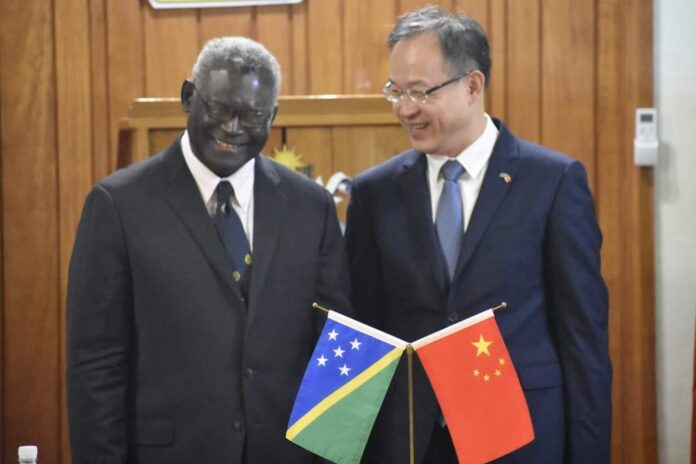
Sogavare(L) and Ming(R)

VIEWPOINT

FRANK S.V BILAUPAINE

SINCE Solomon Islands switched diplomatic relations from Chinese Taipei (Taiwan) to People’s Republic of China (PRC) in September 2019, there are numerous concerns echoed still by fellow Solomon Islanders about the issue of fundamental principles of democracy to that of BRI and debt –trap.

Whatever the concerns and issues are, it is paramount important that we as a diplomatic friend, development partner and aid recipient country must understand China’s positions in terms of their domestic and foreign policies towards their international development engagements and aids assistance.

In this article, I will be brief on what entails in the China’s White Paper 2021 on its international approach in 2021 and beyond and the possible implications to Solomon Islands.

In January this year 2021, China’s State Council, the country’s chief administrative authority, released a long-awaited update to its White Paper on development.

The landmark document marks the culmination of a series of reforms on China’s approach to aid in the last decade, and follows on from two White Papers on foreign aid (first in 2011, then in 2014).

It is also the first to be published following the formation of the China International Development Cooperation Agency (CIDCA) three years ago.

As the largest official creditor to developing countries and the world’s second largest economy, there has been considerable interest in China’s footprint in developing countries, attracting criticism on issues like transparency or alleged debt-trap diplomacy. In this article,

I take a deeper look behind both the rhetoric and the numbers in the White Paper to draw out some details—on what the country should know has changed substantively and what remains the same, what signals we are hopeful about, and what may temper our enthusiasm with our friend and development partner.

The broadens of China’s model of development cooperation

The White Paper moves on from the prior iterations in a number of ways. “China’s International Development Cooperation in the New Era” (published in Chinese language at around 26,000 Chinese characters, it is even longer than the previous two papers combined. and an English version), notably refers to development cooperation rather than aid.

This move is consistent with CIDCA’s naming, which drew attention in 2018 for the same reason.

What is more, this is the first time that the Belt and Road Initiative (BRI) that Solomon Islands already signed to join, which combines investment, development, and trade objectives, is formally included within the development cooperation framework of a White Paper, cementing the BRI’s position at the core of China’s development efforts.

As proponents of comprehensive thinking on development (also the focus of CGD’s Commitment to Development Index), we Solomon Islands should welcome approaches which recognise that development is not just aid and integrate development objectives across policy areas.

The White Paper sees China continuing to open up to global engagement, with the possibility of new partnerships warranting an entire chapter in the paper.

A space to watch in coming years will be tripartite cooperation between China, Development Assistance Committee (DAC) donors, and/or multilateral agencies.

While trilateral pilot projects were mentioned in earlier editions, this White Paper notably features wider mentions of bureau-level discussions held with both Japan and the EU.

Encouraging commitments on aid effectiveness and transparency

Though the White Paper does not mention commonly accepted multi-stakeholder commitments such as those under the Global Partnership for Effective Development Cooperation, it does allude to aid effectiveness principles.

In doing so, it tackles head-on some prominent criticisms levied against Chinese aid in the past until present.

On the principle of ownership of development priorities by developing countries, the document indicates that projects under the BRI should “dovetail with the development strategies of participating countries,” and that developing countries’ control must be the focus in any future trilateral cooperation.

In response to criticisms of opaque processes and ad hoc aid management, China has committed to more “clearly defined project management rules and regulations” as well as to “establish a tendering system focusing on high quality and competitive pricing.” While examples of Chinese untied aid projects are still few, this is the first mention of “pilot projects with sound tendering processes.”

Further, to guard against corruption, China commits to strengthening the “performance appraisal mechanism for entities undertaking projects.”

The White Paper offers few concessions towards greater transparency. Limited additional statistics on the breakdown of China’s $41.6 billion aid budget between 2013-2018, by income group and by region, are included for the first time since the 2011 White Paper.

It is heartening to see the White Paper frequently state that aid should be directed to the needs of least developed countries (LDCs); 46 percent of Chinese financing is directed to LDCs, compared to just 44 percent of global cross-border aid in 2018 (using Country Programmable Aid element of Official Development Assistance).

Still, figures provided for 2009 show that poverty focus may have been even higher in the past (if LDCs and “other lower income countries” are considered together).

Most exciting for transparency, however, is the promise that China will “develop a modern statistical information system for foreign assistance”to enhance supervision and evaluation.

A statistical data hub would be a welcome development for the broader international community, for China’s development partners, and for China itself to better track development outcomes.

The latter is an issue China has recognised as it promises to develop impartial and independent project evaluations (though, confoundingly, in a different section the White Paper claims that “all projects achieve good results,” which seems an unlikely claim for any provider).  

The Paper contains little substance on debt sustainability. While it highlights China’s participation in the G20 Debt Service Suspension Initiative, as well as debt suspension through bilateral consultations, it goes no further.

Our colleagues have previously looked at how Beijing’s participation in the DSSI has been slow and incomplete.

Increased volume, more grants, and emphasis on global public goods

The numbers indicate that Chinese annual aid spend has increased by over 45 percent from the 2010-2012 period to 2013-2018 (from roughly $4.8 to $7.0 billion on an annual basis).

This is in line with our previous estimate for the Finance for International Development (FID) measure, estimating $5.1 billion in 2017 on a “grant-equivalent” basis (or $6.8 billion when recalculated in line with this White Paper’s methodology: including loans on a face-value basis and adding in-country spend on scholarships).

The breakdown of China’s FID was $1.9 billion in grants, $2.0 billion in multilateral core contributions, and $1.2 in loans, based on their grant element.

Within the budget provided in the Paper, China has almost doubled its volume of grants (from $1.7 billion to $3.3 billion annually), significantly increased the amount of annual concessional loans extended (from $2.7 to $3.4 billion a year), and slightly decreased the small amount of interest-free loans it gives (from $389 to $291 million annually).

In terms of sectoral priorities, the focus on agriculture, infrastructure, and trade is similar to 2014. In addition, the 2021 White Paper for the first time makes mention of projects in cultural cooperation, gender, financial integration, and the digital economy, signifying a widening scope of activities.

Meanwhile, governance-related projectsare given more prominence, with reference to Beijing assisting countries in writing their “blueprints for growth” and in sharing its own experience with “reforms to streamline administration, delegate powers, and improve regulation”—crucial elements in China’s own development and economic growth since 1978.

Countries highlighted as having benefitted from governance-related assistance are Ethiopia (more here), Cambodia, and Cuba.

Global public goods are mentioned five times in the White Paper, the first time they appear in a Chinese White Paper on development.

This includes a reiterated pledge to make any Chinese-developed COVID-19 vaccine a global public good after it has been applied in China, and a new pledge to provide $2 billion in additional financing to the countries hardest hit by the pandemic over the next two years. 

Climate is mentioned throughout the document along with a section on environment protection but there’s no reference to the Paris Agreement or mainstreaming climate, with 13 climate projects out of 423 infrastructure projects between 2013-2018 (3 percent). Given President Xi’s commitment last year to net zero carbon emissions in China by 2060, we might expect more focus on this in China’s next strategy.

China also provides details on its diverse forms of aid. Though imprecise for understanding the level of financial support going through each form, it gives an indication of policy direction.

The most prominent trend is the sharp decline, by over half, in the average annual number of “complete” projects—referring to productive or civil infrastructure. In the 2011 White Paper, this was specified as a “major form of China’s foreign aid,” but it seems to have lost ground to increases in technical cooperation projects and capacity-building projects.

This may be another signal Beijing is serious about increasing aid to governance.

What’s unlikely to change soon?

Many of the principles around China’s aid can still be found, including the core ideas of non-interference and mutual benefit. China continues to see itself as a donor outside the mainstream DAC consensus, and couches its activities firmly within the framework of South-South cooperation.

This means that even as Beijing inches towards using principles on aid effectiveness, it will still see itself as operating under different rules than “North-South” aid. In fact, in the opening sentence and throughout the document, China refers to itself as a developing country, and later asserts it will be in the “primary stage of socialism” for a long time to come.

The final step in this stage would see China achieving the GNI of a “moderately developed nation.”

It’s not clear when this will be met—currently China’s income per head (GNI PPP in 2019) is crudely around the level of the US in the 1950s; and it will likely exceed the World Bank’s high-income threshold ($12.5k GNI/ head, Atlas method) in the next decade.

China also continues to be a proponent of multilateralism, this time even calling itself “a defender of international order.”

The White Paper enumerates financial contributions made through various co-financing mechanisms and trust funds, including the FAO-China South-South Cooperation Trust Fund; the China-World Bank Group Partnership Facility; the Africa Growing Together Fund with the AfDB; and the Co-Financing Fund with the IDB. , the picture remains incomplete.

It is unclear what the 4.6 percent of $41.6 billion (or £319 million a year) to international organisations cited earlier represents; it is not enough to cover all of China’s core multilateral contributions, which our FID work suggest were $2 billion in 2017, and over a third of China’s total.

Such confusion over the numbers only underscores that while sporadic updates can be useful snapshots and even provide cause for optimism, without more regular statistical reporting China’s financing remains opaque and evades scrutiny from both its development partners and the broader international community.

Can China deliver against its commitments?

While the purpose of this article is to view China within its own context, it is interesting to note China’s direction opposite some other countries’ development approach, including those in the Development Assistance Committee (DAC),  it has created a separate agency for development rather than folding it in within the foreign ministry, and emphasizes the poverty focus of its aid at a time when many donors are considering a shift to middle-income countries.

Where China does align with other countries’ development approach is in its emphasis on global public goods; this may be a promising area of collaboration.

Still, how well Beijing’s rhetoric on multilateralism, transparency, and other measures of aid effectiveness will filter into practice remains to be seen.

Only time will tell if China ultimately delivers on some promising commitments.

It should be noted that, although China’s foreign aid reform is primarily a domestic campaign, recipients, especially Solomon Islands could play an important role in shaping the discourse.

To fully utilize China’s foreign aid resources and potential, Solomon Islands should not stay passively as mere recipients, but actively voice our needs and concerns.

Only through interactive and collaborative efforts could China’s aid to Solomon Islands be shepherded for the maximum benefits for Solomon Islands the recipient country. 

If there is one voice that China’s aid community cannot afford ignore, it is that of the least developed countries including Solomon Islands.

It is important for our policy makers to understand that China’s aid has been evolving fast in the past decade, and the government’s newest white paper confirms this.

The publication of this document can help answer some questions around China’s aid. However, some key aspects of its aid efforts remain shrouded in mystery.

More critically the paper does not reveal more detailed aid spending data and cannot help observers understand how China’s aid bureaucratic system works.

Solomon Islands strike the iron at the right time with China because over the past several years, an increasingly strong voice has risen in China calling for the reform of its foreign aid policies and systems.

Moreover, there is now a general consensus that China’s foreign aid needs reform.

The past decade has witnessed a great proliferation of foreign aid actors—from government entities to private companies to individuals and social entities—and a significant rise in foreign aid volume.

I have raised this in my previous articles on the related topics about China and I will say it again here. Understanding the dynamics of our new friend China is very important in order to design our development plans and strategies that suits our development context.

Solomon Islands regardless of us now at the right side of history, the Government and the Country needs to set our priorities right, the country needs to take advantage of the demands and expectations exerted to China from recipient countries, and also have diversified, covering a broad range of areas including technical assistance, capacity building, and infrastructure projects.

China is here in the Solomon Islands to stay whether we like it or not, the onus now is with us to work with our new friend China to help us weave our development dreams.

About the author

Frank Sade Varean Bilaupaine is a Ph.D. candidate in the field of Applied Economics, Wuhan University, China. He holds two Master’s Degree in International Economics and International Economic Law both from Xiamen University, Fujian Province in China (PRC).

Disclaimer: The views and opinions expressed here are those of the author and do not necessary reflect the official policy or positions of any institutions. Any opinion provided by the author is of his opinion and are not intended to malign any religion, ethnic group, club, organization, company, individual, or anyone or anything.

Lauru people crying for improved health and medical infrastructures – Taro hospital and Wagina clinic.

The broken floors along the corridor inside Taro hospital

In its most recent face to face Community Awareness Outreach program to Choiseul Province covering South Choiseul Constituency, Moli and Taro in the North West Constituency, two of the urgent issue raised by those participating in the awareness sessions are, the dilapidated state of their Taro hospital and the delay in conducting by-election for the South Choiseul Constituency.

The hospital they said has been left to deteriorate for a number of years and is now no longer fit for purpose.  They lamented that a son of Lauru is now in a prime minister position for the fourth time and nothing much has been done to address the hospital needs of the people of Choiseul Province. In this 11th Parliament, not only is a son of Lauru holding the position of Prime Minister but a son of Lauru is also holding the position of the Minister of Finance.  Not only that but a son of Lauru is the Secretary to Cabinet and a Chief of Staff as well. Their cries for the maintenance of their hospital to be fit for purpose fell on deaf ears as there was no action to date.

The deterioration has been there for a number of years. They do not understand why the three members of Parliament who represented them in the 9th and 10th Parliament did not work together to do something about the hospital both at the national level and at the Constituency level. In the 9th Parliament each of the Constituencies of Choiseul Province received and spend a total of $19,300,000.00 [CDF], public funds channeled through their Member of Parliament and in the 10th Parliament the amount was $26,500,000.00. There was also $4,000,000.00 for each constituency under the Discretionary Fund allocated under the Parliamentary Entitlement Regulation for charitable purposes. With the positions they hold in the government, and the funds channeled through them they could have fixed the hospital. According to them the hospital is the unhealthiest house there is, unsafe for doctors, nurses, and patients alike. 

Broken toilet left inside the abandoned children’s ward.

They lamented that they have raised this time and again and noted that during this 11th Parliament the Prime Minister has visited the hospital twice and yet there is nothing at all with regards to fixing the hospital and commitment to an alternative arrangement such as assistance to Sasamungga Hospital as an interim arrangement whilst the Taro hospital is pulled down and re-built.  Having failed in their cry for the maintenance of the hospital they requested that Transparency Solomon Islands, visit the hospital see for itself what they are talking about and make public their cry for the government and for any donor or development partner come to their rescue.  A Catholic Sister puts it this way with regard to the use of CDF and the hospital quote “ solar/kapa[roofing iron, solar/kapa, year in year out, never ending cycle as every year people get married and more solar/kapa.  Enough of solar/kapa but spend CDF on hospital, schools, sanitation, water supply that will be needed by the children of the never-ending solar/kapa.  Solar/kapa is individual and only buying votes.  Use CDF for what will benefit the majority first such as the Taro Hospital”.

After the awareness session in Taro on the 9th March, Transparency Solomon Islands visited the Taro hospital on the 10th March and confirmed what the people of Lauru are concerned about.  The deteriorating condition of Taro hospital in Choiseul Province, is such that the risk and danger allowances paid to nurses and doctors should be greatly increased for working in such conditions. The hospital is no longer safe for both doctors and nurses and their patients and needs immediate action.  The country is going through a health crisis with Covid-19 pandemic and this hospital showcases the fragile health infrastructure and health and medical services provided in the province of Lauru.  Wagina is the same.  The clinic is now run from a classroom and has been like that for a number of years.  Whilst this is the case millions of dollars in the name of Constituency Development Fund no one knows where it has gone or spent.

The Taro hospital environment is an unsafe and unhealthy environment for doctors and nurses and sick patients seeking medical treatment there. The building used as hospital wards for sick patient has gone past the deteriorating phase and is now a hazardous place for humans to use. The buildings should no longer be use as a hospital to serve sick patients. TSI agreed with the head of the Taro hospital that the proper and responsible thing to do now is to close down the hospital building for the safety of both medical and health staff and the patients.

Operation theater inside the shut-down Taro hospital still used to treat minor surgical cases. Noted that the walls are infested with termites

A visit inside the building was a life-threatening experience to TSI official who had to walk carefully on decaying floors along the corridors, with some broken parts that if not careful any could accidently fall through to the ground while walking. The abandoned equipment used in the wards and beds were left idle for dust and rust. The Ablution blocks inside separate wards were but remains of unused sink and broken toilet pans. The entire building is now a home to termites that silently breed in their nests are visible on the walls and floor. The current state of Taro hospital could be described as a stage for filming horror movies of ghosts. It was completely unfit for humans to even visit, let alone using it.

A nurse working at Taro hospital shared with Transparency Solomon Islands that twice her leg went through a broken floor while carrying out her nursing duties. A medical doctor spoken to said that the building housing the hospital wards and the operation theater is now more dangerous to the lives of people than the disease they treat at the hospital. The doctor said the roofs are leaked and during rain times the water poured all over the floors along the corridors.

Since the global covid-19 pandemic, the sector in the government that has received millions of dollars from both taxpayers and aid donors is the health sector. More money and aid were poured into the country to support the work of the health authorities to counter covid-19 in Solomon Islands. Could some of these be used to address the hospital need of Choiseul Province.  The hospital is at the border and it makes sense to improve or do something about it now than later.  Coming to Honiara they said is now very expensive. It is shared with Transparency Solomon Islands that referred patients and those who care for them must meet their return fare making health services inaccessible to the rural sick and poor.  Most of the funds raised from the exploitation of their natural resources is used to support the growing need of urban life or remitted overseas. Nothing much is poured back to improve health services in the rural for the customary owners of these customary properties. Could some of these funds be considered for funding of improve health infrastructures in the health centers in provincial township. Could there be a better formular for sharing of benefits of the exploitation of natural resources with the provincial government?. Is this a way forward.

Taro Hospital is located on the country’s border with Papua New Guinea (PNG) and with the current rise in Covid – 19 infection in PNG and a very likely border for the virus to enter into the country.  It must be prepared to handle such a situation. Currently most of this hospital is shut down but as and when needed for example in the operating theatre doctors, and their patients still go into these very unsafe areas providing what medical service they can to their patients. Getting health and medical services close to the people is better than bringing them to Honiara, Gizo etc.

Transparency Solomon Islands calls on the Executive Government to hear the cries of the people of Lauru for a hospital facility and take whatever action necessary to bring the service close and back to their province.  The people of Lauru call on the Executive Government, any development partner listening for urgent assistance.  The Lauru people call on the Prime Minister, the Finance Minister, the Secretary to Cabinet, the Permanent Secretary of Health and Medical Services, all sons and daughter of Lauru for this urgent need. They urge that you do all you can to provide Choiseul with a hospital from which Lauru people can receive health and medical services.  It is a first ask of its kind they said.

TSI was also requested to visit Wagina which was also in an awful state. The clinic of Wagina has been long abandoned and temporarily relocated to a classroom at Wagina Primary School. The classroom where the nurses used to see sick patients at Wagina is unsafe being located in an old building unfit for children to use as classroom, as it could collapse at any time. There being no other alternative the clinic is now located here however unsafe.  This too needs addressing urgently.

But enough of Transparency Solomon Islands telling the story.  Let the pictures tell their own story.  This is happening because of the misuse and abuse of public funds that could have gone into providing people with better services be it social or economic.  In all of this and as part of its advocacy awareness Transparency Solomon Islands reminded participants that they can make the change for the better by not corrupting candidates campaigning, by holding them to account once in government and by influencing Political Parties vying for their vote. VOTE Party Policy, Influence Party Policy, and Demand delivery of election promises.

LONE SORE!

Former Honiara City Council Clerk Rence Sore. Photo: Charles Kadamana

Mayor and executive deny attending land sale meeting

BY EDDIE OSIFELO

EXECUTIVE of the Honiara City Council (HCC) has denied selling the council land at Ranadi to Malaysian logger Excellent Resource Management Limited.

And they denied attending a purported council executive meeting held last October, which approved the sale.

In a letter councillors within the executive, including mayor Wilson Mamae, sent to the Minister of Home Affairs Christopher Laore yesterday, they said:

“We have never attended the meeting although our names appeared in the minutes found in the office of the city clerk (Rence Sore).

“We deny receiving any form of payment, gift or in-kind pertaining to the transfer of this HCC land.

“We solemnly declared before your good office that we disassociate ourselves, from any involvement, engagement, or sitting in any meeting that authorise the transfer of this HCC land to any person.

“To our knowledge, this particular HCC land at Ranadi was designated to build a betel nut market house for those betel nut vendors in Honiara.

 “We were shocked of this land saga when we were informed.

 “This is an interesting issue worth investigating within the HCC office to determine how this HCC land dealing was conducted.”

This latest revelation may mean city clerk Rence Sore may have fabricated the minutes of the purported meeting. Sore has been avoiding speaking to the media lately.

Documents the Island Sun cited show Sore prepared and submitted the minutes to the Commissioner of Lands (CoL) to facilitate the transfer of the land title.

The land currently accommodates an incinerator and other facilities owned by the Biosecurity Department within the Ministry of Agriculture and Lands (MAL).

In the minutes Sore presented to the CoL, it claimed the council decided to sell the land because local company Anolpha Enterprise has been attempting to acquire it.

In doing that, the minutes claimed Anolpha has been actively marketing the three plots of land they claimed to have owned, including the council land, to interested buyers.

In its conclusion, the minutes quoted Mayor Mamae as saying “valuation of all council land needs to be done. Land rents need to be paid. And titles need to be renewed to avoid all dirty land deals that may come up unexpectedly”.

The minutes has not been dated, nor signed.

Mayor Mamae is one of the councillors that denied attending the meeting.

But in a letter to CoL Alan McNeil seeking his consent to the transfer of title, Sore claimed “he had applied on behalf of the council”.

Sore was also the one who wrote and signed the letter, dated 2 November 2020, offering the land to Excellent Resources Management Limited for the price of $800,000.

Meanwhile, CoL Alan McNeil , who earlier gave his consent for the transfer of the land, issued a notice to resume the land from Excellent Resources Management.

He said Government needs for the Biosecurity Quarantine incinerator.

Excellent Resources Ltd has a month to respond to the notice of resumption.

Passport mess

By EDDIE OSIFELO

ABOUT 2,200 individuals have received multiple possible passports from the Immigration Department in the Ministry of Commerce, Industries, Labour and Immigration.

The Office of the Auditor General Office found this in its Special Investigation Audit Report into the Passport System on February this year.

The special audit was to confirm whether there was evidence that passports were being issued illegally.

This followed a recent Cyber Security review highlighting sufficient reason to suspect the Passport System may have been compromised by internal or external actors which may have resulted in unauthorised Solomon Islands passports being issued illegally.

In their testing, the Audit has initially identified almost 700 individuals with possible multiple biometric passports (in the e-passport system) and up to 1500 possible multiple passports from the old passport system.

“We undertook testing of 27 individuals and confirmed 10 had at least two live biometric passports in issue.

“Of the 27, 11 were also found to have a valid passport in the old system,” the audit found.

The audit report states these are not deemed to be isolated incidents as their analysis and testing has shown a systematic failure of key controls relating to the issue of passports.

“This requires immediate corrective action to be taken.

“We found the contract in place for the provision of the e-passport system had not been reviewed by the Solicitor or Attorney General prior to signing,” audit report said.

The audit recommends engaging with the provider to resolve some of the gaps in the contract and to ensure a firm basis from which the delivery of the service can be monitored into the future.

“Due to the national significance of the passport system and the reputational damage there could be through such control failings we recommend that the Ministry develop an action plan to address these issues as a priority.

“Given the significance of the issues raised we will undertake a review in 3 months to confirm immediate priority actions have been undertaken followed by a review within 1 year to ensure ongoing progress is being made,” audit said.

 “Due to the failure of these controls this creates opportunities which could be exploited.

“We are therefore unable to provide assurance that passports with false information have not been issued,” audit said.

“This severely undermines the integrity of the Solomon Islands official travel document which could restrict the future rights of Solomon Islands passport holders travelling or working offshore,” audit found.

The audit report was tabled in Parliament on Monday.

NOCSI LOOKS TO PROVINCES

0
NOCSI President, Martin Rara. (1)

BY PETER ZOLEVEKE II

As the challenge in finding sports venues in Honiara continues due to the country’s preparations for the hosting of the 2023 Pacific Games, NOCSI is turning to the provinces for support.

In an interview with SunSPORTS this week NOCSI President Martin Rara said they have been taking initial steps in identifying potential sites in the provinces to hosts athletes training and competitions to prepare Team Solomon for the Pacific Games 2023

NOCSI had done a provincial site assessment since 2020 on six provinces and they have identified Malaita, Western province (Tuna Park) and Central Island province.

Rara confirmed three provinces as potentials candidates to host the athlete’s preparations as the wait for the completion of sports facilities in the capital also continues.

“Since most training grounds have been occupied for the construction of facilities in Honiara and seeing the borders are yet closed to travel now we are reaching out to the provinces,” Rara said.

“What that has been done since last year as to preparation of athletes is that seeing that borders have been closed from allowing our athletes to train overseas now the current move now is prepare within the country,” says Rara.

“Identifications done now are three provinces that are able to accommodate Team Solomon preparations through some sports.

“Few small patches needed for very basic facilities available on the ground that were left behind during the Solomon Games facilities can able to accommodate our athletes now as we continue to wait for the High – Performance center and other facilities to complete.

He says NOCSI will then meet with national sports federation (NFs) with its assessment report before the deployment of its athletes.

“So the options NOCSI will pass on the NFs to look at what they have according to their programs to design their programs fitting for the provincial facilities.

“The focus on the identification of sites for Team Solomon before the message to be passed on to the national federations for them to actually deploy teams, hosts championships to the places, so a report will be finalized after on the assessments and this is where NOCSI will draw out what sports to be allocated to which province.

Meanwhile, the Chinese Embassy Ambassador Li Ming has assured that with the country’s bilateral ties China will support Team Solomon athletes to train in their country.

“NFs now will have to get their competitions going on these identified provinces to come up with their team so that those selected in each federation will make up the numbers to go to China,” Rara says.

EELS ARE CHAMPIONS

1
Henderson-Eels-FC-Head-Coach-Eddie-Marahare-celebrates-after-winning-his-first-TSL-title-as-coach-for-Eels-yesterday.-Eels-defeated-Southern-United-FC-8-0.-Picture-Peter-Zoleveke-II

By Taromane Martin

Henderson Eels FC are the new champion for the Telekom Soccer League (TSL) after handing Southern United FC another heavy defeat yesterday.

Eight unanswered goals saw the Eddie Marahare coached side pick up their 16th win in the season as they grabbed their first TSL silverware.

Golden boot race leader Joses Nawo gave Eels the lead 2 minutes into the game before golden boot contender Raphael Lea’i doubled the lead 17 minutes later before winning a penalty kick for Nawo to grab his second goal from the spot.

Southern first choice goalkeeper was sent off just before half after committing two unnecessary yellow card fouls on Lea’I, leading up to that penalty.

Leading three goals up Lea’i made it 4-0 when second half resumed. Second half substitute Augustine Waita made it 5-0 before Nawo completed his hat trick with a chip over Southern second choice goalkeeper.

Unselfish play from Hudson Felani also allowed Lea’i to complete a hat trick as Nawo and Lea’i turned the game into a race for the golden boot award.

Chances were there for both players to add to their tally; however, it was Waita who scored the last goal to see Eels finish with 8 goals and win the TSL title with 50 points.

After two seasons in second place, Head Coach Eddie Marahare says he is happy and that winning their first TSL title has brought him new confidence.

“For any coach in Solomon Islands, winning the TSL is always one of the objectives. For myself as a coach why I decided to come to Eels was because I knew football is not entirely based on the technical side of the game,” Marahare said.

“Looking at the management and the support the club had, I was sure that if I came with my technical output, I can achieve what I want as a coach.

“Those two years were not wasted because I joined the club in 2018 and then early 2021, I manage to win that so I’m very proud not only of myself but also for the club.

“I’m happy we manage to win the title today. For the club I’m happy because after two seasons we were consistent in maintaining second spot until we manage to finish top this season.

“As a coach this gives me confidence in what I’m doing with the team and I thank all the players for responding and executing every time during training and in our games this season.

“Thank you also to the club owner, Hudson Wakio and Advance Technology, our fans for all the support given towards the team in achieving this historic milestone for the club and my career as coach,” he adds

With one game left against outgoing TSL champions Solomon Warriors FC this weekend, Coach Marahare said this is a must win game despite already having the title in the bag.

“We will not take that game lightly. They are the defending champions so we will have to prove why we are the champions,” Marahare said.

Man who fooled for money gets 4 years

0

BY JENNIFER KUSAPA

A man who had been going around luring people to give him money for overseas investment and in return of huge profits has been sent to jail for four years.

David Tuita Lafuia was sentenced by the court yesterday after he pleaded guilty to nine counts of false pretence on February 19, 2021.

The accused lied to nine individuals and obtained a total amount $27,000 through his cunning actions.

Deputy Chief Magistrate Ricky Iomea who presided over the case said assessing the facts of the case, the accused had pre-meditated the and pre-planned to steal money from the victims.

“This is not a spur of the moment incident but the defendant had taken time to plan this, the offences were repeated and committed over a period of time until it was discovered,” Iomea said.

The accused’s action has put nine different individuals and probably their families in a very difficult financial positions at the time and may take time for them to recover from it, Iomea said.

He said the lies and deceitful tactic used by the defendant clearly demonstrated the work of a pure con man, taking advantage of the situation and fooling the individuals and rob them of their hard-earned money.

“I agreed with the prosecution that this type of offending appears to be prevalent,” Iomea said.

Iomea said the society has no place for people who go around conning others in order to earn money therefore, a deterrent sentence is called for.

“This is a shameful and lazy way of earning an income. Only lazy people resort to this kind of behaviour, I say this because in society, notwithstanding difficult economic situations such as the one presented by COVID-19, there are still genuine ways of earning money to keep one survive.

“Societies disapproves and will not tolerate such behaviour. The court has a duty to ensure that such people are isolated from the community. It must impose a sentence that serves as punishment and deterrence. The sentence that will be imposed should also send the message clear to likeminded other that those who follow suit will face the same consequences,” Iomea said.

This is the incidents that were occurred on different dates of last year in Honiara.

The first incident occurred on June 26, 2020 where the accused called the victim on her mobile phone and introduced the network to her. They had a conversation and introduced to her about an investment he joins namely Barrack Trade Investment Network BTIN and is located in London United Kingdom.

The accused told the victim to give him a sum $1500 and he will complete the remaining amount to reach the required amount of $5000, he told her that she will get an interest of $84,000 after 10 weeks, having heard what the accused have said the victim gave him the money, the victim was also told that she will receive a confirmation through email about the payment, after 10 weeks there was no email or payment received.

DCM Iomea said five incidents occurred on five different people in the month of July on different dates and time and obtained $13,500, from those four victims, he promised then that they will get their money after 10 weeks, that promise was never happen.

The other three incidents occurred in the month of August 21, 2020, the three-victim met with the accused at Water Lilly, he told them about the investment, in which they were convinced and a total of $15,000 was given to the accused, the victims waited for their profits on the dates promised to them but they did not receive any email or any payments since then.

Public Prosecutor Vernon Taupongi appears for the crown while Emy Rusi of the Public Solicitor’s Office represented the accused.