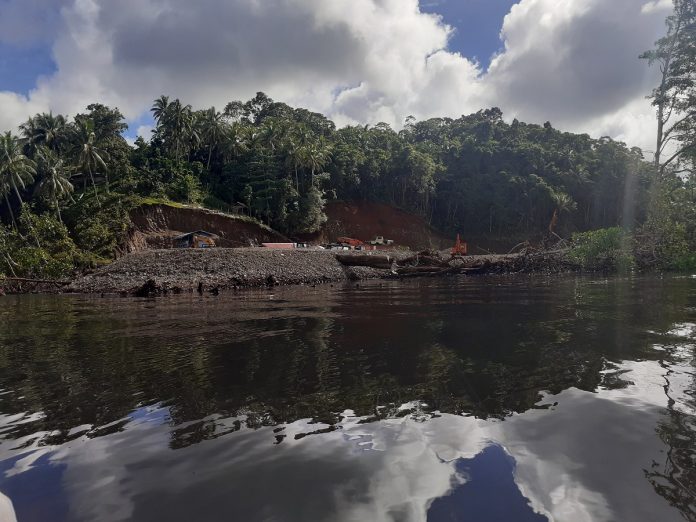
ISABEL Premier Leslie Kikolo says about 51 percent of the provincial revenue is collected from logging royalty and licenses.
He said the total revenue collection makes up 57 percent in total, which is half of its revenue collected, while only six percent through other local collections.
“I understand, that there is no simple solution to transition from the logging industry, my government has envisage attracting foreign investment for tourism, the mining sector, agriculture and fisheries,” Kikolo said.
He said it is a fact that the current revenue regime is unstainable and his government are doing their best to redesign by looking at investing into the six percent revenue collection.
Meanwhile, Prime Minister Manasseh Sogavare said Isabel Province is second only to Western Province in production of round logs.
“From an economic perspective this is good but we all know that the current rate of logging is unsustainable, not only that, but we are also concerned about the social problems that came with logging which is on the rise.
“We have had situations where families are fighting each other because of land disputes, this ugly side of logging is a reminder that we cannot continue to rely on logging,” Sogavare said.
He said logging is an industry that needs to be reformed and better managed and the government is working on a new Forestry Bill, which should be presented to Parliament soon.
Sogavare also acknowledged the province’s idea for re-forestation on areas that have been logged.
“This is something that we would like to further develop and improve on especially as we put more focus towards rehabilitating and restoring our over-logged areas,” Sogavare said.
TOURISM Industry in the Western Province was badly affected due to border restrictions in response to minimizing the spread of COVID-19.
Few operators have local guests visiting their resort while others remain open with no guests.
Tourism Officer of Western Province, Zaza Gina said tourism operators in Western Province are not certain what their future holds.
“Our operators are feeling the impact of COVID-19. I’ve visited some of the operators in Munda and overall respond is that they are badly affected,” she said.
Gina said some of the operators have undergone redundancy while some of the operators established new policies where employees takes turn to work.
“Like Agnes Lodge, they’ve established a policy where employees can take turn to work. Employees will work for certain period then stayed at home for a month for their turn,” she said.
Gina said Agnes Lodge established the policy to help its employees to stay afloat during this time of COVID-19 economic crisis.
A VIRAL diarrhea has alarmed Gizo residents, prompting the public to take extra precaution on what they eat as a way of maintaining good hygienic practices.
Reports reaching SunGizo office state that the viral diarrhea has claimed few lives at Gizo hospital last week.
Reports also state that there are increasing numbers of patients complaining of diarrhea since last week.
Director of Health and Medical Services for Western Province, Dr Dickson Boara said his office received the report and officers have been sent to the communities to investigate it.
“We have received the report and our staff have been sent to community concerned to investigate the issue,” Boara said.
“We are not in the position to say that this is an outbreak until we get to the bottom of this report,” he added.
“At the moment, we are waiting for the feedback of our team who are now in the communities investigating this report,” he said.
SunGizo understands that Gizo Primary School has taken urgent measures in respond to the report.
The school had stopped parents from selling food at the school and at the same time encourages parents to provide fruits and other healthy food for student’s lunch.
Leaders within Arahanimane Council of Chief participating in group discussion during the event.
A special gathering of leaders from the Are’are community on Malaita was held at the end of April.
The Are’are Leaders Land Summit was held at Kopo village, Waisisi frim 27 to 28 April and was organized by the West Are’Are Rokotanikeni Association in collaboration with the Are’Are planning committee based in Honiara as well as chiefs of the region.
This important event was hosted by Arahanimane House of Chiefs. It was co -funded by the Pacific People Advancing Change (PPAC) through the South Pacific Community, WARA and Member of Parliament for West Are’Are.
The Land Summit was attended by more than three hundred leaders throughout the whole of Are’Are Region, covering three House of Chiefs namely; Arahanimane HOC, Hahuarahana HOC and Namoaraha HOC. Leaders who attended the Summit represented young people, women, Chiefs, Church leaders, Waisisi Community High School, Member of Parliament for West Are’Are, John Maneniaru, WARA staff and members, Planning Committee and community leaders.
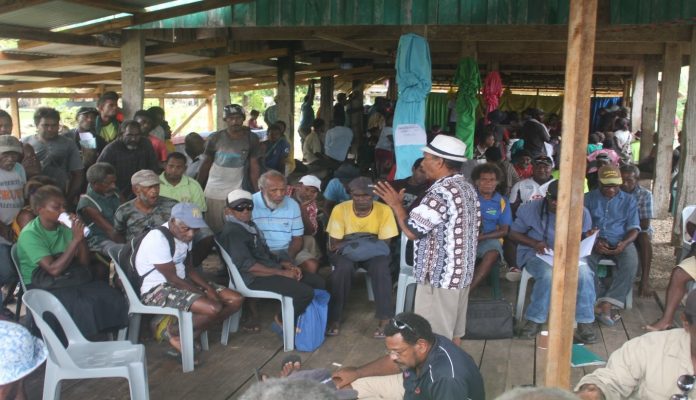
Some of those that were part of the summit. This was within Kopo Village Waisisi, West Are’Are
Furthermore, it was attended by representatives of the Malaita Provincial Government led by the Deputy Premier of Malaita Province, Randell Sifoni who was also the Guest of Honour who officiated the opening ceremony.
Also, the Director of Winrock International, Dr Morgan Wairiu and his Team were present and did an awareness talk about the roles and functions of Winrock International.
The purpose of the Land Summit was for Are’Are Leaders to come together to dialogue and discuss Are’Are land matters, meaning land and all that is on it, in it, above it and around it which are the most important resources of the Are’Are region.
In addition, that Chiefs sort out genealogies, tribes and leadership.
There were five perspectives that Presenters spoke on. These perspectives are:
First, Chief John Pa’e, Chief Bernard Paurara and Chief Joel Hutaranimae spoke on the Are’Are Kustom/Traditional perspective on Are’Are land – meaning how does Are’Are Kastom see and embrace land a as useful resource.
Second, Dr Fr James Ereai spoke on the Biblical Perspective – how does the Bible/Holy Scripture see land in the past and the present.
Third, Nelson Naoapu spoke on the Government Perspective – how does the Solomon Island government see land, referring to the Acts such as the Land and Title Act etc.
Fourth, Max Totorea and Edward Huitarau from Maimasina Green Belt spoke on the Environment and Conservation Perspective – Should the Are’Are people conserve land?
Fifth, Pascal Oritaimae spokesman for Advance Technology talked on the Economic Development Perspective – introducing and explaining how Are’Are people can engage in economic development but in a sustainable way.
Following these presentations, the audience were divided into their House of Chiefs and had open dialogue and discussions on land issues that affect people and tribes and look more constructively on the Are’Are Land Tenure System. They also discussed on exploring economic development opportunities that are available for the people to engage in to raise cash to meet people’s needs.
Participants were encouraged to keep talking on land matters at the Summit and to continue talking afterwards to sort out any land issues and disputes that affect families, tribes and the rest of Are’Are communities. Participants were also called on to work together and restore relationships and map the way forward for peaceful coexistence and active participation in economic development. They were also called upon to strengthen Are’Are Traditional leadership at all levels. WARA wish to acknowledge all who support and made this event possible: The Pacific People Advancing Change (PPAC), South Pacific Community, the Are‘Are Planning Committee, the Waisisi community and hosting committee, Waisisi Community High School, leaders from both east and west Are’Are, Honorable Member for West Are’Are, Deputy Premier for Malaita Province and Team, Winrock International, Maimaasina Green Belt, Advance Technology Limited and everyone who were not mention but contributed one way or another towards and during the Are’Are Leaders Land Summit
Each person has a name, and he or she is called by it. Or so we thought.
For persons with disability, this is not always the case.
In day-three of the ‘Nothing About Us Without Us’ workshop yesterday, participants living with disability gave powerful and moving testimonies of having suffered discrimination of all sorts.
One such is name calling.
In many instances they have been called by ‘names’ relating to their impairment. If it’s not worse enough being called behind their backs, some have had it said to their face.
One, Mr Fred, who lives with visual impairment, shares that it is only in this workshop that he is being called “Fred”. Back, in his community he is simply called “Blind”, he says.
Another, Mr James, who is living with stature and speech impairment, shares that he used to be called “Bottle”, “Big-head” or “Short”.
Ms Marella, says sometimes people in her community even her relatives call her “Bend-leg” or “Short-girl”.
For Ms Ellena, a word in her local dialect meaning “leg that has been shortened” has been used by other people to call her by.
These are just four examples of the many testaments shared yesterday to insensitive and hurtful treatment participants have had to face in their lives – some still do.
Few say they are fortunate to have supportive families who do not put them through this or shield them from it. Others share that although their immediate families do not show them this cruelty, they receive it from relatives.
From public? Nearly all are victims to this cruel act.
One brave girl, living with a limb impairment [name withheld] tearfully recalls that her first encounter with the word “disable” was a one-time incident early in life with her father, who called her using this label. Although he later retracted his comments and apologised, having realised his mistake, this experience left its mark – this participant still painfully remembers it.
Yesterday, a segment in the workshop involved participants dividing into groups to discuss the topic ‘Respectful Language’.
From discussion results, the issue at the forefront is name-calling.
As with any non-disable person, our name is one of the things we hold dear in life. This is the same with persons living with disability.
“Please call me by my name” is the silent cry for each one. Not by labels pertaining to an impairment.
Dian Row, media and health promotion officer for the Ministry of Health (MHMS) partaking in discussions with participants living with hearing and speech impairment, later said:
“[In societies across the country, persons with disability are called by words with meaning that describes their impairment].
“For people living with speech and hearing impairment, they have names, they have real names including a surname. Some also have sign language names which they accept to be called with.”
Ms Row posed a challenging statement for non-disabled persons:
“You just imagine putting yourself in their shoes? What if it was you who was called by those [cruel labels]?
“What if you had hearing and speech impairment and were walking, and someone who wanted to get your attention, threw a pebble at you just to get you to look their way?
“You wouldn’t like it!”
Mr Jabesh Manaika, who is a programme presenter at the SIBC, and is living with visual impairment, speaking for his group, lays it out: Say the person’s name, followed by the impairment.
“You cannot say blind Jabesh, or blind Desmond, you say Desmond who is living with visual impairment.
“You cannot put ‘blind’ in front of the name, because this means ‘blind’ is my first name, making Jabesh my second, thus I no longer have a surname!”
Reflecting on the importance of family in protecting their children who are with a disability, Mrs Eileen Maetoloa-Akaramo shared how her family have taken it on themselves to stand with Jacineth, her third son, who is living with visual impairment.
“As Jacineth grew up, I told my first and second born sons, to stand with their brother.
“I am always by my son’s side because I worry a lot in case someone discriminates my son. I don’t want anyone to ridicule him. If anyone does, they will have to deal with me. I’ll stand there with him, I’m like his advocate.”
Underscoring the vital role family plays in support and awareness for persons with disability, Mr Desmond, who is living with visual impairment, establishes how it should be.
“Awareness and support for persons with disability should begin at the home, and from there go to the community, and from there to the top level [of authority].”
The undaunted Desmond shares that he has faced ridicule even from the likes of members of Parliament (MP).
“Honest, some honourable Members ridiculed me to the bottom of their level, but I remind them that my ballot is important, so please do not discriminate me, call me the right way. You are the one who should be helping me, that’s why I cast my vote, so don’t call me ‘blind con-man’ or ‘blind beggar’. No!
“Just call me Desmond or Desmond who is with visual impairment. In that way, I will feel in my heart who you are as my MP.”
Through the course of these sharing, one could not help but realise just how rife and far-reaching such discrimination and insensitivity is in our society.
This reinforces the idea that more of such workshops and similar awareness activities are needed.
“This workshop is an eye-opener for me. And, I believe it is time we who share this journey we stand together, we preach it in our homes, in our communities,” Mrs Maetoloa-Akaramo said during her reflection.
For Solomon Islands, the road is long and hard, but such activities as the ‘Nothing About Us Without Us’ workshop are milestones which help hasten the country towards inclusiveness of persons with disability.
The four-day workshop is being run by the United Nations Development Programme (UNDP) in partnership with the Ministry of Justice and Legal Affairs through the Public Solicitor’s Office and People with Disability Solomon Islands (PWDSI).
The industrious Ms Naomi Tai of PWDSI, who is with a disability, is the facilitator, and is supported by UNDP’s Mr Jone and Ms Rashmi.
The workshop concludes on Friday at the Heritage Park Hotel conference hall.
SOLOMON Forest Association (SFA) will go through the Drafting Instructions of Forestry Bill today at 10am.
The meeting will be held at SFA Conference Room to discuss matters pertaining to this Forestry Bill.
In an email received by Island Sun, SFA President Johnny Sy advised all members to attend the meeting.
Sy also asked the members who have an issue with Foreign Investment Division to kindly bring the show cause letter and cancellation of FID Certificate plus the Central bank LC issue.
He asked the members to kindly cooperate or else SFA won’t be able to act on behalf of them.
The main objective of the Bill is to make amendments to the Forest Resources and Timber Utilisation Act, Cap 40, in order to make it more robust and forward looking in nature to cater for the new activities and developments which is occurring in the forestry sector now and into the future its fundamental aims and objectives.
The secondary objectives and purposes of the recommended Amendment to the Forest Resources and Timber Utilisation Act include:
Enable the Act to accommodate changes in the Forestry sector and establish the platform for changes in the Forest Resources and Timber Utilisation Act and its relevant Regulations [2005]
The licensing and enforcement of the relevant conditions of the License
One of the recommended Amendments is the Commissioner of Forest Resources” should be replaced with the word “Forestry Technical Committee” (Commissioner will issue License based on the advice of the Forestry Technical Committee).
According to section 10 (1) the word “appropriate Government” should be replaced with the word “Council of Chiefs” and the word “Customary Land Appeal Court” should be replaced with the word “Tribal Land Panel” (as Local Court will no longer have the power to hear Land matters).
Section 17, a fine of three thousand dollars or imprisonment for two years or to both such fine and imprisonment” should be replaced with the phrase “a fine of fifty thousand dollars and five years’ imprisonment or both’.
There will be a Forestry Board established to:
To receive appeals from the Minister of Forestry and Research from aggrieved parties
To advise the Minister to lift suspended license and reinstate cancelled Felling License.
To advise the Minister of Forests on appeal matters generally
Any other matters that are referred to the Board by the Minister.
Make decisions on issues pertaining to all Forestry plantations either owned by individual, family or community.
To call up relevant expertise to advise on technical matters when needs arise.
Deliberate on the Declaration of a Moratorium when the need arises
Deliberate on forest clearance for other development purposes e.g., Agriculture, Palm oil, mining, major settlements, infrastructure developments,
To advise the government of the day on Forest Policy issues, e.g., policy review.
Forestry Board’s decision is final
Furthermore, the Ministry of Forestry and Research will put in place a Budget for all Timber Rights Hearing. The total amount should not exceed $80,000.00 dollars per sitting.
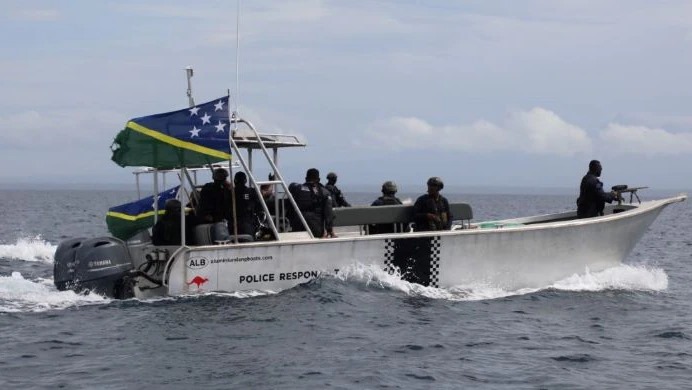
Police officers patrolling the Western border with Bougainville. PHOTO ABC
BY BEN BILUA Gizo
THERE is need to mount extra effort at the Western Border as Papua New Guinea is expecting a third wave of COVID-19 next month or September.
Ppua New Guinea has raised a red flag expecting a third wave of COVID-19 and that advance preparation or improving surveillance is highly recommended.
Speaking to Post Courier Papua New Guinea late last month, Deputy Pandemic Controller, Dr Esrom Daoni stressed that the third wave is expecting to surge in cases with fatality rate expecting to be increased.
The report is threatening to communities in the Western Solomon Islands which includes; Shortland Islands, Choiseul and Western Province.
In an interview with SunGizo, Director of Health and Medical for Western Province, Dr Dickson Boara said strengthening and maintaining border control is the only way to avoid the virus entering Solomon Islands.
“We understand that human is the carrier of this COVID-19 as such avoiding people to cross the border is the best way for us to contain this virus,” he said.
Boara also said that it is important for communities residing close to the Western border to help government agencies who are on the ground to make sure the virus is not invading the border to Solomon Islands.
This paper understands that the government through the Ministry of Health and Medical Service has rolled out vaccination in Shortland Islands.
A recent report states that PNG has recorded a total of 15,415 COVID-19 positive cases in all the provinces with 73 deaths and 14,343 recovery cases.
China’s top legislator Li Zhanshu held talks on Wednesday with Solomon Islands’ parliament speaker John Patteson Oti via video link, agreeing to enhance exchanges and cooperation between their two legislative bodies.
Li, chairman of the National People’s Congress (NPC) Standing Committee, said that China believes in the equality of all countries regardless of size. “China respects the Solomon Islands’ choice of a development path suited to its national conditions, and supports the Solomon Islands in developing the economy and improving people’s livelihoods,” he said.
China appreciates the Solomon Islands’ adherence to the one-China principle and its firm support for China’s core interests and major concerns, such as Taiwan, Xinjiang and Hong Kong, Li added.
Noting that China is willing to maintain exchanges at all levels with the Solomon Islands and to strengthen mutual political support, Li said the two sides should continue to unite in fighting the epidemic, expand pragmatic cooperation, deepen cooperation on infrastructure, agriculture, forestry and fishing on the basis of the Memorandum of Understanding on cooperation within the framework of the Belt and Road Initiative (BRI).
The two countries should expand cultural and people-to-people exchanges, while strengthening exchanges on education, culture, and the sub-national and youth areas, so as to consolidate the foundation of long-term bilateral friendship, Li said, adding that they should strengthen multilateral coordination and cooperation, uphold multilateralism and jointly safeguard the legitimate rights and interests of developing countries.
The two sides can promote exchanges among special committees through flexible means, said Li.
The two sides should timely approve and revise legal documents conducive to the development of bilateral relations, while providing legal guarantees for the joint construction of the BRI and practical cooperation in various fields, he said.
The two sides should learn from each other’s experience on legislation, supervision and governance to help achieve their respective economic and social development goals, Li added.
For his part, Oti congratulated the Communist Party of China on its 100th anniversary.
Noting that the Solomon Islands attaches great importance to developing friendly relations with China and firmly adheres to the one-China principle, Oti thanked China for its important support in fighting the epidemic. He said the National Parliament of Solomon Islands is willing to strengthen exchanges and cooperation with the NPC, and make contributions to pushing forward pragmatic cooperation and promoting friendship between the two peoples.
Pictures depicting activities performed by farm workers during harvesting of cassava at night at the Sape farm in April 2021 for export in partnership with Varivao Holdings Ltd.
ONE of the Government funded agriculture projects through the Ministry of Agriculture and Livestock (MAL), Sape farm is bearing successful results as its cassava tubers now exported overseas since last year with more export expected this year and in the coming years as there is huge interests and demand for cassava.
Managing Director of Sape farm, Dr Paul Bosawai Popora says.
He said last year, Sape farm in partnership with Varivao Holdings Ltd exported 14 tonnes of (its) cassava tubers to Australia, the first export after its establishment in 2018.
“And in April this year, Sape farm delivered its second export of 15.834 tonnes of cassava tubers yet again through Sape-Varivao partnership to Australia. This second export included 4.9 tonnes from one of our (Sape farm) out grower which generated a total of 20.734 tonnes under Sape farm management,” Dr Paul said.
At the moment Dr Paul is embarking on alternatives to make direct export possible with the construction of a processing facility.
“I am now trying to build a processing facility. It will be simple to make export possible.
“I have purchased some materials and the farm boys do the construction work. We expect to do more export next year (2022) on our own,” Dr Paul said.
He said “Sape farm believes in empowering out growers so, for the export Varivao did in April, we provide 15.8 tonnes and our out grower Ben Pogular supplied 4.9 tonnes of cassava tubers. It is the vision of the sape farm to engage our out growers in all export activities we do.”
While acknowledging Varivao Company for the partnership, Paul took the time to explain the processes that they went through during harvest and also its challenges.
“We harvested at night from 7pm to 6am and then we cut both ends.
“We do this to reduce post harvesting deterioration rate. We harvest an average of 3 tonnes per night.
“It involved a lot of work but we managed to do it with the hard work of the farm workers.
“The challenge is to process within a short period of time. If we have a storage facility, we will be able to harvest during the day and control our loading quantity.
“However, with the great team work, we are able to meet the harvesting quantity Varivao needs,” Paul explained.
On the Sape-Varivao partnership Paul said, it is ideal for now but to go commercial they need consistent harvesting and export.
“I thank the Varivao management for buying the cassava tubers from us and our out-grower. We really need consistent export to which we now already have our buyers ready for up to three (3) containers a month. We only need a processing facility to make this possible.”
When asked regarding the root crop (cassava) potential to the local economy, Paul said cassava has known potential and unknown potentials.
“We have to do it right and indeed it will aid our economic growth. Only if we have appropriate mechanisms like processing facilities then going into large scale farming would be possible to absorb farmers who are cultivating this root crop (cassava) and in that way it will encourage more people to engage in cassava farming.”
In May 2020, the Government through the Ministry of Agriculture and Livestock (MAL) and Sape farm management signed a 2.7 million funding support agreement that will see cassava root crop transform into an industry in the future.
Of the 2.7 million support, about 1.7million was used up to support establishment of the farm last year 2020.
The $1 million still outstanding will be used to support construction of the farm processing facility and needed equipment.
Sape Farm is co-financing the processing facility.
The funding agreement and partnership was an initiative to support the government’s Food Security Programme and it would cater for farming machineries and tools, processing and refrigeration machines and working capital.
“While cassava has been here with us we have not been able to go commercial and export so it is time we do that.” Dr Paul said.
He said he is humbled by the MAL support that is making Sape Farm the leader in cassava commercial farming in the country.
A 44-YEAR-OLD man suspected of killing a female Chinese shop owner at the White Angel building in Honiara on 2 May this year has gave himself up to police.
Assistant Commissioner (AC) Crime and Intelligence Patricia Leta said the murder suspect was handed over to police on Wednesday night in Honiara by his parents.
“They travel from west Kwaio to Honiara by boat to hand over the suspect to National Criminal Investigation Department (NCID) of the Royal Solomon Islands Police Force (RSIPF),” Leta said.
“Auki police officers escorted the suspect and his family members from west Kwaio to Honiara,” she added.
“I would like to thank the immediate family members of the suspect and the people of east and west Kwaio to take such initiatives to surrender the suspect to police.
“This is the kind of working relationship we need to establish between us. Let the law deal with him. He is still innocent till proven guilty by the court.”
The man, an employee of the Chinese woman, escaped to Malaita after the killing.
He avoided police attempts to arrest him.
His father, a church pastor who accompanied him to Honiara, thanked the police and other family members for their support in facilitating the arrest.
Director National Criminal Investigation Department (NICD) Superintendent Michael Bole thanked the Provincial Police Commander (PPC) Malaita Province and his officers who were involved in the operation that led to the surrender.
“It’s not easy to do such negotiation but you make it happen,” Bole said.
Meanwhile, Leta said the suspect has now been charged with murder contrary to section 200 of the Penal Code.
He was remanded at the Rove Correctional Centre and will appear in the Honiara Central Magistrates’ court on 17 June 2021. – Police Media Unit