Home Blog Page 1633

Parasi airfield set to re-open

0
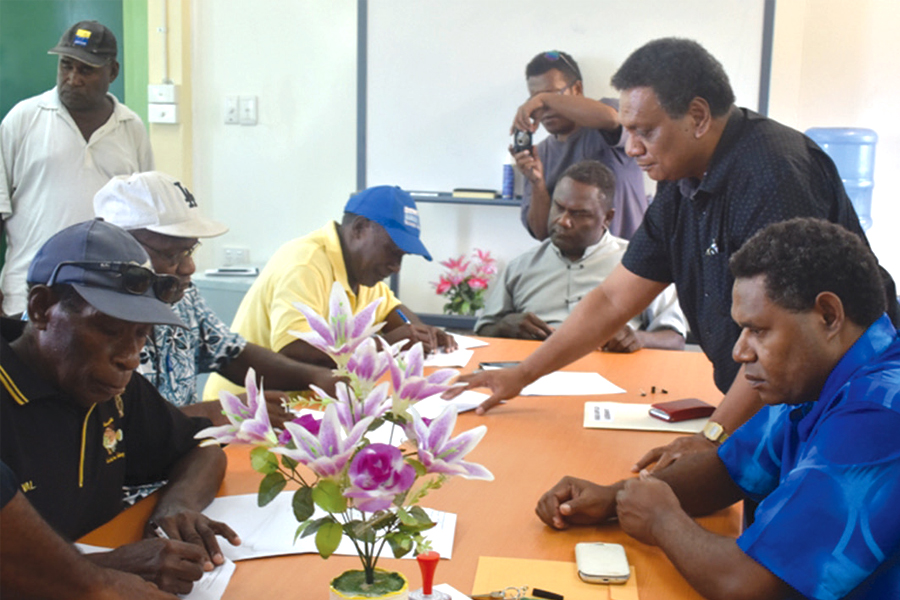
South Malaita landowning parties of Parasi airfield signing agreements yesterday with the Commissioner of lands in paving the way forward for the re-opening of the airfield soon. PHOTO by MANEBONA BARNABAS.

BY BARNABAS MANEBONA

South Malaita landowning parties of Parasi airfield signing agreements yesterday with the Commissioner of lands in paving the way forward for the re-opening of the airfield soon. PHOTO by MANEBONA BARNABAS.

PARASI airfield at Small Malaita being closed for the past seven years is now set to re-open.

In a ceremony yesterday at the Ministry of Infrastructure Development, representatives of the three disputing parties of Parasi airfield land together signed agreements with the Commissioner of Lands paving the way for the re-opening.

Speaking at the signing, Chairman of the Aviation Task Force and also the Permanent Secretary of the Ministry of Communication and Aviation Mr Moses Virivolomo thanked leaders of the disputing parties for their understanding in agreeing to re-open the airfield while waiting for the resolution of their land disputes by responsible authorities.

“Since the closure of the airfield, residents of Small Malaita as well as East and West AreAre who have been using it to travel home have experienced hardships in travelling by sea all the time,” said Mr Virivolomo.

“Re-opening the airfield is a step in the right direction towards facilitating whatever development aspirations there are, not only of Small Malaita, but also Malaita Province and Solomon Islands generally.”

The Permanent Secretary then took the opportunity in expressing his appreciation for the tireless efforts put in by the Aviation Task Force in negotiating for the re-opening of the airfield with the disputing parties.

He is now calling upon the disputing parties of the Manaoba and Lomlom airfields to follow the examples set by the disputing parties of Gwaunaruu and Parasi airfields.

This is to allow the opening of these airfields pending the judicial settlement of their internal disputes.

“Clearing and cleaning of Parasi airfield will start immediately with the hope that Solomon Airlines will commence flights there before the end of the year,” said Mr Virivolomo.

The three disputing parties for Parasi airfield are Wawateimatawa/Ohotai Manioha, Silent No More Brothers and Taraoro/ Waiaraka.

Mr Moses Waririu of Taraoro/ Waiaraka landowners speaking on behalf of the three landowning parties during the signing said the opportunity for the re-open is a great moment for everyone as they have tried to solve this long standing issue.

“We have been affected long enough so we are looking forward to work with the government in the long term of the re-opening of Parasi airfield,” said Mr Waririu.

He added to let such development taking place be an eye-opener for others in seeing the avenue to work closely with the government for positive developments to take place.

Investigation into PC Manelusi’s case begins

0

BY SAMIE WAIKORI

INVESTIGATIONS into a police officer, the son of RSIPF’s deputy commissioner operations Gabriel Manelusi, began yesterday.

Police Media confirmed to this paper that Constable (PC) Moffat Manelusi is under investigation for drink-driving in a police vehicle.

“The RSIPF’s Professional Standard and Internal Investigation (PSII) Division will investigate the report which has appeared in the media,” Police media said.

However, Police media could not comment further, insisting that the case is ongoing, advising Island Sun that “any further decision will be based on the finding of the PSII investigation”.

Social media had reported that PC Manelusi had taken a police vehicle – land cruiser G-4047 on an all-night drinking spree.

According to FSII the vehicle was recovered on Sunday morning by Henderson CID officers at the Deputy Police Commissioner’s residence.

It is unclear whether PC Manelusi has been stood down from duties while investigations continue, or that he is still working.

It is understood that PC Manelusi works at the Henderson Police Post in East Honiara under the Guadalcanal Province.

Complaints on a short beche-de-mer season

0

BY JENNIFER KUSAPA

REMOTE island provinces in the Solomon Islands are calling on the government to extend the beche-de-mer open period to a year.

A concerned man from Duff Island, Temotu province, Walter Baddeley said that the open-season is too short for people from remote areas like Duff.

This is because they depend on the weather, sometimes the bad weather there can last for three months and currently in Duff is rough and the people will be facing difficulties in searching for beche-de-mer, Mr Baddeley said.

“Why not the Government re-considers the opening period and allows us a year?”

Mr Baddeley said while government is concerned with controlled harvesting, it should also consider people living in the remote outliers.

The Ministry of Fisheries and Marine Resources has lifted the ban placed on the beche-de-mer fishery following a cabinet decision to have it lifted.

According to the Ministry of Fisheries the open period as agreed on will be three months from September 1 to November 30, 2017.

The ban was lifted after the current fisheries (Amendment) Regulation 13A 2009 was suspended early this month.

During this open period any person or community who wishes to catch, harvest, or process for sale any sea cucumber (beche-de-mer) species can do so, the Fisheries said.

No decision yet for beche-de-mer export licence

0
The Director of the Ministry of Fisheries and Marine Resources Mr Edward Honiwala

BY BARNABAS MANEBONA

THE Ministry of Fisheries and Marine Resources (MFMR) is still in the process of deciding who will be the four beche-de-mer export licence holders.

This was confirmed by the Ministry’s Director Mr Edward Honiwala to Island Sun yesterday.

He said they are trying their best for the assessment committee to meet this week as some appointed officers being in the committee are on duty travelling overseas since last week.

“What the PS of the Ministry of Fisheries is trying to do now is to make another appointment within the Ministry to replace few of the appointed Officers on duty tour because they will be returning early next month,” said Mr Honiwala.

“We have to make some reassessment on them today or tomorrow [yesterday and today] to allow the committee to precede with their assessment for the four export licence holders.

“These are legal processes so we cannot ignore them.”

SDA mission halted

0

Kwailabesi landowners threaten to close down Church’s development


BY BEN BILUA

SEVENTH Day Adventist Mission’s developments in Kwailabesi, North Malaita, is facing a stop-threat from disgruntled landowners.

Spokesperson of Kao Tribe – the tribe which looks after Kwailabesi land, Mr Ambrose Oiofadolofera says his tribe will stop further development on Kwailabesi land.

He said the embargo is due to unresolved issues pertaining to the land lease between Kao Tribe and the SDA Mission on the said area.

Mr Oiofadolofera said the land lease agreement between Kao Tribe and SDA Mission had already expired in February this year and is pending review.

He furthers that attempts his tribe has made to review the land lease have been negatively met since the land lease expired.

Mr Oiofadolofera conveys his tribe’s disappointment to see failures made by the SDA Head Office to address its stand-off with the tribe.

“We are disappointed to see fundraising in aid of the development programmes still continue, though we have mentioned to the SDA Head office about our disappointments,” he said.

Mr Oiofadolofera said further development can be rolled out if the review of the land lease is made between the two parties.

He explained that his tribe is not against all the positive development and services SDA Mission have done but wants to see a common agreement made between the Mission and Koa Tribe.

“We don’t stop the development and important services that have been offered under this mission, our concern is for us to sign a common understanding under our land lease agreement,” Mr Oiofadolofera said.

He said his tribe is looking forward to discussing the issues with officials from the SDA Head Office here in Honiara.

Attempt to get comments from the SDA Church Head office was unsuccessful yesterday.

Kwailabesi is a Mission Station established by the Seventh Day Adventist Church providing medical, education and also pastoral services for the people in the area.

With the latest turn of events, these services which have been depended on by people from the area and surrounding communities are at risk of closure.

Provincial dissemination workshop for GP held successfully

0
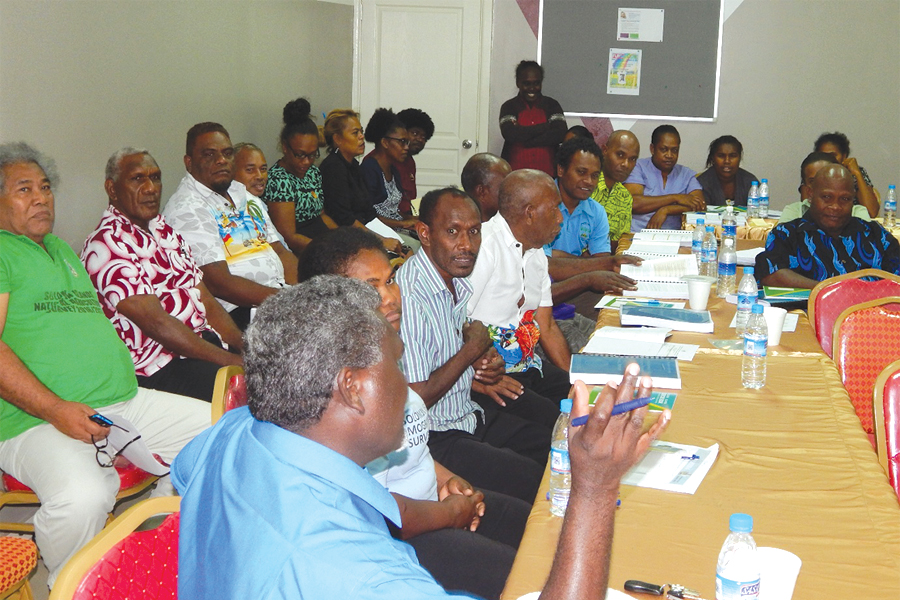
Part of the participants that attended the dissemination workshop last week.

A TWO-day provincial dissemination workshop on the “Solomon Islands Demographic and Health Survey 2015” (SI DHS 2015) for Guadalcanal Province (GP) was successfully held and concluded on Wednesday September 20, 2017.

The event was held at the Star Event Conference room in Honiara from Tuesday 19th to Wednesday 20th, last week.

About 40 participants from Guadalcanal province various government departments, women council/organisation and the Ministry of Health and Medical Services (MHMS) attended the dissemination event.

The workshop was organised by the Solomon Islands National Statistics Office (SINSO) within the Ministry of Finance & Treasury (MoFT) as part of its major roll-out programme on the SI DHS 2015 final report provincial dissemination exercise into the provinces following the official launch and Honiara dissemination workshop held in June 6 -7, 2017.

The purpose of the dissemination exercise is to ensure information (final report) of the survey reach the people in the rural areas who provided the information during the survey.

For Guadalcanal, it was a lively workshop as participants were given the opportunity to discuss topics presented and issues pertaining health concerns in the province (GP) and to ensure responsible authority (divisions) within Guadalcanal Province embarks on ways to formulate strategies to address such pressing problems.

Presenting on the topic “Malaria”, Dr Hugo Bugoro said Malaria is still a major problem in the province and the country as a whole.

He said fighting this endemic health problem means appropriate strategies must be in place and taken by both provincial and national government responsible ministries.

Dr Bugoro encouraged people to ensure everyone uses mosquito nets and other mosquito repellents to avoid catching Malaria.

He said awareness is also important to educate people about Malaria and approaches that one would take to evade getting sick with Malaria.

Other topics that also brought heated debate on the floor include child labour, women’s empowerment, HIV & Aids related knowledge and attitudes and behaviour and more.

Guadalcanal Provincial Member, Hon Brian Tuva Minister for Health and Medical Services while commending the National Statistics Office (NSO) for the survey report said the report and information within it are vital and would be a yardstick for GP health authority to ensure it frames policies to address such health issues affecting the province.

He said the report is significant given the importance that it will help Guadalcanal Provincial Government various divisions in its future policy making course.

Meanwhile, Government Statistician Douglas Kimi said apart from SI DHS 2015 other surveys and projects that the National Statistics Office are currently embark on include;

  • National Agriculture Survey (ongoing)
  • Household Income and expenditure survey – Extended for National CPI Project and poverty (ongoing activities)
  • Village Resource Survey (VRS) and Household Listing (new/ongoing)
  • Proposed quarterly Labour Force Survey (LFS) (new/ongoing).
  • The 2019 Population and Housing Census Preparations

He said Guadalcanal Province was given the first choice for the DHS 2015 dissemination adding NSO is also eyeing to host similar workshops in other venues in the province (Guadalcanal) soon.

Mr Kimi also called on the participants to be advocators for NSO to ensure people collaborate and support Statistics Office in providing vital and right information during the course of its upcoming survey projects.

He said providing right information to the NSO is important to guarantee it was recorded adding such support through providing right information will also help the government, stakeholders and policy makers in formulating appropriate policies/strategies that will help enhance the socio-economic development of the country.

The provincial dissemination workshop is extended to Malaita and Western province this week after Guadalcanal Province, to be followed by Choiseul, Isabel, Central, Makira, Temotu and Renbel Province.

The Solomon Islands Demographic and Health Survey 2015 (SIDHS 2015) is a nationally representative survey of 6,266 women aged 15–49 and 3,591 men aged 15–54.

The SIDHS 2015 was the second such survey for the country. The first one was conducted in 2006–2007.

The primary purpose of the SIDHS is to furnish policy-makers and planners with detailed information on fertility, family planning, infant and child mortality, maternal and child health and nutrition, and knowledge of HIV and AIDS and other sexually transmitted infections.

The SIDHS 2015 is a follow up of the SIDHS 2006–2007 and is designed to provide updated data to monitor the population and health situation in Solomon Islands.

The report which contains 16 chapters summarises the findings of the SIDHS 2015 implemented by the SINSO in collaboration with the Solomon Islands Ministry of Health and Medical Services (SIMoHMS).

The SIDHS 2015 project was funded jointly by the Australian Department of Foreign Affairs and Trade (DFAT)-Aid Programme, SIG and the United Nations Children’s Fund (UNICEF).

–SINSO PRESS

Fiji lauded for taking on COP23 presidency

0

DEAR EDITOR,

According to late evening news bulletin from Radio New Zealand (RNZI) tonight, 20 September 2017, Fiji has been lauded for taking on COP23 presidency.

Quoting RNZI the bulletin said:

“A German government official, Jochen Flasbarth, says Fiji’s decision to take on the presidency of COP23 was a bold move for a small island developing state that is also affected by climate change.

“Germany is hosting the UN climate change meeting this November in Bonn.

“At a side event this week at the UN General Assembly in New York, Mr Flasbarth linked the possibilities that can be derived when two different nations work together to build awareness on climate change.

“At the same event, the Fiji Prime Minister Frank Bainimarama reiterated the importance of working closely with Germany.

“He said “addressing climate change is at the heart of our common future. This is why the Paris Agreement is so important. We all must continue to create prosperity and to ensure the wellbeing of the nations and ecosystems of the world. To do this, we must work together”.


Yours sincerely

Frank Short

The people have spoken

0

DEAR EDITOR, last week the Acting Prime Minister received a petition from a representative of the local Civil Society Organisations (CSOs) which called for the re-introduction of a raft of anti-corruption legislation earlier withdrawn from Parliament by the Prime Minister.

Responding to the petition at the entrance to the Prime Minister’s Office, the Acting Prime Minister said the anti-corruption bill is with Cabinet and as soon as it is finalised, it will go to Parliament to be re-introduced at the upcoming sitting in October.

Quoting an article in the Solomon Star which referred to the handing over of the petition, the Secretary of the Development Services Exchange (DSE)-the Umbrella body of the CSOs in Solomon Islands, Jennifer Wate, said:

“Solomon Islands is crippled by corruption.”

“Corruption affects the hardworking God-fearing men, women, young people and children of Solomon Islands every single day and we will no longer remain idle while schools and hospitals are overflowing with students and patients and essential supplies remain inadequate and infrastructures deteriorate.

“Corruption is an enemy to development and we would like to remind the Members of Parliament are accountable to the citizens of this nation which is growing in numbers.

“We demand that Members of Parliament who were elected to represent the people in the highest decision-making body in the land to represent our best interest to pass the bill without any further delay.

“Your wise decision on this matter will be remembered at the polling booth in the next general elections and in other general elections.”

One must really hope that the long delayed anti-corruption laws will be approved by Parliament when they are re-introduced and the various provisions will have the ‘teeth’ to do what is clearly needed, but the fight against corruption will not be cheap and, as I see it, some reforms of the state will be needed regardless of the anti-corruption measures aimed at stopping corruption.

I have in mind, for one, the need for much better oversight and auditing of the money MPs receive annually to be spent on constituency projects and development.

The success of recent JANUS operations has, no doubt, also created the view that there are some in the top echelons of government that are not providing the right examples of honesty and leadership by having alleged corruption charges brought against them.

When the top political leaders or senior public servants of an organisation do not set the right example, either by allegedly having engaged in acts of corruption, or have condoned other such acts on the part of relatives, friends and wantoks, it cannot be reasonably expected that their juniors in public office will behave any differently.

What I have previously written about the need for effective administrative controls to counter corrupt practices needs re-emphasising and, to quote an analysis by Gary Becker, a Nobel Laureate in economics, he wrote in one of his recent Business Week columns:-

“The existence of these controls reflects to a large extent the attitude of the political body towards the problem.

“Generally, the most effective controls are those that exist inside institutions.

“This is the first line of defence. Honest and effective supervisors, good auditing and clear rules on ethical behaviour should be to discourage or discover corrupt activities.

“Good and transparent procedures should make it easier for those offices to exercise their controls.”

The causes or factors that have been commonly cited as promoting corruption in the Solomon Islands have included, certain government spending decisions, regulations and suspect authorisations, a lack of audits, the provision of goods and services, a lack of transparency in several laws, rules and processes, inadequate penalty systems, examples set by the leadership, logging infringements, customary practices and the level of public sector wages, to name but a few examples.

Procurement spending by the government has often been referred to by TSI as needing better oversight and regulation to enhance accountability.

If, ultimately, the passing of the anti-corruption Bills to be brought before Parliament next month leads to the establishment of an Independent Commission Against Corruption (ICAC) in the Solomon Islands then that body must be fully independent from the political establishment, have adequate resources and staffed by fully skilled, competent personnel of the highest integrity.

It goes without saying that the investigators of a local ICAC must be provided with full powers of investigation, arrest and prosecution.

A draft ICAC Bill in neighbouring Papua New Guinea is under fire from an Opposition Group this week because it is claimed that Bill does not provide for the independence of the office and those that would have the responsibility of examining corrupt acts.

When it comes to considerations about culture and alleged corrupt practices, I turn for a response to Peter Larmour who wrote in his published paper ‘Corruption and the Concept of Culture: Evidence from the Pacific Islands.’

“Despite attacks on cultural relativism, and the universalistic doctrines of TI and the international community, ideas about culture still seem useful in understanding how people recognise and respond to what is judged to be corrupt behaviour.

“These reflections on culture do not deny the ethical basis of judgments about corruption. Rather, they show how ethical meanings develop and change, how people give different weight to different factors in weighing up what is the right thing to do, and to how they may displace onto others the ethical load of doing business.

“Anti-corruption practices need to adapt to this more nuanced picture of how different people decide to behave.”

Yours sincerely

FRANK SHORT

Helping the needy in the SI – an open letter to New Zealand

0

DEAR EDITOR, on the island of Malaita in the Solomon Islands the registered charity trust, ‘Hearts of Hope,’ administered daily by a dedicated team of volunteer women cares for thousands of orphans and elderly widows that are scattered across the vast province.

The charity is desperately in need of all kinds of second hand clothing, especially clothing for children.

There is also a huge demand for donated eye glasses for people in the Solomon Islands who are unable to pay for eye glasses or repair old ones.

LIONS CLUBS in New Zealand very kindly donated 3,000 pairs of eye glasses a year or so ago to the National Referral Eye Centre in Honiara, an excellent facility built with money provided by the New Zealand Government’s Overseas Aid Program.

The eye glasses were freighted to Honiara by ‘Take My Hand’ charity trust, based in Auckland, an organization that has been aiding the Solomon Islands Ministry of Health and Medical Services for several years already.

This letter is by way of an appeal to the good people of New Zealand and to the members of LIONS CLUB (NZ) to kindly consider helping all those in need in the care of Hearts of Hope and those urgently in need of eye glasses throughout the Solomon Islands.

Gifts of second-hand clothing and eye glasses could be donated to ‘Take My Hands’ at the organizations storage depot in Auckland by prior arrangements with the management team. Tel number:   +64 (02) 27-433-4978

Any enquiries can be made to me via the link on my website – www.solomonislandsinfocus.com

Yours sincerely

FRANK SHORT

Aipia questions why ban breakers are scot free

0
Dr Reginald Aipia

BY BARNABAS MANEBONA

Dr Reginald Aipia

DR Reginald Aipia questions why the Ministry of Fisheries is not considering arresting people who had harvested Beche-de-mer when the ban was still in place.

Aipia, one of Solomon Islands’ renowned medical doctors, was brought in by police recently for questioning over his beche-de-mer farming project.

He is facing two counts; operation without licence and harvesting beche-de-mer while ban was active.

“I do not know why they have charged these on me but only the court will decide,” said Dr Aipia.

“I want this farming project to continue as I have already spent 2.5 Million on it.”

“Under the section the Ministry of Fisheries is pointing to for our arrest, it states that an approval can either be for a licence or an endorsement authorised from Fisheries in which I have that since 2014.

“The authorisation for the project to be carried out was given during June this year which is why I went on with this operation.

“If the Ministry of Fisheries had already known that such move is wrong then they should have stopped me in the first place so that I will not lose my money and be in this situation.”

Last week Friday, the Chairman and directors of Ontong Java Association (OJA) arrived in Honiara after travelling for 260km from Ontong Java purposely to support Dr Reginald Aipia with his case.

According to them, the communities in Ontong Java are anticipating Aipia gets approval from the government to continue with the farm project.

“Beche-de-mer farming is the future for our people, with this farming process is one way to help us through years of crying to the government for lifting the ban. It is better to farm and harvest rather than usually harvesting only,” said the members of OJA.

“If the government approves this, then it can take for more than ten years to do Beche-de-mer harvesting and exporting.”