Home Blog Page 1332

Sparking young dreams into reality

0
Oxfam Country Director, Dolores Devesi signs the grant agreements with HCC and HYC. Photos by OXFAM Media

Oxfam, HCC and HYC rolls out second phase of youth grant scheme ‘Statim Faia’

“ONE, two and three say Statim Faia!” Sixteen young leaders representing youth groups across Honiara cheered before the camera as the Statim Faia project successfully rolled out its second phase of providing grants for youth initiatives.

Waving their signed agreement papers in the air, the photo captured it all. Smiles of relief, satisfaction and the energy of determination.

Earlier that afternoon representatives from 16 youth groups signed the grant agreements with Oxfam in Solomon Islands (OISI) Country Director Dolores Devesi, Honiara City Council (HCC) Head of Youth Sports and Women Division Roland GK Pauku and President of the Honiara Youth Council (HYC) Harry James.

Karrie Jionisi, president of Girls For Change is a community of interest group or a network of
young women that works to improve the lives of single mothers in Honiara.
Ali Barnabas aims to boost the Solomon Islands
Deaf Association by making video productions in the hope to attract more intepreters.
A participant with his certificate.

The grant program is funded by Comic Relief fund and Royal Commonwealth Society, under the Queen‘s Young Leaders Programme in honor of Her Majesty The Queen’s 60 years of service to the Commonwealth.

A total sum of SBD$349,397 was signed by the participating youth groups to carry out their proposed projects over the next six months.

These vary from business models to plastic recycling ideas, landscaping and agriculture, empowerment programs and many more creative initiatives.

“Personally I am always excited to support youth groups. We see you as leaders – not for the future – but as leaders of today,” Ms Devesi told the youth representatives at the signing event.

“Our generation today looks upon young people and leaders like yourselves to bring up our society. We’ve seen for ourselves the many issues that our country is facing, particularly issues affecting our young population.”

She said the Statim Faia project is purposely aimed to give youth groups the chance to put their ideas into practise, however with the challenge for young people to learn about sustainability.
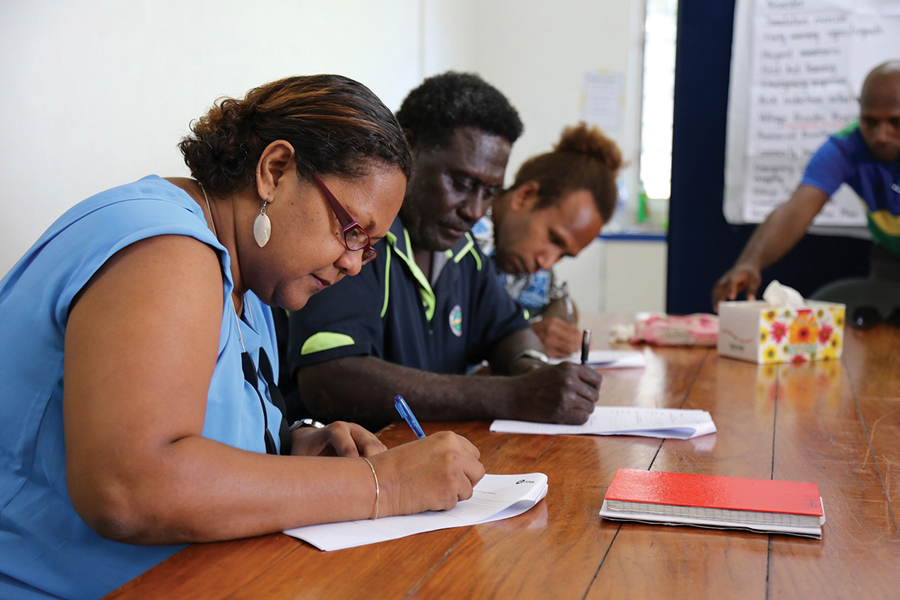
Oxfam Country Director, Dolores Devesi signs the grant agreements with HCC and HYC. Photos by OXFAM Media

“It may not be able to cover all the costs that were proposed but it gives you the capability to start something which can continue to be sustainable even when your grants run out.”

The Country Director congratulated the participants in reaching the funding stage of the project and wished them well in their implementations.

Roland GK Pauku, head of HCC’s Youth Sports and Women Division says HCC is thankful for the existing partnership with Oxfam and will commit to continuously work closely together.

“For us at the Honiara City Council, we are really thankful for what Oxfam is doing,” he says. “As much as possible we will commit to work more closely with the teams involved [Honiara Youth Council and Oxfam’s Youth Governance project] so that we will continue to implement this project.

Roland GK Pauku, head of HCC’s Youth Sports and Women Division says
the City Council will commit to continuously work closely together with its partners.

“I’ve seen the values and commitment of the Oxfam team in implementing this program and I highly applaud them. We must accomplish things,” Pauku urged.

HYC president Harry James in a brief comment encouraged the youths to make use of the opportunity and deliver with uttermost dedication to support youths in the country.

The Statim Faia project was launched in 2015 with the aim to support young women and young men in the Solomon Islands to participate and have their voices heard on issues they care about.

OISI’s Youth and Governance Coordinator Neil Nuia, who takes lead in the Statim Faia project, says the project attracted more participating youth groups than the first year.

Oxfam Youth and Governance Coordinator, Neil Nuia drives the Statim Faia project in partnership with HCC and HYC..

“Compared to seven successful grants in 2017, this year we were very delighted to have 16 youth groups in Honiara who successfully completed the Statim Faia small grants process,” he says.

“I must congratulate these young active citizens for bringing their creative yet powerful ideas forward and putting into proposal their proactive ways of raising youth voice. Now it is time to make positive change and have their impact trickle down to other youths in other provinces.”

We take a look at three of the successful recipients:

Learning sign language in DVD

Ali Barnabas is president of the Solomon Islands Deaf Association (SIDA), an association formed in 2014 to engage and support people with hearing disability.

Though speech impaired, Ali has championed being a vocal voice behind SIDA in raising the concerns of the disabled population – loud enough to get the attention of Prime Minister Rick Hou who agreed to meet with SIDA earlier in January.

A youth participant signs on behalf of his group at the Oxfam Honiara office.

Ali signed the Statim Faia grant agreement on behalf of SIDA with an aim to increase the knowledge of sign language through video productions.

Speaking through an interpreter Ali said: “In our project, we propose to promote sign language through DVDs that can help others to learn with an easier medium. We hope our proposed videos will reach as many people as possible. We also plan to channel our productions to schools and disability centres whom are already aware of our project and are eager to see the output.”

SIDA had undertaken similar projects in the past, but by print materials and books.

Ali said SIDA is in need for more interpreters and he hopes that by using DVDs more people can be reached.

–OXFAM PRESS

The role of children is crucial: Acting PM

0
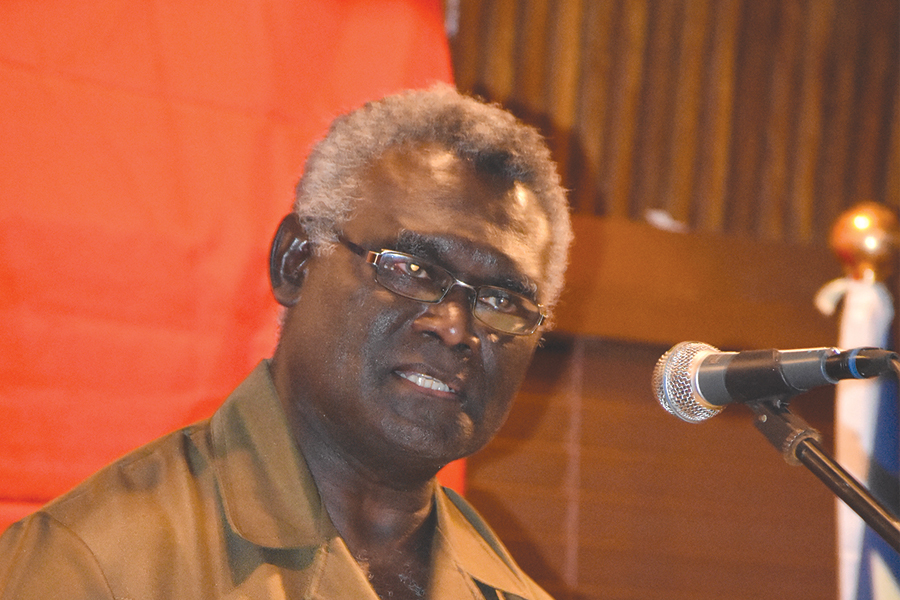
Prime Minister Manasseh Sogavare

BY LORETTA BRIGIDIA MANELE

MY government is totally committed to ensuring that every child in my country has access to basic water, toilet and hygiene facilities in schools. We realise that WASH facilities in schools are critical not only to achieve health and educational results of children.

The above statement was made by acting Prime Minister and Deputy Prime Minister, Hon Manasseh Sogavare during the launch of National Standards on WASH (Water Supply, Sanitation and Hygiene) in schools on June 5 at Mendana Hotel.

Speaking on the lack of appropriate and inadequate WASH facilities in schools, he said this may be the reason for the increase of dropout rates in primary schools and in the junior secondary level.

“Lack of appropriate and adequate WASH facilities in schools may also partly explain the situation of drop-out rates at primary schools [and junior secondary level], which has increased in the period 2007-2009 from 8 percent to 11 percent, and -1 to 4 percent respectively. In particular, girls show higher drop-out rates than boys at 13 percent and 8 percent respectively,” said Sogavare.

He stated that this brings us to the question of how and when we can achieve Sustainable Development Goals (SDGs) in the country for basic WASH services.

Henceforth, Hon Sogavare emphasised that as influencers of opinions and practices in their families and as future adults who need to learn the correct life skills for a generational change, they understand the crucial role of children.

Furthermore, he thanked the government of New Zealand and UNICEF for their support in the WASH project in 42 schools in Guadalcanal province.

“We look forward to the results of this project, so that the learnings can be taken to scale in the entire country. Providing WASH services in all schools of the country is achievable and this project can show us the way”

“I am happy to note that two main ministries – Ministry of Health and The Ministry of Education dealing with water and sanitation have converged here to align their priorities on WASH in schools,” said Sogavare.

He noted that he looks forward to more collaboration between the government, UNICEF, donors, bilateral organisations, NGOs, academia and other institutions to collaborate and address WASH on schools on the priority to achieve the SDGs on water and sanitation.

Makira village peace wardens receive bicycles and mobile phones

0
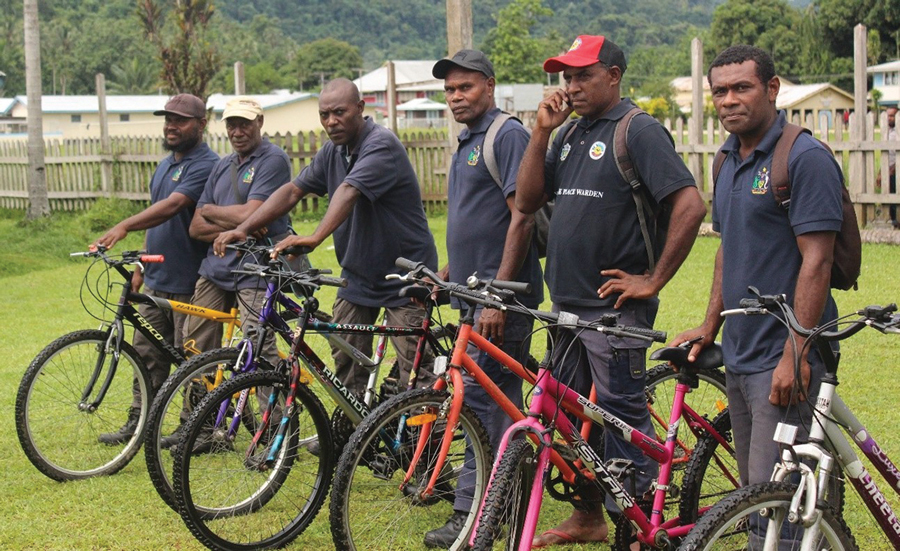
Proud and satisfied recipients - The MUP VPWs in their uniform with the bicycles.

BY LORETTA BRIGIDIA MANELE

MINISTRY of Provincial Government and Institutional Strengthening’s (MPGIS) Community Grievances and Management Project (CGGMP) through the Makira Ulawa provincial government (MUPG) donated bicycles and mobile phones to Makira village peace wardens (VPW) on May 19 at Kira Kira.

This is according to MPGIS’s press release statement which said that 20 bicycles and 19 mobile phones were presented by CGGMP’s Management, Information Management and Project Officer Mr Clinton Zinihite to the Provincial Secretary for Makira Ulawa province (MUP), Mr. James Taeburi and MUP Provincial Police Commander Mr Peter Sitai in the presence of the project’s provincial coordinator, Ms Daisy Zazariao, the VPWs and a number of provincial staff.

Proud and satisfied recipients – The MUP VPWs in their uniform with the bicycles.

Zinihite expressed that as transportation and communication have been identified as the two most pressing challenges, now provided with these equipment, VPWs will carry out their duties more efficiently and effectively thus enhance connectivity and access to rural villages.

He said that they hope these tools will help spread knowledge, build relationships and improve governance and grievances resolutions in the communities.

“When the VPWs perform on time and to the expectation of the communities consistently, then this will instill confidence and trust in the communities,” said Zinihite.

Taeburi in support of Zinihite’s statement urged the village peace wardens (VPWs) to exercise proper care when using the equipment.

On behalf of the VPWs, Mr Danny Danegu who is the VPW for Kokana expressed that this was a moment they have been waiting for and are so thankful that it has finally arrived.

Some of the MUP VPWs and their PS and Police Commander could not resist the joy of trying out the bicycles.

MPGIS emphasised that VPWs needed the bicycles so they can travel and reach more villages especially villages that can’t be covered when walking.

“The mobile phones are also just as important as transportation as the VPWs needed to use the communication equipment for passing messages not only amongst themselves but to their village counterparts and Police in Kira Kira,” said the press statement.

The VPWs as stated are in their roles expected to support the chiefs and existing community governance system to help resolve conflicts and maintain peace in the community.

They are as well expected to build relationships and build better linkages between the communities, the provincial government, police, national government and relevant stakeholders, working in partnership to uphold peace in the community.

The report stressed that the development objective of the Community Grievances and Management Project (CGGMP) is to strengthen community grievance management capabilities and boost the effectiveness of linkages with the government in targeted communities.

In addition, MPGIS administers CGGMP and supports the VPWs, COs and CLOs by providing training, equipment and linking them with national ministries.

Some of the proud and satisfied Makira Village Peace Wardens of the CGGMP pose with the new mobile phones with MUPG PS Mr. James Taeburi and MUP Police Commander Mr. Peter Sitai (2nd & 3rd from right).

The respective Provincial Governments that host the CGGMP recruit remunerate and deal with any issues of the Operative Field Officers and in this case, it is the village peace wardens of Makira Ulawa province.

Moreover, this project as said by MPGIS was piloted in Makira and Rennell and Bellona provinces since 2015 and is still underway in these two provinces.

By 2017, the Community Grievances and Management project extended to Malaita province for work on the recruitment of 15 officers to become Community Liaison Officers (CLOs), a process that is still progressing.

The latest province expected to benefit from this projects in the third quarter of 2018 is Central Islands province.

Furthermore, MPGIS highlighted the importance of the Royal Solomon Islands Police Force (RSIP) in supporting CGGMP Operative Field Officers which include VPWs, COs and CLOs.

RSIP through the office of the respective Provincial Police Commanders provides support for the officers by offering stand by support to help them handle any serious cases should it be violent or law breaking and are also there to assist them in preventing crime by engaging in activities such as conducting crime prevention and grievances awareness during community activities.

Henceforth, reports produced by VPWs, COs or CLOs to provincial police are important sources of information and collaboration.

“CGGMP is funded by the World Bank and the Australian Department of Foreign Affairs and Trade. The Solomon Islands Government support the CGGMP. Together, through MPGIS, RSIPF, and the Provincial Governments, the public is urged to support the CGGMP’s Operative Field Officers (VPWs, COs, CLOs) to work with communities to resolve grievances and conflicts,” said the press statement.

Bahai street food vendors urged to cooperate with HCC

0

BY MAVIS NISHIMURA PODOKOLO

PRINCIPAL inspector of the Honiara City Council (HCC) Ms Ella Rizworld has called on all Bahai street food vendors to cooperate with them (HCC) and comply with the council’s food hygiene and safety regulations.

This was made this week following the vendors’ lack of cooperation with HCC inspection officers and breaching of the council’s food by laws.

HCC is looking to gauge the vendors to work together and introduce hygienic standards to their service.

Speaking to a food hygiene and safety workshop this week Ms Rizwold said they carried out an initiative of street food vendor’s inspection earlier this year followed by demolishing of street food stalls on that site but they (vendors) still did not comply to HCC laws.

“Therefore I strongly called on Bahai street food vendors to cooperate with the us and come with one common understanding (HCC) because the particular environment the foods are prepared and sold is not conducive for the type of foods like fish, chicken and Rice, it can poses major health risks and microbial related issues.

“This is due to the location it was located near the road where the foods can easily expose to dusts particles which are small enough to be exhaled may cause health issues and the lack of water to name a few ,” she said.

Rizworld furthered the council does not prohibit them from selling their food.

Street food vendors trained on food hygiene and safety training

0

BY MAVIS NISHIMURA PODOKOLO

TWENTY-plus street food vendors underwent a three-day food hygiene and safety workshop in Honiara.

The workshop was initiated by United Nations Women purposely to support women in the Solomon Islands in the arena of advancing women’s economic empowerment.

Women’s participation in economic empowerment activities allows them (women) to effect positive changes in their own lives and communities, contributing to positive effects for the whole nation.

Speaking to this paper Ms Ella Riswold, Principal Inspector of the Honiara City Council (HCC) who facilitated the training, said the training was based on food hygiene and safety and it was a prerequisite for all who venture into the food business in this country.

“Hence it is important for all food vendors to have basic understanding of food handling and preparations with regards to hygiene and safety and as well as knowing the councils by-laws that govern the foods.

“Good food hygiene is an important practice that we need to observe to ensure our food is safe for consumption, without this healthy practice, harmful germs that cause food poisoning can spread very easily during food preparation process, it is therefore our full responsibility to keep the food that we and our loved ones eat very clean and safe during and after preparation on a daily basis,” she said.

She said it also essential for vendors to have this knowledge because they also contribute to the economy of this country in a small but important scale.

The market for change project is a six year, multi-country initiative that aims to ensure market places in rural and urban areas of Fiji, Solomon Islands and Vanuatu are safe, inclusive and non-discriminatory promoting gender equality and women’s empowerment.

Stop littering and keep Honiara clean: HCC      

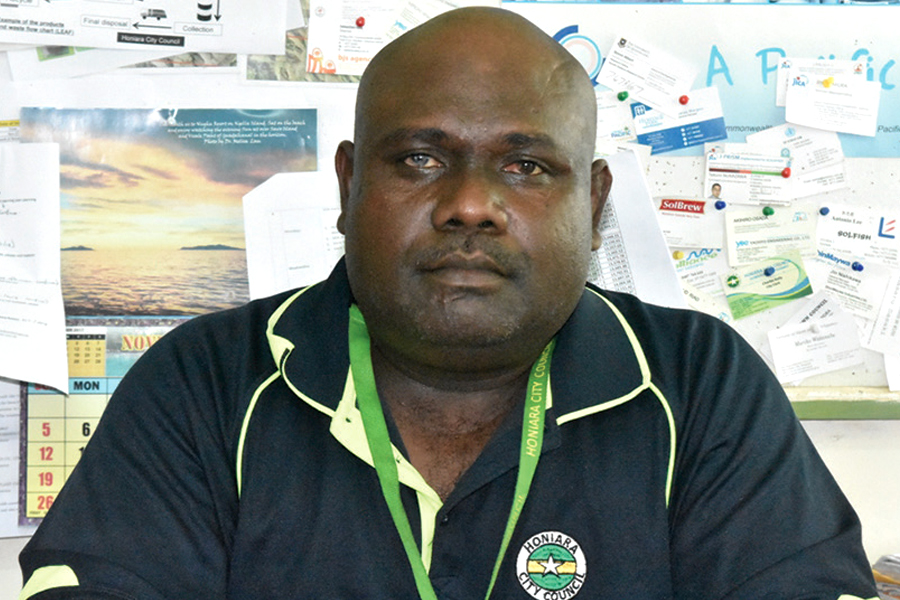
George Titiulu, Head of Environmental Health Division at the Honiara City Council.

By Ezekiel Talatau          

LITTERING ordinance has been enforced since 2009 but lack serious action, it is reported.

Honiara City Council (HCC) health inspector Mr George Titiulu on Wednesday explains that there are two types of littering – major and minor.

Major littering is rubbish that are bigger than the drum height, which Titiulu says is an offence.

Minor littering involves throwing rubbish from a vehicle or seven metres from one’s boundary.

Titiulu said under the littering ordinance, major littering charge fee is $10,000 and minor littering is $1000.

Titiulu shares that on May 31 this year he caught a person littering by throwing a cigarette butt onto the ground, and he fined him on the spot.

He asks the public to take extra care when throwing rubbish because if HCC staff manage to catch anyone in the public littering they will take action.

“Friends of the City is doing well in cleaning up our city for the past few days and we citizens should be responsible in looking after our city. Such activities will also contribute in creating a better environment as well as it will help us reducing plastic waste in around Honiara.”

SPREP establish information centre

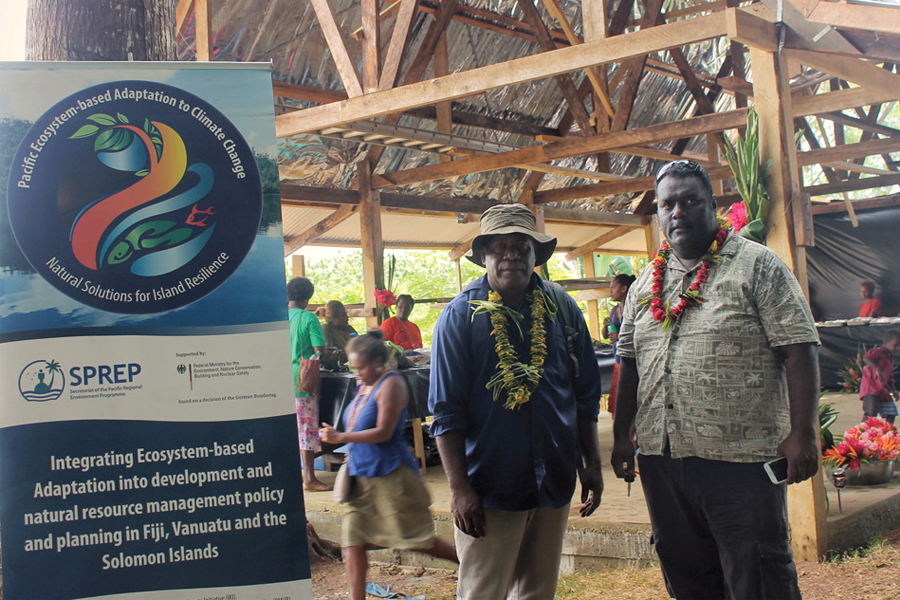
SPREP Country Manager Mr Fred Siho Patison and Chairperson for Barana Community Nature Park Mr Willie Besi picture forefront of the Environment Information Centre

BY LYNTON AARON FILIA

SPREP Country Manager Mr Fred Siho Patison and Chairperson for Barana Community Nature Park Mr Willie Besi picture forefront of the Environment Information Centre

SECRETARIAT of the Pacific Regional Environment Programme (SPREP) has established an environment information centre at the Barana community.

The information centre will be used for disseminating information relating to environment while visitors in-country and out-side country access the Barana Community Nature Park.

The centre is also a hub for trainings and awareness for the Banara community.

SPREP Country Manager Mr Fred Siho Patison explained the building is not a SPREP administration block but an environment information centre.

He said it is a central place for Barana community to do trainings, store awareness materials and also making decisions.

He also adds it is a hub for information about environment and one stop-shop for eco-tourism for over sea visitors who need information before doing any expedition or hiking around the nature park.

Patison said such information centre is very important as it will contain crucial information relating to waste management, climate change and environment related issues in Solomon Islands, Pacific and globally.

It will come in a form of pamphlet, booklet, posters, research, reports, photos and videos, he said.

“We want to build the information centre in a long term one, so we want the government to come and support us,” Patison said.

Chairperson for Barana Community Nature Park Mr Willie Besi said the community has appreciated the SPREP’s initiative to establish an Environment Information Centre and the Nature Park.

He said such initiative will educate people more on ecosystem and raise awareness to see importance of environment and forest towards livelihood of the Barana villagers.

SPREP is an intergovernmental agency which Solomon Islands is also a member country.

Plastic bags pollution high in Honiara

0

BY LYNTON AARON FILIA


PLASTIC bags is the highest contributor of plastic pollution in Honiara, it is reported.

A Ministry of Environment, Climate Change, Disaster Management and Meteorology (MECDMM) report says plastic bags is recorded as the highest among 20 types of rubbish collected per day.

From the litter boom demonstration survey at the Mataniko River MECDMM carried in 2015, plastic bags account to 170, followed by film like plastics 163, plastic bottles 65, ice block 8 and soft plastic 7 – per day.

According to the J-PRISM project report collaborated with the Honiara City Council, Honiara City is estimated to generate solid waste of 80 tonnes per day with total amount of 29,000 tonnes per year.

Organic waste is estimate to 40-50 percent, and if urban population increases at its current rate, solid waste generation is expected to double within 18 years, the report said.

In the pacific, around 1.8 trillion bits of plastic waste have accumulated along a single stretch of the Pacific Ocean between Hawaii and California, a new report shows.

The report found amount of plastic buildup across the pacific ocean in terms of debris could be as much as 16 times higher than previously findings.

Trawling the seas for floating plastic waste, the research team retrieved bottle caps, discarded fishing nets, toys and degrading containers.

The 80,000 tonnes of litter estimated to have gathered in the patch translates to 250 discarded pieces per person around the world.

With the high polluted plastic debris in Solomon Islands, Permanent Secretary for the MECDMM Dr Melchior Mataki said cabinet has endorsed a new waste management and pollution control strategy.

He said the strategy includes policy direction to address plastic pollution.

Mataki also adds his Ministry together with SPREP through the SPC Ridge to Reef project will strengthen focus on the Mataniko catchment and Honiara coastline which described as hub of plastic debris.

To manage littering in Honiara city, HCC’s Chief Inspector Mr George Titiulu said they will re-enforce the Honiara City Council 2009 litter ordinance.

He said the ordinance has been there, and if officers find individuals, residence and shops within Honiara City littering, they will be fine with $1000 on minor littering and $10,000 for major littering.

Titiulu said this actions a part of rubbish management in the city which includes plastic pollution and other solid wastes.

Titiulu said rubbish management in Honiara is everyone’s business and HCC welcomes any initiative from communities.

He commended the Friends of the City for taking a step which shows they have concern over Honiara.

This year, the World Environment Day is celebrated under the theme: “Beating Plastic Pollution”.

Solomon Islands is part of the global campaign to educate people about managing plastic pollution.

Lack of training and poor data identified as key challenges for land valuers in SI

0

THE Solomon Islands Valuers Association conducted a workshop with Australian valuers to identify the main challenges in their work and look for ways to improve land valuation processes in Solomon Islands.

The workshop, arranged through the Pacific Community (SPC) with financial assistance from the Government of Australia, brought together licenced valuers from across the Solomon Islands, to meet and learn from Australian valuers David Sullivan, Paul O’Kelly and Steven Venter from International Valuation & Property Services (IVPS).

At the workshop, the valuers discussed criteria that contribute to land values, such as location, topography, services available on the land, the lot area, along with other important factors that influence the market value of land.

Issues raised and discussed at the workshop included the influence of clients, the lack of reliable sales data and the lack of training and formal guidance currently available to valuers in the Solomon Islands.

Speaking after the workshop, Valuer General Joyce Galo said “this was a very useful opportunity to bring valuers together, to point out our mistakes and so we can start to work out how to improve land valuations and stamp duty collection in the future.

“We will be working more closely now with the Inland Revenue Division to identify under-reporting of land valuations, and to ensure that stamp duty is paid based on the transfer consideration of the land, not just the unimproved value of the land.”

SPC’s Alan McNeil highlighted the importance of the workshop, and praised the commitment shown by the Solomon Islands Valuers Association to improve their professional capacity saying, “Valuers to date have lacked the guidance needed to produce reports based on uniform, consistent criteria, and this inevitably has led to questions being raised about the accuracy of land valuations.

“We are now helping valuers to develop a reliable, accurate, and professional system for determining land valuations, as a means of contributing towards national development goals.”

The valuers from IVPS will be engaged by SPC until October, during which time they will assist the Valuer General and her unit to develop stricter criteria on how land is valued in Solomon Islands, which can then be adopted by the valuation profession.

–MLHS PRESS

Honiara High hosts last Mandarin awareness activity

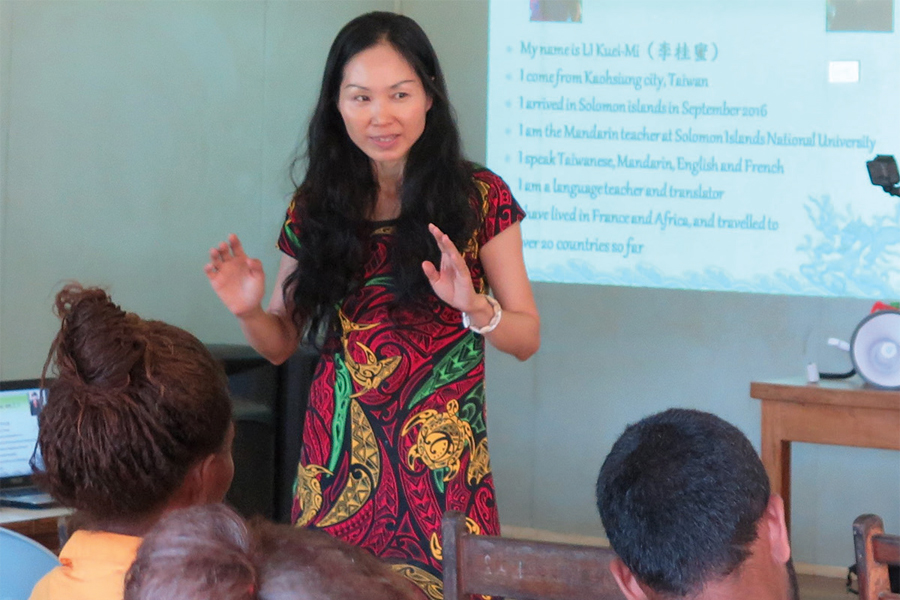
M Li delivering her presentation.

BY LORETTA BRIGIDIA MANELE

M Li delivering her presentation.

ON June 1, SINU’s Mandarin teacher from Taiwan, Ms Kuei Mi Li held her fifth and last Mandarin awareness activity on language and Taiwan culture at Honiara High School.

She expressed that like other students whom she had encountered during her touring, the students have shown intense interest and warm welcome for her presentation, stimulating and gratifying.

Students showed great interest in the presentation with one of them, Alickson Dalu stating that his most favored part of the session was when they were taught how to sing and learn Mandarin.

Ms Li was also assisted by one of her students, Ms Agnes Menapono who spoke and sung to the students in Mandarin.

Ms Menapono said that by the look on their faces, she could tell that they loved the presentation and were interested in to learn more about Taiwan and Mandarin.

“When I spoke and sang in front of the students, I felt nervous, a little bit but I liked it. Speaking and singing Mandarin in front of them made me feel like I was telling them that learning Mandarin is fun, you know singing, dancing and of course the fact that Mandarin is totally a different language but is very important for Solomon Islanders to learn,” she said.

Honiara High students enjoying the presentation.

Li who will leave for Taiwan and return in August stated that she wants to take advantage of this trip and bring back some more interesting linguistic and cultural elements to share with students in Solomon Islands.

“It’s always my concern to motivate the students to learn, whether it’s the language, the culture, or anything that’s relevant to our world,” she said.

Li mentioned that while in Taiwan she also wants meet with Solomon Islands students who are currently in their first year of studying Mandarin.

She added that they were her students at SINU so she wants to see how they are progressing in their Mandarin learning as well as how they are adapting to the Taiwanese lifestyle and culture.

Li who is also fluent in French with a linguistic background looks forward to returning to the country with more interesting things to pass on to students.

“I look forward to coming back to Solomon Islands with refreshed energy to pass on to the students of the Hapi Isles,” she said.

Students from some of the schools Ms Li visited have all shown interest in learning the Mandarin language while picking up brief information about Taiwan and the Taiwanese culture.