Student girls dancing in their traditional outfit.
BY SAMIE WAIKORI
AUKI
ST John Dala Catholic Secondary School in West Kwara’ae held its 8th annual cultural festivity on Friday last week.
The school cultural event was celebrated with the theme, “Unity and diversity of cultures through singing and dancing”.
Chairman of the cultural festivity organising committee, Mr Lawrence Alufurai said the event ensures students learn, promote and showcase their cultural diversity.
“The aim of education is to help children to develop mentally, physically, morally, socially culturally and emotionally.
“The programme was part of it as we try to ensure students to learn on all these development aspects especially their cultures,” he said.
Student girls dancing in their traditional outfit.
Alufurai said the event is held annually and is a special day in which the school and its students showcase various cultural uniqueness they represent.
Guest of honour Fr James Anisia who was the administrator of the diocese of Malaita applauded the school for seeing the importance of culture and heritage.
He praised the initiative and assured the school to continue with the programme so that students going through the schools to learn and uphold their cultural identities.
On the same note, Anisia also appealed to parents of Dala School to set pride in their children by reminding them of their cultures.
He stressed that the kids won’t know their cultures if parents don’t take time to teach their children.
The day gathered more than 500 students of Dala secondary school, the primary division, staffs, parents and supporters to witness the cultural festivity.
Students made up 10 cultural groups namely East Road dancers, Dala North, Fote, Kakara, Kwaisuliniu & Highlands, Dala South, Bubuitolo, Southerners, North Malaita and Polynesian dancers.
Kwaisuliniu and highland dancers presenting their cultural dance.Fote boys presenting a cultural dance during the show on Friday last week.
Some of the students of St John primary school with JICA Volunteer. (INSERT) JICA Volunteer, Honami ready to show students how to plant seed in a cut-out bottle with soil
STUDENTS of St John Primary school this week had an opportunity to learn new skills and knowledge on how to plant tree using simple processes and method.
Honami Kanehori, a Volunteer under the Japanese International Cooperation Agency (JICA) who works with the National Herbarium and Botanical Garden Division of the Ministry of Forestry and Research leads the programme.
Ms Kanehori told the students ‘the importance of trees to us expressing it since the beginning; trees have furnished us with two of life’s essentials, food and oxygen’.
“As we evolved, they provided additional necessities such as shelter, medicine, and tools.
“Today, their value continues to increase and more benefits of trees are being discovered as their role expands to satisfy the needs created by our modern lifestyles,” she adds.
Some of the students of St John primary school with JICA Volunteer. (INSERT) JICA Volunteer, Honami ready to show students how to plant seed in a cut-out bottle with soil
She emphasises that as students at a very young age, “they are the generation with power in your thumb to make that change and help replace the trees that we have used”.
Students were also shown practically how to use waste water bottles or empty cup noodles, to grow seedlings and plant the seedlings in an open environment.
This simple process with the use of simple illustration of pictures drawn in the form of flow charts gave the students a good understanding of the tree planting process.
The awareness programme is a continuous effort of the Ministry of Forest and Research together with JICA in getting the basic tree planting skills and knowledge to the young age especially students who are future generations of this country.
AWARENESS programs organised by the Fataleka Peoples’ Power committee is currently underway in West Fataleka for the 2019 national general election.
Chairman of the Fataleka People’s Power Mr Robinson Ratu said that a series of awareness programmes for West Fataleka communities for Phase 1 began yesterday, and will end next month.
Phase 1 is an awareness programme to remind the communities in West Fataleka to come up with the names of possible candidates for the preliminary election which will be carried out after the registration and after the voters list is finalised.
Ratu said, “The second Phase of the Programme is the Preliminary Election, and the third phase is the declaration of a one candidate for West Fataleka to contest in the upcoming national general election representing the people of West Fataleka in the Fataleka constituency.
“Whilst the fourth phase is the fundraising drive for the campaign and the fifth phase is the campaign.
“The declaration of Mr Rex Taude of Ata’a, East Fataleka by Mr Severino Maegwali (an individual not the People’s Power Committee) to represent West Fataleka People’s Power is illegal and does not represent the interest of the people of West Fataleka because it by passes the procedures and processes under the policies and the system of the People’s Power Network.
“The delegation led by Taude to East Fataleka last month in the name of People’s Power was propaganda which is false and not right.
“The move was to deceive the people of East Fataleka because the People’s Power is yet to go through the Preliminary Election for a one candidate sometimes in December, this year and not the false move initiated by Mr Rex Taude and Mr Maegwali.
“I call on the Fataleka people to follow what has been initiated by the Fataleka peoples’ power as we are now approaching the registration period for the national general election.”
TWO days of Community Base Resource Management training (CBRM) has been conducted in Auki, ending on Friday last week.
The training was facilitated by the Fisheries department in collaboration with the environment department and World Fish.
Speaking to this paper, principal fisheries officer (PFO) of Malaita province Mr Martin Jasper said the aim of this training is to train trainers or facilitators concerning the marine resource management within their communities.
He said this training is also to develop the management plans in their communities’ aswel.
This is the first group of trainers to attend this very important training; the second group will undergo the same training.
“25 participants underwent the training last week where we will expect the number will be increasing on the second set of training starting today.
“After these trainings we will organise and do monitoring programmes whether these trainers are doing their works in their communities or not.”
Jasper added the basic idea of such training is to manage marine resources along the coastal areas where it has being mismanaged and unprotected.
At the moment the fisheries office in Auki have drafted Management plans for 11 communities around Malaita province.
“These drafts will be gazetted where we will be looking at creating ordinances or guidelines as an act and it will be become legal.”
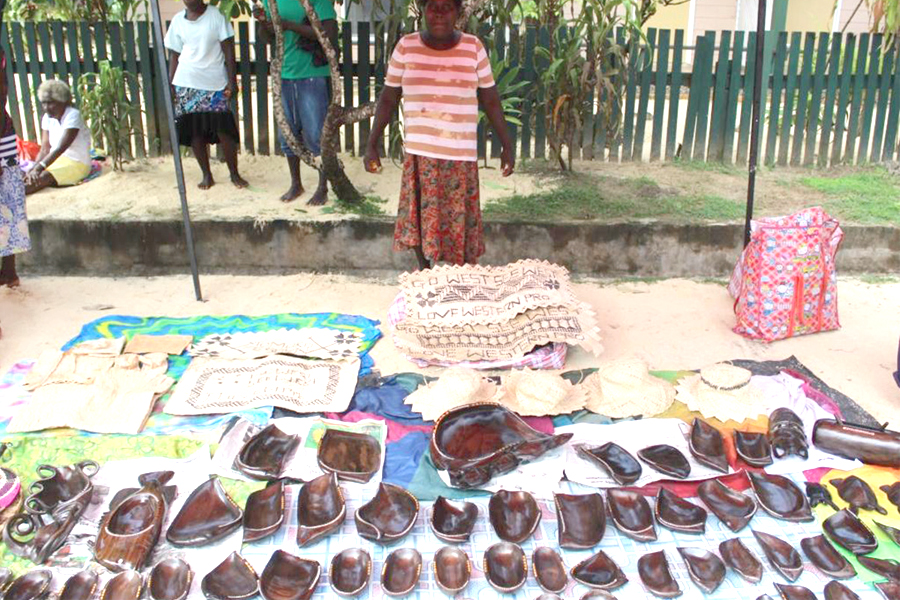
A local carver from Ranonga Village with her carving in front of Gizo Hotel.
BY ALFRED PAGEPITU
GIZO
A local carver from Ranonga Village with her carving in front of Gizo Hotel.
CARVERS from Marovo, Ranonga, Roviana and Vella la Vella are calling on the newly formed government led by Premier David Gina to build a centre for local carvers in Gizo.
This is to accommodate wood carvers, stone carvers and others, especially mothers while they vend their products in the province’s capital.
A spokesman Harold Pae said that when it comes to Cruise Ship visit to Island Capital Town, Gizo is without a proper cultural house for carvers to showcase their wood, stone carving and other traditional items.
“Western Province is the highest number of carvers but the government have fail to accommodate its people from Shortland Islands to Marovo lagoon who wish to showcase the carving during Cruise Ship visited Gizo.
“We are calling on the newly formed government to build one cultural house somewhere in Gizo to focus on capturing the attention of tourists and customers especially those who keep visiting Gizo Island.
“Carvers now seek fairness with those who run their own museum and private business in Gizo why not the government won’t prioritize local carvers to do daily promotion and marketing.”
He said past governments have failed to build a cultural site for local carvers.
“We hope that the current government will plan something special for all local carvers in the province.”
HONIARA is expected to receive 28 Taiwanese youth ambassadors this week for an exchange programme.
The 2018 Youth Ambassadors of the Republic of China (Taiwan) comprises of 28-members youth group who will be visiting Solomon Islands from August 28—September 1 to engage in youth exchange programmes.
The Youth Ambassadors Exchange Programme is run by the Ministry of Foreign Affairs of ROC (Taiwan) which is an important part of the government’s efforts to promote public diplomacy and help Taiwanese youth participate in international affairs.
This year’s programme has four main pillars such as seminars and forums, volunteer work, various visits, and cultural diplomacy, which will allow for an even more immersive experience than in previous years.
The youth ambassadors will also put on artistic performances.
The highlights of this year’s youth exchange program include the culture performance, joined with Betikama College, St Nicholas College and St Joseph’s Tenaru School, at Seventh-day Adventist Church’s Maranatha Hall.
According to the Taiwan Embassy in Solomon Islands, the event is free and open to the public on the principal of “first comes, first served” due to limited space.
Embassy said public is encouraged to arrive 20 minutes in advance of the scheduled time.
During their stay here, the ROC (Taiwan) youth group will also call in at the Prime Minister’s Office, and pay a visit to the Solomon Islands National Parliament.
It said their goodwill visit will further strengthen the long-standing friendship and diplomatic ties between Taiwan and Solomon Islands.
The Embassy adds, the Youth Ambassadors will get to know Solomon Islands and its political, cultural, academic, and development institutions.
There will also visit to the Ministry of Culture and Tourism, JICA, Solomon Islands National University, Red Cross’s Special Development Centre, as well as the Taiwan Technical Mission.
THE numbers of sightings of the coconut rhinoceros beetle is increasing unabated in Western province, it is reported.
Concerned members of Gizo public are calling on authorities to step up and address the problem.
While making the call on authorities, the concerned people are also calling on fellow members of public to help in whatever way they can to stem the increase of the pest.
A Mr Tano says, “Seeing that most coconut trees within Gizo are now affected by rhinoceros beetle we cannot control the spreading now.
“We need everyone must work with alongside Gizo Bio-security Division Gizo to control the spreading of these most World dangerous beetle.
“People are fear over the spreading, especially copra farmers from Ranonga, Vella la Vella and other surrounding Islanders who feared the spreading because the beetle is rated among the most invasive species in the world,” Tano said.
A Mr James Pado, from Ranongga, says people from his island are fearing for their future over news that the pest is spreading in the province.
First feamle MP of Solomon Islands Hilda Kari (left)
BY MAVIS NISHIMURA PODOKOLO
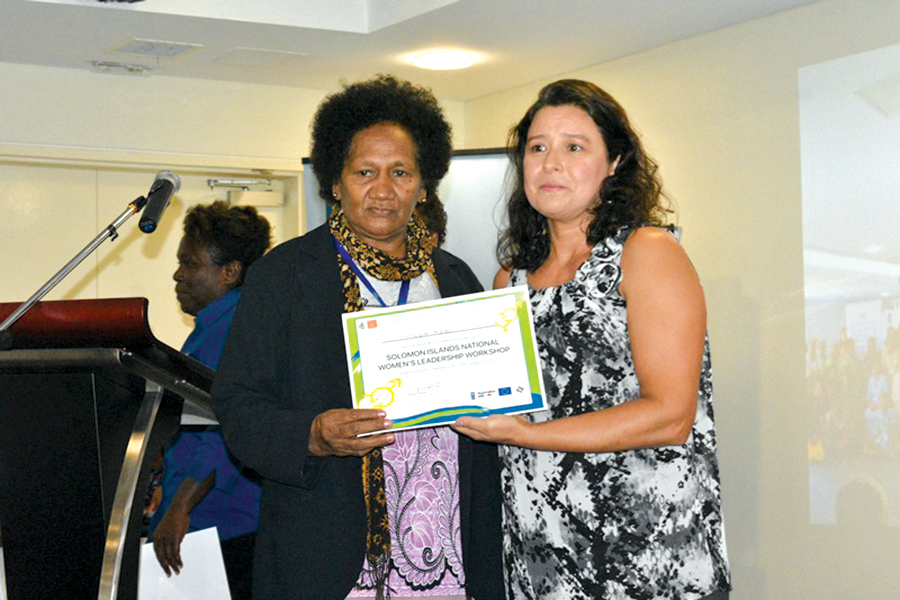
THE Solomon Islands National Women’s Leadership Workshop has successfully completed its four-day programme to prepare aspiring women candidates for the upcoming national general elections and future elections.
The training involved women across the nine provinces and women who reside in Honiara who aspire to be in the national and provincial office.
Speaking at the closing ceremony the Australian High Commissioner to Solomon Islands His Excellency Roderick Brazier encouraged the participants to keep on fighting and aim high.
“Keep on fighting, keep on jumping higher and really look forward to see many of you women in the Solomon Islands leadership positions in both national and provincial offices
“It has been a fruitful workshop involves a wide range of people with different views and approaches.”
Brazier voiced that having more women in parliament is good for the whole country in terms of decision making.
The workshop was implemented by Strengthening the Electoral Cycle in the Solomon Islands project (SECSIP) in partnership with Solomon Islands Electoral Commission (SIEC) and is funded by Australian government, the European Union (EU) and the United Nations Development Programme (UNDP).
First feamle MP of Solomon Islands Hilda Kari (left)Crispin Dora (left) with her certificateEdit Dagi recieves her certificateHon Rhoda Sikelabu receives her certificate of achievementJessica Noere recieves her certificate from the Australian High Commissioner Rodrick BrazierLaneita Leo shares the joy of achievement with HE Rodrick BrazierNanet Tutua with her certificateRuth Waririu with her certificate
DEAR EDITOR, last week saw the launching of the Solomon Islands Youth Status Report 2018
I welcome this initiative and very much hope to see much greater-youth-political participation than I have observed over the last two decades in the Solomon Islands.
During the launching of the official report, the Hon. Minister for Women Youth Children and Family Affairs, Ms Freda Tuki, said as Solomon Islands was embarking on a new set of SDG’s and a national development strategy, it was important to recognise young people’s roles as key stakeholders in achieving such goals.
She added today’s young generation would inherit and drive the future development of Solomon Islands.
Also speaking at the launching ceremony for the Solomon Islands Status Report 2018, Ms. Azusa Kubota, the United Nations Development Programme (Solomon Islands) Country Manager, was quoted as having said, “If the nation wants to boost its economy, foster positive change and meet the 17 SDGs which are aimed at bringing prosperity to all by 2030; then it must engage youth politics and youth civic participation.”
Ms Kubota was also understood to have said the UNDP under the United Nations Peacebuilding Fund Project in Solomon Islands was currently working to provide platforms for dialogue and empowerment to help youth across the country act as agent of change.
I very much look forward to being able to witness better employment opportunities resulting in jobs and the engagement of youths in politics and civic participation which, as I have mentioned, has not been evident for far too long.
Ms Kubota particularly mentioned the greater participation of youths in helping to meet the 17 Solomon Islands Development Goals (SIDG) by 2030.
While I agree with what Ms Kubata has said about youth participation in relation to the SIDG targets for 2030, I have to say that a very much bigger obstacle in reaching the targets lies in the fact that substantial challenges remain in the prevention and control of infectious diseases and NCDs, and in urban and environmental health.
According to the United Nations (UN) Solomon Islands has among the highest rates of malaria incidence, of mortality attributed to exposure to unsafe water, sanitation and hygiene (WASH) services, and of mortality attributed to unintentional poisoning, compared to other countries in the Region.
Speaking at a press conference in Honiara last year, the National Advisor for Non Communicable Diseases, Dr Geoff Kenilorea, reportedly said non communicable diseases like diabetes, stroke, and heart attacks were increasing. He also said two-thirds of beds at the National Referral Hospital were then taken up by patients with non-communicable diseases.
Non-communicable diseases (NCDs), including heart disease, stroke, cancer, diabetes and chronic lung disease, are collectively responsible for almost 70 percent of all deaths worldwide.
Almost three quarters of all NCD deaths, and 82% of the 16 million people who died prematurely, or before reaching 70 years of age, occur in low- and middle-income countries. The rise of NCDs has been driven by primarily four major risk factors: tobacco use, physical inactivity, the harmful use of alcohol and unhealthy diets.
At home real challenges remain in service capacity and access and in infectious disease and non-communicable disease (NCD) prevention and control, specifically in lowering blood pressure levels, tobacco use and access to improved sanitation.
Sam Alasia the President of the Pioneer Movement in Solomon Islands (standing left). The photo taken after facilitating the Pioneer Movement programme this month on the 18th at Tamalupo local
church, Kakabona Tanagai Parish. Photo supplied.
BY BARNABAS MANEBONA
A one-day training workshop called the Pioneer Movement programme was held at Tamalupo local church, Kakabona Tanagai Parish, on August 18.
According to Sam Alasia the President of the Pioneer Movement in Solomon Islands, about 15 leaders including several youths from Tanagai Parish attended the program.
The Pioneer Movement is a Ministry in the Catholic Church that prays and encourages people who have problems with alcohol and drugs to abstain from taking them.
Mr Alasia said the training programme was facilitated by Michael Liliau, Christiano Van Der Laar, himself and the leaders of the Pioneer Movement in the Archdiocese of Honiara.
Sam Alasia the President of the Pioneer Movement in Solomon Islands (standing left). The photo taken after facilitating the Pioneer Movement programme this month on the 18th at Tamalupo local church, Kakabona Tanagai Parish. Photo supplied.
“Christiano the first Speaker highlighted that although the Pioneer Movement was started in Dublin, Ireland, in 1898 by a priest and 4 women who were concerned with the drinking habits of their husbands, and even though the movement reached Fiji in the early 1960s, it was not until in 2005 it was introduced here in the Solomons.
“Fr Joe Tuimavule and Romanu Ticoticoca both from Fiji started the movement in Honiara in 2005. Romanu was working under RAMSI in the area of community policing.
“The movement now has about two million members throughout the World and that its membership is not restricted only to the Catholic Church.
“The second speaker was Michael Liliau who in his presentation pointed out that there are usually 4 stages of drinking alcohol.
“The first stage is when a person takes 1 can of beer to 4 cans.
“This first stage is known as the happy stage and normally people are not intoxicated at this stage, they can still know what is going on except that they are happy and laugh more than in normal situations.
“The second stage is when a person takes five cans to 10 cans of beer.
“This stage is known as the excitement stage. The third stage is when a person takes in 11 cans to 18 cans of beer.
“This is the stage where a person can become stupid and acts irrationally.
“And, in the fourth stage from 20 cans upwards, the person becomes confused, aggressive and thinks that he owns the world.
“It is normally from the 3rd and 4th stages of drinking that the root of such problems as domestic violence, robbery, rape and murder can occur.
“The person is not able to think carefully about his actions. So it is better that people who drink should stop drinking when they are either in the first stage or second stage. People who drink alcohol should know their limits,” stated Alasia in his report.
The third Speaker for the day being Mr Alasia himself emphasised that in the European, Jewish or Polynesian cultures are disciplined in their drinking habits.
“For example in Fiji or Tonga, they have kava which their people respect.
“It is part of their culture. In the Solomon’s we do not have such a drink in our culture so people do not know how to be disciplined and respect alcohol.
“People who drink should train themselves to know their limits and that if their limit is 6 or 7 cans of beer then they should respect that choice and be disciplined to avoid going into the 3rd stage,” said Alasia.
Alasia also pointed out that according to the relevant statistics, about 80 percent of inmates go into Rove prison mainly because of alcohol related crimes and that Solomon Islands have not tackled the root causes of these problems.
He added that the government has not been serious in addressing alcohol and drugs problems in the country.
“This is a great concern and that the new government formed after the national elections in early 2019 should come up with a policy to work together with the churches to address this problem.
“Immediately after the ethnic crisis, the National peace council and RAMSI came up with weapons free communities.
“Any new government should have in its policy a strategy to have alcohol free and drugs free communities in Honiara and in our provinces as from this, we can be able to see a decrease in crime rates.”