Home Blog Page 1154

Atoifi Adventist hospital receives urgently needed drugs  

0
Lester Asugeni of PAU receives a carton of drugs for Atoifi hospital from the Commercial Manager of SIPA Glyn Joshua.

By Alfred Sasako

Lester Asugeni of PAU receives a carton of drugs for Atoifi hospital from the Commercial Manager of SIPA Glyn Joshua.

IT is not always the case that hospitals turn to semi commercial organisations for help. But today times are hard – harder for some than others – including government institutions.

And while some remain quiet, others have reached out and are heard. One such institution is Atoifi Adventist Hospital in East Kwaio on Malaita.

This week the Solomon Islands Ports Authority (SIPA) came its aid, providing $26,860 worth of urgently-needed drugs for the hospital.

The first batch of largely tablets, weighing 13.45kg left Honiara on a Solomon Airlines midday flight yesterday freight free. The second batch of injectable is on order from overseas and is expected to arrive in Honiara next weekend.

SIPA’s Chief Executive Officer, Eranda Kotelawala, who approved the support to the Hospital, was unable to handover the donation yesterday. Mr Kotelawala was engaged with a visiting Asian Development Bank (ADB) team.

His Commercial Manager, Glyn Joshua, stepped in to present the carton of drugs to Mr Lester Asugeni, who received it on behalf of Atoifi Adventist Hospital. Mr Asugeni is in charge of the Pacific Adventist University (PAU) which has now set up a base at the Hospital.

Mr Joshua’s father had a long association with the Hospital and the people of East Kwaio. He said SIPA is always willing to assist causes such as the shortage of drugs which Atoifi Adventist faced in recent months.

“It is my hope this support from SIPA will go a long way in saving lives, not only of the people of East Kwaio but also those who come to seek medical help from the hospital.

“We are happy to assist. This is a worthy cause and SIPA is more than pleased to be associated with it,” he said.

Mr Asugeni who once worked at the Atoifi Adventist Hospital before he joined PAU in Papua New Guinea where he graduated with a Master’s degree said SIPA’s assistance is deeply appreciated.

Tourism Ministry starts rolling out new programme

0
Permanent Secretary for Ministry of Culture and Tourism Andrew Nihopara

By Gary Hatigeva

THE Ministry of Culture and Tourism (MCT) has started rolling out its newly introduced Minimum Standards and Classification for Tourism Accommodation programme, which was adopted in the middle of this year.

This was confirmed to Island Sun by Ministry’s Permanent Secretary, Andrew Nihopara in an earlier interview this week.

Last week, Ministry officials were out in four provinces, including parts of Honiara, holding awareness activities on the programme with tourism operators particularly, the accommodation service providers.

Nihopara explained that the awareness comes as part of the first phase of the roll out for the programme, which is done in three rounds of visits.

He said operators will be given insights to the programme, which is pretty much getting people to understand its application and how it will be helpful and beneficial for both the ministry, and particularly the operators.

Meanwhile, the Ministry’s Director of its Tourism Division, Bunyan Sivoro in an interview yesterday confirmed and further explained that the rounds will also include assessment activities.

Sivoro said in the assessment aspect, officials will look to determine whether existing operators fulfil the categories of classifications, and then to be followed by reports that are expected to help operators understand their status or upgrade if need be, to meet the minimum standards.

The Minimum Standards are a set of measurable criteria that outline items and services that must be in place for a tourism accommodation to operate, according to internationally recognised standards.

There are eight categories under the minimum standards and classification programme, and according to the Director, it is from this programme, accommodation providers will then be classified into one of eight categories, which include ‘Hotels, Resorts, Lodges, Backpackers, and four others.

The Tourism Director said currently, some operators are wrongly naming the status of their accommodation services and the programme will ensure that tourists are not misguided by these statuses, with anticipation to have at least the percentage that is actively using these programs, are properly classified.

He added that there are were worries expressed by some operators on the issue of development capacity to meet the standards, fearing they might lose out on business if they are to upgrade or be part of the programme.

But the Director is encouraging all operators to try as it (programme) will come back to benefit their operations with proper ratings or categories, which will also help guide the ministry and responsible authorities in their programmes as far as marketing the right standards are concerned.

“To be known properly in terms of status and be involved in a competitive market, it is important that operators get involved so to know exactly their status, and based on reports, if they wish to upgrade to another category, they can do so, and this will also give them the confidence to be part of whatever potential markets out there.

“Operators’ participation in this programme is also important because, often at times, tourists are have been mislead on the advertised status of accommodation services, who in most cases, only come to realise that operations are actually lower, and with this, businesses can lose reputations,” Mr Sivoro explained.

When questioned, the Tourism Director revealed that so far, based on the first round of visits, three operators have been identified to have undervalued or used lower standards but are qualified to be upgraded straight away.

All in all, the MCT Director of Tourism explained that while people will feel uncomfortable about this programme, the main benefactors would eventually be the tourism operators themselves.

“The tourism department is very excited about this new chapter in the development of our tourisms sector, and note that it is our wish to see it grow to the country’s advantage,” he said.

This programme has also got Tourism Solomons Chief Executive Officer (CEO) Josefa ‘Jo’ Tuamoto excited, describing the move as a major step in the right direction for the country’s tourism industry.

CEO Tuamoto in an earlier statement, said the introduction of the programme was timely in view of the efforts Solomon Islands has gone to in recent times to increase its profile on the international tourism stage.

“This long-awaited but carefully laid out program will act as a catalyst for the local tourism accommodation sector to take a holistic approach to service excellence,” he said.

Officially launched by the Minister for Culture & Tourism, Bartholomew Parapolo at Honiara’s Heritage Park Hotel, the main thrust behind the programme is to implement what is seen as an essential improvement of standards in the tourism accommodation sector.

Currently there are 160 accommodation providers operating in Solomon Islands but only less than a quarter of these can be sold by international wholesalers offering Solomon Islands travel packages.

Despite only agreeing to three rounds of visits, the Tourism Director has assured that because not all may have been covered by then, and the ministry will continue with a few more visits after, which he suggested that by then, many would be ready to take part in what has been described as, a very important programme, as far as taking the tourism sector in the right direction, is concerned.

Gilbertese re-settlement an example why policy is eminent for re-settlers

0
Dr Tammy Tabe who is the third generation of Gilbertese living in Wagina

BY GEORGINA KEKEA

Dr Tammy Tabe who is the third generation of Gilbertese living in Wagina

A resettlement policy is the way to go when dealing with relocation of people. This sentiment was shared by Dr Tammy Tabe, a third generation of the Gilbertese people in Wagina, Choiseul province.

During the recent draft resettlement policy workshop held by Ministry of Lands, Housing and Survey, Ms Tabe was one of the speakers and academics that contributed to the development of a national policy.

Tabe says as a descendant of migrants, she knows and understands the challenges her people are faced with. She said this national policy will safeguard the future generation.

In her presentation, Tabe says resettlement issues are both man made and of natural causes.

She made reference to the people of Gilbert Islands as a case study for the resettlement policy. She said migration can also happen domestically and government need to prepare itself.

She said growing up she had heard stories from her grandparents about their migration and what it meant to them.

She said imagine leaving the place you know all your life to go to somewhere unknown and unheard of. That’s what her family went through when they came to the Solomon Islands.

‘Some went to Gizo and our family came to Wagina,” she said.

She said, based on the experiences her people had gone through, a national policy for resettlement is a must.

Solomon Islanders living in low lying atolls are at risk of sea level rise and losing their home because of climate change, thus a national policy must safeguard them if/when they have to leave their home island to relocate elsewhere.

“Land is always an issue here in Solomon Islands and this National Policy must consider the ownership of land and how government can go about acquiring land for relocation purposes,” Tabe said.

The Gilbertese re-settlement scheme was undertaken by the British Government in the 1950s.

This was made possible, because at that time, the British Solomon Islands Protectorate and the Gilbert islands were administered by Britain’s Western Pacific High Commission.

Due to poor soils and low rainfall that had caused famines, the British Government through the Western Pacific High Commission decided to relocate the people of Gilbert Islands to the Solomon Islands.

“The only problem for us then was we didn’t think much about the ownership of the place in which we were relocated to.

“We heard that our grandparents were shown the place which we now call home as ours and were led to believe that we own the land.

“However, the ownership of the land is in question and we are in doubt of the land ownership because there was nothing in the records to show that we own the land,” Tabe said.

She said Solomon Islands must learn from the Gilbert Islands case and come up with a proper resettlement policy.

Tabe is a Lecturer at the University of the South Pacific (USP), Laucala Campus.

Previously while studying at the USP she had decided to explore the relocation history of her people where she provided a comprehensive account and analysis of this forced relocation.

She had hoped her research will contribute significantly towards policy-making and governing for Pacific Island states that are being affected by climate change and whose people may become subject to future relocation.

Great come back

Ministry of Provincial Government and Institutional Strengthening (MPGIS) Permanent Secretary Mr Stanley Pirione

Central province bounces back in PCDF to get first place


 BY GEORGINA KEKEA

 CENTRAL Provincial Government has bounced back from being disqualified and denied funds in 2015/16 to take first position in this year’s assessment of Provincial Capacity Development Funds (PCDF).

In a statement released by the Ministry of Provincial Government and Institutional Strengthening (MPGIS), Permanent Secretary (PS) Stanley Pirione congratulates the Central Islands Premier and his hard working administration officers in Central province for the job well done.

“I would also like to congratulate the eight provinces for meeting all the eight minimum conditions for access to the PCDF in 2018/19,” Pirione said.

For provincial governments to have access to PCDF, they must meet all the minimum criteria set out by MPGIS.

Provinces are, however, given a chance to appeal and be reassessed.

If a province does not qualify, it receives only 20 percent of its basic allocation to enable it to continue with its ongoing projects.

However to have access to anything the following year, it has to meet eight minimum conditions.

50 percent of the PCDF is allocated to provinces based on the minimum criteria whilst the second 50 percent is distributed based on scores secured in the performance assessment.

There are eight performance measures with 100 indicators and what the province gets in terms of resources is determined by a score.

“That table shows Central Province taking the lead followed by Isabel whilst Temotu came third,” the statement from MPGIS said.

Central province has a score of 59 out of a hundred, followed by Isabel at 52 and Temotu at 51. The lowest is Guadalcanal province with a score of 21 out of a hundred.

Two independent local consultants were hired from January to May 2018 to assess the PCDF report.

Assessment period covered December 2016 to November 2017.

MPGIS hopes to reinstate the fund to its previous level in 2019.

This year’s amount was lowered because of the cut in PCDF allocation, due to budgetary constraints.

Despite the introduction of new minimum conditions and performance measures, all nine provinces qualified by meeting the eight conditions to access their capital development funds for 2018/19.

Malaita prov govt urges youths forward

0
Malaita provincial desk officer Ms Clera Rikimani.

BY GEORGE MANFORD

AUKI

Malaita provincial desk officer Ms Clera Rikimani.

THE Malaita provincial government has publicly encouraged the province’s youths to utilise their skills to build and progress Malaita.

Malaita province desk-officer Ms Clera Rikimani urged youths during the closing of a two-week frontload training under the Youth@work entrepreneurship component organised for youths last Friday at Kilusakwalo.

“I salute you this young generation for what you have learnt during the past two weeks.

“By availing your time and commitments towards this very important training which I see if you could implement what you’ve learnt here you will be successful in your future endeavours.

“Malaita is waiting for you with the potentials you have.

“We want to see changes in our communities especially to carry out what you have learnt here during the past 14 days in your own communities.

“Young women and young men, this nation is counting on you.

“By involving in small business activities and programmes I believe it is a way forward for you young people for a better future.

“Your future begins today, shift from the past failures and launch out into the deep where you can find ways and make use of your potentials.

“I know you will be benefiting from this programme where projects will be given out to each of you after another set of training by the end of this month and I urge you to manage it well and make use of it.

“On behalf of the Malaita provincial government I wish to thank the SPC and the office of the youth @work for organising and the financial support.

“We will continue to work together to bring this young people into a new height and for a bright future.”

Marine survey for undersea cable now underway

0
The delegation talking to Party Chief Sandy Wilson on board Northern Endeavour.

BY GEORGINA KEKEA

WORK on the undersea cable is progressing well. Currently a marine survey is being done by the EGS group of Companies to map out the precise route for the undersea cable from Australia to Papua New Guinea (PNG) and Solomon Islands.

Speaking to the media on Saturday, Prime Minister Rick Hou says this undertaking is a milestone achievement for the three-party agreement.

Hou said his government is optimistic the project will meet its deadline and is thankful to the Australian Government for the support.

“I have assurance from Australia’s new Prime Minister as well of this project,” Hou said.

At the same time, Australian High Commissioner, HE Roderick Brazier says the strong support by Australia for this project is a reflection of Australia’s commitment to the Pacific.

“This project has the potential to be truly transformative for Solomon Islands. It will deliver, faster and more reliable internet,” Brazier said.

He said the project is expected to complete by the end of 2019 and will have the capacity to provide internet service that is 30,000 times greater than to what it is now.

He said this will foster innovation as well as enable communities and businesses to grow.

The delegation talking to Party Chief Sandy Wilson on board Northern Endeavour.

Meanwhile, Chief Executive Officer (CEO) of the Solomon Islands Submarine Cable Company, Keir Preedy says SISCC is in the process of signing Memorandum of Agreements with seafront owners for the landing points of the cables.

Preedy says mostly this will be business agreements with the owners. SISCC will build the necessary civil infrastructure and put necessary equipment in place to receive the cable and distribute it to internet retailers.

“We will sell to any licensed operator in Solomon Islands,” Preedy said.

The current marine survey is expected to take place till November this year (2018).

The Coral Sea Cable System is a 4,700km long fibre optic submarine cable system linking Sydney, Australia, to Port Moresby, Papua New Guinea and Honiara, Solomon Islands. The project also includes a 730km submarine cable system connecting Honiara to Auki (Malaita Island), Noro (New Georgia Island) and Taro Island.

Vocus is the telecommunication company that will manage the project.

Following the marine survey, manufacturing of the cable will take place, as well as manufacturing of the equipment before other necessary work is being carried out. The time frame for the project is till November 2019. The cable system will be supplied and installed by Alcatel Submarine Networks.

EGS group of Companies tasked to carry out the marine survey is an independent international group of marine survey companies. They have offices in Asia, Australia, Americas and the United Kingdom.

Delegation visits marine vessel to do survey

0
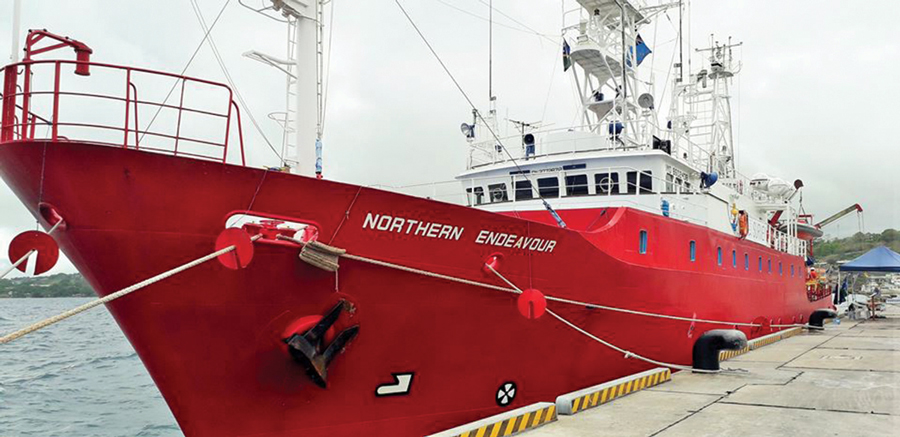
R.V Northern Endeavour that will carry out marine survey.

BY GEORGINA KEKEA

PRIME Minister Rick Hou has joined the Australian High Commissioner, His Excellency, Roderick Brazier to visit the ship tasked to carry out marine survey for the Coral Sea project.

On Saturday, the marine vessel Northern Endeavour stopped in at Honiara Port to survey the area where the Coral Sea Cable System will connect to Honiara.

On this occasion, the Prime Minister and government officials had the opportunity to go on board the vessel to see the facilities. In a joint Press Release by the Australian High Commission and the Office of the Prime Minister, the visit is for the delegation to meet the crew and understand more about the process for delivering this infrastructure.

Prime Minister Rick Hou says, there has been a lot of work done behind the scenes since the signing of the tri-party agreement in July this year.

“This is yet another tangible development and step forward in the progress of the submarine cable project”, he said.

(L-R) Keir Preedy, H.E Roderick Brazier, PM Hou and Sandy Wilson (Party Chief, EGS).

Meanwhile, Australian High Commissioner, Roderick Brazier says he is excited to be able to celebrate this important step with the Prime Minister.

“It has the potential to be truly transformative and I am excited to be able to celebrate this important step towards its completion with the Prime Minister,” Brazier said.

The preliminary planning by the RV Northern Endeavour ensures the manufacture and installation of the cable is precise as possible.

The Northern Endeavour can be able to carry out its work, regardless of poor weather and sea conditions.

“We can work in surprisingly wet weather conditions. Different parts of our work have different windows. Different wind speeds, wave heights where we have to stop. But we can generally always keep busy on something,” Sandy Wilson, of EGS said.

The estimated total project expenditure of the Coral Sea Cable System is AUD$200m. This is an estimated SBD$1.15 billion.

R.V Northern Endeavour that will carry out marine survey.

PCDF disqualification affects Tulaghi’s Shopping Complex

CIP Premier Hon Patrick Vasuni

BY BARNABAS MANEBONA

IN TULAGHI

CENTRAL Islands Province (CIP) being disqualified from the PCDF funding in 2017 resulted in Tulaghi’s incomplete Shopping complex now heavily debated.

To add, with the decreased allocation given by the National Government to all Provincial Capacity Development Funding (PCDF) this year for all provinces dropped the hope CIP’s current provincial Executive Government had to continue with that particular project for the province.

Instead of receiving the usual $15 Million allocation, CIP being re-qualified for the recent 2018 PCDF funding had only received less than $10 Million, and that is $9.9 Million.

The cut in PCDF budgets had sparked great concern throughout the provincial governments of the country seeing that many planned projects and developments will be affected.

CIP’s Premier Patrick Vasuni is aware of heavy criticisms over the Shopping Complex towards his current Executive government however, he states that the incomplete shopping complex building does not mean that they have forgotten about it.

In fact the shopping complex was yet the plan of the past Executive Government over which his Executive Government had fallen victim.

“With the decreased PCDF allocation this time round means that we have to focus first on other prioritised developments for the province such as through its education and health sections before we move on to find ways to continue with such other incomplete projects as the shopping complex having its initial cost spending was nearly $5 Million being just too much for the province PCDF spending,” said Vasuni.

“In reality, the province does not have the capacity in terms of business development which our government question why the past provincial Executive Government came up with such plans.”

From the mess being left behind by the past CIP provincial Executive Government, Vasuni assures through Island Sun yesterday that their government is now trying to address it in which their first step is to allow the local Engineer now given the task over the complex to first make further assessments.

More females enrol in 2017

0

BY LORETTA BRIGIDIA MANELE

The education ministry has achieved success in 2017 under it’s National Education Action Plan (NEAP) 2017-2020 endeavours, however they are also some challenges still need addressing.

According to the Ministry of Education and Humans Resources Development (MEHRD) 2017 Annual Report, the ministry has succeeded in a number of ventures.

As reported, for the year of 2017 alone more children had access to early childhood with an 8 percent increase and more primary and secondary children attended school with a two percent and 3.6 percent increase, respectively.

To add on, MEHRD also mentioned that more classrooms and school facilities were built, more young people accessed further education through scholarships, accounting to more than a 33 percent increase and girls surpassed the number of male enrolled students for ECE, Primary, Junior and Senior Secondary sectors.

While this is a string of achievements for that year alone, the ministry also noted a few issues which are; many children starting school at an older age than expected or repeating grades, an imbalance in expenditure between education sectors where Tertiary costed $425million for 2,756 students and ECE, Primary and Secondary at $224million for 216,137 students.

Female enrolment in schools remains low: Report

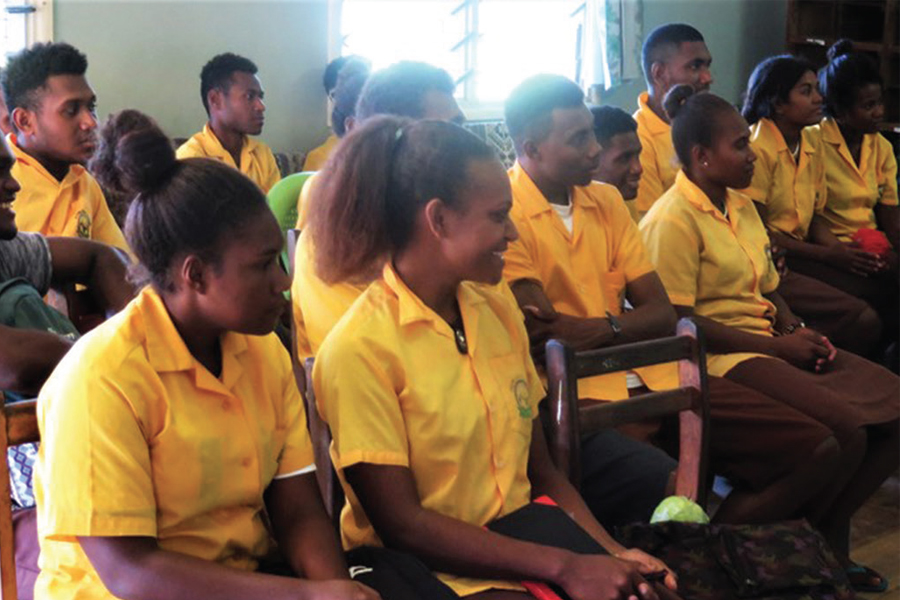
Honiara High students enjoying the presentation.

BY LYNTON AARON FILIA

DESPITE the country’s school enrolment rates showing increasing gender parity, completion of secondary school and further education remains tilted in favour of male students.

The Solomon Islands Youth Status Report 2018 of the United Nation Development Programme shows 47 percent of 18-year-old males are enrolled in education compared to only 37 percent of 18-year-old females.

Literacy rates for boys aged 15-24 are 91 percent compared to 88 percent for girls of the same age – a gap narrower than found among older generations, although there may be a discrepancy between these rates and functional literacy.

UNDP report shows young people access to education is relatively low in rural areas.

It said while 55 percent of children and youth aged 10- 19 in Honiara attend secondary school, only 36 percent of the same age group across the whole of Guadalcanal are in school, and only 25 percent in Malaita.

Following that the report also highlighted such disparities are also reflected in literacy rates.

It shows 56 percent in Malaita and 66 percent in Guadalcanal—although testing by the Asian South Pacific Bureau of Adult Education found only seven percent of people in Malaita and 28 percent in Honiara was judged literate.

In the secondary division, the report shows a concentration of national secondary schools in Honiara has had several effects.

First, it means that the chances of rural people accessing education are lower, due to increased costs and travel needed to go to school.

It also drives migration to Honiara, with education seen as the way to transition from rural to “modern” life.

In areas such as Temotu and Savo, young people have to walk long distances each day (2-4 hours) in order to go to secondary school.

Other students may leave their provinces to go to Honiara and stay with extended family, which puts financial pressure on households and can lead to disillusionment if education is not completed or does not lead to work.

In some areas, such as mountainous parts of Malaita and Weathercoast of Guadalcanal, education is traditionally provided in a village setting to teach children about culture and subsistence agriculture.

In other areas, for example those reliant on illicit trade such as kwaso sales, household poverty and financial pressures may mean education is less of a priority than making a livelihood and earning money.

The lack of resources at provincial secondary schools also puts rural students at a disadvantage in terms of applying for tertiary education, scholarships and other opportunities.