DEAR EDITOR, “Farmers in Samoa are celebrating sending the first shipment of ripe bananas to New Zealand in over 50 years.
“Samoa’s agriculture minister Lopao’o Natanielu Mu’a is the driving force behind the scheme in which farmers grow Jewish bananas introduced from South Africa.
“Lopao’o initially came under fire for coaxing big commercial farmers to spearhead the scheme which has now resulted in 500 cartons of bananas being sent to New Zealand.
“The Samoa Observer reports the President of the Banana Farmers Association, Tuisugaletaua Sofara Aveau saying he hoped the scheme continues to bear fruit as it will benefit the country as a whole.
“He said he and other farmers plan to be in New Zealand when the shipment arrives next week.
“The New Zealand market for ripe bananas is valued at over $US160 million.”
Copyright @ 2018, Radio New Zealand
The Solomon Islands hosts a rich diversity of bananas of good quality and Makira is believed to be the last stronghold of Fei bananas.
DEAR EDITOR, last week, the Speaker of the National Parliament, Ajilon Jasper Nasiu, spoke on the history of the Youth Parliament and how participation in such a forum provided youths with an opportunity to express their ideas and to widen their educational experience.
He also stressed how participation helped to develop confidence, team work and broader awareness of community issues.
I fully endorse what the Speaker had to say about widening the experience of youths and broadening their education and their role in society.
It is very much for the same reasons that I would like to see the broadening of music education and the early creation and sustainability of a National Youth Orchestra in the Solomon Islands.
I believe participation in a youth orchestra would have a profound impact on the development of today’s youth.
Beyond being a recreational activity, it would create opportunities for leadership, engagement, and creativity.
Music builds leadership: Many music programs involve bands, choirs and orchestras, all of which involve working and communicating with others to achieve a common goal. This develops leadership and teamwork skills that can be applied to other areas of life.
A music education can provide the values for students to thrive in all areas of life from academics, to relationships, to careers. Having the understanding that practice makes perfect and sustained effort will achieve positive results is sure to take any music student far.
Australia has several youth orchestra and the one in Sydney has a programme that provides orchestral training to young musicians between 6-25 years.
I believe if a National Youth Orchestra was created in the Solomon Islands participating youths would benefit from the social interaction of being part of an orchestra and lasting friendships would be developed as a result of the experiences they would share.
To get a National Youth Orchestra off the ground it would be my suggestion that approaches should be considered by the new Minister for Women, Youth and Children Affairs, the Hon. Lanelle Olandrea Tanangada, herself an accomplished pianist, to engage a voluntary service specialist from the VSO organizations regionally or from the United Kingdom.
Such a person, with the right qualifications in music education, coupled with determination and enthusiasm could become the essential ‘Partner in Music Education’ and see to the recruitment, selection and training of the youths that would make up the orchestra.
VSO volunteers from the United Kingdom reached 1.5 million people last year.
They brought inspiration, energy and vital practical skills to help achieve community goals and especially in education.
Much similar good work is being undertaken by volunteers from Australia and New Zealand.
I feel confident that there would be many volunteers willing to come to the Solomon Islands possessing high standards of musical excellence and a love of teaching.
Perhaps it is just for the want of asking, so why not?
DEAR EDITOR, last month I had the pleasure with catching up with an old friend and one who rendered considerable help to the Royal Solomon Islands Police Force during the early years following my appointment as the Commissioner of Police in the Solomon Islands from 1997.
Mr Khoo Boon Hui was the Commissioner of Police in Singapore from 1997 to 2010 and in more recent times till 2016 was the President of INTERPOL.
I took the opportunity at lunch to thank Mr Khoo for having made it possible for several senior officers of the RSIPF to go to Singapore in the period 1997-1998 to undergo training in Community Policing and to tell him how that training experience was put to good practice in the initiation of community policing policy and practice in the period leading up to the onset of civil disturbance in the Solomon Islands, a time when, very unfortunately, the community policing concept and operations were radically disrupted.
Mr Khoo also helped the RSIPF in those early years by giving surplus police uniforms when, on my arrival, I had found the members of the local police service had no change of uniform and there was no funds available to acquire uniforms and other accoutrements.
My Khoo retains a strong interest in the Solomon Islands and several times asked how community policing was now progressing. I was happy to tell him that community policing was continuing and progress was being achieved.
DEAR EDITOR, I refer to the above said subject matter at page 2 of your paper issue No 3036 dated Wed 17 Oct 2018.
It says that the Government plans to ban imported rice because “…the government believes eating rice contributes to the spread of infections from Non Communicable disease (NCD).” Para 5 page 2.
Further, it says the plan is to impose higher taxes to ” … discourage families to pay rice.”
Enough of such contradictions.
The plan is to ban, then, came the plan to impose higher taxes.
Who would believe such.
If it intends to ban, just do it.
If it is impossible because every Solomon islanders love that rice and that you don’t want to lose Sol Rais Company (believed to be locally owned or locally registered) and few Wakus who imported rice, don’t proclaim such.
Everybody heard it from doctors that rice is one of the main cause of diabetics and we would welcome the banning of rice.
We don’t believe it is going to be possible. It’s easy to say than do do.
DEAR EDITOR, according to a recent article published in the Island Sun newspaper and from which I quote.
“The Office of the Auditor-General has conducted a Performance Audit on Climate Change Adaptation and Disaster Risk Reduction Strategies. This was in recognition of the impact that Climate Change has and will have on islands in the Solomon Islands.”
Arising from that report the article went on to say –
“The National Climate Change Policy needs to be updated. There needs to be a Food Security Policy developed. There needs to be sufficient budget provision from Parliament to ensure effective policies exist and to ensure that ministries have sufficient resources to implement them effectively and in full. “Solomon Islands cannot stop the rise in sea level but it can become one of the best prepared countries in the world to deal with its consequences and ensure that its people can not only survive but prosper in the post-climate change world.”
When it comes to adaption it should be understood that only when there is likely to be a slow-onset in prolonged environmental changes that communities will have time to react and possibly adapt, but should climate change bring about rapid environmental events, such as frequent cyclones, increased sea levels and inland flooding, people will rarely have any other option but to move to higher ground, if possible, or to migrate.
Already in Kiribati increasingly frequent king tides and storm surges, floods and longer droughts are new, unwelcome additions to the islander’s way of life
Sea level rise has turned freshwater resources salty, rendering the land unable to grow staple crops such as coconut and taro, and eating away the shoreline.
Islanders are being told that they may have to abandon their islands, the places where their ancestors have been buried, where their children have a home and an identity.
Small Pacific nations are increasingly under threat from climate change not of their own making and it is time that those nations, corporations and leaders accept the science and lower carbon emissions, as outlined and agreed upon at the Paris Climate Conference.
If they value the continuing betterment of all nations and an interconnected world, they must take the action that is necessary to preserve the way of life for future generations to enjoy.
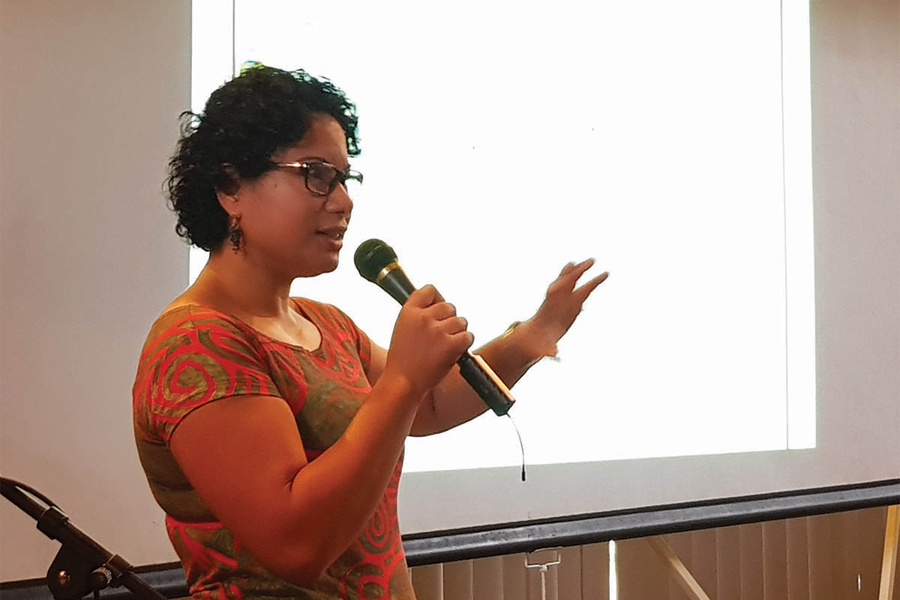
Dr Tammy Tabe doing a presentation for a Solomon Islands resettlement policy.
BY GEORGINA KEKEA
Dr Tammy Tabe doing a presentation for a Solomon Islands resettlement policy.
CLIMATE change will likely increase the rate of migration in the coming decades.
Speaking in the workshop on a proposed draft resettlement policy, Dr Tammy Tabe of the University of the South Pacific (USP) said such movements can be positive if it is well planned and documented.
Ms Tabe says such movement do not always have negative outcomes for those moving and those who are receiving.
She said if well planned and coordinated, migration will increase the capacity of people and communities to adapt to climate change.
“Movements should be voluntary. Involuntary migration or forced relocation should be the last resort,” she said in her presentation.
She said over the years, Solomon Islanders have encountered movement of some sort.
This includes movement because of natural disasters such as earthquake, floods, tsunami and landslide. Man-made relocation includes the ethnic tension.
Tabe said without proper planning and preparation, migration can displace people and communities.
“It can lead to conflict and instability within clans, between communities and within the country,” Tabe said.
She said from experience, government should have a ‘resettlement policy’ to safeguard future citizens of the country.
POLICE Commissioner Matthew Varley says that working on plans for the forfeiture of the boat and destruction of the Cocaine is currently underway.
He said they are working along with the Director of the Public Prosecution on the forfeiture of the boat and after all issues sorted out destruction will be going ahead.
In regards to the cocaine they are working on it as well and especially on technical issues in relation to the burning site of the cocaine and as soon they can get those sorted police have to do that pretty soon.
This is in relation to the bulk of kilos of cocaine found in a yacht last moth month.
It was a joint investigation involved the RSIPF, the Australian Federal Police (AFP), Australian Criminal Intelligence Commission (ACIC), NSW Police Force (NSWPF) and Australian Border Force (ABF).
The yacht was a double-masted yacht and from intelligence reports a joint operation and investigation was conducted and police found the cocaine concealed in a cavity behind a false wall panel in the interior of the yacht.
It was alleged that the cocaine was loaded onto the yacht in South America and sailed to Honiara.
The alleged organisers in Australia were making arrangements to bring the yacht to Australia just before it was searched by the RSIPF.
SOLOMON Islands young women together with other Pacific nation women are part of a weeklong Bougainville Women’s Federation Young Women’s Leadership forum.
The forum is hosted purposely to develop young women’s confidence and leadership skills, and provides the opportunity for young women leaders to take on leadership roles in their communities, initiate business and livelihoods projects.
Also a platform where their (young women) voices, needs and concerns can be heard directly by decision-makers in communities and in all levels of government in Bougainville and across the participating Pacific nations.
It’s an opportunity for them (young women) to as well share how they have incorporated the leadership training in economic empowerment, human rights, sexual and reproductive health and financial inclusion in their lives and in their communities.
May Palatatru on behalf of the Solomon Islands delegations said having this wonderful opportunity to be part of the forum has been a milestone for young women leaders in Solomon Islands.
Palataru said it’s a space in which Solomon Islands young women leaders will share experiences with Bougainville and other Pacific nation young women leaders.
She uttered beside it’s a gathering in which Solomon Islands will learn from the participated countries as well.
“Hence I am very proud to represent Solomon Islands Young women leaders in this forum, what my team will get out from this forum will be taken home to share with other young women leaders in Solomon Islands,” said Palataru.
Moreover, Solomon Islands young women leaders have been part of this event through the Women’s Right Action Movement (WRAM) under the Women’s Action for Voice and Empowerment (WAVE) programme.
The forum starts yesterday and has brought together up to 200 young women leaders from Bougainville and across, Papua New Guinea, Solomon Islands, Fiji and Timo Lester.
The theme of the Forum is “Break The Silence, Hear Our Voice”.
It’s a weeklong Forum which was held in Arawa at Marimari House, Central Bougainville and was hosted by the Bougainville Women’s Federation’s Young Women’s Leadership Project.
And is supported by the Australian Government in partnership with the Government of Papua New Guinea as part of the Pacific Women Shaping Pacific Development program, and supported by the International Women’s Development Agency.
Dr Jack Maebuta presenting implications for resettlement policy and
practices.
BY LYNTON AARON FILIA
Dr Jack Maebuta presenting implications for resettlement policy and practices.
A GROUP of academics in Solomon Islands have presented case studies that might assist the government to establish a National Resettlement Policy for the country.
Organised by the Ministry of Lands, Housing and Survey, the two-day session convened diverse groups of more than 20 participants that include stakeholders that represent national government, local government, NGOs, and faith-based organisations.
During the discussion, climate change was the most talked about subject with natural disaster identified as the main driver of relocation and land as the main obstacle to facilitate such resettlement.
Dr Jack Maebuta from the Solomon Islands National University (SINU) in his presentation highlighted implication for resettlement policy and practice that are important to consider when looking at formatting the National Resettlement policy.
He said from their research implication for resettlement policy should consider building infrastructures as area to reduce poverty associated with resettlement as well as economic bases and livelihood of the population.
He suggested if the RCDF can be used as starter to finance resettlement since money is the government’s main challenge—from the RCDF it can support for purchasing land or meet other demand needed.
With that he adds education is one important tool as well which the intended policy should look at by building more schools or upgrade schools across the province to avoid migration of people to urban centres.
Moreover, he suggested in any development or relocation plans churches can be regarded as key partners when considering resettlement initiatives.
Besides, the workshop last week gave opportunity for all presenters to shared one thing in common highlighting that it is important to formulate resettlement policy with holistic approaches.
It should look at facilitating the sustainable livelihoods of people, ownership and equal opportunities, they said.
Permanent Secretary for Ministry of Lands, Housing and Survey Mr Stanley Waleanisia said resettlement and relocation is faced by small islands nation which includes Solomon Islands.
He said Solomon Islands are vulnerable to natural hazards including extreme weather events as floods, droughts and tropical cyclones.
It also includes seismic activity such as earthquakes and tsunamis which pose risks to internal displacement of vulnerable communities, Waleanisia said.
He said presentation of the findings by presenters is important for them to understand resettlement and transformation of the rural communities in the country and how the policy will be implicated.
Other presenters include Dr Tammy Tabe, a lecturer from USP, Fiji who did a presentation on case study climate change migration and displacement: learning from the past relocation in the pacific.
Country’s PhD Michael Ha’apio from USP, Pacific Centre for Environment and Sustainable Development (PACE-SD) did his presentation on a case study carried out in Western province
He also did a presentation on a Case study, the Transformation of rural communities: lessons from a local self-initiative for building resilience in the Solomon Islands.
Furthermore, other presenters presenting case studies on Minevi resettlement in Temotu, Auki and western province about the Tsunami victims in Gizo.
THE woman allegedly involved in a tragic traffic accident which resulted in the death of a 15-year-old girl in Honiara last month will likely enter her plea today at the Honiara Magistrates Court.
This is the case against 26-year-old Veslyn Ririana.
Ms Ririana is facing three charges in relation to traffic offences.
The allegation said Ririana on the night of September 15 was driving a motor vehicle along the Mendana Avenue in a westerly direction when the collision occurred.
Police said the motor vehicle was allegedly approaching the HCC roundabout at high speed when the vehicle went off the road and allegedly collided with the deceased who was walking in an easterly direction on the road near the Solomon Water office.
Police attended to the fatal accident and assisted the victim to the National Referral Hospital. She was later pronounced dead by medical authorities.
The suspect was transported to the Central Police Station and formally arrested for causing death by reckless and dangerous driving under the Traffic Act.
Ms Ririana also was given a Random Breath Test (RBT) and shows that her alcohol blood reading was 0.184 percent well above the legal rate of 0.050 percent.
The accused was also arrested for driving an unlicensed motor vehicle which expired on June 30, 2018 and driving without a driver’s license.