SOLOMON Islands Students Association (SISA) in Fiji is on standby in light of the Omicron threat in that country.
The virus is now in community transmission in Fiji.
It is reportedly more versatile than the Delta strain in terms of being transmitted among persons.
And, SISA is prepared to gear into action to help and assist students should any case be reported.
In a brief comment to Island Sun, President of SISA, Melissa Siapu said SISA Office will continue to encourage students to adhere to the covid restrictions given by the Fiji govt.
“We are also on standby to assist the Solomon Islands High Com Office to reach out to students if there is a need,” she said.
Island Sun understands that University of South Pacific semester one of 2021 will begin in March, however mode of learning is yet to be confirmed.
It is likely that most courses will be offered online to avoid social gathering and also satisfy social distancing.
ONE of the technical persons who will assist to establish the proposed Malaita Bank has explained the proposal behind the concept.
George Kosui confirmed on his social media page that the Malaita Bank proposal is an initiative of the Malaita Provincial Executive to work on a Financial Institution (Bank) to be established in the Solomon Islands, just like other foreign owned-banks operating in the country.
The former permanent secretary of Ministry of Commerce, Industries, Labour and Immigration, said similar to the other institutions, it will be owned by Malaita Province (Investment Authority) on behalf of the (Province) people of Malaita and operate just like other commercial banks.
“Like other banks, it will be supervised by CBSI as the Regulator.
“It is a prerequisite (minimum requirement) of the Regulator that banks including the proposed Malaita outfit have fit and proper Board and Management to manage/administer the institution,” he said.
The former banker said this initiative is the best option, considering foreign banks operating in the country using our money (deposits from the public – Malaitans and deposits from SINPF – reserves) that is currently used by foreign banks to lend to borrowers (locals).
Kosui said profits from the lending of the funds are sent overseas to those (shareholders) who own the banks. Foreigners use us (SI) as their financial hub for their own purposes.
He said now is the time to have our own bank, and this proposed initiative by the Executive is the way forward for financial progress and prosperity for individuals and business people in Malaita and Solomon Islands as a whole.
Kosui is expected to travel to Auki to join a working group going to set up by Malaita Provincial Government to drive the idea inorder to get a licence from Central Bank of Solomon Islands.
In addition, the Malaita Bank is one of the agendas endorsed by the Malaita Provincial Government in an extraordinary meeting last month.
Premier Daniel Suidani said it is high time that Malaita must establish its own financial institution to depend on.
The Premier told Solomon Star a task force has been appointed where he said by next week the task force should be working on the idea by persuading it forward.
The Premier also admitted that they are looking at getting Malaitans share out of the National Provident Fund (NPF) as stipulated under the Townsville Peace Agreement (TPA) as part of the decentralization of their share.
The Premier said it is time that Malaita should put all its resources together as it works towards being self-reliant.
The Premier said most members of NPF are Malaitans where he said it is high time that Malaitans come back home with their money and form their own bank and work from Malaita.
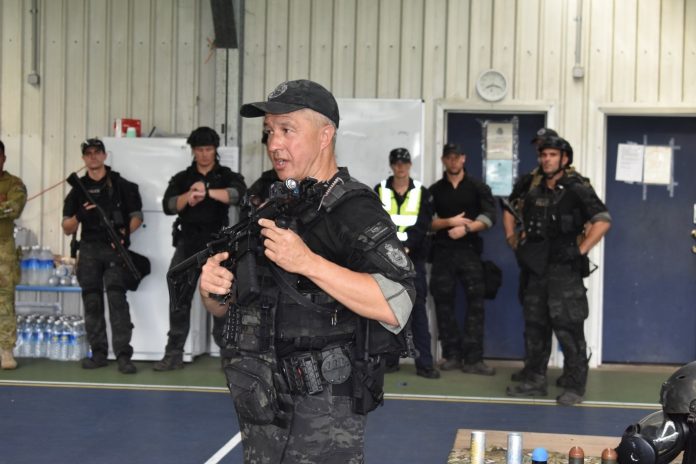
Members of the Australian Federal Police Tactical Specialist Group that provided the training.
POLICE Response Team (PRT) of the Royal Solomon Islands Police Force (RSIPF) were boosted with level three Public Order Management (POM) training, which was conducted by Australian Federal Police (AFP) Specialist Tactical Group at Rove police headquarters on 4 January 2022.
Central Response Unit, Guadalcanal Response Unit and Correctional Services Solomon Islands (CSII) Emergency Response Group (ERG) also form part of the training.
A statement from the police says the training was a simulate real life situation when multiple incidents happening at the same time in different locations.
Officers participate in the training.
Assistant Commissioner (AC) National Operation Evelyn Thugea says the purpose of the training is to merge all Police Support Units together and provide them the opportunity to work with PRT, AFP front line officers, Australian Defence Force, AFP Fire Brigade and the AFP Tactical Response Group.
“In this context, we are enhancing the RSIPF capability in terms of training our officers in POM, the skills, tactics and knowledge they learn will be applicable when they go out and execute their duties when we have any disorder situation,” Thugea said.
Members of the RSIPF Police Response Team (PRT) who participate in the training.
“The training provides officers the opportunity on what they expect when real situations arise, the training will boost officers confidence to confront issues of disorder,” she added.
“I would like to acknowledge AFP Specialist Tactical Group for the support rendered to our officers for this this training.
“It is a good training to refresh our officers and should there any situation arise we know exactly what to do.”
It was just another cloudy Sunday afternoon, December 5, 2021, at Supizae island. Suddenly the sea rose.
Standing on the shore, Carl-Marx Qoso recalls he had to wade through “chest-high” water.
It was like, either the sea rose or Supizae island simply had just sank, he said.
The year’s king tide had arrived. But, it is the “biggest” residents have ever seen. And, they are scared.
Met Service tells Island Sun king tides are expected at this time of the year. But, due to the current La Nina climate pattern and climate change, our coastal communities and low-lying islands will be affected.
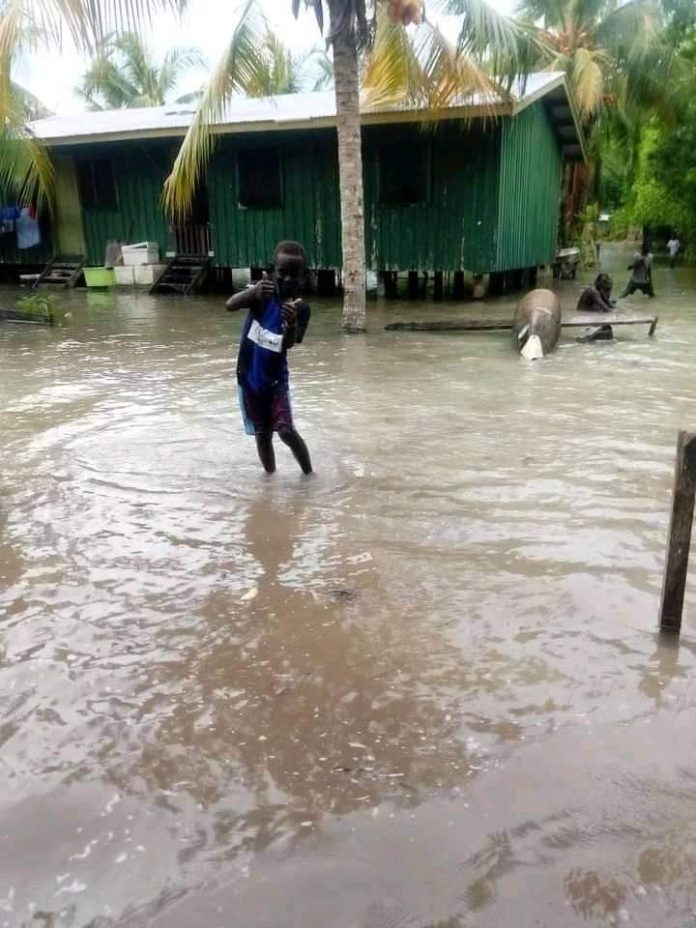
Supizae resident Elma Dediqula sent a video clip to Island Sun two days after, showing her family members wading through knee-deep water outside their house, which is situated about 50m inland north of the island.
Mrs Dediqula said three days following December 5 they had to get accustomed to this scenario.
She shares that they had thought they were relatively safe from king tides because their home was considered “further inland, on higher ground, about a metre above sea level”, plus no king tide had ever reached them before.
“Along the years past we’ve had king tides towards the end of the year, but never before has the sea water high level mark reached our chests,” says Supizae resident Mr Qoso, who describes himself as a 5.5-footer.
Children don’t need to go to the beach to wade in the seawater, Suzipae island. Photo supplied
“Places where sea water had never reached before were now submerged. Only the higher inland of Supizae was spared because it’s a few metres high,” Qoso said.
After the waters subsided, their gardens such as bananas, cabbage, crops had yellow and brown leaves; killed by the seawater.
Qoso said luckily there was no rough weather which would have induced huge waves or swells, otherwise the December-5 king tide could have claimed lives.
“Not to mention the threat of crocodiles, which made us restless those few nights,” he adds.
Dediqula and Qoso are calling for the national government and the provincial government to relocate them to the main island of Choiseul.
Qoso said, “I have heard of relocation for a very long time, but the time is now. Authorities must relocate Taro and Supizae, not sit on this issue. We are under threat. Places water had never reached before are being invaded now.”
And they are not alone. Mr Glen Scott, a Supizae resident currently working in Honiara, says both the national and provincial governments should seriously look into the relocation issue for Taro and Supizae because along the years successive king tides have been observed to be higher than the last.
“King tides of 2010 and 2017 were in memory as being the biggest, especially the 2017 one, but they have been trumped by the December-5 king tide,” Scott said.
Relocation
Sadly, in reality, nothing will immediately happen as hoped by the residents, with authorities revealing that any “realistic movement of people to higher locations might start in five years’ time”.
But, this in itself is only an estimate of the earliest time possible for this dream.
Choiseul province is reportedly the first province in the Solomon Islands to realise the gravity of the climate change threat, and began initiatives towards relocation as early as 2001.
Today, Choiseul is leading the country in the relocation ambition; already advanced in its programmes towards relocation of its population in vulnerable low-lying islands.
Supizae and Taro are low-lying islands about a kilometre west of the northern tip of mainland Choiseul. Taro hosts the provincial capital and is Choiseul’s economic hub.
Supizae and Taro islands a kilometre off Choiseul mainland – Google Earth
By 2010 scoping studies resulting in in-depth documentation of Choiseul’s climate change resilience and adaptation capacity were underway, according to the Choiseul Province Climate Change Vulnerability and Adaptation Assessment Report, published in 2013. This report is significant towards Choiseul’s relocation plans.
But, while it looks good on paper, realistically any relocation now is not possible.
Of note in the 2013 report are “political indifference, economic disparities, population growth, and land tenure and social issues”, which are some of the factors contributing to the delay.
Mr Isaac Lekelalu, Choiseul’s relocation project manager, tells Island Sun that actual relocation might happen in the next five years.
“Frankly, the timeline for relocation, because it’s a long-term plan and project, and is currently in its planning and preparation stage, is in my estimation five years.
“For any relocation to happen now or next year is not possible, not true or realistic.
“Because at the moment, we are completing surveys on plots of land which Choiseul PSS, agriculture and forestry farming are situated on, and will have to register these parcels and tender them out for interested people.
“This also includes a plot of land on which the hospital on Taro will be relocated to.
“So, I’ll just say this, that about 2025 will be the year in which any relocation will likely go down.”
Lekelalu however, assures that the relocation project is a priority of the Choiseul provincial government.
He adds that this is despite the limited funding provided on the provincial level.
On the national level, he works with “government line ministries which provide technical and financial assistance every year, each ministry tends to the sector which comes under its responsibility, for example for energy and water supply we liaise with ministry of mines and energy, with the hospital, we work with the ministry of health”.
Interestingly, Lekelalu adds that the flow of Choiseul’s relocation project is not hampered by the global covid-19 pandemic and country’s states of emergency.
A woman carrying her child through the village, inland of Suzipae island. Photo supplied
The national ministry of environment (MECDM) is one of the key partners of Choiseul in the relocation programme, supporting by way of projects and technical studies.
MECDM permanent secretary Dr Melchior Mataki explains to Island Sun that while his ministry is helping the province in its endeavour, things take time.
“As regards the relocation of Taro, Choiseul Province has an ongoing project for the relocation of Taro township to Tarekukure (Choiseul Bay).
“It has commissioned and completed several technical and scientific studies using both provincial and govt resources including support from externally funded projects under the Choiseul Integrated Climate Change Adaptation Programme.
“Choiseul Province has also approached the ministry (MECDM) to help them secure resources through the multilateral environmental and climate change funding bodies such as the Green Climate Fund.
“Their request has been included in a pipeline of project ideas to be developed for submission Green Climate Fund, however, this will take time as an appropriate Accredited Entity must be identified and the necessary project preparations must be completed as well.
“However, I am aware Choiseul Province is continuing with its Taro relocation project.”
La Nina is not helping
Solomon Islands is currently under a La Nina climate system, and Met Service tells Island Sun while this is a usual time for occurrences such as king tides, the La Nina contributes to exacerbating the effects.
PS Mataki explains that systems such as El Nino and La Nina influence how aggravated or reduced natural phenomenon such as the king tide occurs.
“La Nina will make the tides extremely higher.”
MET Service Ocean Bulletin for December, 2021, explains how La Nina affects Solomon Islands:
“Higher waters is predicted for most parts of the country. Unusual high waters along the coastal areas in many parts of the country is expected to occur. Together with high tides that is usually occurs in December, communities along coastal regions on most province are expected to experience high waters along their shoreline and also coastal inundation.
“In short, La Nina brings more waters to our shores as a result of stronger westerly winds that pushes more waters eastward of the South Pacific resulting. As a country that sits at the western fringes of South Pacific, Solomon Islands is no exception to be the recipient of this higher waters. All these was due to La Nina, ENSO phase we are at now.
“Greater precautionary measures are to be taken to ward-off or mitigate coastal inundation and erosion.”
The boat and its passengers that went missing over the weekend. Survivor Tony Nonga was in the other boat that drifted towards Choiseul Province.
Skipper recalls that fateful journey
BY BEN BILUA Gizo
We watched the other boat heading towards Shortland Island while we tried to fix one of the two 40hp engine and follow them behind. It was the last time we saw them.
These are the words of Tony Nonga who was one of the passengers of two boats which set out of Gizo, one of which is missing.
Fourteen people were onboard the missing boat, most of whom are children.
“The sea was fine when we departed Gizo. Both boats, a 75hp and a double 40hp travelled side by side towards Vella then we went ashore on an Island to better prepare the boats before crossing the sea to Shortland.
“We sort things out and we left the island. It was fine, the sea was fine,” Nonga said.
He said midway to the journey both 40hp engine stopped working due to mechanical issues and both boat came together to fix the issue.
Nonga said the weather changed and they decided for the 75hp boats to go ahead with the children and women while strong men and few women fixed one of the 40hp engine and follow later.
“Let’s go back to when we left Vella. When we left Vella, children and women were the ones boarded the double 40hp boat and when both engines stopped working mid ocean we transfer the children and women to the 75hp boat.
“Another important thing to mention is that, we have only one mechanic who can fix the issue. The mechanic is the skipper of the 75hp, so what happened was, we transfer the kids and women to the 75hp boat, then the skipper of 75hp came to our boat and the skippers of double 40hp transferred to the 75hp boat.
“So, the skippers of double 40 now handle the 75hp boat and the skipper of the 75hp is staying with the double 40hp boat to fix the engines.
“We encourage each other and the 75hp boat went ahead heading towards Shortland.
“At the time the weather was getting worsen,” he said.
Nonga recalled that Shortland Island was sighted and the 75hp with children and women were heading straight towards the island.
He said it was at that moment that a dark cloud, heavy rain with strong wind hit them.
“We saw the other boat disappearing into the dark cloud and that was the last time we saw them,” Nonga said.
He said that was when the two boats separated.
“After the other boat left the mechanic tried to fix one of the 40hp engine and this time the bad weather hit us badly.
“Our boat almost sunk three times but luckily we jump overboard each time the boat filled with water.
“We pumped out water using buckets and get onboard each time and that’s how we survived the strong wind and raging waves,” Nonga said.
“The wind was too strong, the sea current was fierce and the waves hit us like a punching bag,” he added.
Nonga said there was total darkness, visibility was poor and after much effort, the mechanic successfully fixed one of the engines.
“We see nothing and at first we start the engine then heading to the direction we thought heading towards Taro.
“After few attempts trying to figure out where are heading to, we decided to stopped the engine and just float.
“It was around 5pm or 6pm on January 1,2022,” he said.
Nonga said he and another passenger stayed up all night while everyone who was then tired sleep inside the boat.
He said around 3pm on the other day, they saw lights and alerted everyone onboard.
“We thought we were close to Vella Island so we travelled along the coast hoping to cross to Gizo because visibility was poor.
“After travelling for hours, we realised that it was not Vella Island. We went ashore and we realised that we were at Moli, Choiseul Province.
“We stayed there until morning and we contacted Shortland Police to check for the boat that went ahead of us the day before. It was then that we realised that the boat was not able to make it to Shortland Islands.
“We contacted Taro Police and they called us to go to Taro, so we went to Taro to help with the search,” Nonga said.
He described the trip as unfortunate and unlucky for his relatives who went missing.
“I’m lucky to be alive and I thank God for giving me another chance to live,” Nonga said.
“I pray and hope for some good news in the coming days,” he added.
According to Nonga, three men, three women and eight children were on the boat that went missing, while eight men including two kids and six women were on the other boat that survived.
Island Sun understands that search for the missing is ongoing.
LANDOWNING tribes around Turarana in Central Guadalcanal say they were shocked to have received only $447,000 in royalty payments from WinWin Investment Solomon Ltd on Thursday 30th December 2021.
This payment comes out from the alluvial mining operation carried out by Win Win since July 2019.
According to one of the outspoken landowners of a clan on the land, Joel Jackson, they could not believe they amount they were paid because the mining tenement is very wide.
Jackson said landowners usually get $600 to $800 a day when they panned for alluvial gold on the tenement.
He said they could not believe they payment because the company was using machines to extract alluvial gold.
According to the royalty sharing, two big tribes, Garavu and Koenahau, got 30 percent each from the $447,000.
As such each tribe received $75, 000 each.
The other two tribes, Lasi and Manukiki, received 20 percent each from the $447,000.
Each tribe collected $50,000.
Jackson said the Garavu tribe would share the $75,000 to the six trustees that signed the Surface Access Agreement with WinWin.
He said each trustee would get $12,500.
Jackson said their representative in one of six trustees would then share the $12,500 among six sub-clans.
Therefore, he said his clan only received $2,000.
“From the $2,000, I have to share it with my people as far as the Weathercoast region.
“Honestly, we could not share the money so we just use it to buy fish for the New Year,” he said.
Jackson said some families did not receive any money from the royalty payment when it was shared among the tribes and clans.
Currently, three people namely Jackson, Chanel Gibson and John Manegela were mandated by the people to follow up with Director of Mines and Customs to confirm the payments.
Jackson said the landowners are planning to call a meeting this Sunday to discuss with the company on the royalty payments.
However, one of the directors of WinWin, Charles Meke said the royalty payments only covered 20 of the 34 shipments.
Meke said there is a shortfall because the company still waiting for confirmation on exchange rate from Ministry of Mines, Energy and Rural Electrification before it can pay royalty for the outstanding 14 shipments to landowners.
He said during his time with World Bank, they used forex rate, which was standard.
“We are ready to pay, but government is still to confirm the exchange rate.
“We don’t blame the government because we just come out from the festive period,” he said.
According to the current practice of royalty’s payment, the Company pays 3 percent royalties from its gold export to the Government who then is responsible to pay the landowners and the concerned Provincial Governments hosting the operations accordingly.
The 3 percent royalty payment is then proportioned at 50 percent to the Government, 40 percent to the two Turarana Landowner’s Associations and 10 percent to the Guadalcanal Provincial Government.
The company started the trial alluvial mining operation on July 2019.
The trial mining commenced at the Mamasa alluvial flat deposit but was later shifted upstream to the Turarana Area (Kavahambe) after very low gold recoveries (0.15g/cubic meter(cu.m)) were experienced at the Mamasa alluvial flats deposit which is well below break even levels.
After heavy floods that left the Turarana wash plant inundated in October 2019; alluvial mining operations were shifted back to the Mamasa area in November, 2019 while reconstruction of the Turarana wash plant was progressing.
Mining operations were shifted back again to the Turarana wash plant in December 2019 due to improved gold recoveries experienced there.
Up to present time only the Turarana wash plant is currently being worked.
According to the Win Win’s monthly report produced on 10th July 2021 by contracted Geologist, Collin Midobatu, the company has exported a total of 3,258.47 ounce of gold from its last 6th shipment from January to June 2021.
This is worth around $48 million (USD$6million) base on the market prize of US$1,853.00 per ounce.
The export of gold shipment came from its operation at Turarana in Central Guadalcanal.
However, the company could not make any gold shipment from July 2019 to December 2020 as stated in the monthly report released on 10th July 2021.
Vunagi says students should not be denied their right to education
BY MAVIS N PODOKOLO
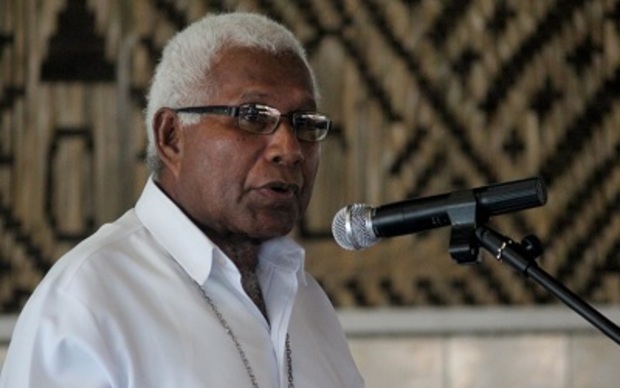
Governor General Sir David Vunagi has called for a review of the secondary school fee system in the country.
He said children should not be denied the right to education just because their parents could not afford the fees schools charged.
“We must realise about 80 percent of parents whose children are in secondary and tertiary institutions live in the rural areas and rely heavily on subsistence means,” Vunagi, an educationist by profession, said in his New Year’s nationa-wide address.
“For such parents no fee, no school is a major obstacle because the level of fees charged is just beyond their means,” he added.
“If data has been compiled about the number of students who withdrew from formal education during the last two or three decades because of difficulties in payment of fees, we would be surprised to see how we have continued to operate very unfair system of education.
“It would be also difficult to understand why and how school authorities happily allow students to leave because fee is the issue of contention.”
Vunagi, who is also a retired bishop of the Anglican Church of Melanesia, said a progressive system of education should not allow a discriminative aspect to be attached to it but drastic reduction of student’s enrolment from 8000 to 5000 in semester one 2021 is a classic example.
“It is good that primary education is free of charge but consideration should also be given to make secondary and tertiary education basically affordable to assist self-employed fee payers.
“We need to explore the possibility of charging consensual fees or provide soft loan schemes to assist students who are determined to pursue studies with predictable positive results.
“To be silent about the principles of no fee no school, only supports marginalisation, social exclusion and poverty that will further increase the gap between the haves and the have not.”
Meanwhile, the Ministry of Education and Human Resources Development says school across the country will start classes for this year on 24 January.
Eleven babies were born on New Year at the labour ward, National Referral Hospital.
This was confirmed by Julian Timothy, nurse in charge for Labour Ward, NRH yesterday.
“During first day of the new year 11 babies were born. Of the 11 nine are males and only two are females,” Timothy said.
She stressed the number of new born babies born this year is less compared to last years 2020.
“Last year in 2020 we have more babies born compared to this year we have only 11 new born babies,” said Timothy.
In addition the Pfizer-Biontech COVID-19 vaccine for prioritized pregnant woman and youth aged 12 to 17 years have already been launched last year on December 16 2021.
For pregnant women in Honiara the vaccine has commenced and available here at the National Referral Hospital.
SOLOMON Islands student in Fiji have expressed they are afraid of the new covid-19 variant Omicron, which has invaded quarantine and now in community transmission.
Speaking to Island Sun, a final year student who wants his name withheld, said the news of Omicron now transmitting in communities has put fear among students.
The student said situation has got worse and that concentration on preparation for this year’s studies has reached rock bottom.
“Most students are okay at the moment but we don’t know what will happen next. While we are fearing for our lives, some of us think that it is best for our government to suspend any repatriation flights from Fiji to Solomon Islands as measures to stop this virus coming into our country,” the student said.
Students said they are taking extra precaution and instructions given out by the Fiji government.
This paper understand that Fiji’s Permanent Secretary for Health Dr James Fong announced yesterday that samples sent to Australia came back positive for both Omicron and Delta variants with confirmation that both viruses are now on what is described as community transmission.
According to the World Health Organisation (WHO), Omicron is labelled as a Variant of Concern and recommended countries to undertake serious mitigation strategies such as enhancing surveillance and sequencing of cases; sharing genome sequences on publicly available databases, such as GISAID; reporting initial cases or clusters to W.H.O; performing field investigations and laboratory assessments to better understand if Omicron has different transmission or disease characteristics, or impacts effectiveness of vaccines, therapeutics, diagnostics or public health and social measures.
Countries should continue to implement the effective public health measures to reduce COVID-19 circulation overall, using a risk analysis and science-based approach. They should increase some public health and medical capacities to manage an increase in cases. W.H.O is providing countries with support and guidance for both readiness and response.
In addition, it is vitally important that inequities in access to COVID-19 vaccines are urgently addressed to ensure that vulnerable groups everywhere, including health workers and older persons, receive their first and second doses, alongside equitable access to treatment and diagnostics.
The B.1.1.529 variant (Omicron) was first reported to WHO from South Africa on 24 November 2021. The epidemiological situation in South Africa has been characterized by three distinct peaks in reported cases, the latest of which was predominantly the Delta variant. In recent weeks, infections have increased steeply, coinciding with the detection of B.1.1.529 variant. The first known confirmed B.1.1.529 infection was from a specimen collected on 9 November 2021.
The variant has a large number of mutations, some of which are concerning. Preliminary evidence suggests an increased risk of reinfection with this variant, as compared to other VOCs. The number of cases of this variant appears to be increasing in almost all provinces in South Africa.
AUKI police are investigating a stabbing incident that happened on 2nd January at Bira village in West Kaio constituency.
Police Operation Manager Michael Ramosaea said the incident was reported to them yesterday.
He says the stabbing happened on Sunday following disagreements between the suspect and the victim.
Ramosaea says the person who was stabbed had to be taken to Kilufi’I hospital for treatment.
He says the victim is still in hospital.
Ramosaea says the matter is now with the police and investigation is underway. He says this is the only serious case they received around the province during New Year celebrations