Home Blog Page 1634

CSO reviews Anti-C0rruption Bill

0

BY BARNABAS MANEBONA

CIVIL society organisations (CSO) is reviewing the anti-corruption bill to make recommendations for the bills and legislations committee (BLC).

CSO Chairman Dr Huddie Namo said, “We are not waiting for the government on now doing our own review in noting what to recommend.

“Though the Petition has already been given, we will not stop in keeping up the momentum for the government to know that they are under our watch.

“We will be having strategic outlined meetings continuing until the 9th of next month.

“There were already two meetings, one on Friday and the other this week Monday in which others will be today and coming Friday rotating till next week.”

According to the Chairman, the meeting is open to all civil society members and interested parties who wish to share their points of view with the committee in regards to issues that will be discussed.

“Other’s who wish to join the meetings will have to contact the CSO and DSE General Secretary Ms Jennifer Wate on landline 23760 for approval,” said Dr Namo.

“We are planning to continue on talking about the Anti-corruption Bill through Broadcast on SIBC and on Barava FM this coming weekend including giving media statements.

“Time is not in our hands so we need to prepare, the Bill might be postponed again that will cause a big problem.”

Gold diggers alert

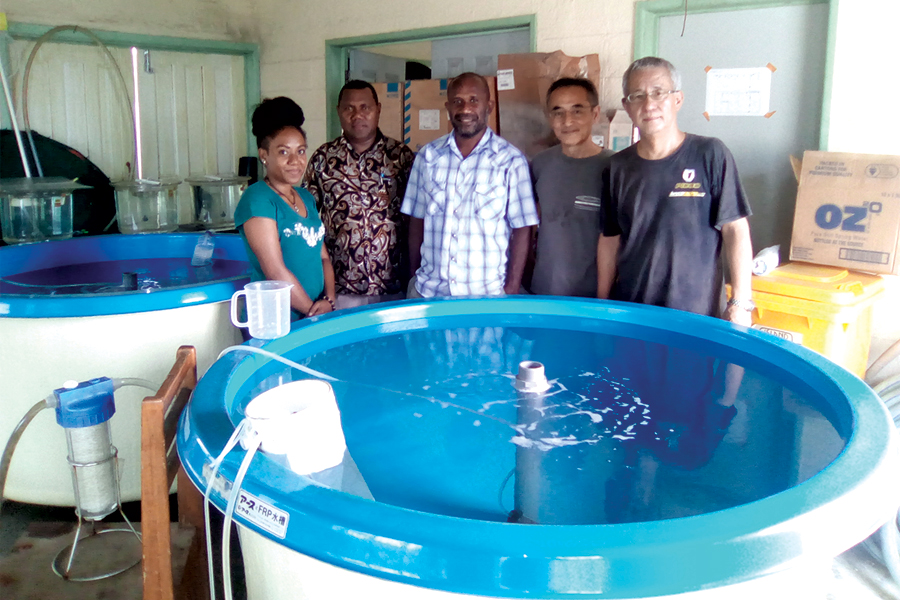
HOW TO DO IT…OFCF Beche-de-mer expert Dr Toru Komatsu, right, Director of Fisheries Mr Edward Honiwala, second left, Mr Kazuhiro Toyama of OFCF and Aquaculture officers James and Catherine at the Ministry of Fisheries and Marine Resources (MFMR) beche-de-mer hatchery project. This year the project is supporting a community in Marau in east Guadalcanal and San Fly in Ngella. Director Honiwala strongly emphasized that such hatchery is what MFMR expects, and rejects farming method operated by Dr Reginald Aipia which is done in open waters and has lack of control over eggs and larvae.

More than half Beche-de-mer applicants only after money, Ministry not interested


BY JARED KOLI

MORE than half of applicants for Beche-de-mer export licence are ‘purely after the chance to draw income’, it is revealed.

As the assessment committee screens applications, Director of Fisheries Edward Honiwala confirms this, saying more than half fall under this category and will not meet all requirements.

The Ministry of Fisheries and Marine Resources (MFMR) has issued four criteria for applicants.

“We know a lot of them will not meet the four or any of the four criteria,” says the MFMR Permanent Secretary Dr Christian Ramofafia, during an exclusive interview with the two incumbents at the MFMR Headquarter yesterday.

The four criteria are:

  • Companies holding valid licence or permit to export Marine Product in 2017, and evidence of doing business in the fisheries sector in the last 3 years.
  • Companies with valid Inland Revenue Division TIN;
  • Companies with documentary evidence of export returns from Central Bank of Solomon Islands
  • Companies with good standing records of compliance with fisheries regulations in the last 3 years

Dr Christian could not reveal the exact number of applicants, but said there are many to be assessed by the assessment committee.

When asked on whether the granting of export licence will be done equally among locals and foreigners, Dr Christian said the ministry will treat all applications the same, and everyone has to fulfil the same criteria.

“If you continue with your business operations, either for locals or outsiders, but if you have licence here that means you are local company, whether the owner is an Asian or foreigner but do things in the country.

“There are many applications but unfortunately only four will be selected on the condition of the criteria set by MFMR.

“If there are many applicants meet the criteria set, we will have to look at them carefully, but according to cabinet we will have only four.

“I think we will look at commitment with the ministry and support on the development of the country, in terms of employment because all these things is based on the development of fisheries.”

The two reiterated that if someone applies just for the sake of a chance to draw money, then that application will be turned down.

Dr Christian said the ministry will put in place a strong guide to support villagers in terms of pricing because the lifting is aimed at supporting them.

“We will provide the price range to buyers and exporters, because the complexity of the trade, many of the buyers didn’t link with exporters,” he said.

The two highlighted that the ministry will put a price range for exporters.

“When we issue export permit we will also be giving them the price guide as condition for their licence. The licence will be issued with conditions, one of the conditions is not to buy undersized beche-de-mer.”

The criteria have been established to identify whether an applicant has been involved in the development of the fisheries sector.

“Others will argue to grant export licence to locals but many locals are backed by Foreigners. From our experience, licence fee is high and even locals do not afford, and we have seen that many locals are backed by outside people.

“In terms of number 1 criteria, we see this as they are genuine companies, and bank transaction is important and tax, locals may complain because some of these criteria some of the local companies cannot meet,” he said.

MFMR plans to carry out a beche-de-mer nationwide survey to determine the stock of beche-de-mer starting early next year.

“We plan to do a nationwide stock assessment of beche-de-mer before we open, but this opening is a decision which demand quick response, but we put in place how we can take information.

“We have funding available to do the exercise, in fact the plan for the nationwide survey has been reschedule for next year.

“But a team will be leaving next week to a place of interest to record information on the ground. This is important for us to take every data to assist in the trend of the beche-de-mer fisheries.

“We have a research team from the fisheries, and also officers from the province will join in, and other NGOs engaged with the fisheries,” Dr Christian said.

HOW TO DO IT…OFCF Beche-de-mer expert Dr Toru Komatsu, right, Director of Fisheries Mr Edward Honiwala, second left, Mr Kazuhiro Toyama of OFCF and Aquaculture officers James and Catherine at the Ministry of Fisheries and Marine Resources (MFMR) beche-de-mer hatchery project. This year the project is supporting a community in Marau in east Guadalcanal and San Fly in Ngella. Director Honiwala strongly emphasized that such hatchery is what MFMR expects, and rejects farming method operated by Dr Reginald Aipia which is done in open waters and has lack of control over eggs and larvae.

Solomon Islands Coconut Day: Joining the fight against the Rhino Beetle

0
Pacific Farm displaying their new products on the market.

STAKEHOLDERS in the coconut and palm oil industry marked and celebrated the Solomon Islands Coconut Day on Monday, September 25, with a theme aimed to tackle the increasing spread of the Coconut Rhinoceros Beetle pest.

The Coconut Day was held at the National Auditorium in Honiara.

The event was organised by the Coconut Industry Working Group with support of the Rural Development Program (RDP), Pacific Horticulture Agriculture Marketing Access (PHAMA), Ministry of Agriculture, Commodities Export Marketing Authority (CEMA) and the Solomon Islands Chamber of Commerce & Industry (SICCI).

The them for the Coconut Day is “Managing the Coconut Rhinoceros Beetle to Protect our Industries and Rural Livelihoods”.

Among speakers at the occasion included Permanent of Secretary for Ministry of Agriculture, SICCI CEO Dennis Meone and representatives from the Coconut Industry Working Group (IWG), Ministry of Commerce and the Australian High Commission.

Key highlights from the speakers focused on the importance of the coconut crop for basic survival and its economic contribution, however more importantly noting the increasing threat of the Coconut Rhinoceros Beetle.

A young man cutting open a coconut at the Solomon Islands Coconut Day held at the National Auditorium in Honiara.

SICCI Export Industry and Development Officer (EIDO), John Paul Alasia says the alarming spread of the Rhinoceros Beetle is a national threat and a worthy cause for working groups or stakeholders in the private sector and the government to come together and support the efforts to contain the spread of the foreign pest.

“Coconut as we all know is known as the ‘Tree of Life’ in the Pacific and is an important commodity that has been the basic survival of our people, especially for those in the rural areas, and a great contributor to our economy.

“The Coconut Rhinoceros Beetle continues to threaten the coconut and oil palm industry at a fast-growing pace.

“SICCI as the representative body of the private sector joins the call on all stakeholders to unite in the fight against this beetle.”

Coconut industry stakeholders were invited to come together at the Coconut Day to recognise the significance of coconuts to our culture, our livelihoods and future sustainability.

Activities included displays of coconut products and value adding processes.

An open forum was held on measures to manage the Coconut Rhinoceros Beetle which threatens our Coconut, Palm Oil and other palm industries.

The Solomon Islands Coconut Day is an annual event and is open to all Coconut Industry Stakeholders including farmers, traders, processors, exporters, government ministries, non-government organisations and donor partners.

–SICCI PRESS

Stakeholders called to remove deadly coconut pest

0
PS Ministry of Agriculture and Livestock Jimmy Saelea

BY LORETTA BRIGIDIA MANELE

PS Ministry of Agriculture and Livestock Jimmy Saelea

STAKEHOLDERS, government representatives and business houses from the coconut industry gathered together yesterday at the Auditorium Building, Museum area to celebrate Coconut Day.

Under the theme “Managing the Coconut Rhinoceros Beetle to Protect our Industries and Rural Livelihoods”, they engaged in discussions regarding the industry’s status, challenges and prospects for future success.

Among the speakers at the event was Ministry of Agriculture and Livestock’s (MAL) Permanent Secretary, Mr Jimmy Saelea.

He said that an approximate 40,000 households rely on coconuts for their livelihoods of which 80 percent of coconut producers are smallholders.

In addition, Mr Saelea stated that the estimated nut production on a yearly basis is around $370million with a gross value of $300million or more thus out of this figure only about $130million is made from the exports of copra and coconut oil.

Moreover, he stressed that challenges the industry is facing relate to land, transport reliability, freight costs, price fluctuations, quality issues, market access and productivity.

Mr Saelea said that one of these challenges is the industry’s stagnant annual production where copra accounts for only 20,000 to 30,000 metric tonnes per year most likely due to the fact that most coconut palms are senile and no longer productive.

In relation, he referred to the coconut rhinoceros beetle scientifically termed “Guam strain or CRB-G as the most challenging concern at the moment posing as a huge threat to the coconut and palm oil industries of which contribute to about 20 percent of the country’s GDP.

Furthermore, Mr Saelea said that destructive coconut pest since being discovered in Honiara back in 2014 has now spread throughout the capital, west to Aruligo and east to Aola with confirmation of its presence in North Malaita and Savo.

He emphasised that the situation is in dire need of collaboration and coordination from all stakeholders including the government, private sector, civil society and communities to plan and execute measures that should curtail the spread of the deadly pest, reduce its population and where possible eradicate it.

Coconut research key to opportunities for SI coconut industry

0
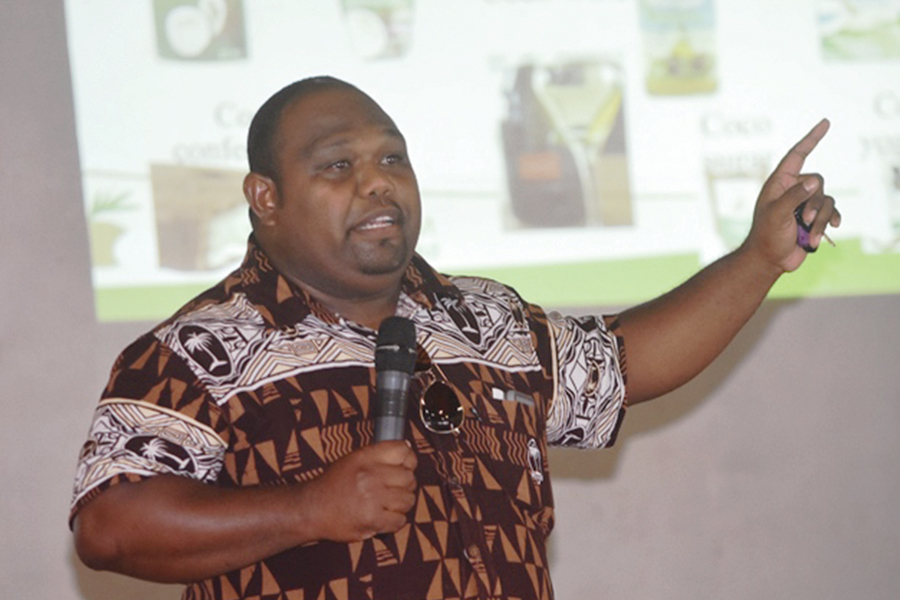
Coconut Industry Rep. Mr Rudolf H. Dora speaking on coconut research.

BY LORETTA BRIGIDIA MANELE

Coconut Industry Rep. Mr Rudolf H. Dora speaking on coconut research.

IF we can increase research and target research on specific products, we can engage companies.

This is according to Coconut Industry representative, Mr Rudolph H Dora who was speaking under the topic “Coconut Research” while contributing to discussions at the Coconut Day event at the Museum Auditorium yesterday.

Giving an example of one country’s business tactic in the coconut international market, he said in the Philippines they yield 1m nuts into their coconut factory on a daily basis.

Mr Dora added that as a small country, Solomon Islands cannot compete with that and so, what the Solomon Islands should do is carry out research on what works well for the country’s coconut industry and use this medium to tap into the global coconut market.

He labelled branding and packaging as essential components in marketing, stating that in order for a product to attract customers and stand out, its brand and packaging must be appealing.

In this case, Mr Dora continued to stress that even though you may have a good product, if you are working with a boring brand, your product won’t sell.

Breaking the Culture of Silence video launched

0
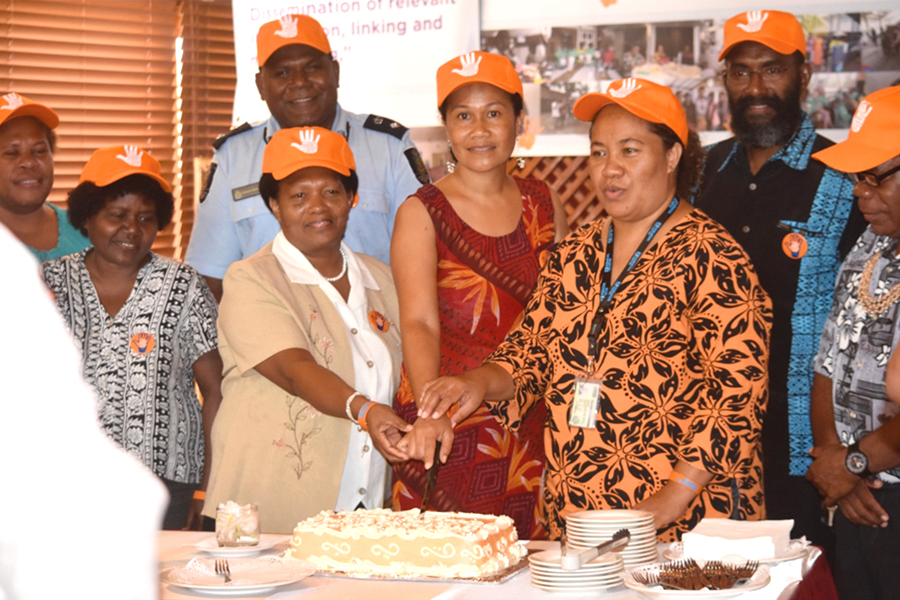
Cutting of Cake at the video documentation Launching ceremony on Monday

BY MAVIS NISHIMURA PODOKOLO

Mrs Florrie Alalo speaking at the launching Ceremony of video documentation Breaking the Culture of Silience.

VOIS Blo Mere Solomon Islands (VBMSI) a local media organisation in the country has launched a first of its kind video documentation on “Breaking the culture of Silence” yesterday at the Mendana Kitano Hotel in Honiara.

This project is funded by the Australian Government and supported by United Nation Women through the Pacific fund on the project communicating Violence against Women and Girls (VAWG)

Speaking at the launching ceremony yesterday, director of (VBMSI) Mrs Josephine Teakeni says the project was established and implemented in response to calls from women in rural areas.

She said testimonies documented in the video are from brave Solomon Islands women who are survivors of violence.

Mrs Teakeni said the core value of the documentary is to help women who continue to live in violent relationships build confidence and make better choices after receiving relevant information.

“Their stories will influence other women who continue to live in violent relationships to make a choice after receiving relevant information as well as knowing where to get help in introducing to them the different services that available for them to access such as services.”

Cutting of Cake at the video documentation Launching ceremony on Monday

Ms Teakeni added, the information gap is huge and there are upcoming information and communication platforms that are available to access and use.

She said VBMSI has and will continue to respond to the call of women in Solomon Islands in a small way.

Alvina Soaki Erekali, UN Women Country Programme Coordinator, said the video documentation is an essential tool kit for women.

She adds that the video is an important awareness tool for everybody to respond, prevent and advocate violence against women and girls as well as survivors to know their rights.

“This video Documentation is an essential tool kit for stakeholders, victims and survivors of violence to look at and take comfort.

“It will also bring hope to women who are in violence to move forward and brings message to the perpetrators to see the wrongs of violence,” Mrs Erekali said.

Australia gov’t stand to eliminate violence

0
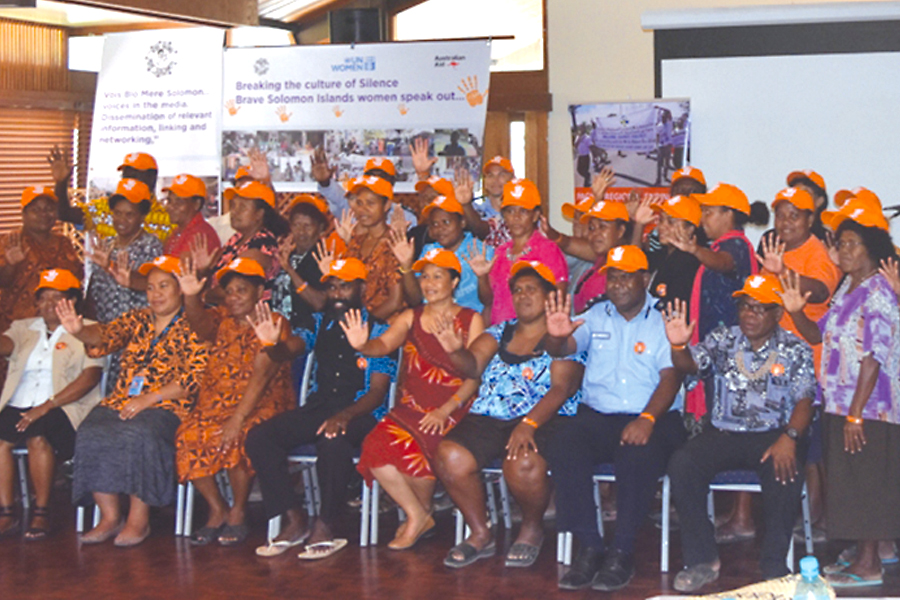
Partcipants who attended the launching ceremony of Video Documentation on Breaking the Culture of Silence on Monday

BY MAVIS NISHIMURA PODOKOLO

Partcipants who attended the launching ceremony of Video Documentation on Breaking the Culture of Silence on Monday

AUSTRALIA Government has maintained its stand to help eliminate violence against women and to reduce the impact of violence in the country.

Speaking at the launching of video documentation on breaking the culture of silence, Mrs Florrie Alalo, representative from the Australian High Commission, said Australia has been and will be instrumental in ending violence against women.

“Ending violence against women and girls is a key priority for Australia both domestically and international development and we are pleased to support the United Nation Women over five years under the Pacific fund.

“Violence and fear of violence restricts women lives, opportunities and causes significant physical and emotional injury and have long life impact.

“It’s still wide spread and creates a significant financial cost for countries, with spending required for health care, social services, policing and justice system,” she said.

Mrs Alalo said launching of a video documentary on real life stories is a significant achievement culminated by Vois Blo Mere Solomon Islands (VBMSI).

She said the documentary signifies hope as it will reach communities and families nationwide who are prepared for better changes.

“These soulful stories of lost hope will bring light at the end of the tunnel and that light can be realised if we collectively support from East to West and from North to South that violence against women is bad,” Mrs Alalo said.

She said it is time to educate younger generations to understand the negative impact of violence against women.

Mrs Alalo said men and women will utilise great potential to move the country forward if women are physically, spiritually, emotionally and financially supported in all level of lives.

Climate change implications already impacting on the human rights of Solomon Islanders

0

THE Prime Minister of the Solomon Islands, the Hon Manasseh Sogavare, last week made a call to the United States to reconsider its position on the Paris climate agreement and join the global fight against climate change.

The Prime Minister made the statement in his address to the 72nd United Nations General Assembly.

He said climate change is the Pacific’s biggest enemy and could have far-reaching impacts.

The Prime Minister called on the UN Security Council to address the issue of climate change as it threatens global peace and security.

“We call on all major emitters to meet their national determined contributions in reducing green house emissions,” he said.

“The impacts of climate change currently occurring at an alarming rate at our shores presents a clear and present danger, which might exacerbate the core drivers of conflicts.”

Few will argue with what the Prime Minister said because it is known that five islands have already disappeared in the Solomon Islands due to rising sea levels and coastal erosion.

A further six reef islands have been severely eroded in the remote areas of the Solomons where 10 houses were swept into the sea between 2011 and 2014.

“At least 11 islands across the northern Solomon Islands have either totally disappeared over recent decades or are currently experiencing severe erosion,” a study published in Australian said.

A senior research fellow at the University of Queensland said recently the Solomons was considered a sea-level hotspot because sea rises there are almost three times higher than the global average.

There is growing evidence, too, of sea rises affecting coastal communities in the Western Province, Malaita, Reef Islands and Choiseul resulting in communities relocating to higher ground, crop damage and polluted drinking water.

Prime Minister Sogavare, together with the Prime Minister of Fiji, have been very active in highlighting the affects of climate changes in their respective countries, but also drawing international attention to the plight of many of the Pacific’s smaller island states suffering also from rising sea levels.

Prime Minister Sogavare was not the only world leader to call upon the United States to reconsider its position on the Paris (COP 21) climate agreement, since the British Prime Minister, Theresa May, reportedly issued a veiled warning to Donald Trump, arguing that his plan to withdraw from the Paris climate change treaty ranked alongside North Korea’s nuclear missile tests as a threat to global prosperity and security.

In her speech to the UN general assembly, the British prime minister sought to project her vision of a “rules-based” international order.

While Prime Minister Sogavare’s ‘diplomatic’ address to the UN body did not raise the specter of a breach of international law of human rights by a failure to address the threats imposed by climate change on the lives of the people of the Solomon Islands, it might be worth considering what the UN Human Rights Council (HRC) decided in 2006.

I will quote from Wikipedia, the Free Encyclopedia.

“In 2005 the Malé Declaration on the Human Dimension of Global Climate Change “stated explicitly (and for the first time in an international agreement) that ‘climate change has clear and immediate implications for the full enjoyment of human rights’ and called on the United Nations human rights system to address the issue as a matter of urgency.”

“The following year, the UN Human Rights Council (HRC) unanimously adopted Resolution 7/23, recognizing that “climate change poses an immediate and far-reaching threat to people and communities around the world and has implications for the full enjoyment of human rights,” and citing the Charter of the United Nations, the Universal Declaration of Human Rights, the International Covenant on Economic, Social and Cultural Rights, and the International Covenant on Civil and Political Rights.[5] The HRC reaffirmed and expanded these statements with resolutions 10/4 of 25 March 2009[6] and 18/22 of 30 September 2011.

“Recent years have seen an increased recognition of the link between human rights and the environment, yet there are still many questions surrounding the relationship between them. As a result the HRC established a mandate on human rights obligations relating to the enjoyment of a safe, clean, healthy and sustainable environment

“Parties should, when taking action to address climate change, respect, promote and consider their respective obligations on human rights, the right to health, the rights of indigenous peoples, local communities, migrants, children, persons with disabilities and people in vulnerable situations and the right to development, as well as gender equality, empowerment of women and intergenerational equity.

“Most international statements on human rights and climate change have emphasized the potential adverse impacts of climate change on the rights to life, food, water, health, housing, development, and self-determination.”

The British Prime Minister’s closing words during her address before the United Nations General Assembly last week, might be quoted here to sum up the relevance of fairness and the respect for Solomon Islanders human rights in relation to the growing threat the country is facing by climate change.

“It is the fundamental values that we share, values of fairness, justice and human rights that have created the common cause between nations to act together in our shared interest and form the multilateral system.”

Let us see that fairness and justice prevail.

Yours sincerely

FRANK SHORT

Solomon expects top representation at COP23

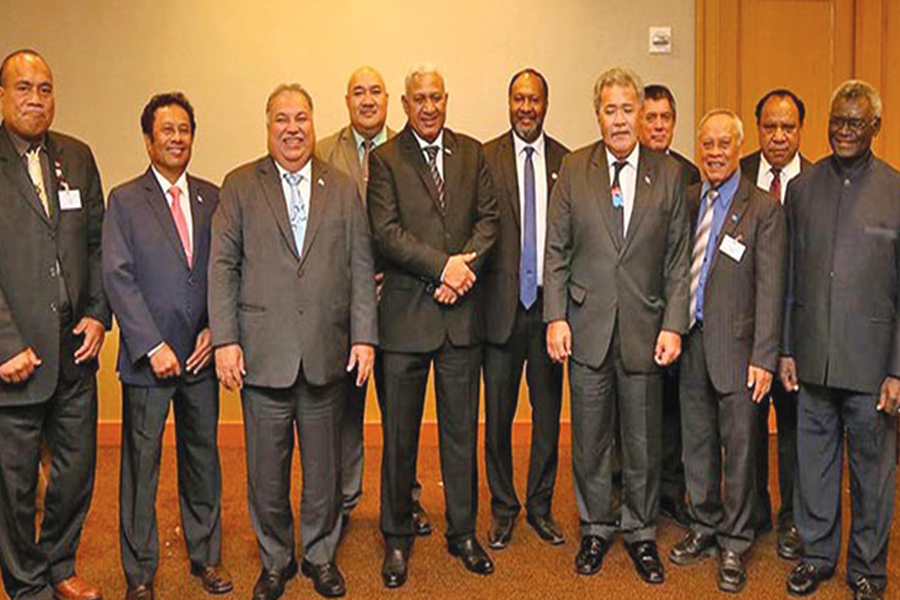
President, the Prime Minister of Fiji Frank Bainimarama meets and updates Pacific leaders at a meeting in the margins of this year’s 72nd session of the United Nations General Assembly (UNGA), last week in New York. Photo courtesy of Fiji Sun

BY JARED KOLI

President, the Prime Minister of Fiji Frank Bainimarama meets and updates Pacific leaders at a meeting in the margins of this year’s 72nd session of the United Nations General Assembly (UNGA), last week in New York. Photo courtesy of Fiji Sun

THE country expects a top representation at the 23rd session of the Conference of the Parties (COP 23) to the UN Convention on Climate Change (UNFCCC) in Bonn, Germany in November.

This will differ from previous COP as Fiji attain the COP23 presidency and wants pacific top leaders to consider COP23 as Pacific COP.

Fiji Prime Minister and incoming President of COP23 Frank Bainimarama told Prime Minister Manasseh Sogavare and other pacific leaders that he wants fellow Pacific leaders to be there with him so that it really is a Pacific COP.

A meeting with pacific leaders held on the margins of this year’s 72nd session of the United Nations General Assembly (UNGA) last week, the meeting saw the PM Bainimarama reminding the leaders on the importance of a collective commitment in addressing the threats of climate change.

The Fiji Sun reports Prime Minister Bainimarama updated leaders on both the pre-COP meeting that is scheduled to take place in October in Nadi this year and the main COP23 event in Bonn, Germany in November.

“For us to tell our stories. And for you to be part of that process,” he said.

“I very much see this as a Pacific presidency – an inclusive process in which I ask you all to stand shoulder-to-shoulder with Fiji as we give voice to the concerns of our own countries, our own region.

“So please give me your complete support so that we make COP23 really an event to remember and one that benefits each and everyone of us and the people who look to us for leadership.”

Prime Minister Sogavare during his address at UNGA said: “The horrors of the impact of a nuclear attack are undeniable but the slow onset caused by the adverse impact of climate change in Solomon Islands is just as cruel.

In a statement, Sogavare said Climate Change is the Pacific’s “number one enemy” and calls on the United States President Donald Trump to reconsider America’s position on the Paris Climate Accord.

The Prime Minister said an unstable climate and the subsequent displacement and relocation of people can exacerbate some core drivers of conflict – such as migratory pressures, clash of cultures and competition for resources.

These are threats to the very existence of humanity and could very well result in threats to global peace and security and this is why the Pacific Small Island Developing States have been requesting the Security Council to also address the issue of climate change.

Sogavare told world leaders that the building of sea walls and wave breakers, to mitigate some of the impacts caused by climate change, while useful is nothing more but a mere band aid solution.

SI reviewed on implementation of UN convention against corruption

0
SI reviewed on implementation of UN convention against corruption

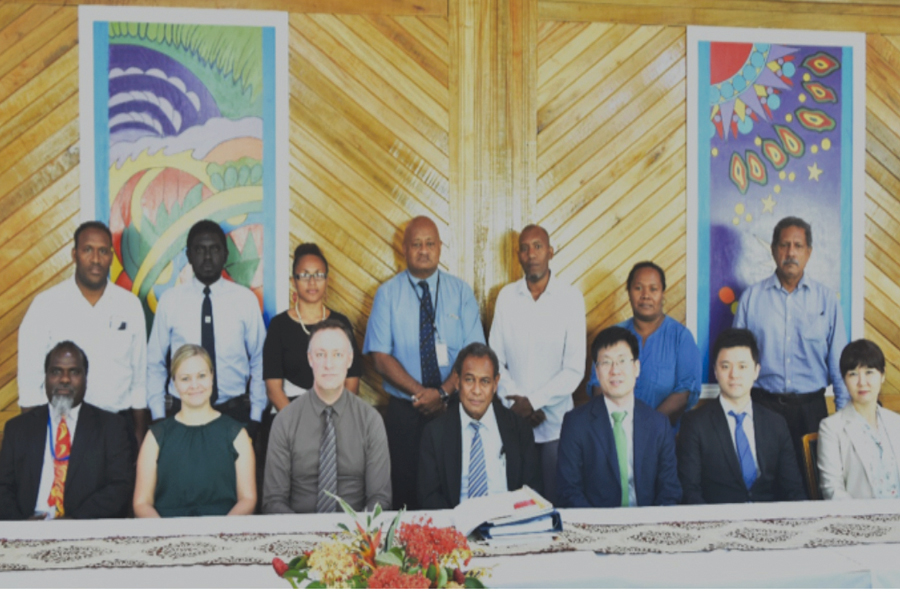
THE Solomon Islands has undergone the second cycle of review of the implementation of the United Nations Convention against Corruption conducted by the Republic of Korea and Vietnam.

Following an invitation by the Solomon Islands Government (SIG) in June 2016 during the Implementation Review Group (IRG) deliberations in Vienna, Austria, Solomon Islands volunteered to be reviewed in the first year of the second review cycle, focusing on Chapters 2 and 5 of the Convention.

Consequently, the SIG invited the review team for a country visit from September 20-22, 2017

The purpose of the visit was to facilitate the review team’s discussions with relevant stakeholders, and to collect additional information to assess Solomon Islands’ compliance with the provisions of UNCAC pertaining to preventive measures and asset recovery.

The second cycle review was officially opened by the Chairman of the Leadership Code Commission, Mr Solomon Kalu.

In his remarks, Mr Kalu stated, “Apart from its undertakings pertaining to the implementation of its anti-corruption policy and frameworks, the Solomon Islands Government is committed to this important review on whether Solomon Islands as a country per its laws and policies have taken into account the provisions of the United Nations Convention against Corruption (UNCAC) pertaining to its Chapters on preventive measures and asset recovery.”

The Chairman also provided a brief overview of UNCAC and noted, “The fight against corruption is not only a national undertaking because corruption crosses national and international boundaries.

“Therefore, the fight against corruption must also be on an international footing. There is a need for us to strengthen our domestic laws, taking into account the international nature of corruption.”

Several stakeholders who attended the review were Chief Justice Sir Albert Palmer, Director of Public Prosecution, Solicitor General from the Attorney General Chambers, Ombudsman, Chairman of the Leadership Code Commission, Officials from the Solomon Islands Law Reform Commission, Officials from Office of the Prime Minister, Ministry of Finance and Treasury, Ministry of Foreign Affairs and External Trade, Ministry of Public Service, President of the Solomon Islands Bar Association, Secretary General of the Development Service Exchange, and Representative from Transparency Solomon Islands.

Updates from the SIG’s anti-corruption efforts were presented by the Deputy Secretary to Prime Minister – Mr Derek Futaiasi.

The Implementation Review Mechanism is divided into two review cycles.

Solomon Islands had undergone the first cycle review pertaining to chapters 3 (Criminalisation and Law Enforcement) and 4 (International Cooperation) of the UNCAC in 2014.

Solomon Islands acceded to the United Nations Convention against Corruption (UNCAC) in 2012. This means that Solomon Islands has committed itself to comply with the provisions of UNCAC.

The United Nations Office on Drugs and Crime (UNODC) is the secretariat to the Implementation Review Mechanism.

–OPMC PRESS