THE number of people undergoing test for Human Immuno-deficiency (HIV) has declined by half last year, it is reported.
MINISTRY of Health and Medical Services (MHMS) in its 2017 Health Core Indicator Report stated the number tests for HIV cases in Solomon Islands has declined significantly from 6,760 in 2016 to just 3,531 in 2017.
Between 2016 and 2017, an average of 4,900 tests were performed each year with a positive rate of 0.3 percent.
This means that on average, less than 2 people tested positive for HIV in the Solomon Islands each year, according to the report.
While this number is low, it is likely to be influenced by considerable under-reporting of new or suspected cases due to low numbers being tested (less than one percent of the total population).
Meanwhile, a HIV-positive test per year in the country is becoming a core indicator for the Solomon Islands to ensure 2030 agendas are achieved.
HIV and AIDS have become major public health problems in many countries, and both the SDGs and UN General Assembly special session on HIV and AIDS (UNGASS) have set goals for reducing HIV prevalence.
THE project of civil registration and vital statistic especially on verbal autopsy will help improve necessary areas of work on diseases in the country.
The project is being implemented in the country with the aim of gathering data on diseases causing death or probable cause of death in the country.
Data for Health Country Coordinator of WHO, Mr Rodley Ruskin said there should be a marked improvement in death certifying in the country after the project.
This is because health practitioners have been trained on what to do.
He says that by collecting data on deaths in the country it will help them find out diseases responsible for deaths in the country.
“As long as we collect enough data we can do analysis of the data and put up the top 10 causes of death in the country.
“So it will list in descending order with diseases responsible for more deaths at the top and going down.
“The data will show us the information and from there we will identify health areas need for more work to be done on them.”
Ruskin said the aim of the project is to provide information to donor partners and government to allocate resources on the right health related areas based the findings.
“For example, rather than spending resources on health areas not really matter, we spend it on areas that cause more death.
“So the finding as the result of this work will guide on what to put priority on and what is less.”
AROUND 395 cases of tuberculosis are reported each year in the Solomon Islands, according to a health ministry report.
The Ministry of Health and Medical Services’ 2017 Health Core Indicator Report says for the period 2015-2017, Solomon Islands had a rate of 65 notified TB cases per 100,000 population which means on average; around 395 cases of TB are confirmed and reported each year.
The rate has remained stable over the past five years, fluctuating between 60 and 75 cases per 100,000 people annually.
Honiara City Council has the highest rate for the period 2015 to 2017; however this figure may be affected by the relative ease of access to the NRH and its diagnostic laboratory for patients.
Rennell-Bellona and Makira also have comparatively high rates; however their smaller populations are likely to be affecting data comparability.
The report stated in Rennell-Bellona, the notification rate was 86 per 100,000 in 2015 which rose in 2016 whilst the difference in cases was just three in the two years.
This demonstrates the high stochastic (or random) variability that occurs in small populations.
Another critically important indicator in monitoring the impact of TB in a population is the treatment success rate.
This relates to the number of confirmed smear-positive cases that were cured or in which a full course of treatment was completed (and is written as a percent).
MHMS’s report highlighted between 2014 and 2016, the Solomon Islands had an average treatment success rate of 92 percent.
This indicates a high number of people are completing treatment with minor at provincial level difference with Malaita (83 percent) and Western province (88 percent) which are below the national average.
Statistics suggests that the cure rate for TB has been significantly low, 63 percent in 2016.
This is likely due to the lower number of sputum smear examination being carried out at the end of treatment which means more people are completing treatment without confirmation TB has been successfully cured.
This situation can provide an environment for the development of drug-resistant TB which is already an issue in neighbouring countries such as Papua New Guinea, according to the MHMS.
As per the global minimum standards for TB, at least 70 percent of people with infectious TB need to be diagnosed under directly-observed treatment, short-course (DOTS), and at least 85 percent of these people are cured.
Looking at the mortality rate for TB, the steady decline in deaths due to TB suggests the low cure rate is a reflection of inadequate testing services and not poor treatment outcomes.
TRIAL into the case against the Member of Parliament for Baegu/Asifola Constituency is set to resume tomorrow.
Yesterday pertaining legal issues were sorted out and the case adjourned for tomorrow for trial proper.
This is the case against David Tome, MP, who is alleged to have involved in converting funds in relation to incidents in 2011.
Prosecution alleged that in 2011 Mr Tome obtained public funds for a constituency project; however those funds were not used as intended and were converted for his own use.
The MP is charged with 14 counts of conversion under Section 278(1) (c) (i) of the Penal Code, involving funds totalling $67,170.
The minister was on $2,000 cash bail and will appear in court faithfully till his case is completed.
Office of the Director Public Prosecution appears for the crown on this case.
THE case against an old man alleged of raping his 11-year-old granddaughter will be mentioned in court today.
On the last occasion the accused attended without a lawyer and the court urged him to follow up with his request made to the Public Solicitor’s Office.
The grandfather who cannot be named to protect the identity of the victim is facing three counts of rape under the Sexual offence amendment Act.
Police allege that the 64-year-old man allegedly raped his granddaughter on several separate occasions at different locations in the West Maringe District of Isabel
The incident was reported to Buala Police in which the old man was arrested and charged for allegedly raping his granddaughter at Tirotue Settlement and Ghozoruru in the Hovikoilo Ward on different dates between December 31, 2015 and February 7, 2018.
Prosecution alleges that the old man and the girl are from the same village.
Office of the Director Public Prosecution appears for the crown.
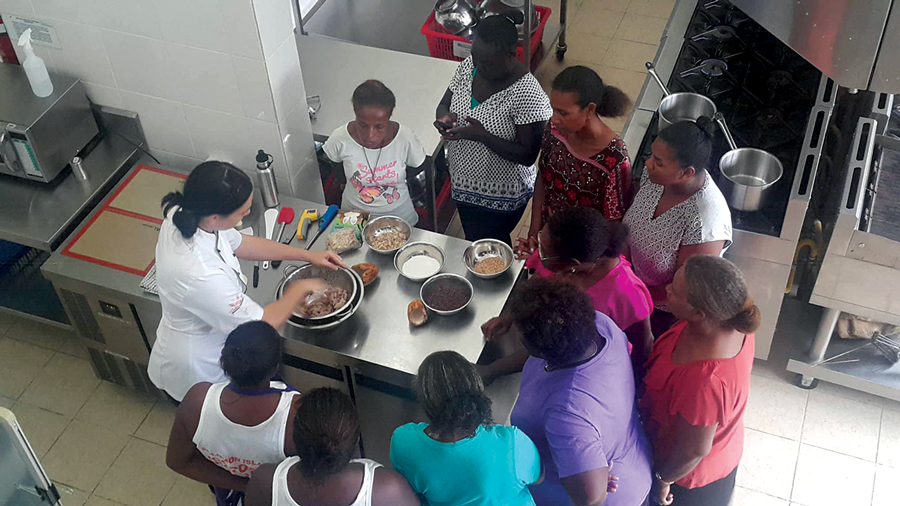
Chef Jessica Pedermont demonstrating while particapants look on.
Ausie Chef says local ingredients have high potentials to produce top grade chocolates
BY GARY HATIGEVA
REPRESENTATIVES from Cocoa Farmers Associations in Guadalcanal and Makira Provinces, along with representatives from the Guadalcanal Council of Women, Youth@Work and the JJD Women’s Association were again selected as participants of the cookery sessions that came as part of the SolChoco Festival currently underway here in Honiara.
This comes as a side event from the SolChoc Festival that is currently underway, held for local cocoa farmers to help promote and market their products, which according to experts, carry high quality and rich in organic.
Just like last Wednesday, participants were again given the opportunity to learn the methods and various form of chocolate products from local cocoa beans, which according to session’s instructor, Chef Jessica Pedermont, are of high quality.
A demonstration of how chocolate are piped into moulds to set.
The participants according to the side event’s co-facilitator, Grace Hilly, learnt the correct and proper ways to handle chocolate from the Sydney based Chef who also did some technical instructions.
Saturday’s session had included three demonstrations on the type of products that can be produced with our local cocoa, and they include cocoa pulp granite, cocoa brittle using local ingredients and chocolate with peanuts.
Participants also learnt a lot of techniques and other tricks including how to melt chocolate without burning it.
Ms Pedermont is a Sydney based chef who owns and runs a cooking school including a business, who came under the invitation of the SolChoco Festival organized by Strongim Bisnis with a collaborative partnership with government through relevant ministries and key stakeholders.
Chef Jessica Pedermont demonstrating while particapants look on.
This is her first time in Solomon Islands, but the Australian Chef had already been amazed by what she described as, the organic richness in local and fresh produces.
Pedermont also pointed out that opportunities here in the country in terms of its produces, especially on cocoa, are endless, that they can produce top quality for the high end market.
Last Saturday’s session according to all participants, was another eye opening experience for them they not only learn how to properly make chocolate using local ingredients, but so as proper methods of ensuring quality end products.
Participants are very grateful for the opportunity and expressed their biggest thanks to the organisers of the festival especially the initiative to include such a segment, which most agreed has already empowered them.
Meanwhile, Ms Hilly stressed that these sessions are very important because it really dag deep into the resources and products that are available locally, with the encouragement for the utilisation of local ingredients, but also for better products.
Participants and event organisers along with SINU Head of the School of Tourism, Charley Panakera, show off the finished products that were made from local cocoa chocolates.
“Events like the SOLCHOC Festival is crucial in creating the networks for our local farmers to be recognised for their hard work producing good quality cocoa beans,” she added.
Meanwhile, organisers of the SolChoc Festival acknowledged what they described as a very important partner, the Solomon Islands National University who has a top standard kitchen facility, which Pedermont as a very well experienced and top chef was amazed with and highly commended.
As party to the organisers of event, the Ministry of Agriculture and Livestock was also pleased with the feedbacks from international experts, whose independent opinions are of importance to the government as it works to further improve its policies for the sector.
Ministry officials stressed that these feedbacks will really help the government come up with better programmes and confidence, especially the stakeholders involved in the cocoa industry on its importance to the economy of Solomon Islands.
BIOSECURITY department within the Ministry of Agriculture and Livestock (MAL) are trying to ensure our country is protected from exotic pests from outside countries.
Speaking to participants at the recent chocolate festival, Crispus Fanai says the biosecurity plays a very important role in the country’s livestock and resources and needs cooperation from everyone.
Mr Fanai says farmers need to understand the role of biosecurity and the role they play in the industry. He says certificates of declaration on plants or animals for exports are very important.
He said there are conditions attached to imports and exports thus it is very important that farmers or general public in general understand the importance of such processes.
He said one particular pest which they are concerned about currently is the cocoa pod borer that is now infesting cocoa plants in Bougainville.
He said the losses felt by PNG now is huge and the biosecurity department are wary of this pest. He said Bougainville is just next to our country and with the movement between the two borders, there is a high chance for Solomon Islands to get the pest into our country.
Fanai says if the cocoa pod borer happens to come into our country, the damages caused will be huge and it is our local farmers who will suffer.
“And this is just a small insect like the mosquito but it has the power to damage our crops. Once it enters our country, there will be a big problem for us.”
Fanai says the cocoa pod borer is a new pest which we are yet to understand. He says what the general public, more so those on the border between Solomon Islands and PNG, they must make sure they follow the right processes so as not to bring in unwanted pests.
He said anyone wishing to bring in plants or animals must make sure they are certified first before bringing them in.
NFD & Soltuna wary of what future holds with SI’s graduation from LDC
BY MIKE PUIA
GIZO
NFD General Manager Frank Wickham
THE country’s premier fishing company, National Fisheries Developments (NFD), is worried about the impact the country’s graduation out of the Least Developed Countries (LDCs) list is having on its operation.
NFD operates a fleet of purse seine and pole-and-line vessels from the port of Noro in the Western province.
NFD and Soltuna form one of the most integrated tuna fishing and processing operations in the South Pacific. They are the producers of canned Soltuna products.
Recently, the United Nations announced that this country is one of the four countries that will graduate out from the LDCs list.
The country’s Ambassador and Permanent Representative in Geneva (Switzerland), Barrett Salato, was quick to point out that this will have serious implications on local companies that are also exporting their products to the European Union (EU) market.
Salato said the graduation is a positive indication that the country is improving but it would have impacts on local companies’ ability to sell its products in the EU market.
This is because this country will not enjoy the privileges of special trade rules, development programmes and assistance accorded to LDCs.
According to Salato, local companies like Soltuna and Guadalcanal Plain Plantation Oil Limited (GIPPOL) stand the risk of going out of business because they will have to undergo a rigorous process of meeting strict criteria before their products can enter the EU market.
Currently, these companies are exporting their products easily into the EU market on a duty-free-quota-free basis under the Everything But Arms (EBA) initiative since they are accorded zero preferential tariffs and no restriction on import quantity under the EBA.
According to Salato, if the country graduated out of the LDC list the preferential arrangement will “go out the window”.
“Thailand, which is the largest tuna exporter to EU pays 24 percent tariff with strict import quota system to enter EU tuna market, Soltuna hardly compete with them. If Soltuna pays 24 percent tariff, I don’t think Soltuna will survive the market,” Salato explained.
He said if Soltuna or GIPPOL is unable to compete then jobs of hundreds of locals, mostly women, are on the line.
NFD’s General Manager, Frank Wickham, in his remarks during the opening of this year’s world tuna day celebration in Noro last Friday expressed concern about this.
Wickham admitted the country’s graduation out from the LDC list will have serious implications on their export to the EU market.
“We will continue to work closely with the national government in order to get maximum benefit from that (EU) market,” Wickham said.
He said tuna fishing, storage and export will face challenges therefore partnership, strategy and intervention must be smart to face any challenge.
Wickham said everyone involved in the fishing industry must be smart in compliance and in keeping to standard.
Simon’s Place where the Pakistani national had left his passport.
BY GEORGINA KEKEA
PACIFIC journalists currently in Tonga for the 5th Pacific Media Summit were confused and shocked when they were being questioned by a Tongan police officer about a Pakistani national who had been living in Tonga for almost two months now.
Last night, local Tongan police took into custody a Pakistani national who was reported to be acting weird in one of the hotels, close to the Nukua’lofa airport.
Upon questioning by the police to show his passport, the Pakistani national said he had left his passport at the Simon’s Place, another hotel in Nukualofa.
So the police brought him to Simon’s Place where some of the Pacific Journalists to the Media Summit were based.
“At first I thought the police officer was joking when he said they had brought a person that might be very dangerous,” a journalist from Fiji said.
However it turned out that it was no joke and that the person of interest might be dangerous.
Staff at Simon’s Place said the guy didn’t bring much and they didn’t think much of his behaviour until the police showed up with him to retrieve his passport.
It seems that he hasn’t paid his bill at the other hotel and he had in his bag, only women’s clothes.
The journalists say it was very odd and most seem quite upset that their quiet Sunday evening had just been ruined by this episode.
“I hope the police here in Tonga will be able to handle this case and clear the air for us. I feel threatened already and that my security here has been compromised,” said the journalist.
Two female Australians working in the hospital in Tonga were also with the journalists when the police questioned the journalists about the person of interest.
Everyone were quite distressed and didn’t know what to think.
After the police left with the Pakistani national, the women sat and contemplate the events of the evening.
Most only hoped the issue will be sorted out and not that serious or to the effect as being said by the police officer.
Local farmers drying its cocoa beans—photo courtesy PHAMA
BY LYNTON AARON FILIA
Local farmers drying its cocoa beans—photo courtesy PHAMA
SOLOMON Islands cocoa is in high demand in the global market due to its quality, it is reported.
This growth in popularity is said to be contributing significantly to the national and rural economy.
Country’s annual cocoa competition is also contributing to raising the profile of the cocoa industry and successfully promoting it nationally and internationally.
Outcome from the competition also promotes country’s cocoa quality in the global market which brings overseas cocoa buyers to source cocoa from Solomon Islands.
Business Advisor SolChoc Festival coordinator, Mr Brown Onahikeni said the number cocoa competition entries have increased each year since 2016.
He adds there is a tremendous interest from buyers overseas as a result to samples sent to the boutique market.
Onahikeni said in 2016 from the 85 samples sent to the boutique market 1.9 metric tonnes (mt) were exported, 30.9mt in 2017 and 26.8mt in April this year.
He explained Solomon Islands cocoa is unique to international buyers because it comes with deep and exotic flavours.
“Cocoa industry contributes significantly to the rural and national economy especially for women and children in our rural area, and about 22 percent of rural household produce cocoa,” Onahikeni said.
Currently, the country’s main buyers are Australia, New Zealand, United Kingdom and the United States of America.
Cocoa is an important export earner and source of rural livelihoods with 75 percent of export returns retained by producers.
20,000-25,000 small holder farmers and their households are involved in production.
More than 50 percent of producers and processors are women, who are involved in growing and harvesting, but have a more limited role in the fermenting and drying of cocoa beans.
According to PHAMA, 4000 –5000 tonnes are produced annually, mainly by smallholders.
PHAMA said cocoa is one of Solomon Islands’ biggest agricultural export earners, generating around USD$15 million in exports per year.
PHAMA adds most exports go to the lower quality and priced, bulk processing markets in Asia, although small exports to niche chocolate makers in Australia and New Zealand are increasing.
PHAMA said rising global demand, particularly in Asia, is expected to mean international prices continue to increase over the long term.
As consumer tastes change, there is also growing demand for high quality, single origin cocoa to make dark chocolate bars, PHAMA said.