Home Blog Page 1359

Shipment for logs continues raising anger

A third shipment for logs only within recent weeks arriving ashore of Tulaghi Island at Big Ngella yesterday. PHOTO BY MANEBONA BARNABAS

BY BARNABAS MANEBONA

A third shipment for logs only within recent weeks arriving ashore of Tulaghi Island at Big Ngella yesterday. PHOTO
BY MANEBONA BARNABAS

LOGS now shipped are said to be of not good size trees but this is the third shipment within recent weeks ashore of Tulaghi Island at Big Ngella raising grave concern for locals.

Whoever behind these shipments amongst local landowners does not go down well with Ngella citizens as negative impacts from the tree resources and environment is growing.

Not only certain specific trees are said to be now logged on Ngella but all sorts of trees as well seeing loggers making use of their chance.

The majority of people at Ngella are now fed up of logging activities in which they threat to form mobs of groups to attack and destroy logging machines and chase out Asian operators if they land on their shores.

Some are blaming the provincial authorities while others call for precaution and there is the majority planning and urging to make a one way move for destroying and chasing the logging operators out of their islands.

This issue is currently heavily debated on the famous Ngella Forum on social media as well.

With this understanding, Central Islands Provincial Government is uniting with its citizens in Ngella to stop logging activities on their islands purposely to protect the environment.

The Provincial Secretary (PS) of CIP, Alan Christian Siale, when contacted recently over the rising issue of logging operations and landings confirmed this.

He elaborated in revealing that he is aware of recent landings by logging groups but there has been a cause of breakdown in the line of communication between them and the Department of Forestry through the Forestry Office in the province for such landings to take place.

“The issue of the province with the Forestry Division is they (Forestry) are issuing permits for logging companies to land but the condition for a permit to land must have proof that they have paid the provincial business license which is the conditions of the Forestry,” said the PS.

“That to this day has never been done by the Forestry Division.”

From radical suggestions now rising from locals, the PS suggests for their people that they can move against these operations but in a more awareness way to educate landowners to not sign documents of such for logging operations which includes mining processes.

CIP’s Premier Hon Patrick Vasuni had also recently announced that the Provincial Government will be banning all logging operations on Ngella.

His Provincial Executive will be imposing the ban at their next Executive meeting if survey confirms over-harvesting and destructions to the environment.

High rate of alcohol consumption raises concern

0

BY BARNABAS MANEBONA

ALCOHOL Consumption at Choiseul Province is raising grave concern.

Recently, Ms Jenny Onoto the Women’s Coordinator at Christ the King Parish Voruvoru Mission Station, Northwest Choiseul, during a Chiefs Leadership summit workshop highlighted the concern showing in her report that alcohol consumption is one of the biggest contributing factors to a lot of anti-social behaviours amongst their communities.

“Consuming alcohol at public places and family residences is causing high disturbances and insecurity to women and children. Continuous practise also contributes to financial problems,” said Ms Onoto.

Ms Onoto is calling on local Chiefs and the police to help decrease the rate of alcohol consumption in their area and the province as a whole.

According to women and children of the province going forward in raising their concern, Ms Onoto said they expressed the high practise experienced as a huge threat to their society.

Voters arrive for Gizo/Kolo by-election

0
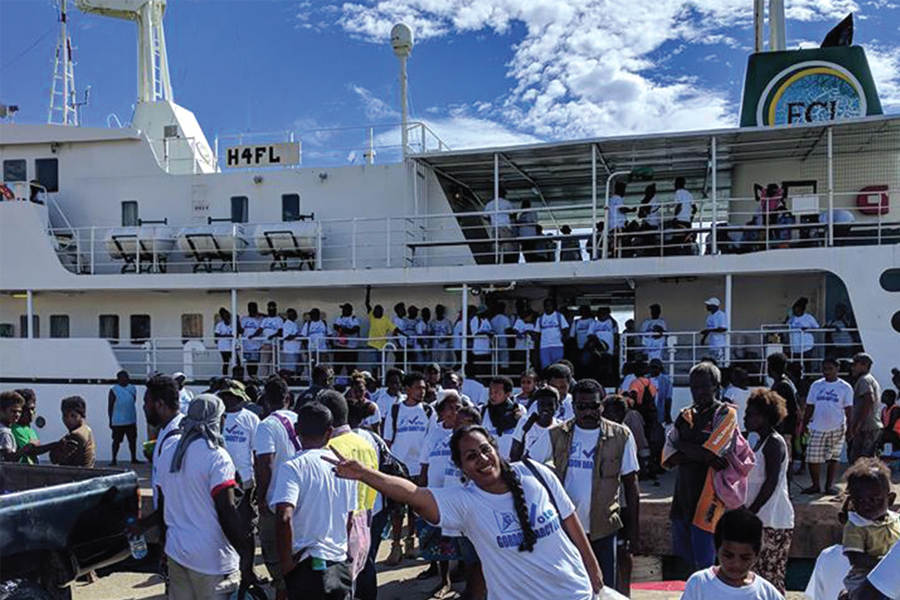
Former Prime Minister Gordon Darcy Lilo Supporters and Voters upon their arrival onboard MV Fair Lady and MV Fair Chief at the Gizo wharf on Monday.

BY ALFRED PAGEPITU

GIZO


Former Prime Minister Gordon Darcy Lilo Supporters and Voters upon their arrival onboard MV Fair Lady and MV Fair Chief at the Gizo wharf on Monday.

HUNDREDS of voters have arrived in Gizo for the Gizo/Kolombangara by-election.

On Wednesday 23rd May, polling stations will open at 7am and close at 5pm.

In an interview with Mr Christian Siale, the Western Province Registration Manager yesterday, he said voters are being urged to get to the polling station within this time.

He said the 12 polling stations are Saeragi, Bibolo, Titiana, Gizo A and Gizo B, Logha Island, Vanga, Poetete, Jack Harbor, Ringi, Hunda and Kukudu.

“Once the polling stations are closed the sealed ballot boxes will be sent to the Gizo election commission office.

“Since there were no to count the ballot boxes, the ballot boxes should be count early on Thursday morning.

“The results are expected to be announced after counting on Thursday.”

Siale calls on the Gizo/ Kolombangara constituents to be calm and vote peacefully to elect the leader who will represent them in parliament.

PM expresses need to purchase CT scan, medical container facility

0
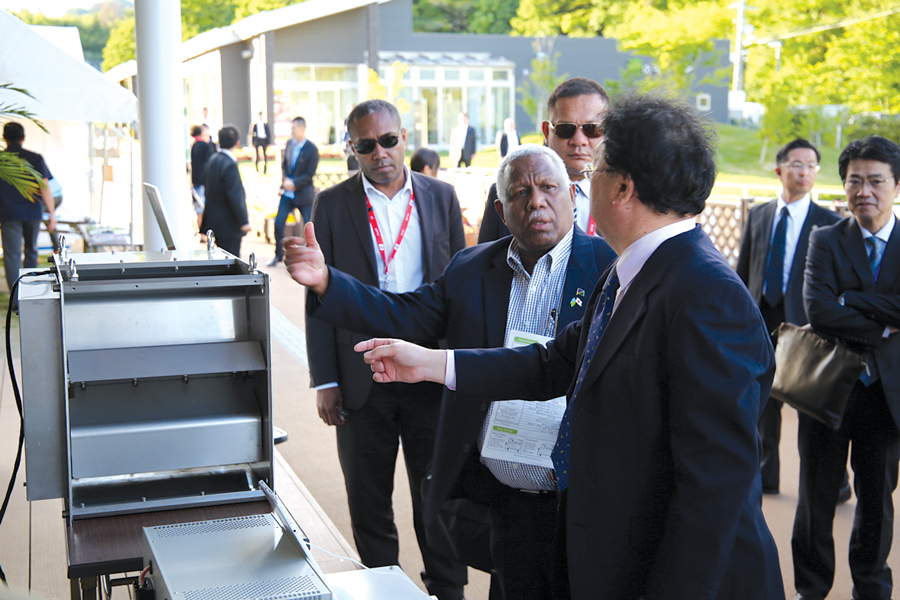
PM Hou is intoduced to the Micro-Hydro Electric Power Generating System. This program will be rolled out under JICA end of this month in the country.

PRIME Minister Rick Houenipwela has expressed the need for the Government to begin the process in seriously purchasing a CT scan for the country.

The Prime Minister highlighted this when he visited Sony’s Medical Container Facility in Iwaki City, Fukushima, Japan recently.

The Sony’s medical container is the latest state of the art innovation by Sony whereby medical equipment’s are set up in a mobile container.

PM and Foreign Minister Tozaka toured inside the facility

The container can either be an operating theatre or specific medical equipment or facility depending on the request needs.

These medical facilities are mobile and can be transported and set up by Sony.

The unavailability of a CT scan in the country is an issue that has been discussed over the years but to no avail to date.

The Prime Minister said it is time the Government needs to seriously consider options to purchase one.

He said it is an issue he will take up in Cabinet when he returns and the responsible ministry can start the process in looking at alternatives on the best options.

PM Hou is intoduced to the Micro-Hydro Electric Power Generating System. This program will be rolled out under JICA
end of this month in the country.

“I am overwhelmed that Sony a powerhouse company in the world has offered to assist in any way possible. Therefore, I hope responsible authorities can start looking at these different options. The ball is in our court,” he said.

The Prime Minister was also introduced to a movable Micro-Hydro Electric Power Generating System which can easily be installed easily in at least 55cm wide water channels.

It has an independent power supply system by connecting its own battery system. This means this that this generating system contributes to local production for consumption of electricity and works as a safety net for electrical power at time of disasters.

PM is introduced to the CT Scan which was also one of the facility in the container.

“This is an interesting innovation that can be very useful for rural areas in Solomon Islands,” he said.

In fact, the interest has paved the way for the manufacturing company of the generating system to come and start introducing the system in the country next month under the JICA program.

Meanwhile, the PALM 8 meeting which the Prime Minister attended concluded on Saturday.

–OPMC PRESS.

One of the mobile facilities
A Sony execurive displaying tne Canon Medical System sign.
The mobile medical facility

World Environment Day proposes expedition to Barana

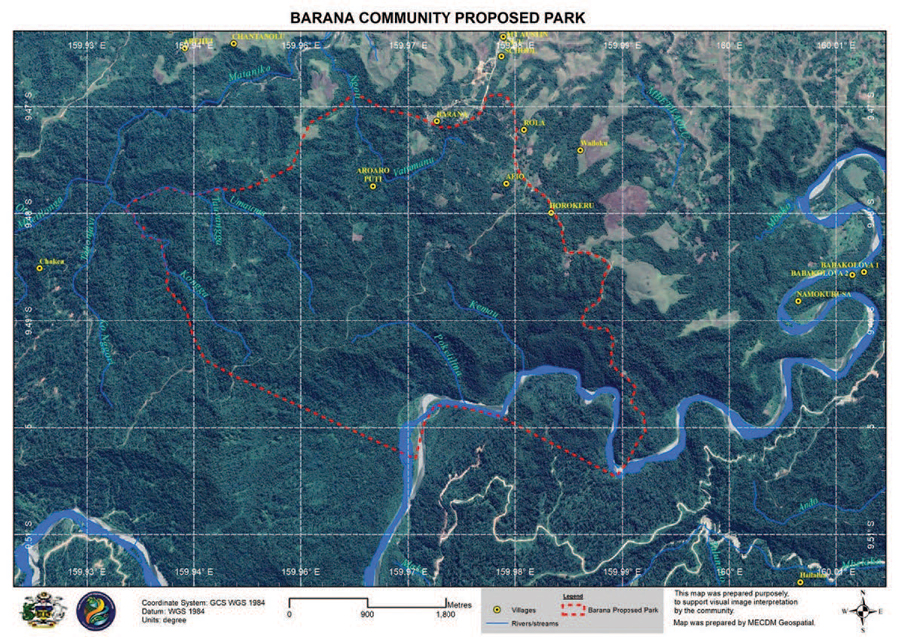
Barana community proposed park.

BY GEORGINA KEKEA

THE first of the meetings to discuss events to mark ‘World Environment Day’ (WED) will take place today.

A small organising committee comprising of various stakeholders has been established to oversee the plan and programme activities for this year’s World Environment Day. Celebrated every year on June 5, this year’s celebration is on the theme ‘Take action to Beat Plastic Pollution’.

For Solomon Islands SPREP PEBACC project as part of its campaign and awareness activities will lead the celebration of the world environment day through an environment expedition to “Barana Community Nature Park”.

This site located at Barana village (Mt Austin) overlooking Honiara city.

SPREP PEBACC project is promoting climate resilience through nature based solution and this site focuses on community natural resources and watershed management.

The objective of this expedition is to commemorate WED, focussing on plastics, promote community ecosystem values of the community nature park and to make general awareness and educating participating scouts, students and community.

The expedition is done in partnership with SI Scouts and other government partners.

NGO for clean city

0

BY GEORGINA KEKEA

 A NON-Profitable Organisation (NGO) called Friends of the City (FTC) is taking initiatives to discuss the development and social challenges facing Honiara City and to fashion the best way forward to a clean, safe and beautiful Honiara City. Last Saturday volunteers and members of FTC came out into the streets of Honiara to do a massive cleanup along the city’s Central Business District (CBD) and roads.

With the vision to build a clean, green and prosperous Honiara City, FTC’s mission is to enhance people participation through volunteerism to build a clean, healthy, pleasant and sustainable Honiara city. FTC believes that to collaborate is better than to compete.

During the recent ‘Business after Five’ (BA5) event of the Solomon Islands Chamber of Commerce and Industry (SICCI) FTC was also given the chance to highlight their work and to make known their entity.

Soon to be launched, FTC hopes to bring together volunteers from all works of life that have the heart for the city.

The initiative by FTC come in light of recent government talks on the ban of plastics and the depressingly formidable challenge the country is faced with in terms of waste management.

Climate change, country’s biggest challenge

One of the artificial Islands in the Lau lagoon facing impacts of sea level rise.

BY LYNTON AARON FILIA


CLIMATE change is still the biggest challenge in the Solomon Islands with impacts of sea level rise and intense weather events posing a serious threat to islands and coastline dwellers.

Solomon Islands is surrounded by islands, and is a nation of hundreds of volcanic islands, coral atolls and reefs in the South Pacific and is a part of the coral triangle – hub for marine biodiversity.

However, the country’s natural beauty has been exposed to many hazards like floods, cyclones, tsunamis and volcanic eruptions with the impacts of rising sea levels and more intense weather events multiplying the risks and posing serious threats to the people of Solomon Islands.

Currently, the government of Solomon Islands and the United Nations Development Programme (UNDP) are working with communities who are on the frontline of negative impacts of climate change to find ways to adapt to the changing environment.

SIG and UNDP specialists under the Solomon Islands Water Sector Adaptation Project (SIWSAP) — Gud Wata Fo Strongem Komuniti Lo Evritaem, have worked with six far-flung communities across the country.

These locations have become innovation hubs to test and refine methods to cope with issues such as drought, salination of wells and the loss of crops to the encroaching sea.

According to SIWSAP, the project was set with a goal to equip people with resilience to meet the challenges of the future and serve as a replicable model of adaptation around the Pacific and the world.

With regards to weather, the SIWSAP project installed five hydro-meteorological stations in Gizo (Western province), Taro (Choiseul province), three in Tigoa (Rennell Bellona province), Ferafalu community (Malaita province), and Tuwo community (Temotu province).

The new hydro-meteorological stations are built upon existing Climate Early Warning Systems (CLEWS) that are monitored and operated by the Solomon Islands Meteorological Services (SIMS).

According to Solomon Islands Climate Change and Disaster Risk Finance Assessment report, SIG commitment with climate change and disaster risk management are issues of high priority.

The report also contained interest from outside partners as new climate financing mechanisms to drive actions.

The international community also works towards the commitment to jointly mobilise USD$100 billion annually in climate finance to 2020.

More broadly, strengthening country systems will improve donor confidence to engage with Solomon Islands and catalyse the achievement of the sustainable development goals, which are linked to the national priorities of Solomon Islands as outlined in the National Development Strategy 2016–2035 (NDS).

Meanwhile, SIG and UNDP through the SIWSAP project worked with communities towards addressing the Sustainable Development Goal 13 on climate change adaptation by building resilience of communities in the water sector.

Beat plastic pollution for World Environment Day

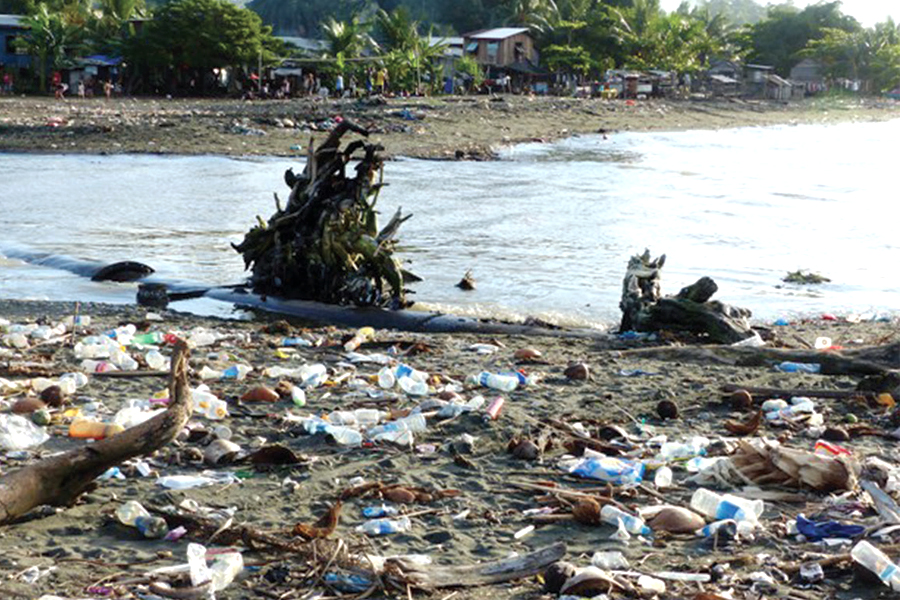
Rubbish collect at Mataniko river mouth (Photo by SPREP)

BY GEORGINA KEKEA

BEAT Plastic Pollution”, the theme for World Environment Day (WED) 2018, is a call to action for all of us to come together to combat one of the great environmental challenges of our time.

As countries plan their events for this year’s WED, the United Nations Environment Program (UNEP) hopes people do not have to wait till June 5 to act.

“This year’s WED provides an opportunity for each of us to embrace the many ways that we can help to combat plastic pollution around the world.”

In Solomon Islands, Deputy Prime Minister Manasseh Sogavare has said that there are small ways to demonstrate participation, commitment and contribution towards tackling the problem of plastic rubbish, environmental and marine waste and pollution. Sogavare made these remarks during a beach cleanup last month to commemorate Commonwealth day.

Meanwhile Friends of the City (FTC) a new Non-Governmental Organisation (NGO) established to discuss issues surrounding the city says education is the key to tackle plastic pollution.

“Correct disposal of rubbish starts from the home thus our children must be educated at an early age on how to dispose rubbish correctly.”

While plastic has many valuable uses, studies show that we have become over reliant on single-use or disposable plastic – with severe environmental consequences. UNEP reports that around the world, 1 million plastic drinking bottles are purchased every minute.

“500 billion disposable plastic bags are used worldwide every year. In total, 50 percent of the plastic we use is single use.”

Nearly one third of the plastic packaging we use escapes collection systems, which means that it ends up clogging our city streets and polluting our natural environment. Every year, up to 13 million tons of plastic leak into our oceans, where it smothers coral reefs and threatens vulnerable marine wildlife. The plastic that ends up in the oceans can circle the Earth four times in a single year, and it can persist for up to 1,000 years before it fully disintegrates.

The issue of plastic waste is a serious one and should not be taken lightly. Recently Premier Maepioh of Western province had been commended for his government’s initiative to ban plastic in the Western Solomon Islands.

Now the country’s Prime Minister is considering the ban of plastics after the recent Commonwealth Heads of Government Meeting (CHOGM) where tackling plastic waste is an outcome of the meeting.

The government of UK announced £61 million to tackle plastic waste, including matching public donations through UK Aid Match up to £5 million.

UNEP on the other hand says if you can’t reuse it, refuse it.

A simple man’s tale of success

0
Dr. Tarcisius Kabutaulaka in one of his recent visits to his beloved ‘Tasimauri’ region.

BY GEORGINA KEKEA

A SOLOMON Islander, is set to be the next director of the Center for Pacific Islands Studies (CPIS) in Hawaii.

Dr Tarcisius Kabutaulaka started his journey from Haimatua village in the Tasimauri area of Guadalcanal on the southern side of the island. Tasimauri simply means ‘alive sea’.

Educated in a Catholic Primary school in Avuavu called St Michael, Kabutaulaka recalled those days through an article he wrote called Kabutaulaka Tuhu-Vera.

In this article he spoke of how he used to walk two miles each day, to and from school in the morning and back at the end of the day with cooked sweet potato, taro or yam for lunch.

“When it rained, we used banana leaves as umbrellas folded our clothes and wrapped them in leaves and ran naked in the rain.”

One of Dr. Kabutaulaka’s daughters and her uncle in Guadalcanal.

Kabutaulaka recalled that life was difficult and he was constantly homesick when he left his parents and became a boarding student prior to the grade six exams.

“It was the first time I had left my parents and village to live elsewhere but I soon grew used to it because I knew everybody and was related to most of the other kids at school and some of the teachers.”

Thereon he furthered his studies to St Joseph Tenaru where he was one of two students that was accepted to do secondary education there.

He did forms one to five at St Josephs and did form six at King George Six School before going on to the University of the South Pacific (USP) in Fiji.

Kabutaulaka received his undergraduate and MA degrees from the University of the South Pacific and a PhD in political science and international relations from the Australian National University.

Making his way up has not been easy as Kabutaulaka told Island Sun.

“Dedication and hard work are the keys to achieving our goals,” he said.

When announcing the news of Kabutaulaka’s appointment, CPIS described Kabutaulaka as well known and widely respected throughout the region.

The statement said Kabutaulaka has established a distinguished record of teaching, research, and service in academic institutions, as well as a reputation for his work as a consultant for regional governments and nongovernmental organisations across Oceania and beyond.

“I think that Solomon Islanders can compete for and get jobs internationally. We can serve and represent our country through those jobs. I encourage other Solomon Islanders to set goals and work for it,” Kabutaulaka told Island Sun.

Dr. Tarcisius Kabutaulaka in one of his recent visits to his beloved ‘Tasimauri’ region.

Kabutaulaka joined CPIS core faculty in 2009, teaching Pacific Islands studies courses at both the undergraduate and graduate levels. This is with particular emphasis on issues related to land and economic development, conflicts, post-conflict rehabilitation/peace-building, natural resources, governance, regionalism, and China in Oceania. In addition to his teaching, Kabutaulaka is currently the Editor of the Pacific Islands Monograph Series and member of the editorial board of The Contemporary Pacific.

Prior to joining the Center, Kabutaulaka was a Research Fellow for the Pacific Islands Development Program of the East-West Center. He has also taught at the University of the South Pacific and the Solomon Islands College of Higher Education.

In the book he wrote, Kabutaulaka muses about his cultural identity as a Solomon Islander and his connection to Guadalcanal where he originated from.

“While I might be mobile, home is not. For me, a Tasimauri man of a particular generation, mobility is not about disconnections. Rather, it is about creating new connections while at the same time maintaining one’s roots in vera; that is what directs and defines one’s mobility”.

Kabutaulaka revealed that family is what brought him home every now and then including work.

“Despite the travels and working overseas most of my life, Solomon Islands is home for me. I am thankful to Solomon Islands for the early years of my education and proud to be a Solomon Islander taking on this job.”

A far cry from his home village of Haimatua. The view from Dr. Kabutaulaka’s apartment in Hawaii.

The Center for Pacific Islands Studies, in the University of Hawai‘i at Mānoa School of Pacific and Asian Studies, is both an academic department and a larger home for initiatives that bring together people and resources to promote an understanding of the Pacific Islands and issues of concern to Pacific Islanders.

Working with scholars at institutions in the region and elsewhere, faculty at the center are seeking new ways to encompass a deeper understanding of a region whose boundaries are constantly expanding.

Kabutaulaka is one of the few Solomon Islanders holding such positions in education institutions overseas.

His wife is also a Solomon Islander from Malaita and they have three daughters.

Project to help deaf people in Pacific gets US funding

0

DEAR EDITOR, a news bulletin on Radio New Zealand on Monday this week said a youth-led project to empower deaf communities in the Pacific region had been granted US funding to further their need for equality.

The particular capacity building project is aimed at assisting deaf communities in both Fiji and Papua New Guinea.

One of the project leaders, Krishneer Sen, said their research project would help ensure people with disabilities could exercise their rights, so no one would be left behind in society.

The pair received US funding from the Pacific Youth Leadership grant.

Having the needs of deaf persons in the Solomon Islands in mind, I was interested to learn more about the US sponsored Young Pacific Grant scheme and this is what I discovered by some internet searching.

I quote.

“WASHINGTON – Twelve winners have been announced for the U. S. Department of State’s 2018 Young Pacific Leaders (YPL) Small Grants Program. The selected teams, representing 11 different Pacific countries, will receive up to $13,750 in grant-funding to implement projects in the region related to the program’s core themes of education, environment and resource management, civic leadership, and economic and social development.

“In addition to funding, YPL grantees attended a kick-off workshop in Auckland, New Zealand on May 10-11, where they refined their project ideas and learned more about successful grant management. The teams will receive mentorship throughout the year to help ensure their project’s success.”

“The 2018 YPL Small Grants Program launched in January and was open to alumni from previous conferences. Alumni include young leaders, aged 20 to 35, from Australia, the Cook Islands, Fiji, the Federated States of Micronesia, Kiribati, the Marshall Islands, Nauru, New Zealand, Niue, Palau, Papua New Guinea, Samoa, Solomon Islands, Tonga, Tuvalu, Vanuatu, and the American-affiliated Pacific (Guam, Commonwealth of the Northern Mariana Islands, American Samoa).”

“2018 Young Pacific Leaders Small Grants Program Awardees:

Kaitiaki Generation

New Zealand and Hawaii

A collaborative exchange between Māori and Kanaka ʻŌiwi communities on traditional knowledge and western science.

Documenting Traditional Knowledge through Digital Media

The Cook Islands

Webseries documenting Cook Islands Māori traditional knowledge and importance of indigenous culture for future generations.

Youth-4-Change Mentoring Program

The Federated States of Micronesia

Youth leadership and mentorship training program to help young peer leaders provide for at-risk youths in Micronesian communities.

Project Sechelik

Palau

To promote literacy and indigenous language in Palau by publishing and distributing an original colorful children’s book written in Palauan.

Training in Jolly Phonics

Papua New Guinea

Providing skills-based training to elementary school teachers in the Kerowagi District of Chimbu Province, Papua New Guinea.

Community Building and Engagement for Deaf Persons

Fiji and Papua New Guinea

Enhancing deaf peoples’ opportunity to be an equal citizen in their society through community empowerment, civic leadership, and training.

Sustainable Livelihood Project

Fiji

Training farmers in Wairuarua Village to develop, implement, and further sustainable livelihoods through permaculture and traditional farming methods.

Removal of Sargassum Seaweed

Tuvalu

Community engagement and environmental clean-up initiative to remove invasive seaweed species and improve coral reef health.

LE VĀ TALANOA

Samoa

A cultural heritage workshop focusing on Samoan architecture and working to bridge the gaps in generational knowledge.

Malasitabu Project

Vanuatu

Supporting Malasitabu Primary School through classroom infrastructure development, promoting healthy lifestyles and education on waste management.

Language Roots the Tree of Culture

Niue

A cultural bridge between Niuean youth in-country and those living overseas to promote and preserve cultural heritage.

Early Literacy- Let’s Read

Vanuatu

Early literacy initiative targeting children under the age of three.”

The Solomon Islands has many young, talented leaders already involved in the kind of projects for which US Embassy grants have been awarded this year and in past years, so I would strongly encourage those young leaders to prepare their own projects and to bid for grants the next time around.

The contact details are: US Embassy, US Embassy Majuro, Mejen WEto, Ocean Side, Majuro, Marshall Islands. Phone +692-247-4011. Fax     +692-247-4012


Yours sincerely

Frank Short