Home Blog Page 1144

Delegation visits marine vessel to do survey

0
R.V Northern Endeavour that will carry out marine survey.

BY GEORGINA KEKEA

PRIME Minister Rick Hou has joined the Australian High Commissioner, His Excellency, Roderick Brazier to visit the ship tasked to carry out marine survey for the Coral Sea project.

On Saturday, the marine vessel Northern Endeavour stopped in at Honiara Port to survey the area where the Coral Sea Cable System will connect to Honiara.

On this occasion, the Prime Minister and government officials had the opportunity to go on board the vessel to see the facilities. In a joint Press Release by the Australian High Commission and the Office of the Prime Minister, the visit is for the delegation to meet the crew and understand more about the process for delivering this infrastructure.

Prime Minister Rick Hou says, there has been a lot of work done behind the scenes since the signing of the tri-party agreement in July this year.

“This is yet another tangible development and step forward in the progress of the submarine cable project”, he said.

(L-R) Keir Preedy, H.E Roderick Brazier, PM Hou and Sandy Wilson (Party Chief, EGS).

Meanwhile, Australian High Commissioner, Roderick Brazier says he is excited to be able to celebrate this important step with the Prime Minister.

“It has the potential to be truly transformative and I am excited to be able to celebrate this important step towards its completion with the Prime Minister,” Brazier said.

The preliminary planning by the RV Northern Endeavour ensures the manufacture and installation of the cable is precise as possible.

The Northern Endeavour can be able to carry out its work, regardless of poor weather and sea conditions.

“We can work in surprisingly wet weather conditions. Different parts of our work have different windows. Different wind speeds, wave heights where we have to stop. But we can generally always keep busy on something,” Sandy Wilson, of EGS said.

The estimated total project expenditure of the Coral Sea Cable System is AUD$200m. This is an estimated SBD$1.15 billion.
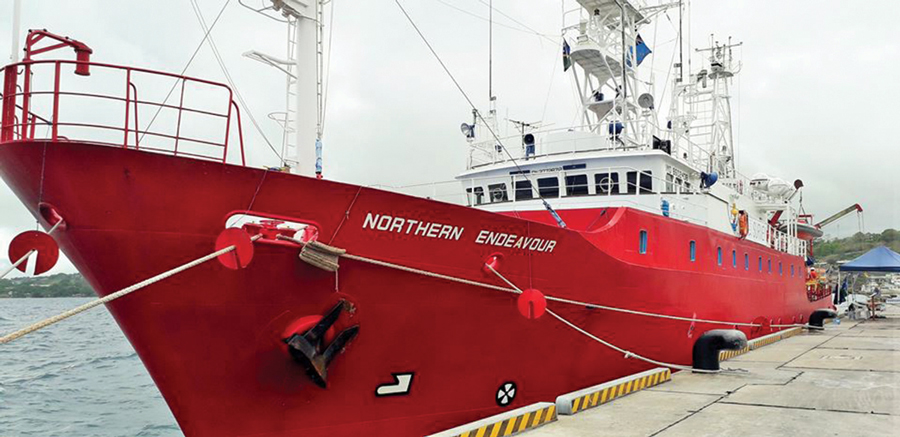
R.V Northern Endeavour that will carry out marine survey.

PCDF disqualification affects Tulaghi’s Shopping Complex

CIP Premier Hon Patrick Vasuni

BY BARNABAS MANEBONA

IN TULAGHI

CENTRAL Islands Province (CIP) being disqualified from the PCDF funding in 2017 resulted in Tulaghi’s incomplete Shopping complex now heavily debated.

To add, with the decreased allocation given by the National Government to all Provincial Capacity Development Funding (PCDF) this year for all provinces dropped the hope CIP’s current provincial Executive Government had to continue with that particular project for the province.

Instead of receiving the usual $15 Million allocation, CIP being re-qualified for the recent 2018 PCDF funding had only received less than $10 Million, and that is $9.9 Million.

The cut in PCDF budgets had sparked great concern throughout the provincial governments of the country seeing that many planned projects and developments will be affected.

CIP’s Premier Patrick Vasuni is aware of heavy criticisms over the Shopping Complex towards his current Executive government however, he states that the incomplete shopping complex building does not mean that they have forgotten about it.

In fact the shopping complex was yet the plan of the past Executive Government over which his Executive Government had fallen victim.

“With the decreased PCDF allocation this time round means that we have to focus first on other prioritised developments for the province such as through its education and health sections before we move on to find ways to continue with such other incomplete projects as the shopping complex having its initial cost spending was nearly $5 Million being just too much for the province PCDF spending,” said Vasuni.

“In reality, the province does not have the capacity in terms of business development which our government question why the past provincial Executive Government came up with such plans.”

From the mess being left behind by the past CIP provincial Executive Government, Vasuni assures through Island Sun yesterday that their government is now trying to address it in which their first step is to allow the local Engineer now given the task over the complex to first make further assessments.

More females enrol in 2017

0

BY LORETTA BRIGIDIA MANELE

The education ministry has achieved success in 2017 under it’s National Education Action Plan (NEAP) 2017-2020 endeavours, however they are also some challenges still need addressing.

According to the Ministry of Education and Humans Resources Development (MEHRD) 2017 Annual Report, the ministry has succeeded in a number of ventures.

As reported, for the year of 2017 alone more children had access to early childhood with an 8 percent increase and more primary and secondary children attended school with a two percent and 3.6 percent increase, respectively.

To add on, MEHRD also mentioned that more classrooms and school facilities were built, more young people accessed further education through scholarships, accounting to more than a 33 percent increase and girls surpassed the number of male enrolled students for ECE, Primary, Junior and Senior Secondary sectors.

While this is a string of achievements for that year alone, the ministry also noted a few issues which are; many children starting school at an older age than expected or repeating grades, an imbalance in expenditure between education sectors where Tertiary costed $425million for 2,756 students and ECE, Primary and Secondary at $224million for 216,137 students.

Female enrolment in schools remains low: Report

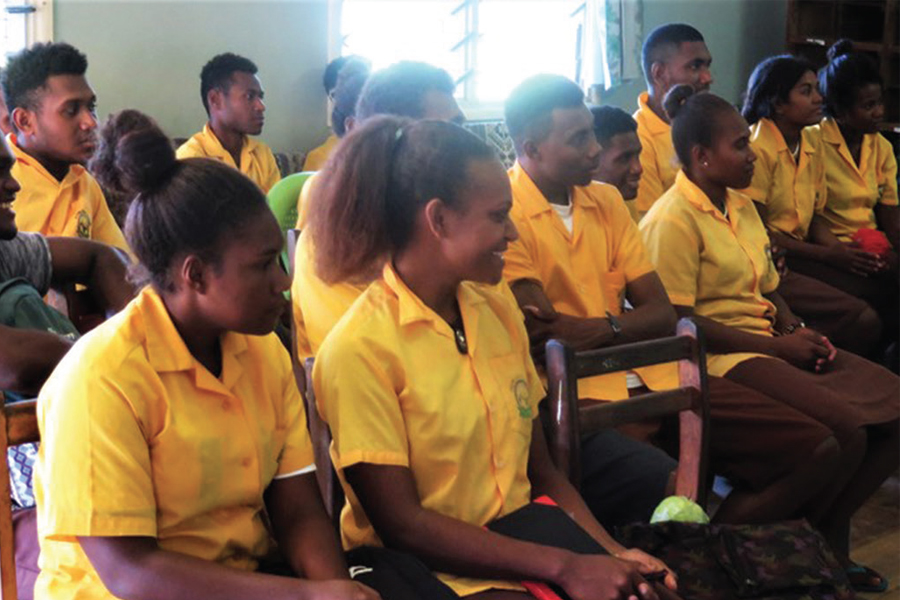
Honiara High students enjoying the presentation.

BY LYNTON AARON FILIA

DESPITE the country’s school enrolment rates showing increasing gender parity, completion of secondary school and further education remains tilted in favour of male students.

The Solomon Islands Youth Status Report 2018 of the United Nation Development Programme shows 47 percent of 18-year-old males are enrolled in education compared to only 37 percent of 18-year-old females.

Literacy rates for boys aged 15-24 are 91 percent compared to 88 percent for girls of the same age – a gap narrower than found among older generations, although there may be a discrepancy between these rates and functional literacy.

UNDP report shows young people access to education is relatively low in rural areas.

It said while 55 percent of children and youth aged 10- 19 in Honiara attend secondary school, only 36 percent of the same age group across the whole of Guadalcanal are in school, and only 25 percent in Malaita.

Following that the report also highlighted such disparities are also reflected in literacy rates.

It shows 56 percent in Malaita and 66 percent in Guadalcanal—although testing by the Asian South Pacific Bureau of Adult Education found only seven percent of people in Malaita and 28 percent in Honiara was judged literate.

In the secondary division, the report shows a concentration of national secondary schools in Honiara has had several effects.

First, it means that the chances of rural people accessing education are lower, due to increased costs and travel needed to go to school.

It also drives migration to Honiara, with education seen as the way to transition from rural to “modern” life.

In areas such as Temotu and Savo, young people have to walk long distances each day (2-4 hours) in order to go to secondary school.

Other students may leave their provinces to go to Honiara and stay with extended family, which puts financial pressure on households and can lead to disillusionment if education is not completed or does not lead to work.

In some areas, such as mountainous parts of Malaita and Weathercoast of Guadalcanal, education is traditionally provided in a village setting to teach children about culture and subsistence agriculture.

In other areas, for example those reliant on illicit trade such as kwaso sales, household poverty and financial pressures may mean education is less of a priority than making a livelihood and earning money.

The lack of resources at provincial secondary schools also puts rural students at a disadvantage in terms of applying for tertiary education, scholarships and other opportunities.

Central Islands province gov’t to seek legal advice over ship wreckage

0

BY BARNABAS MANEBONA

IN TULAGHI

CENTRAL Islands Province (CIP) provincial government will soon be seeking legal advice from the Attorney General’s Chamber for the removal of a former Mbikoi Company’s ship wreckage near Tulaghi.

Numerous calls have been made by the provincial government for the ship’s owner to remove the wreckage fearing threat to the marine life and the provincial town’s water supply pipeline not far from it but to date, there has been no action taken seeing that locals are starting to take away parts of the ship.

“We have been trying to communicate with the ship owner but with no success. One thing Ship owners and companies must be aware of is not to treat our province as a wreckage dumpsite for them to come and throw their mess,” strongly warns CIP’s Premier Patrick Vasuni.

When querying through to the Solomon Islands Maritime Safety Administration (SIMSA) over such matter, the response received was SIMSA has no resources to look after wrecks or Marine Pollution in the country.

‘Planes can be removed but not after signing of MOA’

0

BY GEORGINA KEKEA

AN understanding has been reached between stakeholders in Shortland Islands for the removal of World War two planes on Balalae. In an interview with Island Sun, Chief Edward Kingmele of Maleai village in Shortland Island says after years of wrangling, they have finally reached some understanding for the removal of two planes from Balalae.

“While it is prudent to keep all the war relics on Balalae for people to come and see, we have suffered vandalism amongst other things that have stirred ill feelings between people there. Rather than see the relics destroyed, we will cooperate with the government to save the planes.”

Kingmele said they have agreed to have two of the planes extracted and sent to Australia for rehabilitation. He said it will take two to three years to have the plane rehabilitated.

“And they will return the plane to Honiara to be kept in a museum for people to see,” he said.

Kingmele continued that no matter the people of Shortland islands are quite angry and upset about the war relics, they must understand that the war relics belongs to the government and the state.

He said though the war relics are on their land, the relics belong to the government. However he said, before any loading of the planes take place, government must first of all sign the agreement that they have reached.

“I do not want anything to take place, outside of the agreement,” Kingmele said.

He said they are still to sign the MOA and they are waiting for the government to come back to them with the agreement.

“Government has guaranteed the return of a plane upon its rehabilitation. We want government to keep its word,” Kingmele said.

He said the sooner they sign the MOA, the better so that removal of the planes can be done as soon as possible.

It was in 2007, that Government agreed to the arrangement for the sale of all World War II relics at the community of Balalae in Shortlands to an international group.

MEHRD strives to construct more classrooms 2017-2020

0

BY LORETTA BRIGIDIA MANELE

ACCORDING to the Ministry of Education and Human Resources Development’s (MEHRD) 2017 Annual Report one of the strategies to increase access to education is the availability of quality infrastructure.

The report stresses that one of the key activities under MEHRD’s (National Education Action Plan) NEAP 2016-2020 is to have an Infrastructure Expansion Plan that will provide the basis for infrastructure activities for the Ministry.

Moreover, MEHRD stated that the School Infrastructure Projects Implementation Plan was developed, endorsed and implementation coordinated by the Ministry’s Asset Management Division (AMD) under which seven provinces have developed their provincial infrastructure plans in 2017.

Henceforth, as expressed in the report, a supplementary Annual Infrastructure Procurement Plan is currently being developed by the AMD and MEHRD has also developed an Asset Management Plan.

“All these plans are interconnected to form the Infrastructure Expansion Plan that was endorsed and launched this year at the Education Authority Conference held in Buala,” said MEHRD.

For 2017, it is recorded that MEHRD’s 111 ongoing classroom and school infrastructure projects from the year 2015 were completed.

This includes 24 science Labs, 11 technology workshops, nine home economic labs, three dormitories, two ablution blocks, 22 staff houses and 30 normal classrooms.

The construction of 15 science laboratories also commenced within this year and is ongoing.

The education ministry strives to reach its target of constructing 50 new classrooms each year with a total of 200 new classrooms constructed and operational by 2020.

MEHRD commits to equal access to education for both female and male students

0

BY LORETTA BRIGIDIA MANELE

IN its annual 2017 report, the education ministry shares three change pathways of how they think education improvement will happen amidst its current National Educational Action Plan (NEAP) 2016-2020 timeframe.

Ministry of Education and Human Resources Development (MEHRD) explains that these pathways is also what they refer to as their “Theory of Change” (ToC) which provides the basis for planning, monitoring, evaluation and reporting by clearly describing expected results of what and how the ministry contributed to the results more on, what they will measure and report.

Under the theory of Change (ToC), MEHRD’s three change pathways are; Increased Access to Education, Improved Quality of Education and Improved Management of Education.

MEHRD expressed that it maintains a strong commitment to all female and male students having a safe and equitable access to complete their education irrespective of social, economic or other status.

In addition, as stated, the ministry implements a range of activities to understand what stops children commencing, continuing and completing their education.

“Understanding the ‘blockers’ to access creates an opportunity for evidence based decision-making regarding future access related strategies,” said MEHRD.

To top that off, the ministry mentioned that it will also focus on the implementation of infrastructure activities and reframing pre-primary years into early childhood education as it believes that this will contribute to children’s completion of basic education (inclusive of PPY) and an increased number of children completing 13 years of education.

In the case of “Improved Quality of Education”, MEHRD states that this is a priority area during the first phase of NEAP.

“Developing and implementing a new curriculum, reshaping the approach to student assessment and realigning teaching strategies to focus on the child will form the basis for achieving improvements,” said MEHRD.

As for the third pathway, “Improved Management of Education”, it is reported that the education ministry engages in a collaborative process with education partners to improve education management at the school, education authorities and national level (MEHRD).

MEHRD emphasised that improvements in education management are inter-connected between the three levels of education management to which sound education management provides the foundation for increasing access to and improving the quality of education.

‘Education opportunities not fair in Solomon Islands’

0

BY LYNTON AARON FILIA

PRIVILEGE to tertiary education tends to be entrenched in a privilege belonging to the elite, a report shows.

According to the United Nation Development Programme’s 2018 report on Solomon Islands Youth Status compiled by Dr Anouk Ride, tertiary education tends to entrench elite privilege and gender and other disadvantages.

The report highlighted that every year, students complain about scholarships being allocated not according to merit but to elite and kin-based privileges.

The system tends to disadvantage women, it said.

Besides, in 2017, only 28 percent of government scholarships for school graduates (26 out of 91 pre-service scholarships) were awarded to women.

Respondent recommends there is a need to reform the scholarship system to ensure access according to merit, match scholarships with government and industry needs, and foster effective spending of large financial allocation.

In addition, at the postgraduate level the report stated that few men or women have the opportunity to study.

For Solomon Islanders only 25 currently possess a PhD, which is very low compared to neighbouring countries such as Fiji, and the government stated in 2016 that it wants to support high-achieving tertiary students into post-graduate degrees, it said.

However, access to education is only part of the story; there are many tertiary-educated people in the country who are unable to find work in their field after their studies.

Scholarships have tended to focus on the civil service while neglecting industry needs, resulting in a shortage of finance and managerial staff in most sectors.

The tourism and cultural industries, for example, suffer from a lack of managerial, promotional and marketing expertise – skills needed to professionalise services and export cultural products.

On the other of the spectrum, only one in six school leavers find paid employment. There is an acute lack of vocational and life-skills training, the report stated.

It also stated that rural training centres in the country report high demand for the less than 3,000 places offered each year.

Meanwhile, increasing population numbers have resulted in the current situation where numbers of vacancies in this sector are few and cannot meet the demand for employment of school leavers.

A silent problem

0
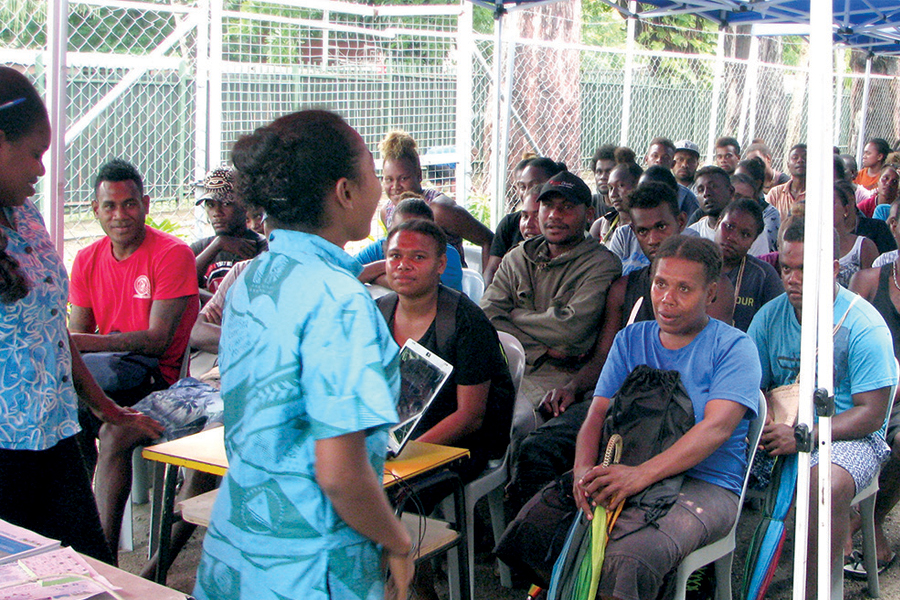
Youth@Work holds information sessions for youth

Youth unemployment continues to increase in SI


BY LYNTON AARON FILIA

YOUTH unemployment in Solomon Islands continues to increase, a report shows.

70 percent of Solomon Islands’ population are youths, and the Solomon Islands Youth Status Report 2018 report shows a majority of youths only reach lower levels in the education system.

One reason which stands out, especially for females, is that they get married in their early or mid-20s; another factor which impacts their chances of getting employment.

The report also states that young mothers in particular are less likely to be able to participate in work and the economy.

In the 2009 census, young mothers in rural areas produced goods for their own consumption (56 percent), but most urban teenage mothers were doing unpaid domestic work (60 percent).

Only 17 percent of young mothers were in paid employment – 28 percent of those in urban areas and 16 percent of those in rural areas.

The report also highlighted their options are limited due to childcare responsibilities and lower levels of education

Meanwhile, average age at first marriage in Solomon Islands is 23.3 years of age for women and 27.1 for men.

According to the International Labour Organisation (ILO), youth unemployment rate is at over 35 percent.

Although this is difficult to measure precisely because of informal work, patterns of shifting between agriculture and informal business, variable incomes and lack of data on livelihood incomes, certain sectors such as retail and journalism have generally young workforces but they also tend to be low-paid, the report shows.

Recently, Solomon Islands Government launched the National Youth Policy 2017—2030.

In the policy, it spells out areas for addressing Solomon Islands’ youth unemployment which are particularly focuses on youth entrepreneurships.

With that, SIG also set agreements with Australia, Japan, Taiwan and New Zealand in terms of Labour mobility with aim to address youth unemployment rate which currently rise in the country.