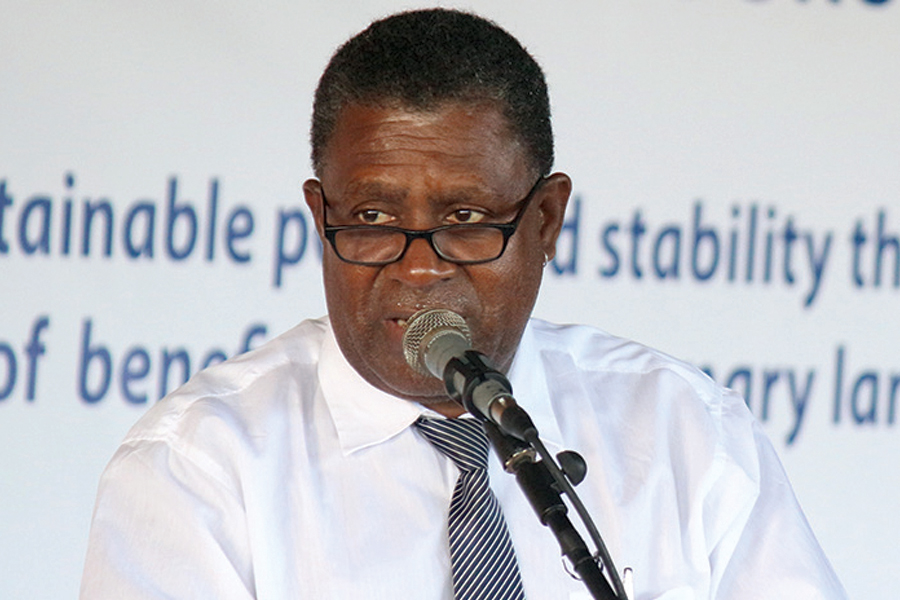
Standing in for the NRH CEO Dr Rooney Jagilly, Sr Elizabeth Sanau, Dr Trina
Sale, Dr Patrick Toito’ona, Willie Falebo (ED RN), Edward Bugotu (ED RN) and
President of the Solomon Islands PNG Association Denyse Ealedona.
Standing in for the NRH CEO Dr Rooney Jagilly, Sr Elizabeth Sanau, Dr Trina Sale, Dr Patrick Toito’ona, Willie Falebo (ED RN), Edward Bugotu (ED RN) and President of the Solomon Islands PNG Association Denyse Ealedona.
THE Solomon Islands PNG Association on Monday this week handed over medical equipment to the National Referral Hospital (NRH).
The Association handed over an ECG and a Suction machine worth over $50,000 at a small but significant event at the NRH.
The medical equipment was purchased with funds raised during an appeal by the Solomon Islands PNG Association as part of its 40th Independence anniversary celebrations in Port Moresby.
President of the Solomon Islands PNG Association Ms Denyse Ealedona said the Association used the occasion of the 40th independence anniversary celebrations to give back to the country.
“This donation to the National Referral Hospital would not have been possible without the support of many people. I would like to sincerely acknowledge the huge support from the member for South Bougainville Timothy Masiu for his contributions towards this appeal. I’d also like to thank our corporate sponsors in Papua New Guinea – Gold Club Lamana, Air Niugini, Keynote Music House, Tasion Group, Credit Corporation and Vision City who supported us for the charity fundraiser concert. A big thank you to the Solomon Islands community in Port Moresby for their support, my Charity Concert Committee and my executives. With the collective support from everyone who contributed one way or another towards this appeal we wouldn’t be making this donation today.”
Ealedona also thanked Solomon Islands students studying in PNG who have continuously supported the work of the association and this appeal.
She announced that as part of its support to charity – SIPNGA will now forge a relationship with NRH to continue to support the hospital wherever it can.
Ealedona said the hospital has a lot of needs and the support the association will make to NRH will go a long way towards assisting the hospital in areas of need.
ALARM has been raised over unlawful drunken activities in the residential areas of the Malaita provincial town of Auki.
According to Auki Town Facebook Forum, residents are becoming distressed over such unlawful activities especially from drunk youths in their area.
The area said to be worse with the problem is Fasitoro, which is the biggest residential area in Auki town.
It articulated in the forum that youths both male and females continue to be part of the activities as well as some elders.
It said youths get drunk with alcohol not only on weekends, but almost every day.
A post reads that youths were “so disturbed with loud music, shouting and swearing from drunken youths almost every night”.
However, their appeal is for police to crack down on such unlawful activities among youths in the area and Auki town.
Meanwhile, it is also reported that concerned residents have already told police about the problem, but since then they have not received any response from police.
“I wonder if we have police role functioning in Auki,” says one commentator.
The forum appealed to police to be serious on this matter.
I write this Column sitting atop perhaps the highest hill in Auki on Malaita. The views are breathtaking any direction one looks.
The site is the Hotel Malaita, one of the many hotels and motels that had sprang up in the Auki Township in the last five years. Their existence was the result of hardworking Malaitans who have decided to go it alone with or without government help.
This week Hotel Malaita is the venue for the first Land Summit on Malaita, with the theme: Sustainable Peace and Stability through equitable distribution of benefits from customary land and sea resources.”
Organisers are hopeful that the outcome of this $600, 000 event, funded by the United Nations Development Programme (UNDP) under the United Nation’s Peace Building Fund will go a long way towards opening up Malaita for investments.
Some 300 people representing women, youths, community chiefs and church leaders from the four corners of Malaita have come to share in unclogging what has kept development away from Malaita for so many years.
In opening the formal gathering this morning, Bishop Hou, the first Melanesian Bishop of the Catholic Church, said in his opening prayer, “we desperately need each other.”
Premier Peter Ramohia who officially opened the gathering said the Land Summit provided “an opportunity and space to identify” land issues, which must be addressed to allow investors to see Malaitans in a different light.
One of the contributing factors to Malaita’s problem in attracting investment is that Malaitans are “disunited and disconnected” at all levels. Right now when an investor looks at Malaita all he sees is land disputes and other negative things,” Premier Ramohia said.
On both points the Premier has a point.
All 14 Malaitan MPs were invited to the Summit. The least anyone expected was for someone to attend the official opening. But none turned up. Premier Ramohia challenged Malaitans to be prepared to take their rightful place, as they work together to find solutions that have bedevilled Malaita’s development efforts for many, many years.
He challenged Malaitans to be prepared to take their rightful place in developing Malaita.
UNDP Country Manager Asuza Kuboto who spoke next made some interesting observations, revealing that Solomon Islands had missed out altogether in fulfilling any of the Millennium Development Goals set by the United Nations.
The MDGs expired in 2015.
“Solomon Islands did not meet any of the eight Millennium Development Goals, which expired in 2015 while many of the emerging countries met most of them through rapid economic growth and proactive policy interventions,” Ms Kuboto said.
“In 2015, along with 192 countries, the Solomon Islands made commitments to achieving 17 Sustainable Development Goals [SDGs] by 2030. These goals talk about people having access to good education and health care systems, safe drinking water and sanitation and food.
“2030 is only 12 years away. Is the Solomon Islands going to look different in 2030,” she asked.
To suggest that the SDGs are ambitious is an understatement, given that the Houenipwela government owed the Solomon Islands National University (SINU) more than $24 million in debts for various items including tuition fees.
This is crunch time for the government, Members of Parliament and even the private sector. Some MPs have begun locking up their Constituency Offices in Honiara. Others, particularly from Malaita who asked their supporters to come to Honiara for the final hand-outs returned home empty-handed last weekend.
Despite repeated warnings, the government appears to have run out of funds to pay for services. So the SDGs are going to be tough in terms of meeting the goals set.
The answer may lie in a new administration of like-minded individuals taking office after next year’s national general election. Then and only then will be a ray of hope for Solomon Islands and its people.
DEAR EDITOR, as a mother, grandmother, great grandmother and the eldest member of my sub-tribe, I am writing to express my concern about how our legal system (SI) came up with a judgement against my sub-tribe on a court case regarding customary land.
It is hard to believe that it is possible to lose a customary land to a non-Guadalcanal person.
A customary land in a Guadalcanal society is a traditional valuable inheritance that has been handed down from the first woman from whom you traced your genealogy, up to the present.
So, how can you lose it through the legal system?
I strongly believe that the law should protect the truth, not a fraud or a mistake.
Our customary land at Titinqe/Tasahe has been passed down from my grandmother, who through our migration route settled and established herself and family there.
Thus, our sub-tribe, in our desire to hand down this same block of land to our current and future generations in a clear from problems and transparent ways, met up with this non-Guale person who acquired land at the site through deals with other people that we have no knowledge of.
We are a third party with original heritage of that land that got caught through this foreign legal system that does not recognise our indigenous law and rights.
It’s about time we look into our legal system that best protects the indigenous right of the ownership of land by the rightful landowners.
We are not grabbing any extra piece of land, no; we just want our 35 Ha of land to come back to us: NO MORE, NO LESS!
Some of SRIPEN Executive Board with Patron after the launching. (Sitting from left to right) George Pego (President)
George Saemani (Patron), Francisca Tamu and Marisa Pepa. (Standing from left to right) Jacob Ghala, Bernard
Kemakeza, John Mark Sanguh and Wilson Sungi. Photo from SRIPEN Media
THE Savo and Russell Islands People’s Empowerment Network (SRIPEN) was officially launched on Saturday November 10, 2018 at Pokilo Village, Savo Island.
SRIPEN Executive team, representative of the Savo House of Chiefs, community elders, leaders of Savo 13 communities and general community members attended the event and witnessed the official launching. The occasion recorded more than 100 people.
At the presentation of SRIPEN, the patron George Saemane who is one of the core founders shared the long journey and many attempts to bring the people of Savo together.
“We call ourselves different names over the last 20 years but that does not matter now, this year for the first time, we were able to bring other Savo Islanders and our wantoks from the Russell Islands under the SRIPEN Banner.”
In May 2018, SRIPEN has adopted its Constitution, registered the group as a charitable entity, called a general meeting and elected its executive members in October and now successfully launched the network.
Some of SRIPEN Executive Board with Patron after the launching. (Sitting from left to right) George Pego (President) George Saemani (Patron), Francisca Tamu and Marisa Pepa. (Standing from left to right) Jacob Ghala, Bernard Kemakeza, John Mark Sanguh and Wilson Sungi. Photo from SRIPEN Media
The huge part of SRIPEN mandate is to; be a social movement that will solicit professional advice from international and national professionals in enhancing village focused development on Savo and Russell Islands; to train, develop and prepare Savo and Russell Island leaders for effective leadership and service; to solicit financial and other assistance from international, internal donors for village development purposes, to provide researched advice to Savo and Russell Island cultural, church and political leaders to made educated decisions; to as much as possible facilitate village development from national funding.
At the formal launching, Fr Ishmael Taisi did the ordination blessing of SRIPEN followed by the proclamation launching statement made by the president of SRIPEN, George Pego.
“Today on the day of Saturday, November 10, 2018, I pronounce the launching of, Savo and Russell Islands people’s empowerment network (SRIPEN),” Mr Pego declares.
As the president, Pego further alludes he is more than excited on the successive mile stones the network has achieved in this year alone.
“We have adopted our constitution, have a fully function board members and with the launching of SRIPEN, I am enthusiastically looking forward for all the work the group will be doing for the common good of Savo and Russells people, he stated.
“Part of the vision for SRIPEN is to somehow work in close collaboration with the Member of Parliament for Savo & Russells constituency. This partnership will be taken seriously to ensure issues within constituency are addressed and sprout of developments materialised 2019 onwards,” Pego added.
In his closing remarks he encourage everyone to work together to achieve the aspiration of SRIPEN.
The SRIPEN executive is planning to hold two other launchings, one in Russell Island and another in Honiara in 2019.
Some of the leaders and community members who took part in the summit. Photo from SRIPEN Media
THE Savo and Russell Islands People’s Empowerment Network (SRIPEN) has successfully held a Leaders Summit in Pokilo Village, Savo Island on November 10, 2018 with the theme: “Together We Can Do More” Dusaka in Savo dialect and Me Sangine in Russells language.
This is a historic event in Savo Island where indigenous Savoans with various expertise came together under the banner of SRIPEN to host a leaders summit, coincides with the official launching of the network, Savo and Russell Islands Peoples Empowerment Network (SRIPEN).
Present at the meeting were representative from Savo House of Chiefs, leaders from 13 communities within Savo Island, church leaders, teachers, youth and women representatives and community elders. The meeting recorded more than 100 participants.
Speaking at the opening ceremony, Chief John William Jeremiah a representative from the Savo House of Chiefs, welcomes SRIPEN team to the shores of Savo and said it is indeed an honour to receive such an event.
“Truly an open door opportunity for islanders to embrace and urge everyone who is present to make good use of this opportunity and network,” he added.
George Pego, the president of SRIPEN, in his introductory speech informs the participants that, “SRIPEN is here to inform and educate us on key issues affecting us, how we should exercise our leadership roles effectively and make conformed decisions to help communities and more importantly what we can do together to achieve the future we want for us, our children and our grandchildren.”
The summit is special and goes down in history especially because it is facilitated by indigenous who are senior government officials and prominent leaders with expertise from different fields with the strong support by a pool of resource personnel who voluntarily commit their time and resources in reaching out to the grassroot.
Some of the leaders and community members who took part in the summit. Photo from SRIPEN Media
Key speakers during the summit were, George Pego Director of Nursing MHMS, who presented on People Centred Development. George Saemane, an educationist and the current principal of Florence Young Christian School who introduced SRIPEN and raise awareness on cultural leadership perspective. Marisa Pepa Galo, Director Parliament Education Unit, Solomon Islands National Parliament presented on “Know your Parliament” theme, followed by Francisca Tamu, CEO Acting Media Association of Solomon Islands who advocated briefly on the election phase “omission and objection” and “election offences” according to the Electoral Act. Jacob Ghala, Director Industrial Development Divison was the final speaker who did a session on small business opportunities for rural people through the government and other financial institution.
Overall it has been an informative session with lots of questions and comments raised according to Richard Ben Duva a host organiser. “All participants stayed all through the program since the beginning of the session until the end, an indication that people are so much interested in the information been disseminated today,” he stated.
Many participants have expressed their gratitude towards SRIPEN for the initiative they have taken.
“The sessions were very educational and enlightening however it could be more impactful if sessions continued for two days, according to Tom Tango a participant. Similar sentiments were shared by others.
SRIPEN President on behalf of the travelling team thanked all individual members who have generously supported in one way or another. Through this support we were able to successfully accomplish the purpose of the trip on the shores of Savo Island.
Premier Peter Ramohia addresses participants at the Malaita Land Summit
in Auki on 13 November 2018. Photo by Tomoko Kashiwazaki/UNDP
Premier Peter Ramohia addresses participants at the Malaita Land Summit in Auki on 13 November 2018. Photo by Tomoko Kashiwazaki/UNDP
IN an effort to examine land-related issues in Malaita province and potential solutions, nearly 300 representatives from across the province, including chiefs, women and youth, are gathered in Auki for a land reform summit.
The difficulty of registering customary land is considered a threat to sustainable peace and development in Malaita, as about 90 percent of land acquisitions for government purposes are not completed.
The three-day summit will consider how land in the province can be allocated for development and managed to ensure that communal ownership of customary land is recognised.
Alienated land, resettlement of Malaitans affected by climate change and attracting foreign investment are other key topics.
Peter Ramohia, Malaita Province Premier, said the summit is a step towards addressing longstanding land issues in the province.
“The introduced law of land alienation continues to permanently take away our customary land, and such dispossession remains as a fundamental cause for land dispute and disagreement, disunity and corruption in our beloved nation.
“This country must fix these fundamental causes — therefore, I look forward to a detailed and fruitful discussion.”
The land summit, organised by the Malaita provincial government and the Ministry of National Unity, Reconciliation and Peace in partnership with the United Nations Peacebuilding Fund (UNPBF) project, is expected to culminate in a communique that outlines resolutions on various land issues.
Participants listen to opening remarks at the Malaita Land Summit in Auki on 13 November 2018. Photos by Merinda Valley/UNDP
The communique will be presented to the provincial government for consideration by the Malaita Provincial Assembly and Malaita members of Parliament.
A draft project proposal outlining a strategy and timeframe for implementing resolutions will follow.
In her remarks at the opening today, UNDP Solomon Islands Country Manager Azusa Kubota emphasised the importance of land in accelerating economic growth.
“History has taught us that peace cannot be achieved without development. Similarly, development cannot be attained without peace,” Ms Kubota said.
“So how do we ensure development takes place while fully respecting people’s rights to land and customs?”
Kubota encouraged participants to tackle those types of questions to help the province and the country overall progress based on collective interests.
“We fully appreciate that land issues are complex matters that cannot be resolved during one summit. However, I hope it will help trigger a chain of action towards solutions.”
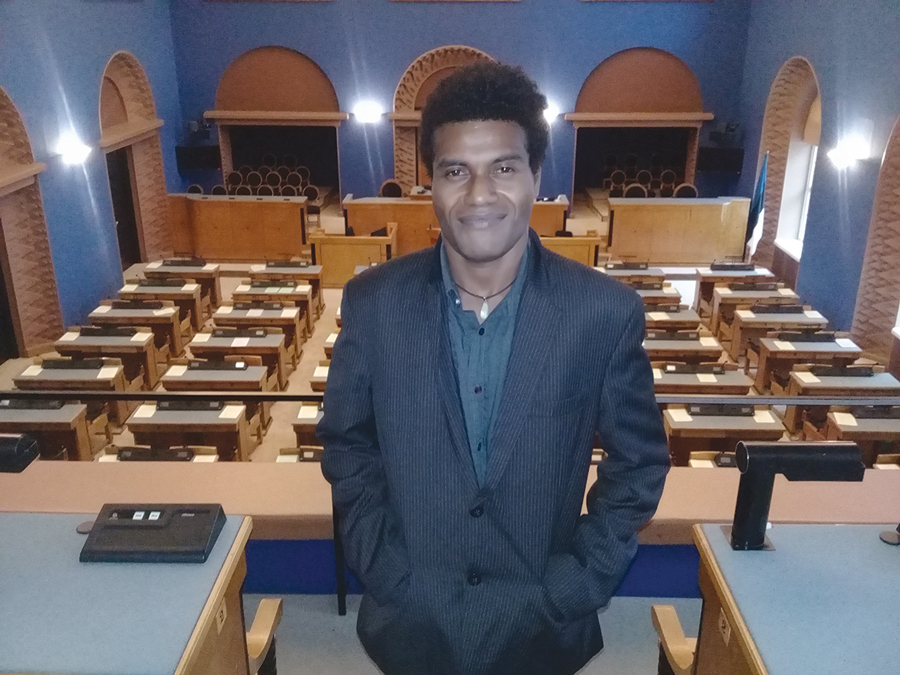
The Island Sun’s Barnabas Manebona when touring inside ‘The
Riigikogu’, the unicameral Parliament of Estonia
A step into the future and back
From the tropical sunny side of the globe, Island Sun’s senior reporter Barnabas Manebona travels to one of the world’s leading e-societies, Estonia, where near-zero temperature and climate is only the tip of the iceberg to what can only be described as a truly exotic adventure
BY BARNABAS MANEBONA
IT was surely a step into the future and back.
I was starting to wonder as soon as I stepped out of Tallinn Airport in Estonia that it might be a robot that would be serving me next concerning my amazed impression over the advanced e-society.
An e-society is defined as one that consists of one or more e-communities involved in the areas from e-Government, e-Democracy, and e-Business to e-Learning and e-Health using information and communication technologies (ICT) in order to achieve common goals and interests.
For Estonia’s e-solution environment, it includes a full range of services for the general public, and since each service has its own databases, they all use X-Road.
X-Road is the backbone of e-Estonia. It allows the nation’s various public and private sector e-Service databases to link up and function in accordance. To ensure secure transfers, all outgoing data from X-Road is digitally signed and encrypted and all incoming data is authenticated and logged.
Estonia now turning 100 years old since gaining Independence in 1918 is a country in northern Europe that borders the Baltic Sea and Gulf of Finland having a population of 1.316 million. The official language spoken is Estonian and the currency used is Euro.
In Estonia you don’t have to go through the bureaucracy filling out papers and documents as you can do them online. Well, Estonia had already started going digital two and a half decades ago.
With its e-governance, Estonia is perhaps the only country in the world where 99 percent of public services are available online 24/7, it is reported.
The only things e-services are impossible for are marriages, divorces and real-estate transactions where one still has to go do outdoors.
The Island Sun’s Barnabas Manebona when touring inside ‘The Riigikogu’, the unicameral Parliament of Estonia
With a safe, convenient and flexible digital ecosystem, Estonia has reached an unprecedented level of transparency in governance and built broad trust in its digital society resulting in showing that Estonia saves over 800 years of working time annually becoming a hassle-free environment for business and entrepreneurship according to the e-Estonia Showroom executive briefing centre.
Estonia has one of the most competitive tax system in the world and also the most competitive tax collector in the world which basically means that every 40 cents that they put into the tax collection system brings back 100 Euros of net tax revenue for the government. How is this possible? Digitalisation.
This country has the most highly-developed national ID card system in the world that is explained much more than a legal ID photo. The mandatory national card provides digital access to all of Estonia’s secure e-services. The chip on the card carries embedded files and using 2048-bit public key encryption, it can be used as definitive proof of ID in an electronic environment.
Some examples of how the ID-card is regularly used in Estonia are through legal travel ID for Estonian citizens travelling within the EU, national health insurance card, proof of identification when logging into bank accounts, for digital signatures, i-Voting, to check medical records, submit tax claims and to use e-Prescriptions.
Thanks to the ID-card, Estonia has one of the world’s most advanced digital signature systems.
The Oceania ‘Exotic Team’ during touring around the Estonian Public Broadcasting Company’s buildings.
Estonians hold heads high over the fact that the Estonian startup ecosystem is known to be a world leader as many just keep on growing. Though they are not big, they are technological companies.
According to Estonians, they are really proud of the Skype telecommunications application software product, which although is owned by Microsoft, is the brainchild of an Estonian initiative.
Skype still has an office present in Tallinn City and some part of its technologies running such as at TalTech, the only technological university in Estonia.
A great outcome today in Estonia is all the companies are exporting to around 120 different countries around the world. Up until May to June this year, Estonia had been the best public sector digital service provider in the EU being for a couple of years until dropping second currently to their neighbour Finland raising frustration at first because they are always competing with them.
“But then acceptance too having the knowledge that a lot of solutions in Finland built for the past five years have also been built in collaboration with Estonian private sector companies,” says the e-Estonia Showroom.
“So we did not feel anything for them or saw their achievement being done by themselves as there has been a lot of mutual beneficial relationships that has happened.”
There are countries in Europe who envy the level of digitalisation in Estonia over which they are aiming in the near future to reach Estonia’s level.
Marking Solomon Islands being history to be the first to mark the country on the world map at the Innovation and Business Centre ‘Mektory’ during visiting TalTech (Tallinn University of Technology) in Estonia
The last time government officials in Estonia actually had email addresses to exchange emails between each other was back in 1991.
From the e-Estonia Showroom, there are many reasons or opinions why Estonia went digital, but two things to note is the fact that seeing Estonia was bigger than Switzerland, Belgium, Denmark and the Netherlands significantly with less people brought them the question of density.
“If the density of people is scattered across the country then it is really hard for the government to provide services but as a democratic state, you want to provide services to everyone equally that lives in the country. That was one challenge.
“The other challenge was there was not enough money to buy government Offices as that is an alternative. You buy a lot of government offices but in reality that is not the sustainable strategy because if you build government offices you have to put people work there and then you can’t have a public sector that is outbalanced compared to the private sector.
“Out of 1.3 million people you can’t have 800,000 people working for the public sector in the government offices so there had to be an alternative.
“It was thought that we would like catch two flies at the same time in which first of all we started providing services electronically. At the same time if we start doing this and the background perhaps everything is all digital then maybe we can save a lot of money and become more efficient by not spending on unnecessary democratic procedures like printing out papers which has kind of happened over the years.
“At first of course it was not kind of a clear strategy, but then working on it there is clear vision and strategy in the targets that has now led Estonia to a situation where we have become members of different international organisations and also giving more of morale higher ground to discuss topics globally,” explained the e-Estonia Showroom.
On the other hand, the e-Estonia Showroom elaborated that digitalisation is something a person just applied onto it, they express that the real foundation comes from the regulation and laws finding things simple such as the tax regulation is definitely an advantage.
“How simple it is to do things in Estonia is for example when you have a job you generate income, you have to take care of taxes as an individual, in Estonia you can take care of your taxes on phone around 37 seconds taking only around three days for the government to send the excessive tax paid. The procedures are easy, user friendly.”
It is said that the challenge for Estonia is to have people with great ideas on how to make sure that everyone including the old people along the border areas know how to use government services digitally or be engaged in a digital society, essentially how to avoid digital divide.
What they have done to remedy this is look towards the private sector being more competent in providing services over which they used the friendliness design from there meaning the government always initiate the change but all the solutions used today are being built by the Estonian private sector companies who have built the Estonian digital society.
I admit I enjoyed free Wi-Fi network to the fullest like never before during my almost nine days in Estonia. Nothing like in my developing country from the South Pacific Region, Solomon Islands, is near such advancements as we are still only dealing yet on mobile data having only two telecommunications companies serving us.
View of Tallinn City’s modern town
The temperature during our stay in Estonia was plus 2 – 12 degrees Celsius including rain and wind but this did not back down our Oceania ‘Exotic Team’ of five (5) as referred to always doing the visit together being part of a foreign journalists from the Pacific Ocean tour cooperation project between the Tallinn University Baltic Film, Media, Arts and Communication School (BFM) and the Ministry of Foreign Affairs of Estonia (MFA) between October 5 and 14.
Me, Ms Ana T Uili a Senior Journalist at the Ministry of Meteorology, Energy, Information, Disaster Management, Environment, Climate Change and Communications from the Kingdom of Tonga, Mr Kevin Onesavi Henry the Vice President of Media Association in Vanuatu, Ms Yone Carolynn Wase from the Press Secretary Office of the President and Cabinet Republic of the Marshall Islands and Ms Renate Anne Rivers from Samoa who is the Assistant Chief Executive Officer at Press & Communications Division of Savali Newspaper were on an opportunity of a lifetime visiting Estonia.
Having all of us staying at the Original Sokos Hotel Viru in Tallinn’s City centre, the exploration started through the cold climate on Day 2 with a walk tour through the Tallinn Old Town with Ms Tiina Rüütmaa, a professional guide and Lecturer at Tallinn University.
Compared to the normal tropical heat climate in Pacifica, it was amusing seeing all of us the Oceania Exotic Team trying to keep ourselves warm as much as we possibly could walking through old castle shaped buildings in the open which lasted for two hours before visiting the Seaplane Harbour at Lennusadam, the Estonian Maritime Museum (one of Europe’s grandest).
The Estonian Maritime Museum is the institution for collecting, preserving, studying and presenting Estonian maritime culture and history.
(Right to Left) Ms Renate Anne Rivers from Samoa who is the Assistant Chief Executive Officer at Press & Communications Division of Savali Newspaper, Ms Yone Carolynn Wase from the Press Secretary Office of the President and Cabinet Republic of the Marshall Islands, Mr Elari Lend the Project Coordinator of BFM, Ms Ana T Uili of the Ministry of Meteorology, Energy, Information, Disaster Management, Environment, Climate Change and Communications from the Kingdom of Tonga, Mr Kevin Onesavi Henry the Vice President of Media Association in Vanuatu and Solomon Islands Barnabas Manebona from The Island Sun daily newspaper when visiting Manija Island, one of Estonia’s thousands of islands in the Baltic sea.
Our Oceania exotic team were fortunate to have been invited to see the authentic submarine Lembit from the 1930s, the century-old steam-powered icebreaker Suur Tõll, a Short 184 seaplane, mines, cannons and many other life-sized exhibits. The museum and the Seaplane Hangar have been recognised with a number of awards being Estonia’s most tourist-friendly Museum 2012, Europa Nostra Grand Prix 2013, Special Commendation from the European Museum of the Year 2014 and a number of others.
During that evening, we were taken to have a movie screening at Artis Cinema on Joosep Matjus’ epic nature film “The Wind Sculpted Land” which makes a deep bow to Estonian nature. It is about Estonia’s wild and primeval nature where its spectacular landscapes together with its wild inhabitants and thousands of migrating birds are opened before viewer’s eyes.
Day 3, we travelled to the Baltic Film, Media, Arts and Communication School of Tallinn University where we attended a seminar (Seminar I (N-416)) on “Media Landscape in Estonia” with Mr Priit Hõbemägi, a Journalist and visiting Lecturer of Journalism Studies at BFM. This was later followed by a tour around the BFM facilities.
We later during that day had the opportunity to meet with Ms Kerstin Meresma who works in Eesti Meedia as a Reporter of Foreign News Department of Postimees Newspaper.
Postimees is the largest daily newspaper in Estonia with a circulation of 43,700 copies on weekdays and 51,700 copies at weekends being an eye opener for me comparing the newspaper’s circulation with a much smaller scale print media company that I work for currently circulating yet less than 4,000 copies daily.
To see Postimees being able to circulate so many copies despite being in an advanced digital country was a good reminder for me in my field of work as a Multimedia-reporter being noted that a newspaper never expires.
Founded in 1857, Eesti Meedia is the largest media group in the Baltics.
A view of Tallinn City’s Old Town
On a second Seminar meeting we had with BFM students, each of us from the Oceania Exotic Team presented our countries and cultures specifically sharing on different areas of experiences in our media works too. The meeting was later followed by open questions and discussions in which I must say was a two way benefit but more for Pacifica in getting the opportunity to share more of its nature for the bigger world to know and understand.
We took the opportunity to share Pacific Islanders struggles everyday through climate change, politics, how much response or assistances we are getting from the outside world, the level of our technologies, influences and consequences, developments and many other areas which was moving for our European friends from their understandings and out views.
For me personally, I did not hide the fact that corruption is digging Solomon Islands’ grave at this present causing a huge setback for positive developments to develop further in the country. I choked when I was still talking about the 3 and 4G Telekom and Bemobile services in the country being not always reliable when Mr Elari Lend the Project Coordinator of BFM interrupted saying “but we are ready to launch our 5G now”.
Shrinking, I had felt lost wondering something like being left back in time from the present world.
After our second Seminar we had an opportunity to have dinner with the Media Ombudsman of the Estonian Public Broadcasting Company, Mr Tarmu Tammerk, who shared his international experience in media relations and ethics.
Following into the week on Day 4, our team visited TalTech (Tallinn University of Technology) adding a visit to the Innovation and Business Centre ‘Mektory’ for an introduction to interactive study labs and student projects.
After the visit we were taken to the e-Estonia Showroom for a presentation on the e-systems and other digital solutions used by the Estonian government as well as the private sector.
We were also taken to meet with the President of Riigikogu, Mr Eiki Nestor, having a short tour around Riigikogu building before visiting the Museum Vabamu and then to the Telliskivi area having a tour at the Creative City.
Telliskivi Creative City is a unique and special place which has a work and leisure environment so effortlessly growing, progressing and developing being a rare sight even worldwide.
Our team later had dinner for that day being hosted at restaurant F-Hoone accompanied by H.E Margus Kolga the Ambassador-at-Large Head and Ms Mari Tomingas the Counsellor of UN Security Council Campaign Task Force under the Ministry of Foreign Affairs of Estonia.
On Day 5, Wednesday, we visited Innove. Foundation Innove is an education competence centre that coordinates and promotes general and vocational education in Estonia offering career and educational counselling services through the nationwide Rajaleidja network and mediates European Union grants in fields of education and working life.
Innove maintains the Tallinn European School which provides high-quality general education for children of the international community living in Estonia.
Being a member of the European School Network, Innove also sends teachers to work in other European schools in Europe and conduct competitions for leading positions in these schools.
Ms Kaie Piiskop the Head of curriculum development centre at Foundation Innove gave a presentation on the topic “Overview of Estonian Education” when we visited.
From Innove we went to have school lunch at Jacob Westholm Gymnasium, a school at first only for boys. We met with the school principal, Mr Rando Kuustik, who gave us a guided tour in the school facilities including school radio before we headed to visit the Estonian Public Broadcasting Company for a tour around its buildings.
One of the many fortunate opportunities when in Tallinn was meeting up with Mr Madis Kareda the Head of Development Unit under The Foundation Environmental Investments Centre.
The Foundation Environmental Investments Centre is a financial institution mediating state budget funds, EU funds, funds from foreign aid programmes and the Green Investment Scheme and granting loans for the implementation of environmental projects.
When our Exotic Team discussed with them over the negative environmental impacts in Pacifica partly blaming causes from the developments of developed countries, Mr Kareda offered the question in what ways they can help assist through our environmental concerns at this stage after hearing the fact on how Oceania and its islands is suffering and trying to adapt through the climate change, sea and air pollutions.
On green light, Mr Madis Kareda on behalf of their team advised our Exotic Team to not hesitate in filing back any report to them where they can assist on concerning our environment after returning back in our own countries. He assured they can look into reports and arrange consulting with their authorities and if plans are approved, they can assist with environmental projects such as on sea pollution and other areas for environmental adaptation purposes.
Later that day we were also taken to the 314 metre high Tallinn TV Tower Restaurant, accompanied by the Project Manager and Director of the Baltic Film, Media, Arts and Communication School of Tallinn University, Ms Katrin Saks, and Ms Heidi Solba, the Head of Network of “Let’s Do It World” where we had dinner.
‘Let’s Do It!’ World is a civic-led mass movement that began in Estonia in 2008 when 50,000 people united together to clean up the entire country in just five hours.
Since then, ‘Let’s Do It!’ has spread its model for one country in one day around the world. To date, nearly 120 countries and 20 million people have joined them to clean up illegal waste.
Meeting up with Ms Heidi Solba was a good opportunity to link Solomon Islands to the ‘Let’s Do It!’ Network as well as she looks forward to working together.
On Day 6 in Estonia as part of the programme, we had Seminar IV of “Media Production across platforms” with Mr Alessandro Nani from Italy, a Lecturer of Cross Media Studies at BFM.
This training under ‘intermediate networking storytelling’ is a boost to my profession being a skill to be able to point out different useful materials from different social media networks apart from just Facebook to solve investigations and other issues.
In the country’s context of facing heavy corruption in the government system, such skill is useful to use against the government if they put out fake news or masterminded articles intended to manipulate the public or a situation. To note, the skill can also apply to any other organisations through their Communication Offices.
In Solomon Islands mainstream medias context, this skill depends respectfully on how many online sites Journalists in the companies have access to especially in their working places where they spend most times to do work.
Blocking off other online sites means limiting the possible availabilities to solve issues too in which after all, accessing all media social networks is all part of media, an area I see if possible, we must slowly improve on in the future.
Later that day we had a bus trip to Manilaid harbour travelling across to small Manija Island for a walking tour meeting with islanders at a local village house accompanied by Mr Mark Soosaar an Estonian filmmaker, politician and member of the XIII Parliament.
He is the founder of Pärnu Museum of New Art and the organiser of Pärnu International Documentary and Anthropology Film Festival as well as the founder and Chairman of the Kihnu Cultural Institute.
Mr Soosaar delivers news from Kihnu every week in Vikerraadio (Estonian Public Broadcasting Company).
On Day 7 we took a boat again from Manilaid to Munalaid and took another bigger boat from Munalaid to Kihnu Island.
Kihnu Island is the seventh largest island in Estonia. The cultural heritage of Kihnu (its clothes, dialect, music and handicrafts) belongs in the UNESCO list of intangible cultural heritage as Kihnu Museum represents this in the most genuine way.
While on Khinu Island we visited Kihnu School meeting with the school children, had lunch at the famous Kihnu Kitchen and a tour at Kihnu Museum before heading back to the mainland for Pärnu, the fourth biggest City in Estonia with a population of around 42,000.
Located in Estonia’s south-western coast, Pärnu is a popular summer holiday resort with many hotels and restaurants and large beaches. Among Estonians, it is known as the Summer Capital of Estonia.
Still under our jet lag feeling and then being driven through our exciting once in a lifetime experience amongst timing hours each day, reaching Pärnu was where our Exotic Team’s trip started winding down to its last hours after checking in at the hotel Hedon Spa.
The atmosphere then when realising that our exciting adventure was heading towards its end was kind of like, well I can say disappointing for the truth that all good things come to an end though.
Personally, I really enjoyed our Exotic Team’s accompany during the few days in Estonia. It was a great team headed by Mr Elari Lend of BFM I will always remember.
We created new friendships, communication links and builded more new contacts with Estonians, a leading e-society in the world that I believe is suitable for us to have good diplomatic relations with.
Now settling back at our countries in Oceania after this exotic trip, each of my Estonian ‘Exotic Team’ family have their different sides of experiences from their views too that they can share with you if you are interested to know more about Estonia. For me, this was my walk into a very advanced digital society going down in history.
Ms Yone Wase from The Marshall Islands had already first left us for her return flight leaving us the other four members of the Exotic Team to visit Tartu Pärnu College on our second to the last day in Estonia where we met with Ms Heli Tooman (PhD), Associate Professor of Tourism Management, to talk about the study programme of Spa and Tourism management there.
For Solomon Islanders, this is a college I would recommend for many of our local tourism students to be aiming to study at for their Spa and Wellness Management Master’s programme in order to return and build Spa hotels in the country that are fitting to the tropical environment and our geographical settings.
In order for Estonia to remain an innovative, effective and successful northern country that leads by example, they need to continue executing their vision of becoming a safe e-state with automatic e-services available 24/7.
Building e-Estonia as one of the most advanced e-societies in the world has involved continuous experimentation and learning from their mistakes. Estonia sees the natural next step in the evolution of the e-state as moving basic services into a fully digital mode. This means that things can be done for citizens automatically and in that sense invisibly.
Estonian communities around the world will have a chance to look back at the past, highlight the present and set new goals for tomorrow. This is to be ancient and innovative, curious and self-confident.
In Solomon Islands context, though it may seem impossible to reach Estonia’s standard but our national government and its ministries should be making the most out of trying to link such other countries that are more advanced in technologies to assist in areas of development needed such as on tourism, dealing with climate change, pollution and many other areas.
I mean look and reach further outside to the other side of the world too for other angles of assistances rather than dwelling only around usual partners being in fact where we are yet in our democracy.
It is the government’s appropriate task in how they will lead to link back developments for future visions in our country and if it is for the best of the future, there must be willingness.
Reaching this date, Solomon Islands is still in chaos with corruption practices. Not forgetting climate change and pollution issues heading over the doorstep, our government system and attitude now need a change to improve our standard, thus look and learn clearly from advanced countries.
To Estonia, the Tallinn University Baltic Film, Media, Arts and Communication School (BFM), the Ministry of Foreign Affairs of Estonia (MFA) through the Ministry of Foreign of Affairs of Solomon Islands to the Media Association of Solomon Islands (MASI) and one of the leading print mainstream media companies of Solomon Islands that I am employed under famously known as the ‘The Island Sun’, all I can say is thank you for an opportunity from a dream to experience an advanced e-society.
It was great for year 2018, it was like stepping into the future and back to reality through a time machine.
PS Karen Galokale (front centre) flanked by participants and facilitators of two-day workshop. Photo from GCU
PS Karen Galokale (front centre) flanked by participants and facilitators of two-day workshop. Photo from GCU
A two-day workshop on the Arms Trade Treaty and Plan of Action for Solomon Islands is underway in Honiara this week.
This is the second workshop for Solomon Islands which is aimed at informing and strengthening key Government agencies involved in National Security services.
Permanent Secretary of the Ministry of Police, National Security and Correctional Services (MPNSCS), Ms Karen Galokale said the Solomon Islands government is yet to ratify the Arms Trade Treaty but this should not stop the Government from looking into prospects that will make it deliver on its state responsibilities.
Galokale highlighted that some government ministries and agencies have already been delivering ministerial responsibilities in relation to national security but some ministries which were created in recent years need support and further insights in the mechanisms that have been already developed to better carry out their responsibilities.
“So this workshop is indeed an important one for us in terms of development or reform in our different ministries,” Galokale said.
The Permanent Secretary said the movement of arms whether lawfully or illegally is an important issue for the National Government and it is critical that responsible agencies must ensure that moving arms legally must be transparent, secure, and safe while illegal movement of arms must be intercepted and reduced.
National Security is an important government policy which establishes that ‘relations with international security and intelligence agencies are established and strengthened and that there is cooperation between law enforcement agencies in Solomon Islands’.
The workshop discusses the Arms Trade Treaty, some global instruments of control; the status of Solomon Islands current national systems and their potential changes for accession to the Arms Trade Treaty.
Discussions are also focused the Arms Trade Treaty requirements for transit and transshipment; Import Obligations under the Treaty; Assistance programmes to implement the Treaty and the needs of Solomon Islands to accede and implement; and the steps needed to prepare Solomon Islands to be an Arms Trade Treaty state party.
The workshop is being facilitated by international experts from the Centre for Armed Violence Reduction and attended by Under Secretaries, Directors and Senior Public Servants and Officials from the RSIPF.
NGELLA Constituents are asking their Constituency Office to explain where the money earmarked for their students’ school fees is.
Question is raised from Ngella’s famous social media forum ‘The Ngella Forum (NGF)’ after learning that Ngella Constituency is amongst the four Constituencies that have not made any payments or necessary arrangements yet as to when and how they will settle their students’ outstanding fees with the Solomon Islands National University (SINU).
It is understood from the Executive Management of SINU being consistent with their Press Release on October 31 that they will have no choice but to publish the names of sponsors and reveal outstanding fees owed by sponsors by the end of November this year.
As of 2019, SINU will no longer accept any sponsorship of students through Constituency Funding arrangements from Members of Parliament (MPs).
This decision according to a statement was made by the Senior Management Committee of SINU after operations were affected as a result of students not paying fees.
“The Constituency Office need to explain now for the students and parents of Ngella before we start regarding this situation as caused by corrupt practice,” raises Ngella Constituents.