Home Blog Page 933

Taking steps to protect leatherback sea turtles

By IAN KAUKUI 

SOLOMON Islands, a country with one of the world’s most extensive shorelines, has taken a step towards conserving the nesting beaches and protection of Pacific leatherback sea turtles.

The Nature Conservancy (TNC) office in Honiara, with the support from their main branch in United Kingdom is the main driver of the turtle conservation work.

“Across the world, turtle species are already endangered and in Solomon Islands, we want to focus on Isabel Province since it was one of the main nesting sites for the Leatherback turtles including other species not only in Solomon Islands but also in the Pacific region.

“This was known following assessment done in the past by National Oceania and Atmospheric Administration (NOAA), a US based organization that deals with different species such as the Leatherback,” TNC Country Director Willie Atu said.   

He said in Isabel, they have four active sites but only two of them engaged with the conservation activities until this month where the other two have formally signed the Memorandum of Understanding (MOU) to be part of the conservation. The two sites include Sasakolo and Lithogahira.

“Sasakolo nesting beach was the first to carryout conservation and monitoring work way back in 1992 but it was halted in 2012 following land dispute whilst Lithogahira is a new comer in the project,” he said.

Isabel Paramount Chief, Bishop James Philip Mason who is one of the hardworking persons supporting the idea to converse the Lithogahira nesting beach said he is very happy to be part of the initiative and would continue to support the project.

“I can still remember when I was attending primary school in Lithogahira during 1940’s where we used to eat those leatherback turtles, but now we have learned the importance of conserving them given their less appearance on our beaches compared to the past.

“Since they are now regarded as endangered species, their survival depends on our attitude towards them and so it is time we together to help protect and allow their population to grow as far as they can,” he said. 

Isabel Provincial Premier Leslie Kikolo said the province is also fully support anything to do with conservation but just that customary land issues have to be sorted out by responsible authorities.

“Our province is so honored and privileged to host such projects given we are the only province those leatherback turtles love to nest on and we want to be role model to other provinces when it comes to conservation of such endangered species.

“I hope that the conservation programs will continue and more Leatherback turtles will come to our shores so that in future we can provide more nesting sites for the turtles,” Kikolo said.

TNC Marine Conservation Scientist Simon Peter Vuto said they also have the satellite tracking journey of those stocked species that fed as far as north California, USA and yet make their treacherous migration thousands of miles just to nest in Isabel islands.

Vuto said the critically endangered Western Pacific leatherback sea turtles embark on an annual migration of over 6,000 miles each year to feed on dense aggregations of their favorite food, jellyfish.

“As the largest of all sea turtles, Leatherback have experienced a catastrophic 95% decline in their Pacific nesting populations over the last several decades due to constant threats of entanglement in commercial fishing gear, poaching of turtles and turtle eggs from nesting beaches, ingestion of plastics and pollutants, and habitat loss on tropical nesting beaches.

“Past scientific assessments already compliment local knowledge which had shown Isabel Province to host some of the most active nesting beaches for leatherback turtles in Solomon Islands.  

“Records also shows those leatherback turtles after their eggs were hatched and released out to sea where they migrated to other parts of the ocean, they will return as they get matured to lay their eggs on the same beach where they know they were born out from and is becoming like a life cycle of any particular thing,” Vuto explained.

TNC Isabel Coordinator, John Pita said for Sasakolo as one of the active nesting beaches for the leatherback turtles, it took around 11 years to carry out the conservation.

“Sasakolo has recorded a total of 227 nests in 6 seasons from 1993-2009 until in 2012 when it was halted due to land issue.

“After Sasakolo, we have Sosoilo where we recorded 77 nests from the 4 seasons beginning from 2015- 2019 and later on we have Haevo where we have recorded 316 nests for the 7 seasons starting from 2013 -2019.”

He said TNC is yet to get the updated data of the figure for the recent years from each conservation sites but from the recent monitoring findings, it shows an increase of the number of nesting sites especially on the already established conservation sites such as Haevo and Sosoilo.

A representative and Chief of the Kolebara decedents at the Lithogahira nesting beach, Chief Clement Eta said with the recent signing of the Memorandum of Understanding between the two landowning groups from Sasakolo and Lithogahira, that increases the conservation sites to four.

But Eta said, prior to all those conservations, harvesting of those leatherback turtle with their eggs is a normal thing for them to do.

“Given the ongoing practice of slaughtering turtles by people, it seems the number of leatherback turtle nesting per week is slowly declining compared to the past.

“Our conviction to offer our beach for the purpose of conservation was after we realized the importance of conserving the species as explained to us when attending several leatherback turtles’ workshops and consultations organized by TNC office together with the Isabel Provincial Government (IPG) as part of encouraging us to protect and conserve leatherback in our shores and in Solomon Islands.

“The other reason to engage with the conservation again is that we want to see the increase of the leatherback turtle population again just as it was in the past where the whole beach is regarded as the nesting sites.

“At first, the whole beach is regarded as the nesting sites but as time goes on and people continue to kill and eat the turtles and their eggs, the nesting sites getting narrowed and it’s a sad thing to see,” he said.

He said with the support from TNC, they are looking forward to participate in ensuring the conservation is effectively carried out including the training of Rangers as they are the front liners to do the work.

Anet Ofu which represent Sasakolo leatherback turtle nesting beach said one of the challenges to such conservation is land issues which endangers conservation efforts.

But she said they are so pleased to be back with the conservation efforts after several years of operation and later got halt in 2012 after some land issues arising.

“Sasakolo leatherback turtle beach is the second longest nesting beach in Isabel province with 3.4 km in length and is one of the active beaches during the period of its conservation.

“At first it was the Ministry of Fisheries and Marine Resources who led the conservation operation and it was not properly set up until the TNC office stepped in later on.

“Following its start off in 1993, later in 2006 a team from US came and conducted a satellite tracking of the leatherback turtle movement in and out of Isabel province to the great Pacific Ocean linking to the California in South America, she said.

“We continue with the work until in 2012 when some issue of land dispute arises, we then halted the conservation until now that we have decided together with the other parties to leave the issue of land aside and allow the conservation work to go ahead,” Mrs. Ofu said.

She said during the first conservation period, communities in and around Sasakolo were aware of the conservation and respect the efforts until it comes to halt in 2012 where they started to harvest the eggs and turtle again.

“Since we are already into it now, I don’t think we have a problem in conserving our beaches, but we really need support from TNC in pushing this effort forward by way of providing equipment, materials and to support the plan to also built an accommodation centre for the Rangers when carrying out the monitoring activities,” she said.

“We are so happy to join Lithogahira in supporting the conservation efforts by signing up the MOU together with TNC as now our main objective is to help get the endangered species population increases again through conservation given its population is now slowly declining.

“Not only that, it’s a pride for us given that apart from other beaches in Solomon Islands and in the Western Pacific, Sasakolo including other beaches in Isabel province are already regarded as one of the highest active sites for those leatherback turtles to nest and we want to see that in the many years to come,” she added.

VIEWPOINT- PPP used to develop Tina Hydro is the best model under the circumstances.

0

PETER FORAU

Honiara

I’M compelled to contribute to the discussion on the PPP form adopted to develop the Tina Hydro Project basically to provide an answer to the question on whether Solomon Islands as the owner of the project (asset) stands to benefit under the PPP variant that has been chosen. 

I believe the country needs to be assured that it won’t lose out on the development. 

I also believe the Minister of Finance has been reassuring that all necessary due diligence has been executed prior to the decision to favour the PPP approach that is now part of the project development arrangement.

First of all, PPP refers to public-private partnership. 

It is basically a form of procurement that works on the basis of forming partnerships with the private sector based on a contract. 

There are many variants (forms) of PPP.  The popular ones are Build Operate and Transfer (BOT), Build Own Operate and Transfer (BOOT), Build Lease and Transfer (BLT), Design, Finance, Build, Operate and Transfer (DFBO), Design, Build, Operate and Transfer (DBO) etc.

The Government in its wisdom (I’m sure with technical advice from knowledgeable entities or persons) has opted to adopt the BOT variant to develop the Tina hydro project.

  Under the circumstances this is the best form because it is introduced after the project has been designed and all finances almost secured. 

At this stage the main functions to be developed are to build the dam, and then followed by operating it successfully. 

In an ideal situation, the most preferred variant would have been the DFBO form which then will have significantly minimized the risks fronting the SIG as owner of the asset. 

But as I mentioned the project has advanced to a stage where the DFBO form would have been inappropriate hence my claim that the BOT form is the best under the circumstances.

For the information of interested citizens and stakeholders that are party to the development, in a PPP approach there are no shares to be allocated. 

There is a contracted partnership which grants  the private partner (which could be a consortium) the right to operate the asset or project for a term, normally thirty years as is the case with the Tina Hydro,  In that arrangement K-Water has been granted under contract the right to operate the asset for 30 years. 

This is perfectly normal which is consistent with the principles of a PPP operation. 

The reason why K-Water or any private partner is allowed time to operate the asset is for it to recover the capital that it has injected into helping fund the project in the “build” stage.

Under normal procurement, the capital risked by the private partner (K-Water) to invest in the project would have been a term loan that would have to be repaid with interest. 

Under the BOT arrangement that has been adopted, this is not the case. 

So technically the SIG has been spared the burden of incurring another debt which is a benefit to Solomon Islands, and ownership of a long-term asset (hydro dam) which potentially will contribute in a huge way to the economic development of this country – cheaper electricity in the long-term, less reliance on fossil fuels and a head start towards reliance on clean energy therefore achieving one of the SDGs. 

The argument around relatively expensive electricity tariffs after the dam has been completed is only relevant when reference is made to the 30 years that the asset will be operated by K-Water. 

After 30 years, the asset (hydro dam) will be transferred at no recourse to the SIG.  This is a key feature of a project developed under a PPP model.  

The asset is transferred at no recourse to the Government or an entity so chosen by the Government.

In this case Solomon Power could assume ownership of the asset. At that future time, there is no obligation to set tariffs to reflect cost recovery therefore electricity will be much cheaper.  

So perhaps the key points to note are that the BOT variant is the best under the circumstances,  SIG under principle of PPP cannot have  shares in the operation of the dam, K-Water will need to recover its $20 million investment, after 30 years the asset (dam) will transfer to the Government at no recourse, and K-Water will be responsible for maintaining the asset to standards that will be specified by the Government. 

The benefits for SIG and the nation will be enormous and cannot be financially estimated.  The economy will benefit from cheap electricity going forward after thirty years. 

All maintenance costs will be borne by K-Water during the 30 years.  

The nation will own a long-term asset which basically was built at no cost to the nation. 

There are opportunity costs in the form of landowners losing their land. 

However, considering the difficult terrain and isolated area, the opportunity costs may be difficult to be quantified. 

That said, the landowners must be compensated for giving up their land for this national project.

Therefore, I would suggest that either an outright payment is considered or a benefit-sharing is agreed with the landowners that they will receive a certain amount over the thirty year period.

I hope with this brief, we are a bit more assured that our Government is doing the right thing over the development of the Tina Hydro dam project.

Mamara city to alleviate Honiara’s congestion issue: Sade

Mr Yii Ging HII presenting chupu to Premier Francis Sade

By EDDIE OSIFELO

THE Mamara New City project on North West Guadalcanal is expected to alleviate the problem of congestion in Honiara.

Guadalcanal Premier, Francis Mbelande Sade highlighted this during the official launching of the multi-million-dollar project on friday.

“But while we celebrate and congratulate each other, it is also important to be conscious of both the positive and negative impacts of such a development, and to ensure that it is inclusive and does not reproduce the challenges that we have seen with Honiara,” he said.

The ‘Mamara New Capital City’ development is the result of the Mamara-Tasivarongo-Mavo Development Agreement Act 1997.

The agreement was between then national government and the investor Metropolis Pacific Pte Ltd, based in Singapore.

Sade said it is important to note that this Act was passed a year prior to the beginning of the civil unrests that started here on Guadalcanal in late 1998.

He said it was a set of events that brought our country to its knees economically, politically and socially, and led some commentators to label our country as a “weak state”.

Prime Minister Manasseh Sogavare with Mamara Tasivarongo council members and Mr Yii Ging Hill pose for official group photo

“This subsequently resulted in the deployment of the Regional Assistance Mission to Solomon Islands in mid-2003.

“It is also vital to note the civil unrests were as much result of the inequalities of development and the inequitable distributions of its benefits, as they were about development approaches, we adopt,” he said.

Sade said one such development is that of urban centers and the rural-urban divide it invokes, and the opportunities and challenges associated with it.

He said globally, human societies are becoming increasingly urbanized with more people moving into rapidly growing cities, some of which are overcrowded and most people living in its economic and social margins. In Solomon Islands, most of our people live in rural areas.

“However, urban centers such as Honiara, Auki, Gizo, Noro, Kirakira, etc. are growing.

“There is therefore a need to put in place policies and plans that, not only facilitate this growth, but also alleviates the negative impacts,” he said.

Mamara new city securities providing entertainment

Sade said according to the United Nations Human Settlements Programme (UN Habitat) 2012 Report, Solomon Islands annual urban growth rate was 4.7 percent.

He said this Report is almost 10 years ago, but illustrates the severity of the issues associated with urbanization.

“The Report states that urbanization leads “to increase in urban poverty and informal settlements with a lack of sanitation and infrastructure.”

“In other words, most of our people who move to urban centers, especially Honiara, do not share in the wealth and opportunities that urban centers supposedly produce,” he said.

Sade said this ‘Mamara New Capital City’ illustrates the growth in urban areas.

The City is expected to accommodate 1,000 houses for public servants before 2023 and Mamara Spring Hotel.

So far, the developer has completed 15 houses.

Prime Minister Manasseh Sogavare was the guest of honor with Deputy PM, Manasseh Maelanga, ministers, senior government officials, Governor of Central Bank, Dr Luke Forau and other diplomatic officials.

CCTV FILM

The scene of the crime: PHOTO CHARLES KADAMANA

Police claim strong evidence on Chinese woman’s death

BY JENNIFER KUSAPA

Police are claiming to have strong evidence into the April-13 killing of the Chinese woman at White Angel building, Pt Cruz.

Deputy Police Commissioner Ian Vaevaso told reporters yesterday they have in possession CCTV footage incriminating a suspect.

Vaevaso said the footage “clearly identified the prime suspect into the incident”.

“The footage is very clear to identify the suspect,” Vaevaso said.

He said investigations have led police to label a shopkeeper of the deceased as the suspect.

Having said this, Vaevaso calls on the suspect currently in hiding in east Malaita to surrender himself in for questioning.

He adds, this is so that the suspect can be given the chance to tell his side of the story.

Vaevaso clarifies that police currently only has one suspect.

“At the moment police have no other suspects but once the prime suspect is arrested then questions will be asked whether there are others who may have involved in the planning of the incident,” Vaevaso said.

He said Honiara and Auki police are collaborating to bring the suspect in, also gathering information.

“Immediate families of the alleged suspect are also working with police officers to bring the alleged suspect in for questioning.”

This is regarding the killing incident which occurred on the morning of April 13 at the White Angel building.

Allegation said the Chinese woman left her house in the Ranadi area, east Honiara to drop off her twin sons at school in the morning and then went down to her shop inside the White Angel Building in Point Cruz to open it as normal.

While the shopkeepers were waiting outside for the deceased to open the shop, the husband of the deceased arrived and sought assistance from a nearby shop to open their shop as the doors were locked from inside. However, that was unsuccessful and police were alerted in which the Police Fire Service came to their assistance and opened the shop and that is when the husband discovered his wife lying on the floor with blood all over her body.

Silver Lake security arrested over alleged $44k robbery.

0

BY JENNIFER KUSAPA

A security guard of the Silver Lake pub has been arrested over the alleged robbery of $44,000.

The arrest was made on April 23.

Deputy Police Commissioner Ian Vaevaso during the Commissioner’s weekly conference yesterday said a male victim was allegedly robbed at the Silver Lake night club by security guards on the early morning of April 10, 2021.

Vaevaso said reports say three security guards approached the victim while he was on his way out of the club.

The allegation said the three securities approached the victim, kicked his leg and assaulted him; as a result of that attack the victim fell on the ground, that is when the securities took his bag and escaped.

Vaevaso said the victim went to the Silver Lake night club with his friends on the evening of April 9, 2021 to have few beers, and as they entered into the entrance, they were checked by the securities and the securities took his bag and left it with a female who worked at the bar for safe-keeping.

Police also alleged that the securities already discovered during their check that a huge amount of money was in the bag.

Meanwhile around 5am the next morning the victim with his friends decided to leave the club, and the victim went to the bar to get his bag while his friends were waiting at the car for him.

Vaevaso said the incident was immediately reported to the Henderson police and on April 23, the first suspect was arrested while the other two suspects are still at large.

SI economy dropped before covid-19: CBSI

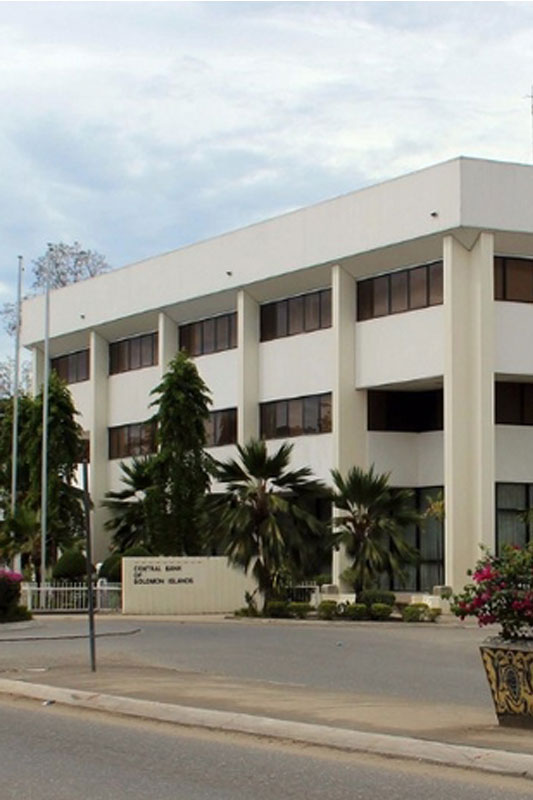
Central Bank of Solomon Islands. Photo by CBSI

By EDDIE OSIFELO

THE Solomon Islands’ economy had slowed down prior to the coronavirus pandemic, according to a Central Bank of Solomon Islands reports.

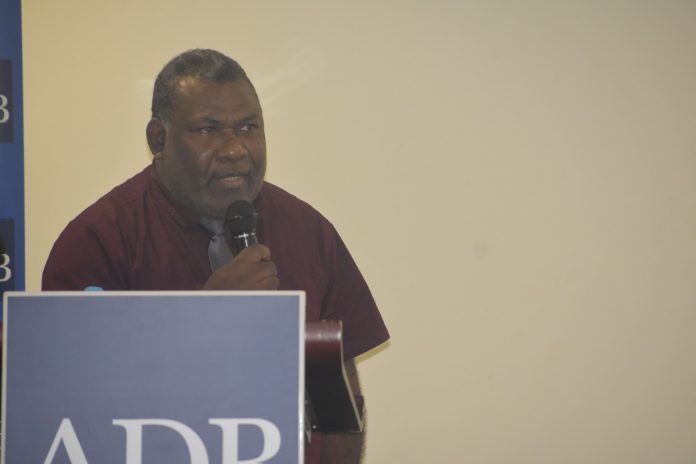
Economic Association of Solomon Islands (EASI) President, Reuben Tovutovu said this in response to Asian Development Bank’s (ADB) Solomon Islands flagship report, the 2021 ADO Report.

The Asian Development Report states the country’s Gross Domestic Growth has contracted to negative 4.5 percent in 2020 due to the pandemic induced recession.

Tovutovu said the covid-19 only exacerbates (worsen) the decline.

He said some of the challenges resulting from this poor economic performance include:

  1. Increasing unemployment rate and the likelihood of remaining high into the future, especially as new graduates enter the labor market,
  2. further deterioration of the quality-of-service delivery. The reprioritisation policy needs to be managed effectively in order to avoid crowding out of investments in plans and activities that create social cohesion and crime-prevention. The one specific area of concern is the reallocation of funds from other ministries to ministry of health as a measure to contain the covid-19. In doing so, this will disrupt the flow of work plans of other important ministries, eventually affecting the key role of the government, i.e, service delivery.    One clear example is the postponement of tertiary scholarships since 2020.
  3. Decline in the overall standard of living. It is hoped that the Government’s current freeze on new recruitment is only temporary.

EASI was established in 2001 as a Charitable Organisation.

Some of its main objectives include: to further the study of economics science, to stimulate economic research, discussions and debate in the country. 

As a professional body representing economists in the country, EASI has been conducting seminars with some key government ministries such as Lands and Ministry of Infrastructure Development, and recently collaborated with Solomon Islands Chambers of Commerce and Industries (SICCI) on “Private Sector Covid-19 Recovery Strategy”.

Illegal harvesting and stockpiling of beche-de-mer high in Luaniua

0
The current illegal bech-der-mer activity in Luaniua, Lord Howe

BY SAMIE WAIKORI

AUKI

Stocks of illegally harvested beche-de-mer are reportedly piled in the Luaniua community of the Malaita Outer Islands’ Ontong Java circle.

Sightings of the piles and open practising of illegal harvesting are contained in a report by a government health team which recently toured the Malaitan outliers on the vaccination programme.

The Ministry of fisheries and marine resources is being called on to investigate this report further and act.

The health team reports that illegal harvesting and stockpiling is rife in Luaniua community and settlements on nearby islands.

They add that the activity is heavier in Luaniua than Pelau, the other main island in the lagoon.

The report describes locals as practising illegal harvesting openly without fear of being seen.

Another highlighted point is that there is no law enforcement system to hold these illegal fishers accountable for breaking the law.

The report adds that large stocks of processed beche-de-mer can be found on the islands.

Meanwhile, Auki fisheries office confirms to Island Sun Auki that the ban is still in force and harvesting of beche-de-mer at this time is illegal.

Auki fisheries adds that there is also no date set yet on when the ban will be lifted, and that all citizens should abide by the law.

On that note, the report also shared the serious economic situation people face as a result of covid-19 and the ongoing impacts of climate change on the islands.

 It said bech-der-mer is the only resource people in Lord Howe depend on and it has been years since the last lift of bech-der-mer nationwide.

The report reiterated that the current economic situation experienced in MOI needs deliberation from the national government to act in possible way to rescue people from the situation.

Economy expected to recover in 2022

Elma Elbling ADB Pacific Country Office

By EDDIE OSIFELO

THE Solomon Islands economy is expected to recover to one percent in 2021 and 4.5 percent in 2022 as fishing and construction rebound.

However, logging output is expected to continue falling.

Asian Development Bank’s Solomon Islands Country Office Unit Head Elmar Elbling said this when he presented Asian Development Outlook (ADB) 2021 at Heritage Park Hotel yesterday.

Elbling said as part of its policy redirection, the Solomon Islands government declared a hiring freeze in February with positions vacant since January made inactive.

He said although essential services and education are exempted, the freeze will contract public services.

“Growth in construction and related business is expected to benefit from infrastructure projects, notably the Tina River Hydropower Project, upgrades to transport, the rehabilitation and expansion of water supply and sanitation systems, and construction for the 2023 Pacific Games.

“The fish catch will likely rebound in 2021 and 2022, but logging output is expected to fall further to 1.8 million cubic meters, reflecting government efforts to improve sustainability,” he said.

Elbling said the government is relying on the COVID-19 Vaccines Global Access Facility (COVAX) to provide vaccines for the remainder.

He said it aims to vaccinate the whole population by the end of 2021, but this may prove to be a challenge, especially on outer islands.

“Only 19 cases of COVID-19 had been recorded as of 31 March 2021, all of them repatriates.

“Despite the cuts in spending, budget deficits are expected to persist in 2021 and 2022 with the need to continue funding for COVID-19 preparedness and support to the economy, subsidies to keep Solomon Airlines operational, and expenditures for the Pacific Games,” he said.

Elbling said inflation is expected to ease to 2.5 percent in 2021 as food supply chains normalize, then accelerate to 3.5 percent in 2022 in tandem with global price increases.

He said although exports in particular fish, crops, and minerals are expected to rise, the current account deficit is forecast to widen to equal 9 percent of Gross Domestic Product in 2021 and 11 percent in 2022 as imports rise to supply construction projects.

High population growth rate challenges country

0
Economic Association of Solomon Islands President, Reuben Tovutovu

By EDDIE OSIFELO

ECONOMIC Association of Solomon Islands (EASI) says one of the challenges confronting the country is the high population growth rate.

The recent national census confirmed the country’s population has reached more than 700,000.

EASI President, Reuben Tovutovu said this in response to Asian Development Bank’s (ADB) Solomon Islands flagship report, the 2021 ADO Report, that unprecedented times demands unprecedented but workable policies.

Tovutovu said currently Solomon Islands has the highest rate in the region with 2.7 percent annually.

He said translated into classrooms, this is equivalent to 1.5 classrooms per day, or 548 classrooms per year.

“However, although the twin challenges of high population growth and urbanisation can create a myriad of socio-economic challenges, they can also be catalysts for growth and innovation, for example as sources of markets for local produce,” he said.

Furthermore, Tovutovu said with the launch of the undersea cable in early 2020 resulting in low costs of data, digital platforms for doing business, especially connecting rural producers to urban markets should be promoted.

He said this will not only indirectly stimulate increased local food production but also ensure food security in the short to medium term.  

Impact of quarantine on economy revealed

By EDDIE OSIFELO

THE Solomon Islands economy contracted by 4.5 percent in 2020 with log output falling by 12 percent and fish catch by 40 percent largely due to quarantine restrictions on production and shipping.

Asian Development Bank’s (ADB) Solomon Islands Country Office Unit Head Elmar Elbling said this when he presented Asian Development Outlook (ADO) 2021 at Heritage Park Hotel yesterday.

Elbling said construction also slowed as the movement of equipment materials, and workers from overseas were delayed.

He said logging and crop production also suffered under the impact of Cyclone Harold, which struck in April.

Furthermore, Elbling said growth in public services accelerated from 1.3 percent in 2019 to 1.7 percent in 2020 due to COVID-19 related spending.

He said an Economic Stimulus Package contributed to an increase in the fiscal deficit from the equipment of 2.0 percent of Gross Domestic Product in 2019 to 2.5 percent.

“In November 2020, the government announced components of a major policy redirection to focus on protection from COVID-19, economic recovery, and sustainable development.

“It also delayed passage of the 2021 budget until April 2021,” he said.

Elbling said inflation almost doubled from 1.6 percent in 2019 to 3.0 percent in 2020, reflecting in part a tripling of the price of betel nut in early 2020 as adverse weather affected supply.

He said food prices rose by 1.3 percent in 2020 because of damage from Cyclone Harold and tax hikes for rice, sugar, and sugary beverages.

“Higher inflow of grants and declining imports shrank the current account deficit significantly, outweighing the 18 percent fall in exports, which saw logs and timber down by 21 percent and fish by 16 percent.

“Imports fell by 19 percent, led by declines of 28 percent for machinery and vehicles, 23 percent for manufactured goods, and 20 for fuel,” he said.

Elbling said to address stress on the balance of payments caused by COVID-19, the government secured in June a $28.5 million financing from the Rapid Credit Facility and the Rapid Financing Instrument of the International Monetary Fund, which also provided debt service relief through the Catastrophe Containment and Relief Trust.

He said Gross International reserves were up by 12.4 percent at the end of 2020 and were sufficient to cover 19 months of merchandise imports.