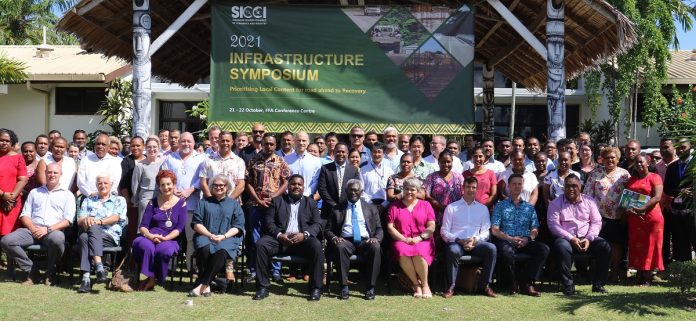
Group photo of the participants with the PM during the opening yesterday
PRIME Minister Manasseh Sogavare says the intention to have local content in infrastructure development is a positive step in infrastructure development in the country.
Speaking during the opening of the SICCI Infrastructure Symposium in Honiara yesterday, he said there is an increasing trend in local content requirements imposed by governments worldwide in the effort to improve employment and industrial performance domestically.
Sogavare said local content can result in job creation, increase use of domestic resources supporting local industries and positive spill over impacts to the overall economy, as it emphases on the use of domestic goods and supply services amongst other measures.
“Therefore, the intent to prioritise local content in infrastructure development in Solomon Islands is not only important but very timely as well given the impacts faced by the economy due to the global pandemic,” he said.
Looking forward, the Prime Minister said we must also bear in mind the urgent need to focus on the recovery of our economy to ensure that we have a vibrant economy that can adequately support our people and country in the next 2 to 5 years.
Some of the participants participated in the Infrastructure Symposium
Sogavare said the private sector is expected to play a key role in infrastructure development.
“Private investment is expected to take advantage of opportunities arising in developments in ICT and digital infrastructures as well as increased trade opportunities in the medium to long term as a result of increased and better connectivity and also improved supply chains,” he said.
Meanwhile, the Prime Minister said whatever outcome reached from this Infrastructure Symposium, must also consider the downsides of local content.
He said the short term impacts of local content policy and local content requirement must be carefully thought through and balanced against its long term impact on the infrastructure industry and the economy as a whole.
SICCI Chairman Ricky Fuo with Sir Bruce Saunders
“I understand that SICCI has done a consultation with businesses from the building and construction industry from 26th May to 4th June 2021 and that common themes and issues were raised,” he said.
Sogavare said he expect these issues to be thoroughly discussed during this two-day workshop by both the public and private sector, and most importantly with donor partners.
“I make specific mention of our donor partners because most of these huge infrastructure development is funded by them,” he said.
PM Sogavare and SICCI Chairman Ricky Fuo before the photo shoot
INFRASTRUCTURE plays a significant role in developing our country.
Prime Minister Manasseh Sogavare highlighted when delivering his opening remarks at the Solomon Islands Chamber of Commerce (SICCI) Infrastructure Symposium at the FFA Conference Centre, in Honiara yesterday.
The Prime Minister said the National Government has recognised the importance of infrastructure development which is stipulated in the National Development Strategy Objectives;
1: Sustained and inclusive economic growth, and under the Medium Term Strategy and;
3: Expand and upgrade weather resilient infrastructure and utilities focused on access to productive resources and markets and to essential services.
“The Government redirection policy also prioritise infrastructure as an important component in keeping our economy afloat and ensuring a resilient economic recovery post COVID-19,” he said.
A guest speaker giving his presentation
The Prime Minister said the need for reliable, effective and high quality infrastructure is magnified by the undeniable challenge of the country’s geography.
He said it is even more challenging by our susceptibility to natural disasters and climate change.
However, Prime Minister Sogavare said what is irrefutable is that our economy cannot accelerate or reach even half its potential with the existing infrastructure that we have, and this must be addressed aggressively.
“Infrastructure development is important for economic development and recovery in any country, and this is also true for Solomon Islands,” he said.
The Prime Minister said infrastructure development does not only enhance connectivity but it also plays a fundamental role in trade facilitation.
Prime Minister Sogavare said it is also a catalyst for development and an enabler for faster and inclusive growth which leads to poverty alleviation and improving standards of living.
“Development in transport infrastructure also impacts productivity significantly and accelerates growth. It generates employment opportunities, contributes to tourism and domestic market development,” he said.
PM Sogavare had a brief conversation with officials
Prime Minister Sogavare said infrastructure forms the basis of building resilient societies and sustainable development.
He said infrastructure designs and investments made now will affect how Solomon Islands responds to challenges such as COVID-19 pandemic, climate change and building inclusive and resilient societies.
“Infrastructure will play an important role in post pandemic recovery efforts due to its multiplier effects. In the same vein, infrastructure projects are pivotal because it helps facilitate the provision of essential services such as water, sanitation, health care and education post COVID-19,” he said.
Prime Minister Sogavare said the Government remains committed to infrastructure development in Solomon Islands and will continue to support the infrastructure development initiatives undertaken by our various development partners and implementing agencies, especially during this global pandemic.
From April 2021, a team comprising specialists from many different fields started a journey that would eventually take them months.
Led by Dr Morgan Wairiu and Community Engagement specialist Nancy Kwalea, the team from the USAID funded SCALE-NRM project were on a mission to share information with rural tribes, resources owners and farmers of Malaita Province in the Solomon Islands about an ambitious program, SCALE-NRM, that seeks to work with them to protect, manage and reap benefits from their natural resources.
People of this most populated province were already aware of the USAID funding that was in the pipeline but had not yet been oriented to the benefits the project will offer them.
The team’s mission was to help resource owners and local populations to understand how the funds can be utilized to help people regain control over their inherited resources, which are at risk of being despoiled by uncontrolled natural resource exploitation.
Logging activities have already ravaged and devastated the Island’s forests for decades.
SCALE-NRM livelihoods manager Brown Onahikeni explains the livelihood component
Solomon Islands has been logged at an unsustainable rate.
With logging activities so far beyond sustainable levels, much of the country’s lowland forests have gone.
In its push to re-engage with the Pacific, the United States of America through USAID have decided to support Malaita Province to not only restore and protect its natural resources but to find alternative economic benefits for Malaitan people.
Naturally, the people of Malaita have high expectations from the new project.
The population is accustomed to financial support being provided from ‘constituency development funds’ for relatively short-term initiatives.
SCALE-NRM Forest specialist Patrick Waetara explains the project concept to villagers
Therefore, when the term ‘project’ is used, people think in term of cash grants.
It was going to be a daunting task to convert mindsets to refocus on long term activities and benefits – the SCALE modality.
The team realized that transforming people’s mindsets was not the only challenge they will encounter.
One of the more daunting tasks was accessing remote rural villages.
Poor road conditions and lack of proper infrastructure around the island rendered the mission challenging, but the team was committed to ensure the SCALE program is rolled out.
Partnership meeting with Technical Institute of Malaita
One sunny morning in May, the SCALE-NRM team set off on one of their awareness raising expeditions.
Leaving Malaita’s capital Auki mid-morning they first had to complete a four-hour truck ride through mountainous terrain.
After braving the rugged road from Auki across the island to East Fataleka, the team arrived under the cover of dark and rain, dripping wet. People from surrounding communities that converged at Bethel village had waited for the arrival of the team since afternoon.
The preparations and anticipation by the villagers were a clear indication of the high expectations the team knew they would need to address across the many villages in the forthcoming days and weeks.
Dr Morgan Wairiu, supported by the project’s team leaders, wasted no time to set out SCALE-NRM’s objectives and key messages.
The team spent almost two weeks in the eastern region of Malaita, holding awareness talks and collecting data at 14 different centers, attracting hundreds of villagers from four different wards. Wards are local authority areas, typically used for provincial and national election purposes.
SCALE-NRM Police and Governance specialist Daykin Horahau collects data from a tribe in Malaita
The team collected data on intact forests, tribal ownership, community establishments and commercial crop types communities are dependent on, in order to inform proposed project activities.
The team met large gatherings and received overwhelming commendation from villagers who expressed the need for more information and clarity regarding the SCALE-NRM program.
“How do we apply for small grants under this project to help us implement our plans” was the most frequently asked question.
This inquiry confirmed the team’s understanding that a direct support approach has become a norm and that other approaches would be a departure for rural dwellers, requiring sensitization and effective communications.
The team engaged villagers using practical examples on how properly planned and designed interventions are crucial for long term results. For example, the team pointed to the rapid growth of the population against the exploitation of the fast disappearing forest and other natural resources.
Villagers feast after a SCALE-NRM gathering in East Fataleka
Villagers did not find it difficult to agree because many rural associations have made failed attempts as well to conserve their resources.
“We have made several attempts in the past,” Hainorae tribal leader in East Malaita Chief Andrew Gwaitalafa admitted.
Mr Gwaitalafa said the challenge is lack of by-laws to deal with villagers who break the conservation rules, “but again it is difficult for everyone because there were no alternatives for villagers who depended entirely on forest for survival.”
SCALE-NRM focuses on ensuring increased community economic benefit for resource owners and communities from their forests through a combination of income-generating activities and conservation concessions.
The project will strengthen models of local conservation economies around opportunities for the pursuit of sustainable livelihoods and development of conservation markets that provide communities with viable alternatives to logging and that incentivize conservation.
The SCALE-NRM team visited the central regions of Malaita thereafter, splitting into two teams to accelerate the awareness process and data collection.
The two teams headed to the northern and southern regions of Malaita.
The teams also held consultations with vocational schools in the province.
As part of the objective to collaborate and strengthen Community Based Organizations, the project also identified vocational schools to partner with in areas relating to natural resource management in Malaita Province.
The livelihood component of the SCALE-NRM project attracted overwhelming interest from farmers around the province.
“For us women, livelihoods activities are the foremost.
“That is what we do to earn little income to meet our families’ daily needs,” Everlyn Soela from New Konga in North Malaita said.
Ms Soela and her family runs a coconut milling business.
“We provide a lot of support to rural people by buying their dry nuts and providing people with cooking oil from the small-scale milling business,” she added.
Women at Subobono village, East Fataleka
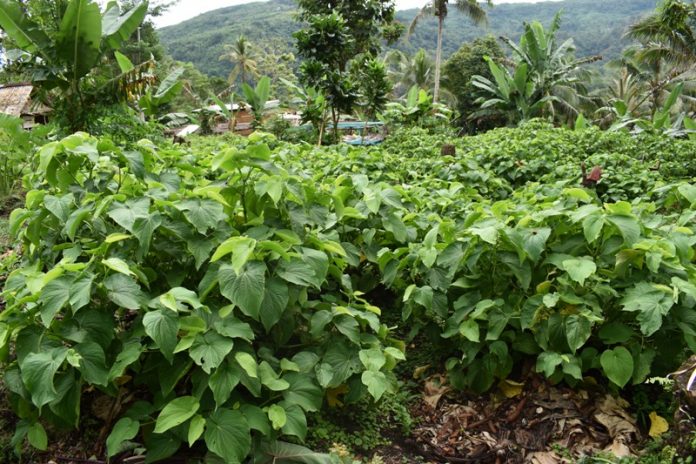
SCALE-NRM under its livelihood component will work with farmers, particularly coconut, cocoa, kava and taro farmers to increase quality production in preparation for the proposed processing plants earmarked for Malaita.
The team found out from data collected and interviews conducted that the major existing cash crops that people have been depending on for years included cocoa and coconut. Kava and taro farming are also major emerging cash crops.
The challenges faced by the team in transforming the mindsets of people as well as accessibility across the province, were successfully overcome as the team concluded the activities by the end of August, winning the hearts and minds of Malaitans.
Many resource owners and farmers emotionally testified about dreaming of such project.
They openly expressed their eagerness to utilize their resources in order to derive beneficial results and pledged their readiness to work together with SCALE-NRM to fulfill these dreams.
The team successfully visited 30 of the 33 wards of Malaita, establishing community connections with traditional and tribal leaders as well as identifying active community associations.
Community, tribal and church leaders expressed readiness to work with SCALE-NRM in implementing the project activities.
The provincial-wide community engagement and data collection activity has created a firm foundation and relevant information that accurately informs the SCALE-NRM project to enter into implementation activities.
The national project, implemented by Winrock International, initially targets Malaita and is made possible by the generous support of the American people to develop and implement sustainable models for improved natural resource governance in Malaita Province and throughout Solomon Islands.
– By EDNAL PALMER, SCALE-NRM Communications coordinator
Part of the students who graduated from KGVI yesterday.
BY CHARLES KADAMANA
Every Scholar has the moral obligation to contribute to society which can make a difference to the world and improve life.
This was highlighted by Dr Alphaeus Zobule guest of honour at the King George Six graduation ceremony yesterday.
Dr Zobule in his reflection on the theme “Equipping, Resilience and Scholars” suggest the theme comes with responsibilities.
That means the responsibility of any scholar is to Acquire, Accept and Apply knowledge to make impact in life, add values, know how to do things and apply knowledge to help others.
Dr Alphaeus Zobule presenting the form six Arts Dux prize to Samuel Sisimia
He said a student who acquire knowledge about a subject is a scholar, a student who is awarded a scholarship is a scholar so therefore somebody who knows the subject well and acquire knowledge to be somebody who is knowledgeable in the subject is a scholar.
“So, every student and teacher in their own rights are scholars by definition so all parents and guardians have all the reason to be here to celebrate today,” he said.
He further elaborates that to acquire knowledge involves the pursue of knowledge, gain knowledge and more than that know how to do things.
Form seven students provide entertainment
He said to accept knowledge means to allow knowledge to make impact in one’s life, values, characters if knowledge is to make difference in the world it must make difference in the scholar. More than that it must be accepted in the heart, strengthen the attitude, character and shape a life
He said when Scholars apply knowledge it means to use it to benefits others like a student scholar applying knowledge to help others and a teacher scholar applying knowledge to help the students.
From left, Primrose Yanda, Wilmina Belo, Charlyn Andrew and Keren Jessy proudly display their certificates
By saying these he believes that every scholars have the moral obligation to contribute to the society and make a difference in the world to improve life.
“By that I simple mean everyone should make an attempt to make a difference in this world, in the society to improve life and that may involve second opportunity to those who don’t have the first opportunity, it may mean building something that can build the community, thinking of solution to issues and creating jobs,” he said.
Files no-confidence motion against Speaker and deputy
BY SAMIE WAIKORI
Auki
MALAITA Premier Daniel Suidani has submitted a motion of no-confidence against the province’s Speaker and his deputy.
The motion was filed by Suidani on Tuesday this week, a day after Speaker Ronnie Butala announced having received notice of a motion of no confidence against Premier Suidani by the non-executives.
Speaking to Island Sun yesterday, Mr Butala welcomes the motion against him and his deputy.
According to the letter, Premier Suidani said:
“I, as the MPA for ward 5 and the Premier of Malaita Provincial Government, I hereby give notice of a motion of no confidence in the Speaker of Malaita Provincial Assembly in accordance to S.O. 116 as read with S.O. 118 of Standing Order of the Provincial Assembly of Malaita province.
The specific Teams and grounds for the lack of confidence in the Speaker are as follows;
1, The Speaker in the previous Motion of No Confidence against me 12 months ago acted contrary to S.O 152 Open Ballot voting. He instead ruled during the vote on that motion to adopt secret ballot voting, which is contrary to S.O. 152.
2, The Speaker in the previous MONC against me was not impartial in conducting the meeting. He was colluding with the movers of that motion to remove the premier from office.
3, More recently, the speaker acted contrary to my advice to administer the oaths of affirmations of office according to the Stand Order 9 of the Malaita Provincial Assembly. This has resulted in the matter now being contested in the High Court.
4, The Speaker is not impartial in exercising his function and is colluding with certain MPAs to move a motion of no confidence against the Premier.
As the head of an Elected Assembly, the speaker is duty-bound to decide independently on Assembly’s practices, procedures and processes following the Standing Orders and Provincial Government Act (PGA) 1997.
Instead, the speaker’s recent decision not to administer MPA oaths contradicted some of his past decision on similar matters.
As a result of specific issues that have been highlighted, the speaker is not impartial or neutral in exercising his duty. His actions bring the reputation and respectability of the assembly into disrepute.
Thus, this motion of no confidence against the Speaker is to restore the sanctity of the Assembly to ensure it is a respectable and impartial institution.”
Speaking to Island Sun yesterday, the provincial clerk Matthew Maefai confirmed his office receiving notice of Premier Suidani’s motion.
Maefai says he will wait for the speaker to arrive back in Auki before issuing a notice and date to table the motion in the provincial assembly.
Meanwhile, Butala welcomes the motion against him and his deputy, saying:
“I was informed on the motion of no confidence against me and my deputy speaker from Auki yesterday and my office is looking forward to facilitate it through the normal process.
“I respect the democratic rights of Premier Daniel Suidani for filing in the motion of no confidence and I and my deputy speaker welcome it.”
Suidani is also facing a no-confidence vote the non-executive bench filed against him Monday this week.
The motion has been scheduled for debate on 27 October 2021.
THE Land Board in the Ministry of Lands, Housing & Survey has tendered the land that hosts the defunct agriculture research station at Dodo Creek, Central Guadalcanal.
The 15.58 hectares of land is registered as Parcel 192-019-005/ Lot 31 of LR.83/ R at Dodo creek.
According to MLHS advertisement on Island Sun, the Perpetual Estate is owned by the Commissioner of Lands with no encumbrances.
MLHS said the land has been disused for more than 20 years and the government has no plan to redevelop the site.
The Ministry said squatters have reoccupied the former government quarters and built their own houses in the area, and there is at least one grave site in the area.
“Tenders are hereby invited for a 75-year Fixed Term Estate over this land.
“The successful bidder is expected to accept the land as it is, and will be fully responsible for any persons already occupying the land,” MLHS said.
The Ministry said no alternative sites will be offered in lieu of this property, regardless of any difficulties encountered.
“Preferences will be given to tenders for tourism and/ or agriculture development of the land, and for partnerships for example with original customary landowners.
“There is no set or minimum Premium price for the land and annual land rent will be set as 1 percent of the unimproved capital value of the land, which is yet to be determined,” MLHS said.
Commissioner of Land, Alan McNeil said all government ministries were asked if they wished to develop the land, and none came forward.
McNeil said the successful tenderer will be responsible for the squatters, and they will have to convince the Land Board that they have the right and appropriate approach.
“The decision on the successful bidder will depend on the Land Board, so I cannot predict whether it will be a ‘big investor’ as you put it,” he added.
The research station at Dodo creek winded up its business following the ethnic conflict from 1998-2003 on Guadalcanal.
MINISTRY of Public Service has sliced the housing rental entitlements for its employees.
This cost-cutting measure is set to take effect next year.
The new arrangement sees a level 1 public servant eligible for $1,500 monthly rental.
While the highest post holder in the government, SS3, is eligible for $4,500.
Permanent Secretary, Nego Sisiolo said their salaries will be untouched.
Sisiolo said the SIG will pay its employees with Public Service Housing Assistance (PSHA) specifically to support them rent a house.
He said Honiara-based officers who have and lived in their own accommodations will now be able to use the PSHA to improve their existing properties.
“Officers who rented houses at higher rate are expected to negotiate rental rates with their landlords to have the rates fall within their respective PSHA allocated rate,” he added.
Sisiolo said this policy change sensitises fairness on housing assistance to all officers and is leaning towards efficiency in public service as there will no longer be cumbersome paper works on tenancy administration as we currently experience.
However, some public servants have complained that the rental is too small which could land most of them in low-cost housing on the outskirts of the city.
MALAITA provincial agriculture office will soon complete its kava pre-processing training for the province.
Provincial supervising chief agriculture officer, Mr Dennis Tafea told this paper six out of eight proposed trainings have already completed for the province.
He said the purpose of the training is to ensure farmers understand the pre-processing stages of the kava product, which can determine quality products for market.
Tafea said most kava farmers only understand the early stages of kava production; nursery, planting and caring for the kava plants.
He said the stage from harvesting that is the pre-processing stage is where the weakness of most farmers lie and this is where the training targets.
Tafea said so far they completed three trainings for southern region, one for eastern, one for northern and another one for central regions.
He said the remaining two kava pre-processing trainings will be for northern and central regions.
Tafea said a total of 240 participants have attended the six training so far and they expect them to share the knowledge learnt with their colleague kava farmers in the province.
He said the kava pre-processing training is funded by the national government through the ministry of agriculture (MAL) towards kava development in the province.
PM Sogavare and his delegation visiting the noni stall
BY MAVIS N PODOKOLO
Government has promised to commit to increasing its investment in the Agriculture sector.
This was revealed by Prime Minister Manasseh Sogavare during the launching event of the 10-year Agriculture Sector Growth Strategy and Investment Plan earlier this week.
“Be rest assured that this government is fully committed to progressively increase our investment in the Agriculture sector now that we have a plan to guide us on how and where will we put our income to,” Sogavare said.
He said this strategy recommends reforming and restructuring the Ministry of Agricultures and Livestock so it can effectively deliver especially the extension services infrastructure like fuel experimental stations.
“Our goal is to grow our subsistence small holder farmers to become to become commercial farmers. Our strategy as well is designed to facilitate nation-wide implementation involved both the public and private sector including farmers, their organisations and Non-Governmental Organisation (NGO’s) supporting the farmers,” Sogavare said.
He said it also involves other crucial implementation partners, our international development partners, CSO and religious group.
“On this note allow me to thank all our development partners in our Agriculture sector development journey all these years,” Sogavare said.
Minister for Women Youth Children and Family Affairs Freda Rotutafi Rangirei.
THE Minister for Women, Youth, Children and Family Affairs Freda Tuki Rotutafi condemns in the strongest term the brutal killing of a young girl at Kolombangara Island, Western Province.
Police media report stated the seven-year-old girl went missing on her way home from school on 14th October and was discovered dead on 18 October.
“I share my heartfelt condolences and deepest sorrow to the immediate family and relatives of this young child and those perpetrators must receive the toughest punishment under the Law of Solomon Islands,” Minister Rotutafi said in a statement issued yesterday.
The Minister said the horrific act of taking away the life of an innocent child and any forms of violence is a serious crime and is not accepted and must not be tolerated.
“Every child including girls should be able to grow up safe and secure wherever they are – at home, at school and in their communities and deserve respect as any other individual.”
She calls for more collective effort to stop any forms of violence against children whether it be physical or sexual abuse and others.
Minister Rotutafi urges all actors including Government agencies, Non-government organizations, Churches, Schools, Community leaders and parents to act and help create safer environment for all children.
“National and Provincial leaders, church leaders, community leaders, teachers, parents including men and boys must come out and speak against violence against children including sexual abuse.
“Whilst the Government is committed to ensure that all children are protected from any form of violence and abuse at home, school, community and our society, we acknowledged the need to strengthen thegood traditional values and practices that help to provide for the care and protection of children and respect for women and girls.”