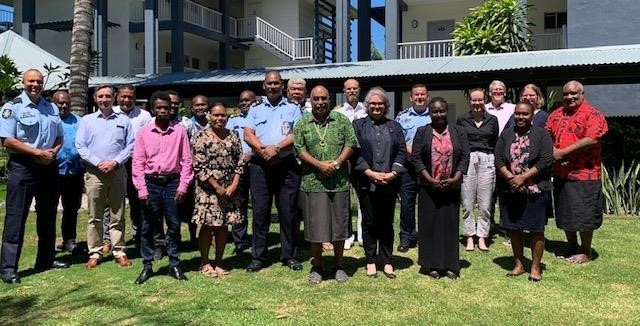
Members of the Australia-Solomon Islands Bilateral Security Dialogue participating from Honiara. Including (in front row) Commissioner Mostyn Mangau, Permanent Secretary Mr Collin Beck (Chair), Acting High Commissioner Sally-Anne Vincent and Permanent Secretary Ms Karen Galokale
Australia and Solomon Islands held their 4th Bilateral Security Dialogue virtually on November 16, committing to deepening our security partnership, including in areas such as policing, border and cyber security.
Australia and Solomon Islands are committed to continuing to work together to ensure a stable, prosperous and secure Blue Pacific region.
“Australia welcomed this opportunity to discuss key aspects of our bilateral security relationship with Solomon Islands”, said Ewen McDonald, Head of the Office of the Pacific.
“Australia and Solomon Islands are longstanding security partners.”
Members of the Australia-Solomon Islands Bilateral Security Dialogue participating from Honiara
The partnership between Australia and Solomon Islands has continued to grow over the past year despite the challenges of COVID-19. Together, we are progressing the Western Border and Patrol Boat Outpost, enhancing cooperation on explosive ordnance disposal, and continuing to support the Royal Solomon Islands Police Force’s capability growth and operations.
Permanent Secretary Beck stated that “this is a meeting of close neighbours on security issues of mutual concern”.
The meeting agreed to enhance our bilateral architecture, including through regular ministerial engagement, inaugural senior officials’ talks next year, and reaffirmed our commitment to continuing to exchange perspectives on our security priorities through this Dialogue.
The Dialogue was co-chaired by Permanent Secretary Collin Beck, Ministry of Foreign Affairs and External Trade, and Ewen McDonald, Head of the Office of the Pacific.
TEACHERS have expressed their disappointment over their travelling allowance, saying it is inadequate to meet their travel for this Christmas Holiday.
Dudley Tutina is among other teachers who will be digging into his own pocket to meet his family’s travel.
He is teaching in one of the schools in Makira/Ulawa province and his family is planning to spend the Christmas holiday in Isabel Province.
Travelling from Makira to Isabel requires lots of money for fare, food, accommodation in Honiara and boat hiring from port of call to final destination, and return trip.
“Just imagine when you receive SBD2000 travelling allowance for a family of five children and you are planning to travel from Makira to Honiara and Honiara to Kia in Isabel province. Not forgetting the return routine to reach Makira province.
“This amount is nothing to say the least if you look at the current sea fare and other cost related to travel for such as long distance,” Tutina said.
He said he has followed the required instruction by submitting a full breakdown of the travelling cost to the Education Authority.
Tuitina said the unfair treatment has been in the teaching service and that Education Authority as well as the Ministry of Education and Human Resource Development must clarify who is responsible for such issues.
Like Tutina, other teachers also took to social media expressing their disappointment at the government through responsible authority for the ill treatment towards teachers.
“The government just splashed out millions of towards Mamara contractors last week but forgot to address some of the country’s top issue like teachers travelling allowance.
“This government has no priority towards what is important for the country,” one teacher commented.
UNVACCINATED pregnant women are being urged to get vaccinated with Pfizer-BioNTech COVID-19 vaccine when have the opportunity to receive it.
Dr Leeanne Panisi, head of Obstetric Gynaecology, NRH made this call during the COVID-19 radio talkback show on the Solomon Islands Broadcasting Corporation in Honiara.
Panisi said studies and reports from those countries that have recorded high number of COVID-19 infections have shown the use oF Pfizer-BioNTech COVID-19 vaccine to have benefits for mother and also the baby.
“It decreases the severity of infection especially the lung infection and also decreases the risk of baby dying inside mother’s womb. It also lessens the risk of baby to born before nine months and the risk of baby to not growing well inside mother’s womb.
“In early studies it also shows that with this vaccination especially if pregnant mothers get it earlier in her pregnancy there will be transfer of some protective antibodies from mother to the baby and also it is protective on the baby’s first few months.
“Because of these benefits as a specialist on our National Referral Hospital I strongly recommend that our pregnant women must get the opportunity to receive the Pfizer-BioNTech COVID-19 vaccine,” she said.
Panisi said during pregnancy she will have changes inside her body where it places her at high risk of getting severe infection like the COVID-19 infection.
She said on some of the experiences from countries who have COVID-19 infection they found that pregnant women with this infection are at high risk of having severe lung infection and they need admission to hospital, they need admission to ICU high density unit and also at risk of dying from that severe infection.
She adds studies also discovered that another complication with COVID-19 infection on pregnancy is the baby will not grow well inside the mother’s womb. It also shows that this vaccine is safe for pregnancy and it does not show any adverse outcome on pregnant women.
“So with those complications it is more important for pregnant women to get the Pfizer-BioNTech COVID-19 vaccine and we recommend that. You can get it anytime during your pregnancy, the earlier the better,” Panisi said.
THE National Referral Hospital has the testing machines and treatment for blood clotting, a side effect of the COVID-19 vaccine, says Dr Yogesh Choudhri.
Choudrhi, senior advisor to Ministry of Health confirmed this at the Ministry‘s radio talkback about the COVID-19 vaccine on the Solomon Islands Broadcasting Corporation (SIBC).
“For blood clotting we have already got the testing machines and the treatment for clothing at the National Referral Hospital because we are worried about the side effects. We do not want any life lose because of the vaccinations.
“So we have to make sure there are treatments and appropriate management can be done,” he said.
Choudhri said the ministry is “pretty confident” that National Referral Hospital can handle any side effects that will be presented by the Pfizer-BioNTech COVID-19 vaccine.
“We did it for AstraZeneca vaccine, Pfizer-BioNTech COVID-19 vaccine we are rolling out we are pretty confident NRH can handle it but in the provinces we will ensure there are appropriate trained team and medicines available to manage the pericarditis and mericaditis.
“For provinces if any person presents these systems will be referred to NRH. But right now we don’t have the treatment and machine in our provinces,” he said.
Choudhri adds, “with Pfizer-BioNTech COVID-19 vaccine if administered yes we are expecting five to six cases of pericarditis and mericaditis this is more reported in young adults”.
He admits that all vaccines have side effects and clotting is one of them.
“And for Pfizer-BioNTech COVID-19 vaccine if administered we are expecting five to six cases of pericarditis (swelling and irritation of the thin, saclike tissue surrounding your heart) and myocarditis (an inflammation of the heart muscle) this is more reported in young adults”.
“Pericarditis and myocarditis following the vaccination will require supportive treatment it doesn’t require any particular treatment,” Choudhri said.
He said usually the presenting symptoms will be just chest pain, construction of the chest or increase heart rate so these could be the side effects leading to pericarditis and mericaditis.
“We have trained the people on these side effects on how to manage. We have person who is responsible for managing the side effects.
“Before we will roll out to the provinces we will ensure that the treatment and health workers who trained to manage pericarditis and mericaditis are there,” Choudhri mentioned.
Elrick Corneius Olvivera, Emmauel Peter and Judd Akwasia.
MEET these three young handsome lads from left, Elrick Corneius Olvivera, Emmauel Peter and Judd Akwasia.
All three are very special boys who were born prematurely meaning their mother gave birth to them months before the normal nine months of birth,
Elrick was born at only 7 months where he weighed only 1.2 kilograms, Emmanuel and Judd both below 1kg at 7 and 6 months respectively.
Today all three are in school, healthy and happy.
Thanks to the hands and hearts of the doctors and nurses whom had cared for them from birth right through to discharge.
On Wednesday 17th of November the trio together with National Referral Hospital (NRH) officials and staff, doctors and nurses of the Paediatrics department and officials from the Australian High Commission gathered in what was an inaugural marking of World Prematurity Day in Solomon Islands.
The World Prematurity Day is marked around the world on the 17th of November each year. Dr George Malefoasi Chief Executive Officer of Paediatric Department NRH, in his remarks explained that the Prematurity Day allows for time to think about how we can better improve support towards the needs of premature babies and their families and about raising awareness around these needs.
As such, Dr Malefoasi highlighted the current situation at NRH.
At NRH special care nursery is one of the busiest and always a fully occupied ward in the past years. Doctors and nurses constantly tried to create extra beds.
Group photo of all those attending and participating in the event
“In the past three quarter of this year, special care nursery has the highest bed occupancy rate of 166%, beyond the normal capacity hence the nursery has to expand into postnatal ward. There is only 14 beds for the very little ones and if we are lucky we get 20 beds.
“Literature has thought us that about 70 percent of premature babies are from week’s 34-36, and in Solomon Islands this is currently what we are seeing.
“Our own statistics at the hospital showed that from January to September 2021, of the total births of 4,668 births, 14 percent which is 695 babies were admitted to the special care nursery mostly due to premature dates or sick at birth,” stated Dr Malefoasi.
More than 60 women participants from the justice sector gathered for the two-day Forum in recognition of the importance of advancing women in leadership ranks across the justice sector.
OVER 60 women representatives from the justice sectors who attended the two-day Women in Justice Forum in Honiara agree that there is a need to promote policies that eliminate gender disparities and stop gender stereotypes.
The Forum came at a very important juncture considering how the COVID-19 pandemic continues to widen existing inequalities and place additional pressure on women outside the home.
Convened by the United Nations Development Programme (UNDP) through its Australian funded Access to Justice Project, the participants had the opportunity to hear from their peers about various support mechanisms, coping strategies and personal reflections that helped to break the proverbial glass ceiling.
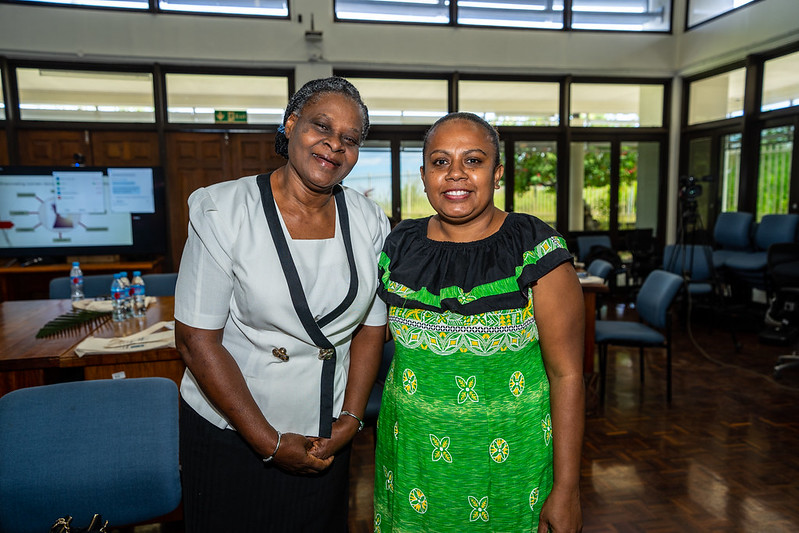
Sharing how the Forum added value to her career aspirations, the Principal Legal Officer for the Solomon Islands Law Reform Commission, Corina Peni said:
“This Forum has been particularly useful for me as a female lawyer, as I have learned from the experience of the presenters and gained advice on the potential, we women have in our chosen career paths.”
A Network of Women in the Justice Sector
The Vice-President of the Solomon Islands Bar Association (SIBA), Anika Kingmele, echoed the agreement of the participants for a network of women in the justice sector to advocate for the of building a respectful, inclusive, supportive workplace and promotion of women to leadership positions.
“A network of women within our sector ensures that we have a collective voice, which in turn supports us to work with our male colleagues to implement just policies that benefit everyone,” said Kingmele.
Deputy Public Solicitor, Martha Manaka providing a recap of Day 1 discussions.
According to the research carried out in Solomon Islands and in other countries has found that forms of violence such as domestic and sexual violence, bullying, and sexual harassment impact significantly upon employees’ ability to remain safely and productively employed[1].
The Acting Australian High Commissioner, Sally-Anne Vincent, in her opening address highlighted how, “over the years, the Solomon Islands Government (SIG), through the Ministry of Public Service, has noted the decrease in number of women and the delayed prolonged career progression for women across the wider SIG public sector workforce.”
She added, “This is an area that requires sustained effort to not lose the gains made.”
Also speaking at the opening ceremony, the Permanent Secretary for Ministry of Police, National Security and Correctional Services, Karen Galokale said:
Karen Galokale, Permanent Secretary of the Ministry of Police, National Security and Correctional Services delivering her address.
“I want to encourage you to use this opportunity to share ideas and establish a network to strengthen our partnership.
“Please take this opportunity to look at ways our different organizations can coordinate and complement each other.”
Of the five key messages identified from the Forum, participants reaffirmed the need to establish a women’s network in the sector with support from development partners. This network will include the membership of the Ministry of Justice and Legal Affairs and the Ministry of Police, National Security and Correctional Services.
Justice and Education Sector
Lessons from this initiative can also be applied across all other sectors.
Building on this, the Minister for Education and Human Resources Development, Lanelle Olandrea Tanangada, views the opportunity as a way to build a bridge between the Justice and Education sectors.
“It is very important for women in the justice sector to take the time to work with the education sector through advocacy programmes with the schools, to speak with young girls and boys on the importance of promoting justice, peace and harmony in this nation,” Tanangada said.
The Acting High Commissioner for Australia to Solomon Islands, Sally-Anne Vincent (left) and the Minister for Education and Human Resources Development, Lanelle Olandrea Tanangada share their expe
“At the same time, it is important that from the education sector, we include this (gender and human rights issues) in the curriculum from as early as primary school so we see how men and women can work together to ensure we live in a peaceful and safe environment,” she added.
Lady Justice
According to the Solomon Islands National Statistics Office and reported by 38 percent of women report their first sexual experience as having been forced.
Further, 63 percent of men believe it is acceptable to hit women in certain circumstances and two of three women have experienced physical violence from an intimate partner.
Reflecting on the depiction of lady justice as the symbol of fair and equal administration of the law, without corruption, favour, greed, or prejudice, the Deputy Public Solicitor, Martha Manaka highlighted the irony of this longstanding association, given the data from the National Statistics Office.
“Addressing the shocking rates and acts of family and intimate partner violence in our country is a complex and multifaceted task, requiring innovative approaches across all levels and across all sectors,” said Manaka.
“Forums such as this is a call to action.
“We all agree that we cannot stand by while so many women suffer harm that is completely avoidable.
“Or capable women that are overlooked in career progressions because of their gender!”
Building Trust
In 2017, an audit conducted by the Ministry of Justice and Legal Affairs (MJLA) (with assistance from the Solomon Islands Justice Programme) found that women made up 48 percent of people employed in the ministry and portfolio agencies.
However, the gender balance across agencies varied and the percentage of women promoted to managerial and leadership positions dropped to 41 percent.
Similarly for our Courts, while women hold 48% of the positions in the National Judiciary,[2] women’s representation is concentrated in lower-level positions, with representation in managerial and leadership positions (L8 to SS3) dropping significantly to just 21 percent.[3]
More generally, official figures published by the Ministry of Women, Youth, Children and Family Affairs (MWYCFA) indicate only 5 percent of senior public servants and 22 percent of mid-level positions were held by women, which highlights the considerable work that needs to be done to address gender equity across the sector.
The CSSI Deputy Commissioner Administration, Catherine Kere (left) and RSIPF Assistant Commissioner, Everlyn Thugea share how the formation of the women support network within CSSI and RSIPF has
“Building trust in our justice system should also mean a body that is reflective of our communities, as women are further disadvantaged due to their lack of physical, financial, and technical access (due to social and cultural norms and barriers), thus resulting in a lack of gender sensitivity at all levels which is then reinforced by male centric training programmes,” said Permanent Secretary, MJLA, Dr Paul Mae.
“Against this backdrop, closing the gender gap makes sense and is the moral thing to do,” Mae added.
Echoing these sentiments, the UNDP Solomon Islands Country Manager, Berdi Berdiyev said:
“Advancing women in leadership ranks across the justice sector is imperative to ensure that all perspectives are considered in the effective administration of justice for users of the justice system, the people of Solomon Islands.
“This Forum, on the back of national, regional and global commitments, not only provides the opportunity for capacity building but also provides a platform to share the challenges and potential solutions to support future female leaders in assuming leadership and decision-making positions.’’
Participants of the Women in Justice Forum included representatives from the Public Solicitor’s Office, MJLA, Office of the Director for Public Prosecutions, Solomon Islands Bar Association, Solomon Islands Law Reform Commission, Royal Solomon Islands Police Force, Correctional Services of Solomon Islands, Ministry of Education, Ministry of Public Service, the private sector, Australia Pacific Training Coalition (APTC), the University of the South Pacific and development partners.
At the conclusion of the Forum, participants agreed to five overarching messages and agreements to inform their way forward based on empowerment, networking, mentoring, capacity building and research.
The Forum was held in the capital Honiara on Monday 8 and Tuesday 9 of November 2021.
The Director for Public Prosecutions, Rachel Subusola Olutimayin (left) with Senior Programme Manager – Governance for the Australian High Commision in Solomon Islands Rinnie Herming
As a fundamental human right and a necessary foundation for a peaceful, prosperous and sustainable world, gender equality is central to UNDP’s support towards implementation and achievement of the 2030 Agenda for Sustainable Development and the Sustainable Development Goals (SDGs).
Encouraging women to take leadership roles is an integral part of SDG 5 with target 5.5 aiming to ensure women’s full and effective participation and equal opportunity for leadership at all levels of decision making in political, economic and public life.
All women need to be able to turn to fair, effective institutions to access justice and essential services.
Without these, instability and injustice spread, and discrimination is perpetuated.
The Forum was convened by the UNDP Solomon Islands Access to Justice Project, which is implemented in partnership with MJLA through the Public Solicitor’s Office and supported by the Australian Government.
[1] IFC, Building Safe and Resilient Workplaces during COVID-19, December 2020
[2] Ministry of Justice and Legal Affairs, Gender Equality and Social Inclusion Audit Report: Towards Access to Justice (2019).
[3] Excludes figures for Grade L8 due to the apparent anomaly in the reported figures.
Sea level only a few meters before covering this island
BY BEN BILUA
Gizo
As dawn broke in the Western Solomons, frigate birds were searching for their resting place only to find few coral stones. The stones are what is left of a sinking island. These stones sit above sea level during low tides and disappeared underwater during high tides.
The birds fought for the stones to rest. After minutes of fighting, few birds flew away while few sat on the stones in despair wondering what had happened to their resting place. The birds are not alone, people have also shared the grief as their childhood memories and heritage were taken away.
This story revealed how sea level rise took away fond memories of sinking islands in the Western Province of Solomon Islands in a span of three years.
Solomon Islands has six main islands, Choiseul, New Georgia, Santa Isabel, Malaita, Guadalcanal and Makira, which are characterized by rugged and mountainous landscape of volcanic origin. Between and beyond the bigger islands are hundreds of smaller volcanic islands and low lying coral atolls. All of the mountainous islands of volcanic origin are forested with many coastal areas surrounded by fringing reefs and lagoons. More than 300 of the 994 islands are inhabited.
According to country’s National Determined Contribution (NDC) 2021 report, Solomon Islands hope is on the Paris Agreement ambition to limit the global average temperature increase to 1.5 oC above pre-industrial levels if it is to withstand the risks and impacts posed by climate change.
A study carried out by World Vision Solomon Islands shows that warmer sea water, coral bleaching, sea-level rise, coastal erosion, soil salinization, changes to tidal patterns and population growth are all connected, and negatively impacting the marine environment.
Solomon Islands Ministry of Environment, Climate Change, Disaster Management and Meteorology says sea levels will rise by as much as 1 meter by 2100, increasing the level of risks to low lying coastal communities throughout the country. Some of these risks include increased coastal erosion due to the rising sea levels as currently being experienced in low laying areas.
The rising sea levels also expose these communities to other risks such as coastal salt water intrusion, which is a serious problem for coral atolls and which leads to decreased levels of fresh water supplies and increased risks to communities’ food gardens and food security in general.
I accompanied 65-year-old, Freedom Tozaka – the Principal Education Officer of Western Province Education Authority on September this year to see firsthand the effect of climate change on islands close to Gizo, the capital of Western Province in Solomon Islands.
Few minutes’ boat drive west from the Western Provincial capital, Gizo, lies the wreckage of Nusa Ivili Island. The island was once a hotspot for communities around Gizo to go for a picnic in the 90s, early 2000 until mid this year when sea level rise invaded the island.
What is left of Nusa Ivili Island in Western Province. This island went underwater in less than three years.
“It is upsetting and surprising that this island went underwater in less than three years. This is a beautiful island with a long sandy beach. It was a haven for people who came and spent their time here,” Tozaka said.
He adds that Nusa Ivili was an inhabited island full of life with beautiful orchid flowers around the island giving sweet aroma for people visiting the island.
“Fish and other seafoods were also abundant – a perfect island to take nap while entertained by the sound of the seabirds and the cold sea breeze coming from Kolombangara Island,” Tozaka said while shaking his head.
He recalled he and his friend went to the Island back in 2018 for a barbeque after returning from a trip to Shortland Islands.
In her statement when launching the Emissions Gap Report 2021, Executive Director of the United Nations Environment Programme, Inger Andersen said Climate change is no longer a future problem but it’s a ‘now’ problem.
“As we saw this year, devastating impacts are spreading across the globe and growing ever stronger. The Intergovernmental Panel on Climate Change told us a few months ago that we have a 50 per cent chance of exceeding a 1.5°C temperature threshold within the next few decades,” she said.
Heartbroken with the scene beforehand, the skipper starts the engine and we travelled further down to a few small islands that were also threatened by climate change.
Cruising past a few beautiful islands, the conversation drew to a close as we approached Mburuburu island, Nusa Belama Islands and Sulumania Island.
This time it was difficult for Tozaka as he had a close connection with the small islands.
Some of the small islands belong to Tozaka’s tribe and now they are eaten up piece by piece, the culture and traditional heritage which connects the tribe with the islands are at risk while some important history have already gone.
Tozaka’s connection to the islands came along way since head hunting days and now the tales of head hunting days are partly gone. In the past, warriors of respective tribes fought to claim ownership of the islands and according to Tozaka, this was how his tribe conquered the islands.
A ridge of sandy beach full of life connecting these Islands is drowning. One can barely see the landscape underwater.
When he was a child, Tozaka used to travel to the inhabited islands with his parents on a Seagull Engine for a picnic every weekend.
65 year old Freedom Tozaka
“These islands are our lives, we are connected to these islands and what lives within. We are helpless as climate change robbed us without warning. We cannot do much to save these islands,” Tozaka said.
He said the islands’ landscape are getting smaller and there’s not much life within them, unlike in the 80s where people shared the paradise islands with the seabirds.
There is no official record showing the exact number of islands disappearing around Gizo in recent years but, 55 year old Patrick Vilaka has his own math.
Vilaka is a well-known boat driver around Gizo and he has been travelling around the islands for over 30 years.
“I think close to three small islands have perished recently around Gizo but people did not take this happening seriously due to lack of awareness.
“To me, many low laying islands are at risk. I’ve travelled around this province and I saw lots of island that are at risk. The islands that we visit today are just a top of this issue,” he said.
Evidences of the effect on the islands we visited were obvious. We show that the islands are getting smaller due to soil erosion caused by sea level rise. I’m curious about how one village I’ve visited earlier this year lived through these adversity.
A small island close to Bhurubhuru island eaten up by sea and will soon disappear in the next 7 to 10 years.
On our way back, I told the driver to stop at a village called Fishing Village. The name of the village say it all. These people depend entirely on sea resources to survive.
Fishing Village is less than five minutes’ drive from Gizo. The village is built on coral surrounded by muddy mangroves. Fifty two year old Emma Edau calls the place her home.
“I came here with my father and mother when I was eight. This place was full of mud, there was no land. My father with the support of my mother build this place with corals.
“It was hard work paid off by my parents for us to call home but there is another concern. We realised that the sea has invaded our land during high tides. It worsened when there is a storm. Sea level can reach up to the floor of my old kitchen,” she said.
Mrs Edau said finding sea foods such as sea shell and reef fish are also becoming difficult putting pressure on women who depend on easy catch to feed their families.
She said sea level rise has caused coral bleaching as a result of rise in sea temperature causing acidification in the mangroves killing few types of mud shells where women normally go and pick for their meal.
“We depend on sea resources for everything; our food and money among other things.
“Most women in my village are not employed so we normally sell fish at Gizo market to meet our needs.
“We pay our children fees, uniforms and also other household needs from money we get.
A house at Fishing Village during low tide.
“This is our life, there is no option or choice,” Edau said.
She said fishing has also be difficult as catch continues to decrease over the years.
Mrs Edau said men of her village have to travel far to catch enough fish to sell at the market.
Mrs Edau is originally from Malaita province but has been living in Western Province most of her life.
She called Fishing Village her home and as a mother she is desperate to relocate her family higher ground behind her village.
“Our village leaders have discussed this idea with the landowners but there is no green light for now. We hope landowners will allow us to relocate to their land in the future,” Mrs Edau said.
In July this year, the government announced that technical studies and community consultation for the development of relocation guidelines for low-lying atolls and artificial islands vulnerable to climate change will commence soon as preparation and logistic work is finalised.
The report states that International Organisation for Migration (IOM) has contracted an international group in partnership with the Ministry of Lands, Housing and Survey (MLHS) to develop the relocation guidelines
It is still unclear the communities that will be part of the relocation program.
Though Solomon Islands contributed very little to global emissions the clock is ticking for Edau and her family.
The islands we visited earlier are also risk sinking – meaning Tozaka will lost everything when that happens.
“This story was produced with the support of the Internews’ Earth Journalism Network”
THE Malaita For Democracy (M4D) group has denied any secret plot carried out with the Malaita Provincial Government or any stakeholders to overthrow the ruling national government as claimed on social media.
Secretary of M4D, Robin Ratu made the statement in response to a recent Facebook post by a Samson Faisi saying “MARA provincial government is secretly plotting to overthrow the DCGA government”.
He said information in the post holds no truth and that it is blatant lies and misleading as far as M4D is concern.
Ratu said in the post Faisi referred to him as “M4D secretary” and the one who revealed the plot to people of west Fataleka during a “highly secretive meeting held by M4D” at Gwaunatafu on Sunday.
He explained that the meeting was not “highly secretive” as referred to by Faisi, as it is a public meeting for communities of west Fataleka in particular ward five (5).
He said the purpose of the meeting was to organize communities in the west Fataleka area for the Malaita Sons and Daughters Reconciliation currently ongoing at Aimela.
Ratu said this is the intention of the meeting and there’s nothing secret or anything secret discussed during the meeting.
He also clarified that M4D had no deals with the MPG, MPs for West Are Are and Aoke Langa Langa and the management of MV Taimareho 1 to provide free transport for 5,000 MARA supporters to Honiara on the 20th November as claimed.
Ratu said there’s nothing of such claimed and Faisi’s mention of the two MPs in his post was only to discredit them as honorable Malaitan leaders.
He stressed that the reconciliation ceremony is for the purpose of reconciling Malaitans and not to organize or incite anything that is contrary to it as he also said in his post “more details on this (plot) will be discussed during the planned reconciliation.”
Ratu said M4D is well aware of Faisi’s status in the DCGA circle and it should not be a surprise for him to make such false rumors on those that are not in good terms with them.
He said as a Malaitan, Faisi must think otherwise that this reconciliation is for Malaitans like him and everyone to iron out their differences and work together for the development of the province.
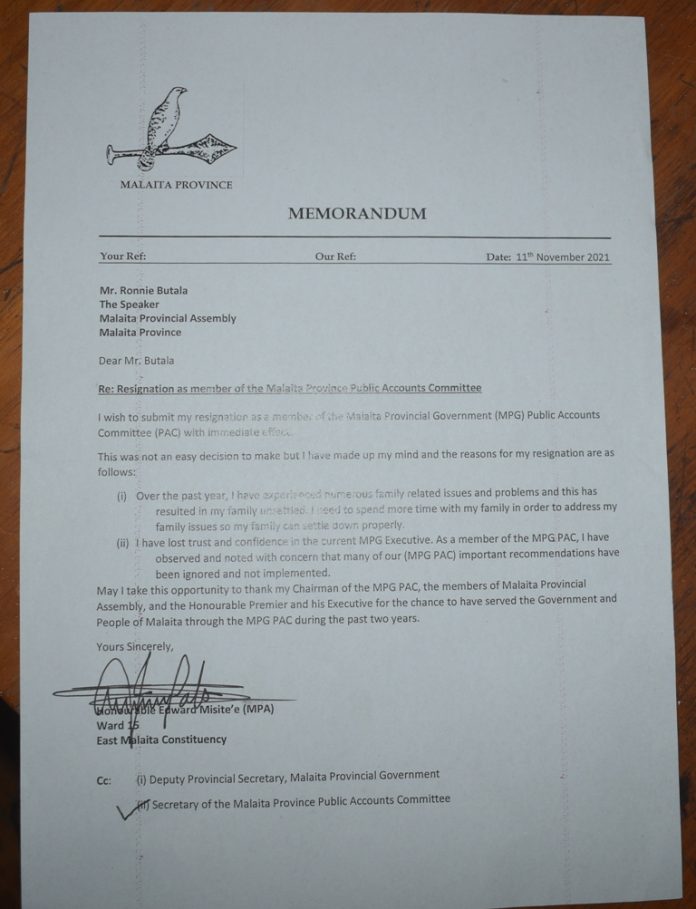
MALAITA Provincial Assembly is currently without its Public Accounts Committee (PAC) after the recent resignation of three of its members (MPAs).
The resignation left the committee with only its chairman after another three committee members joined the executive.
Clerk to Malaita provincial assembly, Matthew Maefai recently told Island Sun as the assembly is preparing for its revise budget meeting, the PAC plays an important role in the budget proceeding and without them the budget won’t pass.
He said what the province needs is an urgent appointment of new members into the PAC to allow the progress of the budget to be passed for the delivery of services in the province.
Maefai said the three resigned members did so on the grounds of: family commitment, health, their insecurity and loss of trust in the executive government.
He said the members are MPA for ward 20 Jimmy Rerehe, MPA for 14 David Solo Baerara and MPA for ward 15 Edward Misite’e.
Maefai said the other three members who left PAC and joined the government are MPA for ward nine Eric Daoni Dauafa, MPA for ward six David Osuria and MPA for ward 19 Meshack Maukera.
He said the departure of these six MPAs from the PAC has left only its chairman, MPA for ward three Martin Fini.
Maefai said with only Fini, he won’t perform the role of the PAC as it needs the appointment of six new ordinary MPAs into the PAC.
He said the matter has become a concern to the office and the office of the speaker and it needs to be addressed so that it won’t hamper the budget.
Maefai said the executive has already completed the budget meeting and by now the PAC should have been looking into the budget.
He added as of Monday this week his office and the office of the speaker are yet to receive appointment of new members (MPAs) into the committee (PAC).
SEVENTY-three-year-old Gideon Luaboe says he is ready to offer the underground water source on his area at Malakerava for any water development in Gizo.
In an interview with Island Sun Gizo, he said the water source on his area never goes dry and is a potential water source that would supply water to parts of Gizo.
Luaboe’s area is at Malakerava 3 and most business houses have been visiting his area to collect water when water shortage strikes Gizo.
“It is an underground water and in the past 30 years I lived in Gizo, the water never went dry. If the government is serious about our water issue, build a huge reservoir, connect to storage tanks and supply water to eastern part of Gizo.
“Similar development should be made for central Gizo and west Gizo,” he said.
Luaboe said there are lots of underground water source within Gizo vicinity that would make such development possible.
He stressed that Gizo water issue is a result of leaders’ lack of commitment for the welfare of people living and working in Gizo.
“I made a proposal to a group called Gizo Water Supply in the 90s but they just ignore the proposal. I don’t know what forced the group to ignore the proposal given the need of proper water supply in Gizo.
“I see this issue has no political support and this must change,” Luaboe said.