Home Blog Page 701

MEDIA CONTROL?

Gov’t takeover of SIBC questioned

By EDDIE OSIFELO

CABINET decision to omit Solomon Islands Broadcasting Corporation (SIBC) as a State-Owned Enterprises (SOE) has raised more questions than answers.

The Government claimed SIBC has not been making any profits as required under the SOE Act 2007.

As such, the Government will now fully finance SIBC operation to broadcast information and education services to the communities around the country that have access to its AM frequency 1035 kHz and Wantok FM 96.3.

SIBC also operates Radio Happy Lagoon in Gizo, Western Province.

However, its Radio Temotu in Lata in the Temotu Province is currently not broadcasting.

Former Chairman of SIBC Board from 2018-2019, Robert Iroga said it is quite interesting to see Government taking this decision because SIBC has been making profits.

Iroga said under his leadership, SIBC had made $2 million profit.

“Maybe Government is blaming the situation on Covid-19?

“However, I am not aware if SIBC is in its bad state,” he said.

Iroga blamed the Government for not living up to its commitment on providing its subvention quickly to allow SIBC to meet is Community Service Obligation (CSO).

He said sometimes SIBC got its subvention very late.

Furthermore, Iroga said SIBC is also facing competition from other media organisations to get advertisements from Government because it is not a monopoly like Solomon Airlines and others.

He hopes the Government has a good intention to omit SIBC as an SOE otherwise it can be seen as a way of controlling the media.

Acting Chairman of the SIBC Board, Dr William Parairato said they will meet soon to discuss the government decision.

However, Parairato said SIBC has been performing well regardless of the challenges faced by any other organisation during the Covid 19 pandemic.

He said SIBC Board has a mitigation strategy in place to address the challenges.

Further to that, he said Government also supported SIBC on its CSO to allow SIBC to reach out to certain areas that are unviable to access the information and news.

Former Press Secretary to Prime Minister, Douglas Marau, said during his time at Office of Prime Minister the SIBC General Manager was summoned twice by PMO.

He said the reason being that SIBC has not given much publicity to the government of the day as expected.

“Sadly, I do not blame SIBC.

“Whilst I understand that the PM is the minister responsible for SIBC, the move to omit SIBC has only confirmed plans by PMO to take control of the national broadcaster,” he said.

Marau, now the press secretary of the Leader of Opposition, said taking control of the national broadcaster for political propaganda and launching a new government newspaper was the plan.

“In fact, I was tasked to head the proposed government newspaper.

“I submitted and presented the proposed newspaper to the PM before I left,” he said.

“The idea of having a government newspaper, radio or TV is in fact a good idea that myself and Director GCU George Herming personally involved in since PM Hou’s term.

“But the intention is not to punish the media industry and to put them on the back foot.

“However, it is likely a government newspaper would see a major cutback in government adverts in our daily newspapers,” Marau said.

“Our newspapers survive on adverts and not street sales and the government provides 70% revenue through adverts to our papers.

“Hope this will not be the case,” he stated.

President of Media Association of Solomon Islands, Georgina Kekea said MASI is concerned on the decision taken by the Government that can be seen as controlling freedom of press.

She said as the Government of the day, it should provide conducive environment for businesses to prosper and not to compete like running a radio, newspaper or TV.

However, Special Secretary to the Prime Minister, Albert Kabui explained that SIBC remains the national broadcaster as provided for under the Broadcasting Act.

In this case, Kabui explained that SIBC has not been viable and has always been seeking government for financial assistance.

By omitting SIBC from the SOE Act, the national broadcaster will now be fully funded by the government with the expectation of it to focus on providing public service to the country rather than profit making.

It is likely SIBC will also cut down its staff in the sales and marketing because the Government will pay their salaries and all staff in the departments.

Currently, the SOEs remaining are:

  1. Commodity Export Marketing Authority (CEMA)
  2. Investment Corporation Solomon Islands (ICSI)
  3. Solomon Airlines.
  4. Solomon Islands Ports Authority (SIPA)
  5. Solomon Islands Postal Corporation (SIPC)
  6. Solomon Islands Water Authority (SIWA)

SIBC was established by an Act of Parliament – The Broadcasting Ordinance 1976.

Solomon Islands happy to host proposed Tropical Research Ocean Centre.

0
Prime Minister Sogavare and Prime Minister Bainimarama pose for a photo with Solomon Islands delegates to the 51th PIFLM

BY BEN BILUA
Suva, Fiji

SOLOMON Islands has expressed its interest to host the Region’s proposed World Class Tropical Research Ocean Centre.

Prime Minister Manasseh Sogavare made the announcement during the signing of Maritime Agreement between Solomon Islands and Fiji.

Sogavare says Solomon Islands is willing to allocate land and offer support towards the construction of the research centre.

 He adds that Solomon Islands is with other Pacific Island countries in the fight to combat issues that threatens the Blue Pacific.

“The Pacific region is in shaping the international convention as we celebrate the 51th anniversary of the Pacific Islands Forum.

“Global work to combat climate change, and keep our ocean vibrant and healthy is not only our duty, but calling as well.

“Moving the tuna away from our wards will need leaders to come together to develop a sustainable ocean economy, exploring farmed of Maritime culture products, Solomon Islands supports the call for a regional world class Tropical Research ocean centre and Solomon registered its interest to host the Centre,” Sogavare says.

Sogavare describes Maritime Agreement as historic achievement.

0
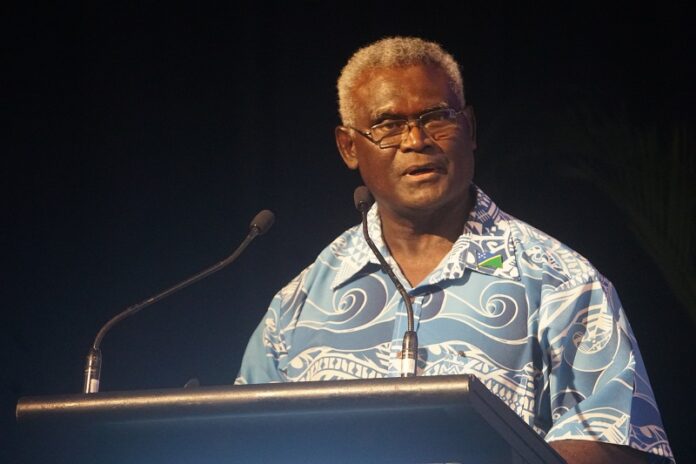
Prime Minister Sogavare during the recent PIF meeting

BY BEN BILUA
Suva, Fiji

PRIME Minister Manasseh Sogavare has described the Maritime Agreement between Solomon Islands and Fiji as a historical achievement.

In his speech during the signing of the agreement, Sogavare says the agreement displayed commitments of Fiji and Solomon Islands to the 1982 United Nations Convention on the Law of the Sea which Fiji and Solomon Islands are both party to the convention.

He says the letter of Exchange complements efforts on preserving both countries maritime boundary while the region continues to work to conclude a uniquely binding biodiversity beyond areas of national jurisdiction framework.

“Today (Monday), signing of Solomon Islands Fiji maritime boundary agreement is a celebration of the rolling out of the ocean chapter as we have on the 2050 strategies as we continue to invest in the sovereignty and sovereign rights of our people over maritime zones.

“It is indeed a momentous day for Solomon Islands as the region embrace our people’s connection to the ocean. As big ocean states, the blue pacific makes up a combined exclusive economic zone of more than 41 million square kilometres.

“I’m deeply appreciative of the fact that we have arrived at this historic moment, owing to the tremendous dedication and spirited efforts of our senior officials of both Fiji and Solomon Islands in ensuring that we finalize and conclude our shared maritime boundary.

“Equally important is the unwavering support and assistance of the South Pacific Commission and the consortium partners to the whole process,” Prime Minister Sogavare says.

He says Solomon Islands have five shared overlapping maritime boundaries with Pacific neighbours – This is includes; Australia, family Papua New Guinea, France, Vanuatu and now with Fiji.

Prime Minister Sogavare says the letters exchanged with Prime Minister of Fiji will ensure the agreement is consistent with the intention of all Pacific Island Forum members to maintain respective maritime zones in the face of climate change related sea level rise, which is set out in the Declaration on preserving maritime zones that was committed to in August last year.

He says Solomon Islands is committed to the agreement and will work alongside Fiji in making sure the treaty is ratified and enter into force in the near future.

Prime Minister Sogavare acknowledges Prime Minister of Fiji, Frank Bainimarama and the people of Fiji for the important achievement.

Prime Minister Bainimarama says the agreement is an important milestone to demarcate both countries reason for shared benefits going forward.

He says the agreement sets a foundation of the great blue Pacific wall to sustainably managed ocean space.

“Today (Tuesday) marks a promising step for a brighter and promising future for Fiji and the Solomon Islands.

“My friend, Hon Sogavare and I have signed maritime boundary delimitation agreement establishing our country’s respective maritime zone in accordance with the principles of the United Nations Convention of the law of the sea, mapping ocean boundaries is a determinative challenge for us, large ocean state in the Pacific implementing regional Ocean Solutions depends on such agreements.

“I am hopeful that the finalization of this agreement today will set the momentum for the finalisation of agreement with Tonga and the other level of many maritime boundary agreements in the region,” Bainimarama says.

Inside the Fiji-Solomon Islands maritime boundary agreement

0
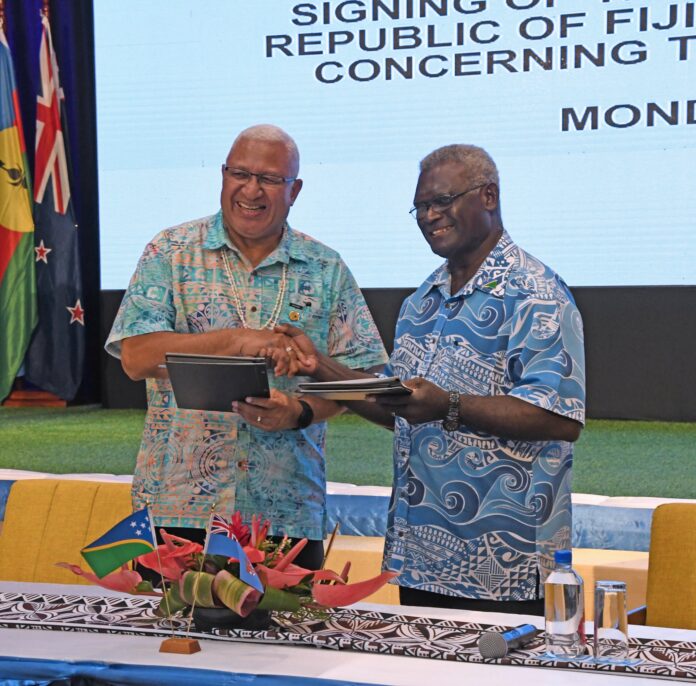
PM Bainimarama and PM Sogavare after the Agreement Signing

The signing of the historic Solomon Islands-Fiji Maritime Boundaries Delimitation Agreement in Suva yesterday by Prime Ministers Manasseh Sogavare and Frank Bainimarama now establishes the two countries’ respective maritime zones in accordance with the principles of the United Nations Convention on the Law of the Sea.

The event marks a promising step towards a brighter and bluer future for Fiji and the Solomon Islands to demarcate their shared maritime boundaries.

Ongoing negotiations and bilateral discussions between officials from the two countries led to this signing with technical support provided by the Pacific Community (SPC) under the Pacific Maritime Boundaries Project and with assistance from Development Partners (the Consortium).

The Agreement sets out the intersecting maritime boundaries of Fiji and the Solomon Islands in accordance with the United Nations Convention on the Law of the Sea (UNCLOS) which both countries are a party to.

As Large Ocean States, the finalization of this Agreement will ensure that both Pacific Island countries’ maritime boundaries are clearly defined and that their rights and obligations under UNCLOS are properly established.

Through this Maritime Boundary Agreement, both Leaders have also declared the permanence of their country’s respective maritime zones, irrespective of climate change-related sea-level rise and its potential impact on maritime boundaries. This aligns with the Pacific Island Leaders’ Declaration on Preserving Maritime Zones in the Face of Climate Change-related Sea-Level Rise (‘Declaration’) that was issued in August 2021.

Prime Minister Sogavare said that the Agreement is a celebration of the chapter on oceans in the 2050 Blue Pacific Strategy.

“This is a historic moment which signifies Solomon Islands’ commitment to the UNCLOS and I thank Prime Minister Bainimarama for creating space for this signing,” he added.

The signing of this Agreement highlights the long history of engagement and diplomatic relations that Fiji has had with the Solomon Islands and paves the way for future cooperation.

There are 48 shared or overlapping boundaries between countries in the Pacific Islands region. 35 of these boundaries have been formalized through an Agreement, and there are 13 outstanding bilateral and five high seas boundaries remaining to be declared.

The signing of this Agreement brings the number of outstanding Agreements to 12.

ENDS///

Bilateral talks line-up for Solomon Islands delegates

0
Prime Minister Sogavare, Minister of Foreign Affairs Jeremiah Manele and Solomon Island High Commissioner to Fiji met with Secretary General of Pacific Island Forum Secretariat on Monday

BY BEN BILUA
Suva, Fiji

SOLOMON Islands delegates to the Pacific Islands Forum Leaders Meeting has a long line of bilateral talks beginning today.

Prime Minister Manasseh Sogavare will meet with the Korean Delegation today to discuss matters that would bolster both countries bilateral relations.

Australia, New Zealand and New Caledonia are up next for bilateral talks.

Source familiar with the arrangements says, Sogavare will meet with leaders of Australia, New Zealand and New Caledonia tomorrow (Wednesday).

The source says there are other countries who are showing interest to hold bilateral talks with Prime Minister Sogavare.

“We are still trying to find a free time to slot in bilateral talk session between Sogavare and the Palau delegates,” the source adds.

According to the source, these bilateral talks are very important for Solomon Islands going forward in terms of development aspirations and also close economic collaborate as countries move towards the post-covid error.

On the ground in Suva, Prime Minister Sogavare has been a most wanted person to talk to since Monday.

International journalists were trying to get hold of Prime Minister Sogavare last night who has had a very busy schedule representing Solomon Islands in the regional leader meetings.

PM pays tribute to Oversight Committee

0
Members of the Oversight Committee recently. Photo PETER ZOLEVEKE II

BY MAVIS N PODOKOLO

PRIME Minister Manasseh Sogavare has paid tribute to the vigilance of the Oversight Committee who have put together efforts to prevent, contain and control COVID-19 in the country.

“I pay tribute to the vigilance of the Oversight Committee who for almost three years oversaw the development and implementation of our strategy to prevent, contain and control COVID-19 in our country,” Sogavare said in his nation-wide address last week.

“As we have finally re-opened our international borders, I thank all the front liners and their families for the huge sacrifices you have made over the past three years to protect our country and our people from COVID-19, in particular our staff from the Ministry of Health and Medical Services; Ministry of Police, National security and Correctional Services; Immigration, Customs and Bio-security,” the prime minister added.

He also thanked all other government ministries that became part of our collective defence against COVID-19 during the pandemic.

“I also take this opportunity to thank the Provincial Premiers and your staff and the Lord Mayor of the Honiara City Council and your staff for working with the national government to control the COVID-19 pandemic. Thank you for leading the vaccination efforts in your respective province.

“I also thank the members of our churches, the business community, and the general public that have assisted the government in our fight against COVID-19.

“It is our collective effort that has allowed the government to fully re-open our borders 6 days ago on 1st July 2022,” Sogavare said.

21,237 infected by covid-19

0
Corona

BY MAVIS N PODOKOLO 

UP to 21,237 people were infected by the COVID-19 virus.

However, Prime Minister Manasseh Sogavare said authorities were able to manage the cases successfully.

“We have successfully managed the COVID-19 pandemic in our country,” he said in his independence speech last week.

“About 153 people lost their lives to COVID-19. Our vaccination rate had been slow,” he added.

The country reopened its international borders on July 1.

Sogavare said about 50 percent of the eligible population are now fully vaccinated.

He added it is government’s policy that all eligible person must still be vaccinated.

“We encourage all eligible persons including children between 12 to 17 years of age to get vaccinated,” he said.

Bleak outlook ahead for country: CBSI

Honiara is the beating heart of the country's economy.

By EDDIE OSIFELO

SOLOMON Islands economic outlook for 2022 points to an even weaker prospect, with myriad of challenges in front of us, both from the external and domestic fronts.

This came about following the COVID 19 pandemic and November riots last year.

Central Bank of Solomon Islands (CBSI) Governor, Dr Luke Forau projected this when he presented the 2021 Annual Report of CBSI in this medium last week.

The theme for my statement is “Navigating the way to recovery and strengthening resilience to mitigate future shocks”.

He said the adverse impacts will continue to linger and take its toll on our economy.

In terms of growth, Dr Luke said the Solomon Islands economy was initially projected to decline by 7.3% in 2022, on the back of sluggish economic activity and on-going COVID-19 containment measures with declines expected across all sectors of the economy.

“This economic fallout was expected to bottom out over the medium term with some moderate rebound expected to start in 2024.

“However, with containment measures now fully eased as of 1st July this year and international border restrictions lifted, the economy is now expected to recover earlier than anticipated,” he said.

Dr Luke said under these conditions, Gross Domestic Product (GDP) growth has been revised upwards and is expected to contract by 4.3% in 2022 (i.e., a 3-percentage points upward revision) and to rebound by 1.9% in 2023.

He said this is better than expected six months ago.

“All sectors, except for logging, are expected to recover in 2023,” he said.

Further to that, Dr Luke said risks to these forecasts however remain, and these include:

  1. resurgence in COVID19 cases that would lead to reinstatement of restrictions in economic activities;
  2. natural and man-made disasters, and the prolong Russian-Ukraine war.

He said all these would reduce GDP.

In terms of inflation, Dr Luke said following the surge in imported inflation in April 2022, inflation is expected to rise to around 3-4% by end of 2022, driven by surging global fuel prices due to the Russian-Ukraine war.

He said core Inflation is expected to rise to 4.7% on account of the passthrough effect of high fuel prices.

On the external front, Dr Luke said the current account deficit is estimated to increase to 10% of GDP in 2022 and 13% of GDP over the medium term.

“This stems mainly from the reopening of the economy and expected higher imports from construction activities of key national projects.

“This is expected to lead to a slight fall in reserves, however, expected strong donor support will keep reserves at comfortable levels over the near-term,” he said.

Furthermore, Dr Luke said fiscal pressures are expected to remain elevated in the near and over the medium term owing to weak revenue from declining logging activities while pressure on spending remains high.

“Consequently, the fiscal deficit is estimated to widen to 9% of GDP in 2022, leading to eroding of fiscal buffers and rapid increase in government borrowing,” he said.

Moreover, Dr Luke said partial employment indicators (Solomon Islands National Provident Fund (SINPF) contributions and Pay As You Earn (PAYE) showed partial signs of recovery from the pandemic in March 2022.

“While employment outlook is unavailable, it is expected that the labour market would move in line with economic activity over the near term,” he said.

CBSI reports $62m loss

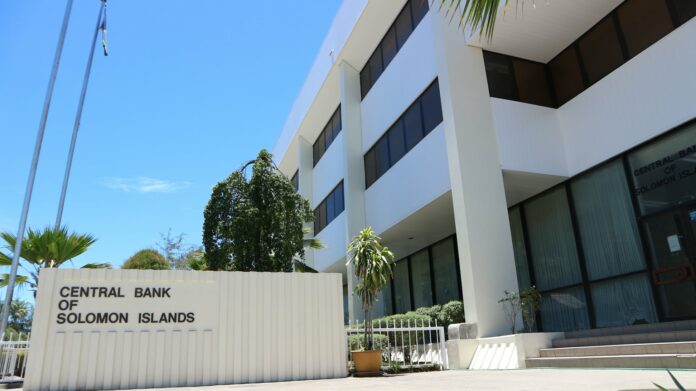
The Central Bank of Solomon Islands

By EDDIE OSIFELO

CENTRAL Bank of Solomon Islands reported a net loss of $62.7 million at the end of last year.

This stemmed from weak investment returns overseas and unfavourable foreign currency revaluations.

CBSI Governor, Dr Luke Forau when presented the Banks’ 2021 Annual Report in this medium last week, said of the $62.7 million loss, $15.5 million was realized (operational) losses and $47 million was due to unrealized foreign currency revaluation.

He said the Bank’s net equity however, remained firm at $308 million.

“Despite the loss, the Bank continued to operate and managed its resources prudently, thereby achieving its mandate.

“Moreover, the Central Bank managed to cushion the economy from worst adversities in the toughest of times,” he said.

“This, of course, was done with the strategic oversight role played by the Board, which I commend them sincerely.

“With the full board comprising nine directors, they were able to provide strategic direction to the organization,” he said.

Furthermore, in terms of staffing, Dr Luke said there was no change to the Bank’s staff complement.

He said the total number of staff complement remained unchanged at 157, as was in 2020.

“Of the 157 staff, 61% were male and 39% female.

“The Bank continues to invest in training and upskilling of its work force despite COVID-19 setbacks,” he said.

Dr Luke said a total of 20 officers were engaged in full and part-time trainings, of which 9 officers successfully completed their tertiary qualifications.

Moreover, Dr Luke said with respect to financial stability, the overall financial system remains stable and sound amidst weak economic conditions and COVID-19 induced disruptions in 2021.

He said the Central Bank relaxed prudential guidelines 2 and 8 during the year to allow financial institutions to provide loan reliefs to borrowers.

Furthermore, CBSI granted a full banking license to Solomon Finance Limited (SFL) in December 2021 to operate banking services as a credit institution.

Dr Luke said in the financial inclusion space, the Bank and its stakeholders launched the third National Financial Inclusion Strategy for Solomon Islands (NFIS3) 2022-2025 in 2021.

The strategy provides a roadmap of key strategic objectives of financial inclusion policies and activities for the next 3 years.

CBSI: November riots push back economic growth

0
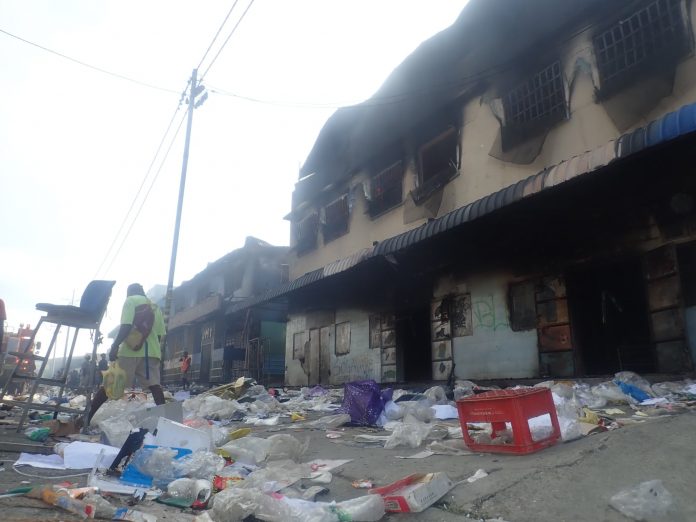
Part of the burnt-out China town from the recent riots. Photo supplied.

By EDDIE OSIFELO

THE November riots in 2021 has pushed the economy into recession with a negative 0.6% growth at the end of 2021.

This after the economy was on its way for recovery in 2021, although at a slower pace, following the depressed condition in 2020.

Central Bank of Solomon Islands (CBSI) Governor, Dr Luke Forau stated this when presented the 2021 Annual Report of the Central Bank of Solomon Islands in this medium last week.

The theme for my statement is “Navigating the way to recovery and strengthening resilience to mitigate future shocks”.

Dr Luke said the decline stemmed from declines across all sectors of the economy, with the exception of fish and copra.

He said the current account position worsened further, driven by the increase in imports relative to the slowdown in exports.

“The fall in primary income surplus during the year also contributed,” he said.

However, Dr Luke said despite the worsening external position, gross foreign reserves for the country grew, reaching 14.2 months of import cover.

He said this is well above the minimum target of six months.

“The increase in foreign reserves came mainly from donor funds and SIG revenue from fishing license,” he added.

Furthermore, in terms of government operations, Dr Luke said the fiscal deficit position stood at 5% of GDP in 2021, owing to the adverse impacts of the COVID-19 pandemic and the November riot.

He said the government debt stock increased to 15% of GDP by the end of the year, owing to COVID related borrowings.

Further to that, he said labour market conditions remained subdued in 2021 in line with sluggish activities.

Furthermore, Dr Luke said partial employment indicators from Solomon Islands National Provident Fund’s (SINPF) showed a decline by 3% to 55,573 contributors in 2021 from 57,028 contributors in 2020.

He said public service positions declined by 38% both for filled and unfilled positions due to the on-going freeze in recruitment.

Moreover, the consumer prices rallied to positive trajectory in 2021, following muted prices in 2020.

Headline inflation reached 2.5% in December due to the surge in food and fuel prices in the second half of last year.

Core inflation increased to 1.2% from -1.5% in 2020.

Dr Luke said the the pick-up in core inflation indicated broad increases in the prices of broad items in the Consumer Price Index (CPI) basket during the year.

He said recent headline inflation for April 2022 eased to minus 0.8% from minus 0.6% in March.

“Falling consumer prices in the domestic component of inflation contributed to this deflation.

“Domestic inflation fell to minus 4.2% from minus 3.2%, owing to price falls in betel-nut and tobacco,” he said.

Further to that, Dr Luke said imported inflation, however, rose to 8% from 6% in March attributable to high global fuel price as a result of the Russian-Ukraine war and its passthrough effects on transport, food and non-alcoholic beverages, housing, water and utilities categories.

“Core inflation increased to 3.3% from 2.8% reflecting broad price increases in April 2022,” he said.