When it comes to business, specifically using energy or electricity, we are dictated by what the world does says Qila Tuhanuku, from (Solomon Islands Chamber of Commerce) SICCI-Manufacturing Industry Working Group (MIWG).
She expressed the sentiment at last week’s Panel Discussion on “Pathways towards better electric power availability, affordability, and sustainability” held by UNDP and Ministry of Mines at Heritage Park Hotel.
“The simple fact is, when it comes to the business side, we are dictated by what the world does. Our infrastructure, our equipment, the way we work, the technology we use is determined by the world,” Tuhanuku said.
She said that this is usually by the likes of countries like US, China, Germany and European countries.
Tuhanuku said these countries set the pace in terms of technology we have to use in order to produce the application.
“And of course, the backbone for all of it is electricity, or energy in this case,” she added.
Tuhanuku said looking at this scene and taking it back to our respective workplaces, she would say easily 100% of what we need to run our operation every day relies on electricity.
She said if we were to switch it off, 100% of jobs or tasks would sit and although we can deploy people to do other things manually, it’s not what they were hired to do.
“I would safely say that 80% of staff will basically have to go home. 10% are engaged in the very little more labour tasks,” she said.
Speaking on behalf of SICCI, Tuhanuku said this is the first critical thing that she always tries to put forward so that people understand where it is they speak from when they talk about the need to address energy and solar panels.
While there are a lot of areas to address when it comes to the topic of electricity, the biggest one is how costly it is.
Qila Tuhanuku, representing the SICCI-Manufacturing Industry Working Group (MIWG) voiced this at a recent Panel Discussion on “Pathways towards better electric power availability, affordability, and sustainability” organised by UNDP and Ministry of Mines last week at Heritage Park Hotel.
She said they are happy to hear that we have come down by $2, but if the global average is sitting around $0.20 USD, which is 2 Solomon dollars, it already means our products are $0.40 more expensive than imports, even before they land on our shores.
“So, it means that if you’re a local manufacturer, you do local services, you cannot compete,” she said.
Tuhanuku stressed that electricity is also tied to every other type of services we engage in.
“So, imagine an ecosystem. We go to the bank, telecom, even our water is pumped by electricity,” she said.
Tuhanuku pointed out that aside from the raw products and what we manufacture, one of the big backbones is electricity.
She said everything is imported so the supply chain for us is important and for distribution into provinces, electricity is a key factor.
In this regard, Tuhanuku emphasised that provinces will not scale up unless they have power there.
Moreover, she pointed out that the private sector recognises that their role is not to determine the legislation or to make policies.
“It is not for us alone to take what the tariff should be, but we also say that we are very much a key partner in that conversation and helping shape those decisions.
“Our job is we deal with the realities of the cost. And it is our job to inform government, to inform Solomon Powers and any other actors in this space,” Tuhanuku said.
She expressed that this is because what you want to conclude on in such discussions is what works for everybody and for utilities to run which is also expensive.
Tuhanuku said this is why them coming together as stakeholders is really critical.
A couple was arrested by Tulagi police for assaulting a 13-year-old girl with a bamboo stem at Toa village in Small Ngella, Central Islands Province on November 11, 2025.
A statement from the Royal Solomon Islands Police Force (RSIPF) on Monday this week, says Provincial Police Commander (PPC) for Central Province, Superintendent David Soakai, said the victim with her friends were heading back home after attending a church activity.
On their way home, they climbed a betel-nut tree and were suddenly attacked by the couple.
As stated, the couple using the bamboo stem whipped the victim and later grabbed the victim’s head and pushed her against the bottom of a Ngali nut tree.
The victim sustained wounds and body bruises and went to Vuturua clinic for medical attention.
PPC Soaki said the couple has been arrested and dealt with.
The wife as mentioned, was charged with one count of assault causing actual bodily harm, while the husband was charged with aiding contrary to section 21(c) of the penal code.
Tulagi police in Central Islands Province have arrested two suspects in their 20’s for throwing rocks at Siota Provincial Secondary School’s Principal’s house on November 8, 2025.
From Royal Solomon Islands Police Force’s (RSIPF) statement on Monday, November 17, 2025, Provincial Police Commander (PPC) for Central Province, Superintendent David Soakai, said it was alleged that the two suspects under the influence of liquor entered the school during lunch hour and committed the offence.
PCC Soaki also said that the suspects first entered the school kitchen in an aggressive manner, ate the student’s lunch without their permission before going to the principal’s house.
As mentioned by PCC Soaki, the third suspect in the incident escaped when police arrived and is still at large.
The suspects involved are said to be from a nearby village.
RSIPF said the two suspects have been dealt with accordingly, charged with two counts of criminal trespass and intimidation and were later released on bail and are set to appear in court on a later date.
Meanwhile, Tulagi police are working closely with the community for the arrest of the third suspect.
Police in Tulagi, Central Islands have arrested an adult male suspect for intimidating a 12-year-old girl at Vuturua village in Small Ngella, Central Province, on 11 November 2025.
In a statement from the Royal Solomon Islands Police Force on Monday, November 17, 2025, Provincial Police Commander (PPC) for Central Province, Superintendent David Soakai, said it was alleged that the suspect disagreed with the 12-year-old girl about the ownership of a cut nut tree, of which the victim should have asked him about before picking up nuts from the tree.
PPC Soaki said that while the victim was collecting nuts from the tree, the suspect walked to the victim with a bush knife and intimidated her.
“Superintendent Soakai said the victim screamed in fear, standing still with panic. Seeing the action done by the suspect, she cried. Luckily, the victim’s elder sister shouted at the suspect, and he walked away from the victim,” said RSIPF.
RSIPF said the suspect was arrested and dealt with and having been released on bail, he will appear before the court on a later date.
A project which could have been Solomon Islands first commercial rice farm in a long time is being delayed by dispute at the GPPOL area, east of Honiara.
Currently, much hype is over recent revelations by permanent secretary of the ministry of agriculture and livestock (MAL) Dr Samson Viulu at the Public Accounts Committee (PAC) this week about MAL’s trial rice projects in collaboration with Jiangsu Academy of Agricultural Sciences (JAAS), a leading research institution in China, that promises to produce full-scale rice farms in the near future.
Minister of MAL Franklyn D Wasi told Island Sun that the country could see commercial farms from this venture either in 2027 or 2028.
“We will need to conduct few trials at different sites to recommend the best variety.
“Depends on how fast to complete the cycles of planting at different sites but we wanted to make it fast. May be 2027 or 2028,” Mr Wasi said.
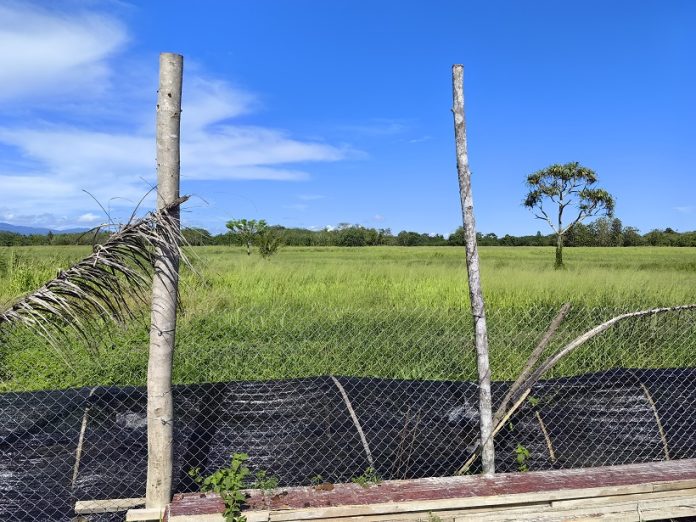
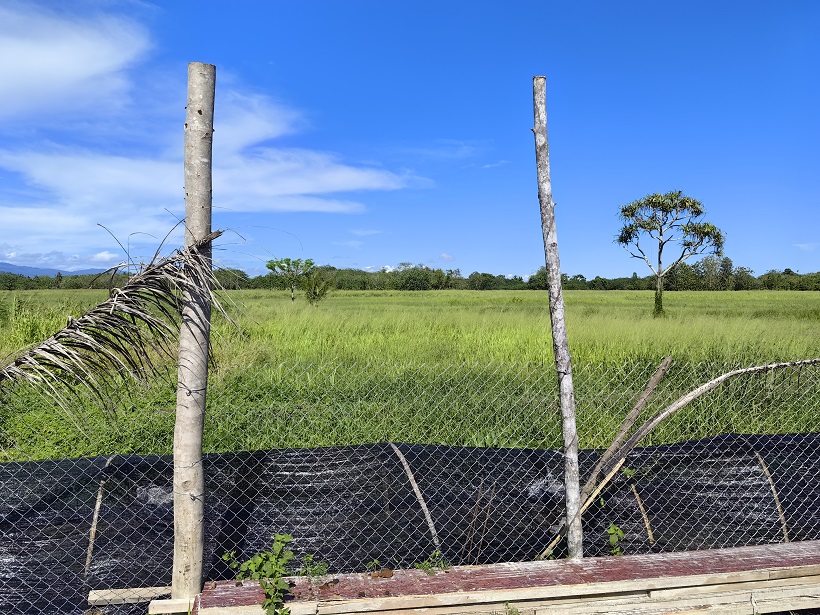
The rice field left untouched
The major rice project being delayed is in the GPPOL 2 area and is 172 hectares. This is much larger than the proposed rice farms by the MAL in both Malaita and Guadalcanal provinces, which are 21 and 10 hectares respectively.
The farm is a venture between landowners and the company, the South Pacific Economy and Technology Development Co. Ltd (SPETDC). The perpetual title to the land is held by Samuel Kuri, the sole surviving trustee to the said land, and SPETDC leased the land from Mr Kuri.
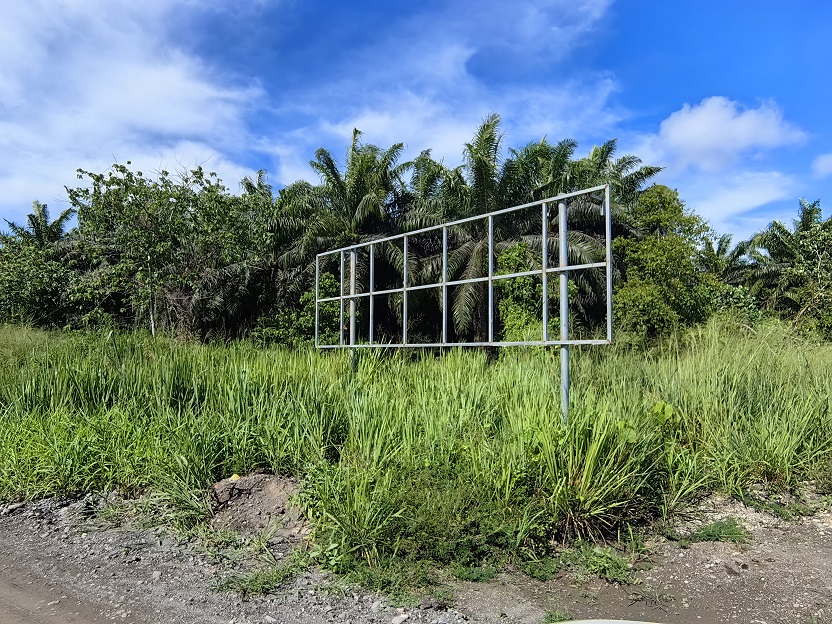
The frame of the project’s signboard remains without the board
A trial rice farm project was piloted two years ago in another area in GPPOL 1 area, where soil testing showed that the soil was ideal for three varieties of rice to grow well there. Customised fertiliser was also created to suit the soil to boost rice growth.
Landowners told Island Sun that the rice grown from this trial project tasted delicious and fresh, much different from the stale rice which are being imported and bought from the shops around the country.
“The rice when cooked (the normal way) tastes just like it was cooked with coconut milk, although no coconut milk was added,” one landowner said.
From the successful results of the test farm at GPPOL 2, the farm at GPPOL 1 was established. All legal and cultural channels were satisfied, and on July 7 this year the company started to clear the farm.
There was much jubilation in the air as landowners looked forward to being part of Solomon Islands’ biggest and first commercial rice farm in a long time.
“We were elated to be part of this rice farm, and when the company began operating the farm on July 7 we all said it was a dream come true for us because we wanted a rice farm on that land which would feed us and the whole country,” Mr Kuri told Island Sun in an interview at his home a few kilometres from the farm.
But the jubilation was short-lived. On August 12, 2025, a disgruntled settler, Desmond Nimepo secured an injunction from the courts to halt the project.
Mr Nimepo reportedly had also wanted to be in on the deal between the company and the landowners in the rice project, but was not considered since he was not a landowner but a settler who was allowed to settle on a piece of land by the rice farm.
Landowner Kuri told Island Sun he had allowed Nimepo to settle there few years earlier. Kuri adds that Nimepo had failed to complete cultural processes to settle there.
Kuri laments the possibility of seeing his dream slip away as the company endures losses due to the injunction and the increasing prospects of the commercial rice farm joining the list of many other failed undertakings in Solomon Islands’ history.
Nimepo has not responded to Island Sun’s attempts to contact him via mobile phone and text for comments.
Guadalcanal supports such investments
Speaking to Island Sun earlier this month, Premier of Guadalcanal Willie Atu said that his government supports such developments in the province.
“We are willing to give the company another land to carry out rice farming, a hundred hectares. Because we see the potential of this project especially to counter the import of rice,” Mr Atu said.
“The company can’t be sitting around here with $44 million worth of rice seeds and machineries and everything waiting for April next year when the case go to the courts, so pending the court we were giving the company a counter offer with the land title belonging to the province,” Premier Atu said.
Loss of business
The SPETDC since having been forced to halt operations has reportedly endured around $50,000 loss of business per day.
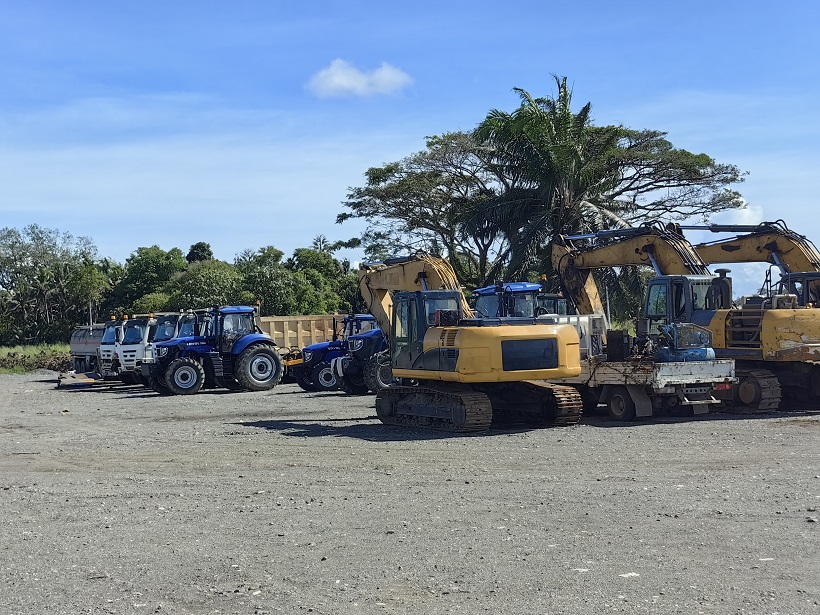
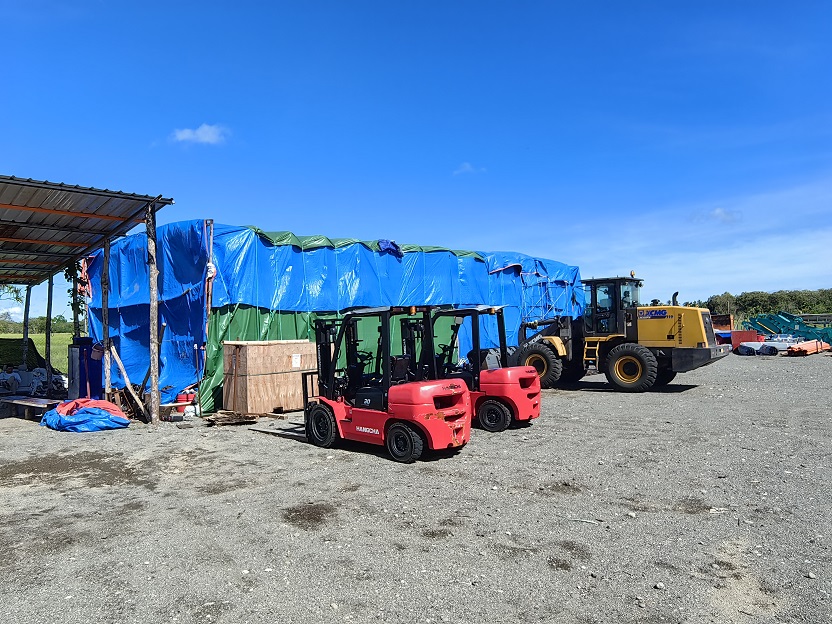
Machineries for the rice project sitting idle
Speaking to Island Sun, a company spokesperson said their machineries are sitting idle and are depreciating, rice seeds are being stored at expensive electricity costs. But, despite this, the seeds are bound to go bad.
Temporary storage huts covered with canvas
“We had brought in 11 metric tonnes of seed to kick start the project. But these are in danger of going bad. The seeds have a half-year lifetime,” the spokesperson said.
The company said it is doing everything it can to abide by the country’s laws, but feels sad that a genuine investment which would help the landowners, Guadalcanal province and the country is being let down.
“Our company came to the Solomon Islands with a clear and positive mission: to partner with local landowners to bring back rice cultivation, a vital step towards ensuring food security for the nation. After years of successful trials at our GPPOL 2 demonstration field, proving that at least three rice varieties can thrive here, we were ready to move to large-scale farming,” a company statement said.
“We entered into a legal and willing lease agreement with Mr. Samuel Kuri, the rightful and sole surviving trustee for the land parcels in Guadalcanal. Our shared goal was simple: to see the land flourish once again, to provide jobs, and to put local rice back on the tables of Solomon Islands families.”
The Ministry of Agriculture and Livestock (MAL) is looking to kick off their coconut replanting program next year, says Samson Viulu, MAL Permanent Secretary.
Appearing before the Public Accounts Hearing (PAC) yesterday for hearing of the 2026 National Budget (Appropriation Bill 2026), Viulu spoke about what the ministry’s doing in terms of their programs for the local commodity.
He said if they are to receive the budget for the above initiative, they will use it to start the program next year.
Viulu also said through other donor funded projects such as one with the World Bank, they are being assisted to replant coconuts.
He highlighted that next year, their target is to establish an additional new 1000 hectares for coconut and then around 300 hectares for cocoa.
“That is the direct intervention from the government through the ministry,” he said.
Viulu also mentioned that in terms of value-added downstream processing, so far, they have 4,000 metric tonne of coconut oil and have exported coconut oil in January up to October this year.
He added that while the production for coconut oil remains steady, for copra there’s a huge jump.
Member of Parliament for Small Malaita and PAC Chairman, Rick Hou asked Viulu how they can help farmers to be steady in production of the commodity; noting that commodity products fluctuate all the time.
In his response, Viulu said they are focusing on providing tools and equipment for trials.
To top that off, he mentioned that they are also working closely on a new programme with Australia’s DFAT (Department of Foreign Affairs and Trade).
Viulu said under the new programme, SICRAD (Solomon Islands Climate Resilient Agriculture Development Program), they will be building several storage sheds, in selected ports of call in every province to help act as buying centres for rural buyers in the provinces.
Moreover, he stated that hopefully when this commences and having some price stability programme, he thinks it should sit the Ministry of Commerce.
“So, we will discuss with Commerce and probably CBSI to help us with this, so that price is maintained,” Viulu said.
He voiced that apart from price, they will also have to continue to strengthen the rehabilitation and replanting of new plantations.
WESTERN Province Council of Women has elected a new executive following the successful hosting of their Annual General Meeting yesterday.
Commissioner of Oath, Charles Kelly, also the clerk of Gizo Town Council was engaged to facilitate the election.
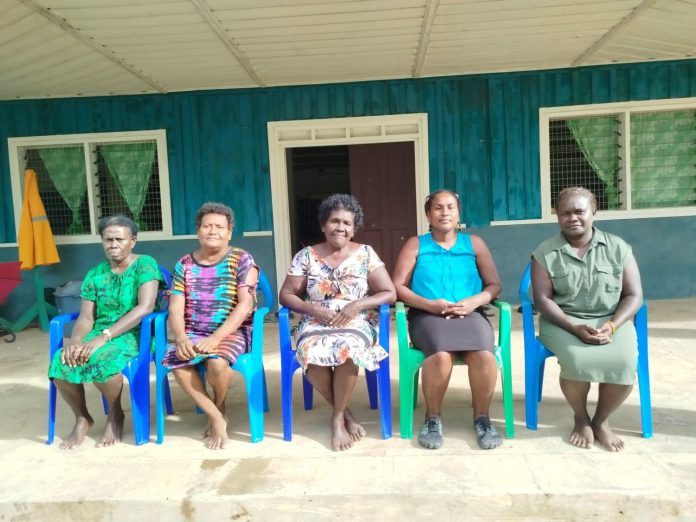
The new WPCW Executives are; Hellen Willie (President), Ripua Mazini (Vice President), Lily Loe (Secretary), Merilyn Roy Vana (Vice Secretary), Greenter George (Treasurer).
Delivering her farewell speech, outgoing President, Rendy Solomon congratulates the new executive for accepting the responsibility.
She also acknowledged the members who voted the new executive into office.
Solomon asked the new executive to give the former, three months to prepare all the needed documents before proper handing over commences.
She said the task will be challenging but can be navigated to better outcomes and positive steps to grow the council.
“Take the challenges as motivation and move forward. I pray God will guide you. Take the challenges for the betterment of our province,” Solomon said.
She also acknowledged the members for supporting the outgoing executive for the past 18 years.
Solomon said the outgoing executive stands ready to support the new executive.
In her maiden speech, President elect, Hellen Willie said the outgoing executive has raised the bar in terms of achievements and leadership.
“I will never be like Rendy Solomon. But I will learn from her, follow her footstep and get her advice,” she said.
Willie said the task will not be easy but she looks forward to any challenges that come her way.
She said she is confident with the new executive and together with the help of the old executive, more achievements can be made.
“There will be no one man decision. There will always be a united decision,” Willie said.
“Nothing is impossible with God. Everything is possible with God,” she added.
THE Western Province Council of Women have successfully concluded its long-awaited Annual General Meeting (AGM) yesterday in Gizo, bringing together women leaders from across the province for the first time in several years.
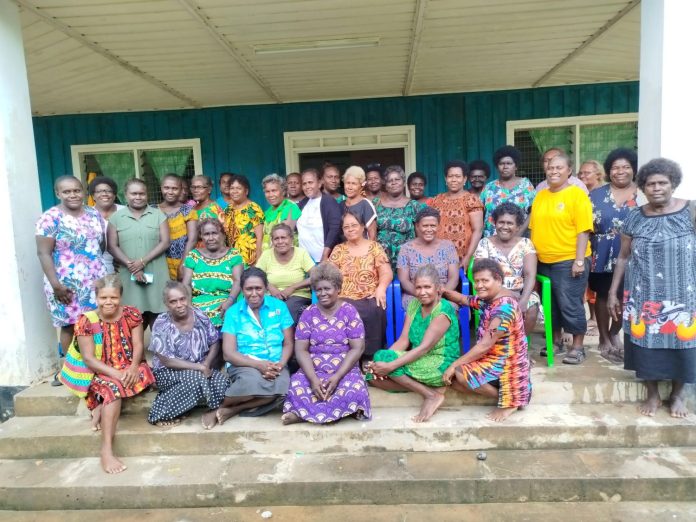
Ward presidents and vice presidents representing all 21 wards attended the meeting, signalling what leaders described as a strong commitment by women to advance national and provincial policies at the community level.
In her welcome remarks, Caretaker President, Rendy Solomon thanked the participants for sacrificing time away from their families to attend the AGM. She said the turnout shows the determination of Western Province women to support development initiatives despite ongoing challenges.
Solomon acknowledged that her executive had struggled for years to organise the AGM due to severe financial constraints.
“Bringing all the women to Gizo, providing them accommodation, meals and their return is an expensive exercise.
“We were told to hold the AGM earlier but as I have said, it was not an easy task. We don’t have the financial capacity to call the AGM. But with the limited resources, the executive managed to produce a financial report from 2012 to 2024,” she said.
Solomon added that the Council relies heavily on rental income from the Women’s Centre to finance its operations, noting that delays in rental payments and arrears contributed to the extended postponement of the AGM. The recent availability of rental income finally made the meeting possible.
She also acknowledged the Western Provincial Government for its support towards the event.
Representing the provincial government, Provincial Secretary Patrick Toiraena congratulated the Council for successfully hosting the AGM and thanked the women for attending despite their responsibilities at home.
He emphasized the important role the Women’s Council plays in project planning and implementation across the province.
“I really salute you for attending this meeting. Your attendance reflects your commitment towards women’s development in your wards and the province.
“Most projects require gender equality or women engagement, so you are stepping in the right direction for your province and communities,” Toiraena said.
He encouraged women to take up more leadership roles, saying this will help share the burden of leadership and introduce new ideas and visions for communities.
Toiraena also called for stronger cooperation between the Western Council of Women, the provincial government, the Ministry of Women, and the national government.
He said he looks forward to receiving the AGM report to ensure the provincial government is fully informed of the outcomes and resolutions made.
Solomon Power is currently progressing work in its renewable energy endeavours.
Delilah Homelo, CEO for the state-owned enterprise gave a brief take on this at a UNDP and Ministry of Mines, Energy and Rural Electrification (MMERE) Panel Discussion on “Pathways towards better electric power availability, affordability, and sustainability” at the Heritage Park Hotel last week.
When questioned about what renewable project Solomon Power is currently engaged in, she said they have a battery storage system.
Homelo explained that right now, they have a grid set up for two connection points which are Lunga and Honiara Powerhouse.
She voiced that they are very conscious about grid stability, noting that if you have multiple generations coming in to different feeders, it will impact the system.
“So, it’s very important that we need to have stability in the grid. As a result of that, we have to have battery storage,” said Homelo.
She mentioned that this battery storage project is funded through ADB and Saudi, together with Solomon Islands Government for exemptions with Solomon Power.
Homelo said they also need to prepare their grid.
She added that if there are different connection points, they will also have to upgrade whatever infrastructure they have in those areas.
“So right now, we’re also doing studies for integration, studies for interconnections as well. And it will identify what sort of upgrades that we need to do. And it will cost money as well.
“We will have to spend money to do that. But then it will enable other parties to come on board as well,” said Homelo.
She noted that as the Lunga Power Station is old, they are in the process of doing electrical upgrade.
Homelo said they are also in the process of setting up their dispatch center, so that they could also be able to manage the various renewable energy that comes through.
“So, in a few years’ time, it will be hydro plus solar plus diesel. So, we need to be able to do that as well. And we have to spend money for that,” she said.