Home Blog Page 211

The impact of energy in education and health

0

BY LORETTA B MANELE

The availability of energy in education and health has an impact especially on those who can only use it when it’s available.

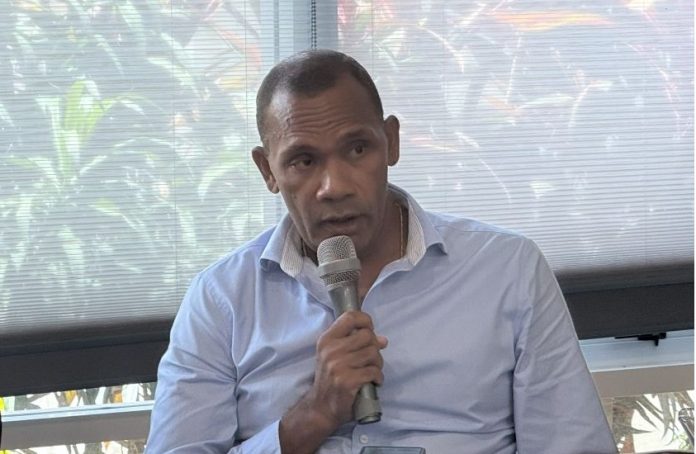
Robert Luke Iroga, a prominent journalist and CEO of Solomon Islands Business Magazine shed light on this whilst speaking from a panel on UNDP and Ministry of Mines Panel Discussion on “Pathways towards better electric power availability, affordability, and sustainability” on Friday, November 14, 2025 at Heritage Park Hotel.

He shared briefly of how as a student back then, using energy was only possible at a certain time and for him and his colleagues at the time, it was only until 10pm.

Iroga said at school, by 10pm, the power would go out and that meant it was the time the generator would be turned off.

“So, after 10 o’clock, you have to use candles,” he said.

Iroga voiced that this experience was like limiting your ability to get extra knowledge and it was because of personal power.

He mentioned that a few years ago, he went back to the school and they still have this problem.

“10 o’clock, power off. There’s nothing more. So, you are constrained by something that others enjoy as part of their life.

“You can’t have computers connected to the school. You can’t have laptops. You don’t have internet, which also uses power,” he stressed.

Iroga went on to speak about energy in the health sector.

He voiced that when you have electricity in the rural areas, in the clinics or in the hospitals, doctors can give instructions for operations in the villages.

“And that’s the power. Once you have everybody connected to the grid, or have some access to energy.

“This happens in India. In India, a lot of the doctors are based in Delhi, but they give instructions to clinics or hospitals in the rural areas,” he said.

Iroga noted that from the perspective of a journalist, these are very good stories that as he puts it “we can actually articulate and go to another level” on.

For feedback, contact: [email protected]

Concerned citizen calls on PM to ratify indigenous peoples act

0

BY MORRIS NAFU

A concerned citizen is calling on Prime Minister Jeremiah Manele to ratify the rights of indigenous people in Solomon Islands.

Rocky Tisah from East Kwara’ae, a member of the Solomon Islands Indigenous Human Rights Advocate Association raised this during an interview with the paper yesterday.

Initially, he said he appreciates PM Manele for recognising rights of indigenous people of Solomon Islands referring to the recent KPL partnership milestone in Kolombangara, with landowners now officially owning 20 percent shares of the company.

Tisah went on to say that they would like the PM to ratify the rights of indigenous people in Solomon Islands.

Moreover, he said when it comes to ownership of a company, the investor and resources owners should own the company in the shareholding percentage while the government should only collect tax.

“If we apply this one, it will allow the country to participate and take ownership of resources,” said Tisah.

Solomon Islands has not yet ratified the “UN Declaration on the Rights of Indigenous Peoples (UNDRIP) or the ILO Convention 169” yet.

These are two international frameworks to protect the rights of indigenous peoples and emphasises self-determination, cultural integrity, and participation in decision-making.

For feedback, contact: [email protected]

We need energy policy: Vehe

0

BY LORETTA B MANELE

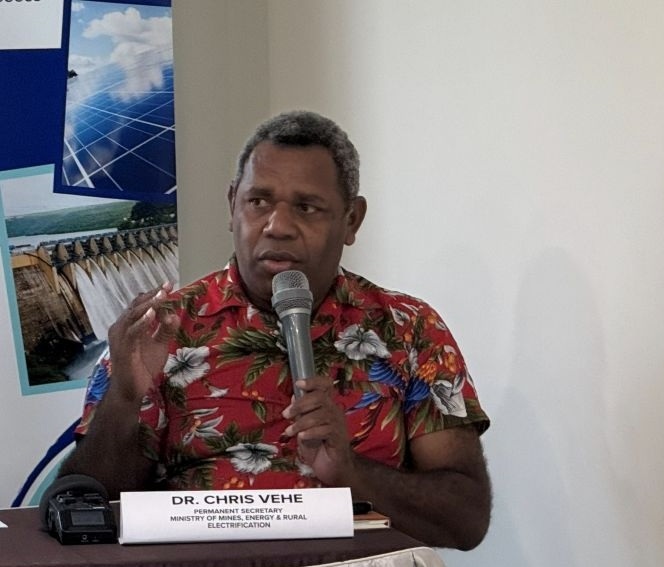
We need to quickly and robustly come up with an energy policy, an energy legislation that can cater for sectors like health and education says Chris Vehe, Permanent Secretary for the Ministry of Mines, Energy and Rural Electrification (MMERE).

He pointed this out as one of the panel members at UNDP and MMERE’s Panel Discussion on “Pathways towards better electric power availability, affordability, and sustainability” on Friday, November 14, 2025 at Heritage Park Hotel.

Vehe stressed that we really need to have a proper guiding framework that will enable us to negotiate on tariffs for schools and health facilities.

“We really need to have a proper guiding framework that will enable us to even negotiate, you know, with our utilities that schools should have different tariffs.

“Health utilities should have different tariffs,” he said.

Vehe added that these are the kind of discussions, that unless you start discussing it with health, you start knowing the expenses and what not.

Speaking of energy, the Permanent Secretary also said that he realised that unless energy that comes from solar panels can be properly managed, it won’t affect the distribution network.

He mentioned that they are having net metering discussions in the energy sector as well as on grid codes.

Vehe said we need properly gazetted grid codes that can take care of various incoming connections to the grid.

“Unless of course we have others, who can also run their own grid, they can accept whatever that comes, but based on their standard grid codes,” he added.

Vehe furthered that while we appreciate education, health as very essential services, we also need to at least understand the technicalities around it.

For feedback, contact: [email protected]

MAL to harvest rice today after trials

0

BY LORETTA B MANELE

The Ministry of Agriculture and Livestock (MAL) is set to harvest rice today after doing some trials.

Samson Viulu, Permanent Secretary to MAL revealed this when speaking at the Public Accounts Committee (PAC) hearing into the 2026 National Budget (Appropriation Bill 2026) yesterday.

Briefly, he said they are doing some trials on rice and will harvest rice today.

Viulu explained that this stems from MAL’s close collaboration with Jiangsu Academy of Agricultural Sciences (JAAS); a leading research institution in China.

Island Sun understands that mid this year, MAL officially launched the China–Solomon Islands Agritech Workshop with JAAS under the Solomon Islands–China Agricultural Cooperation Framework.

The week-long workshop catered to participants from government ministries, educational institutions, the private sector, and MAL’s technical divisions to important sessions including rice cultivation.

This follows the MOU signed between MAL and JAAS on 22 July 2024 between MAL’s Deputy Secretary Technical, Mr. Michael Ho’ota and JAAS Vice President.

Viulu told the hearing that next year, their target for rice is to establish 10 hectares of high standard commercial rice farming here on Guadalcanal and another 21 hectares on Malaita Province which has a sister relationship with China’s Jiangsu Province.

Photo: Supplied

For feedback, contact: [email protected]

FIGHT FOR JUSTICE

0

Lands Commissioner Alan McNeil says he has very strong evidence to disprove the allegations behind his suspension

BY MORRIS NAFU

Lands Commissioner Alan McNeil says he has ‘very strong’ evidence to disprove the allegations behind his suspension.

Mr McNeil was suddenly suspended from duty on Thursday last week.

The suspension by the Ministry of Public Service is enshrouded in secrecy, with McNeil saying he has no inkling whatsoever of the allegations against him, neither was given any opportunity to defend himself.

McNeil however says he refutes these allegations and has ‘very strong evidence’ to clear his name.

McNeil was put on suspension by the permanent secretary of the public service ministry, Luke Cheka, in a letter dated November 13, 2025, and titled ‘Immediate suspension from duty’, sighted by Island Sun.

PS Cheka’s letter stated three points of allegations against the lands commissioner which include:

-Fraudulent execution of lease documents and MOU on Nov 28, 2023 relating to a land parcel at the Kongulai water source.

-Breach of a high court order of 2009,

-misrepresenting a ‘good will’ payment by a former prime minister in a disputed lease agreement of November 2023.

The letter prohibited McNeil from entering the premises of the lands ministry, using the ministry’s properties, conducting any ministry business and representing the ministry during suspension.

The letter said the suspension allows for thorough investigation without interference while due process is undertaken, and adds that McNeil will be given an opportunity to explain his side.

Responding to enquiries by Island Sun on Friday last week, McNeil said he only knew of any investigation or action by the ministry of public service when his suspension letter was served to him Thursday, Nov 13.

“It is just an immediate suspension based on allegations, and that’s coming solely from the permanent secretary of the ministry of public service,” McNeil said.

He believes the way he was given the suspension letter was unprocedural and not correct, and is seeking legal advice.

“There are allegations that have been made against me. I strongly refute all of those allegations. They are not true. I’ve got very solid grounds that I can use to argue against those allegations.

“If the PS of public service had at least given me the opportunity, I could have shown him all of the evidence I have, and it would have take a very short time to prove to him that all of those allegations are false.”

Innocent until proven guilty

Solomon Islands’ system of justice is based on the premise that a suspect is considered innocent until proven guilty.

The action by the Ministry of Public Service is opposite, treating McNeil as guilty and jumping the gun to suspend him before setting out to prove the allegations.

The letter is worded as branding McNeil guilty before investigations are carried out.

It however says that McNeil will be given an opportunity to be heard, but does not detail to whom, or when, or how. The letter also does not detail the process or whether McNeil will be given a copy of the report against him.

It is understood that one of the grounds for suspension has to do with a lease variation which is in a case that is currently before the courts, therefore it is under Sub Judice and reportedly should not be talked about by the Ministry or PS.

In the Solomon Star edition 9310 of Monday 17 November 2025, the front-page headline reads “It’s definitive fraud” with the unauthored article stating that this is based on a purported memo to the Permanent Secretary for Lands, Housing and Survey but without naming who the memo came from. It is unclear how the Solomon Star newspaper could use a headline “It’s definitive fraud” when it is not stated who is saying this and what authority they have to say it, while the matter is still being investigated.

The second point in the letter is on a case dating back to 2009 with orders dating back to 2011. McNeil became Commissioner of Lands in 2018.

Meanwhile, McNeil says this is the first time for him to face such a challenge in his career. He adds that he looks forward to clearing his name as soon as possible.

Comments are being sought from the PS of public service.

Photo: Supplied

For feedback, contact: [email protected]

South Guadalcanal Constituency celebrates successful awareness on partnership with SINU’s DFL

0

BY MORRIS NAFU

South Guadalcanal Member of Parliament Rollen Seleso is pushing further for tertiary education in the constituency.

This follows the completion of an awareness programme in four communities in the constituency about SINU’s distance flexible learning programme.

The South Guadalcanal Constituency Office, in collaboration with the Centre for Distance Flexible Learning (DFL) of Solomon Islands National University (SINU), announced the successful awareness event in a statement on Sunday, November 16.

These events took place at Laloato Community High School, Veramogho SDA Primary School, Kuma Community High School, and Chapuria Community High School, the statement said.

All three community high schools will serve as satellite centres for the programme, with Veramogho SDA Primary School to be hosting the main administrative centre for the initiative within the constituency.

This series of awareness activities follows the signing of a Memorandum of Understanding (MOU) between SINU and the South Guadalcanal Constituency in March of this year.

The partnership aims to establish an out-of-campus centre in the Southern Region, bringing higher education closer to remote communities and breaking down barriers of distance and access, the constituency statement said.

Representing SINU at the awareness events were Obed Szutu, manager of the DFL, along with Clive Marx and McLean Vovo, while the constituency was represented by MP Rollen Seleso and his office team.

All communities expressed deep appreciation for this initiative, recognising it as a transformative step towards positive change, community development, and increased educational opportunities.

Seleso emphasised that education is the cornerstone of progress and development, the statement said.

He highlighted that changing mindsets through education is vital for fostering sustainable growth in South Guadalcanal, a region challenged by its geographical setting.

The MP expressed his heartfelt gratitude to SINU for partnering in this vision, which aligns with his goal of empowering his people and unlocking their full potential.

Szutu reiterated SINU’s commitment to inclusivity and accessibility, stating that by establishing the DFL Centre in South Guadalcanal is a pioneering step to remove traditional barriers to higher education, especially in remote areas.

He said by using innovative teaching methodologies and technology, SINU aims to provide flexible, student-centred learning experiences tailored to diverse needs, ultimately building lifelong learning and community development.

He said that through this partnership, learners in South Guadalcanal and surrounding areas will have access to a wide range of academic and vocational programs, equipping them with skills to contribute meaningfully to their communities and the nation’s sustainable development.

Szutu added that this initiative is not only about opening doors to education but also about nurturing social transformation, economic growth, and community empowerment.

“It aligns with SINU’s strategic goals of ensuring quality education is a right accessible to all, regardless of geographical location”, the DFL Manager explained.

Meanwhile, in one of his closing remarks, Seleso expressed his optimism that this partnership will serve as a major boost for positive change, inspiring communities to embrace education as a pathway to progress and development.

He reaffirmed his commitment to working with SINU to realise his vision of a well-educated, empowered South Guadalcanal, the statement said.

“The South Guadalcanal Constituency Office and SINU look forward to working together to expand educational access across the Weather Coast and beyond, making a lasting impact on the lives of many,” the South Guadalcanal MP concluded.

Photo: South Guadalcanal Constituency Office

For feedback, contact: [email protected]

WWF rescues communities from losing important resource

0

BY BEN BILUA
Gizo

SAERAGI and Kongulavata communities in Western Province have taken a major step towards safeguarding their sea grape resources with the introduction of a new community-led management plan, thanks to support from World Wildlife Fund (WWF) Solomon Islands.

In an interview with Island Sun over the weekend, Community Facilitator of Saeragi, Bibolo, Miles Six and Vorivori, Nerolyn Loni, said the project has transformed local understanding of resource management.

She said the project has opened the eyes of rural people on the importance of managing local resources.

Loni confirmed the formation of the Saeragi Sea-Grape Management Association, which is overseen by a Chairperson, Vice Chairperson, Treasurer, Secretary, and a team of Rangers.

She said the association is now responsible for enforcing new community-agreed rules that govern sea grape harvesting.

“This project is a game changer for us. The trainings, the field trips and awareness reshaped our community’s understanding on the importance of managing the sea grape. I strongly believe this project has made a huge impact in our communities,” Loni said.

Chairperson of the Saeragi Association, Newton Kule explained that the management of the sea grape is driven by two key objectives.

He said the first objective is to ensure the resource is sustainably harvested and the second objective is to ensure community members benefit equally from the resource.

“Each family is only required to harvest two baskets a week.

“Our rangers are always on alert to enforce our rules and regulation. When our rangers advise us to stop harvesting, we enforce the advice,” Kule said.

He said the project has also empowered local rangers with scientific knowledge about the sea grape life cycle, enabling better monitoring and protection.

“This project is a blessing for us. Previously we harvested and ate the grapes without consideration, to a point where the resource started to die out. When this project started, we had doubts, but as we went along, we realised that we need to better manage this important resource,” Kule said.

He also acknowledged WWF for funding Saeragi Community with a community hall.

Longtime sea grape harvester, Gloria Anilafu, said the difference in sea grape growth before and after the project is remarkable.

She stressed that the new management system has boosted production, enabling harvesters to meet the growing demand in Western Province and even Honiara.

Anilafu added that the management system has improved equality in harvesting and selling, and that sea grape beds have expanded since rules were introduced.

“Sea grape is our lifeline. This resource is our source of income to meet our family needs such as school fees, church contributions and other needs,” she said.

Chairman of the Kongulavata Sea Grape Association, Lloyd Wakana, shared similar observations.

He said sea grapes are now regenerating in areas where they had previously died out.

“Previously, people harvested this resource to a stage where it died out in some areas. Now they are growing in places where they were not there before,” Wakana said.

He said Kongulavata’s association operates under similar rules and structures as Saeragi.

Another harvester, Zedilyn Kasa, acknowledged the project for improving the health and quality of sea grapes, which has increased market demand.

“I used to sell at Gizo market but now I just harvest based on orders because of the high demand. Sometimes I receive orders from Honiara.

“This resource is our money and we are thankful that WWF helped us to manage it properly,” she said.

With the new management plans in place, both Saeragi and Kongu communities say they are committed to ensuring sea grapes remain abundant for future generations while also supporting local livelihoods.

WWF-Solomon Islands Conservation Program Manager Henry Kaniki, said the project incentivizes sustainable harvesting practices by supporting women-led community enterprises that depend on healthy sea grape ecosystems.

“By improving the management of sea grapes and related ecosystems such as mangroves and coral reefs, we are enhancing climate resilience and supporting the economic stability of these communities,” he said.

Kaniki added that the project is a leading example of climate mitigation driven by traditional knowledge and local stewardship.

The WWF-Solomon Islands “Sea Grape Management Project” is a nature-based solution focused on the sustainable management of sea grapes in the Western Province.

It aims to improve environmental health by combining traditional knowledge with conservation tools to empower local communities and create sustainable livelihoods.

Key activities include training communities in sustainable harvesting and processing, developing value-added products like soap and syrup, and conducting ecosystem monitoring.

The project is supported by Climate Resilient by Nature (CRxN), an Australian Government initiative in partnership with WWF-Australia.

CRxN supports nature-based solutions that restore and protect critical ecosystems, build sustainable livelihoods, and increase resilience to climate shocks.

For feedback, contact: [email protected]

Climate change threatens Saeragi’s vital sea grape resource

0

BY BEN BILUA
Gizo

THE people of Saeragi community in Western Province are witnessing worrying changes in one of their most valuable marine resources ‘sea grapes’ as the impacts of climate change intensify.

Speaking to Island Sun, long-time sea grape harvester Newton Kule said harvesters have observed unusual patterns in growth and survival of sea grapes in recent years, including deaths of entire patches.

He said such occurrences were never seen two decades ago.

“We saw that when there is a long dry season, sea grapes on the shallow areas will die. When it’s rainy season and extreme high tides, the sea grapes grow healthy,” Kule explained.

He added that harvesters have also noticed the sea grapes gradually shifting into deeper areas, possibly in response to warming ocean waters.

“We also witnessed that the sea grapes are moving into the deep. Maybe because the sea is getting hotter,” he said.

According to Kule, sea grapes are commonly harvested and sold in markets across the province, making it a crucial source of income for many Saeragi households.

He said the decline of the resource poses a direct threat to livelihoods and food security.

Kule said the community is now exploring ways to adapt and protect their sea grapes.

“We are planting this resource in some areas that we believe they can grow in. Some of our trials worked — the sea grapes did grow in some of the places,” he said.

Kule said the community needs greater support to properly respond to the climate-driven changes.

“This is a good sign for us, but we need more support to help us mitigate this issue. We need scientific knowledge to complement our traditional knowledge,” he said.

Kule warned that the long-term survival of sea grapes will depend heavily on how sea temperatures and sea levels change in the coming years.

“If the sea level continues to increase and the temperature increases, we might lose this important marine resource,” he said.

For feedback, contact: [email protected]
Lack of energy in rural areas prompted solar project

0

BY LORETTA B MANELE

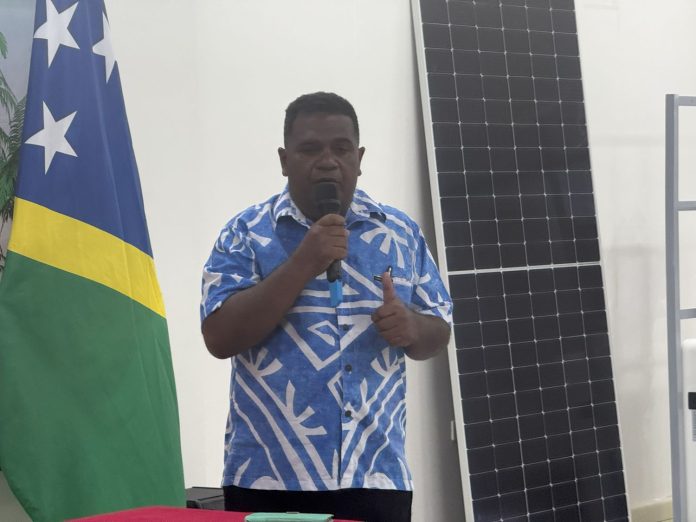
The lack of energy in rural areas was one of the reasons for the application of the solar power system project says, Trevor Manemahaga, Minister of Planning.

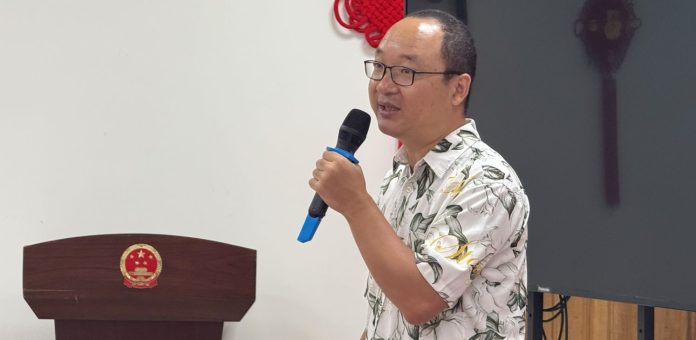
He highlighted this after expressing gratitude to Chinese Ambassador to Solomon Islands, Cai Weiming and officials from the Chinese embassy for the 2-year solar power system project.

From this project, some of the remaining constituencies from the first 25 out of 50 constituencies to receive the project, received their projects during a handover ceremony on Friday, November 14, 2025 at the Chinese embassy.

In his remarks at the ceremony, Manemahaga said there were two things that they were trying to address by applying for this project.

He explained that the first was to reduce our carbon footprint and to advance the endeavour taken by the Ministry to address climate change issues.

Second to this was Ministry of Environment having seen the importance of rural electrification as part of rural economic advancement and part of economic transformation.

“As I’ve always argued to all of you in my departments when I was with the Ministry, I always believe one of the issues facing rural areas is lack of energy.

“Lack of energy. And if you really want to address value chain productivity, we have to address energy. We have to have energy in the rural areas,” he said.

Manemahaga said energy is one of the areas that is lacking in our country, especially in the rural areas and because of this they started to embrace the idea that we have to have energy across the country.

“And this perhaps 6-kilowatt system which can give you light, which can power two deep freezers. So, for fishermen or fisherwomen in the rural areas, it’s really good if you have a catch. You can, you know, it supports the whole value chain,” he said.

Manemahaga reiterated that the two important areas they want to address is to reduce our carbon footprint by using green energy and solar energy and secondly, economic transformation.

“….transformation by reaching out to rural areas by giving energy to rural areas so that they can start just, you know, enjoy life just like everybody in the urban areas,” he added.

The Minister of Planning said this is the main idea and it is also part of GNUT’s current policy for rural retrofitting and economic transformation.

“This is basically why we are here today,” he noted.

For feedback, contact: [email protected]

China to work with Pacific Island countries in climate change

0

BY LORETTA BRIGIDIA MANELE

An official from the Chinese Embassy in Honiara, Gu Wenlong says they will continue to try their best to work together with Pacific Island countries to enhance capacity to deal with climate change.

He highlighted this at the embassy last week during a handover ceremony of solar power system to remaining constituencies of the first 25 out of 50 constituencies in Solomon Islands to receive the equipment.

Wenlong expressed that recently, China for the third time, has hosted the Pacific Island Countries Foreign Ministers Meeting.

On this note, he said China’s Foreign Minister, Wang Yi’s new proposal includes working together with Pacific Island Countries to tackle climate change issues.

“Our Foreign Minister expressed our formal position to stand firmly with the Pacific island countries and reaffirm commitment to the global principle of the United Nations Framework on Climate Change and the Paris Agreement,” he said.

Wenlong stressed that China will increase coordination with Pacific Island countries to build a fair and effective global climate governance system and will support Pacific Island countries through clean energy, low carbon infrastructure, disaster prevention and maritime environment protection.

“Over the next three years, China will implement more than 100 community-based climate projects and deepen maritime cooperation to support sustainable development,” Wenlong said.

He emphasised that working together with Pacific Island countries, they can gather even stronger efforts to help these countries tackle the climate change issue.

“And we can work together to build a shared future for both China and some of our Pacific Island countries,” he noted.

For feedback, contact: [email protected]