
Home Blog Page 209

UK supports film show depicting perilous state of our oceans

0

BY MORRIS NAFU

The British High Commission has supported the screening of a new British film which depicts the dire state of our oceans.

British High Commissioner, HE Paul Turner, spoke at the screening of the film entitled ‘Oceans’; the film is narrated by the legendary British conservationist and broadcaster, Sir David Attenborough. 

The documentary film shows the perilous situation of our oceans and how saving the oceans is fundamental to saving our planet.

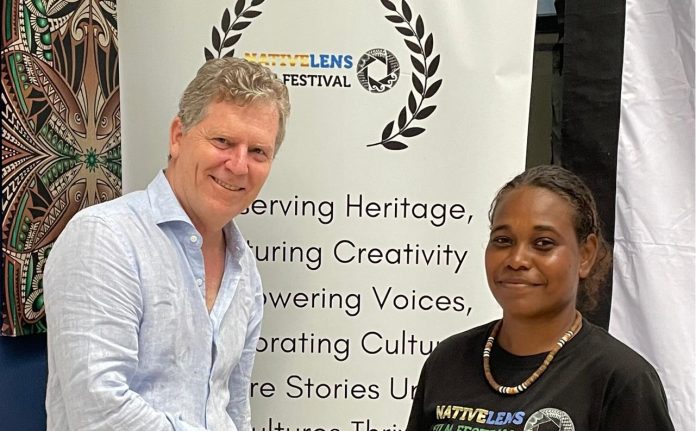
With UK support, the Native Lens Film Festival hosted the screening of ‘Oceans’ at the National Art Gallery in Honiara on Wednesday.

The Native Lens Film Festival (NLFF) is the Solomon Islands’ own film festival providing a platform for indigenous Pacific stories and raising Solomon Islands voices.

In his opening remarks, Turner highlighted some key findings from the British-made documentary. 

Oceans cover 70 percent of our planet, produces half the oxygen we breathe, and absorbs enormous amounts of carbon dioxide, which helps slow down climate change.

Without healthy oceans, life on Earth collapses.

The documentary takes the viewer on a breathtaking journey—from coral reefs to vast kelp forests and majestic whales.

“The film is beautiful, but it is also a warning. Beneath the surface, the ocean is in crisis,” he said.

The film shows that industrial-scale fishing is stripping life from the seas with more up to 75 percent of what is caught is subsequently thrown away.

The audience at the Native Lens Festival were youth groups and students from across Guadalcanal. 

Turner said the film ends on a hopeful note showing that the oceans can recover—if we act now. 

He said that the state of the oceans was for the young people of today to act. 

He urged the young people to speak up and demand action on conserving the oceans, praising global campaigns such as #ProtectOurOceans.

Turner finished by highlighting the impact that young people in the Pacific can have when they come together. 

He said the recent advisory judgement of the International Court on Justice (ICJ) was a great example of how young climate activists in the Pacific can force change by lobbying international organisations. 

The ICJ advisory judgement in July was ground-breaking as it stated for the first time that countries had a duty to prevent environmental harm and protect the climate system for future generations. 

The ICJ said that countries could face penalties if they failed to do this.

Photos: Supplied

For feedback, contact: [email protected]

Chiefs question Ministry over approval to harvest endangered tubi

0

BY BEN BILUA
Gizo

CHIEFS of San Jorge Island are seriously concerned over the government’s decision to grant Sunrise Limited Investment Ltd approval to harvest the endangered tubi tree, questioning the rationale behind endorsing a company previously found guilty of illegal harvesting.

Speaking on behalf of the chiefs, Pual Fota said the community is shocked that both the Director of Environment and Conservation and the Minister for Environment, Climate Change, Disaster Management and Meteorology have signed off on the latest gazette orders permitting the company to resume operations.

Fota said Sunrise Investment Ltd’s history with the people of San Jorge has been problematic, adding that its prior conviction for illegally harvesting tubi should have automatically disqualified the company from further approvals.

“We are dumbfounded with the reasoning of the government. We thought these people are well-educated but our judgement was wrong.

“To allow a company that has been found guilty to go back and do the harvesting is something else. Where is common sense here? Are we that dumb?” he said.

Fota insisted that it is time for responsible authorities to exercise sound judgement rather than signing off on approvals without proper consideration of the consequences.

Fota’s comments follow a report by Transparency Solomon Islands (TSI) highlighting two legal notices published in Extra-Ordinary Gazette No. 136 on 1 October 2025, which collectively grant Sunrise Investment Ltd permission to harvest tubi at Korona, San Jorge Island.

According to the report, Legal Notice 419 — issued by Director of Environment and Conservation Joseph Hurutarau under Section 8 of the Wildlife Protection and Management Act 1998 — declares Sunrise Investment Ltd an approved person for exporting tubi for a period of 12 months. The approval allows the company to fell tubi (Xanthostemon) trees for export, having met requirements under Regulation 9 of the Wildlife Protection and Management Regulations 2008.

Legal Notice 420, signed by Environment Minister Polycarp Paea, grants approval to the company’s submitted management programme under Section 6 of the same Act, officially endorsing it as an Approved Management Programme.

The new approvals add to a growing number of authorisations issued in recent years despite tubi being a protected species found primarily in Isabel and Choiseul provinces. The increasing frequency of such approvals has raised environmental concerns, with TSI particularly alarmed that Sunrise Investment Ltd — given its past breaches — has once again been entrusted with harvesting rights.

Chiefs of San Jorge say they will continue to question the ministry’s decision and are calling for greater accountability from government agencies tasked with safeguarding the country’s natural resources.

For feedback, contact: [email protected]

Agriculture is next for Ranongga/Simbo

0

BY BEN BILUA
Gizo

RANONGGA/SIMBO constituency is gearing up to roll out small-scale agriculture projects to strengthen rural livelihoods and support the growing number of farmers and market vendors within the constituency.

Speaking to Island Sun, Constituency Development Officer (CDO) Walter confirmed that discussions are underway and implementation is set to kick off soon.

He said the constituency recognises the vast agricultural potential of both Ranongga and Simbo, particularly in local food production and vegetable farming.

“Ranongga and Simbo Islands are blessed with good soil that produce more foods and vegetables. Our women are always at Gizo Market selling root crops and vegetables, so we want to support them,” Walter said.

He further highlighted that Ranongga Island is also rich in coconut plantations and cocoa, both of which have long supported families through small-scale commercial activities.

Walter said several existing copra and cocoa businesses continue to operate and provide vital services for local communities.

“These are the businesses that we will be supporting in our plan,” he added.

Island Sun understands that most market vendors supplying fresh root crops and vegetables to Gizo originate from Ranongga Island.

For years, women have braved rough seas and unpredictable weather to bring their produce to town.

Their hard work has not gone unnoticed. Recently, the constituency donated boats and outboard motor engines to help communities transport fresh produce to Gizo more safely and efficiently.

With the upcoming agriculture projects, leaders hope to further empower rural farmers and enhance the constituency’s contribution to local food security and the Gizo market economy.

For feedback, contact: [email protected]
Open defecation needs a whole government approach: McNeil

0

BY LORETTA B MANELE

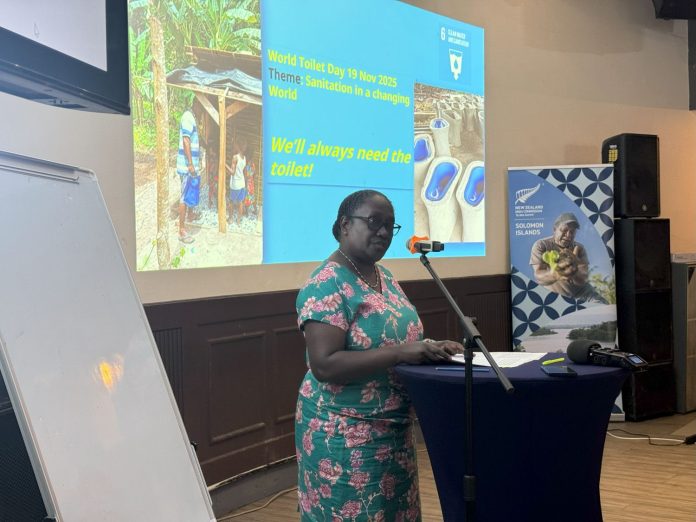
The issue of open defecation is not a health issue anymore, it’s a development issue, says Pauline McNeil, Permanent Secretary to the Ministry of Health and Medical Services (MHMS).

She raised this whilst delivering her speech at the “World Toilet Day-We’ll Always Need the Toilet” event at Heritage Park Hotel yesterday.

McNeil said last year, the ministry started to sector in their RWASH (Rural Water Supply, Sanitation and Hygiene Program) program in their development budget.

“Because it’s not a health issue anymore, it’s a development issue.

“It needs the whole of government to approach this sector,” she stressed.

McNeil emphasised that last year they started shifting the budget for sanitation from recurrent to development budget so they could be more effective and ensure other players come on board to implement on their behalf.

She explained that because of the HR gaps they have in their sector and in other sectors of the line ministries and partners and owners, they had to expand implementation.

And while there has been progress, McNeil said much more needs to be done.

“We must continue to work together with our development partners who are here with us and our provincial governments, represented by the head of provincial governments, and of course working with communities, will bring you the wisdom for how you implement the work on the ground,” she said.

She also took the opportunity to acknowledge UNICEF in regards to communities that have declared themselves as NOD (No Open Defecation) communities.

McNeil said looking at the communities that have been notified on the NOD, the number she has from her officials right now is 263 communities that have achieved NOD recognition.

“Let’s give a clap to UNICEF,” she said.

As mentioned by the Permanent Secretary, in terms of the breakdown, Malaita province ranks the highest with 124 communities with NOD, Isabel province has 16 communities with NOD, Western Province is at 38 communities with NOD, Guadalcanal at 17 and Makira, 16.

While this is progress, McNeil reiterated that there is a lot more work to be done, noting the importance that resources have to remain available and accessible if we are to progress further.

She calls on all partners to continue to advocate for the importance of accepting this initiative in communities.

For feedback, contact: [email protected]
Australia remains committed to strengthen health services in SI

0

BY LORETTA B MANELE

Australia as Solomon Islands biggest donor partner in the RWASH (Rural Water Supply, Sanitation and Hygiene Program) remains committed to strengthening health services in the country.

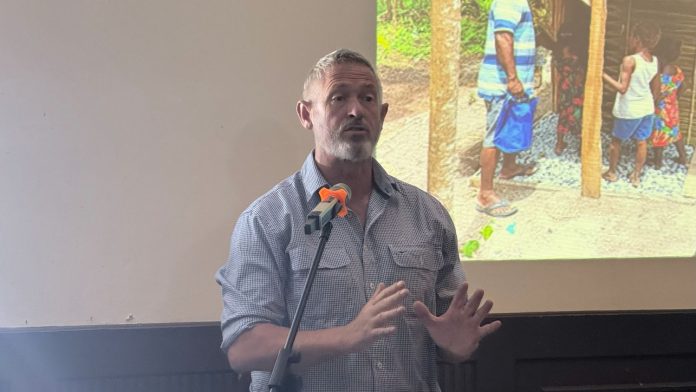
Dr Tristan Armstrong, Counsellor for Human Development from the Australian High Commission expressed this at the “World Toilet Day- We’ll Always Need the Toilet” event at Heritage Park Hotel yesterday.

Armstrong said every man, woman and children no matter where they live, have the right to safe and clean sanitation.

He added that this is something we must know and remember, noting that being able to access safe and clean sanitation doesn’t just changes lives but also saves lives.

Armstrong said when people have this kind of access, it avoids people using the environment whether be it the bush or sea hence allows communities to live in a clean environment.

As the population in Solomon Islands increases so does the importance of the issue of having proper sanitation.

To top that of, Armstrong said while there are a number of changes happening around us like changes in climate, population change or sea-level change one thing that doesn’t change is the fact that everyone needs to have a proper toilet to use.

“So, this is a struggle that we need to think about,” he said.

Armstrong said at the moment, 21 percent of rural families have basic sanitation but this is not good enough as it still poses a danger to health, especially for children in terms of getting sick from water that is not clean.

He emphasised that work in ensuring communities have proper and clean sanitation is not just about health but also about the health of the future of Solomon Islands.

With that being said, Armstrong said Australia is so proud to be the largest donor in RWASH in Solomon Islands.

He voiced that in every village and province he has gone to, he tries to reach out to help communities to help change lives.

“…..because we Solomon Islands and Australia, we are neighbours, close friends, we are close in terms of our history and we will continue to help Solomon Islands,” said Armstrong.

With that being said, he announced that through Australia and Solomon Islands health partnership, Australia will pour in over 150 million dollars over the next four years to strengthen health services.

He added that this includes 75 million that will go straight to provincial health departments to support a lot of things including small infrastructures, water sanitation and hygiene.

Armstrong strongly voiced that to reach 100 percent no open defecation, everyone must work together and this includes provinces, central government, NGOs, and donors.

He furthered that their commitment is very clear and they will continue to support Solomon Islands to build a strong and resilient health system including toilets in every village because this part of the health system of the country.

“We invest in schools and villages in water and sanitation because we know that this is a foundation for a healthy life and a healthy life is a foundation for happy life and this is to have a big and strong economy,” he said.

Armstrong calls on every donor and leader in the national and provincial levels to always make sanitation their top priority, to include it in their budget and to talk strongly about it and champion it in every opportunity they have.

For feedback, contact: [email protected]
SI ranks highest in open defecation in Pacific

0

BY LORETTA B MANELE

Solomon Islands has the highest rate in open defecation in the Pacific.

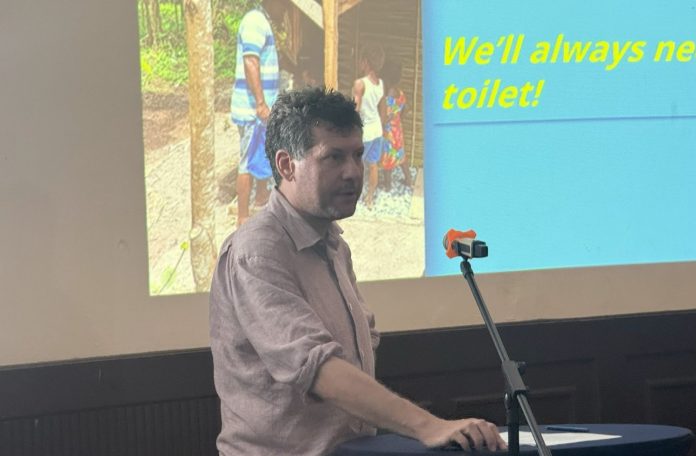
Ben Grubb, UNICEF Chief of the Solomon Islands Field Office, revealed this at the “World Toilet Day” event themed “We’ll Always Need the Toilet” at Heritage Park Hotel yesterday.

In early remarks, he said UNICEF commends the efforts of the Solomon Islands Government over the years in establishing legislation, policies, strategies, and systems to improve sanitation access.

Through this, Grubb said notable progress has been made including increased access to sanitation from 30 percent in 2015 to 35 percent in 2024.

“With leadership from MHMS, with funding support from DFAT and technical support from UNICEF and CSO partners, provincial governments of CIP, Malaita, and Western achieved NOD (No Open Defecation) in 180 communities and 21,000 people gained access to basic sanitation,” he said.

However, Grubb stressed that in the Solomon Islands, approximately 65 percent of the population; around 535,000 people do not have access to basic sanitation.

Following this, he said the alarming rate of about 371,000 people, or 45 percent of the population are still practicing open defecation.

“This is the highest rate in the Pacific region,” Grubb said.

He explained that since 2015, access to basic sanitation has only increased by 5 percentage points, from 30 percent in 2015 to 35 percent in 2024.

Grubb said in schools, the 2024 national WASH in Schools survey found that just over two-fifths of schools (41percent) provide a basic level of water service, while nearly half (47 percent) are at a limited level and 12 percent have no service at all.

He also took the opportunity to acknowledge Australia and New Zealand for their long-standing investments in water, sanitation, and hygiene that have brought much-needed infrastructure to schools, especially across Central Islands and Guadalcanal Province.

“Their support has enabled the construction and rehabilitation of safe water systems and toilets—improvements that not only protect student health but also restore dignity, safety, and privacy for girls, particularly during menstruation.

“These investments are transforming the school environment, helping children learn, thrive, and participate fully in their education, said Grubb.

Moreover, he said consequences of poor sanitation such as child mortality, public health risks, loss of human dignity, reduced tourism potential, and hindered economic development are well documented.

Henceforth, he pointed out that with the year 2030 fast approaching, Solomon Islands must intensify efforts to stay on track towards achieving SDG 6.2, which aims to eliminate open defecation and ensure universal access to basic sanitation.

Grubb also commended the Ministry of Health and Medical Services (MHMS) and the provincial governments of Malaita, Central Islands, and Western Province, for their implementation of the National Sustainable Sanitation Plan (NSSP), supported by DFAT and UNICEF.

He mentioned that on UNICEF’s part, through support from DFAT and KOICA, they have procured 15,000 Sato pans, which are currently being shipped to Honiara for nationwide distribution.

“This will ensure the regular supply of affordable sanitation products across the country and is expected to benefit up to 100,000 people,” said Grubb.

He furthered that despite these achievements, the road ahead remains challenging.

“We call on the Solomon Islands Government and provincial authorities to work closely with NGOs, CSOs, development partners, and the private sector to scale up efforts and investments in climate-resilient sanitation,” he said.

Grubb stated that UNICEF remains committed to supporting the Solomon Islands Government and provincial administrations in expanding access to climate-resilient sanitation.

For feedback, contact: [email protected]
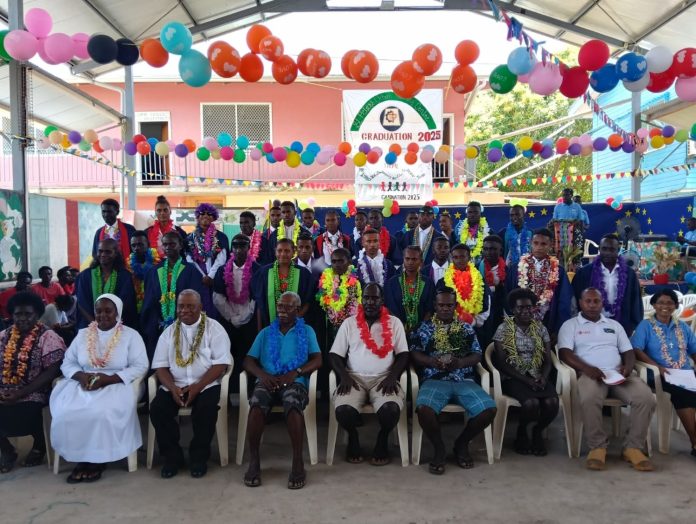
Another successful year for Saint Peter Urban Training Centre

0

BY BEN BILUA
Gizo

SAINT Peter Urban Training Centre in Gizo, Western Province has celebrated yet another milestone with the successful graduation of its 18th cohort since the institution was established.

Speaking during the ceremony yesterday, School Principal, Sister Regina Varghese said the event marked another proud moment for the institution as it continues to nurture and empower young people through skills training.

She said a total of 29 students graduated this year from various fields of study, including Electrical, Mechanics, Life Skills and Carpentry.

Sister Varghese said all graduating students have successfully completed their courses and are now equipped with essential skills to join the workforce.

Varghese also highlighted that 65 additional students have completed their trades courses and are now preparing to embark on six months of practical attachments with companies and industries across the country.

She described St Peter Urban Training Centre as a community of dedicated educators committed to the holistic formation of young people, guided by the preventive system of Don Bosco — transforming them into “good Christians and citizens of Solomon Islands.”

“We provide our students with a good educational environment in which young people are formed to be qualified and competent workers, professionals who embody the ideals of justice and love — prosperity with integrity and technology with soul,” Varghese said.

She added that the school embraces and respects all cultures represented within its student body, promoting understanding and appreciation of their diverse heritage and values.

“At our school, we set standards and goals for ourselves and strive to achieve them, whether in academics, technical studies, co-curricular activities, discipline, or leadership,” Varghese said.

She reiterated that academic and technical excellence remain the core focus of the centre, and the institution will continue strengthening its curriculum to meet the highest standards.

Varghese said the school upholds the belief that every student matters every day, and that all students are capable of achieving strong academic and technical outcomes, supported by positive behaviour and discipline.

“We instructors make sure that each student understands the lesson and the instructions given — and at times, we adopt one-on-one teaching methods until they are competent and excellent, and we are satisfied with their learning,” she added.

For feedback, contact: [email protected]
Renewal of 1960s hydro investigation can help revamp hydro plans

0

BY LORETTA B MANELE

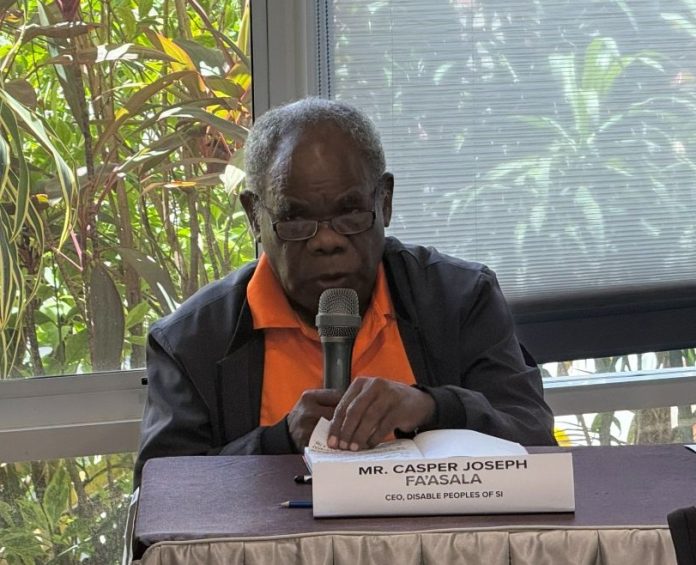
Renewing 1960s investigations on hydro can help revamp how we think, moving forward when it comes to hydro power says Casper Fa’asala.

The CEO of People with Disability, Solomon Islands expressed this when he contributed to UNDP and Ministry of Mines, Energy and Rural Electrification’s (MMERE) Panel Discussion on “Pathways towards better electric power availability, affordability, and sustainability” on Friday, November 14, 2025 at Heritage Park Hotel.

Fa’asala said during the 1960s, communities were engaged in an investigation on hydro in the country.

“Renewal of this investigation, therefore, would be paramount to the way we think to move forward and to carry out where necessary,” he said.

Fa’asala went on to state that, in a survey from the investigation, Mataniko right in Honiara was identified to be a location for hydro power.

Along with Mataniko, he mentioned Tenaru Falls, Lata in Temotu and Western Province’s Kolombangara as other places that were also identified.

Fa’asala stressed that in order for us to make such plans happen, we should feel that we need to appreciate the readiness of it.

“The readiness of how we would accept the utilisation of the energies,” he said.

Fa’asala pointed out that of course we would like to see more hydro being built in Solomon Islands given the many rivers we have.

On this note, he pointed out that the challenge we have is being confused when it comes to land rights and land policy.

“The challenge we have is, of course, Solomon Islands is confused with what is called land rights and land policy.

“We are too greedy to call land policy. We are not land owners. God owns the land, not us,” he said.

“We all have the right, and therefore if we use the right that is given to us in utilising our resources, we will be already rich,” he added.

Moreover, Fa’asala said seeing the need for water rights acquisitions, we are in need of such a policy to get it correct in order for us to utilise the many rivers we have.

He emphasised that we have the Protected Act 2010 and its regulations 2012, but we have not done enough to push those things in order for resource owners to come forward.

“We also have the Customer Land Records Act 1994, but government has not invested enough in order to comply with that, bringing people to come to again record their land, if they want to wish to do so,” Fa’asala said.

He noted that these are instruments that we already have and should explore.

For feedback, contact: [email protected]
MAL lacks technical capacity and capital to fight CRB

0

BY LORETTA B MANELE

The Ministry of Agriculture and Livestock (MAL) lack technical capacity and money to utilise in the fight against CRB (Coconut rhinoceros beetle).

Samson Viulu, Permanent Secretary for MAL shed light on this when asked by Matthew Wale, Opposition Leader on the number of trees lost or that have not produced up to capacity because of CRB during a PAC (Public Accounts Committee) hearing into the 2026 National Budget (Appropriation Bill 2026) on Monday, November 17, 2025.

Viulu told PAC that in terms of the battle against CRB, while they don’t have the exact field data, they think they can win this fight as compared to that of the Giant African snail.

In regards to CRB, he explained that they now have a small scientific lab in Henderson facility, where they are using fungus and virus infected with lava on that beetle to release it as a biocontrol approach.

Viulu mentioned that with workers carrying out this approach it is quite effective at GPPOL.

He added that this biocontrol approach is also being carried out in Western Province, Russell Islands, and certain parts of Guadalcanal, Malaita and Isabel Provinces.

The Permanent Secretary highlighted that what the ministry is also doing now is instead of controlling CRB they want to eradicate it thus have chosen Bellona to carry this out.

He explained that Bellona was selected because the movement of people is not as heavy as compared to other islands as well as the low rate of shipping service there.

“So, we want to eradicate.

“Instead of control, we are targeting eradication in Bellona.

“So, we’ve just placed extension officers there to start last month and then hopefully with the presence there, we can coordinate the movement on this,” said Viulu.

He said while reach out from the ministry is very minimal in this endeavour, this is one area they are talking with donor partners about.

“This is one area that we are still talking to donor partners to help us strengthen because we don’t really have the technical capacity, especially for using what biocontrol measures,”, he said.

When asked by the Opposition Leader whether the reason for this is the number of human resource or that of financial means, Viulu said it’s both human and financial resources that they lack to address the spread of CRB in the country.

As the ministry struggles in it’s fight against CRB, the Permanent Secretary said the New Zealand government is helping them.

And while they might get a little allocation to address CRB, it may still be insufficient.

The Opposition Leader asked how much it would cost to have a really robust response to CRB to which Viulu in his response said, roughly, they would need around 6 to 10 million Solomon Dollars per annum.

For feedback, contact: [email protected]

EMPOWERING WOMEN

0

Western Province reviews Women Policy

BY BEN BILUA
Gizo

Western Province is currently reviewing its Women’s Empowerment and Transformation Policy for Development with consultations rolling out across communities.

Women Desk Officer for Western Province, Lisi Wong, said her team has begun meeting with women to gather views and recommendations for the revised policy.

She said consultations will take place this week in Buri on Ranongga Island, and Rarumana in Roviana as part of efforts to ensure women’s voices are central to the update.

Wong said the review aims to strengthen the policy by including components that were missing from the original version.

She said the policy is important as it guides women development so as any development that involves women in Western Province.

“Under the policy we downstream national polices to provincial and community level. Our previous focus was on Policy Outcome four which deals with Women Empowerment and Outcome 8 which is ending Violence Against Women and Girls.

“One of our top priorities is to empower and encourage women participating in decision making processes,” Wong said.

She said women in Western Province have seen the benefit of the policy and that it is the reason why her department is putting effort to review the policy.

Wong said the policy was launched and came into effect in 2018 and ends in 2022.

“So, under this policy we saw lots of development for our women. We saw the development of Gizo, Noro, Munda and now the Seghe Markets.

“We were also able to bring Family Support Centre to Gizo to help victims of domestic abuse,” she said.

Wong said the first draft of the revised policy is expected to reach completion next year followed by further reviews before endorsement.

Island Sun understand that the “Women’s Empowerment and Transformation Policy for Development” is the first women’s policy launched by the Western Provincial Government in the Solomon Islands in July 2018.

It serves as a blueprint for strategies to remove obstacles to women’s full participation in provincial development and aims to empower women economically, socially, and politically.

This multisectoral policy involves the provincial government, civil society, private sector, and other partners to create a more inclusive and equitable environment for women.

For feedback, contact: [email protected]