Home Blog Page 1654

HEAD COACH PLEASED

0

SI-Vanuatu friendly next week

THE senior men’s soccer has kicked off their preparations for their Oceania, 2018 World Cup qualifiers match against New Zealand with a 3-1 over the Solomon Cup All Stars team yesterday.

Goals from Henry Fa’arodo, Micah Lea’alafa and Gagame Feni saw the national side defeating the All Stars, after Clement Baegeni pulled a goal back for the All Stars in the second half.

Solomon Islands national football coach Felipe Vega Arango- Alonso said he was pleased with the result and performance yesterday, as they wait to take on the Vanuatu national team in a second friendly match next week at Lawson Tama.

“Some areas needs little work but it’s a good result for the team. It was an entertaining match, for us, the players and the fans. Everyone was entertained so yes I’m pleased,” he said.

Mr Alonso said he was also happy with the performance of the Solomon Cup All Stars players who were selected for the national teams’ training squad.

“I’m happy with how they did things and they are happy they are part of the national team. Martin Rence, Andrew Raragia did a good job, Clement Baegeni and Kennedy Watemae were also brilliant.

“I would have liked to play against Clifton Aumae today because I like his game style. But I thought the selected provincial and the players from the national squad performed brilliantly despite undergoing hard training on Monday,” he said.

With Benjamin Totori still in New Zealand and the prospect of him not available for the Vanuatu friendly, Felipe said he is happy with the striking option available for him and will use the friendly to prepare Watemae and Baegeni for the World Cup qualifiers match against New Zealand.

“I want to win always and I’m happy because I will have the players who did not play with us today (yesterday) for the friendly match against Vanuatu next week.

“Totori is currently playing in New Zealand and might not be available to play next week. However, I’m happy with the options upfront for our second friendly match with the likes of Baegeni and Watemae.

“New Zealand plays at a different level so I might start with a different 11 against them in September but at least I can have these players with me. Hopefully we can take some of them with the team to play New Zealand,” Coach Alonso said.

Solomon Islands will take on New Zealand on September at the North Harbour Stadium in Auckland for the first match and then will meet them on September 5 at the Lawson Tama Stadium in Honiara.

ESSI CONDUCTS GPS TRAINING FOR 12 REGIONS ON CHOISEUL

0

A local Non-Government Organisation (NGO) Ecological Solutions Solomon Islands (ESSI) has received a small grant from Global Green Grants Fund.

David Boseto of ESSI said the fund will support the group’s working in partnership with Lauru Land Conference of Tribal Community (LLCTC) to conduct Global Positioning System (GPS) training for 12 regions around the Island of Choiseul. A total of 12 trainings altogether will be conducted.

Boseto added that the training will enable each tribe to use the GPS to map their customary land boundary.

He said ESSI is currently implementing the Choiseul Province Medium Term Development Plan on Ridges to Reef on Choiseul Island.

“Stage one is a biological survey, stage two is mapping of the customary land boundaries, genealogy recording, and develop land use planning and the third step is set up of Protected Area within the Mount Maetambe to Kolobangara River Watershed.

“They have mapped 10 customary land boundaries and record their genealogy with the help of LLCTC. This is in support of one of the major fundamental vision of LLCTC mandate for each tribe on Choiseul Island. The mapping of customary land that is promoted by LLCTC is to sketch the land boundaries based on verbal and written documents of the customary land boundaries and at the same time confirming the boundaries with neighbouring tribes.”

“It is the use of GPS to map customary boundaries and the land use plan that other tribes outside of our project sites have requested. Therefore, we have to look for additional resource to fund our work so that we can reach more tribes around the island of Choiseul.Boseto said ESSI has incorporated the instruction by LLCTC and then add to it by using GPS for mapping of customary land boundaries and at the same time map the land use within the customary land owned by the different tribe.

“Our team and Lauru Land Conference of Tribal Community would like to thank Global Green Grants for funding our work on Choiseul Island,” Boseto said.

GOV’T DECLARES RHINOCEROS EMERGENCY PEST

0

THE National government has declared the invasive Coconut Rhinoceros Beetle (CRB) as an emergency pest as it steps up its fight against the beetle that has killed more than half the population of coconuts in Honiara and nearby Guadalcanal.

Ministry of Agriculture and Livestock – Director of Biosecurity, Francis Tsastia announced this on Friday.

He said it has been gazetted and signed this week by the Minister of Agriculture and Livestock (MAL) that Coconut Rhinoceros Beetles (CRB) is now an emergency pest.

“CRB now is an emergency pest in Honiara and Guadalcanal, that triggers a lot of things, resources is one of the issues because once it’s an emergency requires implementation of control measures

“It’s good because it provides us a strong backing to request for funding from the government, we could now liaise with the National Disaster Management Office (NDMO) according to a provision of the Biosecurity Act.”

Speaking during the information sharing session day with the media on Friday, Mr Tsatsia said the Act provides the provisions to support eradication of CRB.

Since 2015 Biosecurity Solomon Islands has taken several actions in the fight against the invasive beetle.

A fungus expert was here in early July 2016 but due to financial hold-ups within the Solomon Islands Government much needed laboratory supplies could not be shifted here.

“The expert is working with Biosecurity Solomon Islands staff to transfer the skills needed to produce large quantities of the fungus needed to infect breeding sites.”

In the second half of July 2016, a virus expert arrived in the country, and has brought in several strains of the only virus known to work against this beetle.

“This will be tested against the CRB-G strain present here in the hope that one will be effective against it,” said the Biosecurity Solomon Islands.

IT’S NOW OR NEVER

0

Solomon Islands faces wrath of climate change

FROM the melting glaciers of Greenland and Antarctica to the low-lying states of the Pacific Islands, like in the Solomon Islands, the impact of climate change is taking its toll on people’s livelihood on a scale never seen before.

The country, an archipelago of six main islands and over 900 small islands has a population of just above 600,000 people, according to 2017 projection, 80 per cent whose lives depend on terrestrial and marine resources for food.

But the land and the ocean are turning against the very people they are supposed to serve.

In the Weather coast of Guadalcanal, sustaining a livelihood from the land is a daily struggle on the steep coastal mountain slopes that plunge to the sea, worsened by the increasing changes in atmospheric temperature and unpredictable weather pattern on the already precarious food situation there.

Coordinator of Talise Community Base Rural Training Centre (TBRTC), Celestine Aloatu told The Island Sun that over the years, heavy rains have eroded soil nutrients, naturally selecting a new environment which harbours thriving plant pests and diseases that affect taro, the main staple root crop.

Mr Aloatu said climate change effects on soil have made life hard for farmers, and threatened food production in the weather coast. He said the training centre has become a food bank centre to support other communities on planting materials.

“The effects of climate change is a reality here, the training centre is trying its best to source planting material for these communities, but is still in need of assistance to support the continuity of the assessment.

“The support would also help to empower lead farmers, to take the lead in family food crop farming in this region, to ensure that food is secure for people,” Aloatu said.

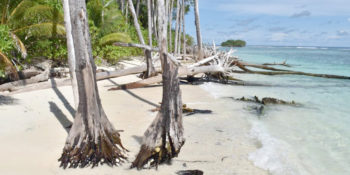
Vonu village located at Marau on the eastern tip of Guadalcanal’s coastline was shallowed by the rising sea and as a result, most villagers have fled and rebuild their homes more than 200 meters further inland.

“During the 1990s dwelling homes were about 20 meters from the beach. Today water has covered where homes used to be, with coconut and other fruit trees washed away by the eroding waves. Only a few palms remain standing in salt water, but their growth is deteriorating,” John Akosia, a villager, said.

The smaller outer islands in the country are hit hard by the rising seas. In the Ontong Java atoll, crops are dying due to salinity of the swamp and sandy soil resulted from salt water intrusion.

Tuo, a remote island community in the far-flung eastern Solomon’s Temotu province is also facing the brunt of sea level rise. Graves at the village cemetery are now completely washed away by the scourge of the raging waves associated with king tides.

“The entire cemetery has been washed away, and the place is now in total jeopardy, a nightmare for concerned islanders as there is no proper burial ground to house the dead. Many elders are puzzled by what is happening on their land. The cemetery was about 50m away from the beach during the 1980s, but now the ocean is taking over the land,” Lawrence Nodua, an islander, local researcher and environmental campaigner said.

He noted that Tuo communities have embarked on a number of adaptation measures supported by UNESCO with the national government. Although attempt to construct a sea wall is difficult as the ground is easy to wear away, communities are joining forces with government and other NGOs on adaptation as well as mitigation measures.

Mr Nodua with financial backing from UNESCO’s France Bureau, has conducted a research in Tuo and surrounding islands. His latest report found that there is also a tremendous decline of coral reefs in the past two decades and is continuing unabated. Utterly concluded what other leading scientists stated about greenhouse gas emissions, as the principle cause of warming sea surface temperatures and ocean acidification that destroys coral reefs in the pacific islands.

However, in a confronting new study by Dr Simon Albert recently published in Environmental Research Letters, it stated that the sea-level rise has caused five Solomon Islands to vanish.

Dr Albert’s report, published last month, tracked the shape shifting of 33 reef islands in the country between 1947 and 2014. It found that five had been washed away completely and six more had been severely eroded. The study blamed the loss on a combination of sea-level rise and high wave energy.

Like other pacific islands and low-lying states, the Solomon Islands future is at stake. The focus now turns to COP23, where the country will join other likeminded states in their continued fight to limit the rise of global temperatures to 1.5 degrees Celsius above pre-industrial levels.

Solomon Islands stands in solidarity with the international community in reaffirming its commitment to the agreement. To date 195 countries have signed the Paris Agreement and 146 have ratified it.

Prime Minister Manasseh Sogavare admitted that the Paris Agreement and the Sustainable Development Goals remain the country’s last chance in creating a sustainable future for our people and humanity. He said Paris Agreement must not allow to fail.

Expressing his disappointment on President Donald Trump on the intention of United States to withdraw from the Paris Agreement, Sogavare said Climate change is a global issue that needs global action now.

“The government has been working with a number of Non-governmental Organisation and multilateral partners, some of which include UNDP, SPREP and GEF to build resilience to the impacts of climate change,” Acting, Director of Climate Change in the Ministry of Environment, Climate Change, Disaster Management and Meteorology (MECDM), Hudson Kauhiona said in an interview.

He said the Solomon Islands government is tackling climate change impacts on two way mitigation. One is the partnership with UN REDD+ Programme which the government is partnering with local communities on its implementation to promoting the importance of sustainable forest management (SFM), enhance of caron stock and conversation of carbon stock.

On January this year, the REDD+ programme spread its arms to Isabel province, the third amongst the earmarked pilot sites for REDD+ programme, after Ulawa-Ugi in Makira and Kolombangara in Western Province.

According to REDD + Team Leader, Cathy Unga, the programme is now in its second phase and working towards qualifying to its full implementation.

Acting Permanent Secretary of the Ministry of Forestry and Research, Vaeno Vigulu said REDD + is a new programme and a recommended measure for mitigation and adaptation to climate change that is on trial in local setups.

The initial REDD+ stands for; Reduce Emissions from Deforestation and forest Degradation with the plus sign covering – Conservation of forest carbon stocks; Sustainable management of forests; and Enhancement of forest carbon stocks.

At the same time, Mr Kauhiona said the government is initiating measures to enhance the country’s energy efficiency and decrease resilience on fossil fuels through solar and other renewable energy sources.

“We are joining the fight for global action in an effort to limit the rise of global temperatures to 1.5 degrees Celsius above pre-industrial level. We are focusing on ambitious actions to address the underlying causes of climate change,” Mr Kauhiona said. He highlighted that sea levels here have risen three times the global average since 1993, reaching up to 10 millimetres per year.

MECDM developed the National Adaptation Programmes of Action (NAPA) which sets out priority areas for climate change adaptation in the country.

Last year, Australia has committed around SB$5.8 million to building climate change resilience and reducing emissions in the country over the next five years.

The people of rural Roviana in Western Province have taken ownership of a five-year Climate Change Resilience Plan (2013 – 2017) supported by Australian Government’s Pacific Adaptation Strategy Assistance Programme (PASAP).

Dr Simon Albert wrote on the summary of results from PASAP that the programme has made the environment and people ready.

Some of the actions include construction seawalls near essential infrastructure, encouraged new marine reserves, including connections between coral reef, seagrass and mangrove ecosystem, improve people’s understanding of the importance of mangroves, ensure buffer zones around rivers are respected by logging companies and improve transfer of traditional knowledge between generations.


NEW CRAFT CENTRE FOR THE COUNTRY

0

THE Ministry of Culture and Tourism through its Culture Division has proposed establishing the first ever crafts centre for the country.

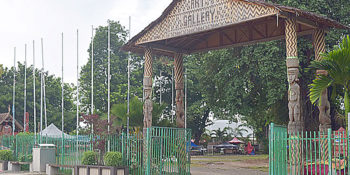
The crafts centre is being planned to be built in the current Art Gallery site in Honiara.

Director of Culture Division under the Ministry of Culture and Tourism, Mr Dennis Marita said the plan was already formalised and is only awaiting implementation.

He told this paper yesterday that this is part of the preparation for the 2018 Melanesian Festival of Arts and Culture, as they plan to integrate the site to become a central venue for crafts showcasing during the festival.

Mr Marita said this is one of the key areas they will work towards, as it was their utmost hope for the venue to complete before the festival next year.

He added that in preparation to build the craft centre, his office will meet with key donors and relevant ministries next week to discuss ways forward to carry-out the plan.

Mr Marita said integration of the site will be a milestone for the crafts people in the country as it will help them sell their products in a more improved and attractive environment.

“Putting on this idea is indeed a relief for crafts people in the country as it will solve their long standing issue to have a well build crafts centre to do their market.

“As the plan targeted the festival next year, that will just a part of the plan but the infrastructure will be there and later use by the local crafts people.

“A well-integrated site where it will be a centre for arts and crafts where people can go straight to the area if they want crafts products.

“Establishing the site will also an improvement whereby it will make easy for tourists to come only to a venue to find the products they may wish rather than going from venue to venue,” he said.

Mr Marita said coming up with this plan is a long time plan of the ministry to create a better site for crafts people.

COUNCIL OF TOURISM MINISTERS A SUCCESS

0

COUNCIL of Tourism Ministers in Gizo is being hailed a success as the national Tourism Ministry heard for itself the plans of each provincial ministry towards tourism development.

All ideas contributed are collected and combined into a document as data information for the National Government to push the tourism industry forward.

Tourism Minister for Western Province Hon Chris Mesepitu said it was good to learn from the visitors’ survey report on SIVB’s data collection pointing out the country’s strengths and weaknesses towards attracting more tourists.

“I thank such meetings as the CTMM because it is from such meetings we can access data’s and information’s that will help us know where to improve our development in the tourism industry of the country,” said Hon Mesepitu.

Speaking on behalf of all the Provincial Tourism Ministers and Senior Officers during the official closing of the CTMM last Friday night, the Premier of Rennell and Bellona province, Hon Collin Singamoana, said they have learnt a lot within the few days spent in Western Province. “We will take back to our various provinces what we have learnt here so that we will improve our development in tourism,” said the Premier.

He thanked the Tourism Minister and his hardworking staff, the Premier of Western Province Hon Wayne Maepio and his executive and lastly the people of Western Province for their gifts and hospitality.

“On behalf of the eight provinces including HCC, there is no other word we can say more but thank you,” said the Premier for Renbel.

Minister of Culture and Tourism Hon Bartholomew Parapolo, before his official announcement for the closing of the CTMM, thanked local chiefs of Western Province as well for the traditional shell monies of the province presented to them.

He said that the gifts marked unity, peace and love amongst the provinces of Solomon Islands for the development towards tourism.

CULTURE IS THE ATTRACTIVE PRODUCT: HON MESEPITU

1

WESTERN Province Tourism Minister Hon Chris Mesepitu after the recent Council of Tourism Ministers Meeting (CTMM) in Gizo Town said culture is the attractive product of tourism.

He said it is the most interesting product people will want to come and explore in Solomon Islands.

“We have a diverse culture of nine different ones representing our provinces,” said Hon Mesepitu.

“I would really like the tourism industry of the country to develop more on culture attraction in terms of conservation, artefacts, carvings, traditional beliefs, dancing and so on.

“This is because only culture product will make a big difference.

We may have a lot of white sandy beaches or so but it is just similar to other countries. It is our cultures that will make a difference compared to other countries.”

The Minister suggests that this is one of the areas in tourism development the country should dwell within and improve on as well.

“I thank the CTM meeting that had recently took place in the province because from such meetings is where we can access data’s and information’s that will help us know where to improve our development in the tourism industry of the country,” said Hon Mesepitu.

The Hon Minister is focusing on culture because he said it was one of the interesting data’s surveyed by Solomon Island Visitors Bureau (SIVB) shown during the CTMM in Gizo Town last week.

SINU SCHOOL OF NURSING AWARDS PRE-DIPLOMA GRADUATES

0

NURSE Aide students of Solomon Islands National University (SINU) have successfully completed a bridging programme which qualifies them to enroll for the Diploma Nursing programme.

A total of 36 Nurse Aides graduated in yesterday’s mini graduation held at Ranadi Campus of SINU.

The bridging course had taken 13 weeks and the candidates were sponsored by their respective provinces, the national referral hospital and the Honiara City Council.

SINU’s Acting Vice Chancellor Professor Basil Shelton Marasinghe thanked the Ministry of Health and Medical Sciences (MHMS) especially, National Director Mr Michael Larui and Under Secretary Mr George Pego for their support to the programme.

Prof Marasinghe said SINU is grateful for the close working relationship the SNAHS-SINU is enjoying now.

The SNAHS has advanced so much because of the support the school received from its stakeholders MHMS and other national and international partners, Prof Marasinghe said.

SNAHS offers four bachelor degree programmes, a number of Diploma programmes and Certificate programmes.

In the meantime, the school is considering starting a postgraduate programme, Master of Health Management with the support of World Health Organisation (WHO) and an Australian university, Prof adds.

The SNAHS is the leading school of Nursing in South Pacific Region.

It has a very close relationship with Kaohsiung Medical University (KMU) in the Republic of China, Taiwan.

Every year 2-3 lecturer of this school are admitted to KMU for Masters’ Degree Programmes.

READ SI WINS PRIME MINISTER’S HEART

0

A recently established literacy organisation in the Solomon Islands has won Prime Minister Manasseh Sogavare’s heart for its mission to battle the country’s high illiteracy rate by providing literacy classes and libraries in 600 villages across the country by April 2018.

As a result, “READ SI” which stands for “Resources for Education to Advance Development in Solomon Islands” was given a SB$2 million assistance under a partnership programme between the Solomon Islands Government and the Republic of China, ROC (Taiwan) today.

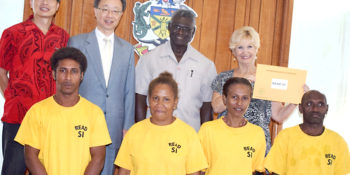
Prime Minister Manasseh Sogavare and ROC Ambassador H.E. Roger Luo handed over the SB$2 million cheque to Ms Joyce Boykin, Founder of READ SI in the presence of the Organisation’s teachers and senior government officials.

Expressing his deepest appreciation to the Organisation, Prime Minister Sogavare reiterated his earlier pledge to the Organisation last year saying, “My Government will be an ally in this fight against illiteracy”.

“We all know that illiteracy was and still is a concern amongst the rural people yet for some of us Solomon Islanders, it was convenient to have this issue swept under the mat,” Mr Sogavare said.

The money will assist the Organisation to advance development by teaching people and providing them with books on informal topics, such as making and saving money, economic planning, better farming methods, strengthening families, creating healthier communities, good governance and helping people with disabilities.

“Our belief is that when people get the information they want, they will be better decision makers and problem solvers,” said Ms Boykin during the handover ceremony.

“The most powerful way to receive information is by reading and studying it. Smart people deserve that opportunity and that is the main goal of the National Literacy Campaign,” she explained.

ROC Ambassador, Roger Luo said literacy or education is a key ingredient in development and his Government has valued education so much that they are keen to share their experience with countries like Solomon Islands to elevate the level of literacy in programmes such as the National Literacy Campaign.

“ROC (Taiwan) is keen to help in such a valuable endeavor and we are ready to assist when called upon to help,” Ambassador Luo said.

READ SI was started by Ms Boykin in 2015 and has since depended largely on funding by local businesses in Solomon Islands.

Since its inception, the organization trained teachers and dispatched them to villages around the country. With its successes in 2015 and 16, READ SI is targeting 600 villages across the country by April 2018.

SCHOLARSHIP REDUCTION FOR 2018

0
Permanent Secretary for MEHRD, Dr Franco Rodie.

IT has surfaced that overseas scholarships for next year, 2018 will perhaps be reduced.

The Ministry of Education and Human Resources Development (MEHRD) Permanent Secretary highlighted this during last week’s Public Accounts Committee (PAC) hearing.

“As of next year, we would like to see reduction in the number of scholarship that will be available to students wanting to go overseas,” the ministry’s permanent secretary Dr Franco Rodie said.

He said the government sends students to regional universities such as in Fiji, Papua New Guinea and lately in the Philippines based on the opportunity list and the skills that are required to attain

The education permanent secretary said the government is committing largely towards the Solomon Islands National University (SINU) to cater for students.

He emphasized that the Solomon Islands National University (SINU) must continue to develop courses and programmes to prepare skilled people that the country needs.

“Let’s take stock of the courses and programmes that our students go over to the regional universities to take,”   Dr Rodie said.

He sternly warn leaders not to interfere in the scholarship system and let the Ministry do its job.

Dr Rodie has revealed that scholarship and payroll received most of the allocated funding in the 2016 budget.

Responding to reports that claim Fiji students are to defer studies, the permanent secretary he was assured by the ministry of Finance that there will be enough finance to support the students who are currently on scholarship in Fiji.

“But those that did not perform will be recalled.

“The problem only happens in Fiji, our students are not performing, but in other institutions such as in Papua New Guinea our students are performing very well,” he said.

He said in PNG institutions, rules are really tough and universities assess students’ GPA and if students are found below the expected GPA, concerned students will not continue.