Home Blog Page 1647

Australia Awards Programme 2018

0
Dear Editor,
FORTY lucky Solomon Islands students will study in universities in both Australia and in the Pacific region in 2018 under Australia Awards Scholarships.
A local media release covering the awards it said:-
“The Australia Awards program provides successful applicants with the skills and knowledge to drive change and influence economic and social development in Solomon Islands.

“The awards cover travel, health insurance, living allowances, tuition fees and university costs.

“Award recipients will be undertaking undergraduate and postgraduate studies in various fields including health, education, gender equality, economics, law, engineering, fisheries, environment, agriculture, information technology and statistics.

“Congratulating the successful students, Australia High Commissioner Roderick Brazier said ‘Increasing the number of women in leadership positions is very important and we are proud that half of the scholarships awarded for 2018 are for women.’

“The scholarships are an important part of Australia’s partnership with Solomon Islands as it provides opportunities for Solomon Islanders to receive a quality education and to build skills, leadership, knowledge and expertise for the benefit of the whole country,” Mr Brazier said.”
Thank you Australia!

Yours sincerely
Frank Short


Medical breakthrough – A device to detect cancer in seconds

0
Dear Editor,
ACCORDING to a Press Association article on 7 September 2017, Researchers at the University of Texas claim to have invented a device capable of identifying cancerous cells more than 150 times faster than existing technology.
Here is a quote from the published article in the Science Translational Medicine journal.
“A handheld tool similar to a pen can detect cancer in a matter of seconds and give surgeons a better chance of removing “every last trace” of the disease, a team of scientists said.
“The MasSpec Pen can give surgeons precise information about which tissue to cut or preserve, helping to improve treatment and reduce the chances of cancer reoccurring, they said.
“Tests conducted by the team found the tool took just 10 seconds to provide a diagnosis and was more than 96% accurate.
“Livia Schiavinato Eberlin, an assistant professor of chemistry who designed the study, said: “If you talk to cancer patients after surgery, one of the first things many will say is: ‘I hope the surgeon got all the cancer out’.
“It’s just heartbreaking when that’s not the case. But our technology could vastly improve the odds that surgeons really do remove every last trace of cancer during surgery.”
“The current method for establishing the boundary between cancer and normal tissues, called frozen section analysis, can be slow and unreliable – and not removing enough of the cancerous tissue can cause tumours to regrow.
“But removing too much healthy tissue, in an attempt to ensure as much of the cancer is eliminated as possible, can have detrimental effects, including painful side effects and nerve damage in breast cancer patients and the loss of speech ability for thyroid patients.
“James Suliburk, head of endocrine surgery at Baylor College of Medicine, said: “Any time we can offer the patient a more precise surgery, a quicker surgery or a safer surgery, that’s something we want to do.
“This technology does all three. It allows us to be much more precise in what tissue we remove and what we leave behind.”
“The pen works by releasing a tiny droplet of water onto the tissue, which soaks up chemicals inside the cells. It is then sucked back up and analysed by an instrument known as a mass spectrometer, which can detect thousands of molecules, before doctors are given the results on a computer screen.
“The team hopes to start testing the new device during oncology surgeries next year.
Yours sincerely
Frank Shor

A warning on de-forestation

0
Dear Editor,
I recently wrote to congratulate the community of Barana on Mount Austen on plans to re-plant trees and protect the ecosystems in a proposed park.
Communities in the Solomon Islands, like the Barana one, must be further encouraged to work towards environmental sustainability as climate change continues to threaten livelihoods.
Resilience to climate change can be helped by curtailing deforestation as recent evidence has demonstrated in other parts of the world.
In a recent article on the subject in the International Business Times on 7 September 2017, it said:-
“More attention should be paid to deforestation and how the land is used subsequently – the effects of which make a bigger contribution to climate change than previously thought.
“Research, conducted by Cornell University and published in the journal Environmental Research Letters, shows just how much this impact has been underestimated. Even if all fossil fuel emissions are eradicated, if current rates of deforestation in the tropics continue through to 2100 then there will still be a 1.5 degree Celsius increase in global temperature.
“Most scientists believe that a temperature increase of 1.5 degrees above pre-industrial levels will bring dangerous disruption to the world’s climate. Indeed, many already think this target may be unattainable.
“In addition to reducing reliance on fossil fuels, scientists and policymakers must pay more attention to deforestation and the subsequent changes in land use for agricultural and other human industry. The negative consequences of this process are manifold.
“When deforestation occurs, the burning of trees and plants releases carbon dioxide – a greenhouse gas – into the atmosphere. The problem is compounded when the land is then converted to farming or other human usage, releasing large amounts of other greenhouse gases like methane and nitrous oxide. Furthermore, the deforested area can no longer function as a carbon sink – trees and plants absorb carbon dioxide from the atmosphere.
“The research showed this process has double the overall warming contribution than previously thought making it “twice as important”
“Normally people only think about what’s happening right now when they think about the carbon budget. But if you think about what’s going to happen over the lifetime of that land, long into the future, you should multiply that land conversion by two to understand the net effect of it.”
In the Solomon Islands if de-forestation occurs without re-planting then looking forward in time one can only assume the impact de-forestation will add to climate change and the prospect isn’t looking good.
Yours sincerely
Frank Short

Tackling allegations of corruption – A personal view

0
THE debate rages on in the Solomon Islands following the withdrawal by the Prime Minister of a raft of anti-corruption bills he brought before Parliament last week.
Prime Minister Sogavare has announced that the bills will be re-introduced following some strengthening measures that had been recommended by the Office of the Attorney-General.
Today, Thursday, it is being claimed that provisions that had been much early raised by the Law Reform Commission, during its hearings, to deal with unjust enrichment (or illicit wealth) have been dropped from the  revised draft legislation the PM is promising to bring to Parliament.
The arguments cover these reported concerns:-
“According   to the LRC, unjust enrichment   can occur when someone cannot justify, based on their means of income, how they own things that are beyond their income.
“It places the burden   of proof on an accused to prove that their level of income is sufficient   to procure assets they own.
“The LRC recommended its inclusion to the sponsoring ministry, but the recommendation was rejected.
“According to the LHC there has been a study carried out by the United Nations and World Bank in 2012, which 44 countries have adopted that particular provision to enhance the legal framework they have to fight corruption and they found it to be a very effective tool.
“The LRC advocated that it is good for Solomon Islands to consider adopting and having such provision in our legislation.
“This, the Committee added, would show our people how serious we are about fighting corruption.
“In response, officials from the Office of the Prime Minister and Cabinet (OPMC) and supported by some witnesses say that such provisions takes away the principle of presumption of innocence.
As a legal principle, any person accused of a crime is always presumed to be innocent unless proven guilty by a court of law.
Including such provisions in the Bill may erode this principle as there are already related offences in the Penal Code and other legislations that can take care of the issue.
“On balance, however, and in light of the levels of corruption in our public sector, unjust enrichment  provisions are justifiable and do not pose a threat to the principle of presumption   of innocence.
“The Committee finds the exclusion of provisions against illicit/unjust enrichment as a regrettable and serious omission. Such provisions offer the most effective tool in the fight against corruption.
“The Committee recommends that the bill be amended to include provisions against illicit/unjust enrichment,” the report on the Anti corruption stated.
“During discussions Committee members concurred with the submission by the LRC that the Bill should take a zero tolerance approach against all forms of corrupt practice that is intruding into various levels of our society.”
Leaving aside such considerations for others to debate again, I would like to refer to what I see as the success, so far, of the joint anti-corruption operations conducted by staff of the Ministry of Finance and investigating officers of the RSIPF.
As I see the situation, given the level of alleged corruption and the undoubted concerns of the public at large regarding such allegations, including the perception rightly, or wrongly, that persons are unlawfully enriching themselves, including some public servants, the RSIPF needs to increase its team of skilled investigators to be able to cope with the scale of the task they will increasingly face as more revelations come to light of alleged corruption and corrupt practices.
In a previous letter to the media this week on the subject of investigating cases involving corruption allegations and prosecuting offenders, I said the task of the police is often complicated for a whole host of factors, especially as there is no crime scene, so to say, and investigations are painstaking, slow and involving following, often, complex paper trails.
Police investigators need to have special skills to carry out their investigations into corruption reports and in corporate crime aspects.
According to a letter written by Mr. Alfred Sasako in the Sun newspaper this week, the RSIPF’s investigators are under pressure and under-resourced to deal with the mountains of paper work needed to complete a corruption based file report.
While JANUS is the tangible evidence of something being achieved in local anti-corruption efforts, I suggest that it might be time to recruit specialist’s academics to join the police force skilled in financial handling, auditing, banking and with a sound, practical knowledge of all banking procedures, rules and regulations.
We have come to know that the policemen and policewomen joining the RSIPF have been recruited to undertake ‘core policing’ roles that are predominately concerned with work within the ‘core policing’ objectives of the Force and likely to include regular contact with victims, witnesses, offenders and the public.  
Nowadays, in many countries, including the United Kingdom and Australia, personnel are being appointed to purely specialist posts –  posts requiring additional training and skills that are unique to the position and, a post where there is limited opportunity to deal regularly with victims, witnesses, offenders and the public.
 In the UK, the Home Office has outlined that specialist appointees should have roles diverse from ‘core policing’ and fulfill duties concerned with asset confiscation and fraud investigations amongst other duties, including vice control.
The Solomon Islands is not the same as I knew the country 20 years ago but many of the old challenges remain and get more challenging with the scourge of corruption being uppermost on people’s minds and clearly impeding progress, economic development and national unity.
Last year, when in Brisbane, Prime Minister Sogavare spoke to a Solomon Islands Community when he mentioned what he described as a paradigm shift in education at home in order to encourage more Solomon Islanders to pursue higher degrees and secure employment abroad.
The Prime Minister said the then new educational focus was necessary because the country relies on natural resources as the mainstay of its economy but the emphasis needed to shift to human resources.
After reading what the PM had said in Brisbane, I wrote the following piece for the media in Honiara:-
“The Solomon Islands has many talented academics and I support the DCCG’s policy on encouraging bright, qualified Solomon Islanders to find employment abroad and to remit some of their overseas earning back home.
“I also believe that it might now be time for the Solomon Islands Government to adopt current trends in the United Kingdom, in particular, to consider direct entry of qualified graduates into the senior ranks of the RSIPF at both Inspector and Superintendent levels, after undergoing professional training at the UK‘s excellent College of Policing, or similar training in Australia or New Zealand.
“My views on this approach to direct entry into the senior ranks of the RSIPF are very much my views I held during my time as the Commissioner of Police now 18 years ago, but I now see such a scheme very much more important as direct entry Superintendents and Inspectors will open the local police service to graduates who will bring new perspectives to support the continuous development of policing with the aim of giving leadership, top management skills and be more adapt at leading the RSIPF into a future less dependent on outside policing support at the top management level.
“The UK provides an 18 month development program to allow civilian graduates to make the transition from a civilian to a police leader with strategic skills to be undertaken at senior management level.
“Apart from having academic ability, the UK program looks for those having exceptional leadership talents that will inspire confidence and bring with them innovative thinking that will help shape the future of policing in a changing world, the Solomon Islands being no exception.
My views might still be at odds with policy and thinking in the Solomon Islands, especially as 48 AFP and NZ police advisors have, or will, be aiding the members of the RSIPF with their day-to-day duties.  
Seconding police advisors, however, it must be appreciated is a short term solution as I see it.  The better solution I believe is to build up the capacity of the RSIPF with leaders having academic qualifications, skills and talents to take the police service forward, including having specialist personnel specifically targeting corruption as a main driver.
 
Yours sincerely
Frank Short

Slack service

0

An inexcusable slip-up in Government ministries exposed by Commissioner of Public Services

BY BEN BILUA

THE Commissioner of Public Service says accurate reporting is lacking in most public service offices.

Speaking during the Permanent Secretary’s conference yesterday, Mr Allan Arafoa said some officers with leading roles in various Government ministries have failed to make accurate reporting, especially when it comes to staff increments.

He told government officials that some reports his office receives are confusing in the sense that they lack clarification and indication of subjects required.

“One issues I observed as the Commissioner of Public Service is that most reporting are 100 percent without indication of what makes the report’s subject 100 percent.

“That is an issue that I normally came across when going through reports from government ministries,” Mr Arafoa said.

He adds that consistent reporting of staff increment has been very weak over 30 years within public service offices.

On the other hand, Mr Arafoa said a few staff reports have been written with honesty, demonstrating clear understanding and allowing the commission to decide time-frames for junior servants’ promotion.

He said the Commission of Public Service welcomes and also congratulates people who always make honest report to the commission.

“We welcome and at the same time congratulate this honesty and on behalf of the commission I’d like to encourage this practice,” Mr Arafoa said.

He explained that honest reporting of public servant junior staffs contributes to positive decision making with fair outcomes.

You either leave power or power will leave you

0

By Alfred Sasako

THE last thing any leader, political and industrial leaders alike would consider doing, particularly when they are pushed, is making the rush decision to accept that the time has come to throw in the towel.

Examples of the unwillingness to do so are everywhere – here and abroad.

There are key indicators which show that time is up. These manifest in many different forms. People’s dissatisfaction, sometimes shown in published comments in newspapers, hardships faced by workers due to rising cost of living and the government’s management or rather mismanagement of the economy.

If we are being truthful about these things, we have seen them every single term of government, any government, in our own country since independence.

As a matter of fact, we are today witnessing this very phenomenon in our country. Love of power and or rather hanging on to power far outweighs all other sane considerations for those who have made it their habit to remain in power no matter what.

The reasons are obvious.

Position of authority gives the occupier status regionally and or globally. It provides prestige and pride. These make it a lot harder to dispense with such position easily.

For the occupier, hanging on to the position of authority provides living on cloud number 9. And when you are on cloud Number 9, nothing else matters. Everything revolves around oneself, family and cronies.

For these individuals, leaving the office prematurely and or at the end of their tenure is out of the question. The longer they remain in office, the stronger the temptation there is to extend their tenure. All at the expense of the ordinary folks.

Irrespective of the hurts and hardships their subjects are enduring as we are going through right now, it is no business of theirs. Over time, leader’s focus changed and keeps changing, from truth to untruths at first and in the end to cases of plain, naked lies.

By then lying no longer matters. It is almost the end anyway. The more they could amass by hanging on, the better or merrier it is.

There’s some useful advice on the BBC’s Hard talk Programme on Monday night for those hanging on to power simply for the sake of hanging on to power.

It was a hard-hitting interview with a former Nigerian president.

The man, a former military coup leader had been described as the grandfather of corruption in Nigeria – charges he had refuted, arguing that he established the anti-corruption body in Nigeria during his watch.

He also told his listeners that leadership changes are coming to the Continent of Africa.

Young people are taking up leadership in countries around Africa, he told his. The message to those hanging on to power, he said, is if you don’t leave power when your time comes, power will leave you.

A timely warning.

In our situation, what legacy is there to inspire others taking up the torch where it is left off? Unfortunately, there’s very little or nothing at all to show for the multi-billion dollar budgets each year for the last three years.

In the case of Members of Parliament, the average funding entrusted to them each year was around $7 million per constituency – that’s $350 million annually.

That’s $1.4 billion in total constituency funding over four years. Divided equally amongst the 50 Constituencies, that’s around $28 million per Constituency over four years.

Sadly, only in some Constituencies can one get to see tangible evidence of micro economic activities on the ground. In others, it’s like looking for a needle in a haystack.

SI will soon sell goods universally

0
Director of National Public Health Laboratory, Mr Dickson Manongi.

BY SAMIE WAIKORI

Director of National Public Health Laboratory, Mr Dickson Manongi.

THE country will soon trade its goods, especially consumable products for the first time to the rest of the world.

Work is currently in its preparatory stage and focus is on pursuing accreditation for services which will be provided by the country’s National Public Health Laboratory (NPHL) on local products for the matter.

Director of NPHL, Mr Dickson Manongi told islandsun during a one day inception workshop yesterday that the workshop is a break-through to one of the trade barriers that the country has.

He said currently one of the problems that the country faced with its products is to certify them under the ISO 17025 accreditation.

Mr Manongi said now the possible trade that the country has in its export failed to meet the standard requirement.

“That is one of the trade barrier we have because we lack accredited facilities to certify export productions.

“But having the NPHL accredited to ISO 17025, the world is open. And it will be a privilege for our local market to access any markets in the world.

“Because having an accredited laboratory we’ll also have accredited facilities that will certify food and water or consumable goods that can meet international standard,” he said.

Mr Manongi said although the programme is small, it came under lots of issues in regards to quality to trades and health aspects of the products.

He also said that under the initiative a new project was launched yesterday aimed at developing the capacity of the National Public Health Laboratory (NPHL) in Honiara.

Mr Manongi said under the project they are to look first at the microbiological testing on water and food products in compliance with international standards.

He said there is lots of packaging of micro-food where people can eat that leads to disease, this is the reason to first look at the microbiological test for safety hygiene on food and water.

Mr Manongi said the second aspect of the project will cover chemistry methods, but the government is yet to secure the project.

Interestingly, he said the motivating aspect about having this accredited laboratory in the country is to ensure every consumable items coming in (import) and going out (export) will be checked for their health status.

“For export food products like water, tuna and others, we must ensure they go through the microbiological testing to prove they meet the standard requirement with ISO 17025 stamp before exporting.

“The same for importing food products. All food items coming into the country must be checked in the lab to know its health status before putting them for public consumption,” Mr Manongi said.

Food outlets in Honiara soon to be monitored

0

BY SAMIE WAIKORI

Participants attending the inception workshop on Tuesday

FOOD outlets in the city are expected to be strictly monitored to ensure they adhere to the ISO 17025 accreditation when it comes to be enforced in two years’ time.

Director of the National Public Health Laboratory (NPHL), Dickson Manongi told islandsun in an interview that as long as the biological food testing project completes, they will liaise with HCC for that matter.

He said currently people are complaining about the safety and hygiene status of many food outlets in Honiara.

Mr Manongi said within two years’ time that will change. He said they will work with food outlets to ensure they perform to the international ISO 17025 accreditation.

He said the exercise is to take samples from their food outlets and test them on whether they meet the required international standard.

Mr Manongi said it’s upon this test that they will know whether the food outlet is to be given or stamped with ISO 17025 or not, and that depends on the test findings.

He said if the food outlets are stamped with ISO 17025 accreditation it means they are certified and their food staff meets the international food safety and hygiene standard.

“Saying for those who might have failed to meet the accreditation, whether they might be closed or given the opportunity to perform to the standard.

Mr Manongi pointed out that the programme will not necessarily be for imported and exported food items only, but also for locally made food thats sold in the country.

Petition against withdrawal of Anti-corruption Bill takes place

0
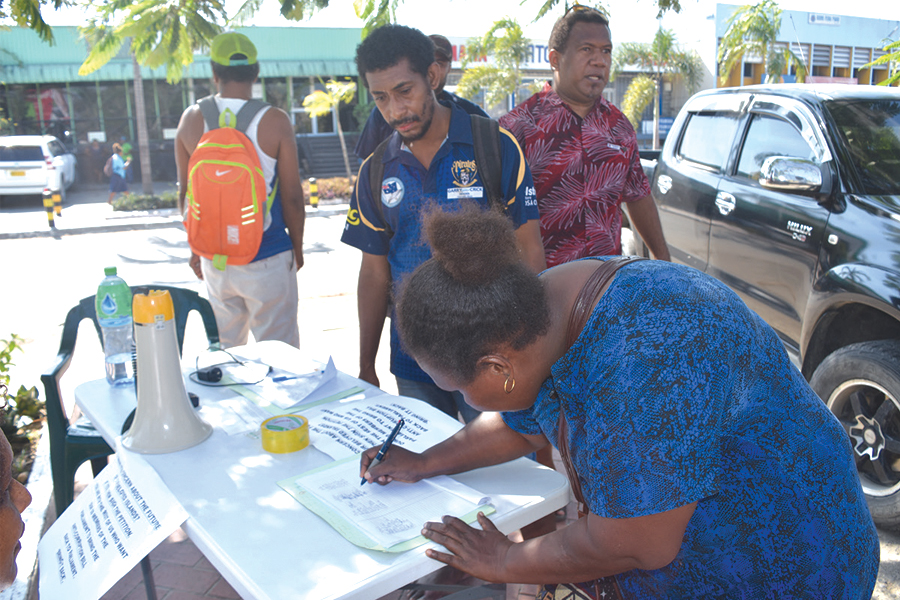
Members of the public signing for petition against the withdrawal of the Anticorruption Bill at Parliament on Tuesday

BY BARNABAS MANEBONA

Members of the public signing for petition against the withdrawal of the Anticorruption Bill at Parliament on Tuesday

PUBLIC signing for a petition against the withdrawal of the Anti-corruption Bill at Parliament started yesterday along Honiara Town.

Leading the public signings is the Civil Society Organisation’s Anti-corruption Committee.

According to Dr Huddie Namo the Chairman of CSO’s Anti-corruption Committee, the Prime Minister says that he will bring back the piece of legislation on the Anti-corruption Bill as a new Bill in 2018 came as a political insult greatly cried for by the public.

“Unfortunately, the statement that was published on Island Sun recently was not made by the Prime Minister. It was made yet by his Legal Technical Advisor on which having that kind of scenario does not make sense. There is no consistence coming from the PM’s Office,” said the CSO Chairman.

“Because of such, we have decided to carry out this signing for the petition. If the Government brings back the Bill in Parliament next month then that is well done.”

The signing for the petition is to conclude today. The CSO Anti-corruption Committees aim is to reach 10,000 signings from the general public before the Member of Parliament for West Makira Hon Derick Manu’ari will do the last signing and present it to Parliament.

SIPA staff to fight other outstanding issues

CEO of SIPA Mr Eranda Kotelawala.

By Alfred Sasako

EMPLOYEES of Solomon Islands Ports Authority say payment of special bonuses this week will not deter them from pursuing other important outstanding issues, including the re-alignment of staff salaries.

Insiders told Island Sun yesterday the push to include all staff in the special bonus payout has brought to the fore a plethora of issues that has the potential to bring down SIPA if left unattended.

“SIPA is already coming apart at the seams. The onus is on the management and the Board to resolve the outstanding issues,” one insider warned.

“A lot of things have gone wrong and unless the Management and the SIPA Board work together to resolve these issues, SIPA is on the way down,” the insider said.

“And these are issues which have been on the table since the new Chief Executive Officer arrived in this country to oversee SIPA’s operations,” he said.

The insider pointed to the purchase earlier this year of a brand new vehicle for the Secretary of SIPA Board, Charles Ashley.

“In-house procurement process was never followed in the acquisition of the vehicle at all,” the insider said.

The insider said staff are also very concerned about the number of overseas trips undertaken by the CEO and Board members since they took over the rein from Singaporean Colin Yow.

“Mr Kotelawala is the most travelled CEO SIPA has ever engaged,” the insider said.

“As staff, we want to know why because so far we have not seen any tangible evidence that those overseas trips were in the best interest of SIPA,” he said.

The insider said another matter of concern to the entire staff is whether anything would come out from the Commission of Inquiry which the government ordered after former CEO, Colin Yow was sacked in April last year.

“It is important that recommendations in the Report be actioned so that what was happening during Mr Yow’s tenure does not re-appear,” he said.

“We are also demanding that:

  • Outstanding payments in entitlements owed to staff members who were reinstated after their illegal sacking be dealt with immediately;
  • Temporary staff hired by Colin Yow be addressed;
  • The outstanding case involving the removal of Mr Barile as CEO be also addressed given that other staff members have been reinstated, he is not. If he is no longer with SIPA, why is he still occupying a SIPA house?
  • Management releases the Commission of Inquiry Report immediately; and
  • The Audit Report of the organisation’s financial situation over the last six years be made available to staff.